
CHAPTER 12 UNDERSTANDING ORGANISATIONAL CULTURE Edited by Christine
CHAPTER 12 UNDERSTANDING ORGANISATIONAL CULTURE Edited by Christine Cross and Ronan Carbery
Learning Outcomes • Understand the concept of organisational culture and explain the nature of culture within an organisational context • Identify and discuss both the visible and invisible elements of organisational culture • Understand how organisational culture is formed, transmitted, reinforced, and changed by management, groups and individuals Organisational Behaviour, edited by Christine Cross and Ronan Carbery ©Palgrave, Macmillan 2016
Learning Outcomes • Outline the linkage between organisational culture and organisational type • Demonstrate the benefits and drawbacks of strong organisational cultures • Describe the interplay between organisational culture and work performance Organisational Behaviour, edited by Christine Cross and Ronan Carbery ©Palgrave, Macmillan 2016
What is Organisational Culture? • Organisational Culture is the basic pattern of shared assumptions, values, beliefs, and practices that govern behaviour in an organisation; these assumptions, values, beliefs and practices are transmitted (and sometimes adapted) from one generation of employees to the next, and observed by all new organisational members • Schein (1985) defined organisational culture as a set of beliefs, values, and assumptions that are shared by members of an organisation • Another common definition still utilised by many practitioners today is, simply, “the way we do things around here” Organisational Behaviour, edited by Christine Cross and Ronan Carbery ©Palgrave, Macmillan 2016
Organisational Culture and Organisational Climate: Different or the Same? • Organisational culture refers to “the way” in which tasks are completed, and organisational climate relates to “how it feels” to work in that organisation • Interpersonal relationships are core to the development of an organisation’s climate • Climate is prone to more variability across the organisation, with climate varying between different subsidiaries, departments or units • Organisational culture is very difficult to change in a short period of time • Organisational climate has a more immediate impact on employees and is something which can be adjusted more easily than organisational culture Organisational Behaviour, edited by Christine Cross and Ronan Carbery ©Palgrave, Macmillan 2016
Organisational Culture and Organisational Climate: Different or the Same? • A healthy organisational climate is one where support, cooperation and democratic decision-making are strong and contribute towards greater work effectiveness • Stressful organisational climates are characterised by limited participation in decisions, use of punishments, conflict avoidance and non-supportive group and leader relations • A variety of dimensions have been found to impact on employees’ perceptions of organisational climate, these include: – – – Support Fairness Autonomy Recognition Trust Organisational Behaviour, edited by Christine Cross and Ronan Carbery ©Palgrave, Macmillan 2016
Schein’s Model of Culture • Schein proposed that there are three ‘layers’ or ‘levels’ of organisational culture: – First, there is the visible layer, which he termed ‘surface manifestations’ – Second, there are ‘organisation values and beliefs, ’ located beneath the surface – Third, there are the ‘basic assumptions’ which underpin both the first and second layers – See Figure 12. 1, page 289 in your book Organisational Behaviour, edited by Christine Cross and Ronan Carbery ©Palgrave, Macmillan 2016
Layer 1: Surface Level Manifestations • Artefacts: These are physical, tangible manifestations of an organisation’s culture such as furniture, appliances, tools, and clothing. For example, Mc. Donald’s “Ronald Mc. Donald” statues • Symbols: These are visuals that represent the organisation, usually in the form of company logos • Norms: Norms are expected behaviours that are demonstrated by members of the organisation • Ceremonials and Rituals: Activities that express and reinforce the values and assumptions of an organisation’s culture. Examples would be the concept of “casual Fridays”, where some organisations allow employees to dress more informally on Fridays Organisational Behaviour, edited by Christine Cross and Ronan Carbery ©Palgrave, Macmillan 2016
Layer 1: Surface Level Manifestations • Language: This can refer to jargon or more technical vocabulary which is used to express and reinforce an organisation’s culture • Mottos and Slogans: These are phrases used in organisations that manifest an organisation’s culture. For example, Mc. Donald’s “I’m loving it” • Stories: Stories are narratives which can contain elements of both truth and fiction, and are based on real-life events that often have shaped the organisation, or focus on decisions made by individuals which helped to steer the success of the organisation (often referred to as “heroes”) • Physical Layout: This is the way in which an organisation chooses to organise its office space, floor space or store space and is another manifestation of its culture Organisational Behaviour, edited by Christine Cross and Ronan Carbery ©Palgrave, Macmillan 2016
Layer 2: Organisation Values and Beliefs • While values and beliefs are intangible, and invisible, organisational members can be made aware of them • These values and beliefs usually hold meaning to the founders or senior management, and are typically based on moral principles • Organisation values and beliefs are manifestations which can be articulated and transmitted throughout the organisation • They are often articulated in an organisation’s mission statement, or values statement, and can be incorporated into employee handbooks, company policies and procedures, as well as employee induction programmes and other forms of organisational training and development Organisational Behaviour, edited by Christine Cross and Ronan Carbery ©Palgrave, Macmillan 2016
Layer 3: Basic Assumptions • True organisational culture lies within the basic assumptions that individuals hold about the organisation and how it should function • Huczynski and Buchanan (2001: 633) describe basic assumptions as “invisible, preconscious and ‘taken for granted’ understandings held by individuals with respect to aspects of human behaviour, and the nature of reality” • The strength of an organisation’s culture is based on how homogenous the basic assumptions of all organisational members are Organisational Behaviour, edited by Christine Cross and Ronan Carbery ©Palgrave, Macmillan 2016
How is Organisational Culture Formed? • The personal assumptions, beliefs and values of the organisational founder(s) shape the development of organisational culture • As an organisation grows in size, these assumptions, values and beliefs, are passed on to every new employee • Founders and senior level management may consciously set out to “design” an organisation’s culture, or it may form organically as a response to the business environment • Some organisations train their employees on “the way we do things around here”, draw up extensive mission and value statements, and pay particular attention to the surface level manifestations of the espoused basic assumptions held by senior level management Organisational Behaviour, edited by Christine Cross and Ronan Carbery ©Palgrave, Macmillan 2016
Socialisation • Socialisation is the process through which organisational culture is reinforced among employees • Typically referred to as assimilation, transition, orientation, alignment, organisational entry, integration and onboarding • Socialisation process can be considered effective when newcomers understand accept the organisation’s key values, goals and practices • Ashkanasy et al (2000) suggest that if socialisation is implemented correctly within an organisation it can ensure that both the organisation’s and the newcomer’s expectations are met Organisational Behaviour, edited by Christine Cross and Ronan Carbery ©Palgrave, Macmillan 2016
Socialisation • According to Feldman (1976), three phases occur during socialisation: – The anticipatory phase: the organisation should have created a realistic set of expectations for the individual before they take up a role there – The entry/encounter phase: the formal process of placing an individual in a new role – The change/metamorphosis phase: focuses on the ability of the new employee to master tasks, resolve problems and ‘fit in’ with the organisational culture as well as sustain working relationships Organisational Behaviour, edited by Christine Cross and Ronan Carbery ©Palgrave, Macmillan 2016
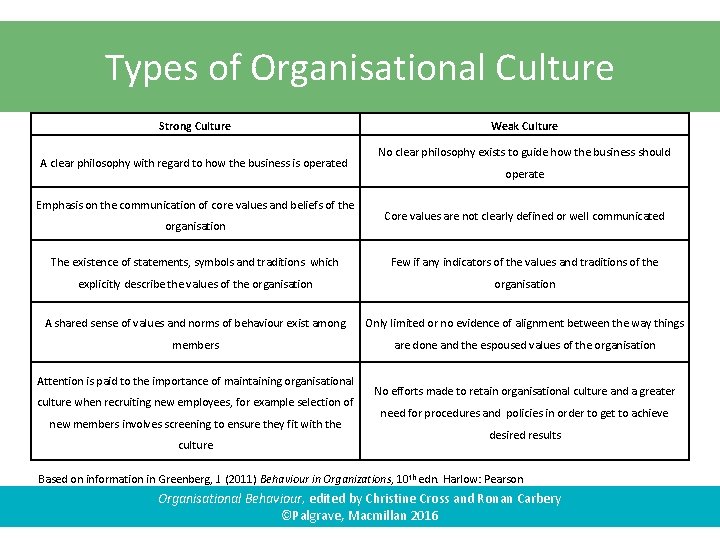
Types of Organisational Culture Strong Culture A clear philosophy with regard to how the business is operated Emphasis on the communication of core values and beliefs of the organisation Weak Culture No clear philosophy exists to guide how the business should operate Core values are not clearly defined or well communicated The existence of statements, symbols and traditions which Few if any indicators of the values and traditions of the explicitly describe the values of the organisation A shared sense of values and norms of behaviour exist among Only limited or no evidence of alignment between the way things members are done and the espoused values of the organisation Attention is paid to the importance of maintaining organisational culture when recruiting new employees, for example selection of new members involves screening to ensure they fit with the culture No efforts made to retain organisational culture and a greater need for procedures and policies in order to get to achieve desired results Based on information in Greenberg, J. (2011) Behaviour in Organizations, 10 th edn. Harlow: Pearson Organisational Behaviour, edited by Christine Cross and Ronan Carbery ©Palgrave, Macmillan 2016

Subcultures • A subculture is one which holds the core assumptions of the dominant culture, as well as supplementary assumptions unique to members of that particular section of the organisation • Subcultures tend to develop in different sections of the organisation - for example, different departments or geographic locations - and reflect common issues faced by members of those sections • The larger an organisation grows, the more diffused the culture becomes and this typically results in more subcultures Organisational Behaviour, edited by Christine Cross and Ronan Carbery ©Palgrave, Macmillan 2016
Forms of Organisational Culture: The Competing Values Framework • The Competing Values Framework (CVF) developed by Cameron and Quinn (1999) identifies four unique types of organisational culture: – Hierarchy Culture – has an internal focus, and demonstrates a strong interest in maintaining stability and control. It is characterised by formalisation, structures, policies and procedures – Market Culture - The core assumptions are competitiveness and productivity. Places a strong emphasis on external positioning and control – Clan Culture - Typical characteristics are teamwork, employee involvement programmes and corporate commitment to the employee – Adhocracy Culture - The major goal is to foster adaptability, flexibility and creativity so as to produce innovative products and services and adapt quickly to new opportunities – See Figure 12. 2, page 296 in your book Organisational Behaviour, edited by Christine Cross and Ronan Carbery ©Palgrave, Macmillan 2016
The Impact of Organisation Culture on Organisational Performance • The culture of any organisation affects the performance of that organisation through its impact on individuals and teams at work • Organisational culture should guide employees to form attitudes and consequently behave in ways that are consistent with its values and beliefs • Kotter and Heskett (1992) found that strong corporate cultures facilitated change, and were associated with strong positive financial results • A common feature of the strongest performing companies were cultures that encouraged leadership, but also empowered everyone in the organisation Organisational Behaviour, edited by Christine Cross and Ronan Carbery ©Palgrave, Macmillan 2016
The Impact of Organisation Culture on Organisational Performance • Denison and Misra (1995) identified four major cultural traits that correspond to high performance and overall organisational effectiveness: – Involvement, Consistency, Adaptability, Mission • However, whilst a positive organisational culture can enhance business performance, it can never supersede the effects of a flawed business model • Moreover, according to Sorenson (2002) strong cultures contributed to successful business strategy in a stable operating environment, but in scenarios where market or economic conditions were volatile, businesses with strong cultures tended to be less successful Organisational Behaviour, edited by Christine Cross and Ronan Carbery ©Palgrave, Macmillan 2016
Promoting Creativity and Innovation through Culture • Oldham and Cummings (1996) identified a number of conditions which organisations can create in order to foster an environment conducive to innovation. These are: – Autonomy – Empowerment – Encourage diversity – Top level support for creativity – Making tasks intrinsically motivating – Resources Organisational Behaviour, edited by Christine Cross and Ronan Carbery ©Palgrave, Macmillan 2016
Culture Change • Organisational culture is difficult to change, or at the very least, cultural change takes a long time to achieve • A performance enhancing culture is unlikely to be in need of change; however, a culture which is toxic or unethical and therefore damaging to either the organisation’s performance or reputation does need to be altered • Culture is developed, transmitted and reinforced through a system of rituals, communications, symbols and values. These facets of an organisation are deep rooted, and therefore require enormous effort to change • While organisational changes affect the culture of the organisation, the existing culture also affects or constrains the process and impact of any changes Organisational Behaviour, edited by Christine Cross and Ronan Carbery ©Palgrave, Macmillan 2016
Approaches to Culture Change • Asleigh and Mansi (2012) have identified the following different approaches to achieving cultural change in an organisation: – Changing employees’ values and beliefs – Altering the composition of the workforce – Altering the organisational climate – Behaviour change Organisational Behaviour, edited by Christine Cross and Ronan Carbery ©Palgrave, Macmillan 2016
Employee Responses to Cultural Change • Piderit (2000) outlines three types of negative responses to cultural change: – Affective – Cognitive – Behavioural • Achieving employee “buy in” and commitment to new practices and new ways of doing things can be one of the most challenging aspects of an organisational change process • Even when top level managers are dedicated to introducing a cultural change, they may inadvertently revert to old patterns of behaviour since the existing culture is so engrained Organisational Behaviour, edited by Christine Cross and Ronan Carbery ©Palgrave, Macmillan 2016
National and International Cultures • Values, language, education, political and legal systems vary widely from country to country, and these practices in turn impact on the culture within organisations • An appreciation of cultural difference is imperative in international business, in order to understand how best to accomplish organisational goals effectively • Hofstede’s Cultural Dimensions Theory describes the effects of a society's culture on the values of its members, and how these values relate to behaviour – IBM in the 1960 s and 1970 s – The original theory proposed four dimensions along which cultural values could be analysed: individualism-collectivism; uncertainty avoidance; power distance, and masculinity-femininity Organisational Behaviour, edited by Christine Cross and Ronan Carbery ©Palgrave, Macmillan 2016
National and International Cultures • Individualism-collectivism: this relates to the extent to which societies reflect an individualistic or a collective ethic. In individualistic societies, great importance is placed upon personal achievement, competition and individual rights. A collectivist society is one which favours members acting in a cohesive fashion • Uncertainty avoidance: this dimension examines the extent to which members attempt to minimise or avoid uncertain situations • Power distance: this relates to the extent to which members of society accept that power is distributed unequally, and this manifests in individuals’ interactions with hierarchy and management • Masculinity-femininity: this dimension refers to a continuum between characteristics assumed to be masculine in nature such as assertiveness and competition at one end and characteristics assumed to be feminine such as care and concern at the other Organisational Behaviour, edited by Christine Cross and Ronan Carbery ©Palgrave, Macmillan 2016
National and International Cultures • GLOBE is a long-term research effort designed to explore the complex effects of culture on leadership, organisational effectiveness, and the economic competitiveness of societies (House, Hanges, Javidan, Dorfman, and Gupta, 2004) • Project GLOBE developed nine cultural dimensions that make it possible to capture the similarities and/or differences in norms, values, beliefs and practices among societies Organisational Behaviour, edited by Christine Cross and Ronan Carbery ©Palgrave, Macmillan 2016
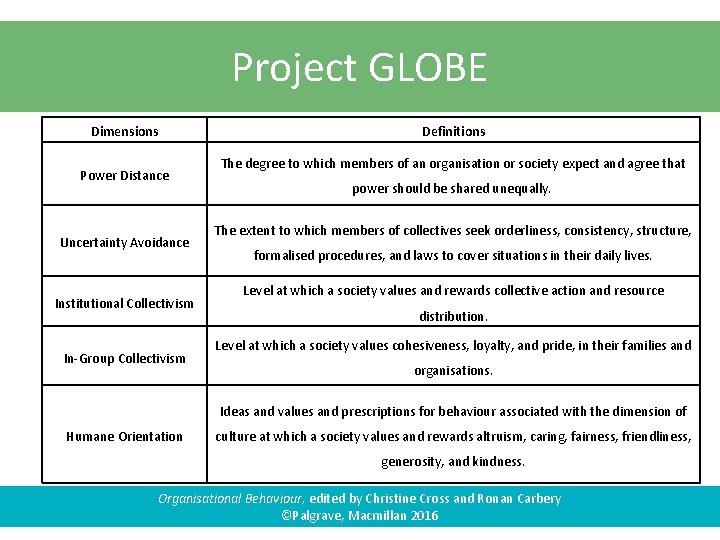
Project GLOBE Dimensions Power Distance Uncertainty Avoidance Institutional Collectivism In-Group Collectivism Definitions The degree to which members of an organisation or society expect and agree that power should be shared unequally. The extent to which members of collectives seek orderliness, consistency, structure, formalised procedures, and laws to cover situations in their daily lives. Level at which a society values and rewards collective action and resource distribution. Level at which a society values cohesiveness, loyalty, and pride, in their families and organisations. Ideas and values and prescriptions for behaviour associated with the dimension of Humane Orientation culture at which a society values and rewards altruism, caring, fairness, friendliness, generosity, and kindness. Organisational Behaviour, edited by Christine Cross and Ronan Carbery ©Palgrave, Macmillan 2016
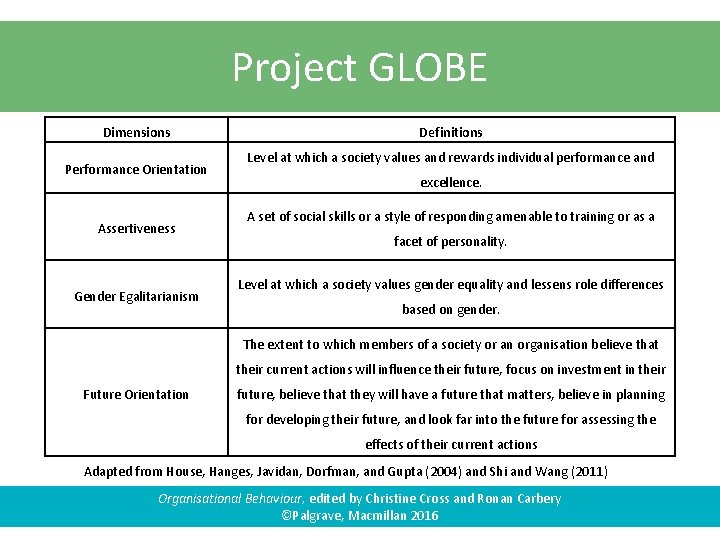
Project GLOBE Dimensions Performance Orientation Assertiveness Gender Egalitarianism Definitions Level at which a society values and rewards individual performance and excellence. A set of social skills or a style of responding amenable to training or as a facet of personality. Level at which a society values gender equality and lessens role differences based on gender. The extent to which members of a society or an organisation believe that their current actions will influence their future, focus on investment in their Future Orientation future, believe that they will have a future that matters, believe in planning for developing their future, and look far into the future for assessing the effects of their current actions Adapted from House, Hanges, Javidan, Dorfman, and Gupta (2004) and Shi and Wang (2011) Organisational Behaviour, edited by Christine Cross and Ronan Carbery ©Palgrave, Macmillan 2016
Summary • What is organisational culture? • Does organisational culture have a purpose? • How is organisational culture formed, transmitted and reinforced? • Discuss the visible and invisible aspects of organisational culture • Does culture impact on organisational performance? • How can we tell if an organisation has a strong culture? • Are there different types of cultures in organisations? • Describe how organisational culture can be changed Organisational Behaviour, edited by Christine Cross and Ronan Carbery ©Palgrave, Macmillan 2016
- Slides: 29