
Chapter 12 Traditional Electricity Regulation The Calm Before
Chapter 12 Traditional Electricity Regulation: The Calm Before the Storm Part B
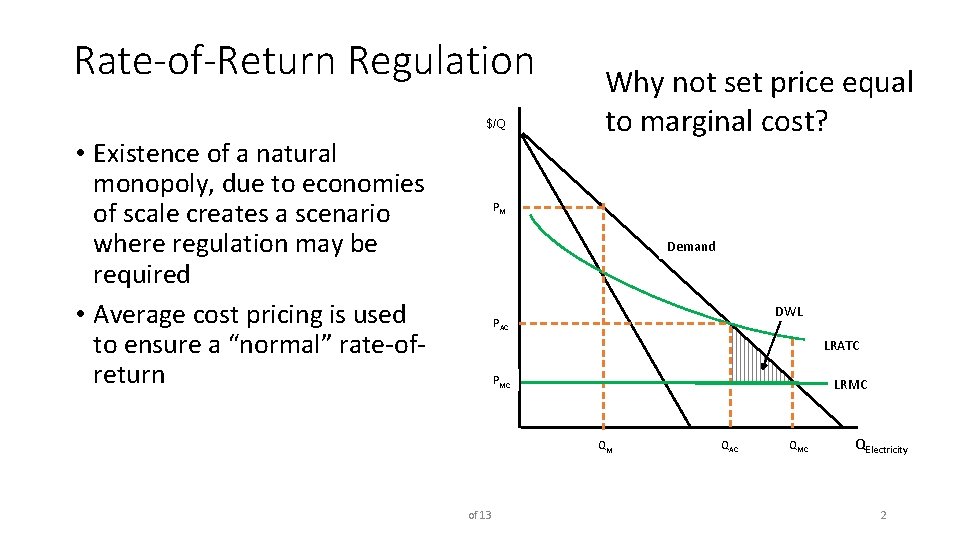
Rate-of-Return Regulation $/Q • Existence of a natural monopoly, due to economies of scale creates a scenario where regulation may be required • Average cost pricing is used to ensure a “normal” rate-ofreturn Why not set price equal to marginal cost? PM Demand DWL PAC LRATC PMC LRMC QM of 13 QAC QMC QElectricity 2
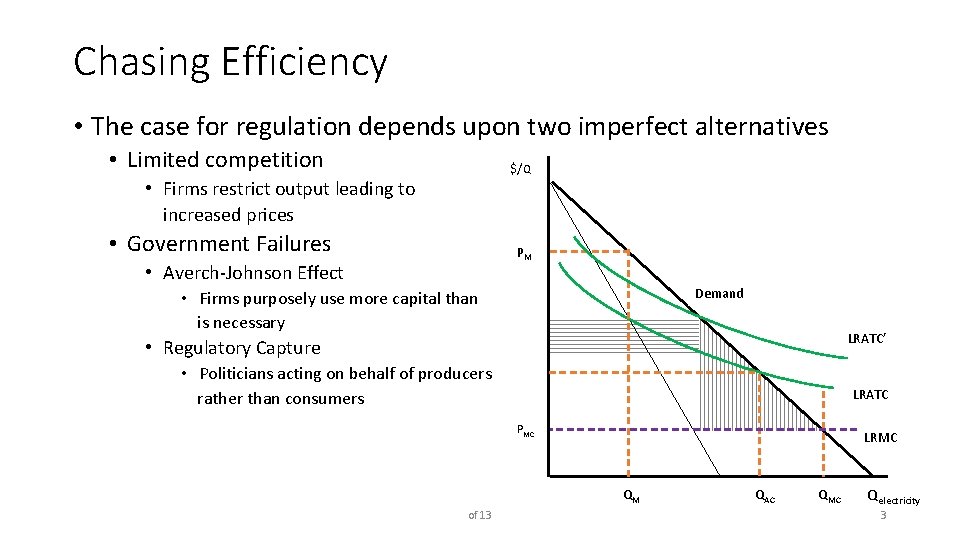
Chasing Efficiency • The case for regulation depends upon two imperfect alternatives • Limited competition $/Q • Firms restrict output leading to increased prices • Government Failures PM • Averch-Johnson Effect Demand • Firms purposely use more capital than is necessary LRATC’ • Regulatory Capture • Politicians acting on behalf of producers rather than consumers LRATC PMC LRMC QM of 13 QAC QMC Qelectricity 3
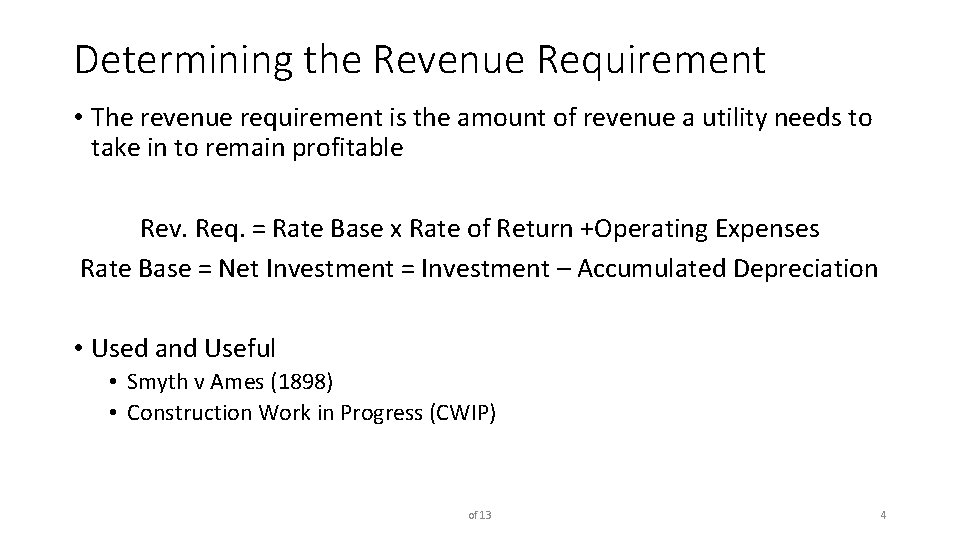
Determining the Revenue Requirement • The revenue requirement is the amount of revenue a utility needs to take in to remain profitable Rev. Req. = Rate Base x Rate of Return +Operating Expenses Rate Base = Net Investment = Investment – Accumulated Depreciation • Used and Useful • Smyth v Ames (1898) • Construction Work in Progress (CWIP) of 13 4
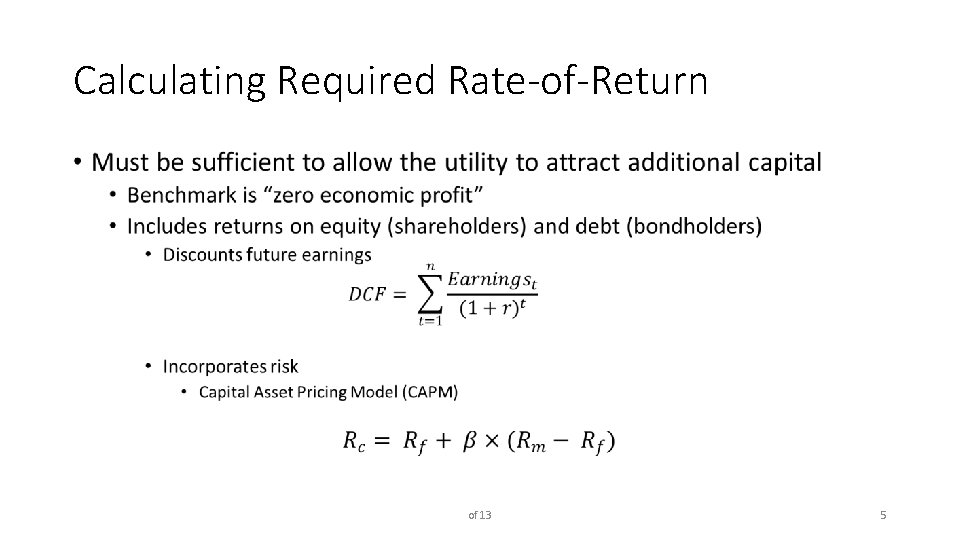
Calculating Required Rate-of-Return • of 13 5

Rate Classes • Utilities set different rates for residential, commercial, and industrial customers • Industrial customers face the lowest costs, residential the highest, and commercial in between • This is determined based on the marginal costs of supplying electricity • Rules for allocating capacity costs (fixed costs) is arbitrary • Based on population, % peak energy demand, or % energy sold • Residential customers prefer when determined by % energy sold • Industry uses a higher percentage of electricity • Industrial customers prefer when determined by population • Basing rates off population size will often decrease the share of fixed costs paid by industrial customers of 13 6
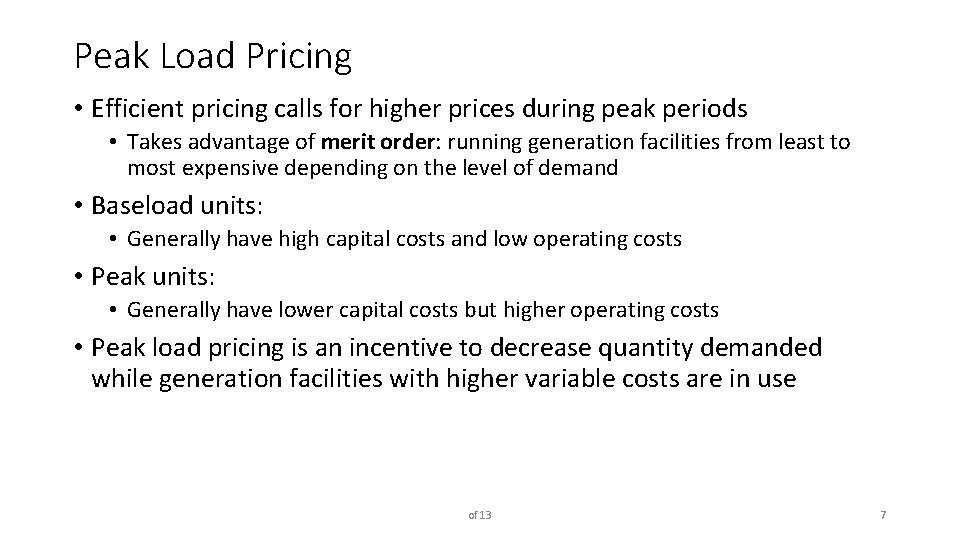
Peak Load Pricing • Efficient pricing calls for higher prices during peak periods • Takes advantage of merit order: running generation facilities from least to most expensive depending on the level of demand • Baseload units: • Generally have high capital costs and low operating costs • Peak units: • Generally have lower capital costs but higher operating costs • Peak load pricing is an incentive to decrease quantity demanded while generation facilities with higher variable costs are in use of 13 7
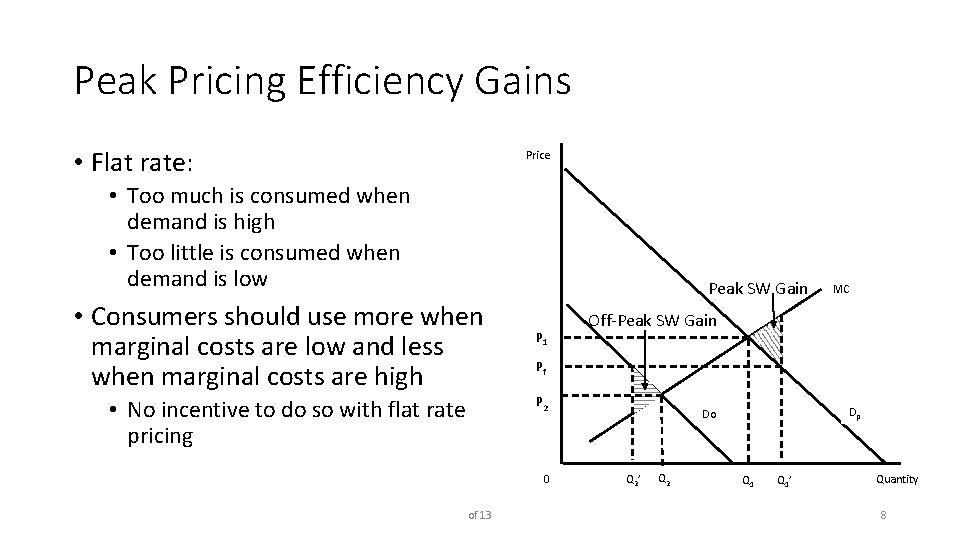
Peak Pricing Efficiency Gains • Flat rate: Price • Too much is consumed when demand is high • Too little is consumed when demand is low • Consumers should use more when marginal costs are low and less when marginal costs are high Peak SW Gain P 1 Off-Peak SW Gain Pf P 2 • No incentive to do so with flat rate pricing 0 of 13 MC Dp Do Q 2’ Q 2 Q 1’ Quantity 8
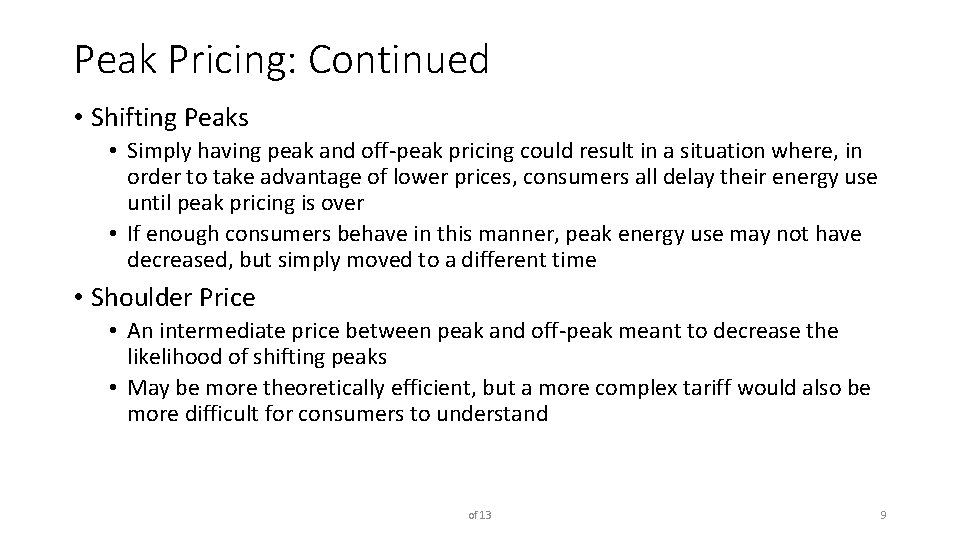
Peak Pricing: Continued • Shifting Peaks • Simply having peak and off-peak pricing could result in a situation where, in order to take advantage of lower prices, consumers all delay their energy use until peak pricing is over • If enough consumers behave in this manner, peak energy use may not have decreased, but simply moved to a different time • Shoulder Price • An intermediate price between peak and off-peak meant to decrease the likelihood of shifting peaks • May be more theoretically efficient, but a more complex tariff would also be more difficult for consumers to understand of 13 9
Demand Reduction (DR) • Subsidizes customers for reducing demand during peak hours • Consumers can be reluctant to accept peak pricing formats • Customers fear that their bill might increase although the average consumer would likely pay less • Demand reduction is a second-best option • Compensates consumers for using less peak power than their baseline • May cause consumers to artificially inflate their baseline if they are expecting any demand reduction programs in the future of 13 10
Energy Efficiency Programs • Utilities may encourage customers to consume less energy • Complimentary energy saving bulbs • Rebates for reducing energy use • Not generally in the best interest of the utility • Often mandated by state regulatory commissions What is the difference between demand reduction and energy efficiency programs? of 13 11
Decoupling • Concept where utility revenue no longer depends on sales • If sales decrease due to energy efficiency, rates will shift upward so that revenue remains constant • May be difficult to determine the cause of decreased sales • Could result in load control • Consumers face a reduced rate for shutting down certain appliances • Rebound effect results in increased energy use in other areas, offsetting savings due to the decreased use of energy intensive appliances of 13 12
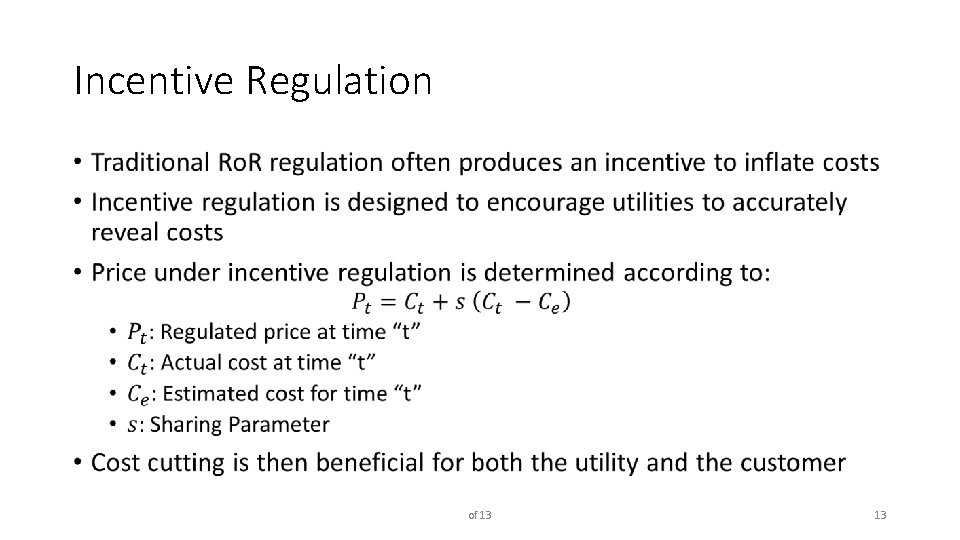
Incentive Regulation • of 13 13
- Slides: 13