
CHAPTER 12 THREADS FASTENERS AND SPRING OBJECTIVES 1
CHAPTER 12 THREADS, FASTENERS AND SPRING
OBJECTIVES 1. Define and label the parts of a screw thread. 2. Identify various screw thread forms. 3. Draw detailed, schematic, and simplified threads. 4. Define typical thread specifications. 5. Identify various fasteners and describe their use. 6. Draw various screw head types. 7. Draw springs.
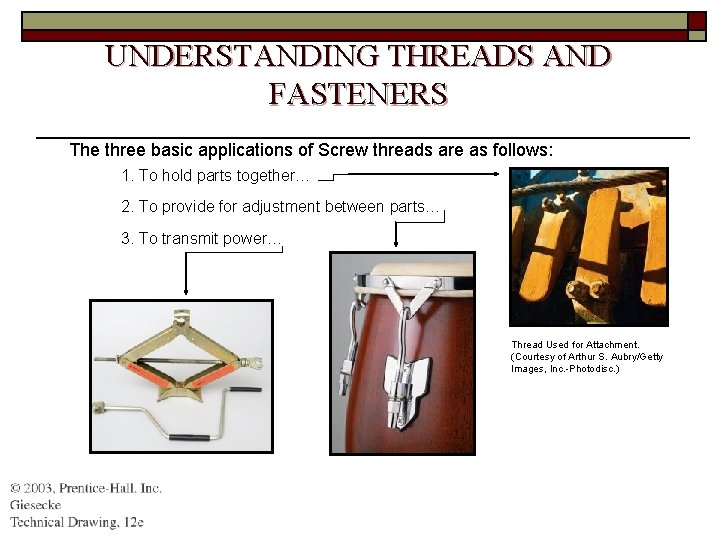
UNDERSTANDING THREADS AND FASTENERS The three basic applications of Screw threads are as follows: 1. To hold parts together… 2. To provide for adjustment between parts… 3. To transmit power… Thread Used for Attachment. (Courtesy of Arthur S. Aubry/Getty Images, Inc. -Photodisc. )
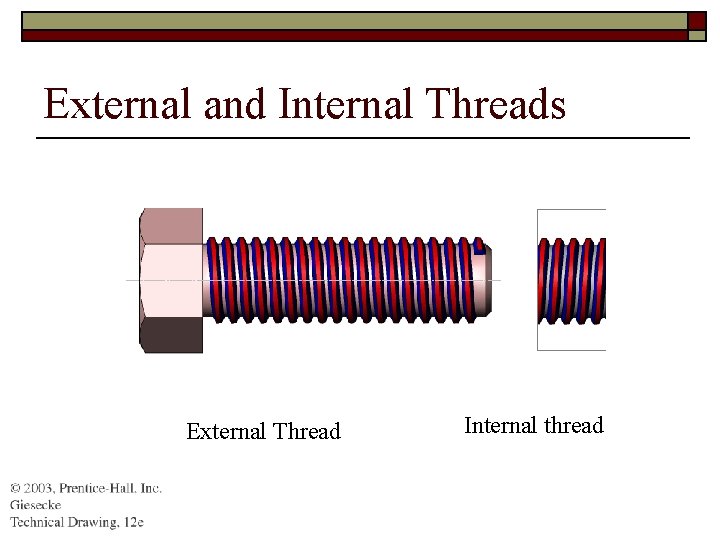
External and Internal Threads External Thread Internal thread
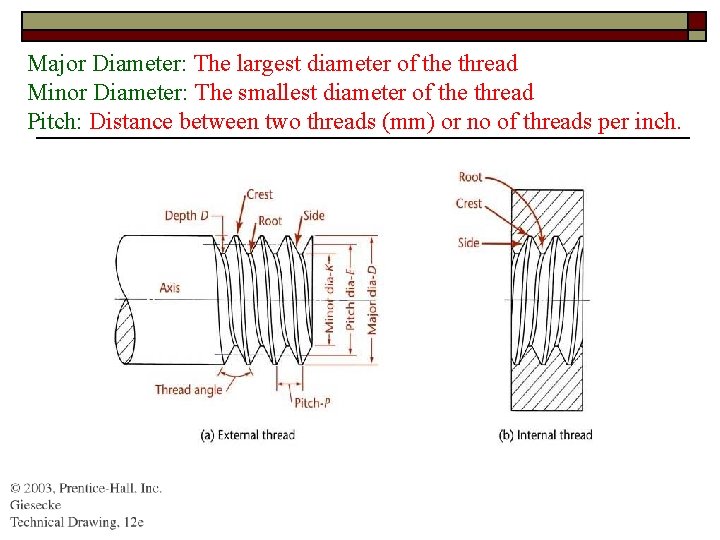
Major Diameter: The largest diameter of the thread Minor Diameter: The smallest diameter of the thread Pitch: Distance between two threads (mm) or no of threads per inch.
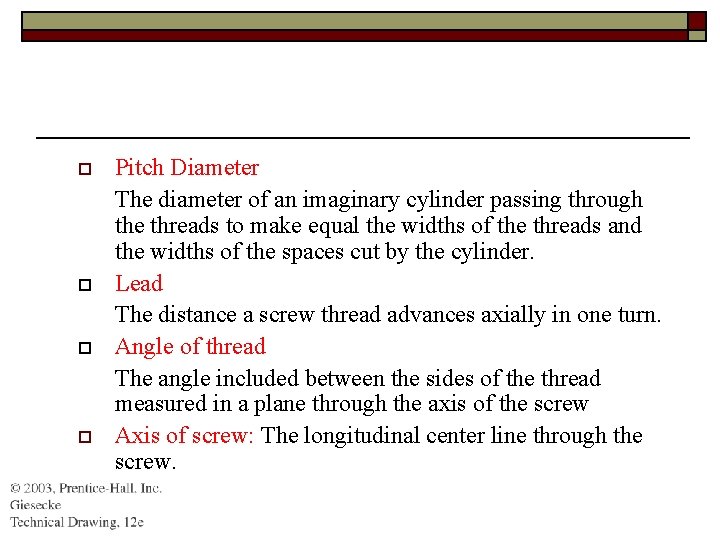
o o Pitch Diameter The diameter of an imaginary cylinder passing through the threads to make equal the widths of the threads and the widths of the spaces cut by the cylinder. Lead The distance a screw thread advances axially in one turn. Angle of thread The angle included between the sides of the thread measured in a plane through the axis of the screw Axis of screw: The longitudinal center line through the screw.
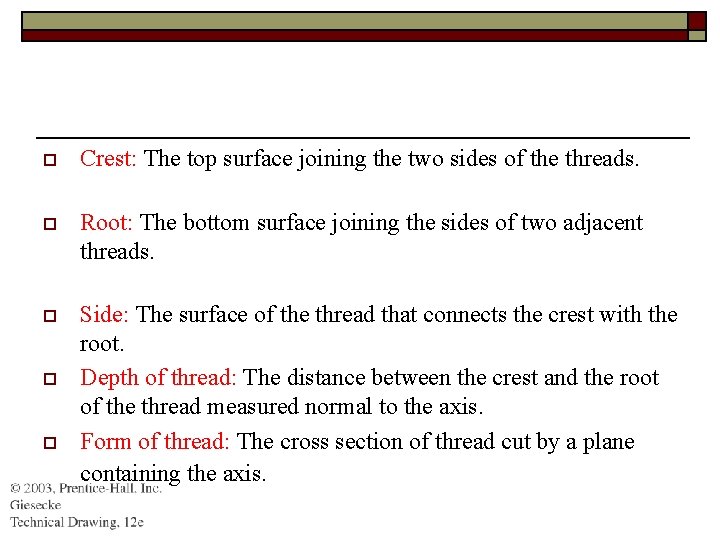
o Crest: The top surface joining the two sides of the threads. o Root: The bottom surface joining the sides of two adjacent threads. o Side: The surface of the thread that connects the crest with the root. Depth of thread: The distance between the crest and the root of the thread measured normal to the axis. Form of thread: The cross section of thread cut by a plane containing the axis. o o
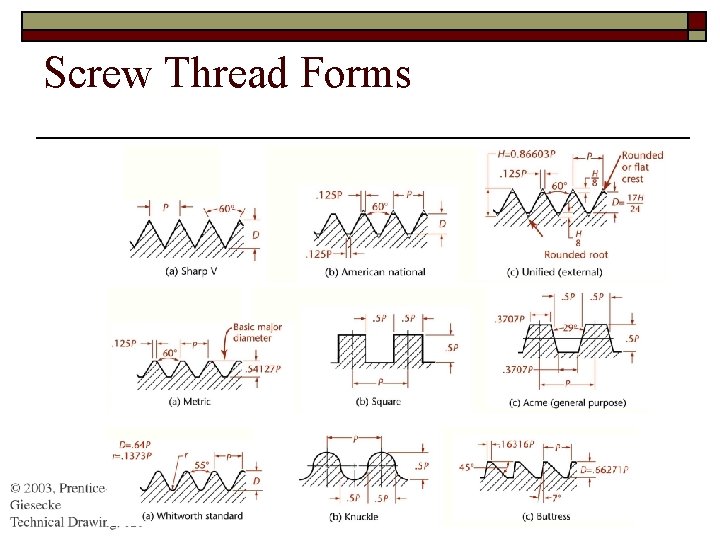
Screw Thread Forms
13. 3 SCREW THREADS FORM o o Sharp V threads called United States Standard threads. Used on brass pipe works. American National Threads replaces the Sharp V for general use. Unified thread is the standard agreed upon by the USA, Canada, Britain in 1948 and has replaced American National form. Square Thread are to transmission of power.
13. 3 SCREW THREADS FORM (Continue) o o ACME Thread replaces the Square threads since it is difficult to manufacture. Whitworth thread (British standard) has been replaced by the Unified thread. Knuckle thread is used in electrical bulb and other electrical applications. Buttress Thread is designed to transmit power in one direction.
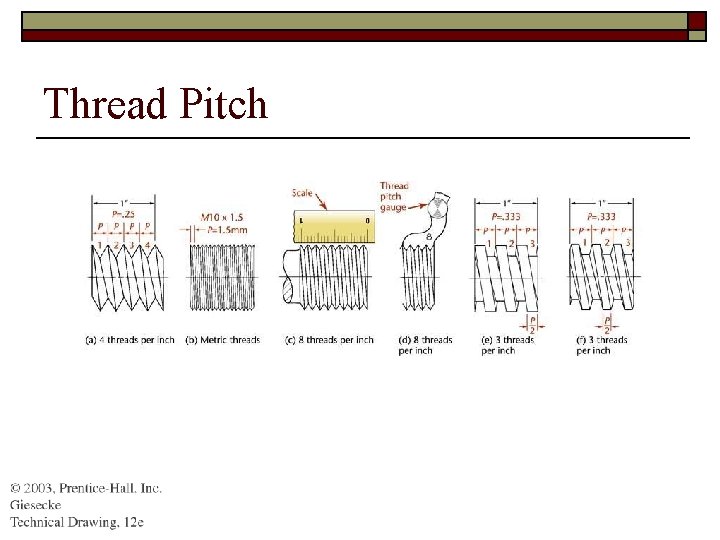
Thread Pitch
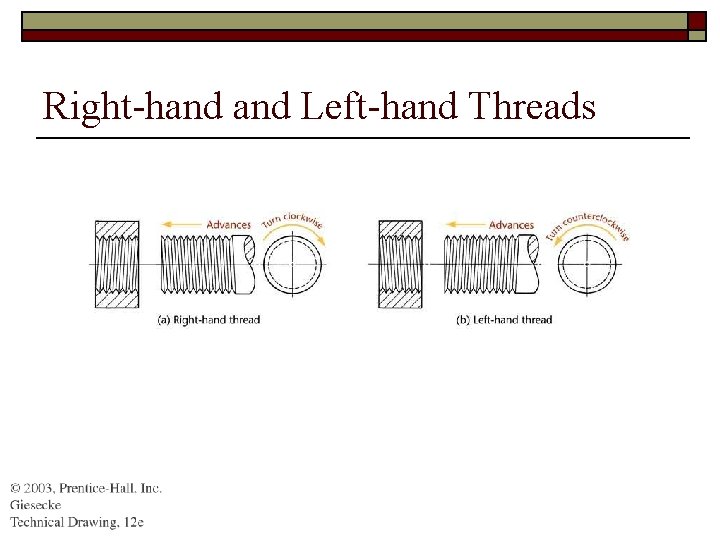
Right-hand Left-hand Threads
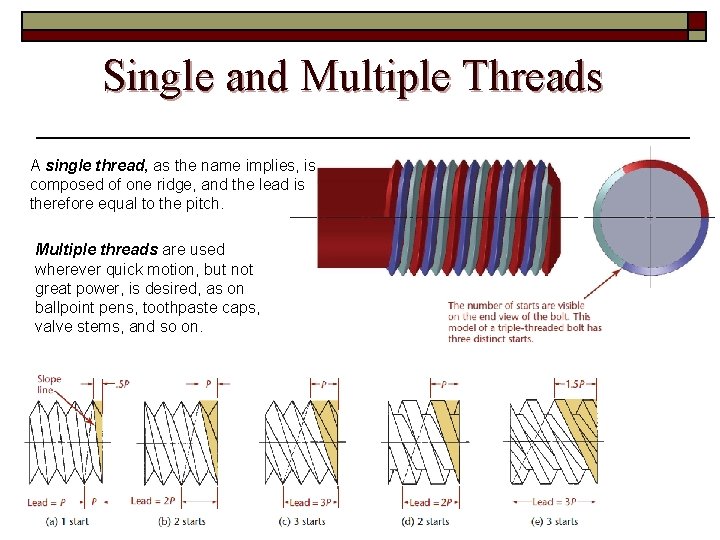
Single and Multiple Threads A single thread, as the name implies, is composed of one ridge, and the lead is therefore equal to the pitch. Multiple threads are used wherever quick motion, but not great power, is desired, as on ballpoint pens, toothpaste caps, valve stems, and so on.
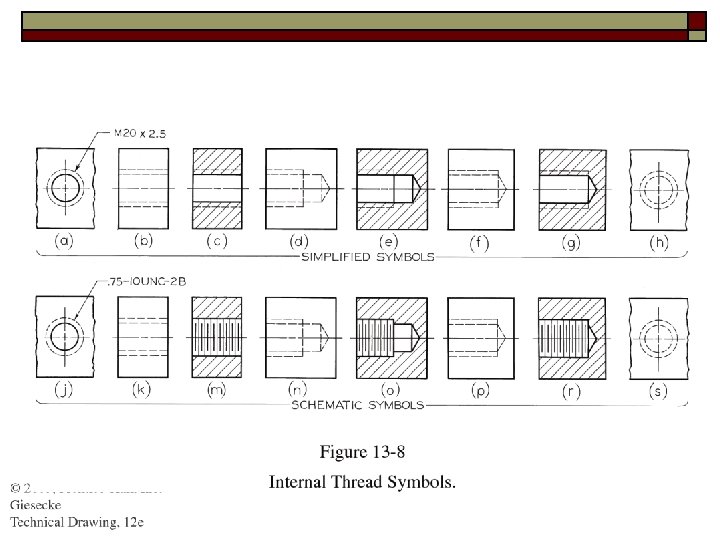
Thread Symbol Three method of representing thread on drawing. o Schematic, use for smaller diameter, about 25 mm (1 inch) o Detailed, for diameter more than 25 mm (1 inch) o Simplified, commonly used.
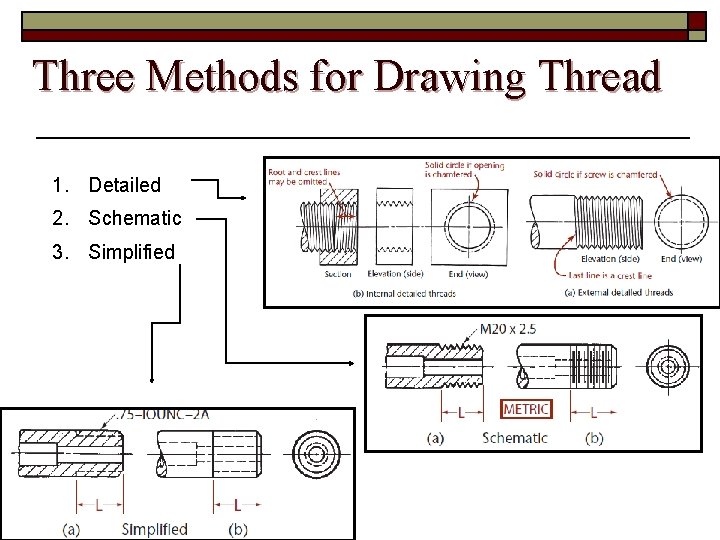
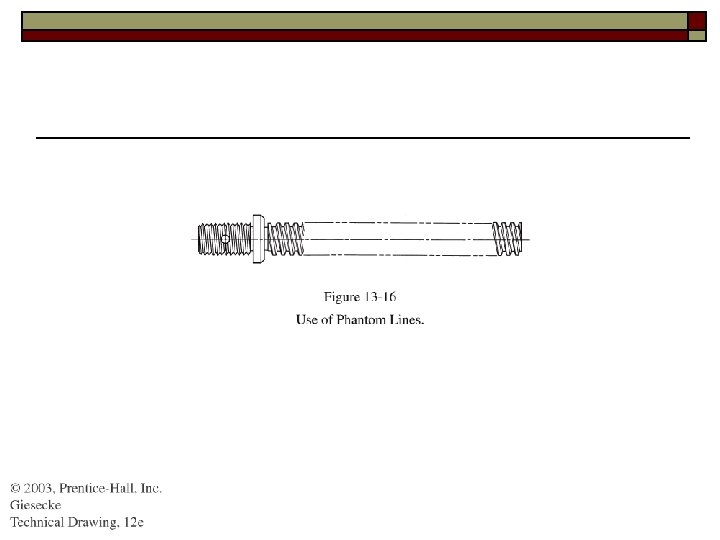
Three Methods for Drawing Thread 1. Detailed 2. Schematic 3. Simplified
Metric Threads fit o o Two class of fit, one for general purpose, 6 H for internal threads and 6 g for external threads, therefore default class of fit is 6 H/6 g if not specified. Second class for closer fit, 6 H for internal threads and 5 g 6 g for external threads.
Unified threads fit o o o A represents for external threads and B represents for internal threads. Number 1, 2 and 3 represents the class of fit. 2 A/2 B is general class (equivalent to 6 H/6 g) 3 A/3 B for close fit. 1 A/1 B for Rapid assembly.
Thread Notes o ASME/ANSI Y 14. 6 -2001 “Screw Thread Representations” is a standard for representing, specifying, and dimensioning screw threads on drawings n These same notes or symbols are used in correspondence, in records, and in specifications for parts, taps, dies, tools, and gages
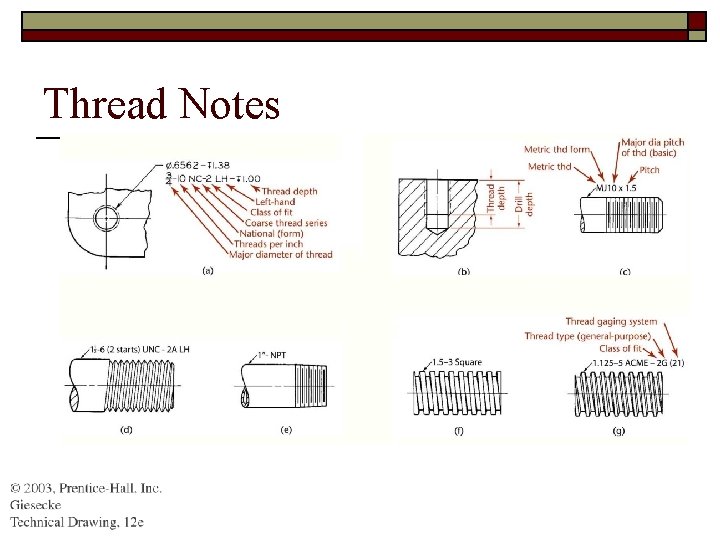
Thread Notes
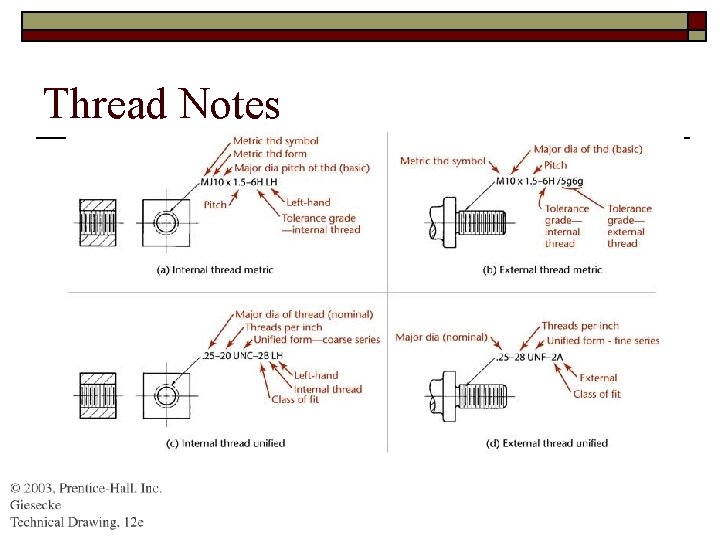
Thread Notes
Clearance Holes o o A simple hole without thread used to insert a bolt. There is clearance between clearance hole and the bolt or screw.
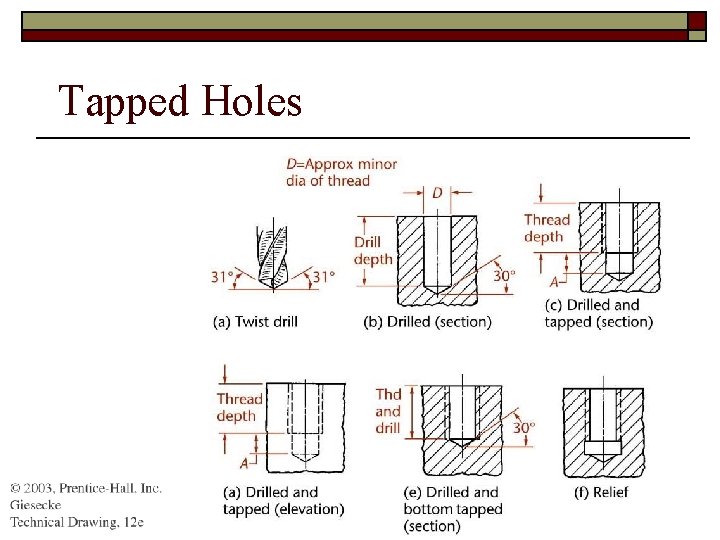
Tapped Holes o o A hole with internal thread is called Tapped hole The bottom of a drilled hole formed by the point of a twist drill is cone shaped The thread length is the length of full or perfect threads The tap drill depth does not include the cone point of the drill
Tapped Holes
Bolts, Studs, and Screws
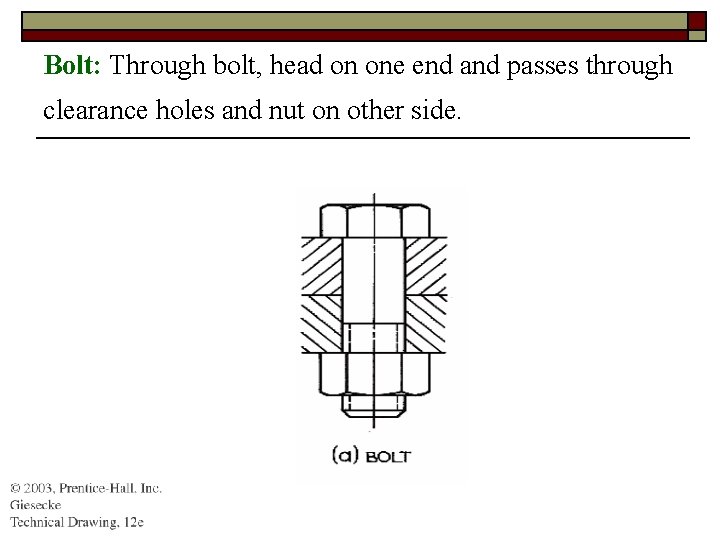
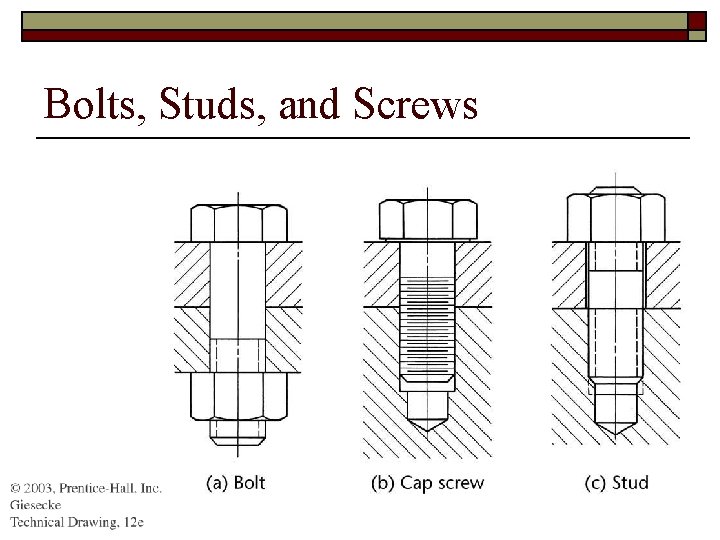
Bolt: Through bolt, head on one end and passes through clearance holes and nut on other side.
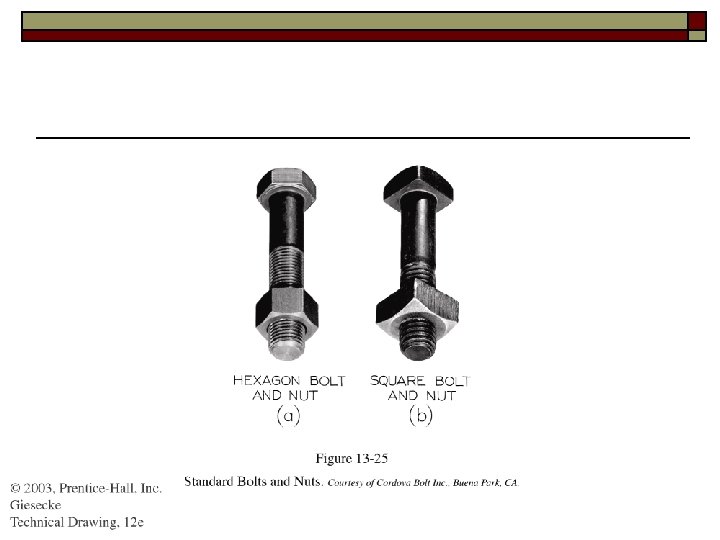
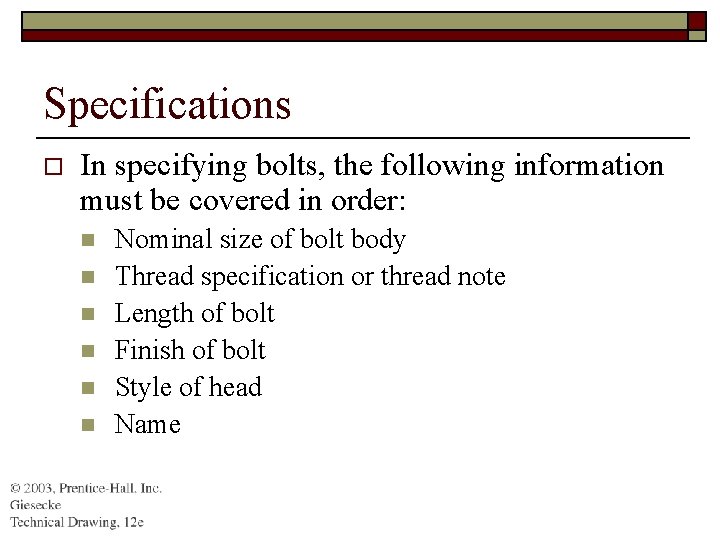
Specifications o In specifying bolts, the following information must be covered in order: n n n Nominal size of bolt body Thread specification or thread note Length of bolt Finish of bolt Style of head Name
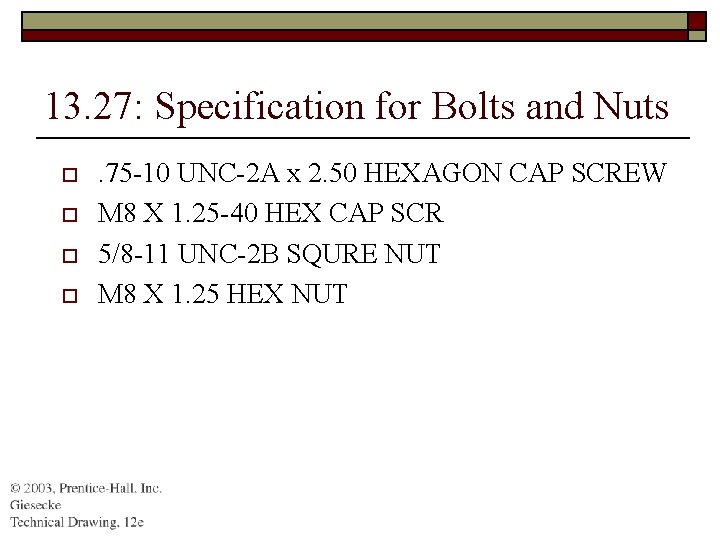
13. 27: Specification for Bolts and Nuts o o . 75 -10 UNC-2 A x 2. 50 HEXAGON CAP SCREW M 8 X 1. 25 -40 HEX CAP SCR 5/8 -11 UNC-2 B SQURE NUT M 8 X 1. 25 HEX NUT
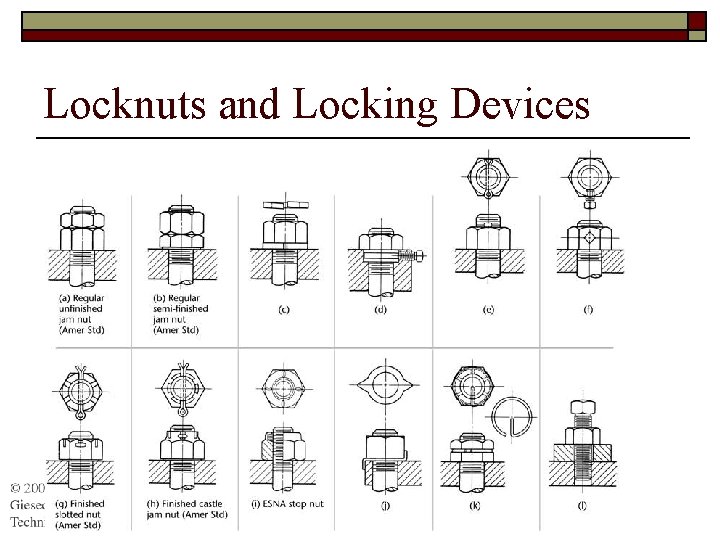
Locknuts and Locking Devices
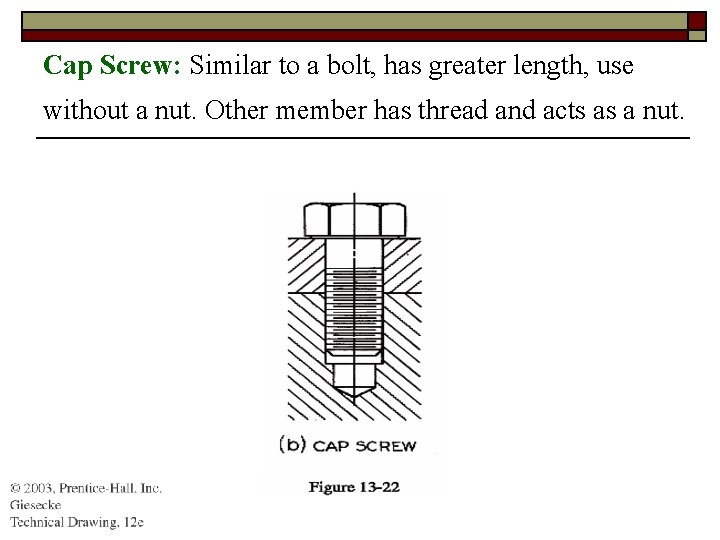
Cap Screw: Similar to a bolt, has greater length, use without a nut. Other member has thread and acts as a nut.
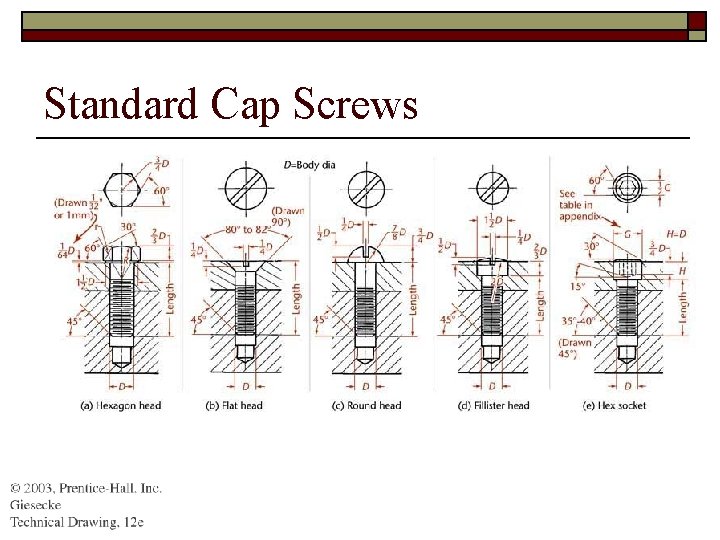
Standard Cap Screws
o o MACHINE SCREW: is similar to the slotted head cap screws but in general is smaller. Can be used with or without nut. SET SCREW: is a screw with or without a head that is screwed through one member and whose special point is forced against another member to prevent relative motion between the two parts.
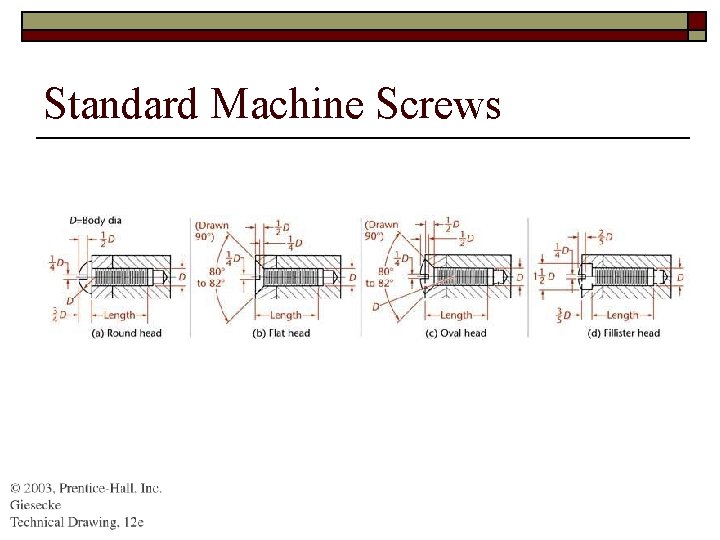
Standard Machine Screws
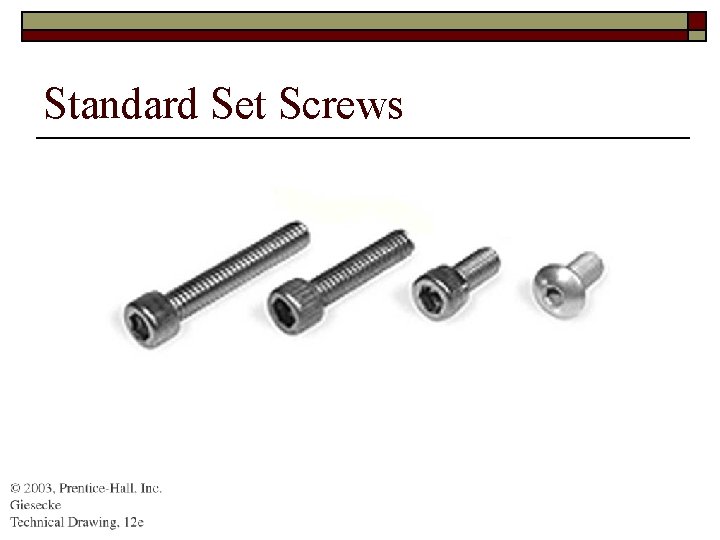
Standard Set Screws
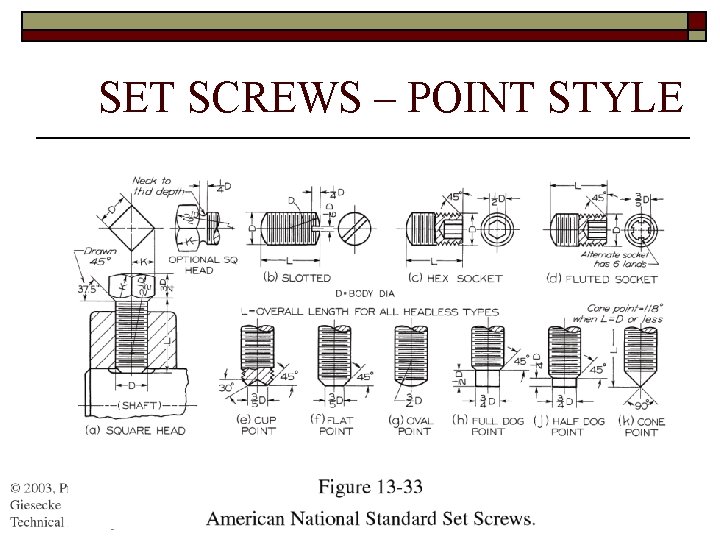
SET SCREWS – POINT STYLE
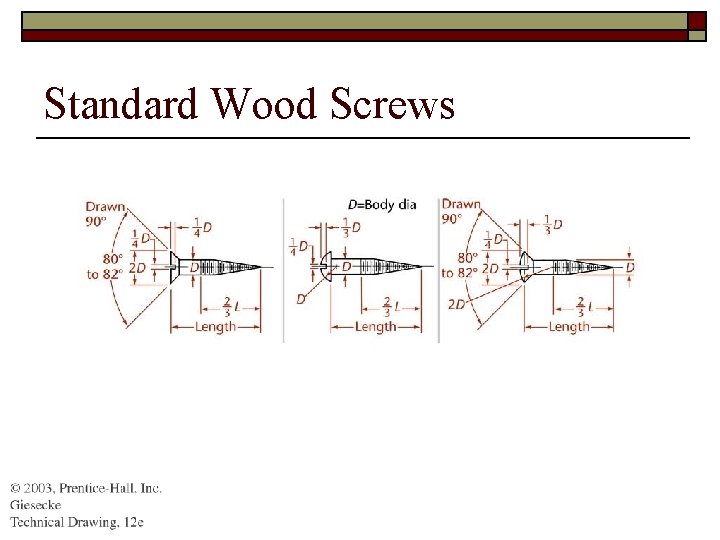
Standard Wood Screws
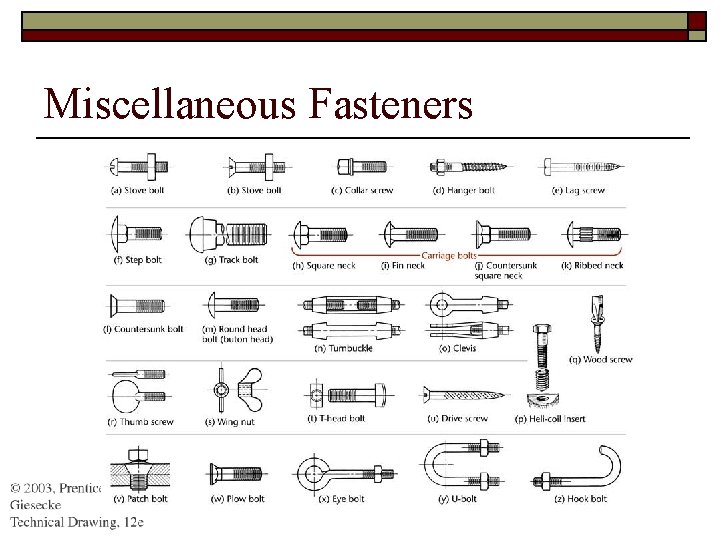
Miscellaneous Fasteners
Keys o Keys are used to prevent movement between shafts and wheels, couplings, cranks, and similar machine parts attached to or supported by shafts
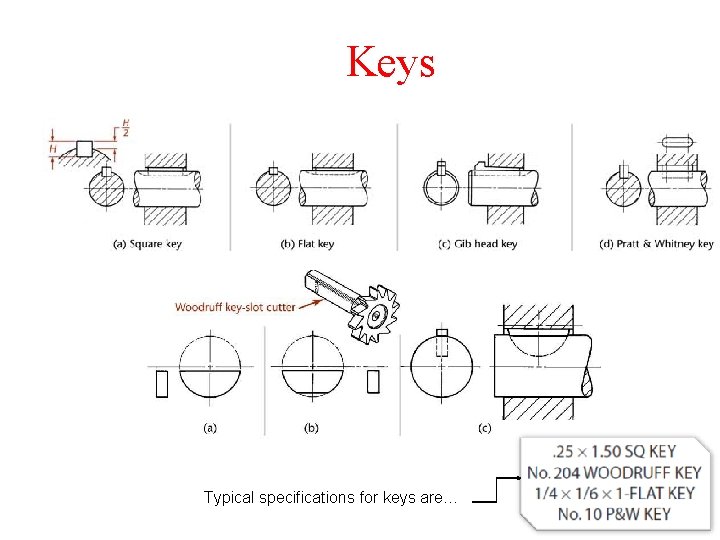
Keys Typical specifications for keys are…
A key seat in a shaft and a key way in the hub or surrounding part. o o ¼ x 1 ½ SQ KEY No. 204 WOODRUFF KEY ¼ x 1/16 x 1 ½ FLAT KEY No. 10 P & W KEY
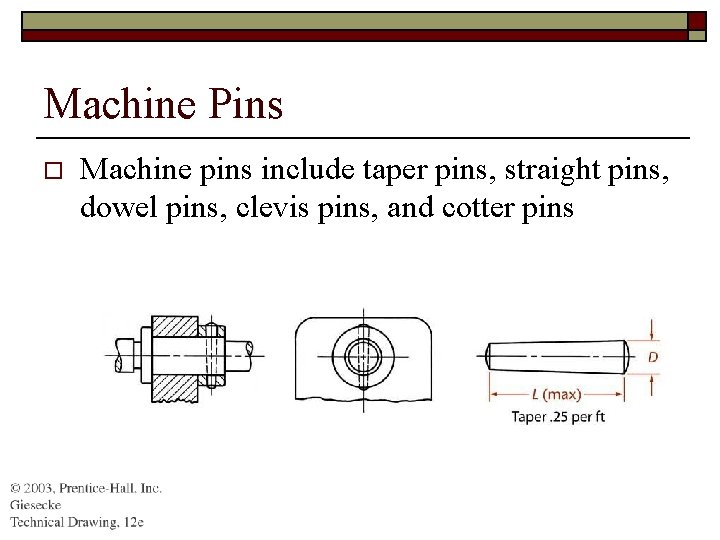
Machine Pins o Machine pins include taper pins, straight pins, dowel pins, clevis pins, and cotter pins
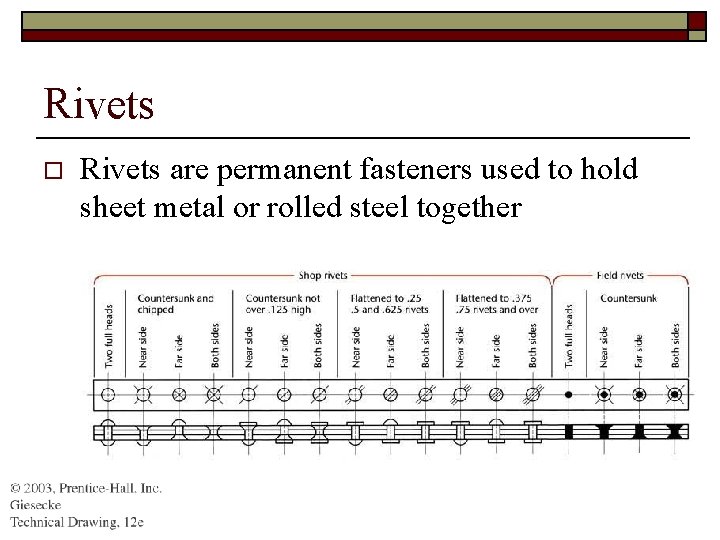
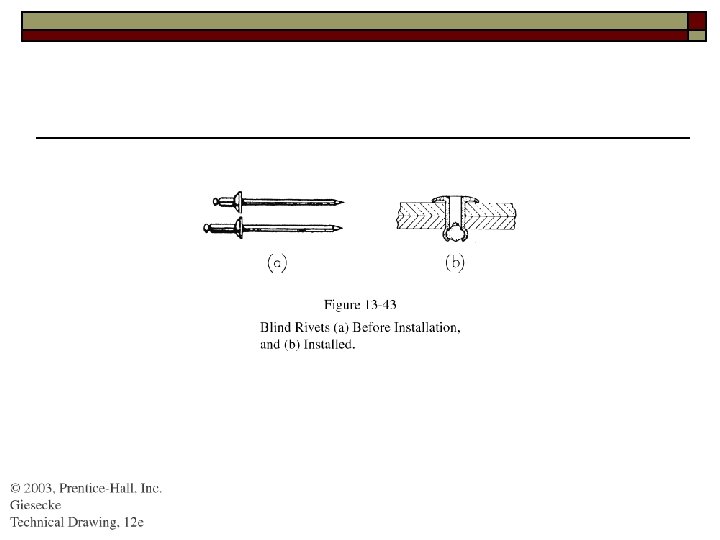
Rivets o Rivets are permanent fasteners used to hold sheet metal or rolled steel together
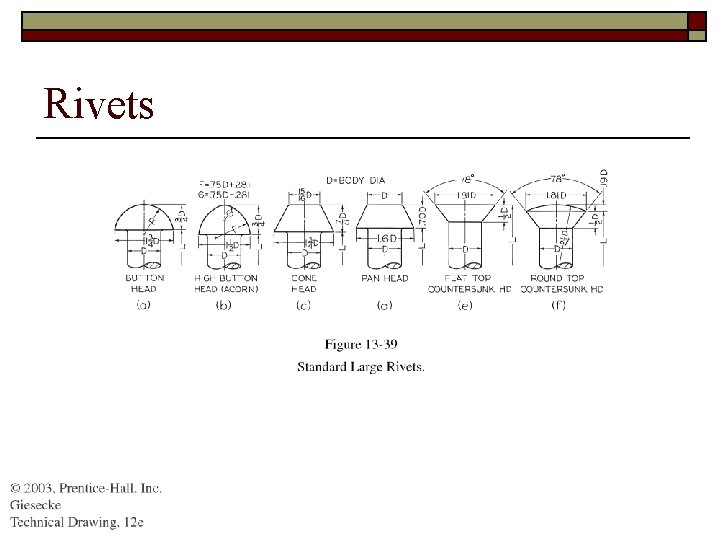
Rivets
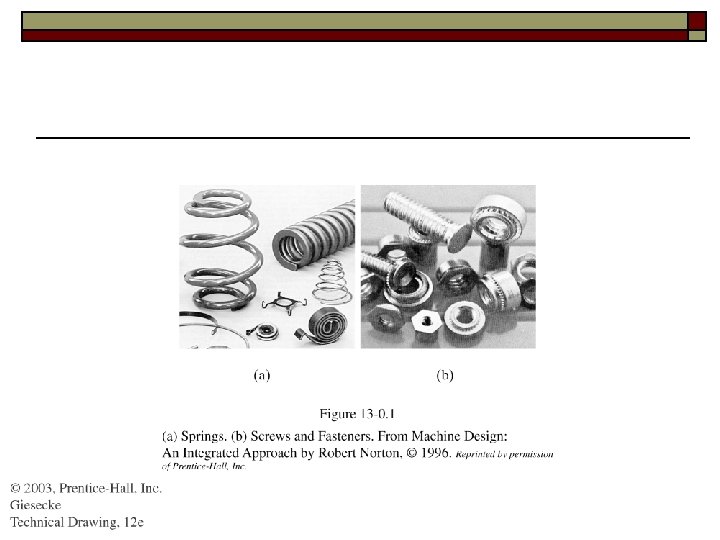
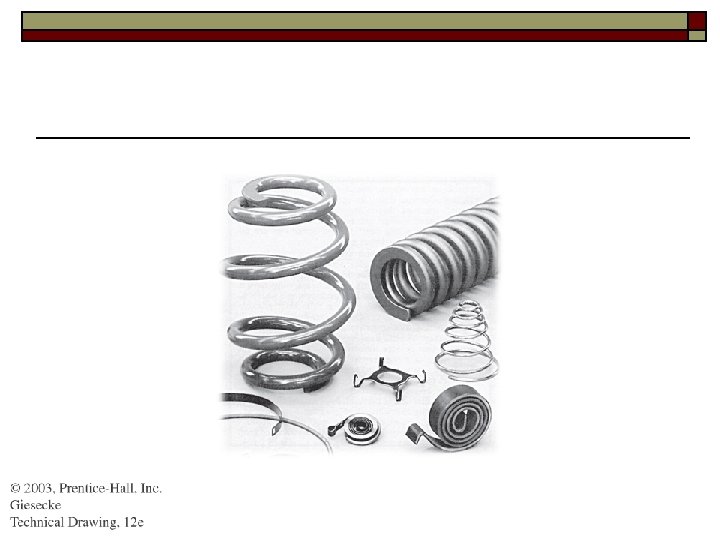
Springs o o o A spring is a mechanical device designed to store energy when deflected and to return the equivalent amount of energy when released Springs are commonly made of spring steel, which may be hard-drawn wire, or oil-tempered wire. Other materials used for compression springs include stainless steel, beryllium copper, and phosphor bronze. Urethane plastic is used in applications where conventional springs would be affected by corrosion, vibration, or acoustic or magnetic forces. Springs are classified as: n Helical springs n Flat springs
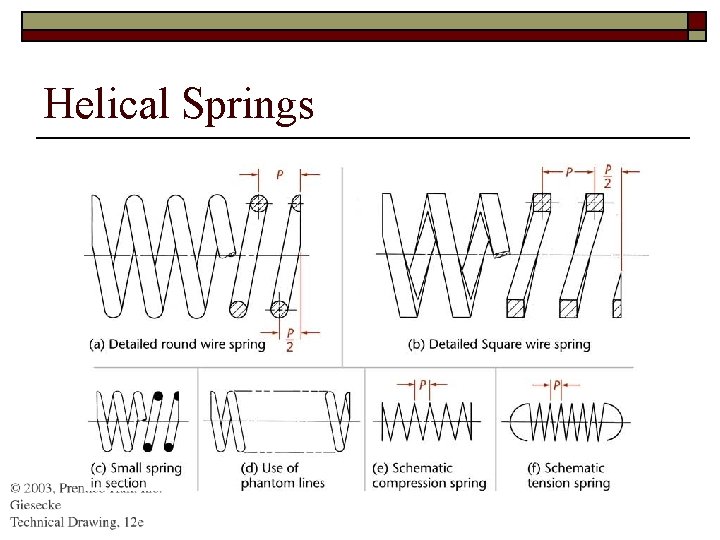
Helical Springs o Helical springs have three types: n n n Compression springs Extension springs Torsion springs
Helical Springs
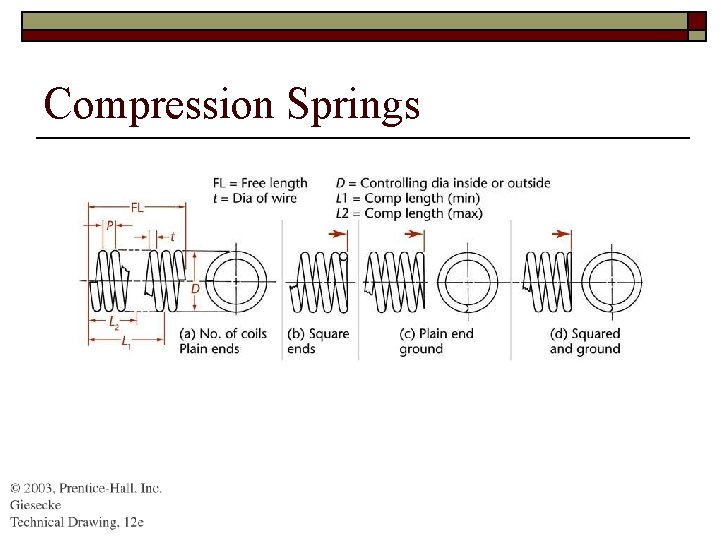
Compression Springs
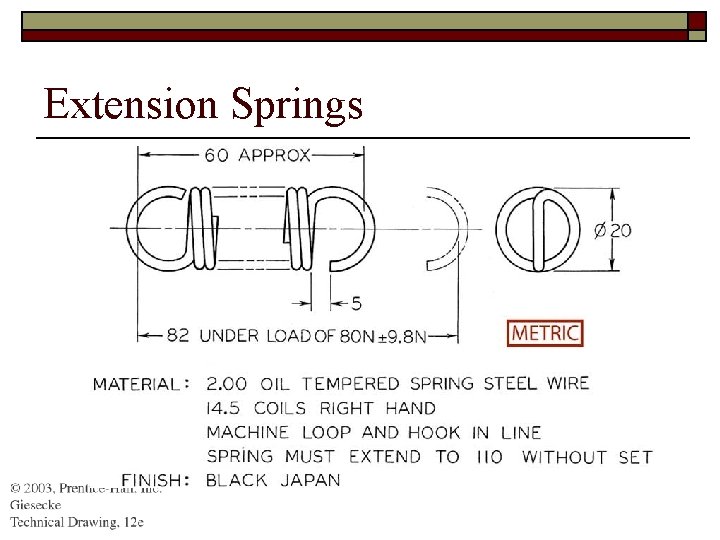
Extension Springs
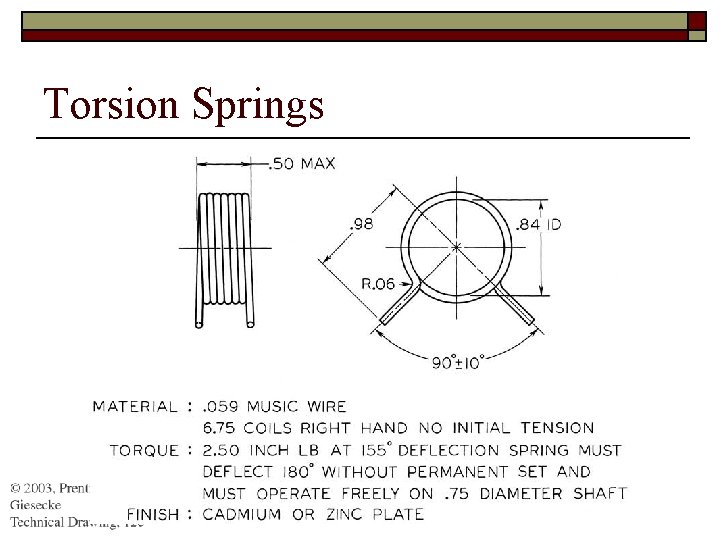
Torsion Springs
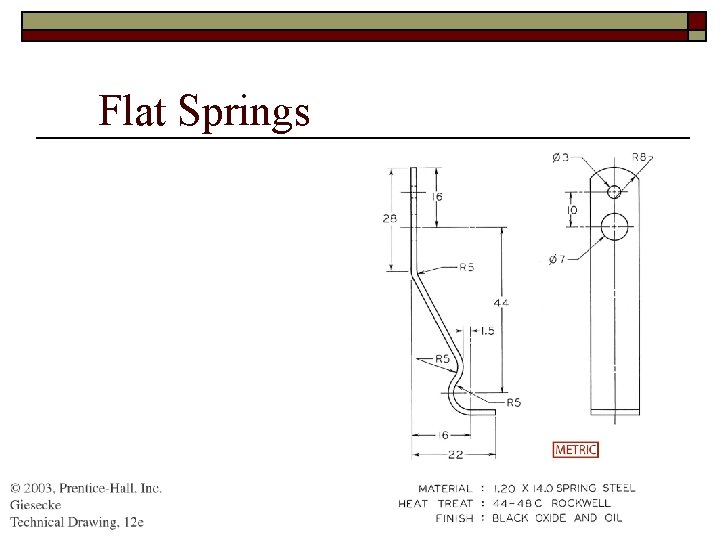
Flat Springs
- Slides: 56