
Chapter 12 Theory of Computation Computer Science An
- Slides: 27
Chapter 12: Theory of Computation Computer Science: An Overview Eleventh Edition by J. Glenn Brookshear Copyright © 2012 Pearson Education, Inc. Publishing as Pearson Addison-Wesley
Chapter 12: Theory of Computation • • 12. 1 Functions and Their Computation 12. 2 Turing Machines 12. 4 A Noncomputable Function 12. 5 Complexity of Problems 1 -2 Copyright © 2012 Pearson Education, Inc. Publishing as Pearson Addison-Wesley 12 -2
The powers of computers • Goal: To investigate the capabilities of computers • Question: What computers can and can not do? • Unsolvable v. s. Solvable v. s. Intractable 1 -3 Copyright © 2012 Pearson Education, Inc. Publishing as Pearson Addison-Wesley 12 -3
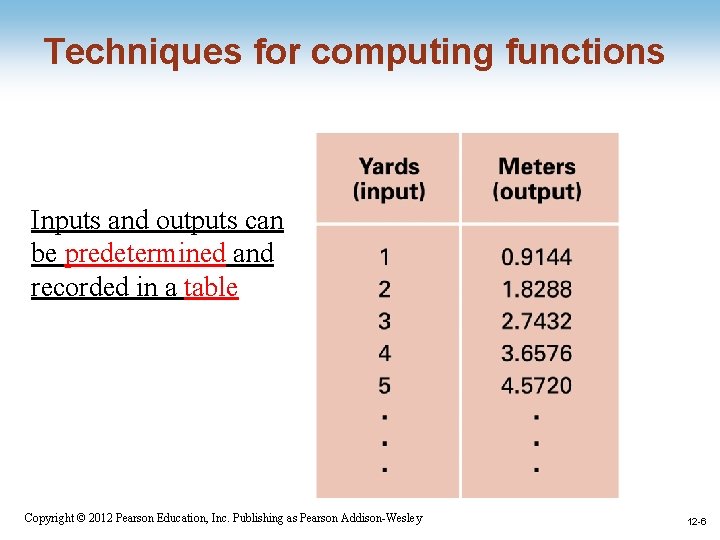
Functions • Function: A correspondence between a collection of possible input values and a collection of possible output values so that each possible input is assigned a single output – Converting measurements in yards into meters – Sort function – Addition function – etc Copyright © 2012 Pearson Education, Inc. Publishing as Pearson Addison-Wesley 1 -4 12 -4
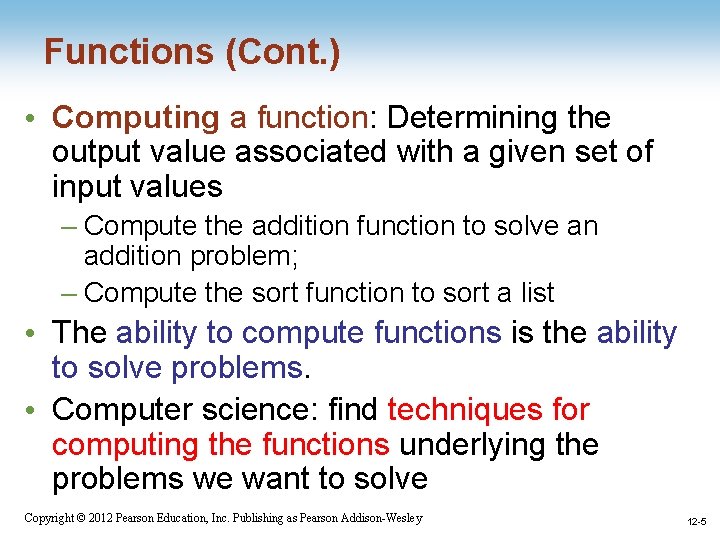
Functions (Cont. ) • Computing a function: Determining the output value associated with a given set of input values – Compute the addition function to solve an addition problem; – Compute the sort function to sort a list • The ability to compute functions is the ability to solve problems. • Computer science: find techniques for computing the functions underlying the problems we want to solve Copyright © 2012 Pearson Education, Inc. Publishing as Pearson Addison-Wesley 1 -5 12 -5
Techniques for computing functions Inputs and outputs can be predetermined and recorded in a table 1 -6 Copyright © 2012 Pearson Education, Inc. Publishing as Pearson Addison-Wesley 12 -6
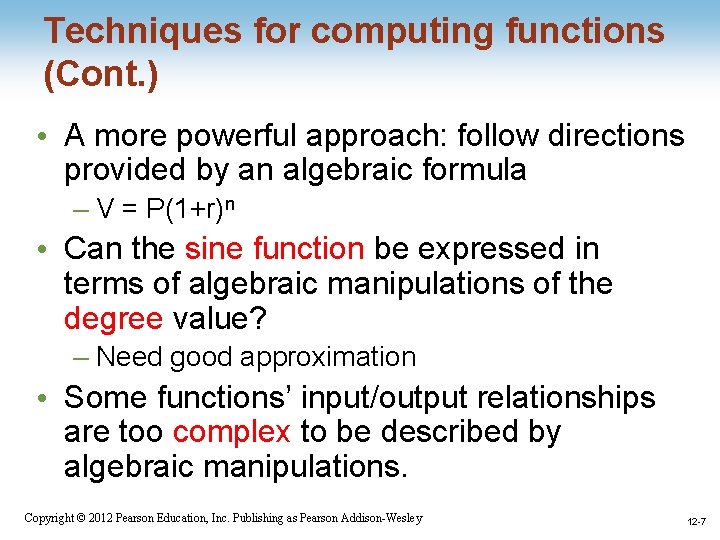
Techniques for computing functions (Cont. ) • A more powerful approach: follow directions provided by an algebraic formula – V = P(1+r)n • Can the sine function be expressed in terms of algebraic manipulations of the degree value? – Need good approximation • Some functions’ input/output relationships are too complex to be described by algebraic manipulations. Copyright © 2012 Pearson Education, Inc. Publishing as Pearson Addison-Wesley 1 -7 12 -7
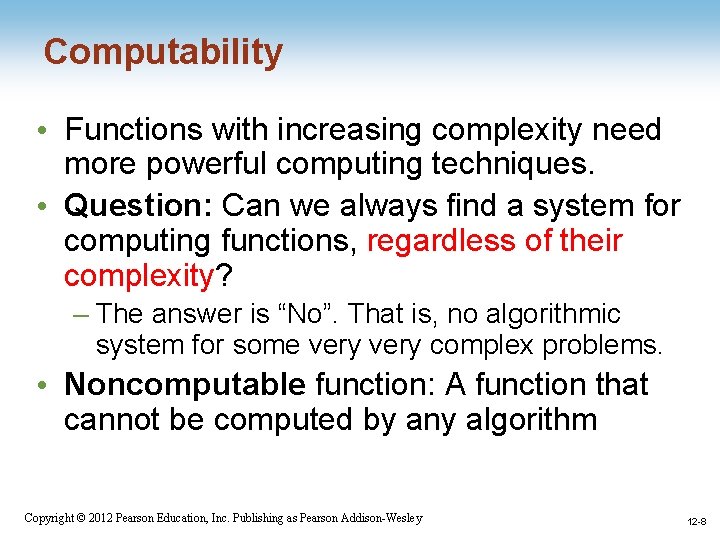
Computability • Functions with increasing complexity need more powerful computing techniques. • Question: Can we always find a system for computing functions, regardless of their complexity? – The answer is “No”. That is, no algorithmic system for some very complex problems. • Noncomputable function: A function that cannot be computed by any algorithm 1 -8 Copyright © 2012 Pearson Education, Inc. Publishing as Pearson Addison-Wesley 12 -8
Turing machines • To understand capabilities and limitations of machines, many researchers have proposed and studied various computational devices. • Alan M. Turing in 1936 proposed the Turing machines, which is still used today as a tool for studying the power of algorithmic processes. 1 -9 Copyright © 2012 Pearson Education, Inc. Publishing as Pearson Addison-Wesley 12 -9
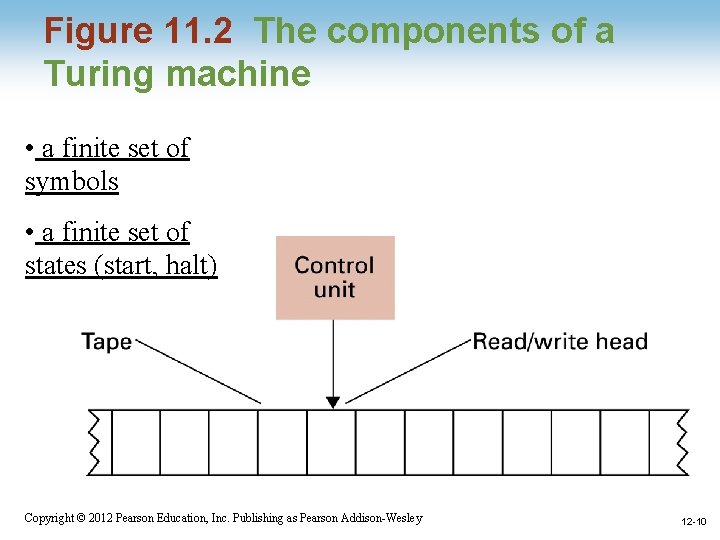
Figure 11. 2 The components of a Turing machine • a finite set of symbols • a finite set of states (start, halt) 1 -10 Copyright © 2012 Pearson Education, Inc. Publishing as Pearson Addison-Wesley 12 -10
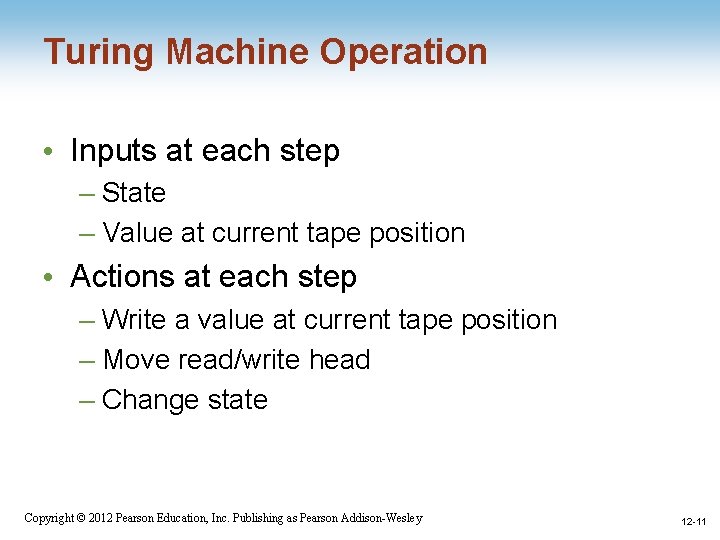
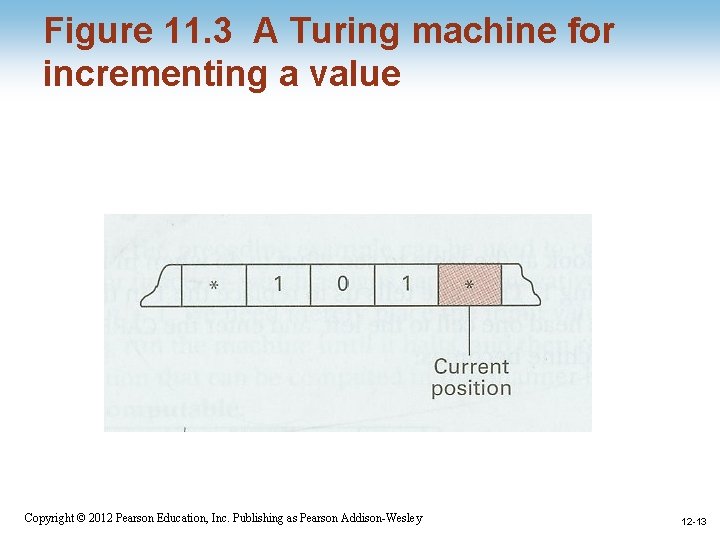
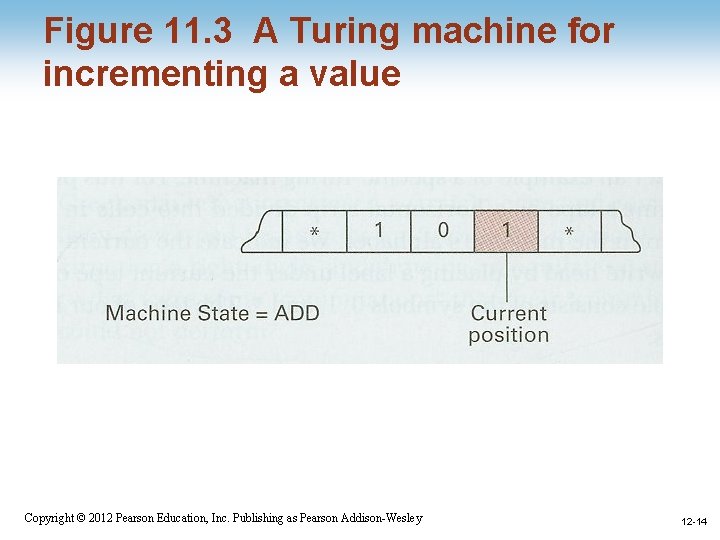
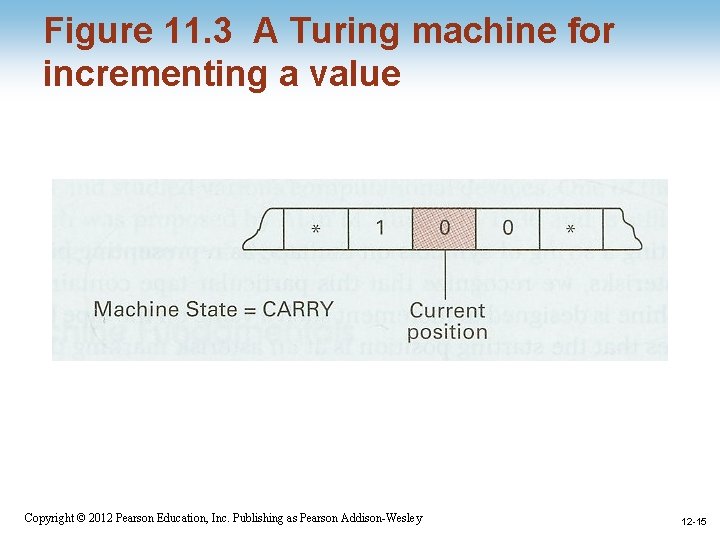
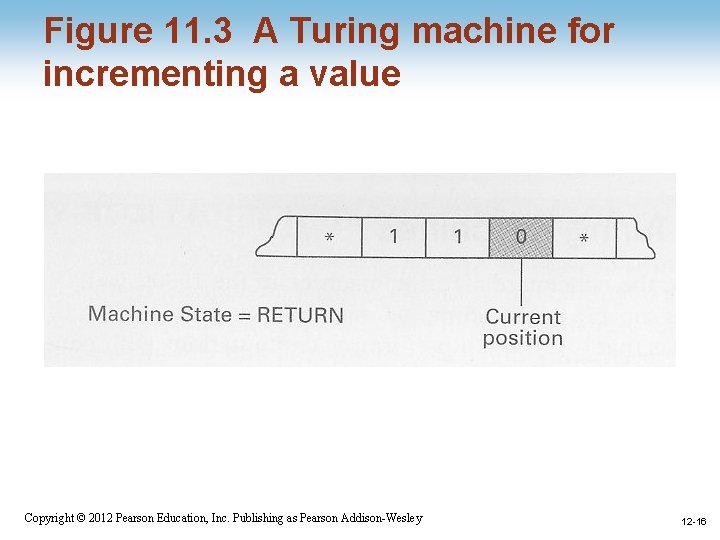
Turing Machine Operation • Inputs at each step – State – Value at current tape position • Actions at each step – Write a value at current tape position – Move read/write head – Change state 1 -11 Copyright © 2012 Pearson Education, Inc. Publishing as Pearson Addison-Wesley 12 -11
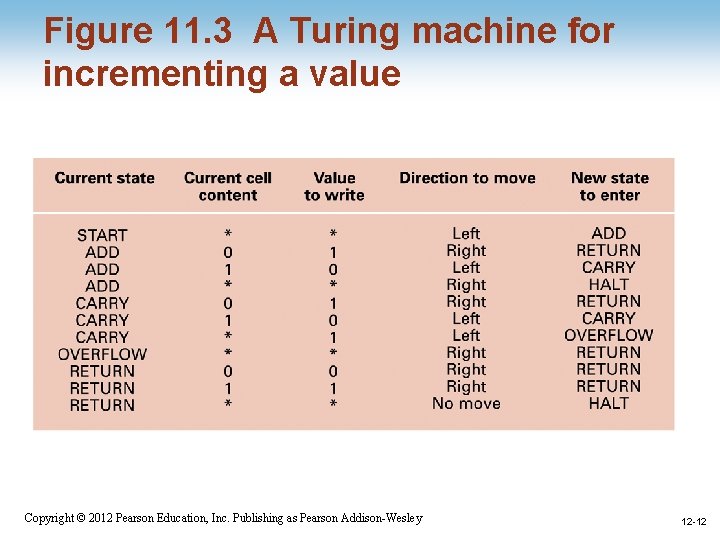
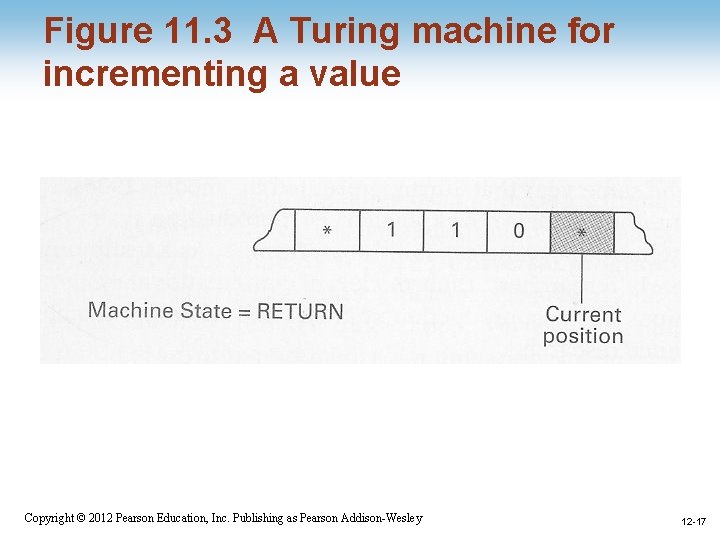
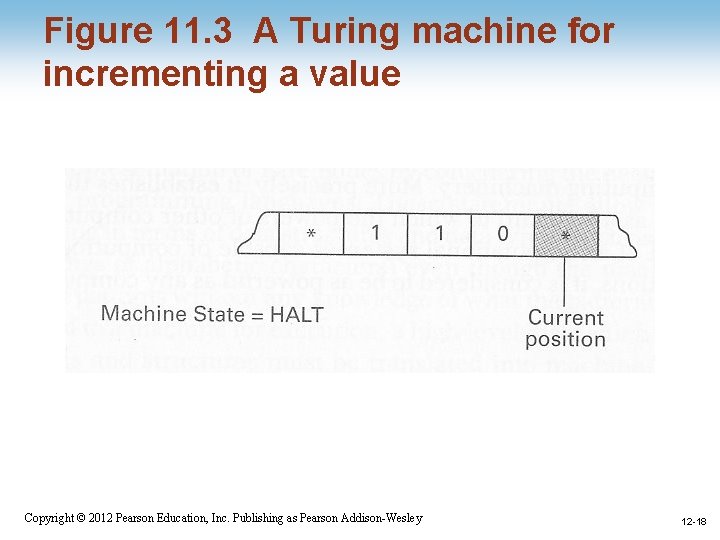
Figure 11. 3 A Turing machine for incrementing a value 1 -12 Copyright © 2012 Pearson Education, Inc. Publishing as Pearson Addison-Wesley 12 -12
Figure 11. 3 A Turing machine for incrementing a value 1 -13 Copyright © 2012 Pearson Education, Inc. Publishing as Pearson Addison-Wesley 12 -13
Figure 11. 3 A Turing machine for incrementing a value 1 -14 Copyright © 2012 Pearson Education, Inc. Publishing as Pearson Addison-Wesley 12 -14
Figure 11. 3 A Turing machine for incrementing a value 1 -15 Copyright © 2012 Pearson Education, Inc. Publishing as Pearson Addison-Wesley 12 -15
Figure 11. 3 A Turing machine for incrementing a value 1 -16 Copyright © 2012 Pearson Education, Inc. Publishing as Pearson Addison-Wesley 12 -16
Figure 11. 3 A Turing machine for incrementing a value 1 -17 Copyright © 2012 Pearson Education, Inc. Publishing as Pearson Addison-Wesley 12 -17
Figure 11. 3 A Turing machine for incrementing a value 1 -18 Copyright © 2012 Pearson Education, Inc. Publishing as Pearson Addison-Wesley 12 -18
Church-Turing Thesis • A function that can be computed by a Turing machine is said to be Turing computable. • Turing’s conjecture (Church-Turing Thesis): The functions that are computable by a Turing machine are exactly the functions that can be computed by any algorithmic means. – Widely accepted today 1 -19 Copyright © 2012 Pearson Education, Inc. Publishing as Pearson Addison-Wesley 12 -19
The Halting Problem • Given any program with its inputs, return 1 if the program is self-terminating, or 0 if the program is not. 1 -20 Copyright © 2012 Pearson Education, Inc. Publishing as Pearson Addison-Wesley 12 -20
The Polynomial Problems • The question of whether a solvable problem has a practical solution. • Polynomial problems P: a problem is a polynomial problem if the problem is in O(f(n)), where f(n) is either a polynomial itself or bounded by a polynomial – E. g. , O(n 3), O(nlg n) – Searching a list, sorting a list • The problems in P are characterized as having practical solutions. 1 -21 Copyright © 2012 Pearson Education, Inc. Publishing as Pearson Addison-Wesley 12 -21
The Polynomial Problems (Cont. ) • Consider the problem of listing all possible subcommittees that can be formed from a group of n people. – There are 2 n-1 such subcommittees – Any algorithm that solves this problem must have at least 2 n-1 steps – This problem is not in P. • The non-polynomial problems are called “intractable”. 1 -22 Copyright © 2012 Pearson Education, Inc. Publishing as Pearson Addison-Wesley 12 -22
The traveling salesman problem • Traveling salesman problem (TSP): visit each of his clients in different cities without exceeding his travel budget (the length of the path does not exceed his allowed mileage) – An exponential time algorithm: consider the potential paths in a systematic manner 1 -23 Copyright © 2012 Pearson Education, Inc. Publishing as Pearson Addison-Wesley 12 -23
A nondeterministic algorithm for the traveling salesman problem Pick one of the possible paths, and compute its total distance If (this distance is not greater than the allowable mileage) then (declare a success) else (declare nothing) => A nondeterministic algorithm based on “lucky guess”. 1 -24 Copyright © 2012 Pearson Education, Inc. Publishing as Pearson Addison-Wesley 12 -24
P versus NP • Class P: All problems in any class O(f(n)), where f(n) is a polynomial • Class NP: All problems that can be solved by a nondeterministic algorithm in polynomial time – Nondeterministic algorithm = an “algorithm” whose steps may not be uniquely and completely determined by the process state • We know that P is a subset of NP. • Whether the class NP is bigger than class P is currently unknown. – NP = P? 1 -25 Copyright © 2012 Pearson Education, Inc. Publishing as Pearson Addison-Wesley 12 -25
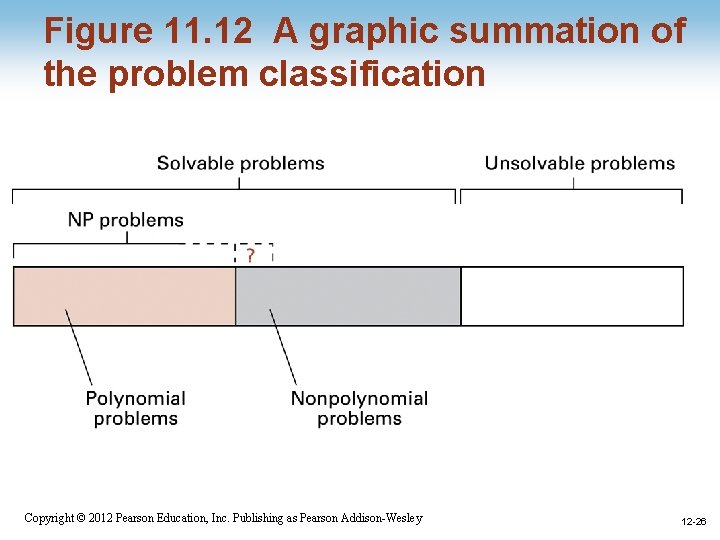
Figure 11. 12 A graphic summation of the problem classification 1 -26 Copyright © 2012 Pearson Education, Inc. Publishing as Pearson Addison-Wesley 12 -26
NP-Complete problems • NP-complete problems: NP problems to which all other NP problems can be reduced in polynomial time • The traveling salesman problem is a NPcomplete problem • 3 -Coloring problem: Given an undirected graph G = (V, E), determine whether G can be color with three color with the requirement – Each vertex is assigned one color and no two adjacent vertices have the same color Copyright © 2012 Pearson Education, Inc. Publishing as Pearson Addison-Wesley 1 -27 12 -27