
Chapter 12 Theories of Learning A History of
- Slides: 35
Chapter 12: Theories of Learning A History of Psychology (3 rd Edition) John G. Benjafield
Ernest R. Hilgard (1904– 2001) • Wrote series of popular and influential textbooks – Introductory text: most successful academic textbook of the 1970 s – Conditioning and Learning (1940) – Theories of Learning (1948) • Became a defining survey textbook • Served as a prototype for later survey textbooks
E. R. Guthrie (1886– 1959) • Trained in logic and philosophy of science • Concluded: ‘The laws of logic are conventions and not laws of thought. ’ – Skeptical of notions of possibility of completely rigorous deduction, ultimate validity in an argument • Presented his theory of learning in an informal way
Contiguity • Continguity: ‘A combination of stimuli which has accompanied a movement will, on its recurrence, tend to be followed by that movement. ’ • Principle at the core of Guthrie’s learning theory
Repetition • Typical view: repetition acts to strengthen the connection between stimulus and response • Guthrie’s view: repetition provides the opportunity for additional stimuli to become associated with a response
Reward • Typical view: reinforcement strengthens the connection between stimulus and response • Guthrie: reward acts to prevent the animal from unlearning the association formed just before the reward
One-Trial Learning • Guthrie’s writing was in touch with everyday life – Suggestions for meeting the problems of animal training, child rearing, and pedagogy • Ex. breaking a habit 1. Find the cues that initiate the action 2. Practice another response to these cues
Clark L. Hull (1884– 1952) • Motivational theory – Based on the concept of drive • Drive: any persistent and intense stimulus • Similarities shared with psychoanalytic hypotheses about motivation
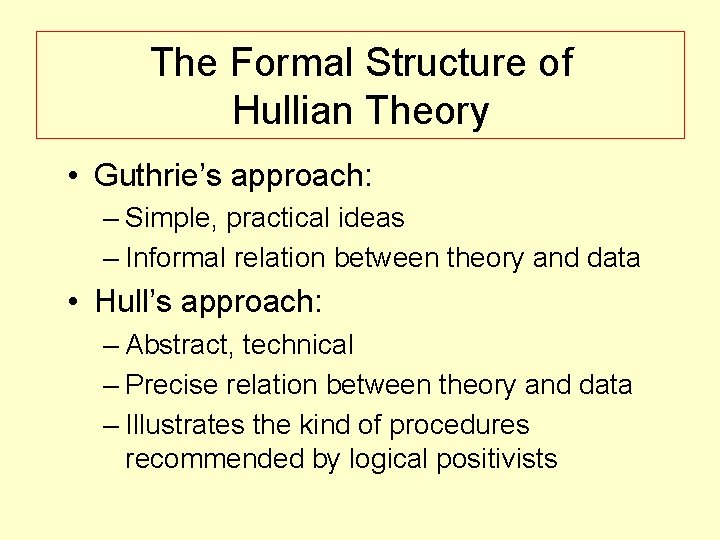
The Formal Structure of Hullian Theory • Guthrie’s approach: – Simple, practical ideas – Informal relation between theory and data • Hull’s approach: – Abstract, technical – Precise relation between theory and data – Illustrates the kind of procedures recommended by logical positivists
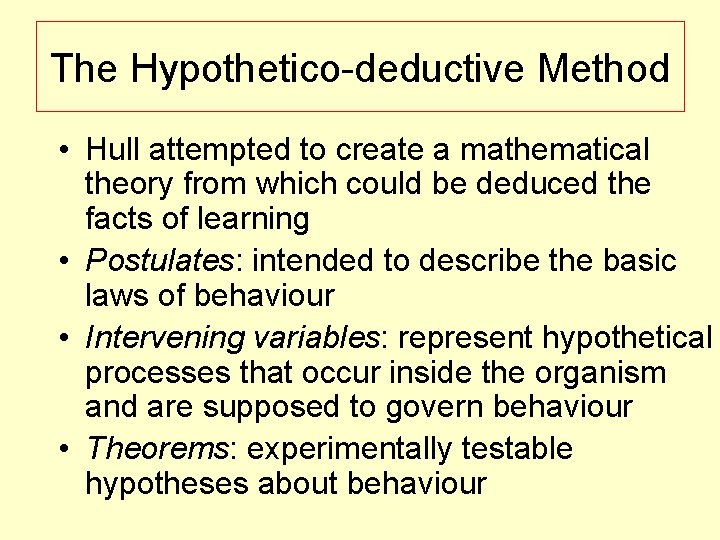
The Hypothetico-deductive Method • Hull attempted to create a mathematical theory from which could be deduced the facts of learning • Postulates: intended to describe the basic laws of behaviour • Intervening variables: represent hypothetical processes that occur inside the organism and are supposed to govern behaviour • Theorems: experimentally testable hypotheses about behaviour
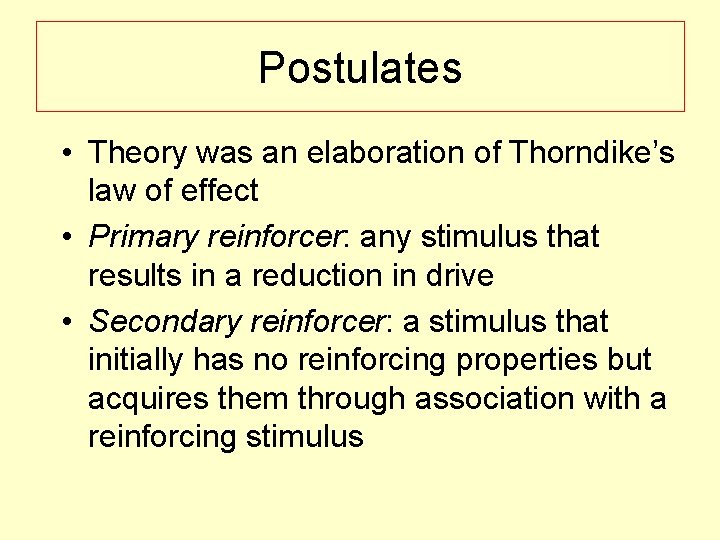
Postulates • Theory was an elaboration of Thorndike’s law of effect • Primary reinforcer: any stimulus that results in a reduction in drive • Secondary reinforcer: a stimulus that initially has no reinforcing properties but acquires them through association with a reinforcing stimulus
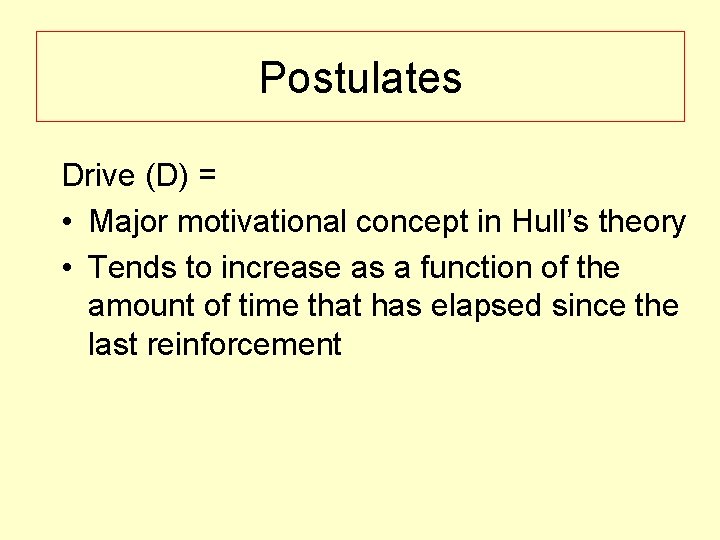
Postulates Drive (D) = • Major motivational concept in Hull’s theory • Tends to increase as a function of the amount of time that has elapsed since the last reinforcement
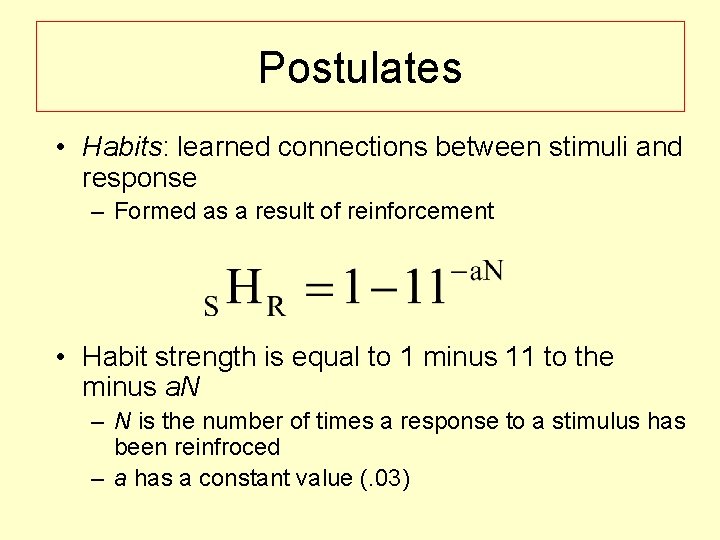
Postulates • Habits: learned connections between stimuli and response – Formed as a result of reinforcement • Habit strength is equal to 1 minus 11 to the minus a. N – N is the number of times a response to a stimulus has been reinfroced – a has a constant value (. 03)
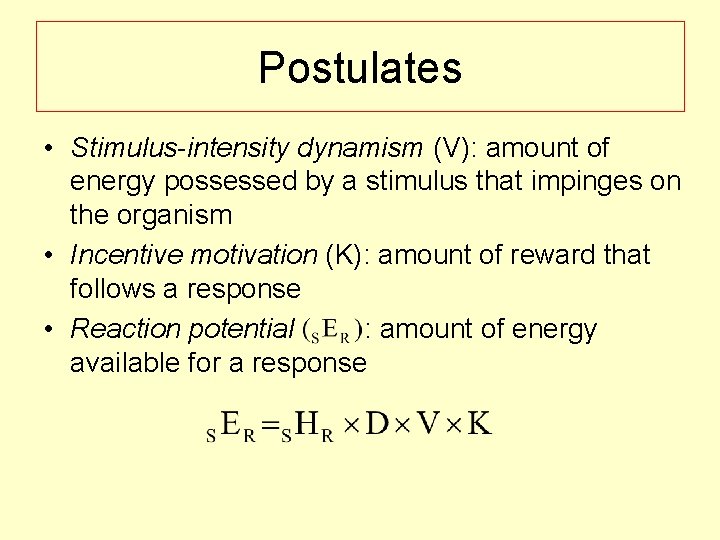
Postulates • Stimulus-intensity dynamism (V): amount of energy possessed by a stimulus that impinges on the organism • Incentive motivation (K): amount of reward that follows a response • Reaction potential : amount of energy available for a response
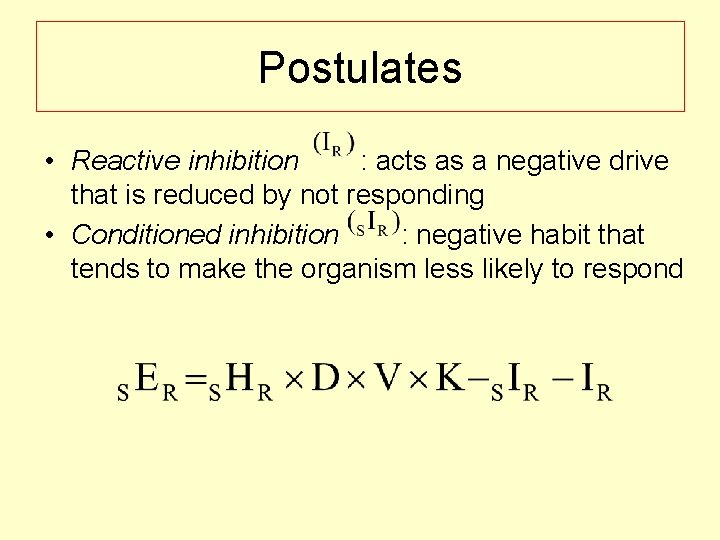
Postulates • Reactive inhibition : acts as a negative drive that is reduced by not responding • Conditioned inhibition : negative habit that tends to make the organism less likely to respond
Kenneth W. Spence (1907– 1967) • Worked closely with Hull • Attempted to explain Köhler’s transposition experiments – Animals learn relationships between stimuli • Realized Köhler’s Gestalt explanation was a threat to an associationist form of explanation, like Hull’s
Charles E. Osgood (1916– 1991) • Graduate work at Yale • Extended the Hullian approach • Mediational processes – A way of explaining how stimuli acquired meaning for an organism
The Semantic Differential • Mediating processes often associated with words • Mediators carry the meanings of words, particularly their emotional or affective meanings • Semantic differential technique: rate a person, thing, or event on a set of sevenpoint bipolar scales
E. C. Tolman (1886– 1959) • 1914: Converted to behaviourism = Phenomenology in operational behaviouristic terms • Blend of methodological behaviourism and Gestalt psychology with other influences
Purposive Behaviour • Subject matter: behaviour described with reference to the goal that the animal is seeking • Molar descriptions: in terms of what the behaviour is intended to accomplish • Molecular descriptions: in terms of specific muscular and glandular reactions • Tolman attempted to explain molar behaviour, therefore purposive behaviour
Cognitive Maps • The explanation of purposive behaviour requires an understanding of how an animal represents its environment • Cognitive maps – Contain expectancies: representations of what the animal is likely to find by following the different routes represented in the map – Expectancies integrated into sign Gestalts: representations of the way one event leads to other events in the cognitive map
The Place vs. Response Controversy • Does learning consist of the formation of stimulus–response connections? • Does learning consist of the formation of expectations?
The Verbal-Learning Tradition • Studies of verbal learning – Ebbinghaus’ nonsense syllables – Calkins’ paired associates – Concerned with uncovering the basic laws of the formation of associations in humans
Acquisition • Irvin Rock (1922– 1995) – Tested the hypothesis of one-trial learning – Results: repetition plays no role in the formation of associations – Some criticisms re: experimental procedures used
Serial Learning • When asked to learn lists of nonsense syllables, participants learn the middle of the list more slowly than the ends • Real world context? – Roediger and Crowder (1982) • Listing names of the presidents of the United States shows serial position curve
The Fate of Verbal Learning • Benton J. Underwood (1915– 1994) – By the 1960 s, verbal learning considered dull • Symposium: Verbal Behavior and General Behavior Theory – Adequacy of an associationist approach to the study of learning was called into question
D. O. Hebb (1904– 1985) • Studied with Karl Lashley • Career at Mc. Gill University • First foreign president of the American Psychological Association (Canadian)
The Organization of Behavior • Neuropsychology: combined aspects of psychology with neurophysiology • Cell assemblies: physiological mediating processes responsible for representing stimulation • Hebb rule: when neuron A fires neuron B, some change occurs in A or B or both, which then increases A’s capacity to fire B in the future • Phase sequences • Phantom limbs
Motivation • Arousal system: ‘the nonspecific or diffuse projection system of the brain stem which was shown. . . to be an arousal system whose activity in effect makes organzied cortical activity possible’
Experiments in Sensory Deprivation • Funded in part by the Canadian Department of National Defence • Participants: paid undergraduate students • Procedure: participants placed in insolation chambers, received only unpatterned sensory stimulation
Experiments in Sensory Deprivation • Results: – Participants began to have hallucinations after 2– 3 days – Participants more likely to believe propaganda than controls – Participants less able to think about problems – Participants quit the experiment quickly
Albert Bandura (1925–) • Undergraduate degree at University of British Columbia • Ph. D at University of Iowa – Influenced by Kenneth Spence
Social-Learning Theory • Stressed the importance of modelling in shaping a person’s learned behaviour • Modelling takes place through observational learning – Observational learning: a person can acquire novel responses through the observation of another person’s actions • Bandura has drawn out the social implications of modelling
Behaviour Modification • Mary Cover Jones (1896– 1987) – Study with boy named Peter, afraid of furry objects – Placed a caged rabbit nearby while the boy was fed – Decreased distance between rabbit and boy on subsequent occasions = Systematic desensitization
Reciprocal Determinism • Is the person or the situation more important in determining behaviour? • Reciprocal determinism: assumes neither that the environment controls behaviour nor that people are free to do as they wish – Triadic reciprocal causation: the person, the environment, and behaviour interact so as to determine each other