
Chapter 12 THE PARTIAL EQUILIBRIUM COMPETITIVE MODEL Copyright

Chapter 12 THE PARTIAL EQUILIBRIUM COMPETITIVE MODEL Copyright © 2005 by South-Western, a division of Thomson Learning. All rights reserved. 1
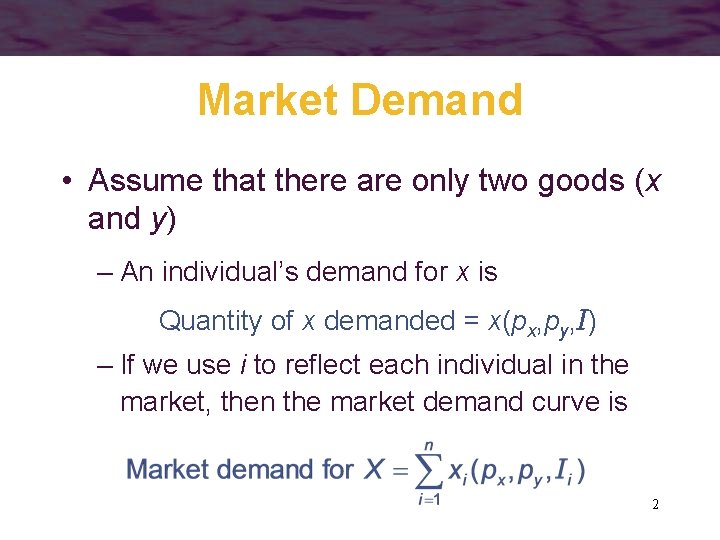
Market Demand • Assume that there are only two goods (x and y) – An individual’s demand for x is Quantity of x demanded = x(px, py, I) – If we use i to reflect each individual in the market, then the market demand curve is 2
Market Demand • To construct the market demand curve, PX is allowed to vary while Py and the income of each individual are held constant • If each individual’s demand for x is downward sloping, the market demand curve will also be downward sloping 3

Market Demand To derive the market demand curve, we sum the quantities demanded at every price px px Individual 1’s demand curve Individual 2’s demand curve px Market demand curve px* x 1* X x 2 x x 2* x X* x x 1* + x 2* = X* 4
Shifts in the Market Demand Curve • The market demand summarizes the ceteris paribus relationship between X and px – changes in px result in movements along the curve (change in quantity demanded) – changes in other determinants of the demand for X cause the demand curve to shift to a new position (change in demand) 5
Generalizations • Suppose that there are n goods (xi, i = 1, n) with prices pi, i = 1, n. • Assume that there are m individuals in the economy • The j th’s demand for the i th good will depend on all prices and on Ij xij = xij(p 1, …, pn, Ij) 6

Generalizations • The market demand function for xi is the sum of each individual’s demand for that good • The market demand function depends on the prices of all goods and the incomes and preferences of all buyers 7
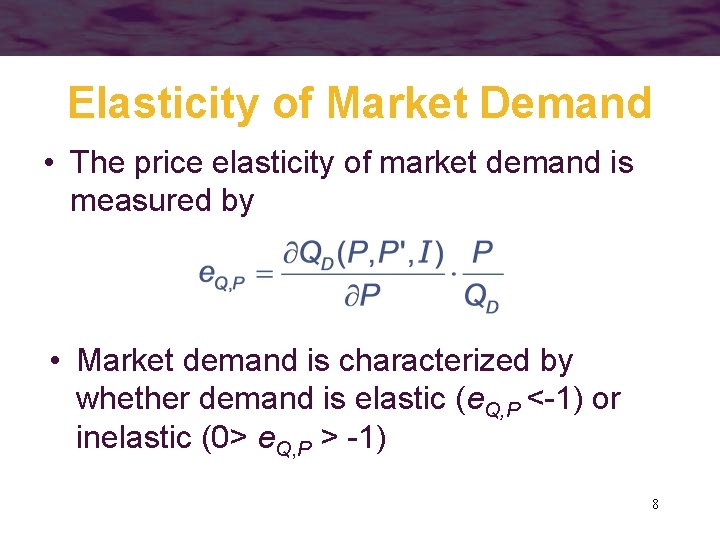
Elasticity of Market Demand • The price elasticity of market demand is measured by • Market demand is characterized by whether demand is elastic (e. Q, P <-1) or inelastic (0> e. Q, P > -1) 8
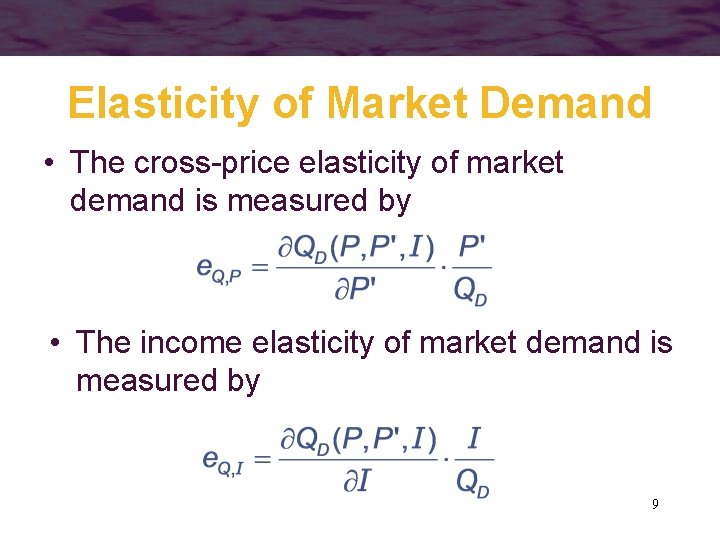
Elasticity of Market Demand • The cross-price elasticity of market demand is measured by • The income elasticity of market demand is measured by 9
Timing of the Supply Response • In the analysis of competitive pricing, the time period under consideration is important – very short run • no supply response (quantity supplied is fixed) – short run • existing firms can alter their quantity supplied, but no new firms can enter the industry – long run • new firms may enter an industry 10
Pricing in the Very Short Run • In the very short run (or the market period), there is no supply response to changing market conditions – price acts only as a device to ration demand • price will adjust to clear the market – the supply curve is a vertical line 11
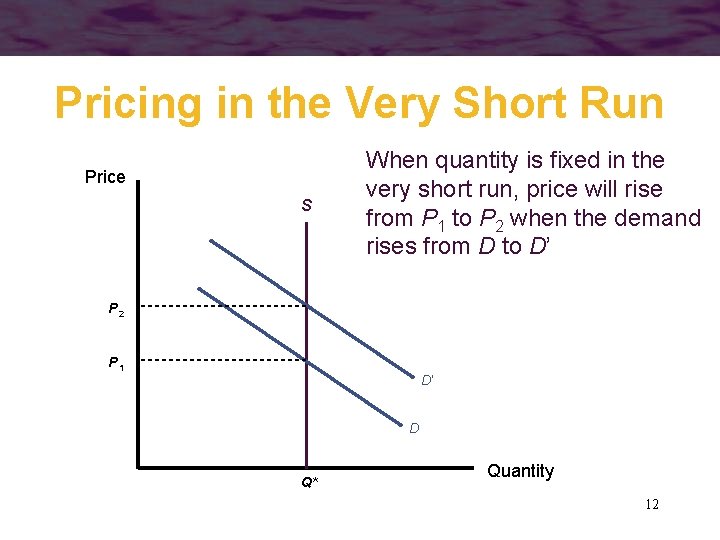
Pricing in the Very Short Run Price S When quantity is fixed in the very short run, price will rise from P 1 to P 2 when the demand rises from D to D’ P 2 P 1 D’ D Q* Quantity 12
Short-Run Price Determination • The number of firms in an industry is fixed • These firms are able to adjust the quantity they are producing – they can do this by altering the levels of the variable inputs they employ 13
Perfect Competition • A perfectly competitive industry is one that obeys the following assumptions: – there a large number of firms, each producing the same homogeneous product – each firm attempts to maximize profits – each firm is a price taker • its actions have no effect on the market price – information is perfect – transactions are costless 14
Short-Run Market Supply • The quantity of output supplied to the entire market in the short run is the sum of the quantities supplied by each firm – the amount supplied by each firm depends on price • The short-run market supply curve will be upward-sloping because each firm’s short-run supply curve has a positive slope 15
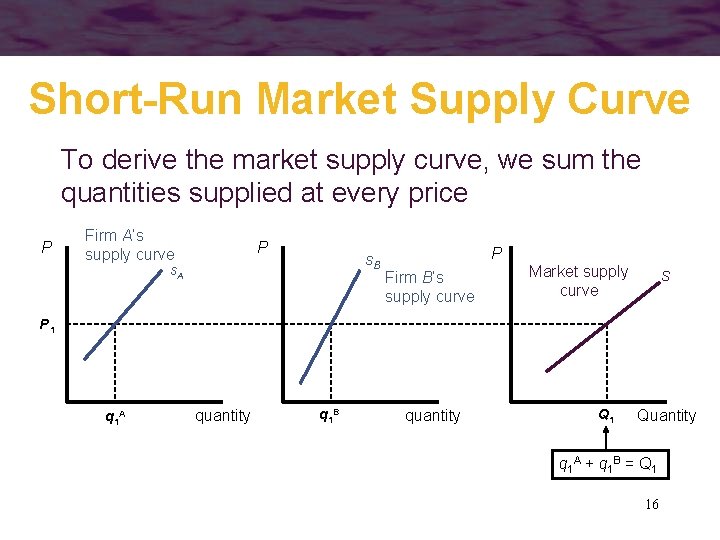
Short-Run Market Supply Curve To derive the market supply curve, we sum the quantities supplied at every price P Firm A’s supply curve P s. B s. A P Firm B’s supply curve Market supply curve S P 1 q 1 A quantity q 1 B quantity Q 1 Quantity q 1 A + q 1 B = Q 1 16
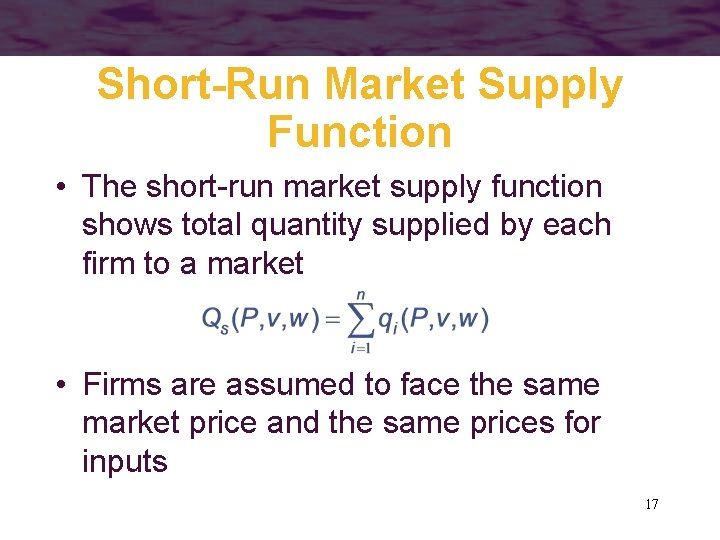
Short-Run Market Supply Function • The short-run market supply function shows total quantity supplied by each firm to a market • Firms are assumed to face the same market price and the same prices for inputs 17
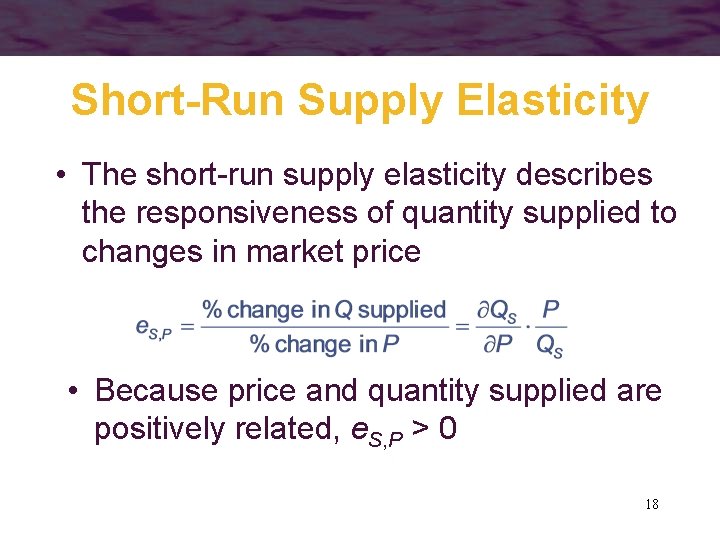
Short-Run Supply Elasticity • The short-run supply elasticity describes the responsiveness of quantity supplied to changes in market price • Because price and quantity supplied are positively related, e. S, P > 0 18
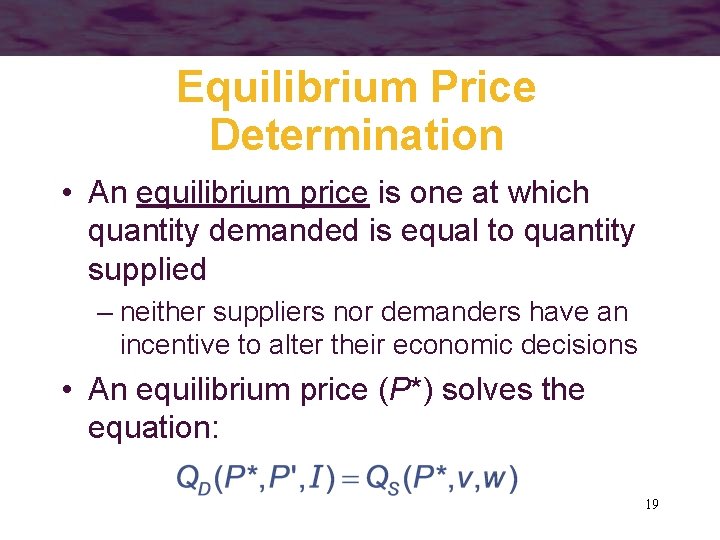
Equilibrium Price Determination • An equilibrium price is one at which quantity demanded is equal to quantity supplied – neither suppliers nor demanders have an incentive to alter their economic decisions • An equilibrium price (P*) solves the equation: 19

Equilibrium Price Determination • The equilibrium price depends on many exogenous factors – changes in any of these factors will likely result in a new equilibrium price 20
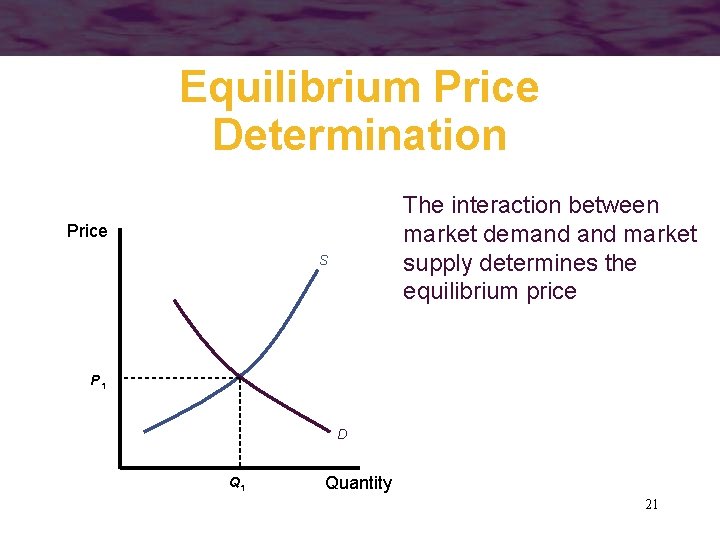
Equilibrium Price Determination The interaction between market demand market supply determines the equilibrium price Price S P 1 D Q 1 Quantity 21
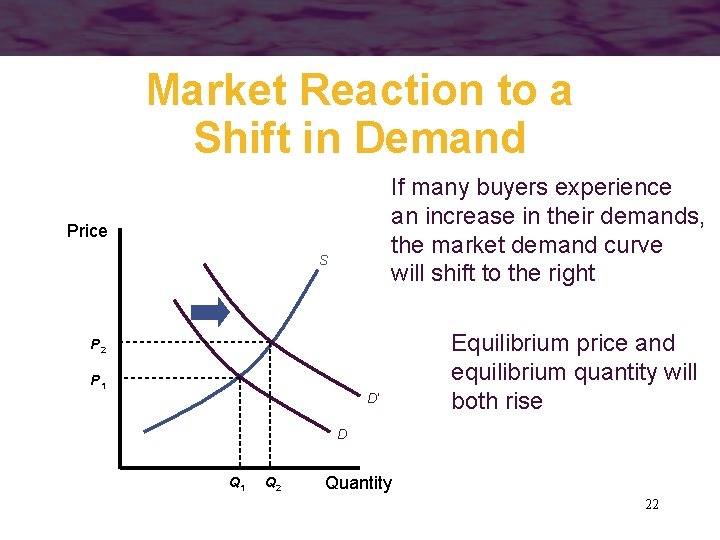
Market Reaction to a Shift in Demand If many buyers experience an increase in their demands, the market demand curve will shift to the right Price S P 2 P 1 D’ Equilibrium price and equilibrium quantity will both rise D Q 1 Q 2 Quantity 22
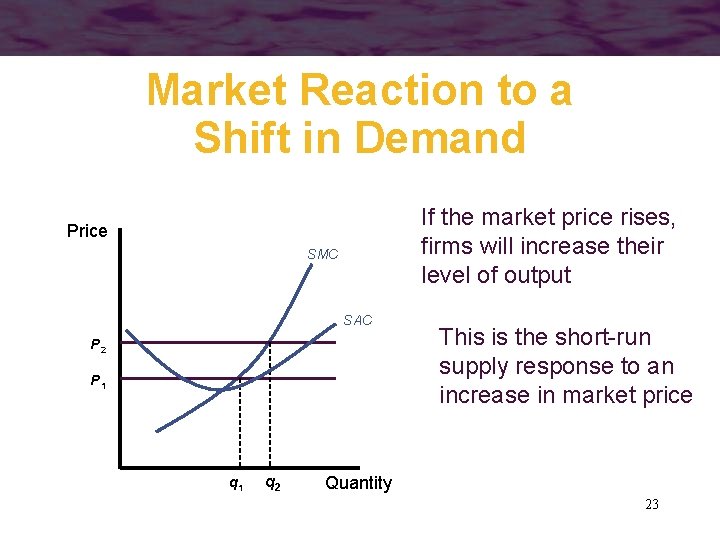
Market Reaction to a Shift in Demand If the market price rises, firms will increase their level of output Price SMC SAC P 2 P 1 q 2 This is the short-run supply response to an increase in market price Quantity 23
Shifts in Supply and Demand Curves • Demand curves shift because – incomes change – prices of substitutes or complements change – preferences change • Supply curves shift because – input prices change – technology changes – number of producers change 24
Shifts in Supply and Demand Curves • When either a supply curve or a demand curve shift, equilibrium price and quantity will change • The relative magnitudes of these changes depends on the shapes of the supply and demand curves 25
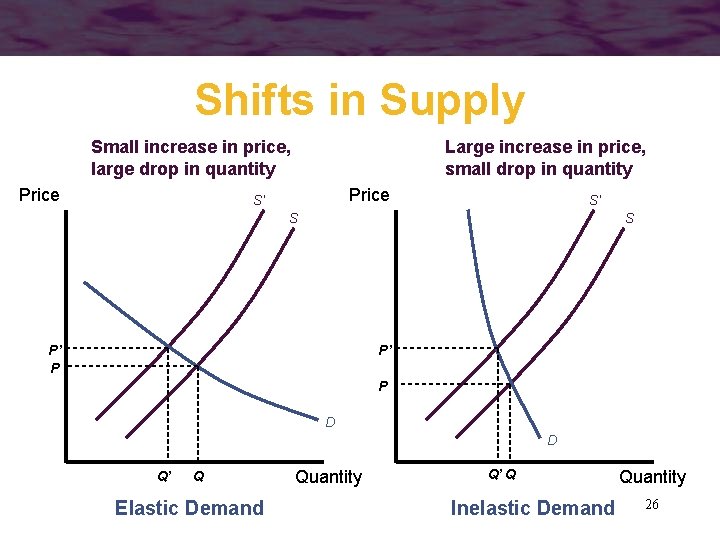
Shifts in Supply Small increase in price, large drop in quantity Price Large increase in price, small drop in quantity Price S’ S’ S S P’ P D D Q’ Q Elastic Demand Quantity Q’ Q Inelastic Demand Quantity 26
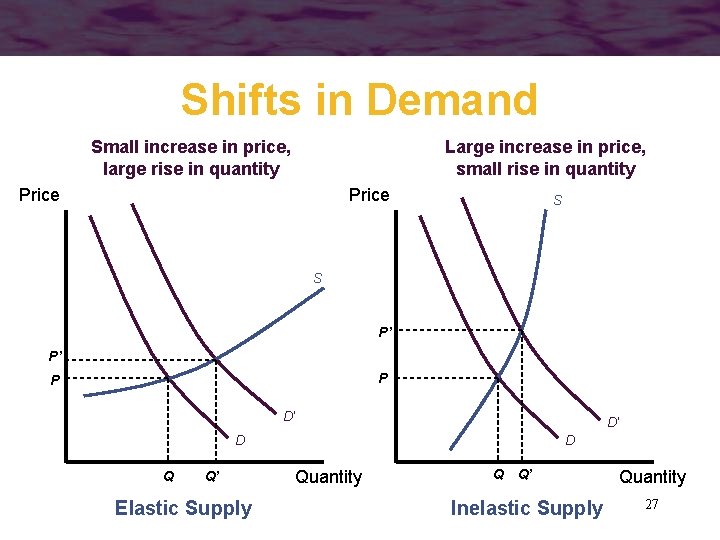
Shifts in Demand Small increase in price, large rise in quantity Large increase in price, small rise in quantity Price S S P’ P’ P P D’ D’ D Q Q’ Elastic Supply D Quantity Q Q’ Quantity Inelastic Supply 27
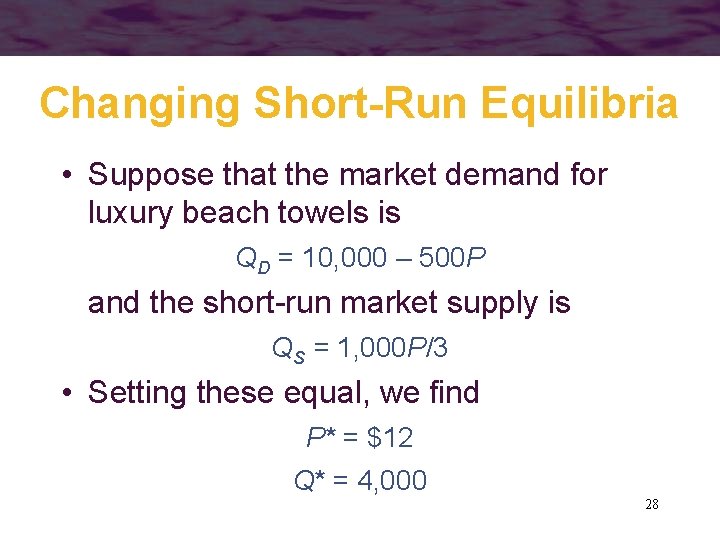
Changing Short-Run Equilibria • Suppose that the market demand for luxury beach towels is QD = 10, 000 – 500 P and the short-run market supply is QS = 1, 000 P/3 • Setting these equal, we find P* = $12 Q* = 4, 000 28

Changing Short-Run Equilibria • Suppose instead that the demand for luxury towels rises to QD = 12, 500 – 500 P • Solving for the new equilibrium, we find P* = $15 Q* = 5, 000 • Equilibrium price and quantity both rise 29
Changing Short-Run Equilibria • Suppose that the wage of towel cutters rises so that the short-run market supply becomes QS = 800 P/3 • Solving for the new equilibrium, we find P* = $13. 04 Q* = 3, 480 • Equilibrium price rises and quantity falls 30
Long-Run Analysis • In the long run, a firm may adapt all of its inputs to fit market conditions – profit-maximization for a price-taking firm implies that price is equal to long-run MC • Firms can also enter and exit an industry in the long run – perfect competition assumes that there are no special costs of entering or exiting an industry 31
Long-Run Analysis • New firms will be lured into any market for which economic profits are greater than zero – entry of firms will cause the short-run industry supply curve to shift outward – market price and profits will fall – the process will continue until economic profits are zero 32
Long-Run Analysis • Existing firms will leave any industry for which economic profits are negative – exit of firms will cause the short-run industry supply curve to shift inward – market price will rise and losses will fall – the process will continue until economic profits are zero 33
Long-Run Competitive Equilibrium • A perfectly competitive industry is in long-run equilibrium if there are no incentives for profit-maximizing firms to enter or to leave the industry – this will occur when the number of firms is such that P = MC = AC and each firm operates at minimum AC 34

Long-Run Competitive Equilibrium • We will assume that all firms in an industry have identical cost curves – no firm controls any special resources or technology • The equilibrium long-run position requires that each firm earn zero economic profit 35
Long-Run Equilibrium: Constant-Cost Case • Assume that the entry of new firms in an industry has no effect on the cost of inputs – no matter how many firms enter or leave an industry, a firm’s cost curves will remain unchanged • This is referred to as a constant-cost industry 36
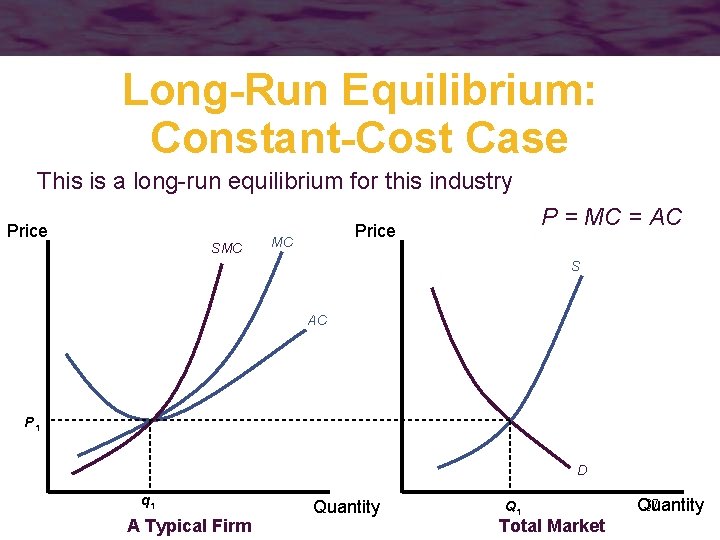
Long-Run Equilibrium: Constant-Cost Case This is a long-run equilibrium for this industry Price SMC P = MC = AC Price MC S AC P 1 D q 1 A Typical Firm Quantity Q 1 Total Market 37 Quantity
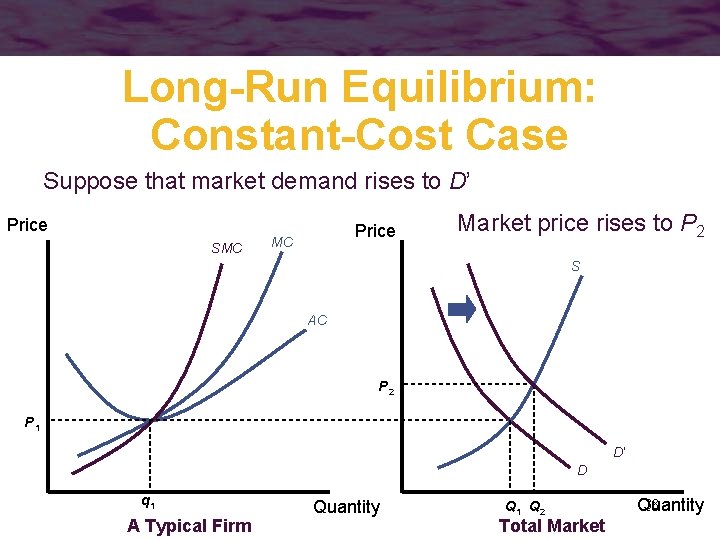
Long-Run Equilibrium: Constant-Cost Case Suppose that market demand rises to D’ Price SMC Price MC Market price rises to P 2 S AC P 2 P 1 D’ D q 1 A Typical Firm Quantity Q 1 Q 2 Total Market 38 Quantity
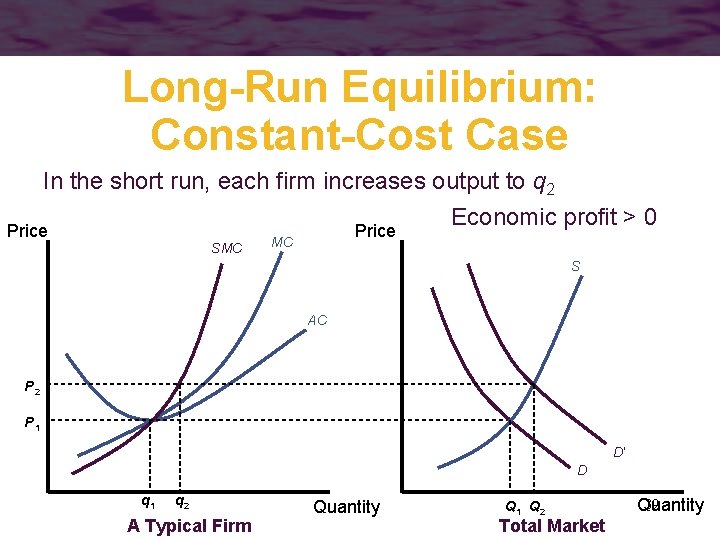
Long-Run Equilibrium: Constant-Cost Case In the short run, each firm increases output to q 2 Economic profit > 0 Price SMC Price MC S AC P 2 P 1 D’ D q 1 q 2 A Typical Firm Quantity Q 1 Q 2 Total Market 39 Quantity
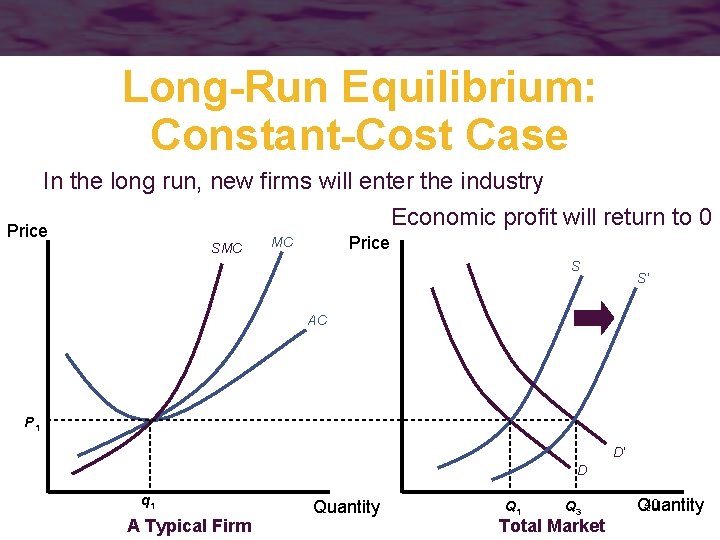
Long-Run Equilibrium: Constant-Cost Case In the long run, new firms will enter the industry Economic profit will return to 0 Price SMC Price MC S S’ AC P 1 D’ D q 1 A Typical Firm Quantity Q 1 Q 3 Total Market 40 Quantity
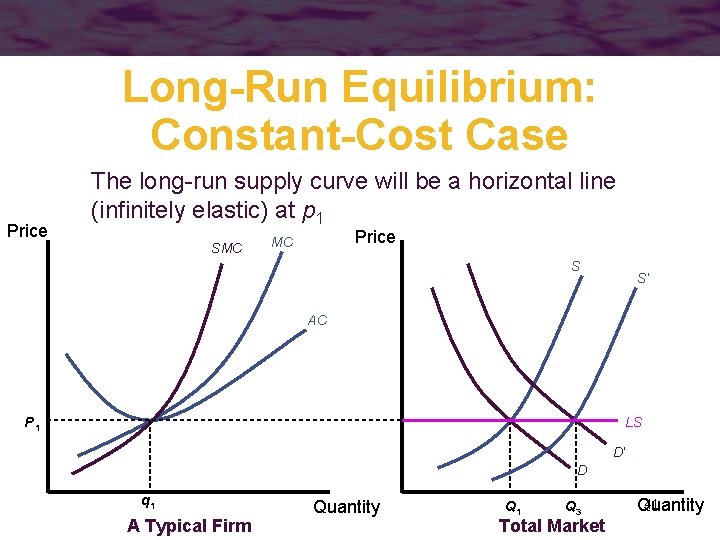
Long-Run Equilibrium: Constant-Cost Case Price The long-run supply curve will be a horizontal line (infinitely elastic) at p 1 SMC Price MC S S’ AC P 1 LS D’ D q 1 A Typical Firm Quantity Q 1 Q 3 Total Market 41 Quantity
Shape of the Long-Run Supply Curve • The zero-profit condition is the factor that determines the shape of the long-run cost curve – if average costs are constant as firms enter, long-run supply will be horizontal – if average costs rise as firms enter, long-run supply will have an upward slope – if average costs fall as firms enter, long-run supply will be negatively sloped 42
Long-Run Equilibrium: Increasing-Cost Industry • The entry of new firms may cause the average costs of all firms to rise – prices of scarce inputs may rise – new firms may impose “external” costs on existing firms – new firms may increase the demand for tax -financed services 43
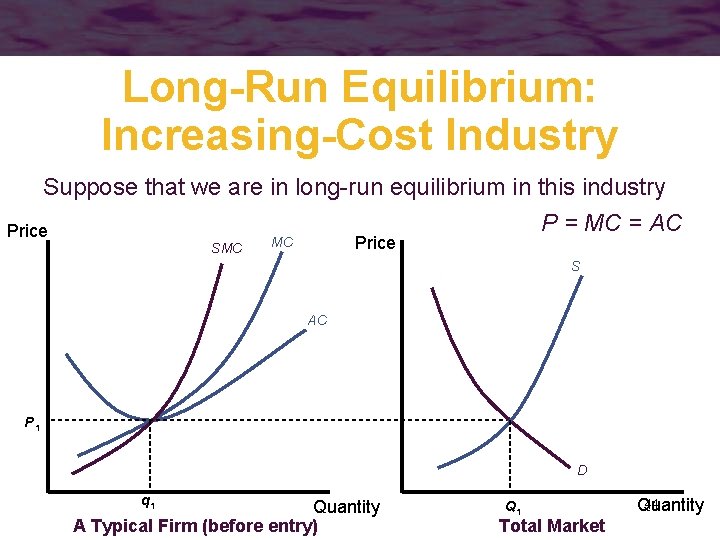
Long-Run Equilibrium: Increasing-Cost Industry Suppose that we are in long-run equilibrium in this industry P = MC = AC Price SMC Price MC S AC P 1 D q 1 Quantity A Typical Firm (before entry) Q 1 Total Market 44 Quantity
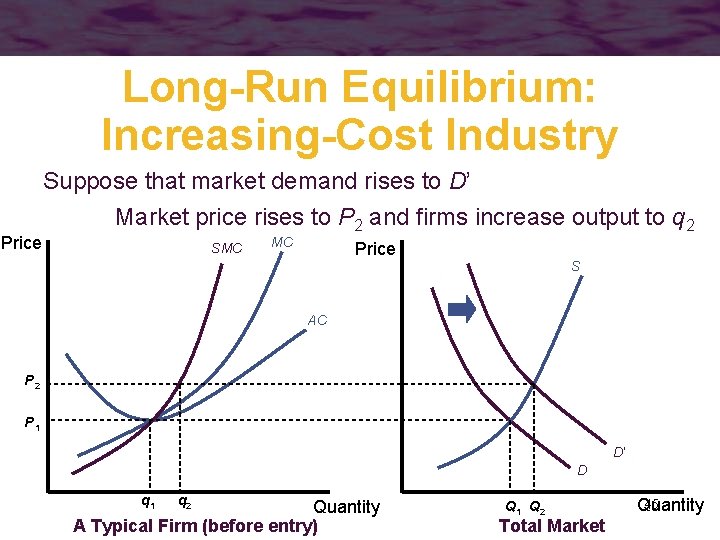
Long-Run Equilibrium: Increasing-Cost Industry Price Suppose that market demand rises to D’ Market price rises to P 2 and firms increase output to q 2 SMC MC Price S AC P 2 P 1 D’ D q 1 q 2 Quantity A Typical Firm (before entry) Q 1 Q 2 Total Market 45 Quantity
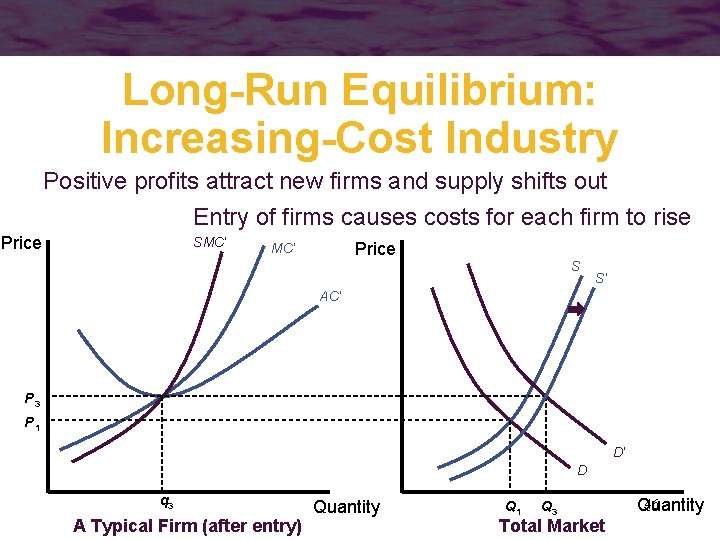
Long-Run Equilibrium: Increasing-Cost Industry Positive profits attract new firms and supply shifts out Entry of firms causes costs for each firm to rise Price SMC’ Price MC’ S S’ AC’ P 3 P 1 D’ D q 3 A Typical Firm (after entry) Quantity Q 1 Q 3 Total Market 46 Quantity
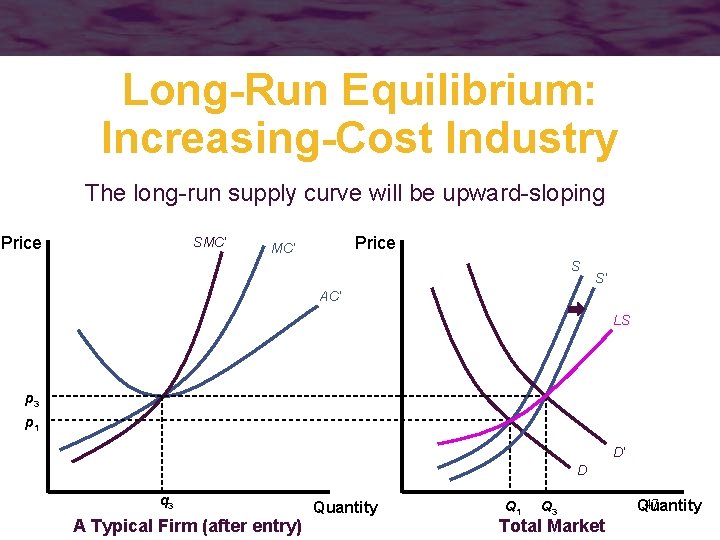
Long-Run Equilibrium: Increasing-Cost Industry The long-run supply curve will be upward-sloping Price SMC’ Price MC’ S S’ AC’ LS p 3 p 1 D’ D q 3 A Typical Firm (after entry) Quantity Q 1 Q 3 Total Market 47 Quantity
Long-Run Equilibrium: Decreasing-Cost Industry • The entry of new firms may cause the average costs of all firms to fall – new firms may attract a larger pool of trained labor – entry of new firms may provide a “critical mass” of industrialization • permits the development of more efficient transportation and communications networks 48
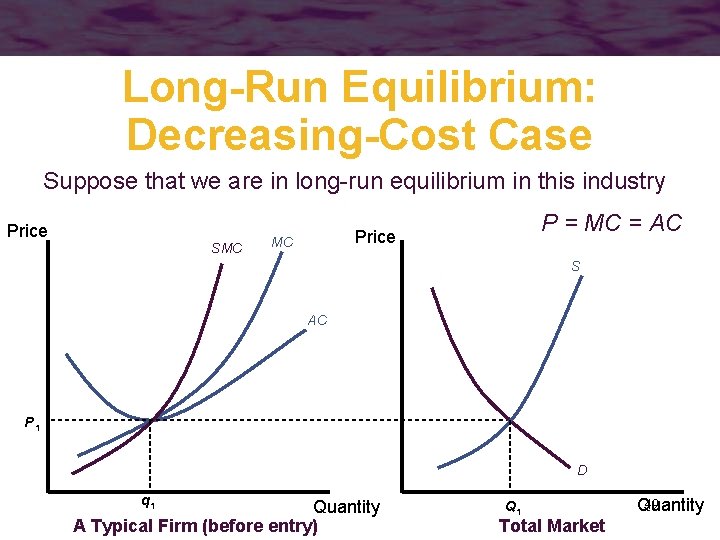
Long-Run Equilibrium: Decreasing-Cost Case Suppose that we are in long-run equilibrium in this industry Price SMC P = MC = AC Price MC S AC P 1 D q 1 Quantity A Typical Firm (before entry) Q 1 Total Market 49 Quantity
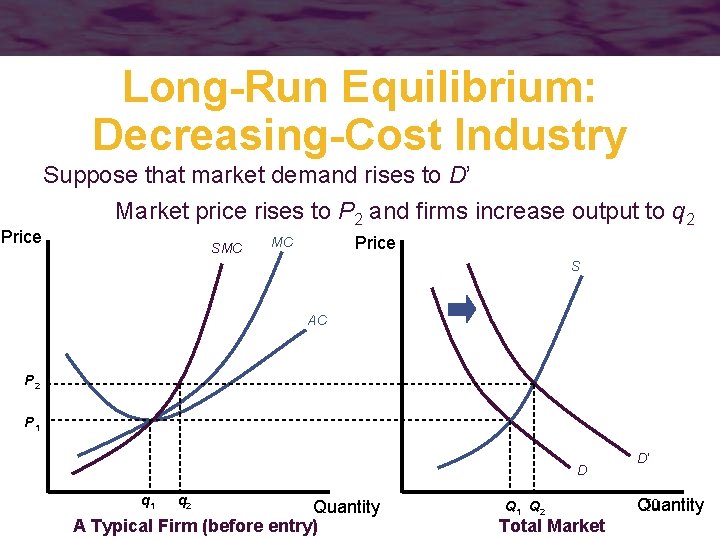
Long-Run Equilibrium: Decreasing-Cost Industry Price Suppose that market demand rises to D’ Market price rises to P 2 and firms increase output to q 2 SMC Price MC S AC P 2 P 1 D q 1 q 2 Quantity A Typical Firm (before entry) Q 1 Q 2 Total Market D’ 50 Quantity
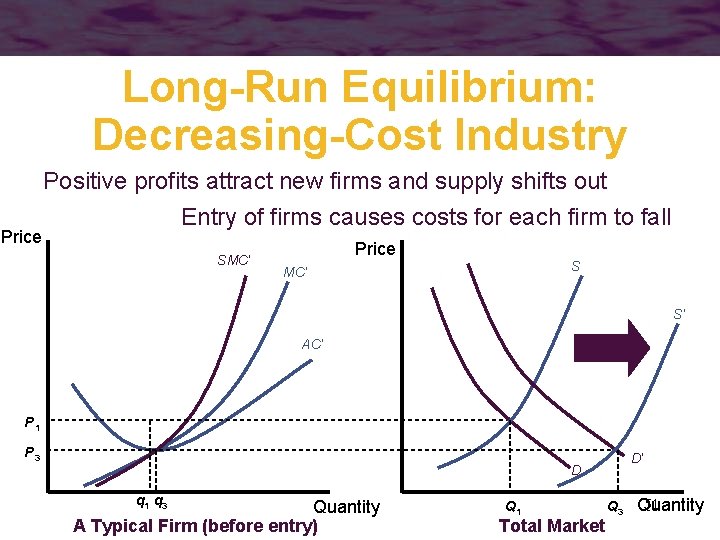
Long-Run Equilibrium: Decreasing-Cost Industry Price Positive profits attract new firms and supply shifts out Entry of firms causes costs for each firm to fall SMC’ Price S MC’ S’ AC’ P 1 P 3 D’ D q 1 q 3 Quantity A Typical Firm (before entry) Q 1 Total Market Q 3 51 Quantity
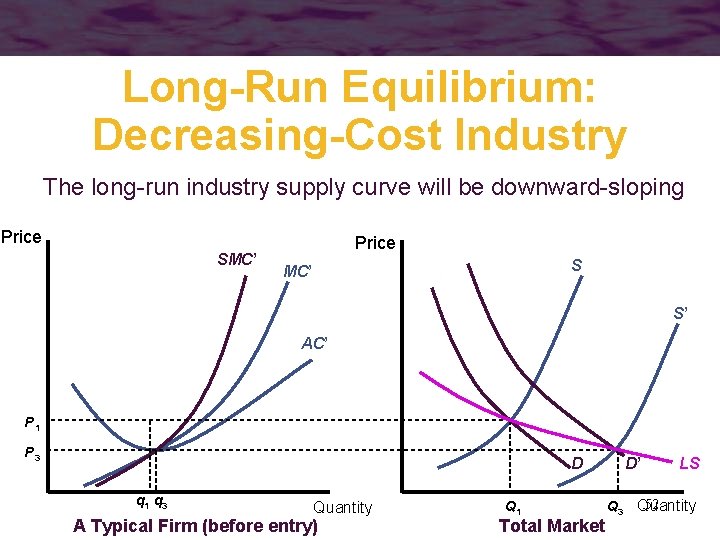
Long-Run Equilibrium: Decreasing-Cost Industry The long-run industry supply curve will be downward-sloping Price SMC’ Price S MC’ S’ AC’ P 1 P 3 D q 1 q 3 Quantity A Typical Firm (before entry) Q 1 Total Market D’ LS 52 Q 3 Quantity
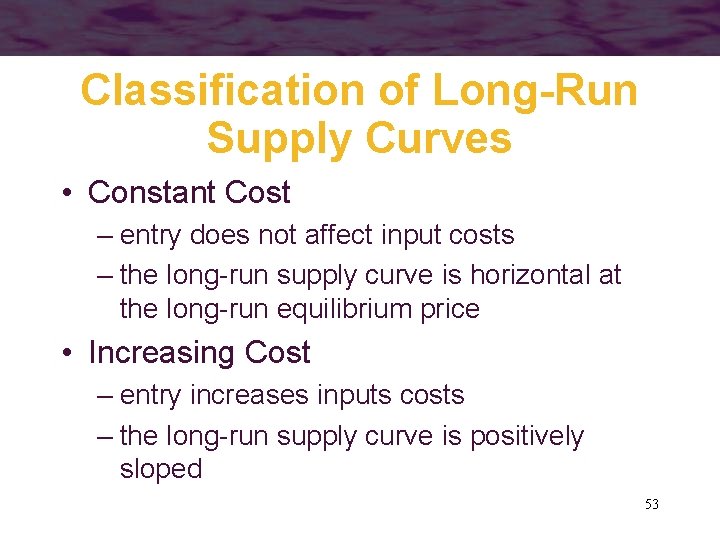
Classification of Long-Run Supply Curves • Constant Cost – entry does not affect input costs – the long-run supply curve is horizontal at the long-run equilibrium price • Increasing Cost – entry increases inputs costs – the long-run supply curve is positively sloped 53
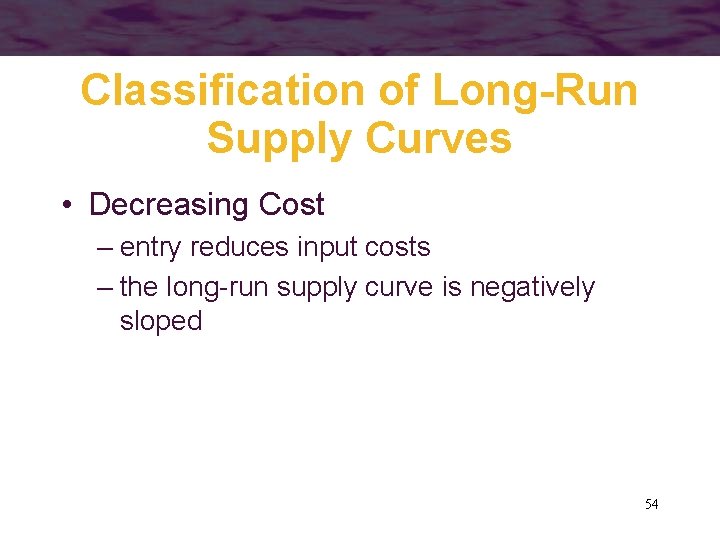
Classification of Long-Run Supply Curves • Decreasing Cost – entry reduces input costs – the long-run supply curve is negatively sloped 54
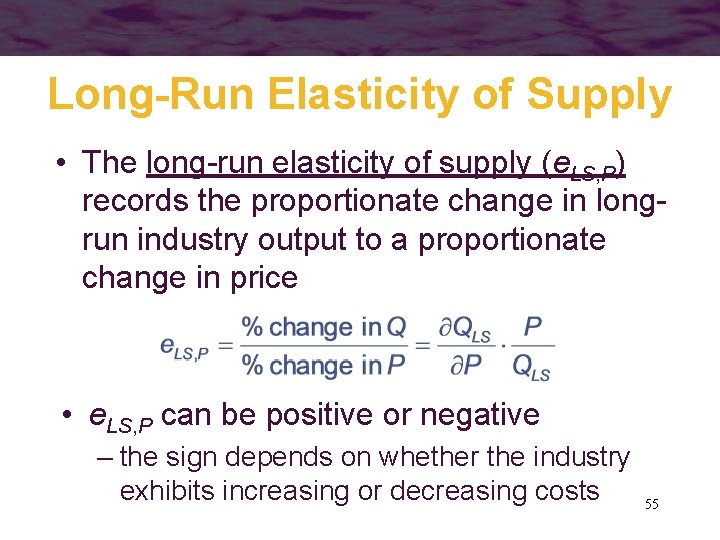
Long-Run Elasticity of Supply • The long-run elasticity of supply (e. LS, P) records the proportionate change in longrun industry output to a proportionate change in price • e. LS, P can be positive or negative – the sign depends on whether the industry exhibits increasing or decreasing costs 55

Ricardian Rent • Long-run producer surplus can be most easily illustrated with a situation first described by economist David Ricardo – assume that there are many parcels of land on which a particular crop may be grown • the land ranges from very fertile land (low costs of production) to very poor, dry land (high costs of production) 56
Ricardian Rent • At low prices only the best land is used • Higher prices lead to an increase in output through the use of higher-cost land – the long-run supply curve is upward-sloping because of the increased costs of using less fertile land 57
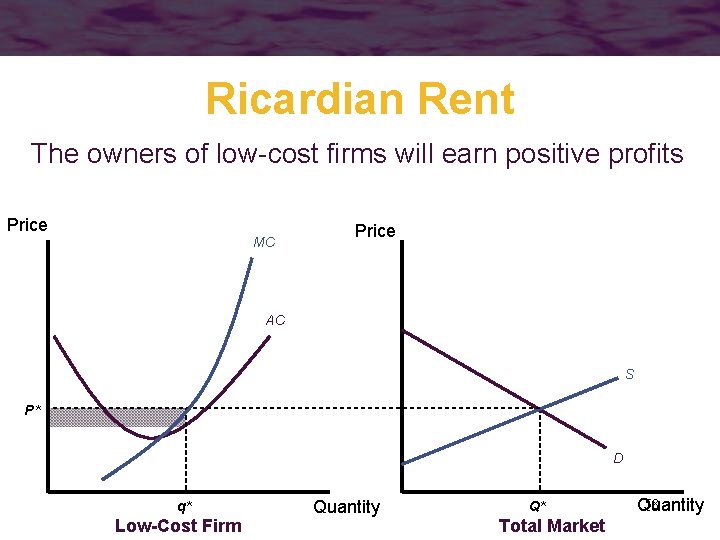
Ricardian Rent The owners of low-cost firms will earn positive profits Price MC Price AC S P* D q* Low-Cost Firm Quantity Q* Total Market 58 Quantity
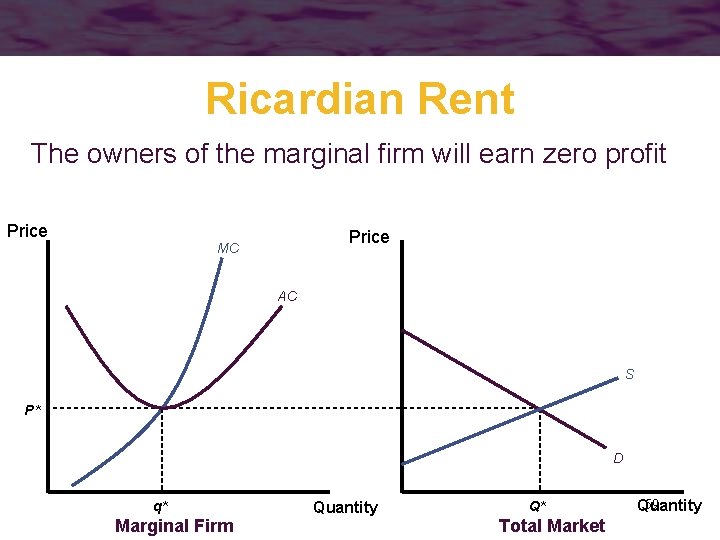
Ricardian Rent The owners of the marginal firm will earn zero profit Price MC AC S P* D q* Marginal Firm Quantity Q* Total Market 59 Quantity
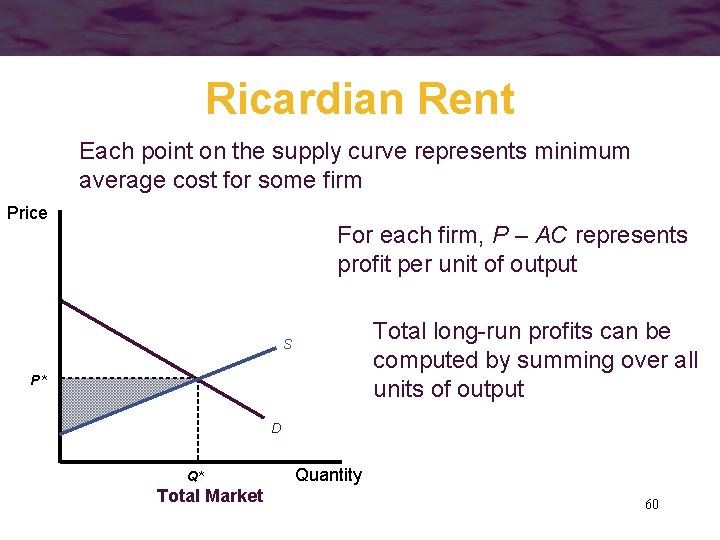
Ricardian Rent Each point on the supply curve represents minimum average cost for some firm Price For each firm, P – AC represents profit per unit of output Total long-run profits can be computed by summing over all units of output S P* D Q* Total Market Quantity 60
Ricardian Rent • The long-run profits for the low-cost firms will often be reflected in the prices of the unique resources owned by those firms – the more fertile the land is, the higher its price • Thus, profits are said to be capitalized inputs’ prices – reflect the present value of all future profits 61
Ricardian Rent • It is the scarcity of low-cost inputs that creates the possibility of Ricardian rent • In industries with upward-sloping longrun supply curves, increases in output not only raise firms’ costs but also generate factor rents for inputs 62
- Slides: 62