
Chapter 12 The Invertebrates 12 D Segmented Worms
Chapter 12: The Invertebrates
12 D: Segmented Worms- The Earthworm

Introduction Worms that have segments in their bodies (divided into small lined sections) belong to phylum Annelida. Segmented bodies is what differentiates them from other types of worms They all have long bodies, and the segments are mostly similar Examples: Earthworm, fireworms leeches, tubeworms, scale worms, sandworms,

The Earthworm: Body Structure 1. Epidermis: this is the outer skin lining Very thin layer of skin Exchanges gasses (oxygen and carbon dioxide) Secretes cuticle, a thin outer protective layer protecting from harmful parasites and substances

The Earthworm: Body Structure 2. Muscle Layer: there are 2 different layers under epidermis The first layer is arranged in circles around the worms body. This helps the worms to become long and thin Circular muscles The second layer is arranged along the worms body (the length) from head to tail. This helps the worm to be short and wide Longitudinal muscles 3. Setae: tiny bristles on the each of its segments anchor into the ground to help it to move as muscles contract
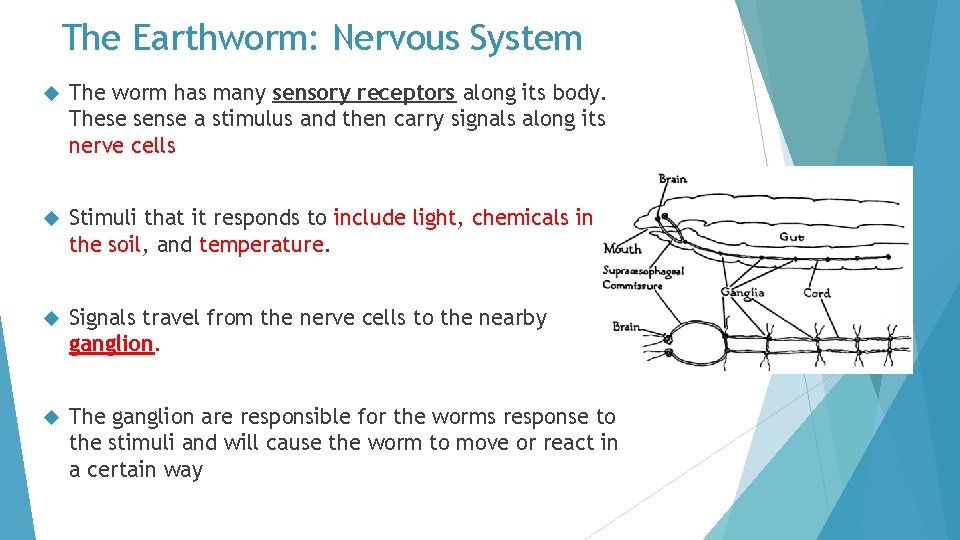
The Earthworm: Nervous System The worm has many sensory receptors along its body. These sense a stimulus and then carry signals along its nerve cells Stimuli that it responds to include light, chemicals in the soil, and temperature. Signals travel from the nerve cells to the nearby ganglion. The ganglion are responsible for the worms response to the stimuli and will cause the worm to move or react in a certain way
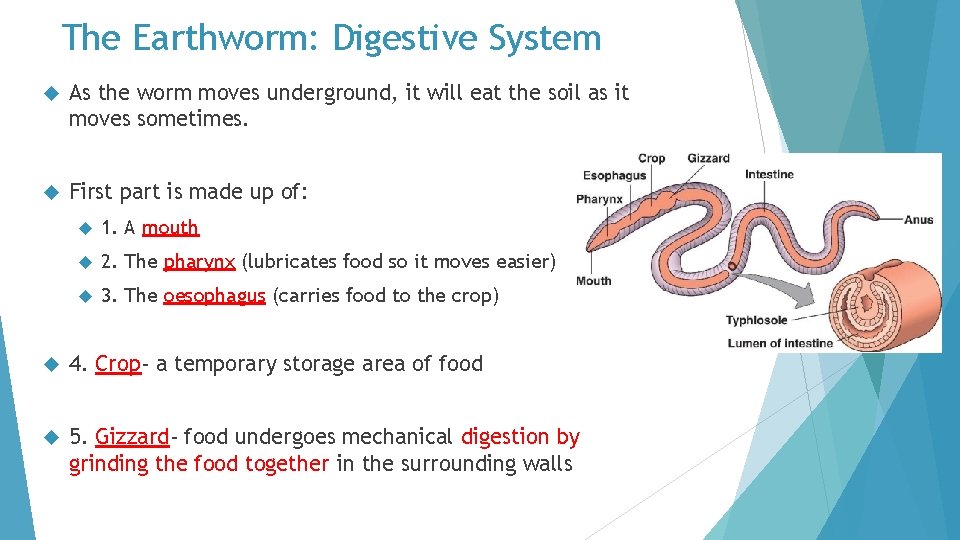
The Earthworm: Digestive System As the worm moves underground, it will eat the soil as it moves sometimes. First part is made up of: 1. A mouth 2. The pharynx (lubricates food so it moves easier) 3. The oesophagus (carries food to the crop) 4. Crop- a temporary storage area of food 5. Gizzard- food undergoes mechanical digestion by grinding the food together in the surrounding walls
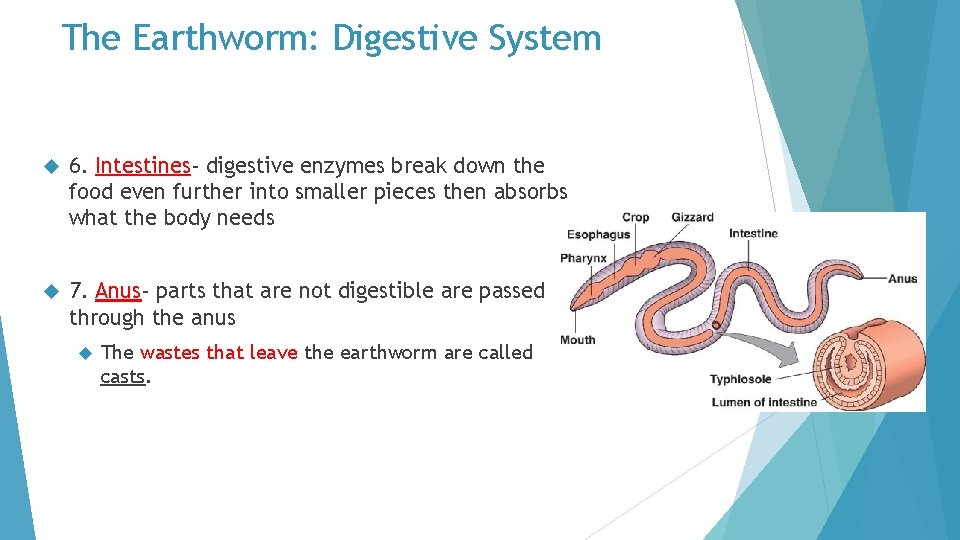
The Earthworm: Digestive System 6. Intestines- digestive enzymes break down the food even further into smaller pieces then absorbs what the body needs 7. Anus- parts that are not digestible are passed through the anus The wastes that leave the earthworm are called casts.
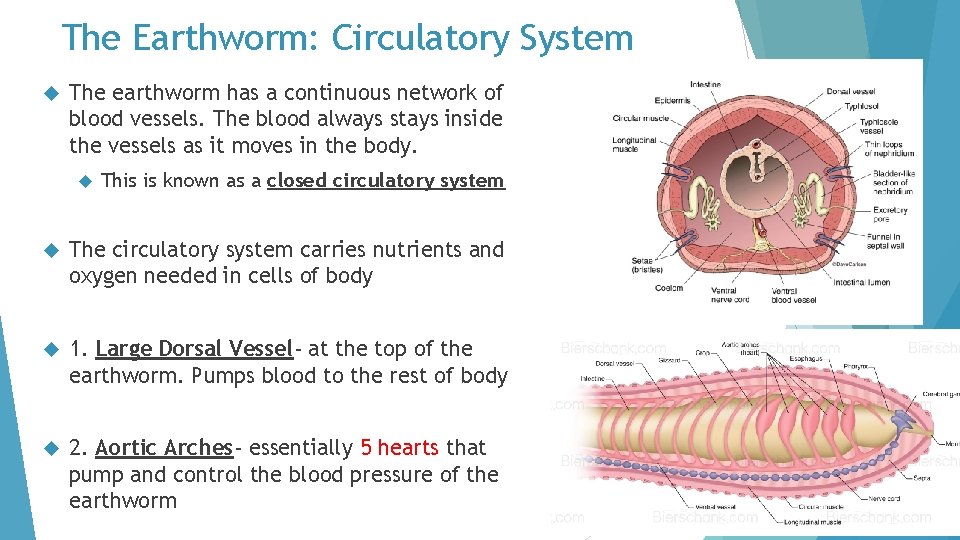
The Earthworm: Circulatory System The earthworm has a continuous network of blood vessels. The blood always stays inside the vessels as it moves in the body. This is known as a closed circulatory system The circulatory system carries nutrients and oxygen needed in cells of body 1. Large Dorsal Vessel- at the top of the earthworm. Pumps blood to the rest of body 2. Aortic Arches- essentially 5 hearts that pump and control the blood pressure of the earthworm
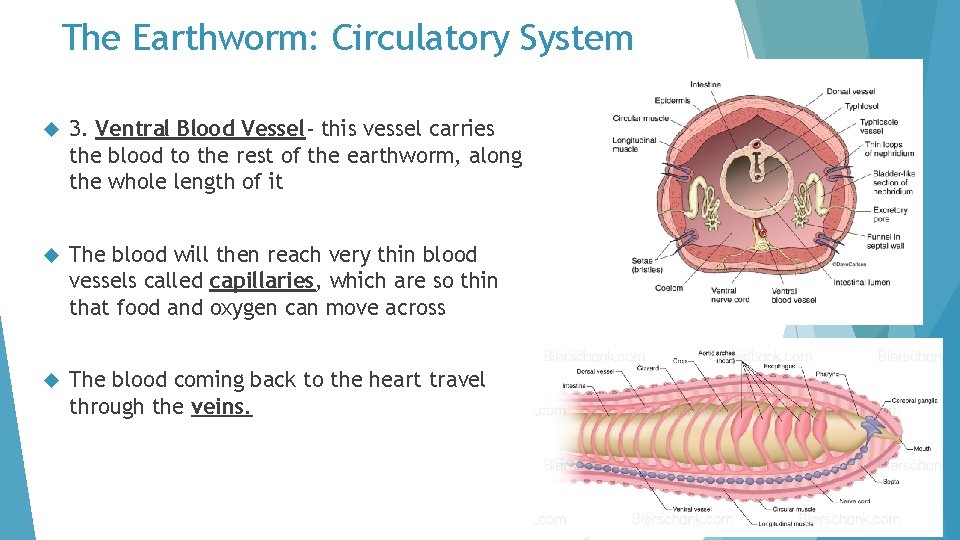
The Earthworm: Circulatory System 3. Ventral Blood Vessel- this vessel carries the blood to the rest of the earthworm, along the whole length of it The blood will then reach very thin blood vessels called capillaries, which are so thin that food and oxygen can move across The blood coming back to the heart travel through the veins.
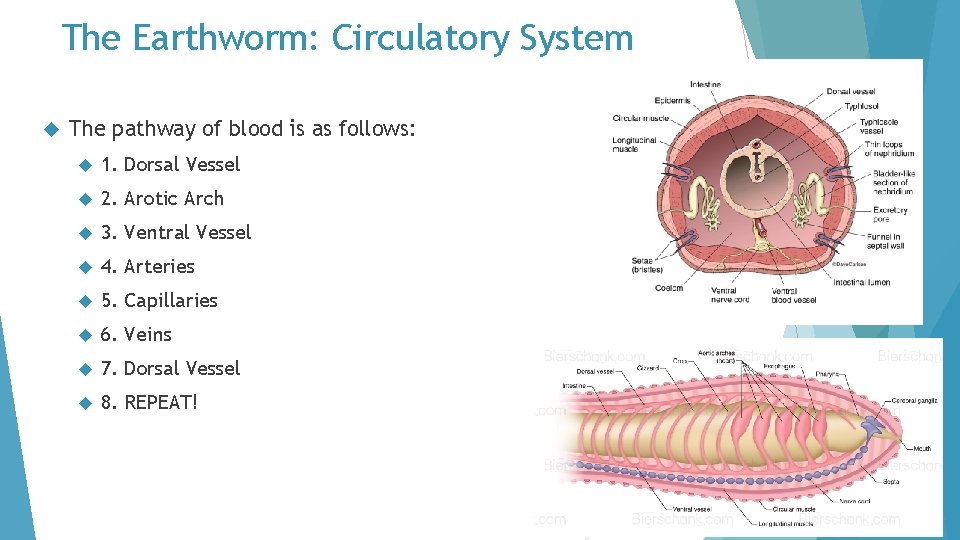
The Earthworm: Circulatory System The pathway of blood is as follows: 1. Dorsal Vessel 2. Arotic Arch 3. Ventral Vessel 4. Arteries 5. Capillaries 6. Veins 7. Dorsal Vessel 8. REPEAT!
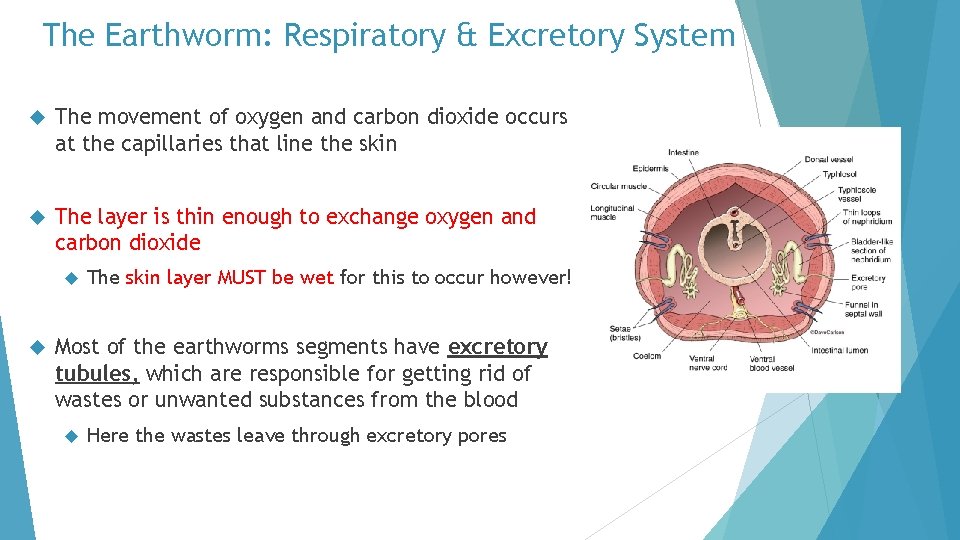
The Earthworm: Respiratory & Excretory System The movement of oxygen and carbon dioxide occurs at the capillaries that line the skin The layer is thin enough to exchange oxygen and carbon dioxide The skin layer MUST be wet for this to occur however! Most of the earthworms segments have excretory tubules, which are responsible for getting rid of wastes or unwanted substances from the blood Here the wastes leave through excretory pores
The Earthworm: Reproductive System Earthworms usually reproduce sexually Like the planarian, it has both male and female reproductive parts This is known as being a hermaphrodite Although it is not common, they can also reproduce asexually Like planarians, when they are cut they can regenerate themselves!
- Slides: 13