
Chapter 12 The International Context Only to be

Chapter 12 The International Context Only to be used with Strategy : An International Perspective 5 th edn by Bob de Wit © 2014, Cengage Learning EMEA, ISBN 97814082683
Contents Introduction The issue of international configuration The paradox of globalization and localization Perspectives on the international context Managing the paradox of globalization and localization • The international context in international perspective • Readings and Case 12 • • • Only to be used with Strategy : An International Perspective 5 th edn by Bob de Wit © 2014, Cengage Learning EMEA, ISBN 97814082683
Introduction • How important are the international differences for firms operating across borders? • To what extent do events in one country have an impact on what happens in other countries? • Countries might be quite different yet developments in one nation might influence developments elsewhere • Globalization occurs where there is a development towards lower international variety and tighter international linkages on a worldwide scale. Only to be used with Strategy : An International Perspective 5 th edn by Bob de Wit © 2014, Cengage Learning EMEA, ISBN 97814082683
The issue of international configuration Dimensions of globalization • Worldwide scope – ‘global’ can be used as a geographic term, globalization is the process of international expansion on a worldwide scale • Worldwide similarity – ‘global’ can refer to homogeneity around the world, globalization is the process of declining international variety • Worldwide integration – ‘global’ can refer to the world as one tightly linked system, globalization is the process of increasing international interconnectedness Only to be used with Strategy : An International Perspective 5 th edn by Bob de Wit © 2014, Cengage Learning EMEA, ISBN 97814082683
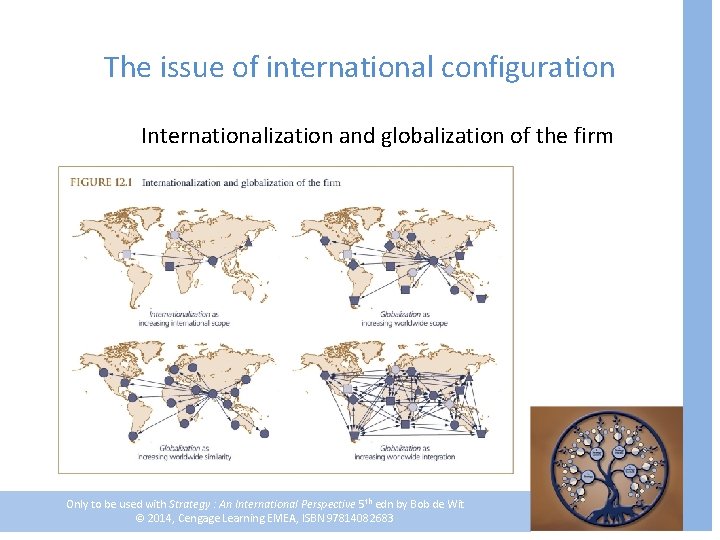
The issue of international configuration Internationalization and globalization of the firm Only to be used with Strategy : An International Perspective 5 th edn by Bob de Wit © 2014, Cengage Learning EMEA, ISBN 97814082683
The issue of international configuration Levels of globalization • Globalization of companies – micro level – extent to which firms have a global strategy, structure, culture, workforce, management team and resource base. The globalization of one product or activity does not necessarily entail the globalization of all others. • Globalization of businesses – meso level – globalizing markets is about the growing similarity of worldwide customer demand worldwide product flow, globalization of industries is about the emergence of a set of producers that compete with one another on a worldwide scale. • Globalization of economies – macro level – world’s economies are experiencing a convergence trend. Only to be used with Strategy : An International Perspective 5 th edn by Bob de Wit © 2014, Cengage Learning EMEA, ISBN 97814082683
The issue of international configuration International composition • An international firm operates in two or more countries • When a firm starts up value-adding activities in another country this process is internationalization • International scope – geographic spectrum covered by the firm • International distribution – how the firm has distributed its value-adding activities across the countries selected Only to be used with Strategy : An International Perspective 5 th edn by Bob de Wit © 2014, Cengage Learning EMEA, ISBN 97814082683
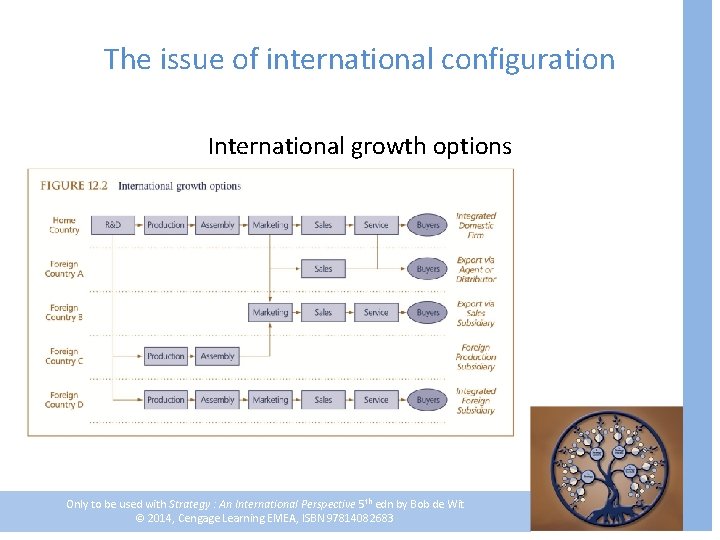
The issue of international configuration International growth options Only to be used with Strategy : An International Perspective 5 th edn by Bob de Wit © 2014, Cengage Learning EMEA, ISBN 97814082683
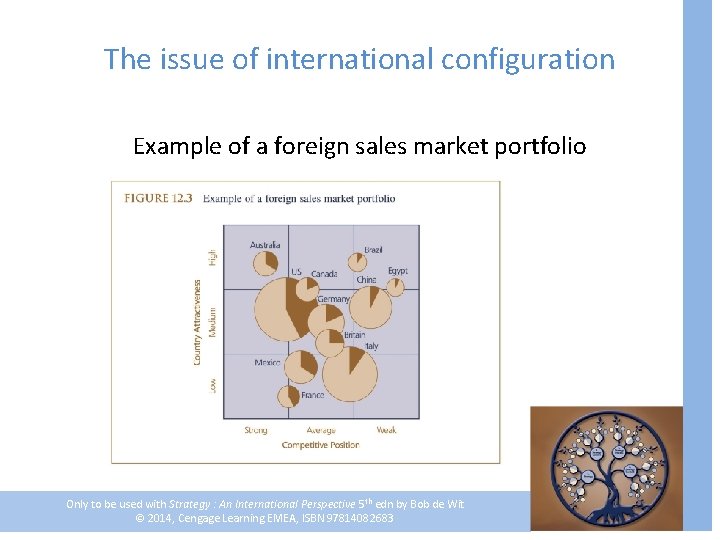
The issue of international configuration Example of a foreign sales market portfolio Only to be used with Strategy : An International Perspective 5 th edn by Bob de Wit © 2014, Cengage Learning EMEA, ISBN 97814082683
The issue of international configuration International management • Internationalization only makes sense if enough crossborder synergies can be reaped to offset the extra cost of foreignness and distance • Three most important integration mechanisms: § § § Standardization – do the same thing in each country Coordination – align varied activities in different countries by cross-border coordination Centralization – activities within the firm can be integrated at one central location Only to be used with Strategy : An International Perspective 5 th edn by Bob de Wit © 2014, Cengage Learning EMEA, ISBN 97814082683
The issue of international configuration • Four generic organizational models: • Decentralized federation – firm is organized along geographic lines, with each country subsidiary largely self-sufficient and autonomous – multinational Coordinated federation – firm is organized along geographic lines, but the country subsidiaries have a closer relationship with the international headquarters in the home country Centralized hub – national units are relatively unimportant as all main activities are carried out in the home country Integrated network – country subsidiaries have a close relationship with international headquarters but also a close relationship with each other • • • Only to be used with Strategy : An International Perspective 5 th edn by Bob de Wit © 2014, Cengage Learning EMEA, ISBN 97814082683
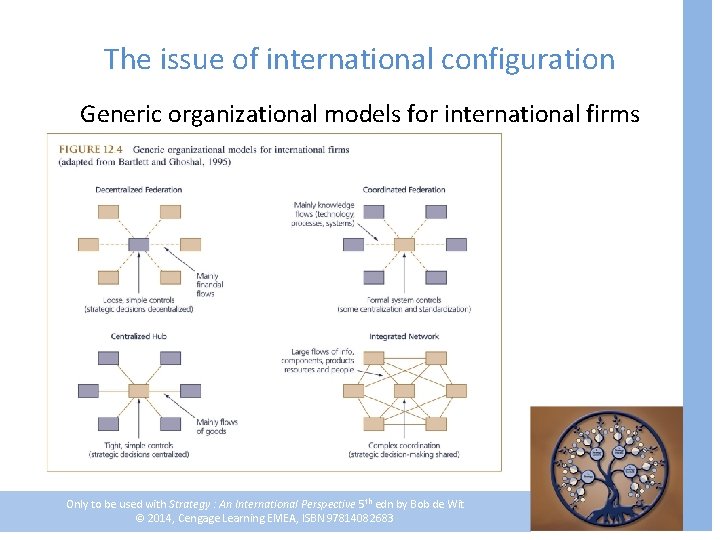
The issue of international configuration Generic organizational models for international firms Only to be used with Strategy : An International Perspective 5 th edn by Bob de Wit © 2014, Cengage Learning EMEA, ISBN 97814082683
The paradox of globalization and localization • Tension between international uniformity and meeting local demands • International standardization is a means for achieving cross-border synergies • Synergies can be achieved by leveraging resources, integrating activities and aligning product offerings across two or more countries Only to be used with Strategy : An International Perspective 5 th edn by Bob de Wit © 2014, Cengage Learning EMEA, ISBN 97814082683
The paradox of globalization and localization The demand for global synergy • Synergy by aligning positions – align market positions in the countries in which the firm operates § Dealing with cross-border customers § Dealing with cross-border competition • Synergy by integrating activities – integrating the value-creating processes across borders to realize economies of scale and take advantage of specific competitive advantages of each nation § Reaping scale advantages § Reaping location advantages • Synergy by leveraging resources – sharing resources across national markets § Achieving resource reallocation § Achieving resource replication Only to be used with Strategy : An International Perspective 5 th edn by Bob de Wit © 2014, Cengage Learning EMEA, ISBN 97814082683
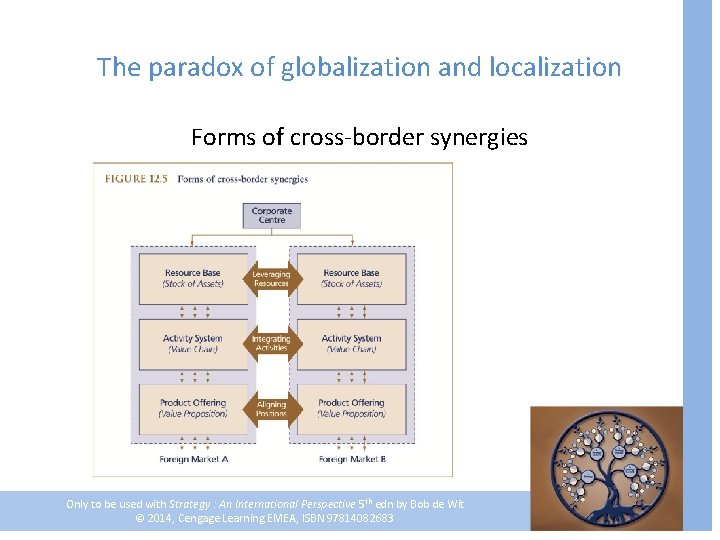
The paradox of globalization and localization Forms of cross-border synergies Only to be used with Strategy : An International Perspective 5 th edn by Bob de Wit © 2014, Cengage Learning EMEA, ISBN 97814082683
The paradox of globalization and localization The demand for local responsiveness • Companies must remain attuned to the specific demands of each national market • The most important differences between countries include: § § § § Differences in market structure Differences in customer needs Differences in buying behaviour Differences in substitutes Differences in distribution channels Differences in media structure Differences in supply structure Differences in government regulations Read carefully Exhibit 12. 1 Nespresso in China: Where else? Only to be used with Strategy : An International Perspective 5 th edn by Bob de Wit © 2014, Cengage Learning EMEA, ISBN 97814082683
Perspectives on the international context The global convergence perspective Global convergence is driven by the ease, low cost and frequency of international communication, transport and travel. Technology has created a ‘global village’ in which goods, services and ideas are easily exchanged. • Growing similarity between countries offers opportunities for leveraging resources and sharing activities across borders. • Suppliers, buyers and competitors can operate as if there are no borders. • Demands of standardization, centralization and coordination require a global firm with a strong centre responsible for global strategy. Read carefully Exhibit 12. 2 Qoros: Driving a global orchestra • Only to be used with Strategy : An International Perspective 5 th edn by Bob de Wit © 2014, Cengage Learning EMEA, ISBN 97814082683
Perspectives on the international context The international diversity perspective • • It is important to recognize in which respects countries remain different, e. g. they may be drinking the same soft drinks but in different places, times, circumstances and for different reasons. Cultural norms and values that influence its purchase and use remain diverse across countries Differences remain in languages, political systems, legal systems, fiscal regimes, educational systems and technological infrastructure International diversity and political obstacles will limit the extent to which nations can become fully integrated International diversity creates opportunities for different innovations Read carefully Exhibit 12. 3 Walking down Sesame Street in Afghanistan Only to be used with Strategy : An International Perspective 5 th edn by Bob de Wit © 2014, Cengage Learning EMEA, ISBN 97814082683

Perspectives on the international context • The term ‘glocalization’ suggests a synthesis – going global while adapting to local conditions e. g. Mc. Donald’s introduced Veggie Mc. Nuggets in India and Mc. Lobster in Canada • Balancing – trade-off between global synergy and local responsiveness • Navigating • Embracing – differences can be exploited • Resolving – franchise Only to be used with Strategy : An International Perspective 5 th edn by Bob de Wit © 2014, Cengage Learning EMEA, ISBN 97814082683
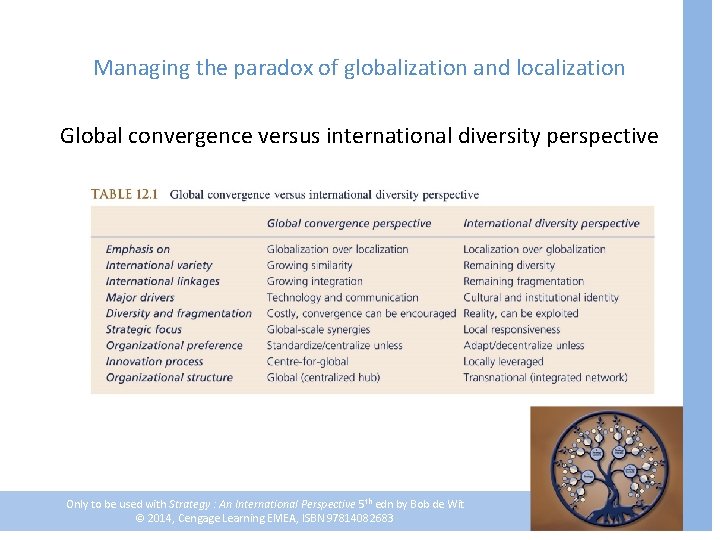
Managing the paradox of globalization and localization Global convergence versus international diversity perspective Only to be used with Strategy : An International Perspective 5 th edn by Bob de Wit © 2014, Cengage Learning EMEA, ISBN 97814082683
Perspectives on the international context A short history of internationalization • Transborder trade has been carried out since 2500 BC. • The first multinational enterprise was the English East Asian Company or the Dutch East Indian Company from beginning of the 17 th century • After WWII foreign direct investment (FDI) accelerated and outpaced the growth of international trade Only to be used with Strategy : An International Perspective 5 th edn by Bob de Wit © 2014, Cengage Learning EMEA, ISBN 97814082683

Perspectives on the international context Firms as exploiters of market imperfections • • • Traditional trade theory was based on the assumption that factor endowments for production, capital and labor were of the same quality everywhere in the world. Most FDI theories focus on the opposite. Mass production is one of the fundamental forms of market imperfections. Mass production reached its peak in the early 1960 s. From the mid 1960 s the economic relationship between the US and Western Europe changed as Western European firms had mastered the mass production technologies invented in the US Only to be used with Strategy : An International Perspective 5 th edn by Bob de Wit © 2014, Cengage Learning EMEA, ISBN 97814082683
Perspectives on the international context Firms as seekers of host country advantages • Natural resources seeking FDI – desired resources are not available in the firm’s home country • Market seeking FDI – location advantages may shift over time • Efficiency seeking FDI – efficiency, a product of the quality of labor and capital, may change over time • Strategic asset seeking FDI – assets of foreign firms are secured by new plants and acquisitions or joint ventures Only to be used with Strategy : An International Perspective 5 th edn by Bob de Wit © 2014, Cengage Learning EMEA, ISBN 97814082683
Perspectives on the international context Locational shift of production • From the 1960 s three developments turned FDI in laborintensive production industries into losses: • • • Liberalization of world trade initiated by the IMF, the world bank and GATT Rise of FDI in developing countries – countries changed their policy from import-substitution to export orientation, offered cheap labor and created free trade zones Better communication, transport and new process technology enabled companies to maximize cost efficiency while remaining in control of the supply chain Only to be used with Strategy : An International Perspective 5 th edn by Bob de Wit © 2014, Cengage Learning EMEA, ISBN 97814082683
Perspectives on the international context Firms as internalizers • • In time most labor intensive production will be concentrated in countries with cheap labor whereas R&D and higher technological production and supporting services industries will be concentrated in countries with superior levels of education, income and infrastructure When external conditions are equal for all, international companies that are best in internalizing opportunities will have a competitive advantage Structural changes • • From the mid 1980 s new technology made it possible to offset labor costs with a high level of productivity Flexible automation emerged. Some firms started relocating production back to their home countries, high R&D costs forced companies to concentrate on the developed markets of the US, EU and Japan. Technological changes meant that internalization of non-transferable information no longer ensured competitive advantage. Only to be used with Strategy : An International Perspective 5 th edn by Bob de Wit © 2014, Cengage Learning EMEA, ISBN 97814082683
Perspectives on the international context FDI from developing countries • • • New economic powerhouses attracted FDI because of cheap labor The rising middle class in e. g. China became an interesting market for Western consumer products especially after the 2007/2008 financial crisis Regions within China attract cheap labor and higher-end production geared for both export and their own home market. Microsoft sells more Office programs in Mandarin than in English, China has more Ph. D students than the US, China is ahead in some new technological innovations FDI outflows from developing countries • • • The above changes resulted in the growing number of internationalizing firms from developing countries Some companies from these developing countries have risen quickly on the FT Global 500 list MNEs from these countries engage in higher end commercial activities Born Globals • New ventures starting out as globally active operations from the beginning e. g. Facebook, Twitter and Linked. In. Only to be used with Strategy : An International Perspective 5 th edn by Bob de Wit © 2014, Cengage Learning EMEA, ISBN 97814082683
Perspectives on the international context The future of internationalization • • Level of nationalism – some countries believe that foreign values, norms, habits and behaviors are being imposed and are undermining national culture. In other countries the benefits of globalization are more widely accepted. Size of country – smaller countries are more exposed to the international context than larger countries. Smaller countries commonly export more of their GDP and import more as well. Companies in larger countries normally grow to a significant size at home achieving some economies of scale and establishing a domestically-oriented management style. Strategists from smaller countries will favor the view that international diversity will remain. Strategists from larger countries will tend to emphasize the growing similarities and seek international standardization. Only to be used with Strategy : An International Perspective 5 th edn by Bob de Wit © 2014, Cengage Learning EMEA, ISBN 97814082683
- Slides: 27