
Chapter 12 The European Central Bank and Monetary
Chapter 12 The European Central Bank and Monetary Policy © Dünhaupt, Dullien, Goodwin, Harris, Nelson, Roach, Torras
Chapter outline 1. 2. 3. 4. 5. The European Central Bank Monetary Policy Theory of Interest Rates, Money, and Aggregate Expenditure Monetary Policies in Practice Theory of Money, Prices, and Inflation Chapter 12 2
Learning goals § After today‘s lecture, you will be able to: – Understand the basic workings of central banks. – Describe the tools the ECB can use to carry out monetary policy. – Explain how monetary policy is expected to affect investment and aggregate demand. – Explain the European monetary policy experience of the 1999 -2015 period. – Become familiar with the notions of “liquidity trap” and “credit rationing. ” – Understand the quantity equation, the quantity theory of money, and monetarism. – Describe possible sources of inflation. – Understand the controversy over rules versus activism in monetary policy. Chapter 12 3
The European Central Bank
![The European Central Bank in Frankfurt Chapter 12 5 (http: //creativecommons. org/licenses/by/2. 0)], via](http://slidetodoc.com/presentation_image_h2/79dbafa65ce1ac8f8ddb0c464d41e15d/image-5.jpg "The European Central Bank in Frankfurt Chapter 12 5 (http: //creativecommons. org/licenses/by/2. 0)], via")
The European Central Bank in Frankfurt Chapter 12 5 (http: //creativecommons. org/licenses/by/2. 0)], via Wikimedia Commons By http: //www. flickr. com/photos/maveric 2003/ - Eric Chan [CC BY 2. 0
![ECB president Mario Draghi Chapter 12 6 (http: //creativecommons. org/licenses/by-sa/2. 0)], via Wikimedia Commons](http://slidetodoc.com/presentation_image_h2/79dbafa65ce1ac8f8ddb0c464d41e15d/image-6.jpg "ECB president Mario Draghi Chapter 12 6 (http: //creativecommons. org/licenses/by-sa/2. 0)], via Wikimedia Commons")
ECB president Mario Draghi Chapter 12 6 (http: //creativecommons. org/licenses/by-sa/2. 0)], via Wikimedia Commons By World Economic Forum (Flickr: Special Address: Mario Draghi) [CC BY-SA 2. 0
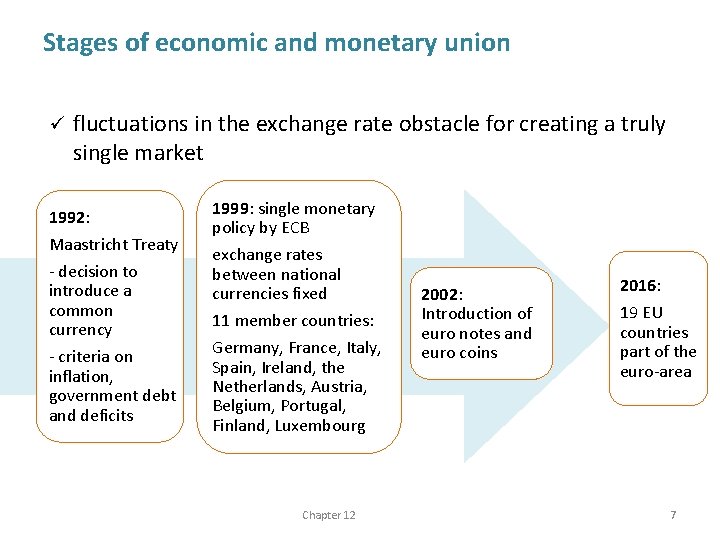
Stages of economic and monetary union ü fluctuations in the exchange rate obstacle for creating a truly single market 1992: Maastricht Treaty - decision to introduce a common currency - criteria on inflation, government debt and deficits 1999: single monetary policy by ECB exchange rates between national currencies fixed 11 member countries: Germany, France, Italy, Spain, Ireland, the Netherlands, Austria, Belgium, Portugal, Finland, Luxembourg Chapter 12 2002: Introduction of euro notes and euro coins 2016: 19 EU countries part of the euro-area 7
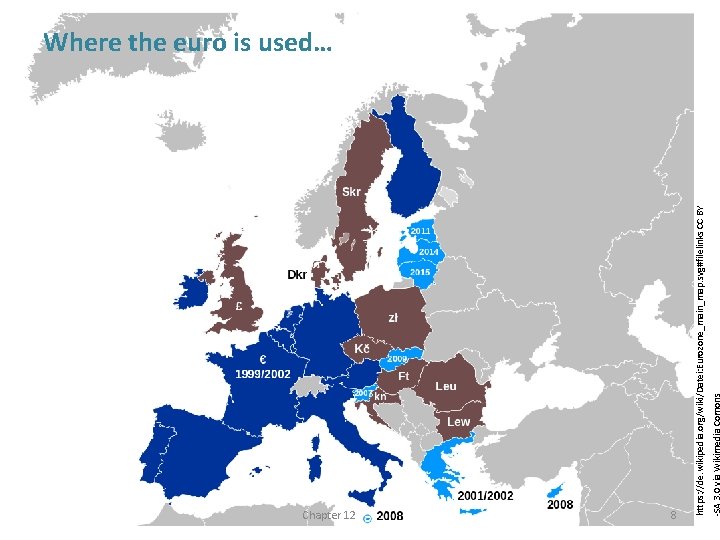
Chapter 12 8 https: //de. wikipedia. org/wiki/Datei: Eurozone_main_map. svg#filelinks CC BY Where the euro is used…
The ECB has been given a primary mandate by the European Treaties § “maintain price stability” § “[w]ithout prejudice to the objective of price stability, the [ECB] shall support the general economic policies in the Union” § “price stability” : annual consumer price inflation “of below, but close to 2 percent” § focus primarily on price stability, and if this goal is not put into jeopardy, to support other goals such as stimulating employment and economic growth Chapter 12 9
The ECB’s mandate is very different from that of other central banks United States Federal Reserve, for example, has a broader mandate: § It is supposed to aim at “maximum employment, stable prices, and moderate long-term interest rates” Ø sometimes criticized for prioritizing price stabilization above the other goals Chapter 12 10
The ECB is independent § completely free from influence of national governments or European institutions § independence guaranteed by the European treaties, which can only be changed by unanimous vote of all 28 EU members § prohibited to give loans to governments or to finance governments’ budget deficits Chapter 12 11
The role of national central banks § implement decisions of the ECB § deal with national commercial banks § deliver cash § inform decision-making level in the ECB about economic and financial situation in member states § Ø vote in interest rate decisions of the ECB set-up of national centrals banks and ECB is called Eurosystem Chapter 12 12
Monetary Policy
How the ECB influences the money market interest rate influence corporations’ and households’ price-setting behavior indirectly § main instrument: main refinancing rate § – the interest rate at which commercial banks can borrow funds from the ECB Chapter 12 14
If inflation picks up… the ECB increases the interest rate § commercial banks have to pay more for the funds they can get at the ECB § – commercial banks tighten their credit supply – increase the interest rates they charge to their customers Ø less credit creation compared to a situation of unchanged interest rates Chapter 12 15
If inflation is too low… …because the economy is not growing strongly enough and corporations cannot increase prices… § the ECB cuts interest rates – commercial banks can get funds more cheaply – they will provide more and cheaper loans to their customers – customers spend more on structures, dwellings, machines or new consumer goods § the ECB cannot force banks to lend out more or corporations and households to borrow Chapter 12 16
The ECB’s Governing Council takes decisions about monetary policy tools, including interest rates § consists of 6 members of the ECB’s Executive Board and (currently 19) heads of national central banks § – members of the Executive Board have permanent voting rights – voting rights of the heads of the national central banks rotate • at any given moment, 15 of them have the right to vote meets every two weeks on Thursday § every six weeks, it decides on changes in its monetary policy § Chapter 12 17
The main refinancing rate interest rate at which the ECB auctions off liquidity to commercial banks in its weekly main refinancing operations § commercial banks provide the ECB with some collateral § the ECB lends to the banks a certain share of the collateral’s value for usually one week § commercial banks either hold these funds as reserves at the ECB, use it to make payments to other banks or change them into cash, or lend the funds to other commercial banks § Chapter 12 18
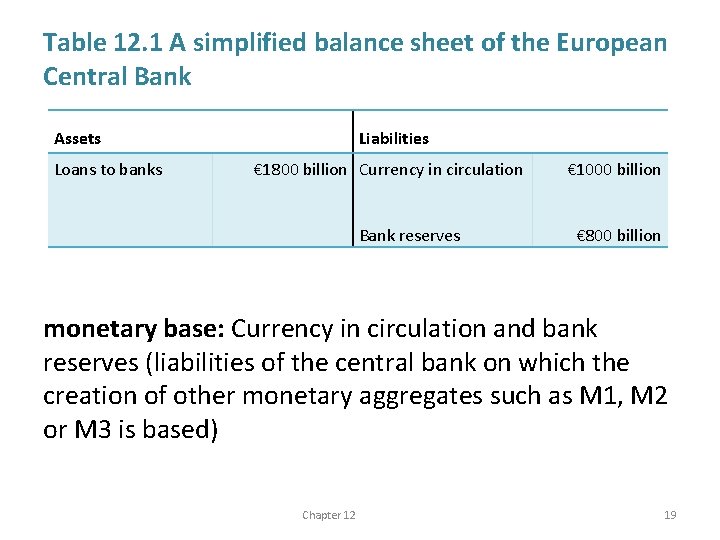
Table 12. 1 A simplified balance sheet of the European Central Bank Assets Loans to banks Liabilities € 1800 billion Currency in circulation Bank reserves € 1000 billion € 800 billion monetary base: Currency in circulation and bank reserves (liabilities of the central bank on which the creation of other monetary aggregates such as M 1, M 2 or M 3 is based) Chapter 12 19
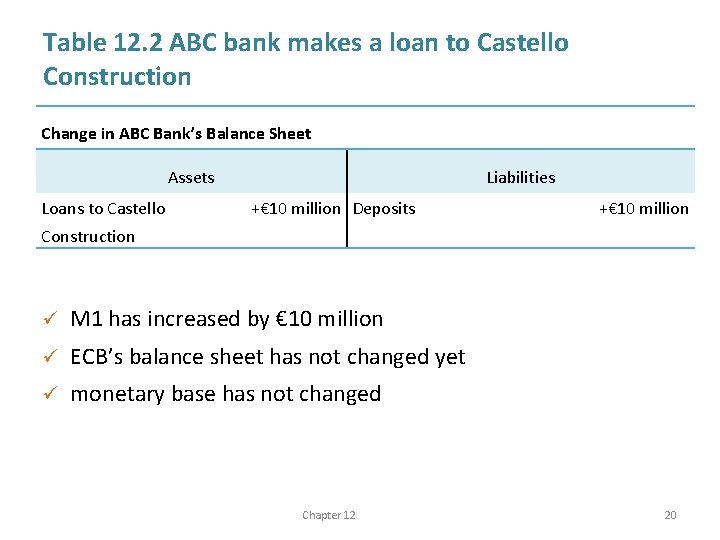
Table 12. 2 ABC bank makes a loan to Castello Construction Change in ABC Bank’s Balance Sheet Assets Loans to Castello Liabilities +€ 10 million Deposits +€ 10 million Construction ü M 1 has increased by € 10 million ü ECB’s balance sheet has not changed yet ü monetary base has not changed Chapter 12 20
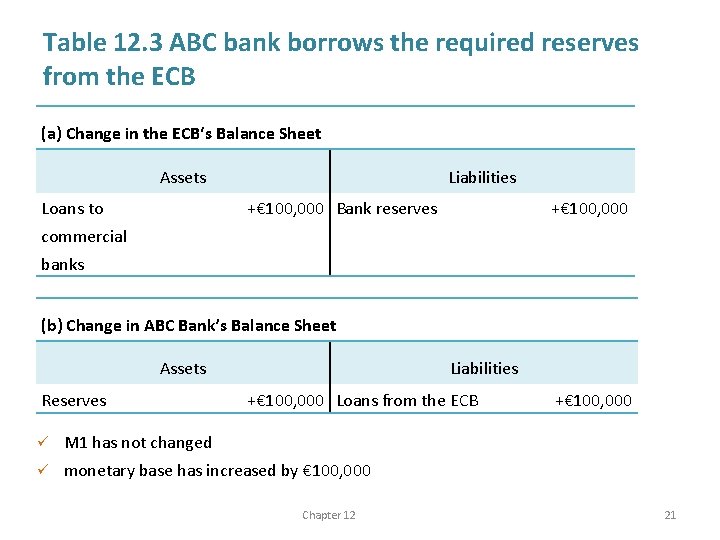
Table 12. 3 ABC bank borrows the required reserves from the ECB (a) Change in the ECB‘s Balance Sheet Assets Loans to Liabilities +€ 100, 000 Bank reserves +€ 100, 000 commercial banks (b) Change in ABC Bank’s Balance Sheet Assets Reserves Liabilities +€ 100, 000 Loans from the ECB ü M 1 has not changed ü monetary base has increased by € 100, 000 Chapter 12 +€ 100, 000 21
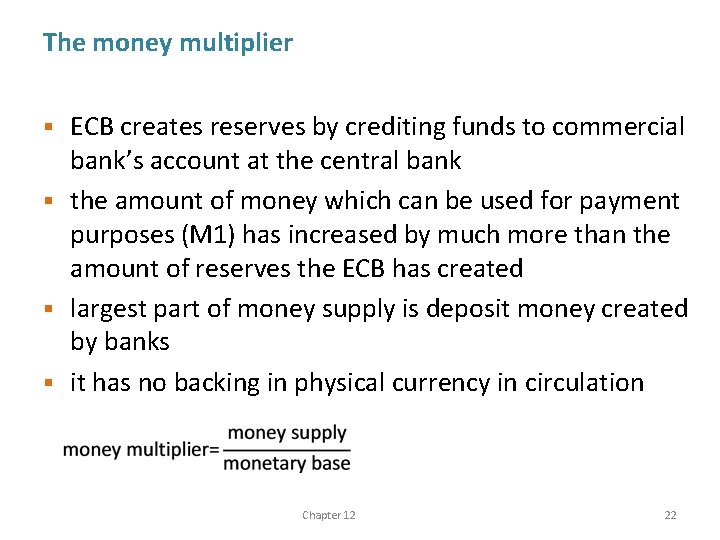
The money multiplier ECB creates reserves by crediting funds to commercial bank’s account at the central bank § the amount of money which can be used for payment purposes (M 1) has increased by much more than the amount of reserves the ECB has created § largest part of money supply is deposit money created by banks § it has no backing in physical currency in circulation § Chapter 12 22
How much money can be created on a single euro provided by the ECB? § reserve requirements as a guideline: – if commercial banks have to hold 1 percent of their deposits in reserves, then € 1 of reserves can support € 100 in deposits § some money is exchanged into cash and carried around Ø empirically, the ratio between M 1 and the monetary base is much smaller. Chapter 12 23
Two standing facilities are open to commercial banks permanently § The marginal lending facility – slightly higher interest rate than under main refinancing operations (good-quality collateral required) – usually upper border of interest rates charged in the money market § The deposit facility – banks deposit excessive reserves at the ECB – get an interest rate on these deposits – usually the bottom for interest rates in the money market Chapter 12 24
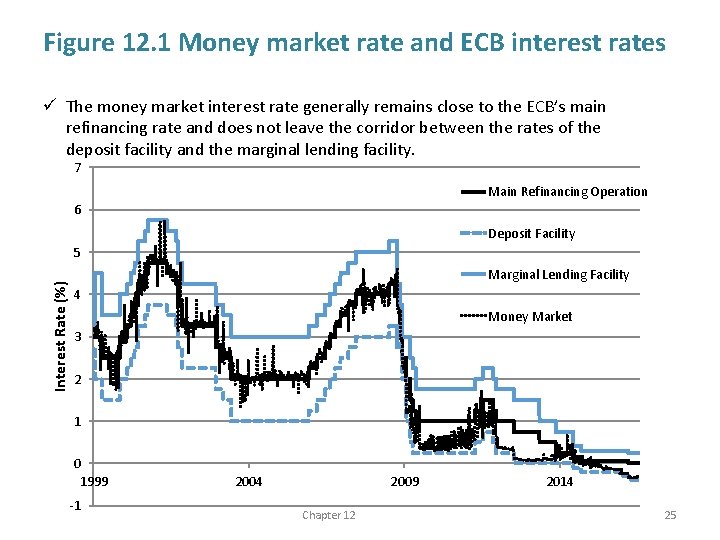
Figure 12. 1 Money market rate and ECB interest rates ü The money market interest rate generally remains close to the ECB’s main refinancing rate and does not leave the corridor between the rates of the deposit facility and the marginal lending facility. 7 Main Refinancing Operation 6 Deposit Facility Interest Rate (%) 5 Marginal Lending Facility 4 Money Market 3 2 1 0 1999 -1 2004 2009 Chapter 12 2014 25
New instruments of the ECB (since the euro crisis) ECB has lent large amounts of reserves to commercial banks in operations with very long maturities (several years instead of the usual one week) § ECB has bought directly government bonds and corporate bonds from commercial banks § ECB has moved its deposit interest rate into negative territories § Chapter 12 26
The Theory of Interest Rates, Money, and Aggregate Expenditure
Interest rates and investment § Empirically, interest rates work most on housing investment – Changes in mortgage rate usually have a strong influence on building activity § For firms’ investment, effect usually is considered to be smaller – General mood of firms might be more important – accelerator principle: the idea that high GDP growth leads to high investment growth – However, given a certain state of growth, interest rates do influence investment Chapter 12 28
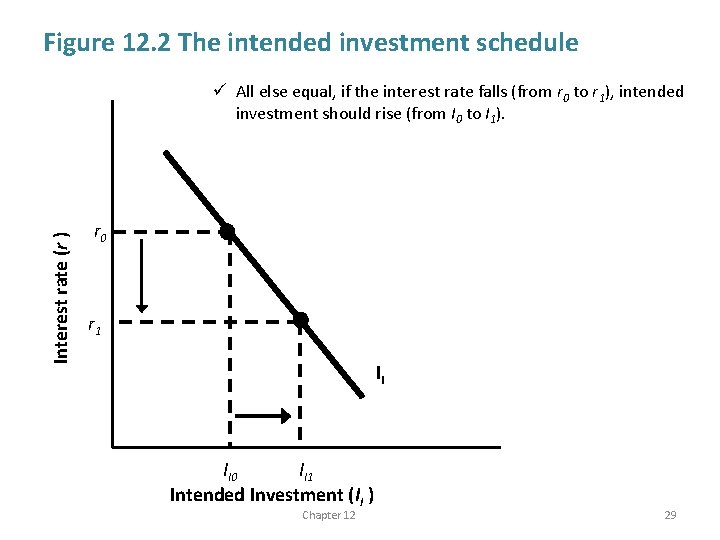
Figure 12. 2 The intended investment schedule Interest rate (r ) ü All else equal, if the interest rate falls (from r 0 to r 1), intended investment should rise (from I 0 to I 1). r 0 r 1 II II 0 II 1 Intended Investment (II ) Chapter 12 29
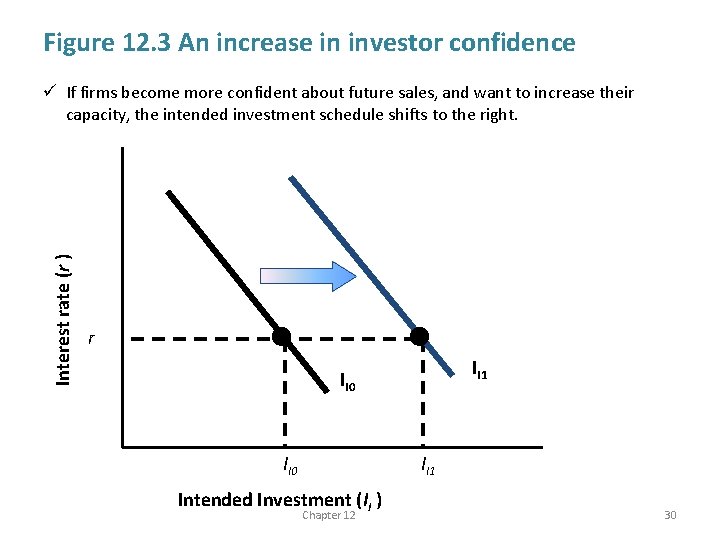
Figure 12. 3 An increase in investor confidence Interest rate (r ) ü If firms become more confident about future sales, and want to increase their capacity, the intended investment schedule shifts to the right. r II 1 II 0 II 1 Intended Investment (II ) Chapter 12 30
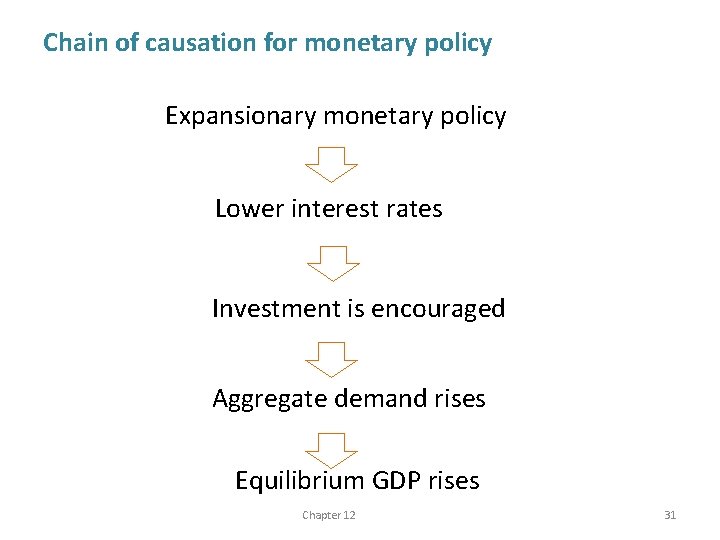
Chain of causation for monetary policy Expansionary monetary policy Lower interest rates Investment is encouraged Aggregate demand rises Equilibrium GDP rises Chapter 12 31
How is monetary policy used (I)? If there is a danger of recession, interest rates are often cut § expansionary monetary policy: the use of monetary policy tools to increase the money supply, lower interest rates, and stimulate a higher level of economic activity § accommodating monetary policy: loose or expansionary monetary policy intended to counteract recessionary tendencies in the economy § Chapter 12 32
How is monetary policy used (II)? If there is a danger of inflationary overheating, interest rates are often increased § contractionary monetary policy: the use of monetary policy tools to limit the money supply, raise interest rates, and encourage a leveling off or reduction in economic activity § Chapter 12 33
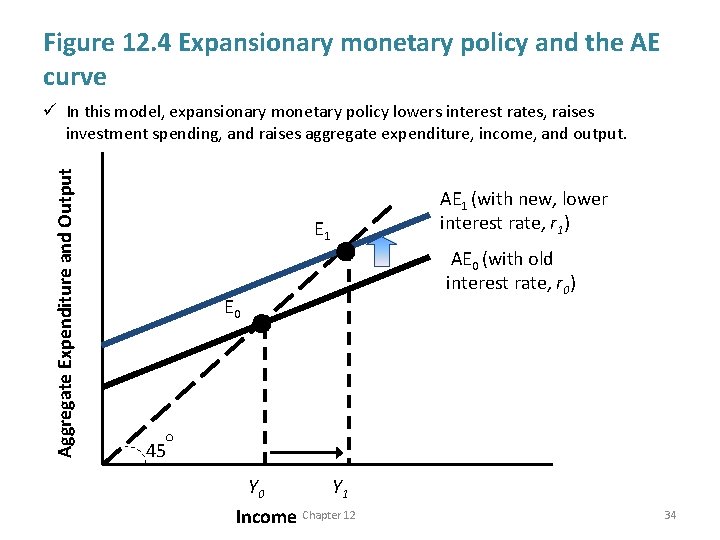
Figure 12. 4 Expansionary monetary policy and the AE curve Aggregate Expenditure and Output ü In this model, expansionary monetary policy lowers interest rates, raises investment spending, and raises aggregate expenditure, income, and output. E 1 E 0 AE 1 (with new, lower interest rate, r 1) AE 0 (with old interest rate, r 0) 45 Y 0 Y 1 Income Chapter 12 34
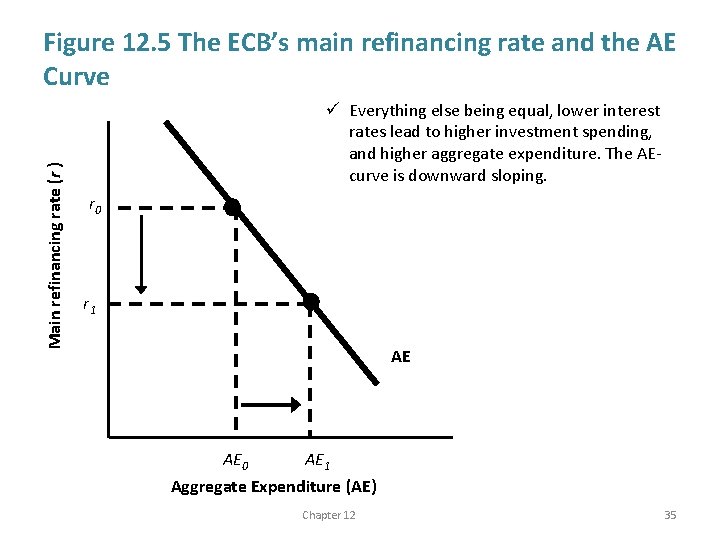
Main refinancing rate (r ) Figure 12. 5 The ECB’s main refinancing rate and the AE Curve ü Everything else being equal, lower interest rates lead to higher investment spending, and higher aggregate expenditure. The AEcurve is downward sloping. r 0 r 1 AE AE 0 AE 1 Aggregate Expenditure (AE) Chapter 12 35
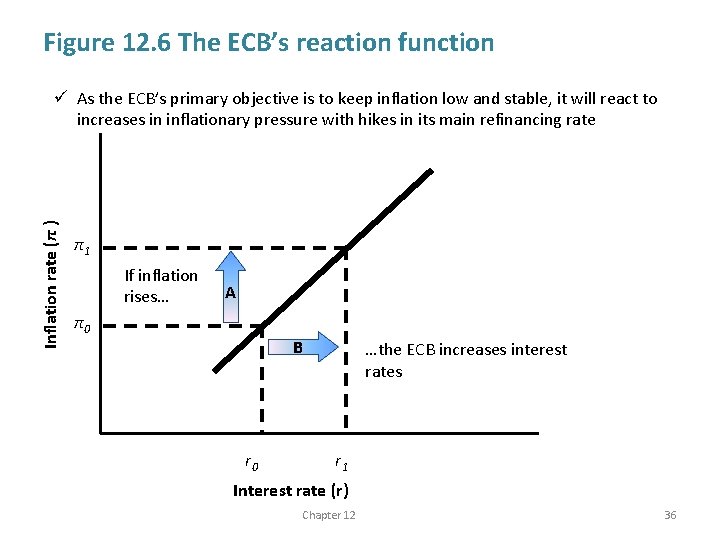
Figure 12. 6 The ECB’s reaction function Inflation rate (π ) ü As the ECB’s primary objective is to keep inflation low and stable, it will react to increases in inflationary pressure with hikes in its main refinancing rate π1 If inflation rises… A π0 B r 0 …the ECB increases interest rates r 1 Interest rate (r) Chapter 12 36
Monetary Policies in Practice
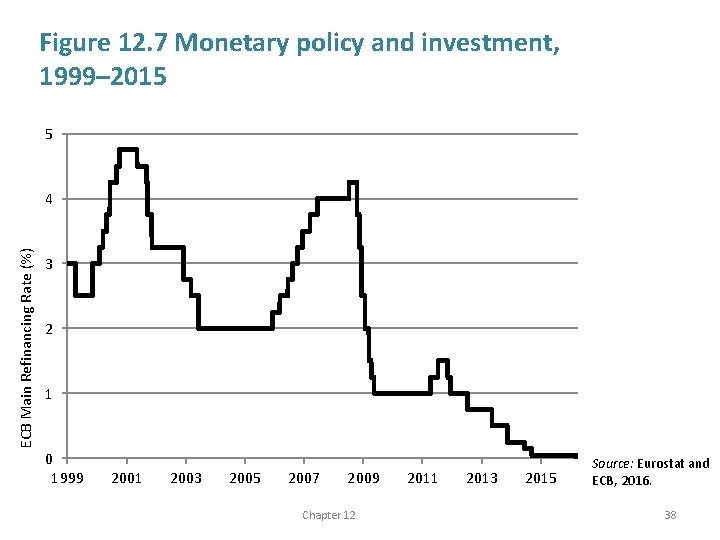
Figure 12. 7 Monetary policy and investment, 1999– 2015 5 ECB Main Refinancing Rate (%) 4 3 2 1 0 1999 2001 2003 2005 2007 2009 Chapter 12 2011 2013 2015 Source: Eurostat and ECB, 2016. 38
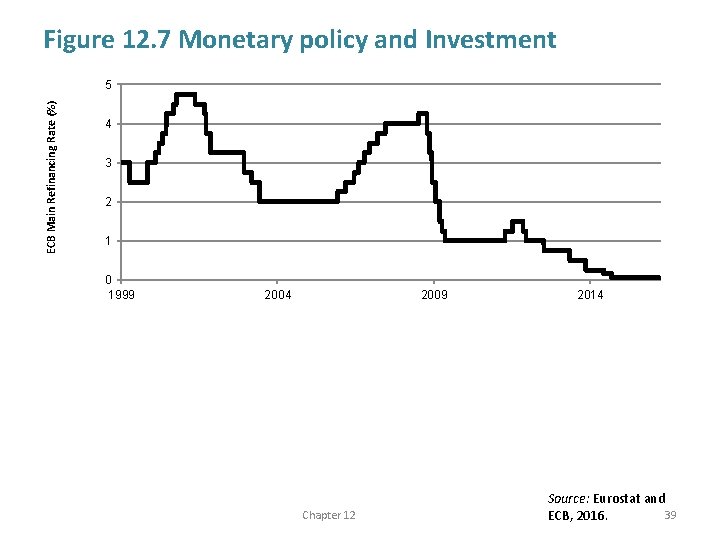
Figure 12. 7 Monetary policy and Investment ECB Main Refinancing Rate (%) 5 4 3 2 1 0 1999 2004 2009 Chapter 12 2014 Source: Eurostat and 39 ECB, 2016.
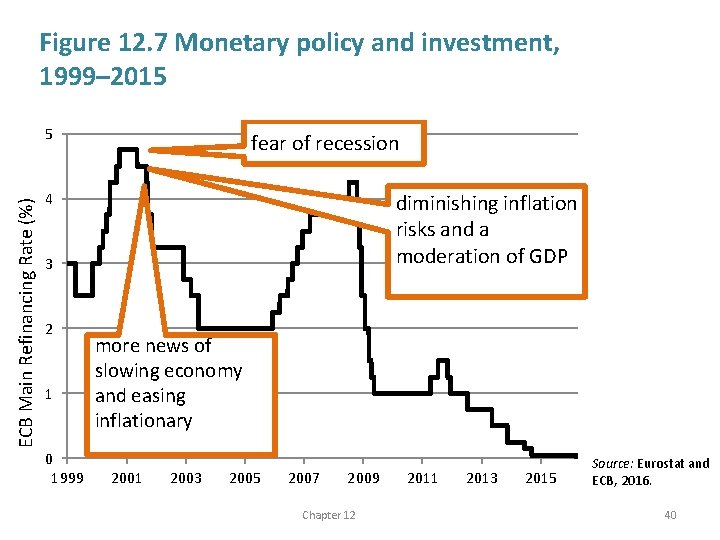
Figure 12. 7 Monetary policy and investment, 1999– 2015 ECB Main Refinancing Rate (%) 5 fear of recession 4 diminishing inflation risks and a moderation of GDP 3 2 1 0 1999 more news of slowing economy and easing inflationary 2001 2003 2005 2007 2009 Chapter 12 2011 2013 2015 Source: Eurostat and ECB, 2016. 40
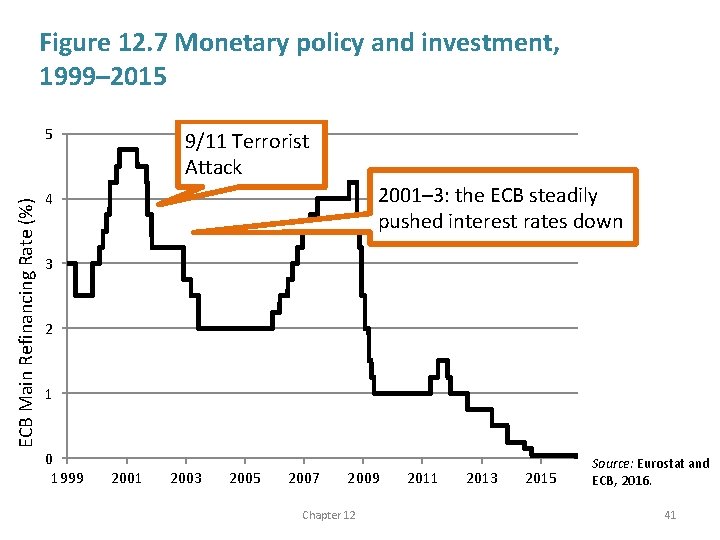
Figure 12. 7 Monetary policy and investment, 1999– 2015 ECB Main Refinancing Rate (%) 5 9/11 Terrorist Attack 2001– 3: the ECB steadily pushed interest rates down 4 3 2 1 0 1999 2001 2003 2005 2007 2009 Chapter 12 2011 2013 2015 Source: Eurostat and ECB, 2016. 41
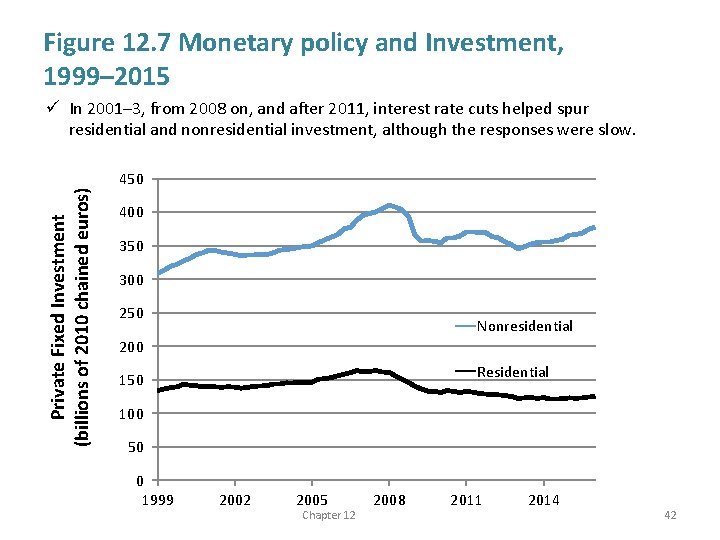
Figure 12. 7 Monetary policy and Investment, 1999– 2015 Private Fixed Investment (billions of 2010 chained euros) ü In 2001– 3, from 2008 on, and after 2011, interest rate cuts helped spur residential and nonresidential investment, although the responses were slow. 450 400 350 300 250 Nonresidential 200 Residential 150 100 50 0 1999 2002 2005 Chapter 12 2008 2011 2014 42
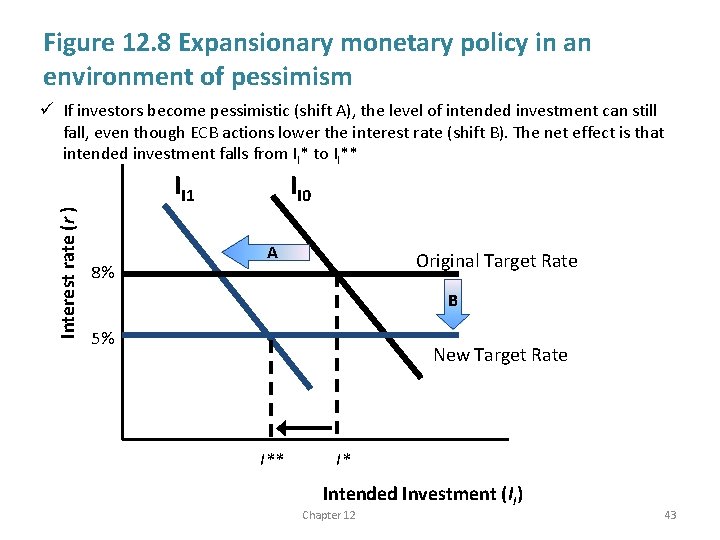
Figure 12. 8 Expansionary monetary policy in an environment of pessimism ü If investors become pessimistic (shift A), the level of intended investment can still fall, even though ECB actions lower the interest rate (shift B). The net effect is that intended investment falls from II* to II** Interest rate (r ) II 1 8% II 0 A Original Target Rate B 5% New Target Rate I** I* Intended Investment (II) Chapter 12 43
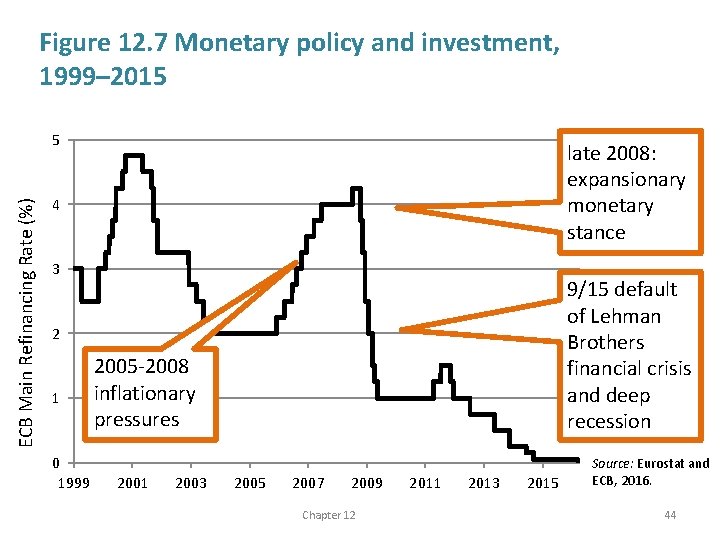
Figure 12. 7 Monetary policy and investment, 1999– 2015 ECB Main Refinancing Rate (%) 5 late 2008: expansionary monetary stance 4 3 9/15 default of Lehman Brothers financial crisis and deep recession 2 1 0 1999 2005 -2008 inflationary pressures 2001 2003 2005 2007 2009 Chapter 12 2011 2013 2015 Source: Eurostat and ECB, 2016. 44
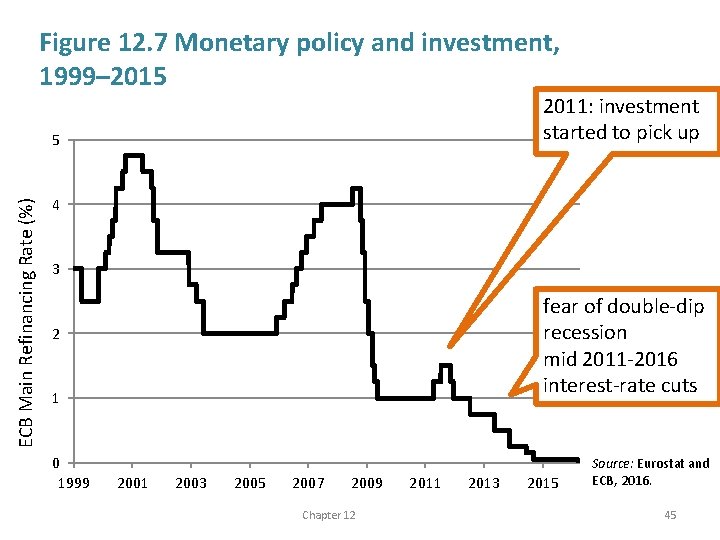
Figure 12. 7 Monetary policy and investment, 1999– 2015 2011: investment started to pick up ECB Main Refinancing Rate (%) 5 4 3 fear of double-dip recession mid 2011 -2016 interest-rate cuts 2 1 0 1999 2001 2003 2005 2007 2009 Chapter 12 2011 2013 2015 Source: Eurostat and ECB, 2016. 45
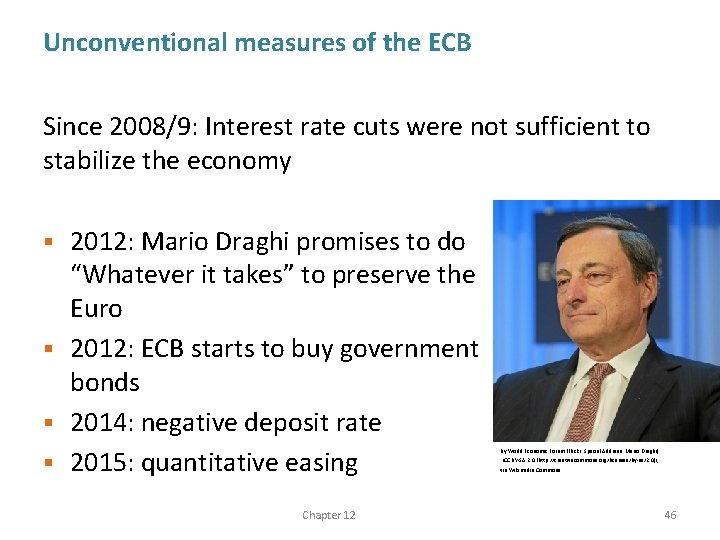
Unconventional measures of the ECB Since 2008/9: Interest rate cuts were not sufficient to stabilize the economy 2012: Mario Draghi promises to do “Whatever it takes” to preserve the Euro § 2012: ECB starts to buy government bonds § 2014: negative deposit rate § 2015: quantitative easing § Chapter 12 By World Economic Forum (Flickr: Special Address: Mario Draghi) [CC BY-SA 2. 0 (http: //creativecommons. org/licenses/by-sa/2. 0)], via Wikimedia Commons 46
Quantitative easing The purchase of financial assets including long-term bonds by the ECB, creating more monetary reserves and lowering long-term interest rates Hopes: get banks to lend more to firms and households ü get households and other investors to invest in more risky assets ü provide corporations with finance through nonbanks ü Chapter 12 47
2016: No normalization of monetary policy § yields for German government bonds below 0 percent § economy recovered and investment slowly picking up § unemployment still high § inflation around 0 percent § critics: – low interest rates as a way to “expropriate savers” – fueling financial bubbles or causing inflation to rise Chapter 12 48
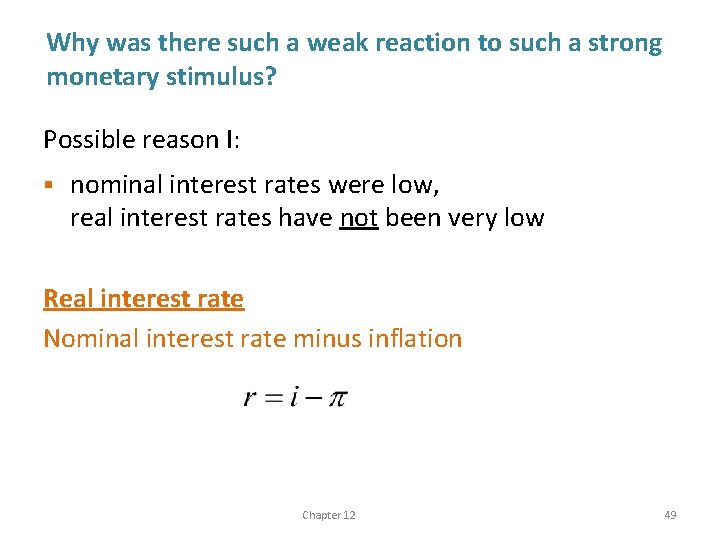
Why was there such a weak reaction to such a strong monetary stimulus? Possible reason I: § nominal interest rates were low, real interest rates have not been very low Real interest rate Nominal interest rate minus inflation Chapter 12 49
Why was there such a weak reaction to such a strong monetary stimulus? Possible reason II: § existence of of a liquidity trap – a situation in which interest rates are so low that the central bank finds it impossible to reduce them further – banks engage in credit rationing to ensure their own profitability and deny loans to some potential borrowers Chapter 12 50
Why was there such a weak reaction to such a strong monetary stimulus? Possible reason III: § problems in the banking sector – in a situation with problems in the banking sector, banks might refrain from lending even if interest rates fall – a cut in interest rates then does not translate into an increase in aggregate demand any more Chapter 12 51
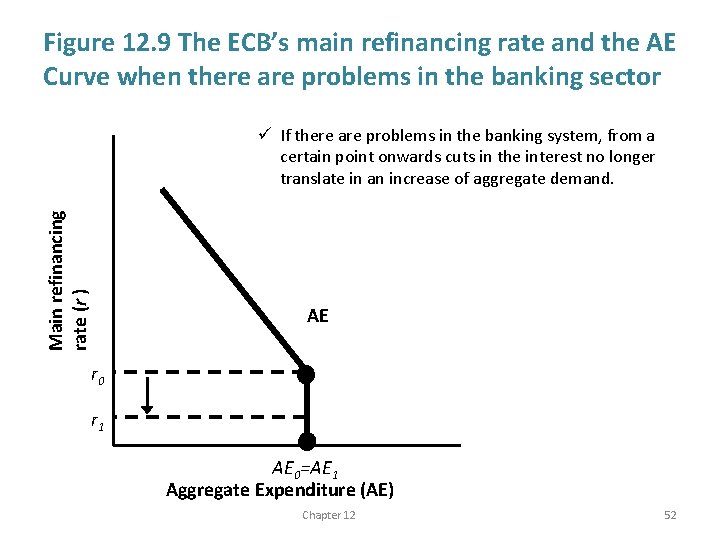
Figure 12. 9 The ECB’s main refinancing rate and the AE Curve when there are problems in the banking sector Main refinancing rate (r ) ü If there are problems in the banking system, from a certain point onwards cuts in the interest no longer translate in an increase of aggregate demand. AE r 0 r 1 AE 0=AE 1 Aggregate Expenditure (AE) Chapter 12 52
Does that mean that the ECB’s efforts are fruitless? No! § over a longer period, low interest rates may help businesses to pay back debt and banks to accumulate profits § as of 2016, banks in the euro-area made new loans to households (even if not yet to firms) § increase in the overall amount of loans Chapter 12 53
Concerns about The ECB’s monetary policy money might go to the wrong places, creating bubbles in asset prices § increase in excess reserves might in the future lead to a sudden outbreak of inflation § negative interest rates might depress banks’ profitability and further keep them from lending § Chapter 12 54
The Theory of Money, Prices, and Inflation
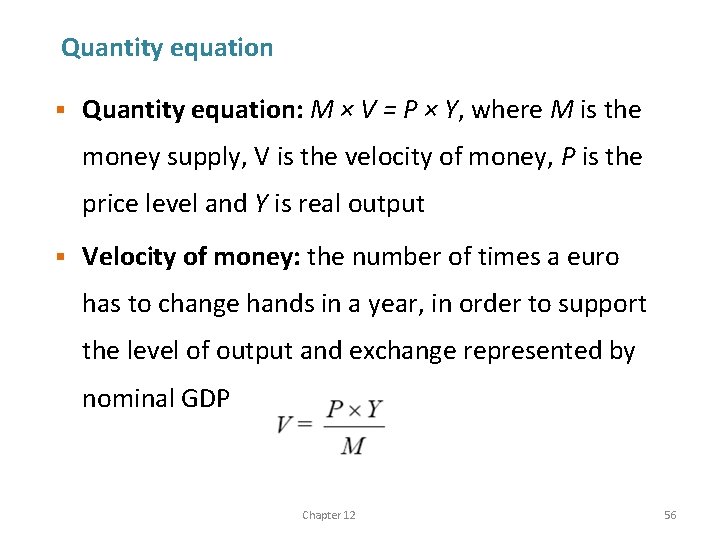
Quantity equation § Quantity equation: M × V = P × Y, where M is the money supply, V is the velocity of money, P is the price level and Y is real output § Velocity of money: the number of times a euro has to change hands in a year, in order to support the level of output and exchange represented by nominal GDP Chapter 12 56
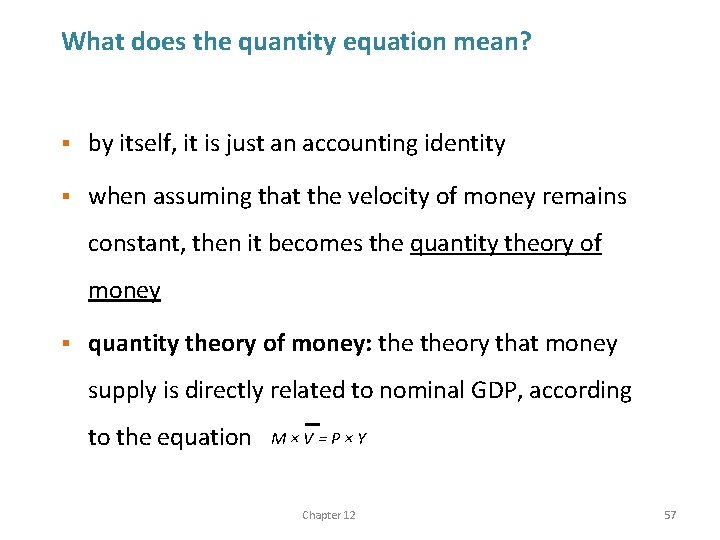
What does the quantity equation mean? § by itself, it is just an accounting identity § when assuming that the velocity of money remains constant, then it becomes the quantity theory of money § quantity theory of money: theory that money supply is directly related to nominal GDP, according to the equation M×V=P×Y Chapter 12 57
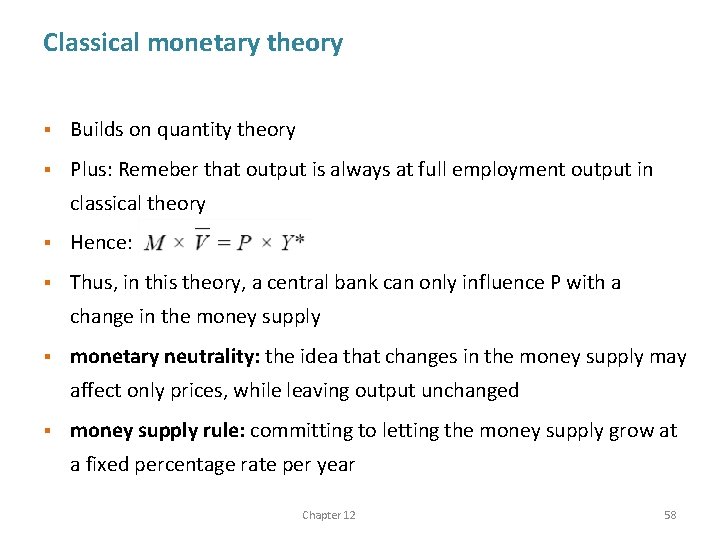
Classical monetary theory § Builds on quantity theory § Plus: Remeber that output is always at full employment output in classical theory § Hence: § Thus, in this theory, a central bank can only influence P with a change in the money supply § monetary neutrality: the idea that changes in the money supply may affect only prices, while leaving output unchanged § money supply rule: committing to letting the money supply grow at a fixed percentage rate per year Chapter 12 58
Monetarism § a theory associated with Milton Friedman, which claims that macroeconomic objectives are best met by having the money supply grow at a steady rate § believes in power of monetary policy § doubts that monetary policy will more often do harm than good by using monetary policy Chapter 12 59
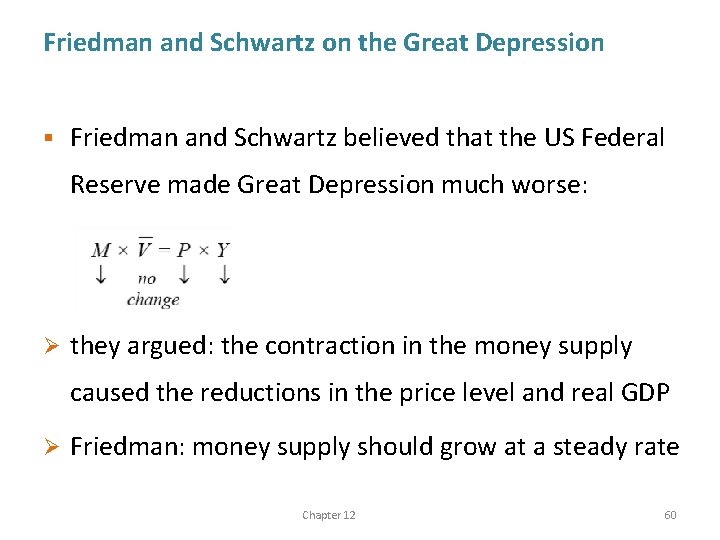
Friedman and Schwartz on the Great Depression § Friedman and Schwartz believed that the US Federal Reserve made Great Depression much worse: Ø they argued: the contraction in the money supply caused the reductions in the price level and real GDP Ø Friedman: money supply should grow at a steady rate Chapter 12 60
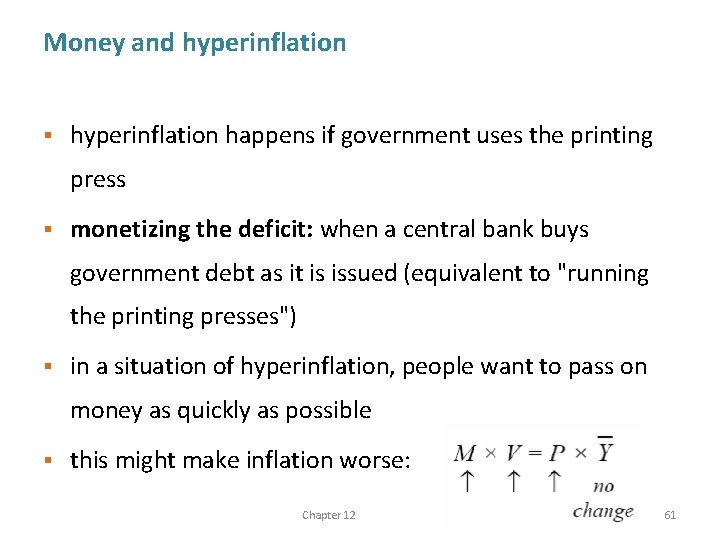
Money and hyperinflation § hyperinflation happens if government uses the printing press § monetizing the deficit: when a central bank buys government debt as it is issued (equivalent to "running the printing presses") § in a situation of hyperinflation, people want to pass on money as quickly as possible § this might make inflation worse: Chapter 12 61
Complications and Policy Controversies
The ECB’s dilemma it sounds easy: cut interest rates in a downturn, increase them in an upswing… § …but there a lot of unanswered questions § – What amount of inflation is acceptable? – How early do you need to dampen growth so that inflation does not pick up? – How to deal with imported inflation? Chapter 12 63
What about timing? § Inside lag: – decisions about monetary policy can be made quick (ECB‘s Governing Council meets every two weeks; decisions on interest rates every six weeks) § Outside lag: – monetary policy has only an effect on aggregate demand as people change their (long-term) plans abound investment and spending – danger of exacerbating the business cycle instead of flattening it out Chapter 12 64
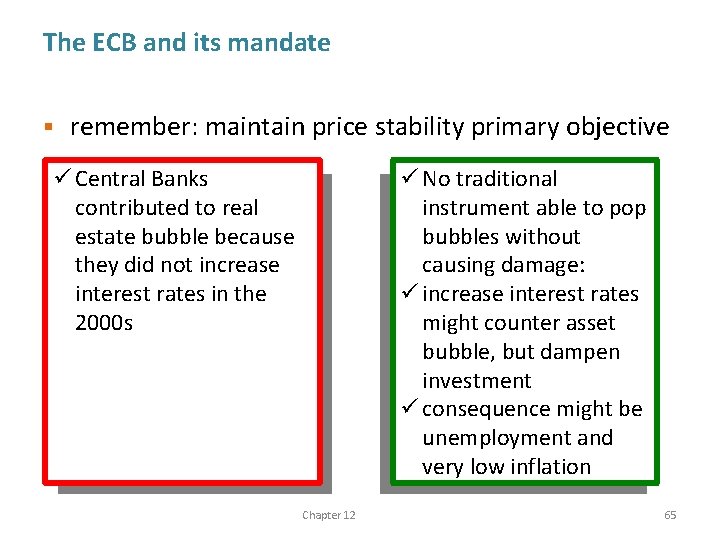
The ECB and its mandate § remember: maintain price stability primary objective ü Central Banks contributed to real estate bubble because they did not increase interest rates in the 2000 s ü No traditional instrument able to pop bubbles without causing damage: ü increase interest rates might counter asset bubble, but dampen investment ü consequence might be unemployment and very low inflation Chapter 12 65
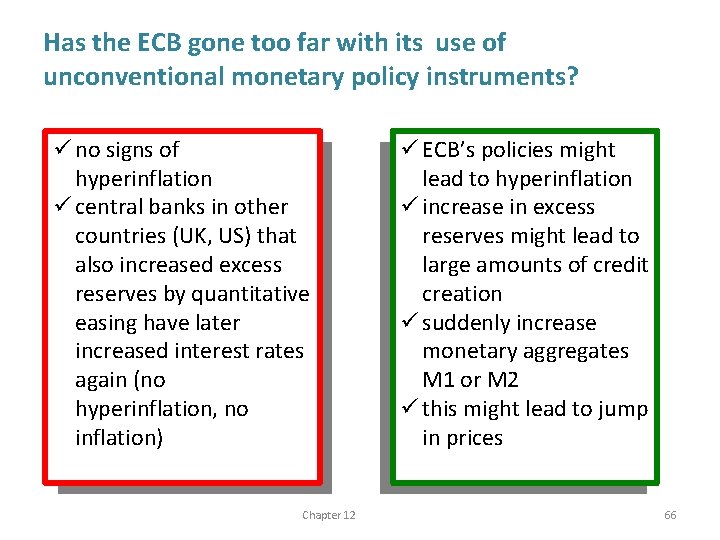
Has the ECB gone too far with its use of unconventional monetary policy instruments? ü no signs of hyperinflation ü central banks in other countries (UK, US) that also increased excess reserves by quantitative easing have later increased interest rates again (no hyperinflation, no inflation) Chapter 12 ü ECB’s policies might lead to hyperinflation ü increase in excess reserves might lead to large amounts of credit creation ü suddenly increase monetary aggregates M 1 or M 2 ü this might lead to jump in prices 66
What about the ECB’s decision on the negative deposit rate and the purchase of government bonds? ü negative interest rates redistribute between savers (in the “Northern countries) and borrowers (in the “Southern” countries) ü ultra-low interest rates endanger traditional savings banks Chapter 12 ü negative return on government bonds result of an imbalance of investments and savings 67
Does the ECB take to much pressure off governments to reform? ü the ECB does not have the mandate to impose structural reforms or permanent budget cuts on member states ü slightly higher interest rates would probably not lead to more reforms Chapter 12 ü ECB policy has led to very low government bond yields even for countries with high debt levels ü low interest rates lower incentives of governments to implement structural reforms and cut budget deficits permanently 68
What to take home (I) § § § Banks are important for the creation of money Credit conditions are important for aggregate expenditure The European Central Bank decides on monetary policy in the euro area Monetary policy influences the rate of interest By changing the interest rate, monetary policy influences behaviour of commercial banks Chapter 12 69
What to take home (II) Depending on the position in the business cycle, ECB tries to increase or lower aggregate demand § ECB can only influence inflation indirectly § There remain a number of disputes § Chapter 12 70
- Slides: 70