
Chapter 12 The Cell Cycle Copyright 2005 Pearson


- Slides: 34
Chapter 12 The Cell Cycle Copyright © 2005 Pearson Education, Inc. publishing as Benjamin Cummings
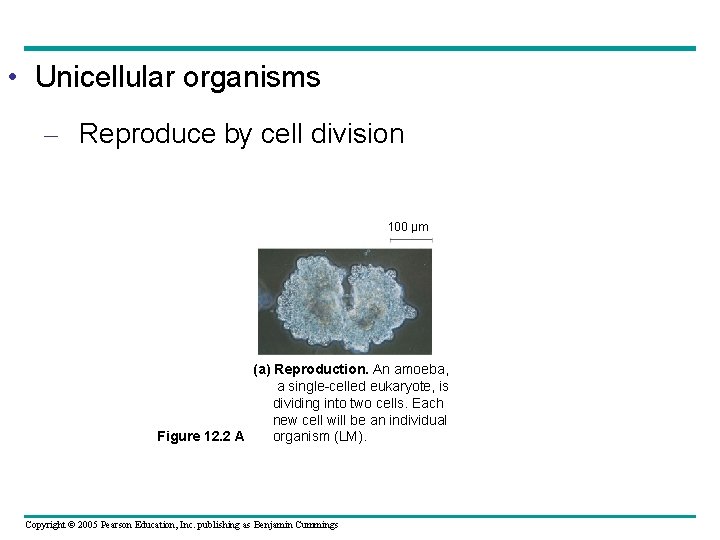
• Unicellular organisms – Reproduce by cell division 100 µm (a) Reproduction. An amoeba, a single-celled eukaryote, is dividing into two cells. Each new cell will be an individual Figure 12. 2 A organism (LM). Copyright © 2005 Pearson Education, Inc. publishing as Benjamin Cummings
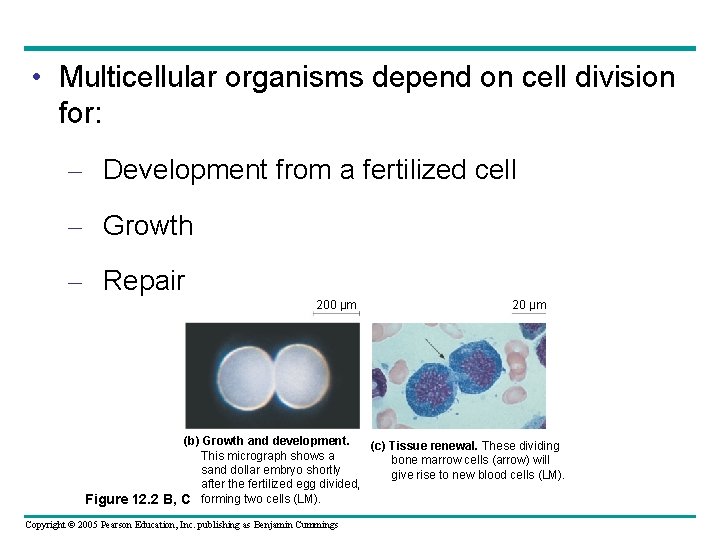
• Multicellular organisms depend on cell division for: – Development from a fertilized cell – Growth – Repair 200 µm 20 µm (b) Growth and development. (c) Tissue renewal. These dividing This micrograph shows a bone marrow cells (arrow) will sand dollar embryo shortly give rise to new blood cells (LM). after the fertilized egg divided, Figure 12. 2 B, C forming two cells (LM). Copyright © 2005 Pearson Education, Inc. publishing as Benjamin Cummings
• The cell division process – Is an integral part of the cell cycle • Mitotic Cell division results: – In genetically identical daughter cells • Cells duplicate their genetic material – Before they divide, ensuring that: • Each daughter cell receives an exact copy of the genetic material, DNA Copyright © 2005 Pearson Education, Inc. publishing as Benjamin Cummings
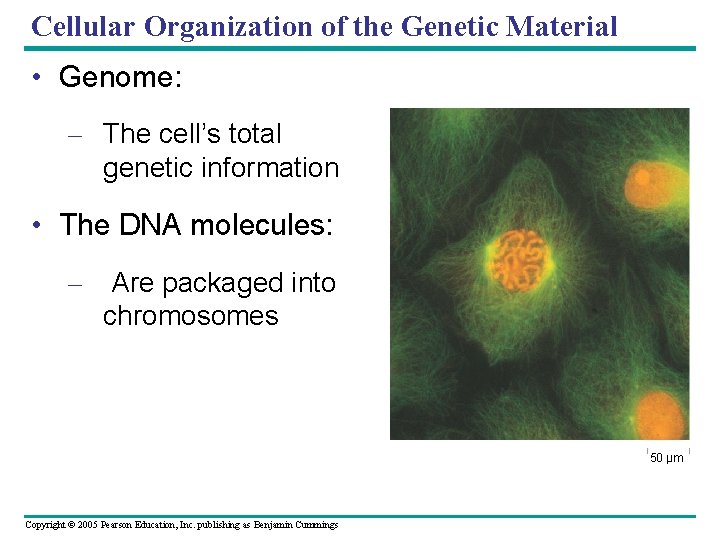
Cellular Organization of the Genetic Material • Genome: – The cell’s total genetic information • The DNA molecules: – Are packaged into chromosomes 50 µm Copyright © 2005 Pearson Education, Inc. publishing as Benjamin Cummings
• Eukaryotic chromosomes consist of: – Chromatin, a complex of DNA, and – A protein, condenses during cell division • In animals – Somatic (body) cells • have two sets of chromosomes – Gametes (sperm/ova) • have one set of chromosomes Copyright © 2005 Pearson Education, Inc. publishing as Benjamin Cummings
Distribution of Chromosomes During Cell Division • In preparation for cell division: – DNA is replicated (what stage ? ) – Chromosomes condense (what stage? ) Copyright © 2005 Pearson Education, Inc. publishing as Benjamin Cummings
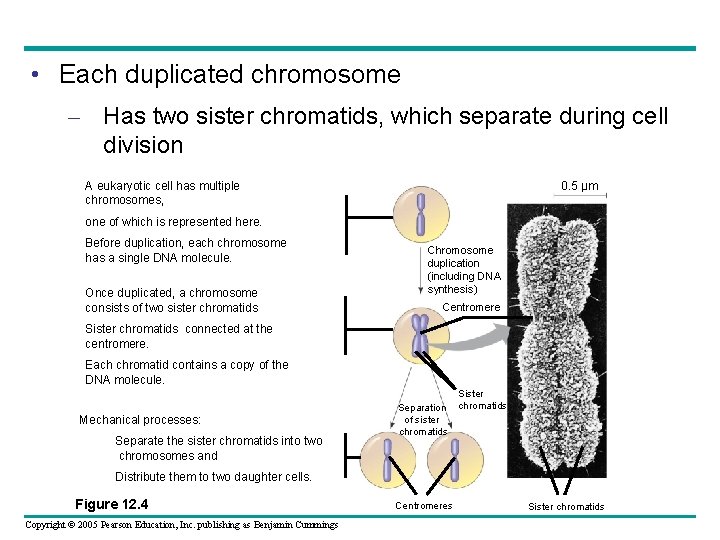
• Each duplicated chromosome – Has two sister chromatids, which separate during cell division A eukaryotic cell has multiple chromosomes, 0. 5 µm one of which is represented here. Before duplication, each chromosome has a single DNA molecule. Once duplicated, a chromosome consists of two sister chromatids Chromosome duplication (including DNA synthesis) Centromere Sister chromatids connected at the centromere. Each chromatid contains a copy of the DNA molecule. Mechanical processes: Separate the sister chromatids into two chromosomes and Separation of sister chromatids Sister chromatids Distribute them to two daughter cells. Figure 12. 4 Copyright © 2005 Pearson Education, Inc. publishing as Benjamin Cummings Centromeres Sister chromatids
• Eukaryotic cell division consists of – Mitosis, the division of the nucleus – Cytokinesis, the division of the cytoplasm • In meiosis – Sex cells are produced – Chromosome number is reduced Copyright © 2005 Pearson Education, Inc. publishing as Benjamin Cummings
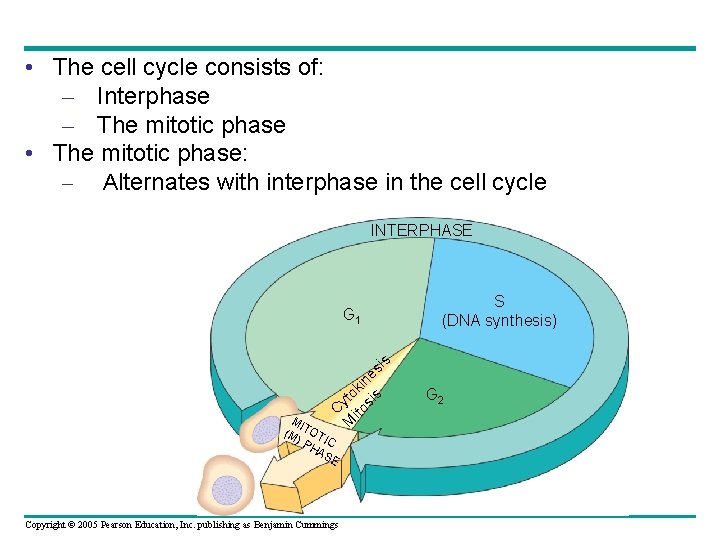
• The cell cycle consists of: – Interphase – The mitotic phase • The mitotic phase: – Alternates with interphase in the cell cycle INTERPHASE S (DNA synthesis) C M yto ito ki si ne s si s G 1 MI (M TOT ) P IC HA SE Copyright © 2005 Pearson Education, Inc. publishing as Benjamin Cummings G 2
Interphase & Mitotic Phase • Interphase can be divided into subphases – G 1 phase – S phase – G 2 phase • The mitotic phase is made up of: – Mitosis, and – Cytokinesis Copyright © 2005 Pearson Education, Inc. publishing as Benjamin Cummings
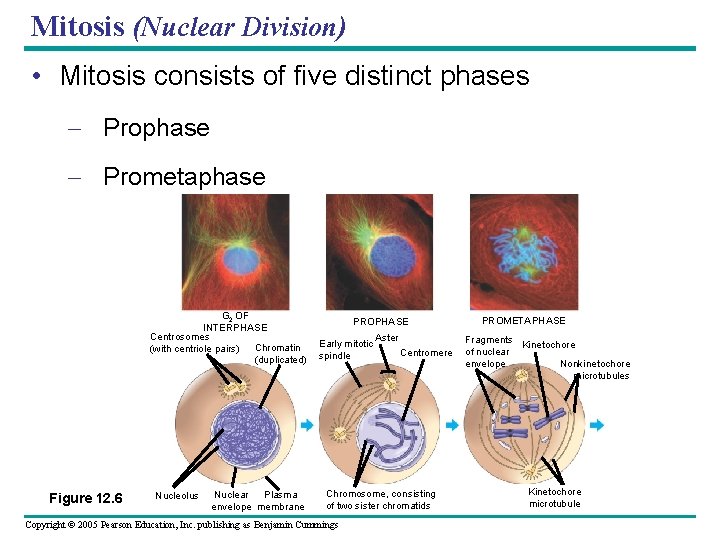
Mitosis (Nuclear Division) • Mitosis consists of five distinct phases – Prophase – Prometaphase G 2 OF INTERPHASE Centrosomes (with centriole pairs) Chromatin (duplicated) Figure 12. 6 Nucleolus Nuclear Plasma envelope membrane PROPHASE Early mitotic spindle Aster Centromere Chromosome, consisting of two sister chromatids Copyright © 2005 Pearson Education, Inc. publishing as Benjamin Cummings PROMETAPHASE Fragments Kinetochore of nuclear envelope Nonkinetochore microtubules Kinetochore microtubule
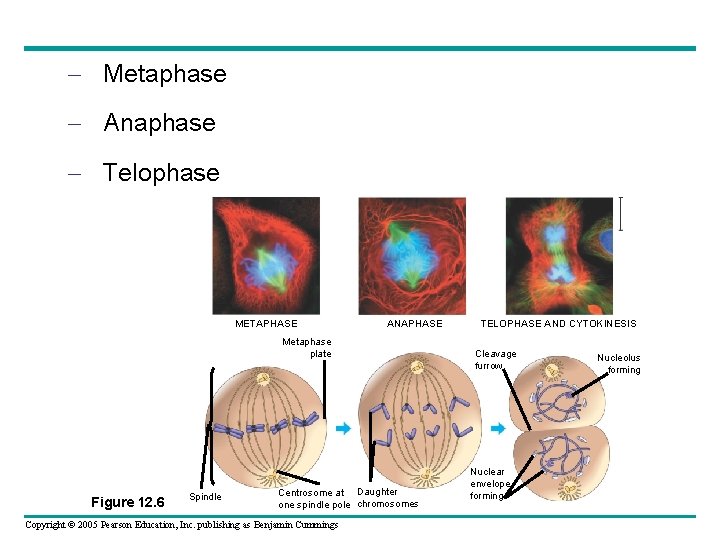
– Metaphase – Anaphase – Telophase METAPHASE ANAPHASE Metaphase plate Figure 12. 6 Spindle Centrosome at Daughter one spindle pole chromosomes Copyright © 2005 Pearson Education, Inc. publishing as Benjamin Cummings TELOPHASE AND CYTOKINESIS Cleavage furrow Nuclear envelope forming Nucleolus forming
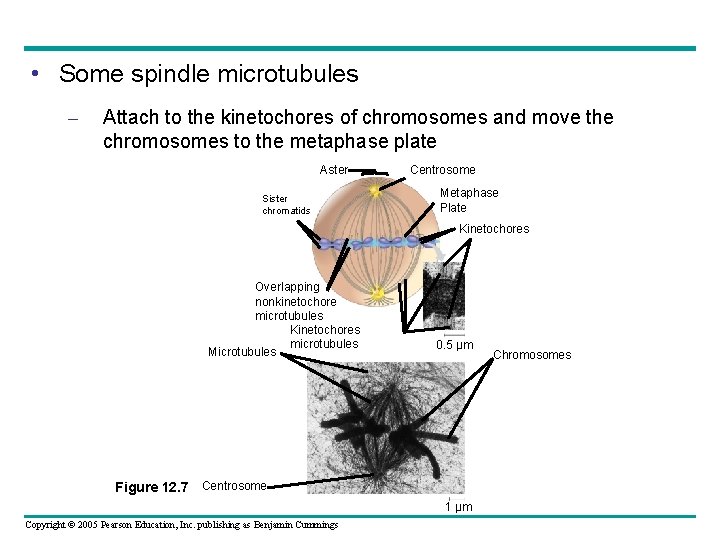
The Mitotic Spindle: A Closer Look • The mitotic spindle: – Is an apparatus of microtubules – Controls chromosome movement during mitosis – Arises from the centrosomes – Includes: • Spindle microtubules • Asters: – short microtubules radiating toward the cell membrane Copyright © 2005 Pearson Education, Inc. publishing as Benjamin Cummings
• Some spindle microtubules – Attach to the kinetochores of chromosomes and move the chromosomes to the metaphase plate Aster Sister chromatids Centrosome Metaphase Plate Kinetochores Overlapping nonkinetochore microtubules Kinetochores microtubules Microtubules 0. 5 µm Figure 12. 7 Centrosome 1 µm Copyright © 2005 Pearson Education, Inc. publishing as Benjamin Cummings Chromosomes
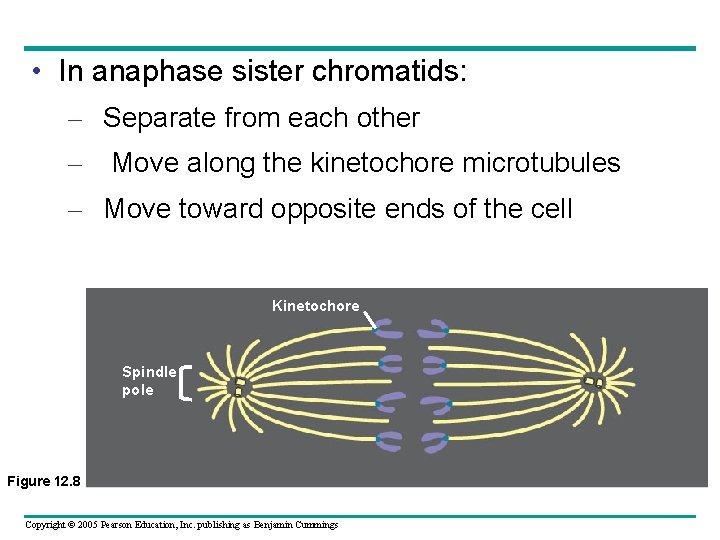
• In anaphase sister chromatids: – Separate from each other – Move along the kinetochore microtubules – Move toward opposite ends of the cell Kinetochore Spindle pole Figure 12. 8 Copyright © 2005 Pearson Education, Inc. publishing as Benjamin Cummings
• Nonkinetechore microtubules from opposite poles – Overlap and push against each other, elongating the cell • In telophase – Genetically identical daughter nuclei form at opposite ends of the cell Copyright © 2005 Pearson Education, Inc. publishing as Benjamin Cummings
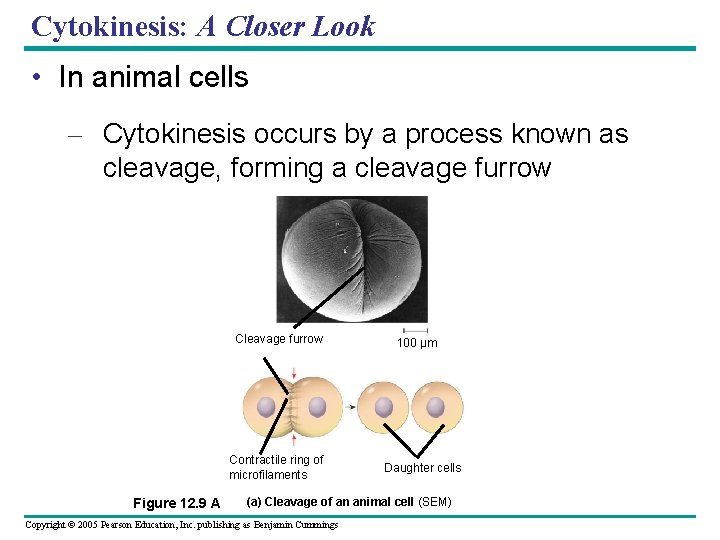
Cytokinesis: A Closer Look • In animal cells – Cytokinesis occurs by a process known as cleavage, forming a cleavage furrow Contractile ring of microfilaments Figure 12. 9 A 100 µm Daughter cells (a) Cleavage of an animal cell (SEM) Copyright © 2005 Pearson Education, Inc. publishing as Benjamin Cummings
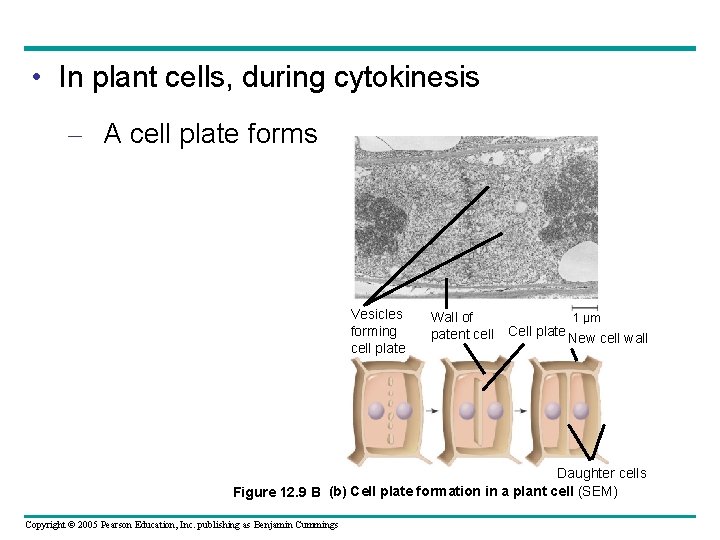
• In plant cells, during cytokinesis – A cell plate forms Vesicles forming cell plate 1 µm Wall of patent cell Cell plate New cell wall Daughter cells Figure 12. 9 B (b) Cell plate formation in a plant cell (SEM) Copyright © 2005 Pearson Education, Inc. publishing as Benjamin Cummings
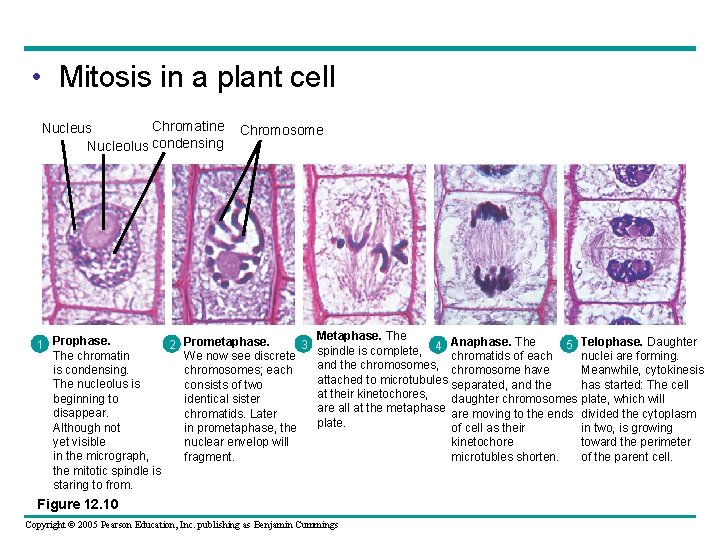
• Mitosis in a plant cell Chromatine Nucleus Nucleolus condensing Chromosome Metaphase. The 2 Prometaphase. 3 1 Prophase. spindle is complete, 4 The chromatin We now see discrete and the chromosomes, is condensing. chromosomes; each attached to microtubules The nucleolus is consists of two at their kinetochores, beginning to identical sister are all at the metaphase disappear. chromatids. Later plate. Although not in prometaphase, the yet visible nuclear envelop will in the micrograph, fragment. the mitotic spindle is staring to from. Figure 12. 10 Copyright © 2005 Pearson Education, Inc. publishing as Benjamin Cummings Anaphase. The 5 chromatids of each chromosome have separated, and the daughter chromosomes are moving to the ends of cell as their kinetochore microtubles shorten. Telophase. Daughter nuclei are forming. Meanwhile, cytokinesis has started: The cell plate, which will divided the cytoplasm in two, is growing toward the perimeter of the parent cell.
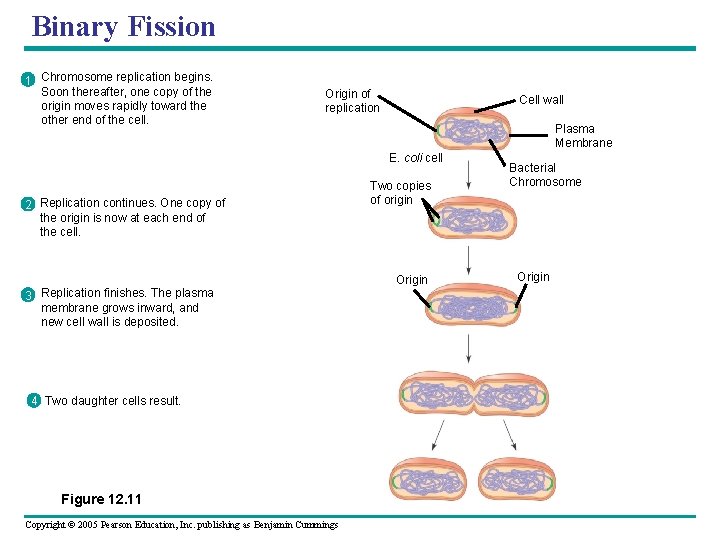
Prokaryotes (bacteria) • Prokaryotes reproduce by a type of cell division called: – Binary fission • In binary fission – The bacterial chromosome replicates – The two daughter chromosomes actively move apart Copyright © 2005 Pearson Education, Inc. publishing as Benjamin Cummings
Break Slide BIOL 1406. 43799 Mon 4/6/2015 Copyright © 2005 Pearson Education, Inc. publishing as Benjamin Cummings
Binary Fission 1 Chromosome replication begins. Soon thereafter, one copy of the origin moves rapidly toward the other end of the cell. Origin of replication Cell wall Plasma Membrane E. coli cell 2 Replication continues. One copy of the origin is now at each end of the cell. Two copies of origin Origin 3 Replication finishes. The plasma membrane grows inward, and new cell wall is deposited. 4 Two daughter cells result. Figure 12. 11 Copyright © 2005 Pearson Education, Inc. publishing as Benjamin Cummings Bacterial Chromosome Origin
Brake Slide on ______ Biol 1406. 29022 Copyright © 2005 Pearson Education, Inc. publishing as Benjamin Cummings
Regulation of the Cell Cycle • The cell cycle is regulated by a molecular control system • The frequency of cell division – Varies with the type of cell – Some (liver cells) divide when needed – Others (nerve and muscle cells) don’t divide • Cell cycle differences result from: – Regulation at the molecular level Copyright © 2005 Pearson Education, Inc. publishing as Benjamin Cummings
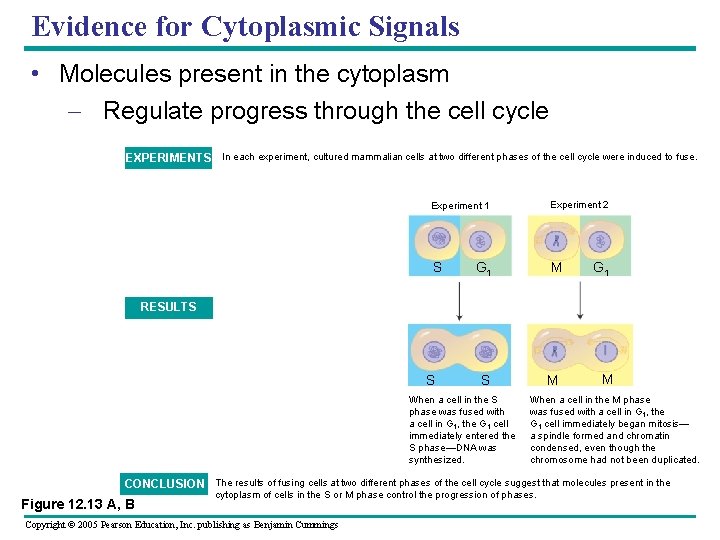
Evidence for Cytoplasmic Signals • Molecules present in the cytoplasm – Regulate progress through the cell cycle EXPERIMENTS In each experiment, cultured mammalian cells at two different phases of the cell cycle were induced to fuse. Experiment 1 Experiment 2 S G 1 M S M G 1 RESULTS S When a cell in the S phase was fused with a cell in G 1, the G 1 cell immediately entered the S phase—DNA was synthesized. M When a cell in the M phase was fused with a cell in G 1, the G 1 cell immediately began mitosis— a spindle formed and chromatin condensed, even though the chromosome had not been duplicated. CONCLUSION The results of fusing cells at two different phases of the cell cycle suggest that molecules present in the Figure 12. 13 A, B cytoplasm of cells in the S or M phase control the progression of phases. Copyright © 2005 Pearson Education, Inc. publishing as Benjamin Cummings
The Cell Cycle Clock: Cyclins and Cyclin-Dependent Kinases • Two types of regulatory proteins are involved in cell cycle control: – Cyclins and – cyclin-dependent kinases (Cdks) Copyright © 2005 Pearson Education, Inc. publishing as Benjamin Cummings
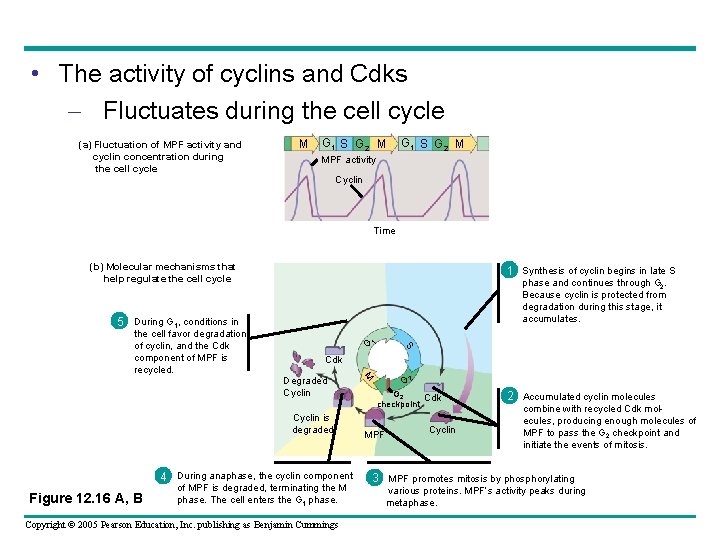
• The activity of cyclins and Cdks – Fluctuates during the cell cycle (a) Fluctuation of MPF activity and cyclin concentration during the cell cycle M G 1 S G 2 M MPF activity Cyclin Time (b) Molecular mechanisms that help regulate the cell cycle 1 Synthesis of cyclin begins in late S phase and continues through G 2. Because cyclin is protected from degradation during this stage, it accumulates. G 4 During anaphase, the cyclin component of MPF is degraded, terminating the M phase. The cell enters the G 1 phase. Copyright © 2005 Pearson Education, Inc. publishing as Benjamin Cummings 2 G Degraded Cyclin is degraded Figure 12. 16 A, B S Cdk M the cell favor degradation of cyclin, and the Cdk component of MPF is recycled. 1 5 During G 1, conditions in G 2 Cdk checkpoint MPF Cyclin 2 Accumulated cyclin molecules combine with recycled Cdk molecules, producing enough molecules of MPF to pass the G 2 checkpoint and initiate the events of mitosis. 3 MPF promotes mitosis by phosphorylating various proteins. MPF‘s activity peaks during metaphase.
Stop and Go Signs: Internal and External Signals at the Checkpoints • Both internal and external signals Control the cell cycle: – Growth factors: • Are substances that stimulate other cells to divide Copyright © 2005 Pearson Education, Inc. publishing as Benjamin Cummings
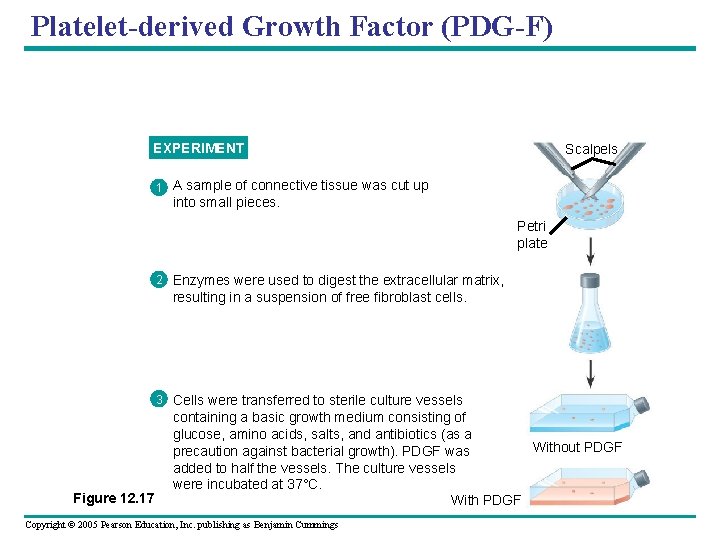
Platelet-derived Growth Factor (PDG-F) EXPERIMENT Scalpels 1 A sample of connective tissue was cut up into small pieces. Petri plate 2 Enzymes were used to digest the extracellular matrix, resulting in a suspension of free fibroblast cells. 3 Cells were transferred to sterile culture vessels Figure 12. 17 containing a basic growth medium consisting of glucose, amino acids, salts, and antibiotics (as a Without PDGF precaution against bacterial growth). PDGF was added to half the vessels. The culture vessels were incubated at 37°C. With PDGF Copyright © 2005 Pearson Education, Inc. publishing as Benjamin Cummings
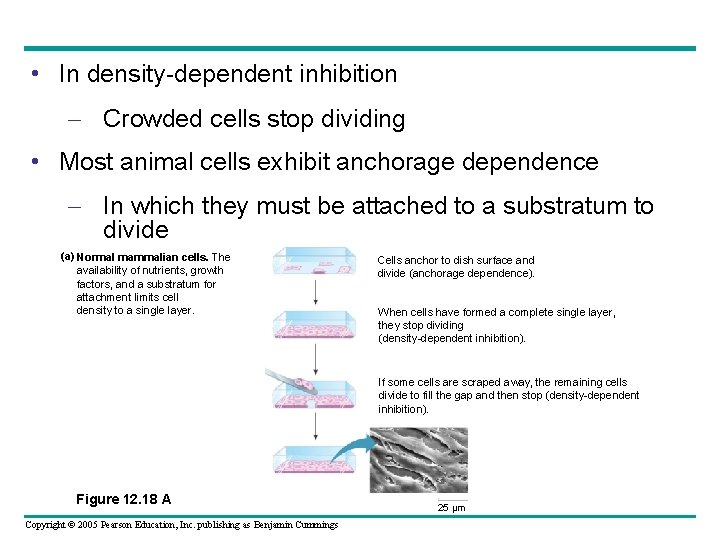
• In density-dependent inhibition – Crowded cells stop dividing • Most animal cells exhibit anchorage dependence – In which they must be attached to a substratum to divide (a) Normal mammalian cells. The availability of nutrients, growth factors, and a substratum for attachment limits cell density to a single layer. Cells anchor to dish surface and divide (anchorage dependence). When cells have formed a complete single layer, they stop dividing (density-dependent inhibition). If some cells are scraped away, the remaining cells divide to fill the gap and then stop (density-dependent inhibition). Figure 12. 18 A Copyright © 2005 Pearson Education, Inc. publishing as Benjamin Cummings 25 µm
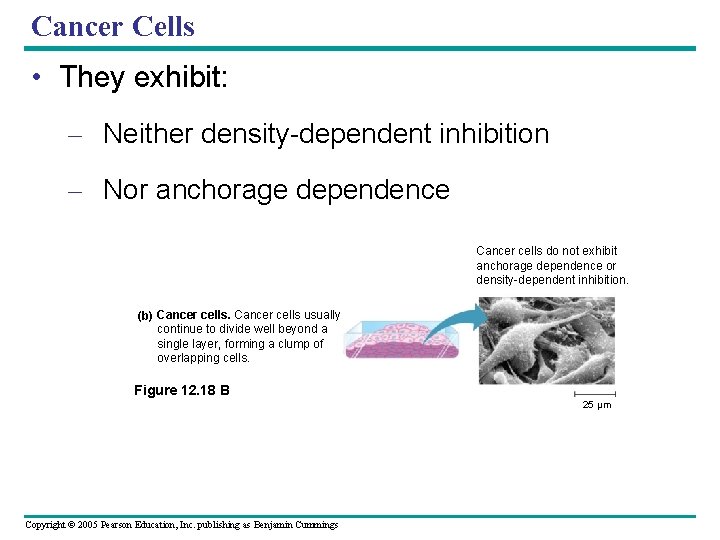
Cancer Cells • They exhibit: – Neither density-dependent inhibition – Nor anchorage dependence Cancer cells do not exhibit anchorage dependence or density-dependent inhibition. (b) Cancer cells usually continue to divide well beyond a single layer, forming a clump of overlapping cells. Figure 12. 18 B 25 µm Copyright © 2005 Pearson Education, Inc. publishing as Benjamin Cummings
Loss of Cell Cycle Controls in Cancer Cells • Cancer cells – Do not respond normally to the body’s control mechanisms – Form tumors Copyright © 2005 Pearson Education, Inc. publishing as Benjamin Cummings
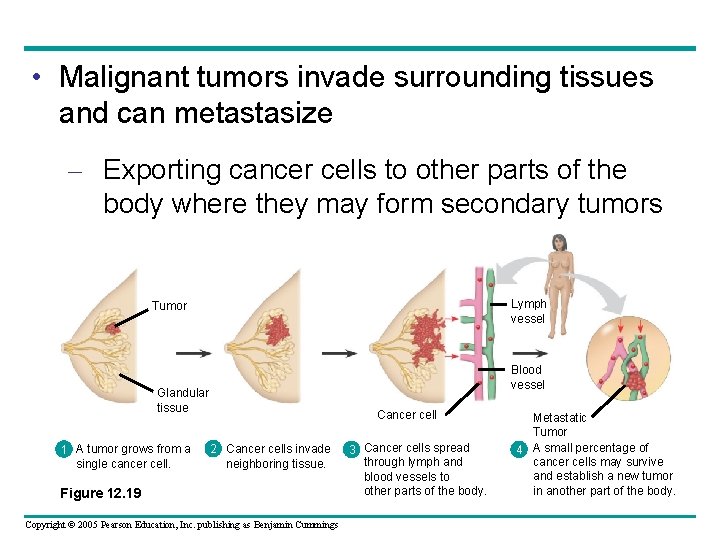
• Malignant tumors invade surrounding tissues and can metastasize – Exporting cancer cells to other parts of the body where they may form secondary tumors Lymph vessel Tumor Blood vessel Glandular tissue 1 A tumor grows from a single cancer cell. Cancer cell 2 Cancer cells invade neighboring tissue. Figure 12. 19 Copyright © 2005 Pearson Education, Inc. publishing as Benjamin Cummings 3 Cancer cells spread through lymph and blood vessels to other parts of the body. Metastatic Tumor 4 A small percentage of cancer cells may survive and establish a new tumor in another part of the body.