
Chapter 12 The Cell Cycle Copyright 2005 Pearson
- Slides: 30
Chapter 12 The Cell Cycle Copyright © 2005 Pearson Education, Inc. publishing as Benjamin Cummings
Concept 12. 1: • Cell division results in genetically identical daughter cells • Cells duplicate their genetic material – Before they divide, ensuring that each daughter cell receives an exact copy of the genetic material, DNA Copyright © 2005 Pearson Education, Inc. publishing as Benjamin Cummings
Cellular Organization of the Genetic Material • A cell’s endowment of DNA, its genetic information – Is called its Copyright © 2005 Pearson Education, Inc. publishing as Benjamin Cummings
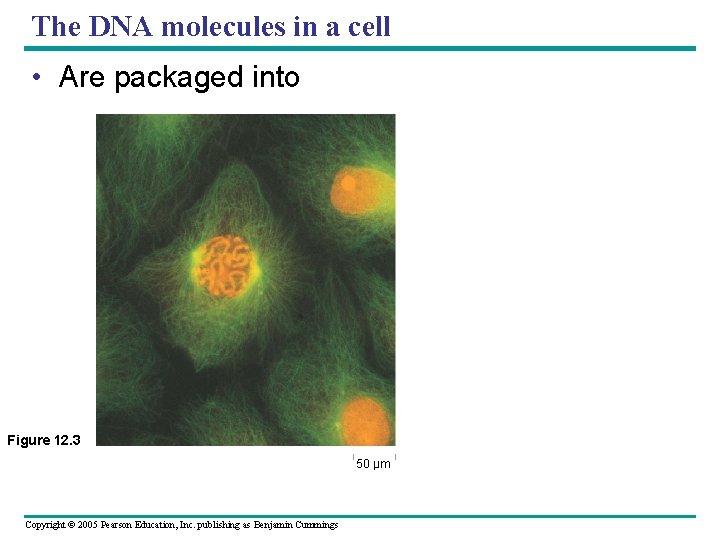
The DNA molecules in a cell • Are packaged into Figure 12. 3 50 µm Copyright © 2005 Pearson Education, Inc. publishing as Benjamin Cummings
• Eukaryotic chromosomes – Consist of , a complex of DNA and protein that condenses during cell division • In animals – have two sets of chromosomes – have one set of chromosomes Copyright © 2005 Pearson Education, Inc. publishing as Benjamin Cummings
Distribution of Chromosomes During Cell Division • In preparation for cell division – DNA is replicated and the chromosomes condense Copyright © 2005 Pearson Education, Inc. publishing as Benjamin Cummings
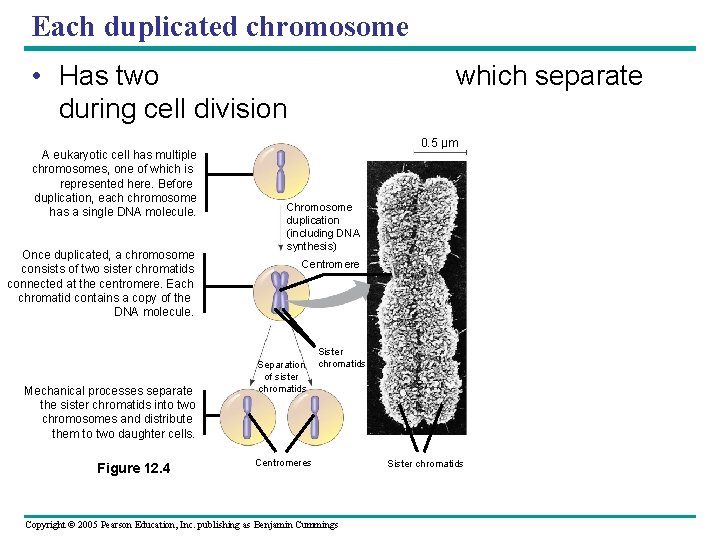
Each duplicated chromosome • Has two during cell division A eukaryotic cell has multiple chromosomes, one of which is represented here. Before duplication, each chromosome has a single DNA molecule. Once duplicated, a chromosome consists of two sister chromatids connected at the centromere. Each chromatid contains a copy of the DNA molecule. Mechanical processes separate the sister chromatids into two chromosomes and distribute them to two daughter cells. Figure 12. 4 which separate 0. 5 µm Chromosome duplication (including DNA synthesis) Centromere Separation of sister chromatids Sister chromatids Centromeres Copyright © 2005 Pearson Education, Inc. publishing as Benjamin Cummings Sister chromatids
• Eukaryotic cell division consists of – the division of the nucleus – , the division of the cytoplasm Copyright © 2005 Pearson Education, Inc. publishing as Benjamin Cummings
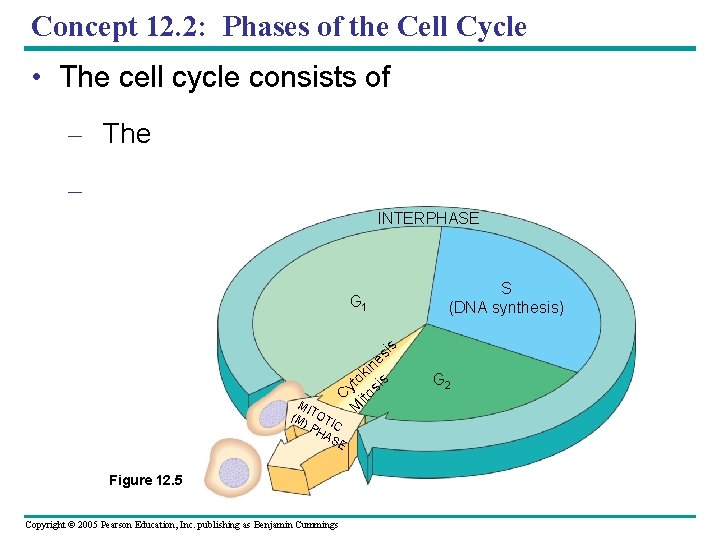
Concept 12. 2: Phases of the Cell Cycle • The cell cycle consists of – The – INTERPHASE S (DNA synthesis) C M yto ito ki si ne s si s G 1 MI (M TOT ) P IC HA SE Figure 12. 5 Copyright © 2005 Pearson Education, Inc. publishing as Benjamin Cummings G 2
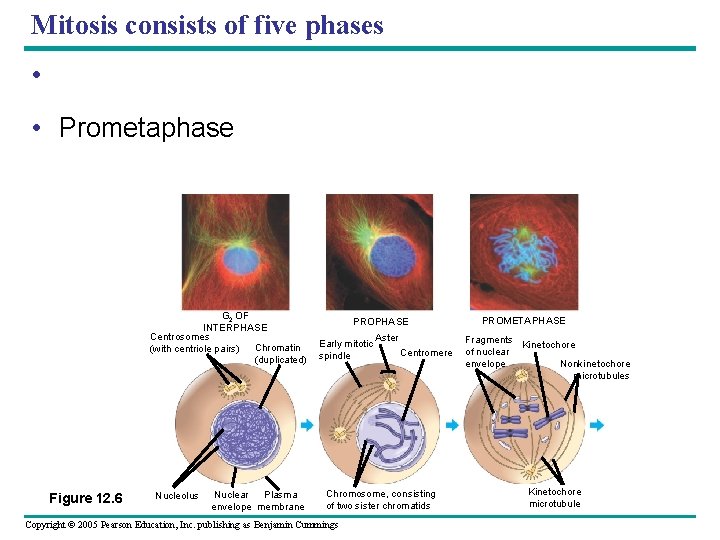
Mitosis consists of five phases • • Prometaphase G 2 OF INTERPHASE Centrosomes Chromatin (with centriole pairs) (duplicated) Figure 12. 6 Nucleolus Nuclear Plasma envelope membrane PROPHASE Early mitotic spindle Aster Centromere Chromosome, consisting of two sister chromatids Copyright © 2005 Pearson Education, Inc. publishing as Benjamin Cummings PROMETAPHASE Fragments Kinetochore of nuclear envelope Nonkinetochore microtubules Kinetochore microtubule
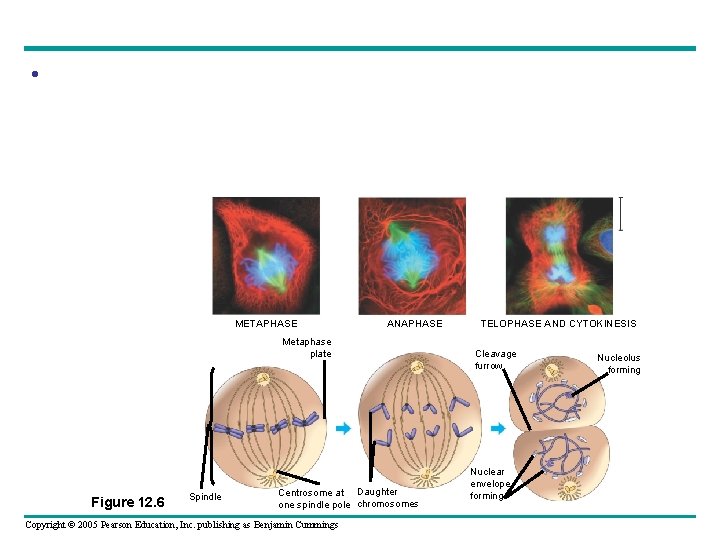
• METAPHASE ANAPHASE Metaphase plate Figure 12. 6 Spindle Centrosome at Daughter one spindle pole chromosomes Copyright © 2005 Pearson Education, Inc. publishing as Benjamin Cummings TELOPHASE AND CYTOKINESIS Cleavage furrow Nuclear envelope forming Nucleolus forming
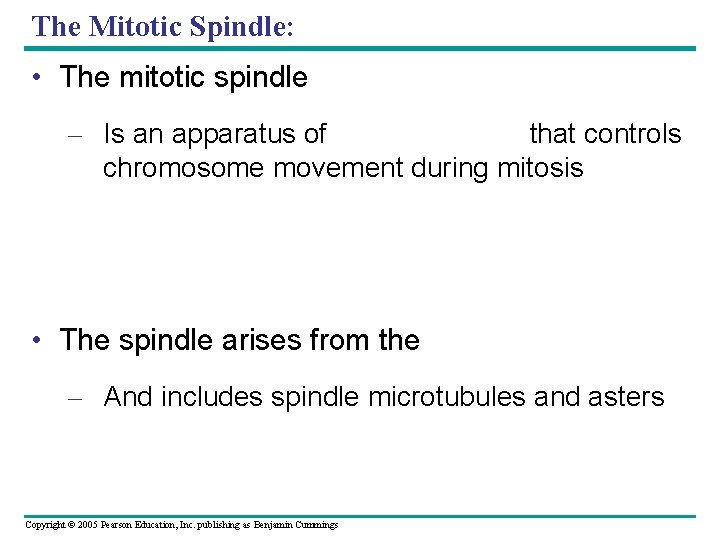
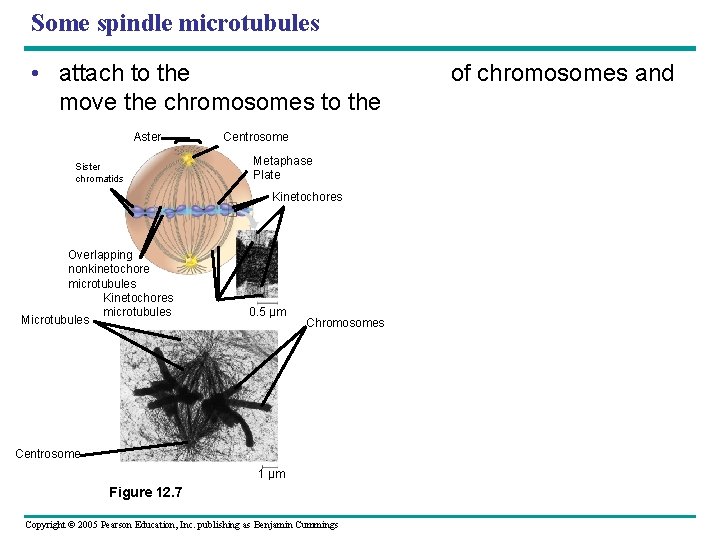
The Mitotic Spindle: • The mitotic spindle – Is an apparatus of that controls chromosome movement during mitosis • The spindle arises from the – And includes spindle microtubules and asters Copyright © 2005 Pearson Education, Inc. publishing as Benjamin Cummings
Some spindle microtubules • attach to the move the chromosomes to the Aster Sister chromatids Centrosome Metaphase Plate Kinetochores Overlapping nonkinetochore microtubules Kinetochores microtubules Microtubules 0. 5 µm Chromosomes Centrosome 1 µm Figure 12. 7 Copyright © 2005 Pearson Education, Inc. publishing as Benjamin Cummings of chromosomes and
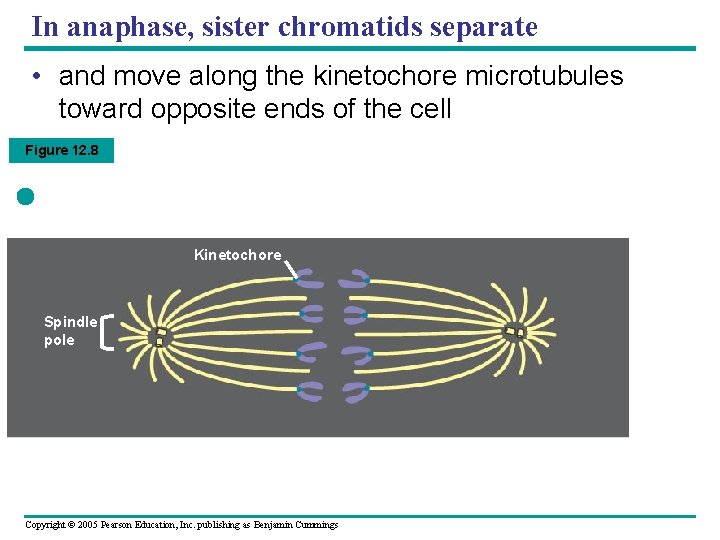
In anaphase, sister chromatids separate • and move along the kinetochore microtubules toward opposite ends of the cell Figure 12. 8 Kinetochore Spindle pole Copyright © 2005 Pearson Education, Inc. publishing as Benjamin Cummings
• Nonkinetechore microtubules from opposite poles – Overlap and push against each other, elongating the cell • In telophase – Genetically identical daughter nuclei form at opposite ends of the cell Copyright © 2005 Pearson Education, Inc. publishing as Benjamin Cummings
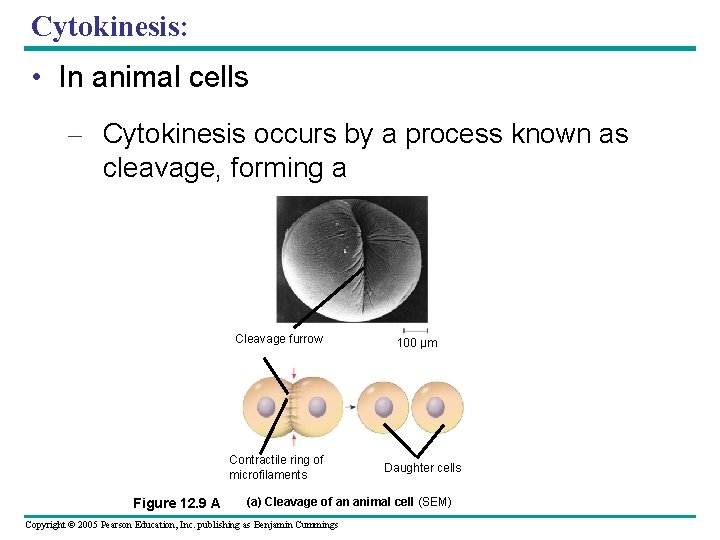
Cytokinesis: • In animal cells – Cytokinesis occurs by a process known as cleavage, forming a Cleavage furrow Contractile ring of microfilaments Figure 12. 9 A 100 µm Daughter cells (a) Cleavage of an animal cell (SEM) Copyright © 2005 Pearson Education, Inc. publishing as Benjamin Cummings
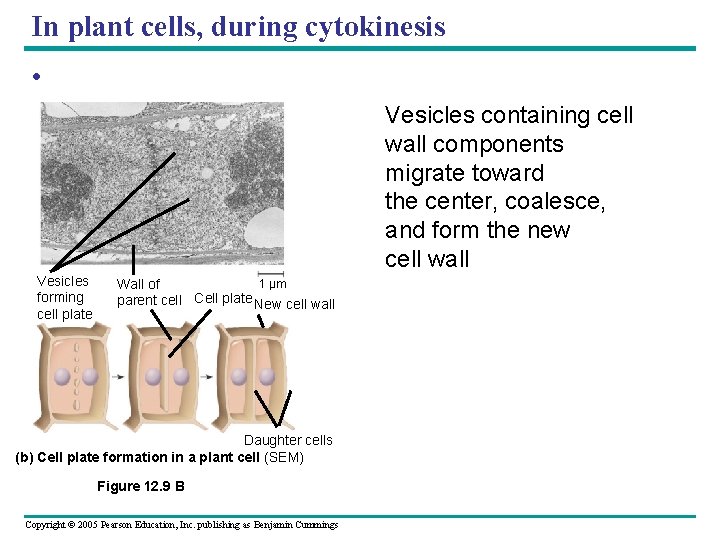
In plant cells, during cytokinesis • Vesicles containing cell wall components migrate toward the center, coalesce, and form the new cell wall Vesicles forming cell plate 1 µm Wall of parent cell Cell plate New cell wall Daughter cells (b) Cell plate formation in a plant cell (SEM) Figure 12. 9 B Copyright © 2005 Pearson Education, Inc. publishing as Benjamin Cummings
Prokaryotes • reproduce by a type of cell division called – The bacterial chromosome replicates – The two daughter chromosomes move apart – Plasma membrane “pinches” inward forming two new daughter cells Copyright © 2005 Pearson Education, Inc. publishing as Benjamin Cummings
Concept 12. 3: • The cell cycle is regulated by a molecular control system • The frequency of cell division varies with the type of cell • These cell cycle differences result from regulation at the molecular level Copyright © 2005 Pearson Education, Inc. publishing as Benjamin Cummings
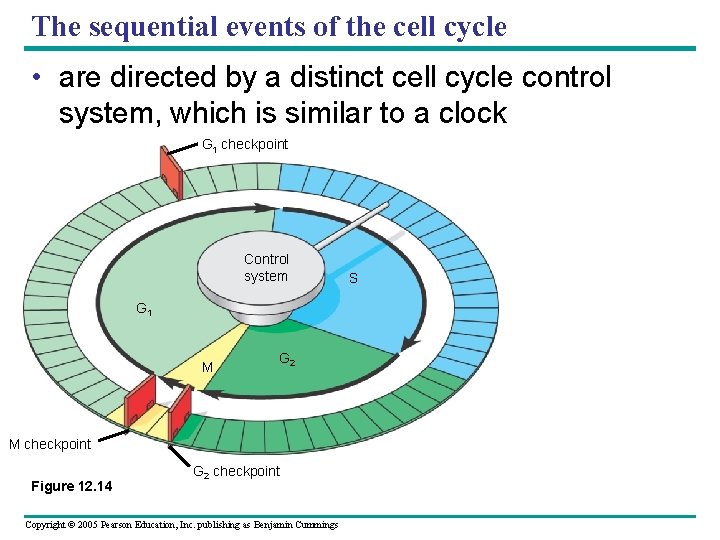
The sequential events of the cell cycle • are directed by a distinct cell cycle control system, which is similar to a clock G 1 checkpoint Control system G 1 M G 2 M checkpoint Figure 12. 14 G 2 checkpoint Copyright © 2005 Pearson Education, Inc. publishing as Benjamin Cummings S
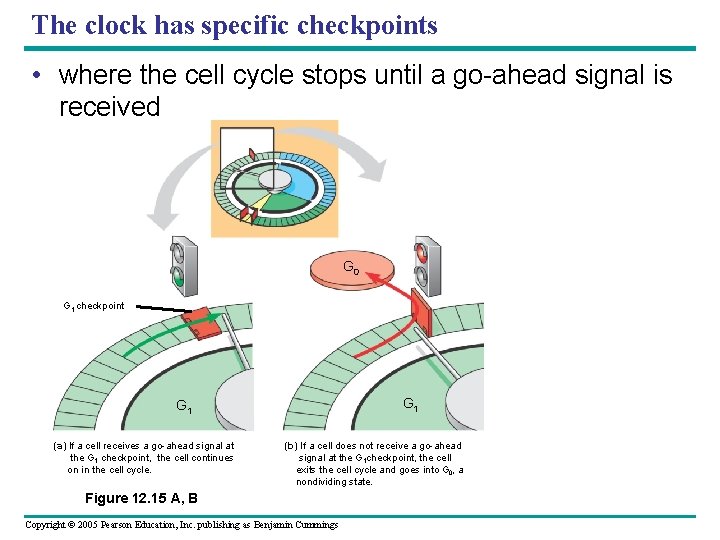
The clock has specific checkpoints • where the cell cycle stops until a go-ahead signal is received G 0 G 1 checkpoint G 1 (a) If a cell receives a go-ahead signal at the G 1 checkpoint, the cell continues on in the cell cycle. (b) If a cell does not receive a go-ahead signal at the G 1 checkpoint, the cell exits the cell cycle and goes into G 0, a nondividing state. Figure 12. 15 A, B Copyright © 2005 Pearson Education, Inc. publishing as Benjamin Cummings
The Cell Cycle Clock: Cyclins and Cyclin-Dependent Kinases • Two types of regulatory proteins are involved in cell cycle control • and Copyright © 2005 Pearson Education, Inc. publishing as Benjamin Cummings (Cdks)
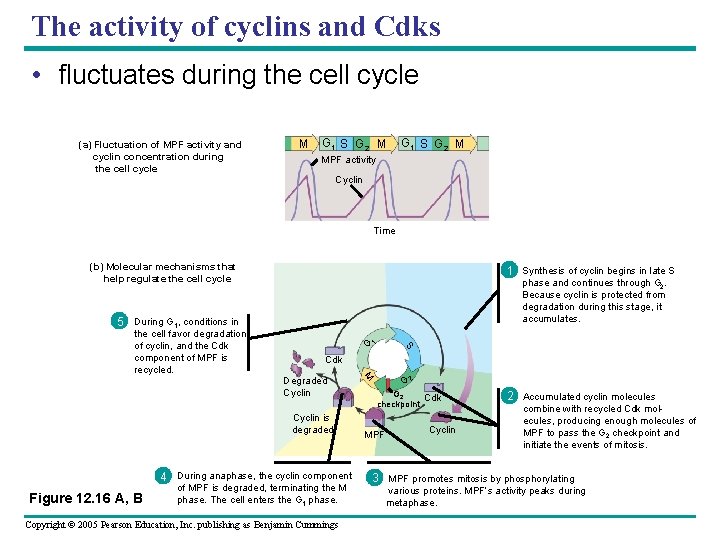
The activity of cyclins and Cdks • fluctuates during the cell cycle (a) Fluctuation of MPF activity and cyclin concentration during the cell cycle M G 1 S G 2 M MPF activity Cyclin Time (b) Molecular mechanisms that help regulate the cell cycle 1 Synthesis of cyclin begins in late S phase and continues through G 2. Because cyclin is protected from degradation during this stage, it accumulates. G 4 During anaphase, the cyclin component of MPF is degraded, terminating the M phase. The cell enters the G 1 phase. Copyright © 2005 Pearson Education, Inc. publishing as Benjamin Cummings 2 G Degraded Cyclin is degraded Figure 12. 16 A, B S Cdk M the cell favor degradation of cyclin, and the Cdk component of MPF is recycled. 1 5 During G 1, conditions in G 2 Cdk checkpoint MPF Cyclin 2 Accumulated cyclin molecules combine with recycled Cdk molecules, producing enough molecules of MPF to pass the G 2 checkpoint and initiate the events of mitosis. 3 MPF promotes mitosis by phosphorylating various proteins. MPF‘s activity peaks during metaphase.
Stop and Go Signs: Internal and External Signals at the Checkpoints • Both intracellular and extracellular signals – Control the cell cycle checkpoints Copyright © 2005 Pearson Education, Inc. publishing as Benjamin Cummings
Intracellular Signal • Sister chromatids at the metaphase plate will not separate unless all are attached to – Why is this important? Copyright © 2005 Pearson Education, Inc. publishing as Benjamin Cummings
Extracellular Signal • stimulate other cells to divide – i. e. platelet derived growth factor (PDGF) • stimulates fibroblast division Copyright © 2005 Pearson Education, Inc. publishing as Benjamin Cummings
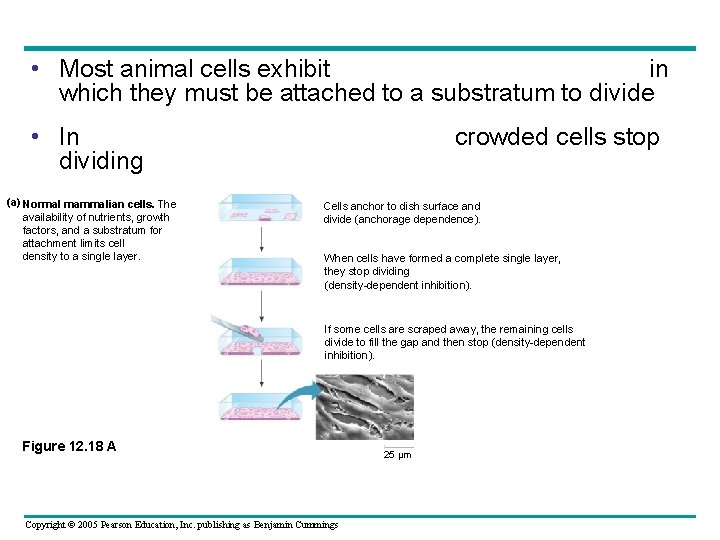
• Most animal cells exhibit in which they must be attached to a substratum to divide • In dividing (a) Normal mammalian cells. The availability of nutrients, growth factors, and a substratum for attachment limits cell density to a single layer. crowded cells stop Cells anchor to dish surface and divide (anchorage dependence). When cells have formed a complete single layer, they stop dividing (density-dependent inhibition). If some cells are scraped away, the remaining cells divide to fill the gap and then stop (density-dependent inhibition). Figure 12. 18 A Copyright © 2005 Pearson Education, Inc. publishing as Benjamin Cummings 25 µm
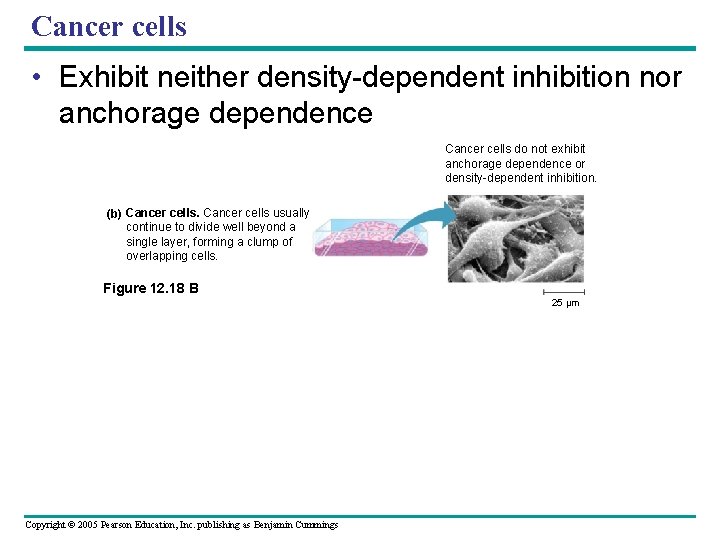
Cancer cells • Exhibit neither density-dependent inhibition nor anchorage dependence Cancer cells do not exhibit anchorage dependence or density-dependent inhibition. (b) Cancer cells usually continue to divide well beyond a single layer, forming a clump of overlapping cells. Figure 12. 18 B 25 µm Copyright © 2005 Pearson Education, Inc. publishing as Benjamin Cummings
Loss of Cell Cycle Controls in Cancer Cells • Cancer cells – Do not respond normally to the body’s control mechanisms – Form tumors Copyright © 2005 Pearson Education, Inc. publishing as Benjamin Cummings
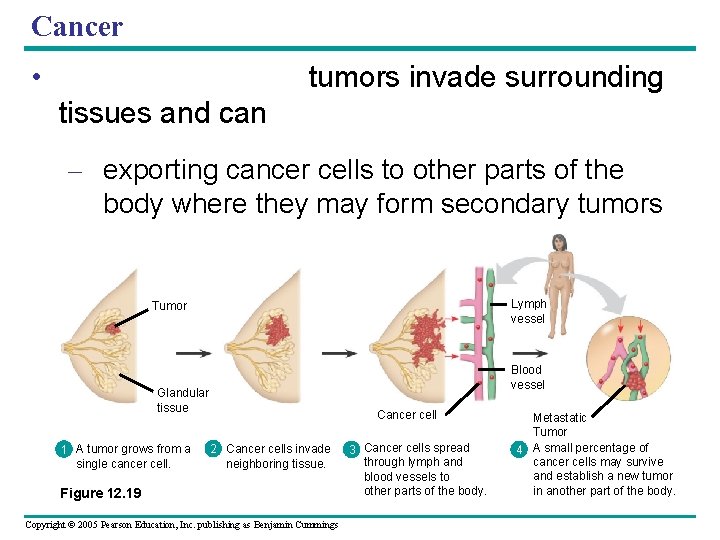
Cancer • tumors invade surrounding tissues and can – exporting cancer cells to other parts of the body where they may form secondary tumors Lymph vessel Tumor Blood vessel Glandular tissue 1 A tumor grows from a single cancer cell. Cancer cell 2 Cancer cells invade neighboring tissue. Figure 12. 19 Copyright © 2005 Pearson Education, Inc. publishing as Benjamin Cummings 3 Cancer cells spread through lymph and blood vessels to other parts of the body. Metastatic Tumor 4 A small percentage of cancer cells may survive and establish a new tumor in another part of the body.