
Chapter 12 The Brain Regions of the Brain
Chapter 12 The Brain

Regions of the Brain · Cerebral hemispheres · Diencephalon · Brain stem · Cerebellum Copyright © 2003 Pearson Education, Inc. publishing as Benjamin Cummings Figure 7. 12 Slide 7. 27

Cerebral Hemispheres (Cerebrum) · The surface is made of ridges (gyri) and grooves (sulci) Figure 7. 13 a Copyright © 2003 Pearson Education, Inc. publishing as Benjamin Cummings Slide 7. 28 b
Cerebral Cortex analyze sensory data n perform memory functions n learn new information n form thoughts and make decisions. n
Left Hemisphere Sequential Analysis: systematic, logical interpretation of information. n Language n Mathematics n abstraction and reasoning. n
Right Hemisphere Holistic Functioning: processing multi-sensory input simultaneously to provide "holistic" picture of one's environment. n Artistic, creative, music n
Corpus Callosum n Connects right and left hemisphere.

Frontal Lobe n Involved in planning, organizing, problem solving, selective attention, personality and a variety of "higher cognitive functions" including behavior and emotions.
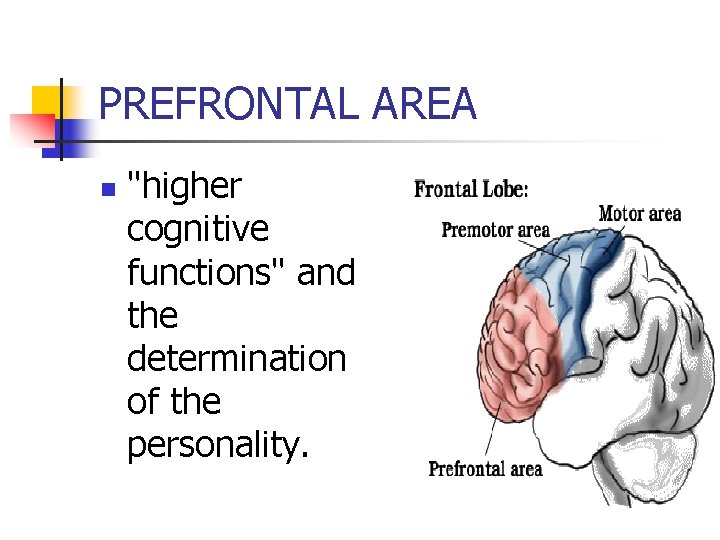
PREFRONTAL AREA n "higher cognitive functions" and the determination of the personality.
Occipital Lobe Visual information. n Visual recognition of shapes and colors. n

Parietal Lobe Contain the primary sensory cortex which controls sensation (touch, pressure). n Controls fine sensation (judgment of texture, weight, size, shape). Body orientation. n

Temporal Lobe Allow a person to tell one smell from another and one sound from another. n Help in sorting new information and are believed to be responsible for short-term memory. n
Right Lobe (Temporal) n Mainly involved in visual memory (i. e. , memory for pictures and faces).
Left Lobe (Temporal) n Mainly involved in verbal memory (i. e. , memory for words and names).

DIENCEPHALON n n n Sits on top of the brain stem Enclosed by the cerebral heispheres Made of three parts n n n Thalamus Hypothalamus Epithalamus

Thalamus · Surrounds the third ventricle · The relay station for sensory impulses · Transfers impulses to the correct part of the cortex for localization and interpretation Copyright © 2003 Pearson Education, Inc. publishing as Benjamin Cummings Slide 7. 35
Hypothalamus · Under the thalamus · Important autonomic nervous system center · Helps regulate body temperature · Controls water balance · Regulates metabolism · An important part of the limbic system (emotions) Copyright © 2003 Pearson Education, Inc. publishing as Benjamin Cummings Slide 7. 36 a
Epithalamus · Houses the pineal body (an endocrine gland) · Includes the choroid plexus – forms cerebrospinal fluid Copyright © 2003 Pearson Education, Inc. publishing as Benjamin Cummings Slide 7. 37
Brain Stem · Attaches to the spinal cord · Parts of the brain stem · Midbrain · Pons · Medulla oblongata Copyright © 2003 Pearson Education, Inc. publishing as Benjamin Cummings Slide 7. 38 a
Midbrain · Mostly composed of tracts of nerve fibers · Reflex centers for vision and hearing Copyright © 2003 Pearson Education, Inc. publishing as Benjamin Cummings Slide 7. 39
Pons Serves as a relay station from the medulla. n It contains the respiratory center. n
Medulla Oblongata · The lowest part of the brain stem · Merges into the spinal cord · Contains important control centers · Heart rate control · Blood pressure regulation · Breathing · Swallowing · Vomiting Copyright © 2003 Pearson Education, Inc. publishing as Benjamin Cummings Slide 7. 41

Cerebellum n Helps coordinate movement (balance and muscle coordination).
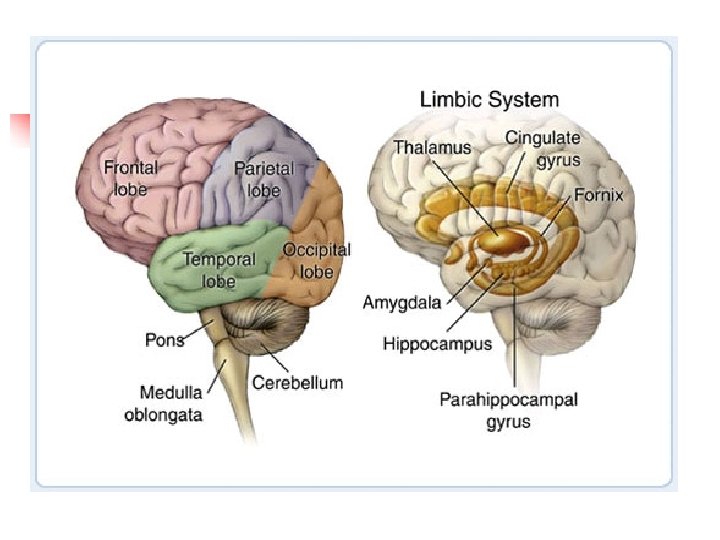
LIMBIC SYSTEM n a group of interconnected structures that mediate emotions, learning and memory.
Cingulate gyrus n plays a role in processing conscious emotional experience.

Fornix n an arch-like structure that connects the hippocampus to other parts of the limbic system.
Parahippocampal gyrus n an important connecting pathway of the limbic system.
Hippocampus – n plays a significant role in the formation of long-term memories
Amygdala n limbic structure involved in many brain functions, including emotion, learning and memory. It is part of a system that processes "reflective" emotions like fear and anxiety.
- Slides: 30