
Chapter 12 Tables and Priority Queues CS 102
Chapter 12 Tables and Priority Queues CS 102 Sections 51 and 52 Marc Smith and Jim Ten Eyck Spring 2008 © 2006 Pearson Addison-Wesley. All rights reserved 1
The ADT Table • The ADT table, or dictionary – Uses a search key to identify its items – Its items are records that contain several pieces of data Figure 12 -1 An ordinary table of cities © 2006 Pearson Addison-Wesley. All rights reserved 2
The ADT Table • Operations of the ADT table – – – – Create an empty table Determine whether a table is empty Determine the number of items in a table Insert a new item into a table Delete the item with a given search key from a table Retrieve the item with a given search key from a table Traverse the items in a table in sorted search-key order © 2006 Pearson Addison-Wesley. All rights reserved 3
The ADT Table • Pseudocode for the operations of the ADT table create. Table() // Creates an empty table. Is. Empty() // Determines whether a table is empty. table. Length() // Determines the number of items in a table. Insert(new. Item) throws Table. Exception // Inserts new. Item into a table whose items have // distinct search keys that differ from new. Item’s // search key. Throws Table. Exception if the // insertion is not successful © 2006 Pearson Addison-Wesley. All rights reserved 4

The ADT Table • Pseudocode for the operations of the ADT table (Continued) table. Delete(search. Key) // Deletes from a table the item whose search key // equals search. Key. Returns false if no such item // exists. Returns true if the deletion was // successful. table. Retrieve(search. Key) // Returns the item in a table whose search key // equals search. Key. Returns null if no such item // exists. table. Traverse() // Traverses a table in sorted search-key order. © 2006 Pearson Addison-Wesley. All rights reserved 5
The ADT Table • Value of the search key for an item must remain the same as long as the item is stored in the table • Keyed. Item class – Contains an item’s search key and a method for accessing the search-key data field – Prevents the search-key value from being modified once an item is created • Table. Interface interface – Defines the table operations © 2006 Pearson Addison-Wesley. All rights reserved 6
Selecting an Implementation • Categories of linear implementations – – Unsorted, array based Unsorted, referenced based Sorted (by search key), array based Sorted (by search key), reference based Figure 12 -3 The data fields for two sorted linear implementations of the ADT table for the data in Figure 12 -1: a) array based; b) reference based © 2006 Pearson Addison-Wesley. All rights reserved 7
Selecting an Implementation • A binary search implementation – A nonlinear implementation Figure 12 -4 The data fields for a binary search tree implementation of the ADT table for the data in Figure 12 -1 © 2006 Pearson Addison-Wesley. All rights reserved 8
Selecting an Implementation • The binary search tree implementation offers several advantages over linear implementations • The requirements of a particular application influence the selection of an implementation – Questions to be considered about an application before choosing an implementation • What operations are needed? • How often is each operation required? © 2006 Pearson Addison-Wesley. All rights reserved 9
Scenario A: Insertion and Traversal in No Particular Order • An unsorted order in efficient – Both array based and reference based table. Insert operation is O(1) • Array based versus reference based – If a good estimate of the maximum possible size of the table is not available • Reference based implementation is preferred – If a good estimate of the maximum possible size of the table is available • The choice is mostly a matter of style © 2006 Pearson Addison-Wesley. All rights reserved 10
Scenario A: Insertion and Traversal in No Particular Order Figure 12 -5 Insertion for unsorted linear implementations: a) array based; b) reference based © 2006 Pearson Addison-Wesley. All rights reserved 11
Scenario A: Insertion and Traversal in No Particular Order • A binary search tree implementation is not appropriate – It does more work than the application requires • It orders the table items – The insertion operation is O(log n) in the average case © 2006 Pearson Addison-Wesley. All rights reserved 12
Scenario B: Retrieval • Binary search – An array-based implementation • Binary search can be used if the array is sorted – A reference-based implementation • Binary search can be performed, but is too inefficient to be practical • A binary search of an array is more efficient than a sequential search of a linked list – Binary search of an array • Worst case: O(log 2 n) – Sequential search of a linked list • O(n) © 2006 Pearson Addison-Wesley. All rights reserved 13
Scenario B: Retrieval • For frequent retrievals – If the table’s maximum size is known • A sorted array-based implementation is appropriate – If the table’s maximum size is not known • A binary search tree implementation is appropriate © 2006 Pearson Addison-Wesley. All rights reserved 14
Scenario C: Insertion, Deletion, Retrieval, and Traversal in Sorted Order • Steps performed by both insertion and deletion – Step 1: Find the appropriate position in the table – Step 2: Insert into (or delete from) this position • Step 1 – An array-based implementation is superior than a reference-based implementation • Step 2 – A reference-based implementation is superior than an array-based implementation • A sorted array-based implementation shifts data during insertions and deletions © 2006 Pearson Addison-Wesley. All rights reserved 15
Scenario C: Insertion, Deletion, Retrieval, and Traversal in Sorted Order Figure 12 -6 Insertion for sorted linear implementations: a) array based; b) reference based © 2006 Pearson Addison-Wesley. All rights reserved 16
Scenario C: Insertion, Deletion, Retrieval, and Traversal in Sorted Order • Insertion and deletion operations – Both sorted linear implementations are comparable, but neither is suitable • table. Insert and table. Delete operations – Sorted array-based implementation is O(n) – Sorted reference-based implementation is O(n) – Binary search tree implementation is suitable • It combines the best features of the two linear implementations © 2006 Pearson Addison-Wesley. All rights reserved 17
A Sorted Array-Based Implementation of the ADT Table • Linear implementations – Useful for many applications despite certain difficulties • A binary search tree implementation – In general, can be a better choice than a linear implementation • A balanced binary search tree implementation – Increases the efficiency of the ADT table operations © 2006 Pearson Addison-Wesley. All rights reserved 18
A Sorted Array-Based Implementation of the ADT Table Figure 12 -7 The average-case order of the operations of the ADT table for various implementations © 2006 Pearson Addison-Wesley. All rights reserved 19
A Sorted Array-Based Implementation of the ADT Table • Reasons for studying linear implementations – Perspective – Efficiency – Motivation • Table. Array. Based class – Provides an array-based implementation of the ADT table – Implements Table. Interface © 2006 Pearson Addison-Wesley. All rights reserved 20
A Binary Search Tree Implementation of the ADT Table • Table. BSTBased class – Represents a nonlinear reference-based implementation of the ADT table – Uses a binary search tree to represent the items in the ADT table • Reuses the class Binary. Search. Tree © 2006 Pearson Addison-Wesley. All rights reserved 21
The ADT Priority Queue: A Variation of the ADT Table • The ADT priority queue – Orders items by a priority value – The first item removed is the one having the highest priority value • Operations of the ADT priority queue – – Create an empty priority queue Determine whether a priority queue is empty Insert a new item into a priority queue Retrieve and then delete the item in a priority queue with the highest priority value © 2006 Pearson Addison-Wesley. All rights reserved 22
The ADT Priority Queue: A Variation of the ADT Table • Pseudocode for the operations of the ADT priority queue create. PQueue() // Creates an empty priority queue. pq. Is. Empty() // Determines whether a priority queue is // empty. © 2006 Pearson Addison-Wesley. All rights reserved 23
The ADT Priority Queue: A Variation of the ADT Table • Pseudocode for the operations of the ADT priority queue (Continued) pq. Insert(new. Item) throws PQueue. Exception // Inserts new. Item into a priority queue. // Throws PQueue. Exception if priority queue is // full. pq. Delete() // Retrieves and then deletes the item in a // priority queue with the highest priority // value. © 2006 Pearson Addison-Wesley. All rights reserved 24
The ADT Priority Queue: A Variation of the ADT Table • Possible implementations – Sorted linear implementations • Appropriate if the number of items in the priority queue is small • Array-based implementation – Maintains the items sorted in ascending order of priority value • Reference-based implementation – Maintains the items sorted in descending order of priority value © 2006 Pearson Addison-Wesley. All rights reserved 25
The ADT Priority Queue: A Variation of the ADT Table Figure 12 -9 a and 12 -9 b Some implementations of the ADT priority queue: a) array based; b) reference based © 2006 Pearson Addison-Wesley. All rights reserved 26
The ADT Priority Queue: A Variation of the ADT Table • Possible implementations (Continued) – Binary search tree implementation • Appropriate for any priority queue Figure 12 -9 c Some implementations of the ADT priority queue: c) binary search tree © 2006 Pearson Addison-Wesley. All rights reserved 27
Heaps • A heap is a complete binary tree – That is empty or – Whose root contains a search key greater than or equal to the search key in each of its children, and – Whose root has heaps as its subtrees © 2006 Pearson Addison-Wesley. All rights reserved 28
Heaps • Maxheap – A heap in which the root contains the item with the largest search key • Minheap – A heap in which the root contains the item with the smallest search key © 2006 Pearson Addison-Wesley. All rights reserved 29
Heaps • Pseudocode for the operations of the ADT heap create. Heap() // Creates an empty heap. Is. Empty() // Determines whether a heap is empty. heap. Insert(new. Item) throws Heap. Exception // Inserts new. Item into a heap. Throws // Heap. Exception if heap is full. heap. Delete() // Retrieves and then deletes a heap’s root // item. This item has the largest search key. © 2006 Pearson Addison-Wesley. All rights reserved 30
Heaps: An Array-based Implementation of a Heap • Data fields – items: an array of heap items – size: an integer equal to the number of items in the heap Figure 12 -11 A heap with its array representation © 2006 Pearson Addison-Wesley. All rights reserved 31
Heaps: heap. Delete • Step 1: Return the item in the root – Results in disjoint heaps Figure 12 -12 a a) Disjoint heaps © 2006 Pearson Addison-Wesley. All rights reserved 32
Heaps: heap. Delete • Step 2: Copy the item from the last node into the root – Results in a semiheap Figure 12 -12 b b) a semiheap © 2006 Pearson Addison-Wesley. All rights reserved 33
Heaps: heap. Delete • Step 3: Transform the semiheap back into a heap – Performed by the recursive algorithm heap. Rebuild Figure 12 -14 Recursive calls to heap. Rebuild © 2006 Pearson Addison-Wesley. All rights reserved 34
Heaps: heap. Delete • Efficiency – heap. Delete is O(log n) Figure 12 -13 Deletion from a heap © 2006 Pearson Addison-Wesley. All rights reserved 35
Heaps: heap. Insert • Strategy – Insert new. Item into the bottom of the tree – Trickle new item up to appropriate spot in the tree • Efficiency: O(log n) • Heap class – Represents an array-based implementation of the ADT heap Figure 12 -15 Insertion into a heap © 2006 Pearson Addison-Wesley. All rights reserved 36
A Heap Implementation of the ADT Priority Queue • Priority-queue operations and heap operations are analogous – The priority value in a priority-queue corresponds to a heap item’s search key • Priority. Queue class – Has an instance of the Heap class as its data field © 2006 Pearson Addison-Wesley. All rights reserved 37
A Heap Implementation of the ADT Priority Queue • A heap implementation of a priority queue – Disadvantage • Requires the knowledge of the priority queue’s maximum size – Advantage • A heap is always balanced • Finite, distinct priority values – A heap of queues • Useful when a finite number of distinct priority values are used, which can result in many items having the same priority value © 2006 Pearson Addison-Wesley. All rights reserved 38
Heapsort • Strategy – Transforms the array into a heap – Removes the heap's root (the largest element) by exchanging it with the heap’s last element – Transforms the resulting semiheap back into a heap • Efficiency – Compared to mergesort • Both heapsort and mergesort are O(n * log n) in both the worst and average cases • Advantage over mergesort – Heapsort does not require a second array – Compared to quicksort • Quicksort is the preferred sorting method © 2006 Pearson Addison-Wesley. All rights reserved 39
Heapsort Figure 12 -16 a) The initial contents of an. Array; b) an. Array’s corresponding binary tree Figure 12 -18 Heapsort partitions an array into two regions © 2006 Pearson Addison-Wesley. All rights reserved 40
Tables and Priority Queues in JFC: The JFC Map Interface • Map interface – Provides the basis for numerous other implementations of different kinds of maps • public interface Map<K, V> – – – methods void clear() boolean contains. Key(Object key) boolean contains. Value(Object value) Set<Map. Entry<K, V>> entry. Set() V get(Object key); © 2006 Pearson Addison-Wesley. All rights reserved 41
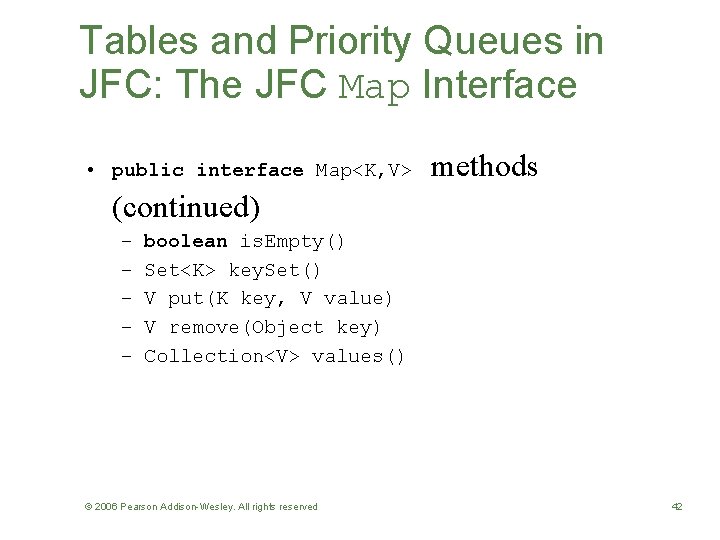
Tables and Priority Queues in JFC: The JFC Map Interface • public interface Map<K, V> methods (continued) – – – boolean is. Empty() Set<K> key. Set() V put(K key, V value) V remove(Object key) Collection<V> values() © 2006 Pearson Addison-Wesley. All rights reserved 42
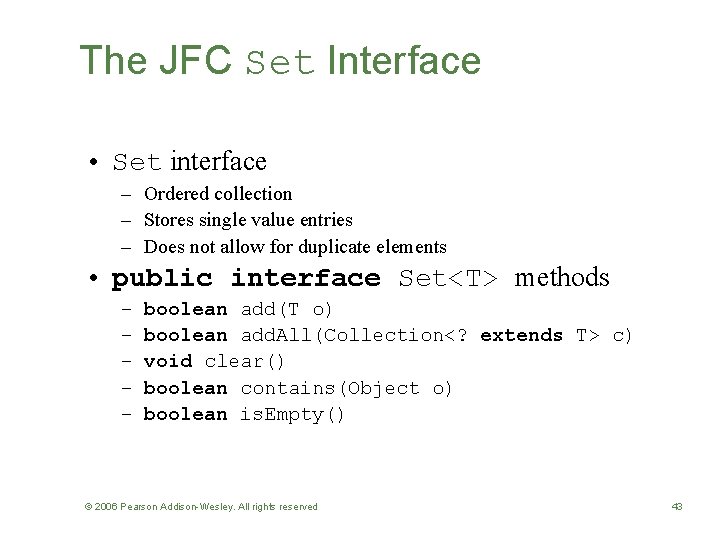
The JFC Set Interface • Set interface – Ordered collection – Stores single value entries – Does not allow for duplicate elements • public interface Set<T> methods – – – boolean add(T o) boolean add. All(Collection<? extends T> c) void clear() boolean contains(Object o) boolean is. Empty() © 2006 Pearson Addison-Wesley. All rights reserved 43
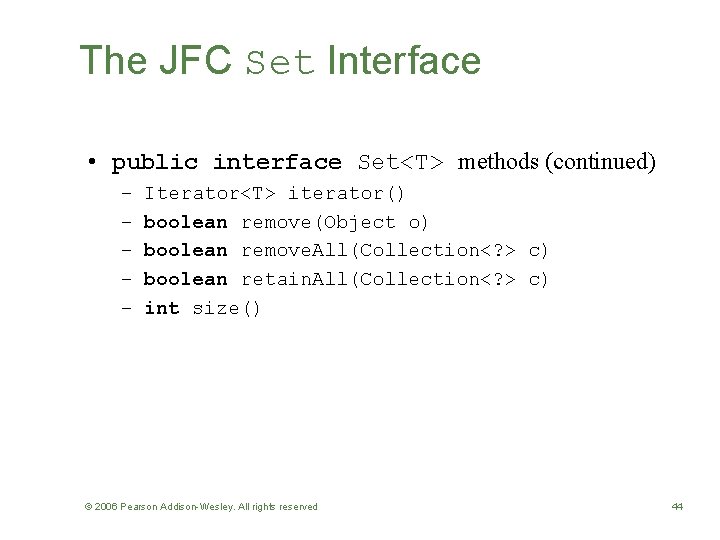
The JFC Set Interface • public interface Set<T> methods (continued) – – – Iterator<T> iterator() boolean remove(Object o) boolean remove. All(Collection<? > c) boolean retain. All(Collection<? > c) int size() © 2006 Pearson Addison-Wesley. All rights reserved 44
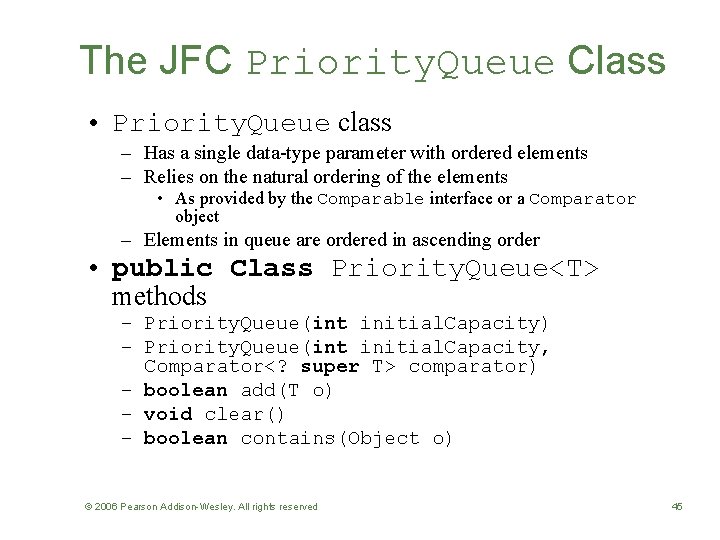
The JFC Priority. Queue Class • Priority. Queue class – Has a single data-type parameter with ordered elements – Relies on the natural ordering of the elements • As provided by the Comparable interface or a Comparator object – Elements in queue are ordered in ascending order • public Class Priority. Queue<T> methods – Priority. Queue(int initial. Capacity) – Priority. Queue(int initial. Capacity, Comparator<? super T> comparator) – boolean add(T o) – void clear() – boolean contains(Object o) © 2006 Pearson Addison-Wesley. All rights reserved 45
The JFC Priority. Queue Class • public Class Priority. Queue<T> methods (continued) – – – – Comparator<? super T> comparator() T element() Iterator<T> iterator() boolean offer(T o) T peek() T poll() boolean remove(Object o) int size() © 2006 Pearson Addison-Wesley. All rights reserved 46
Summary • The ADT table supports value-oriented operations • The linear implementations (array based and reference based) of a table are adequate only in limited situations or for certain operations • A nonlinear reference-based (binary search tree) implementation of the ADT table provides the best aspects of the two linear implementations • A priority queue, a variation of the ADT table, has operations which allow you to retrieve and remove the item with the largest priority value © 2006 Pearson Addison-Wesley. All rights reserved 47
Summary • A heap that uses an array-based representation of a complete binary tree is a good implementation of a priority queue when you know the maximum number of items that will be stored at any one time • Efficiency – Heapsort, like mergesort, has good worst-case and average-case behaviors, but neither algorithms is as good in the average case as quicksort – Heapsort has an advantage over mergesort in that it does not require a second array • Tables and priority queues in JFC – Map interface – Set interface – Priority. Queue class © 2006 Pearson Addison-Wesley. All rights reserved 48
- Slides: 48