
Chapter 12 Sustaining Change Mc GrawHillIrwin Copyright 2009


- Slides: 9
Chapter 12 Sustaining Change Mc. Graw-Hill/Irwin Copyright © 2009 by The Mc. Graw-Hill Companies, Inc. All rights reserved.
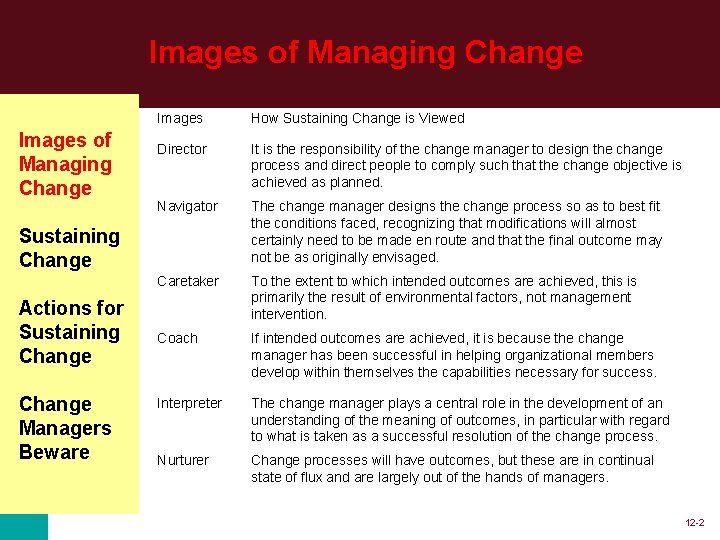
Images of Managing Change Images How Sustaining Change is Viewed Director It is the responsibility of the change manager to design the change process and direct people to comply such that the change objective is achieved as planned. Navigator The change manager designs the change process so as to best fit the conditions faced, recognizing that modifications will almost certainly need to be made en route and that the final outcome may not be as originally envisaged. Caretaker To the extent to which intended outcomes are achieved, this is primarily the result of environmental factors, not management intervention. Coach If intended outcomes are achieved, it is because the change manager has been successful in helping organizational members develop within themselves the capabilities necessary for success. Interpreter The change manager plays a central role in the development of an understanding of the meaning of outcomes, in particular with regard to what is taken as a successful resolution of the change process. Nurturer Change processes will have outcomes, but these are in continual state of flux and are largely out of the hands of managers. Sustaining Change Actions for Sustaining Change Managers Beware 12 -2
Sustaining Change Images of Managing Change Sustaining Change Actions for Sustaining Change Managers Beware • Once implemented, change is not always embedded in an organization • The ability to make the change “stick” indicates the long-term success of the change • There a number of actions that can help sustain change. 12 -3
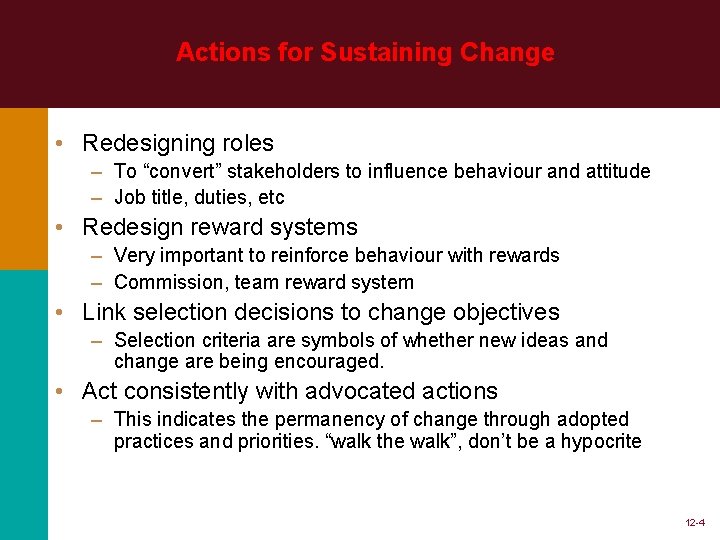
Actions for Sustaining Change • Redesigning roles – To “convert” stakeholders to influence behaviour and attitude – Job title, duties, etc • Redesign reward systems – Very important to reinforce behaviour with rewards – Commission, team reward system • Link selection decisions to change objectives – Selection criteria are symbols of whether new ideas and change are being encouraged. • Act consistently with advocated actions – This indicates the permanency of change through adopted practices and priorities. “walk the walk”, don’t be a hypocrite 12 -4
Actions for Sustaining Change (2) • Encourage “voluntary acts of initiative” – New practices that support the change should be encouraged as the norm at all levels of the organization • Measure progress: – Measures are used as a means to quantify the progress of change and to provide achievable goals. • Celebrate “en route”: – It is encouraging for all involved in the change if short term wins are acknowledged and celebrated. This enhances the credibility of the program. • Fine-tune: – The change program should be open to remodifications which will improve the change outcomes. 12 -5
Words of Caution • Expect some unanticipated outcomes – Perfectly predictable outcome unlikely – Environment may react • Be alert to measurement limitations – Benefits may not appear immediately • Don’t “declare victory” too soon • Recognize “productive failure” – Occasional failure can be acceptable 12 -6
Escalation • Beware escalation of commitment – When is a cost “sunk”? • Determinants of Escalation – Problems considered temporary – Emotional Investment – “save face” “stick to their guns” – Project link to identity
Avoiding Escalation • Don’t ignore negative feedback or external pressure • Hire external assessors to provide an independent review • Don’t be afraid to withhold resources/limit loss • Look for opportunities to redefine the problem instead of just abandoning change
Avoiding Escalation • Frame the “de-escalation” to save face • Prepare stakeholders. They may resist de-escalation • Make it clear that the project is not central to the organization • Regular progress reports can build a case for de-escalation