
CHAPTER 12 Stratification by Age Sociology in Modules
CHAPTER 12 Stratification by Age Sociology in Modules, 4 th edition Richard T. Schaefer ©Mc. Graw-Hill Education. All rights reserved. Authorized only for instructor use in the classroom. No reproduction or further distribution permitted without the prior written consent of Mc. Graw-Hill Education.
Chapter Modules • Module 37 Aging and Society • Module 38 Aging Worldwide • Module 39 Age Stratification in the United States ©Mc. Graw-Hill Education.
Module 37 Aging and Society • All societies have some system of age stratification that associates certain social roles with distinct periods in life ©Mc. Graw-Hill Education.
Age Stratification • In the United States, “being old” a master status that commonly overshadows all others • “Old” designation has major impact on how others perceive individuals and how they view themselves • All who live long enough will eventually assume the ascribed status of an older person ©Mc. Graw-Hill Education.

Age Stratification (2) • Properties of a minority or subordinate group can be applied to older people in the U. S. – – – ©Mc. Graw-Hill Education. Experience unequal employment treatment Share physical characteristics Membership is involuntary Strong sense of group solidarity Generally married to others of comparable age
Sociological Perspectives on Aging • No clear-cut definitions for different periods of the aging cycle in the U. S. – Old age typically regarded as beginning at 65 – Increase in life expectancy led writers to refer to people in their 60 s as the “young old” • Gerontology: scientific study of sociological and psychological aspects of aging and problems of the aged ©Mc. Graw-Hill Education.
Functionalist Perspective • Older people are socially isolated, with reduced social roles • Disengagement theory: society and aging individuals mutually sever many of their relationships • Functionalists emphasize that passing social roles from one generation to another ensures social stability ©Mc. Graw-Hill Education.
Interactionist Perspective • Older people involved in new networks and changing social roles • Activity theory: elderly persons who remain active and socially involved will be best-adjusted – Social interaction can lower death rates among elderly – Same need for social interaction as other groups – Focus on the potential contributions of older people to the maintenance of society ©Mc. Graw-Hill Education.
Labeling Perspective • Old age a life stage defined by society – Society reconsidering what makes a person old – Should old age be defined not by how old one is, but by how long one is expected to live? • Labeling of old age differs between cultures ©Mc. Graw-Hill Education.
Conflict Perspective • Elderly often victimized by social structure – Affluence softens economic hardships • Impact of social structure on aging patterns – Treatment of older people in the U. S. reflects many divisions in society – In developing world, transition from agricultural economies to industrialization and capitalism not always beneficial to elderly ©Mc. Graw-Hill Education.
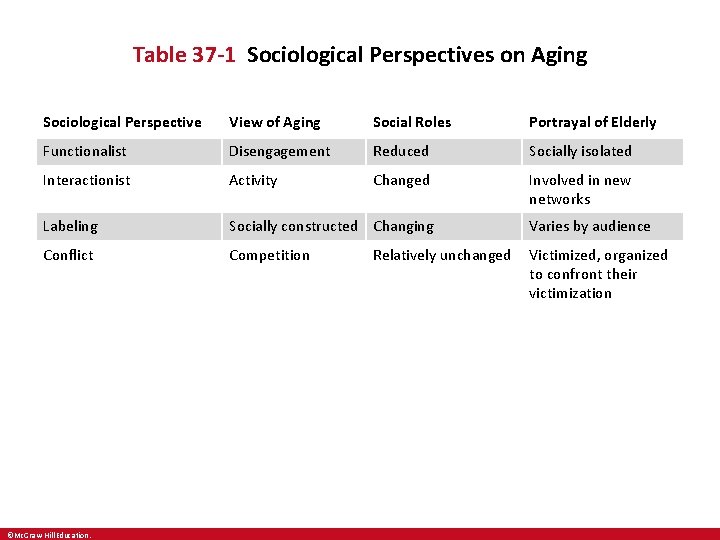
Table 37 -1 Sociological Perspectives on Aging Sociological Perspective View of Aging Social Roles Portrayal of Elderly Functionalist Disengagement Reduced Socially isolated Interactionist Activity Changed Involved in new networks Labeling Socially constructed Changing Varies by audience Conflict Competition Victimized, organized to confront their victimization ©Mc. Graw-Hill Education. Relatively unchanged
Box 37 -1 Research Today: Elderspeak 1. Have you ever worked alongside an older person? If so, did that person’s age affect the way he or she did the job? In what ways? 2. Are older people the only ones who experience ageism? What signs of ageism might those who are not old experience? ©Mc. Graw-Hill Education.
Module 38 Aging Worldwide • By 2015, more than 617 million people age 65 and over – Europe’s population older than others – Japanese enjoy life expectancy of 83 years, compared to 79 in the United States – In most developing countries, people over 60 likely to be in poorer health than in industrialized nations ©Mc. Graw-Hill Education.
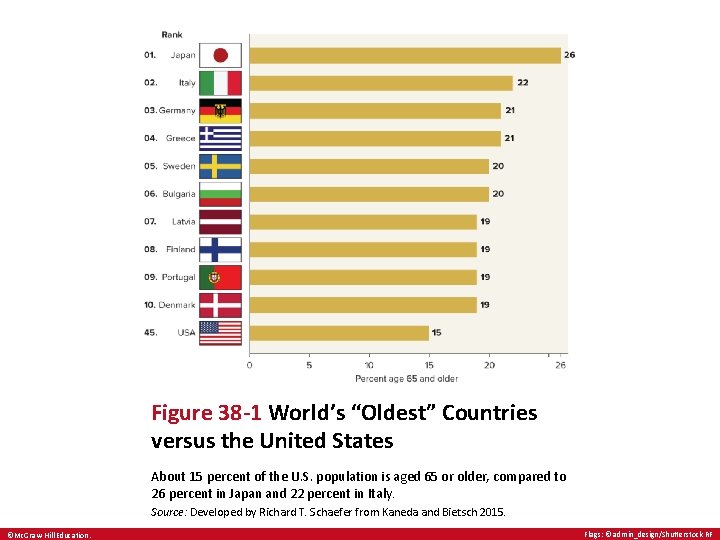
Figure 38 -1 World’s “Oldest” Countries versus the United States About 15 percent of the U. S. population is aged 65 or older, compared to 26 percent in Japan and 22 percent in Italy. Source: Developed by Richard T. Schaefer from Kaneda and Bietsch 2015. ©Mc. Graw-Hill Education. Flags: © admin_design/Shutterstock RF
Role Transitions throughout the Life Course • Socialization a lifelong process – Levinson: One transitional stage begins when individual gradually enters adult world – Midlife crisis: stage in which men and women realize they have not achieved basic goals and ambitions ©Mc. Graw-Hill Education.
The Sandwich Generation • Sandwich generation: adults who simultaneously try to meet the needs of their parents and their children – By 2010, 13 million Americans caring for both children and parents – Caregiving role falls disproportionately to women ©Mc. Graw-Hill Education.
Adjusting to Retirement • Phases of Retirement – – – – ©Mc. Graw-Hill Education. Preretirement Near phase Honeymoon phase Disenchantment phase Reorientation phase Stability phase Termination phase
Adjusting to Retirement (2) • Naturally Occurring Retirement Communities (NORCs) – When older people congregate in areas that have gradually become informal centers for senior citizens – Often emerge as singles and young couples move out and older people move in – Residents of some of these communities threatened by gentrification ©Mc. Graw-Hill Education.
Death and Dying • Through her book On Death and Dying, Kubler-Ross encouraged open discussion of the process of dying – Identified five stages of the dying experience: denial, anger, bargaining, depression, acceptance • Five stages of dying has been challenged • Functionalists: concept of a “good death” – Hospice care: efforts to improve dying people’s last days by helping them to stay at home or in a homelike setting ©Mc. Graw-Hill Education.
Box 38 -1 Sociology in the Global Community: Aging, Japanese Style 1. What do you think caused the change in housing patterns that has resulted in so many elderly Japanese living alone? Could the change in housing patterns be related to the change in life expectancy? How? 2. How might living alone contribute to the retiredhusband syndrome noted among aging Japanese couples? ©Mc. Graw-Hill Education.
Box 38 -2 Research Today: Native Americans and Death 1. Does your own family observe traditional cultural practices regarding death and dying, independent of formal religious ritual? If so, explain their meaning and importance to your family. 2. Apply the concepts you learned in Chapter 3 to Native American burial practices. Which of them do you find most useful in understanding these practices? ©Mc. Graw-Hill Education.
Module 39 Age Stratification in the United States • People over 100 now constitute the fastest-growing age group in the United States • In the future, increasing proportion of the population will be older people ©Mc. Graw-Hill Education.
The “Graying of America” • Elderly more likely to be female than male – Men have higher death rates • Elderly also more likely to be White and non-Hispanic – Racial and ethnic minorities have higher death rates – Younger Latinos and Asians continue to immigrate to the United States – Elderly nevertheless becoming more racially and ethnically diverse • Highest proportion currently found in Florida, Pennsylvania, Rhode Island, Iowa, West Virginia, and Arkansas ©Mc. Graw-Hill Education.
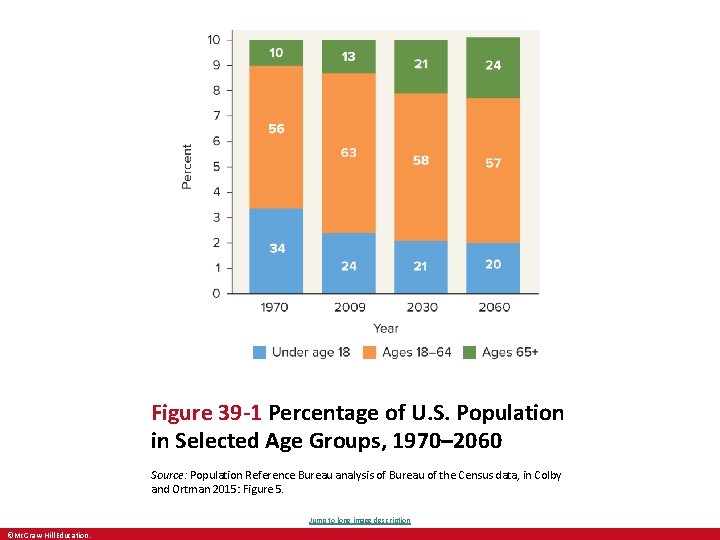
Figure 39 -1 Percentage of U. S. Population in Selected Age Groups, 1970– 2060 Source: Population Reference Bureau analysis of Bureau of the Census data, in Colby and Ortman 2015: Figure 5. Jump to long image description ©Mc. Graw-Hill Education.
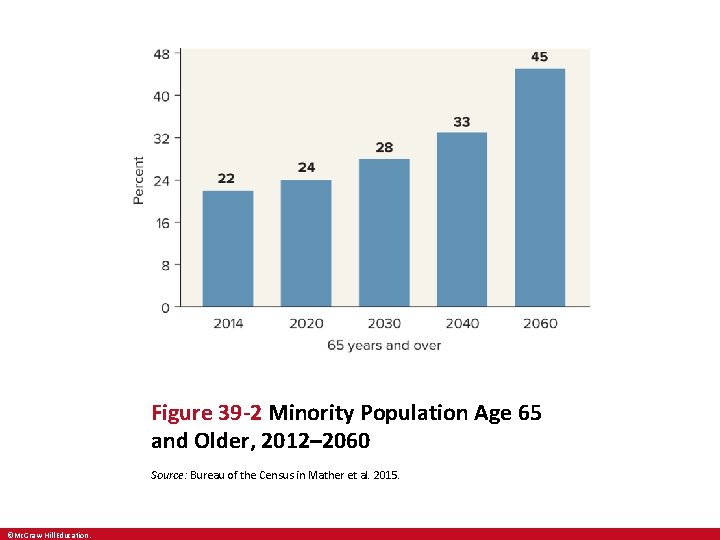
Figure 39 -2 Minority Population Age 65 and Older, 2012– 2060 Source: Bureau of the Census in Mather et al. 2015. ©Mc. Graw-Hill Education.
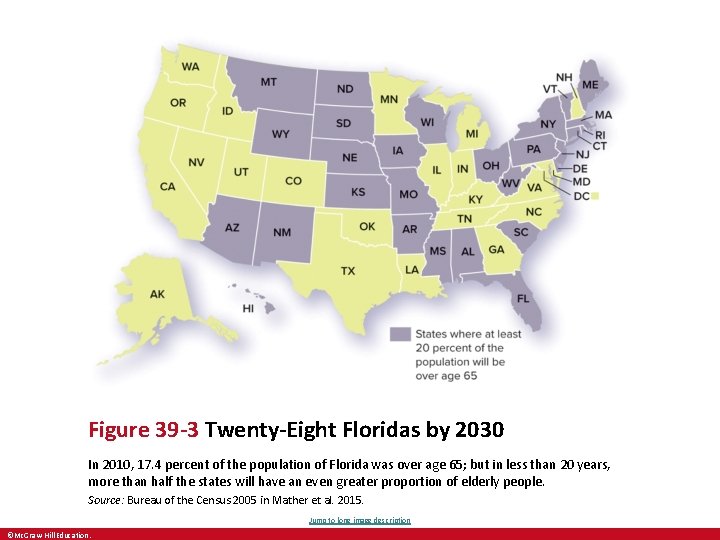
Figure 39 -3 Twenty-Eight Floridas by 2030 In 2010, 17. 4 percent of the population of Florida was over age 65; but in less than 20 years, more than half the states will have an even greater proportion of elderly people. Source: Bureau of the Census 2005 in Mather et al. 2015. Jump to long image description ©Mc. Graw-Hill Education.
Wealth and Income • Significant variation in wealth and poverty among nation’s older people • Typically have higher standard of living than in nation’s past – Greater accumulation of wealth in form of home ownership, private pensions, and financial assets • Extremes of poverty seen among those more likely to be poor at earlier points in life: female-headed households and racial and ethnic minorities ©Mc. Graw-Hill Education.
Ageism • Ageism: prejudice and discrimination based on a person’s age – For many, old age symbolizes disease – While physical condition does weaken with age, today’s older people are in much better shape than their counterparts one generation ago – Silver collar economy: hiring of people 65 and older because of belief they are more reliable and productive ©Mc. Graw-Hill Education.
Competition in the Labor Force • Older workers seen by some as “job stealers” – In 2002, for first time, more older people working full-time than part-time • Nevertheless face discrimination in the labor force – Federal Age Discrimination in Employment Act (ADEA) went into effect in 1968, to protect workers aged 40 and older; strengthened in 1996 • Only 14 percent of workers confident of living comfortably in retirement ©Mc. Graw-Hill Education.
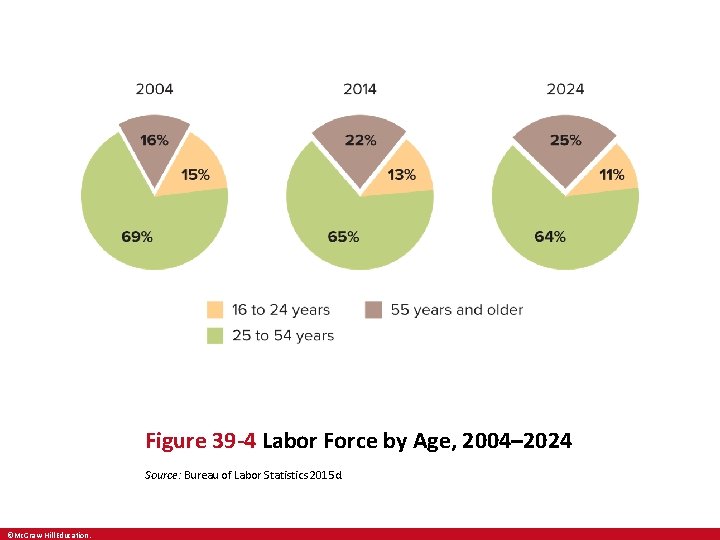
Figure 39 -4 Labor Force by Age, 2004– 2024 Source: Bureau of Labor Statistics 2015 d. ©Mc. Graw-Hill Education.
The Elderly: Emergence of a Collective Consciousness • Growing awareness of the social power of the elderly – AARP a powerful lobbying organization – Formation of organizations for elderly homosexuals – Elderly in the U. S. better off today than before, but they constitute a diverse group ©Mc. Graw-Hill Education.
Social Policy and Age Stratification: The Right to Die Worldwide • Looking at the Issue – Physician-assisted suicide one aspect of a larger debate in the United States – Euthanasia: “act of bringing about the death of a hopelessly ill and suffering person in a relatively quick and painless way for reasons of mercy” – Public opinion divided – Greater legal tolerance for passive euthanasia, such as disconnecting life-support from a comatose patient ©Mc. Graw-Hill Education.
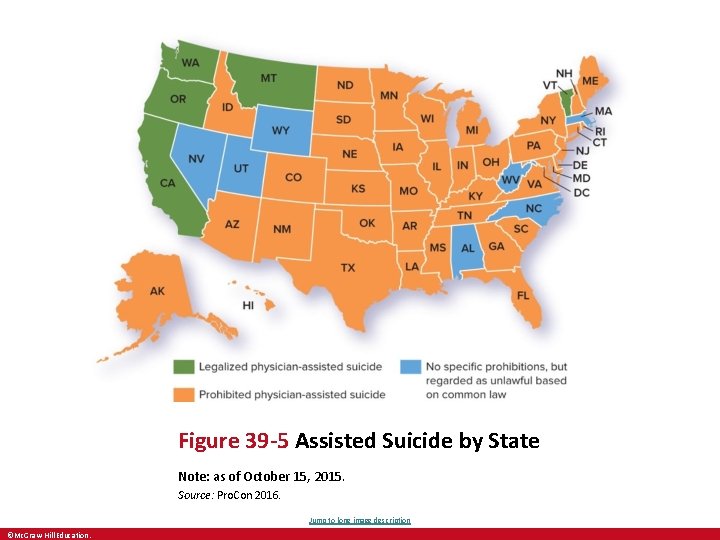
Figure 39 -5 Assisted Suicide by State Note: as of October 15, 2015. Source: Pro. Con 2016. Jump to long image description ©Mc. Graw-Hill Education.
Social Policy and Age Stratification: The Right to Die Worldwide (2) • Applying Sociology – Many societies known to have practiced senilicide—“killing of the aged”—or “death-hastening” behavior – Conflict theorists ask questions about the values raised by such decisions • Precedent set by physician-assisted suicide might contribute to negative social views and labeling of all disabled persons – People who die with a doctor’s help more likely to be socially, economically, and educationally privileged ©Mc. Graw-Hill Education.
Social Policy and Age Stratification: The Right to Die Worldwide (3) • Initiating Policy – In industrialized world, euthanasia legal and widely accepted in the Netherlands, Belgium, Switzerland, Canada, and Colombia • “Suicide tourism” controversial – In the United States, fifth state to allow assisted suicide was Oregon, with the Death with Dignity Act in 1997 – Medical and technological advances allow us to prolong life but cannot provide answers to complex ethical, legal, and political questions involved ©Mc. Graw-Hill Education.
Box 39 -1 Research Today: Cautiously Good News: Declining Poverty among the Aged 1. To what extent do the elderly people in your family rely on Social Security for their income? Do they have employer-funded pensions or other sources of regular income? 2. Do you think you will enjoy Social Security benefits when you reach retirement age? How do you think the retirement system will change by then? ©Mc. Graw-Hill Education.
Review • Age, like gender and race, is an ascribed status that forms the basis for social differentiation • In this chapter: – – – Perspectives on aging and age stratification Rising older populations in industrialized world Stages of aging Ageism in the United States “Right to die” ©Mc. Graw-Hill Education. All rights reserved. Authorized only for instructor use in the classroom. No reproduction or further distribution permitted without the prior written consent of Mc. Graw-Hill Education.

Long image description APPENDIX A ©Mc. Graw-Hill Education
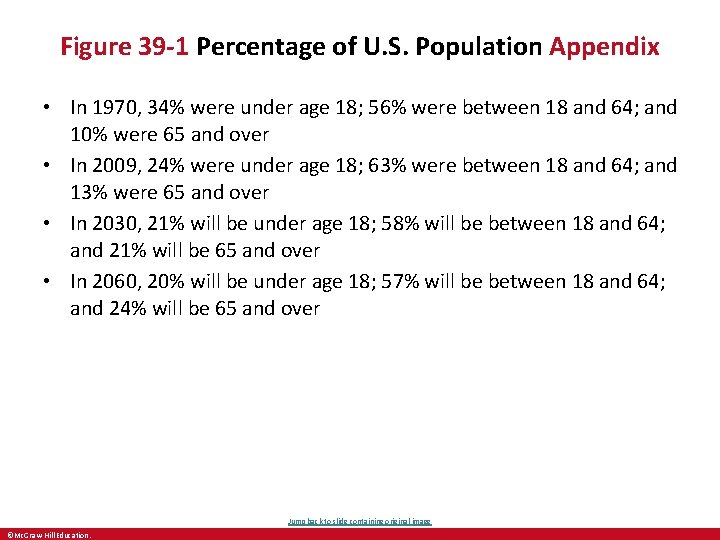
Figure 39 -1 Percentage of U. S. Population Appendix • In 1970, 34% were under age 18; 56% were between 18 and 64; and 10% were 65 and over • In 2009, 24% were under age 18; 63% were between 18 and 64; and 13% were 65 and over • In 2030, 21% will be under age 18; 58% will be between 18 and 64; and 21% will be 65 and over • In 2060, 20% will be under age 18; 57% will be between 18 and 64; and 24% will be 65 and over Jump back to slide containing original image ©Mc. Graw-Hill Education.
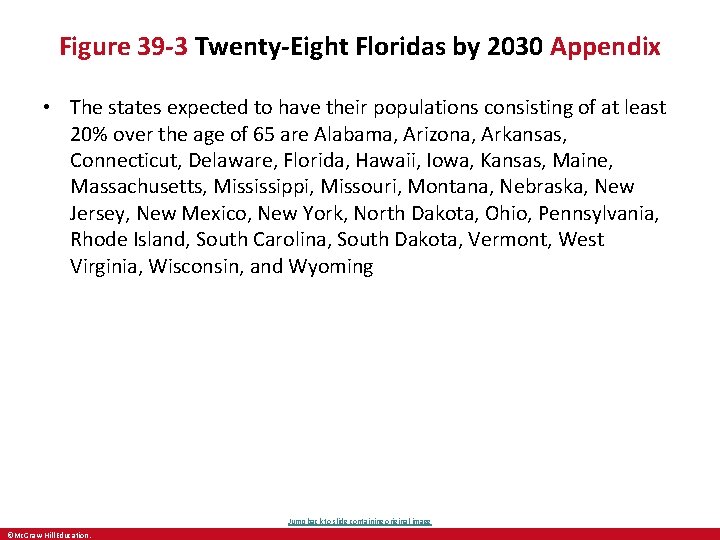
Figure 39 -3 Twenty-Eight Floridas by 2030 Appendix • The states expected to have their populations consisting of at least 20% over the age of 65 are Alabama, Arizona, Arkansas, Connecticut, Delaware, Florida, Hawaii, Iowa, Kansas, Maine, Massachusetts, Mississippi, Missouri, Montana, Nebraska, New Jersey, New Mexico, New York, North Dakota, Ohio, Pennsylvania, Rhode Island, South Carolina, South Dakota, Vermont, West Virginia, Wisconsin, and Wyoming Jump back to slide containing original image ©Mc. Graw-Hill Education.
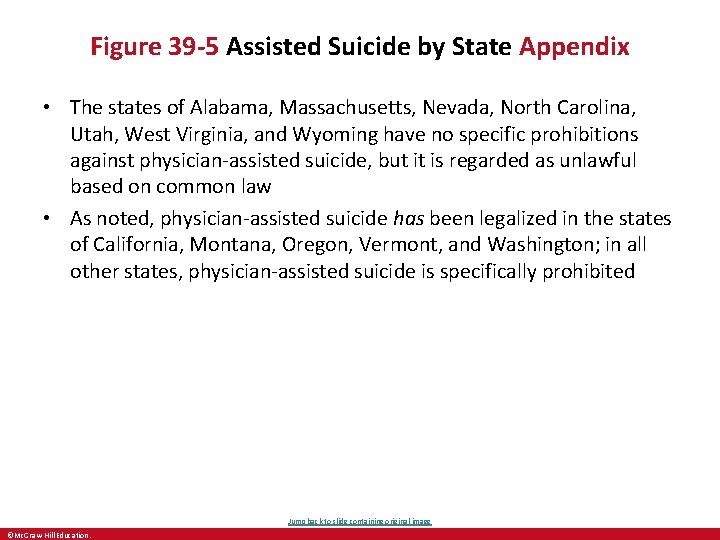
Figure 39 -5 Assisted Suicide by State Appendix • The states of Alabama, Massachusetts, Nevada, North Carolina, Utah, West Virginia, and Wyoming have no specific prohibitions against physician-assisted suicide, but it is regarded as unlawful based on common law • As noted, physician-assisted suicide has been legalized in the states of California, Montana, Oregon, Vermont, and Washington; in all other states, physician-assisted suicide is specifically prohibited Jump back to slide containing original image ©Mc. Graw-Hill Education.
- Slides: 41