
Chapter 12 Strategic Leadership Power Point slides by
Chapter 12 Strategic Leadership Power. Point slides by: R. Dennis Middlemist Colorado State University Copyright © 2004 South-Western All rights reserved.
Knowledge Objectives • Studying this chapter should provide you with the strategic management knowledge needed to: Ø Define strategic leadership and describe top-level managers’ importance as a resource. Ø Define top management teams and explain their effects on firm performance. Ø Describe the internal and external managerial labor markets and their effects on developing and implementing strategies. Ø Discuss the value of strategic leadership in determining the firm’s strategic direction. Copyright © 2004 South-Western. All rights reserved. 2
Knowledge Objectives (cont’d) • Studying this chapter should provide you with the strategic management knowledge needed to: Ø Describe the importance of strategic leaders in managing the firm’s resources, with emphasis on exploiting and maintaining core competencies, human capital, and social capital. Ø Define organizational culture and explain what must be done to sustain an effective culture. Ø Explain what strategic leaders can do to establish and emphasize ethical practices. Ø Discuss the importance and use of organizational controls. Copyright © 2004 South-Western. All rights reserved. 3

The Strategic Management Process Figure 1. 1 Copyright © 2004 South-Western. All rights reserved. 4
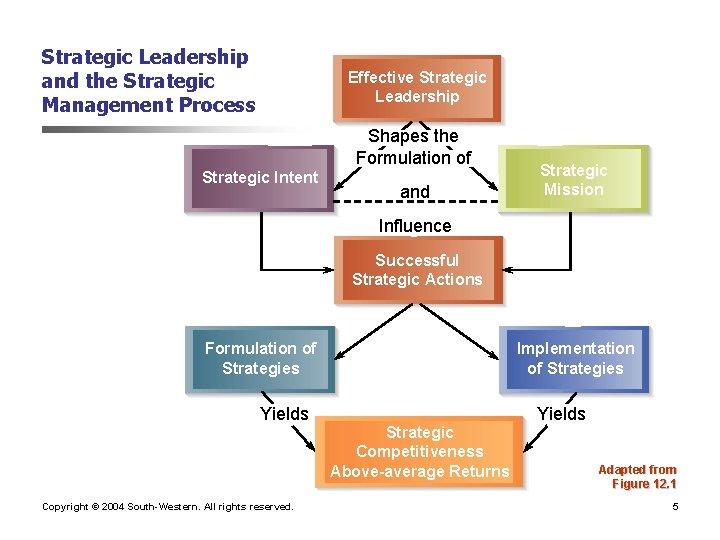
Strategic Leadership and the Strategic Management Process Effective Strategic Leadership Shapes the Formulation of Strategic Intent and Strategic Mission Influence Successful Strategic Actions Formulation of Strategies Yields Copyright © 2004 South-Western. All rights reserved. Implementation of Strategies Strategic Competitiveness Above-average Returns Yields Adapted from Figure 12. 1 5
Strategic Leadership • Requires the managerial ability to: Ø Anticipate and envision Ø Maintain flexibility Ø Empower others to create strategic change as necessary • Strategic leadership is: Ø Multi-functional work that involves working through others Ø Consideration of the entire enterprise rather than just a sub-unit Ø A managerial frame of reference Copyright © 2004 South-Western. All rights reserved. 6
Strategic Leadership (cont’d) • Effective strategic leaders: Ø Manage the firm’s operations effectively Ø Sustain a high performance over time Ø Make better decisions than their competitors Ø Make candid, courageous, pragmatic decisions Ø Understand how their decisions affect the internal systems in use by the firm Ø Solicit feedback from peers, superiors and employees about their decisions and visions Copyright © 2004 South-Western. All rights reserved. 7
Managers as an Organizational Resource • Managers often use their discretion when making strategic decisions and implementing strategies • Factors affecting the amount of decisionmaking discretion include: Ø External environmental sources Ø Characteristics of the organization Ø Characteristics of the manager Copyright © 2004 South-Western. All rights reserved. 8

Factors Affecting Managerial Discretion Adapted from Figure 12. 2 External Environment • Industry structure • Rate of market growth • Number and type of competitors • Nature and degree of political/legal constraints • Degree to which products can be differentiated Copyright © 2004 South-Western. All rights reserved. Managerial Discretion SOURCE: Adapted from S. Finkelstein & D. C. Hambrick, 1996, Strategic Leadership: Top Executives and Their Effects on Organizations, St. Paul, MN: West Publishing Company. 9

Factors Affecting Managerial Discretion Adapted from Figure 12. 2 External Environment Characteristics of the Organization • • • Size Age Culture Availability of resources Patterns of interaction among employees Copyright © 2004 South-Western. All rights reserved. Managerial Discretion SOURCE: Adapted from S. Finkelstein & D. C. Hambrick, 1996, Strategic Leadership: Top Executives and Their Effects on Organizations, St. Paul, MN: West Publishing Company. 10

Factors Affecting Managerial Discretion Adapted from Figure 12. 2 External Environment Characteristics of the Organization Characteristics of the Manager • Tolerance for ambiguity • Commitment to the firm and its desired strategic outcomes • Interpersonal skills • Aspiration level • Degree of self-confidence Copyright © 2004 South-Western. All rights reserved. Managerial Discretion Characteristics of the Manager SOURCE: Adapted from S. Finkelstein & D. C. Hambrick, 1996, Strategic Leadership: Top Executives and Their Effects on Organizations, St. Paul, MN: West Publishing Company. 11

Top Management Teams • Composed of the key managers who are responsible for selecting and implementing the firm’s strategies • A heterogeneous top management team: Ø Has varied expertise and knowledge Ø Can draw on multiple perspectives Ø Will evaluate alternative strategies Ø Builds consensus Copyright © 2004 South-Western. All rights reserved. 12
Firm Performance and Strategic Change • Heterogeneous top management teams: Ø Have difficulty functioning effectively as a team Ø Require effective management of the team to facilitate the process of decision making Ø but … Ø Are associated positively with innovation and strategic change Ø May force the team or members to “think outside of the box” and be more creative Ø Have greater capacity to provide effective strategic leadership in formulating strategy Copyright © 2004 South-Western. All rights reserved. 13
CEO and Top Management Team Power • Higher performance is achieved when board of directors are more directly involved in shaping strategic direction • A powerful CEO may: Ø Appoint sympathetic outside board members Ø Have inside board members who report to the CEO Ø Have significant control over the board’s actions Ø May also hold the position of chairman of the board (CEO duality) Copyright © 2004 South-Western. All rights reserved. 14
CEO and Top Management Power • Duality often relates to poor performance and slow response to change Ø CEOs of long tenure can also wield substantial power Ø CEOs can gain so much power that they are virtually independent of oversight by the board of directors • The most effective forms of governance share power and influence among the CEO and board of directors Copyright © 2004 South-Western. All rights reserved. 15
Managerial Labor Market • Organizations select managers and strategic leaders from two types of managerial labor markets: Ø Internal managerial labor market: advancement opportunities related to managerial positions within a firm Ø External managerial labor market: career opportunities for managers in organizations other than the one for which they currently work Copyright © 2004 South-Western. All rights reserved. 16
Managerial Labor Market (cont’d) • Advantages of internal managerial labor market include: Ø Experience with the firm and industry environment Ø Familiarity with company products, markets, technologies, and operating procedures Ø Produces lower turnover among existing personnel Copyright © 2004 South-Western. All rights reserved. 17
Managerial Labor Market (cont’d) • Advantages of the external managerial labor market include Ø Long tenured insiders may be “stale in the saddle” Ø Outsiders may bring fresh perspectives Copyright © 2004 South-Western. All rights reserved. 18
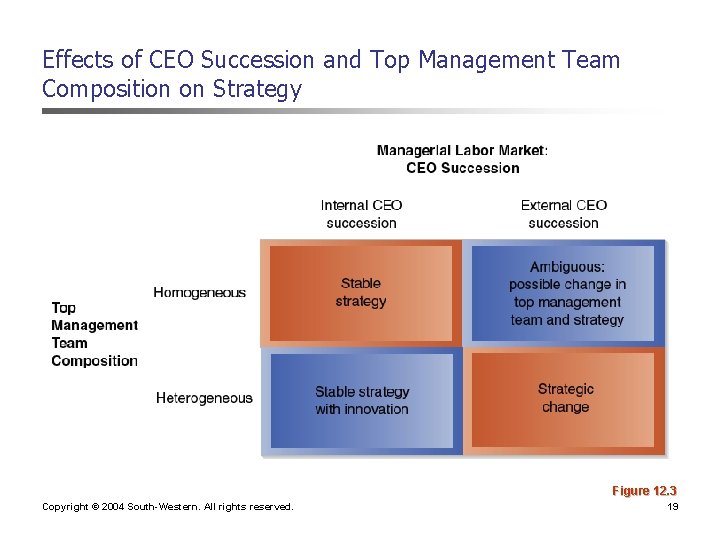
Effects of CEO Succession and Top Management Team Composition on Strategy Figure 12. 3 Copyright © 2004 South-Western. All rights reserved. 19
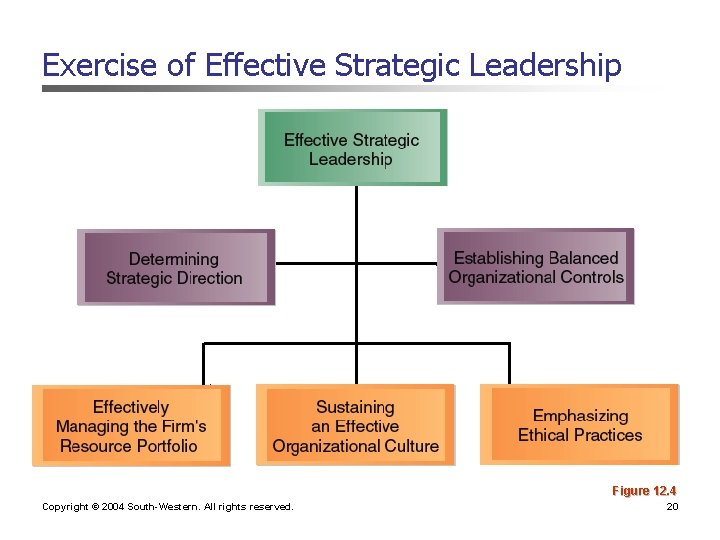
Exercise of Effective Strategic Leadership Figure 12. 4 Copyright © 2004 South-Western. All rights reserved. 20
Key Strategic Leadership Actions: Determining Strategic Direction • Determining strategic direction involves developing a long-term vision of the firm’s strategic intent Ø Five to ten years into the future Ø Philosophy with goals Ø The image and character the firm seeks • Ideal long-term vision has two parts: Ø Core ideology Ø Envisioned future Copyright © 2004 South-Western. All rights reserved. 21
Key Strategic Leadership Actions: Exploiting and Maintaining Core Competencies • Core competencies Ø Resources and capabilities of a firm that serve as a source of competitive advantage over its rivals Ø Leadership must verify that the firm’s competencies are emphasized in strategy implementation efforts Ø Firms must continuously develop or even change their core competencies to stay ahead of competitors Copyright © 2004 South-Western. All rights reserved. 22
Key Strategic Leadership Actions: Developing Human Capital and Social Capital • Human capital Ø The knowledge and skills of the firm’s entire workforce are a capital resource that requires investment in training and development • Social capital Ø Relationships inside and outside the firm that help it accomplish tasks and create value for customers and shareholders Copyright © 2004 South-Western. All rights reserved. 23
Key Strategic Leadership Actions: Sustaining an Effective Organizational Culture • Organizational culture Ø The complex set of ideologies, symbols and core values shared through the firm, that influences the way business is conducted • Entrepreneurial orientation Ø Personal characteristics that encourage or discourage entrepreneurial opportunities Autonomy Proactiveness v Innovativeness Risk taking v Copyright © 2004 South-Western. All rights reserved. 24
Key Strategic Leadership Actions: Sustaining an Organizational Culture (cont’d) • Changing a firm’s organizational culture is more difficult than maintaining it Ø Effective strategic leaders recognize when change in culture is needed • Shaping and reinforcing culture requires: Ø Effective communication Ø Problem solving skills Ø Selection of the right people Ø Effective performance appraisals Ø Appropriate reward systems Copyright © 2004 South-Western. All rights reserved. 25
Key Strategic Leadership Actions: Emphasizing Ethical Practices • Effectiveness of processes used to implement the firm’s strategies increases when based on ethical practices • Ethical practices create social capital and goodwill for the firm Copyright © 2004 South-Western. All rights reserved. 26
Key Strategic Leadership Actions: Emphasizing Ethical Practices • Actions that develop an ethical organizational culture include: Ø Establishing and communicating specific goals to describe the firm’s ethical standards Ø Continuously revising and updating the code of conduct Ø Disseminating the code of conduct to all stakeholders to inform them of the firm’s ethical standards and practices Copyright © 2004 South-Western. All rights reserved. 27
Key Strategic Leadership Actions: Emphasizing Ethical Practices (cont’d) • Actions that develop an ethical organizational culture include: Ø Developing and implementing methods and procedures to use in achieving the firm’s ethical standards Ø Creating and using explicit reward systems that recognize acts of courage Ø Creating a work environment in which all people are treated with dignity Copyright © 2004 South-Western. All rights reserved. 28
Key Strategic Leadership Actions: Establishing Organizational Controls • Controls Ø Formal, information-based procedures used by managers to maintain or alter patterns in organizational activities • Controls help strategic leaders to: Ø Build credibility Ø Demonstrate the value of strategies to the firm’s stakeholders Ø Promote and support strategic change Copyright © 2004 South-Western. All rights reserved. 29
Key Strategic Leadership Actions: Establishing Balanced Organizational Controls • Balanced Scorecard Ø Framework used to verify that the firm has established both strategic and financial controls to assess its performance Ø Prevents overemphasis of financial controls at the expense of strategic controls • Four perspectives of balanced scorecard Ø Financial Customer Ø Internal business processes Ø Learning and growth Copyright © 2004 South-Western. All rights reserved. 30
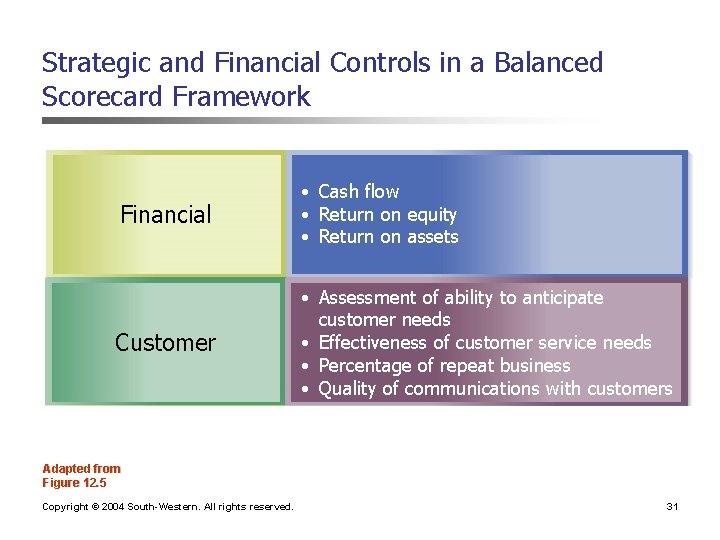
Strategic and Financial Controls in a Balanced Scorecard Framework Financial • Cash flow • Return on equity • Return on assets Customer • Assessment of ability to anticipate customer needs • Effectiveness of customer service needs • Percentage of repeat business • Quality of communications with customers Adapted from Figure 12. 5 Copyright © 2004 South-Western. All rights reserved. 31
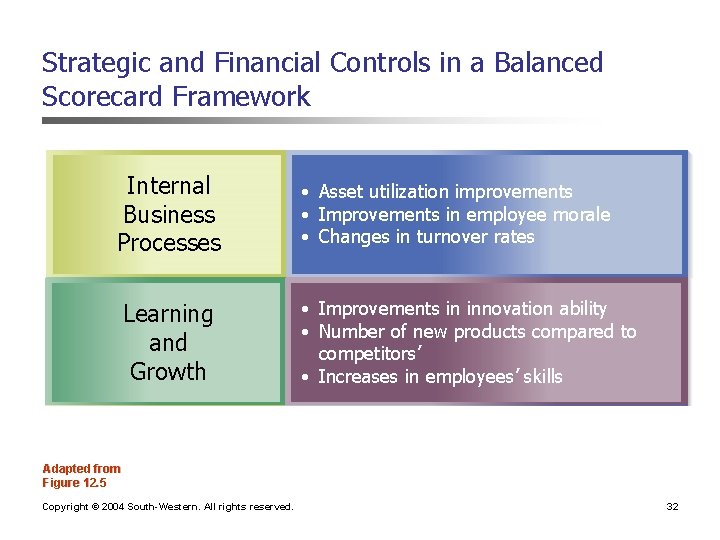
Strategic and Financial Controls in a Balanced Scorecard Framework Internal Business Processes • Asset utilization improvements • Improvements in employee morale • Changes in turnover rates Learning and Growth • Improvements in innovation ability • Number of new products compared to competitors’ • Increases in employees’ skills Adapted from Figure 12. 5 Copyright © 2004 South-Western. All rights reserved. 32
- Slides: 32