
Chapter 12 Stoichiometry SCSh 5 e Solve scientific
- Slides: 30
Chapter 12 Stoichiometry SCSh 5. e: Solve scientific problems by substituting quantitative values, using dimensional analysis and/or simple algebraic formulas as appropriate. SC 2. d: Identify and solve different types of stoichiometry problems, specifically relating mass to moles and mass to mass. SC 2. e: Demonstrate the conceptual principle of limiting reactants. Online Resources: Stoichiometry Practice Problems: http: //mailer. fsu. edu/~rlight/stoich/ Click Stoichiomentry: http: //misterguch. brinkster. net/explains 2. html 1
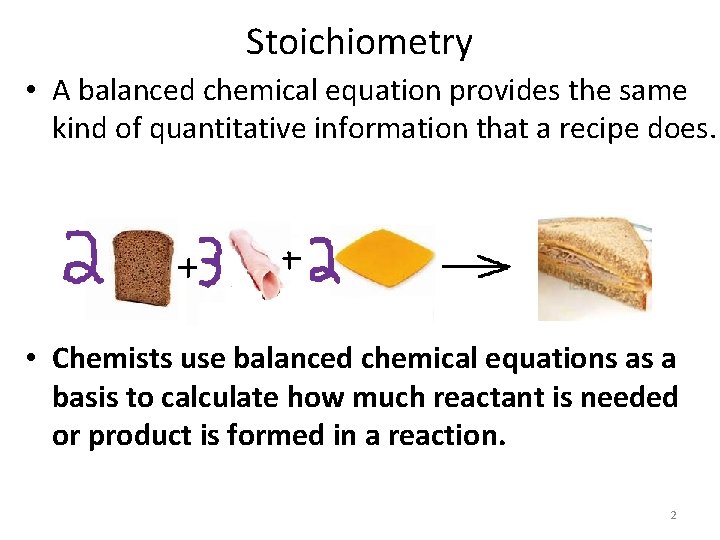
Stoichiometry • A balanced chemical equation provides the same kind of quantitative information that a recipe does. • Chemists use balanced chemical equations as a basis to calculate how much reactant is needed or product is formed in a reaction. 2
Stoichiometry • Stoichiometry is the calculation of quantities in chemical reactions. • When you know the quantity of one substance in a reaction, you can calculate the quantity of another substance consumed or created in the reaction. • A quantity can be grams, moles, liters, molecules, atoms, ions, formula units or particles. 3
Stoichiometry • A balanced equation indicates the number and type of each atom, molecules, and/or moles that makes up each reactant and each product • A balanced chemical equation obeys the law of conservation of mass – The total number of grams of reactants DOES equal the total number of grams of product • Assuming standard temperature and pressure, a balanced equation also tells you about the volume of gases. • Mass and atoms are conserved in every chemical reaction 4
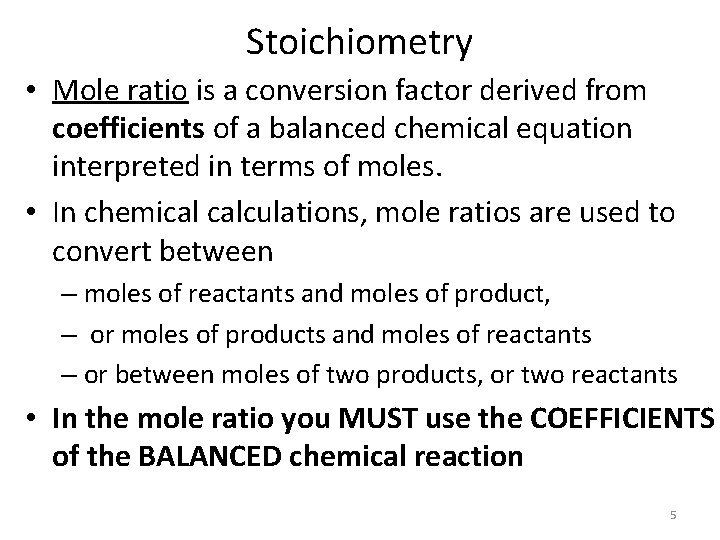
Stoichiometry • Mole ratio is a conversion factor derived from coefficients of a balanced chemical equation interpreted in terms of moles. • In chemical calculations, mole ratios are used to convert between – moles of reactants and moles of product, – or moles of products and moles of reactants – or between moles of two products, or two reactants • In the mole ratio you MUST use the COEFFICIENTS of the BALANCED chemical reaction 5
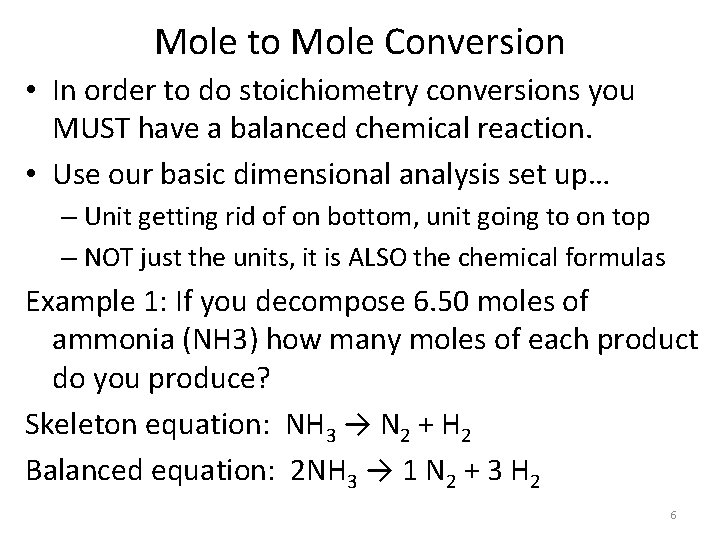
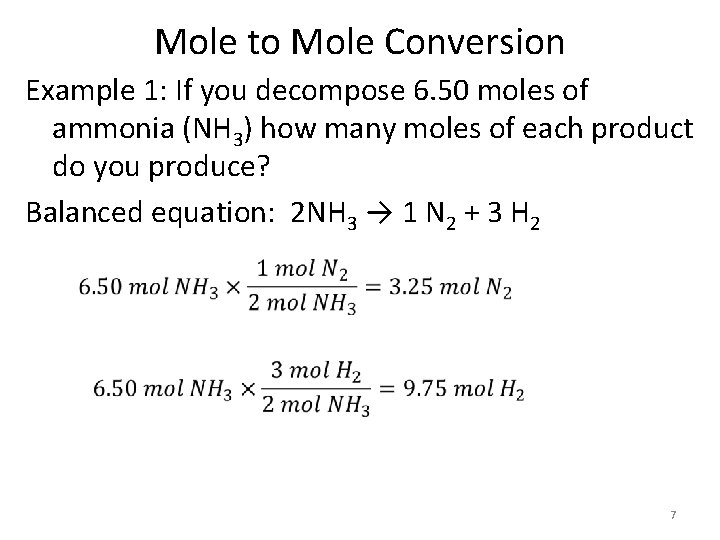
Mole to Mole Conversion • In order to do stoichiometry conversions you MUST have a balanced chemical reaction. • Use our basic dimensional analysis set up… – Unit getting rid of on bottom, unit going to on top – NOT just the units, it is ALSO the chemical formulas Example 1: If you decompose 6. 50 moles of ammonia (NH 3) how many moles of each product do you produce? Skeleton equation: NH 3 → N 2 + H 2 Balanced equation: 2 NH 3 → 1 N 2 + 3 H 2 6
Mole to Mole Conversion Example 1: If you decompose 6. 50 moles of ammonia (NH 3) how many moles of each product do you produce? Balanced equation: 2 NH 3 → 1 N 2 + 3 H 2 7
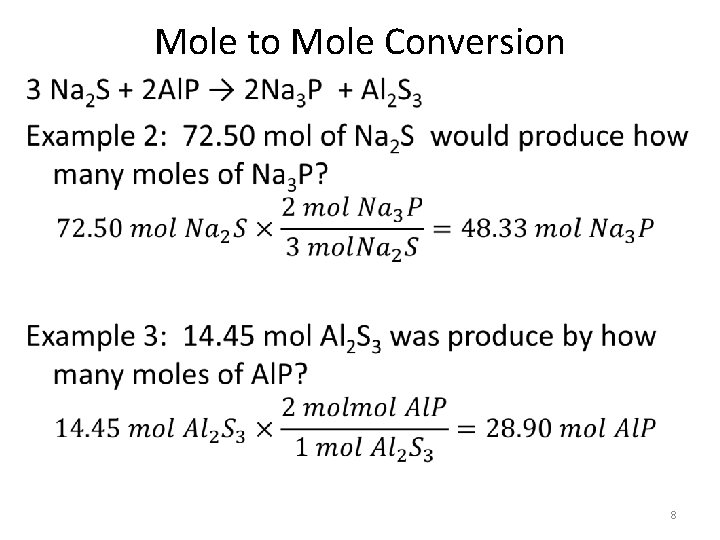
Mole to Mole Conversion • 8
Things to remember • 9
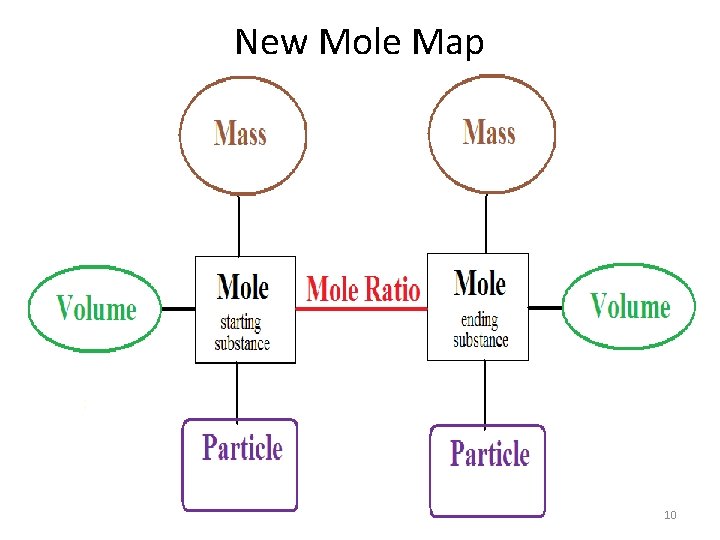
New Mole Map 10
Terminology • Theoretical yield is the maximum amount of product that will form during a reaction. • Any time you are calculating the amount of product produced you are calculating theoretical yield. • Actual yield is the amount of product that actually forms when the reaction is carried out in a laboratory. 11
Stoichiometry Calculations 1. the first step is to convert the give substance measurement to moles. (if not starting with moles) 2. Next use the mole ratio to switch between substances 3. Finally convert to the desired substance to the correct unit for the final answer. Use your mole map to help determine the number of fractions needed to do conversion. 12
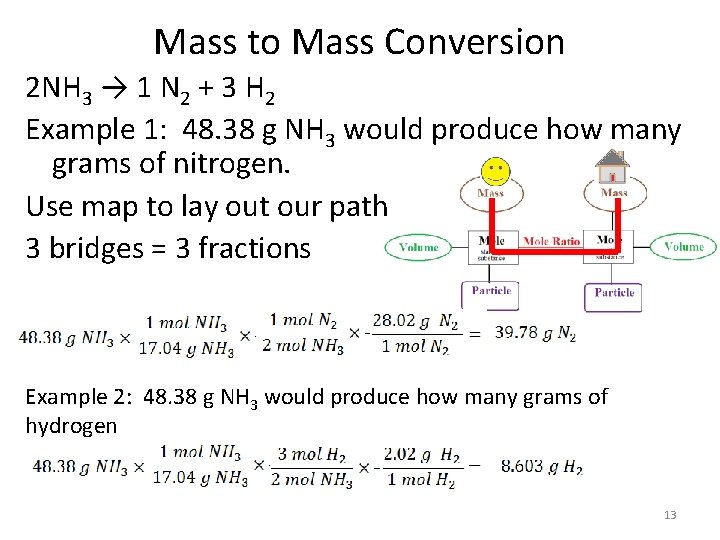
Mass to Mass Conversion 2 NH 3 → 1 N 2 + 3 H 2 Example 1: 48. 38 g NH 3 would produce how many grams of nitrogen. Use map to lay out our path 3 bridges = 3 fractions Example 2: 48. 38 g NH 3 would produce how many grams of hydrogen 13
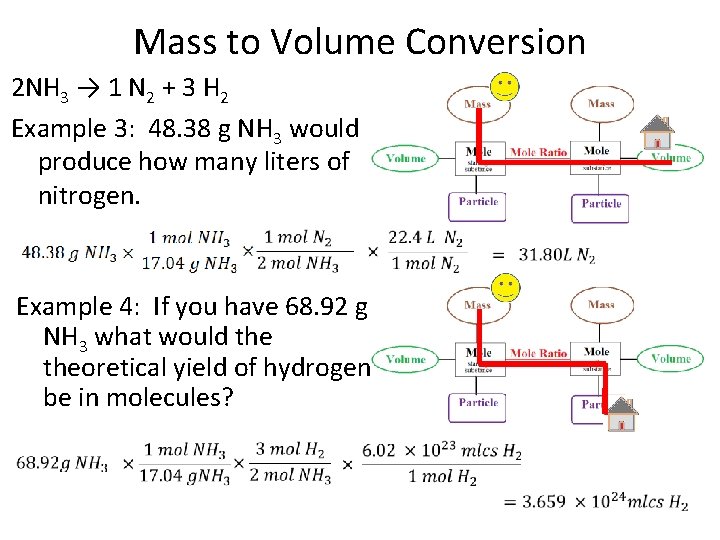
Mass to Volume Conversion 2 NH 3 → 1 N 2 + 3 H 2 Example 3: 48. 38 g NH 3 would produce how many liters of nitrogen. Example 4: If you have 68. 92 g NH 3 what would theoretical yield of hydrogen be in molecules?
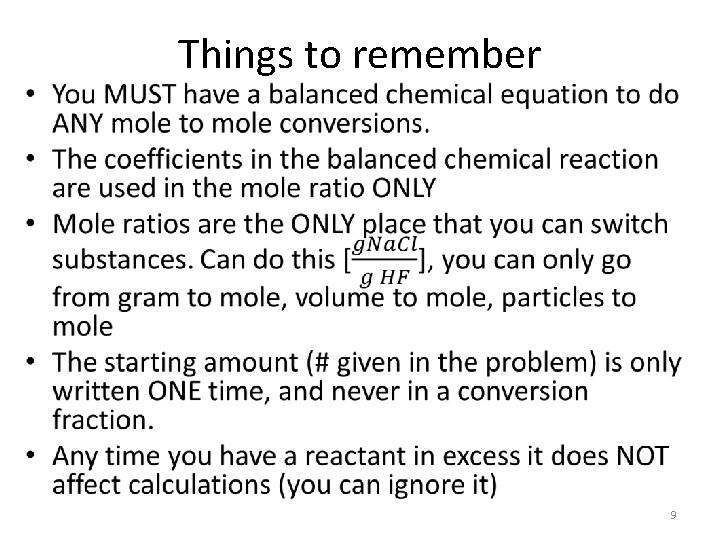
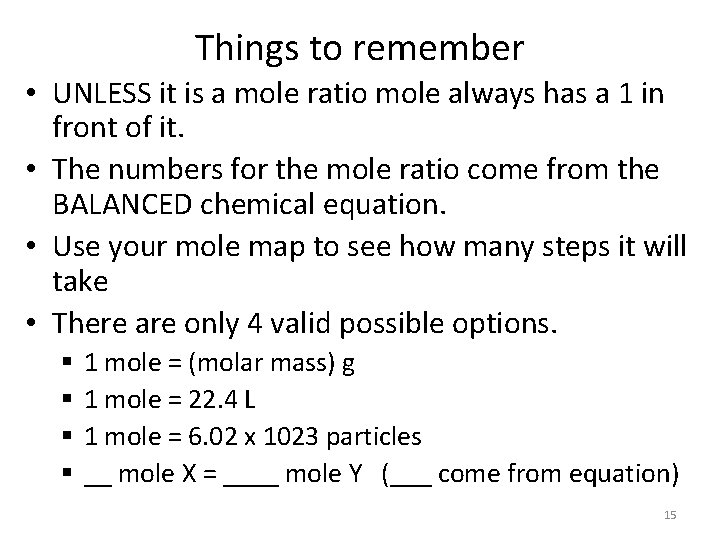
Things to remember • UNLESS it is a mole ratio mole always has a 1 in front of it. • The numbers for the mole ratio come from the BALANCED chemical equation. • Use your mole map to see how many steps it will take • There are only 4 valid possible options. § § 1 mole = (molar mass) g 1 mole = 22. 4 L 1 mole = 6. 02 x 1023 particles __ mole X = ____ mole Y (___ come from equation) 15
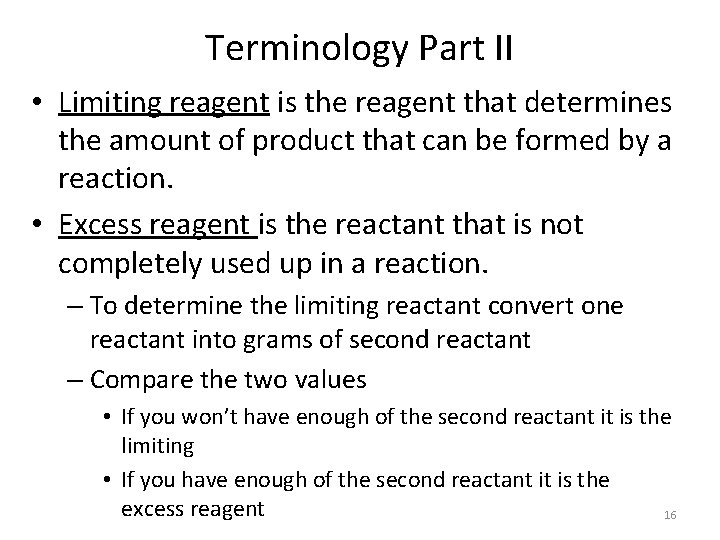
Terminology Part II • Limiting reagent is the reagent that determines the amount of product that can be formed by a reaction. • Excess reagent is the reactant that is not completely used up in a reaction. – To determine the limiting reactant convert one reactant into grams of second reactant – Compare the two values • If you won’t have enough of the second reactant it is the limiting • If you have enough of the second reactant it is the excess reagent 16
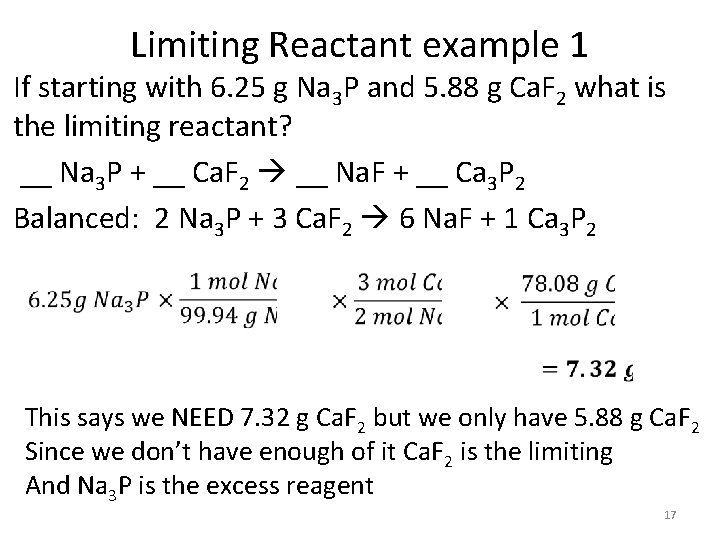
Limiting Reactant example 1 If starting with 6. 25 g Na 3 P and 5. 88 g Ca. F 2 what is the limiting reactant? __ Na 3 P + __ Ca. F 2 __ Na. F + __ Ca 3 P 2 Balanced: 2 Na 3 P + 3 Ca. F 2 6 Na. F + 1 Ca 3 P 2 This says we NEED 7. 32 g Ca. F 2 but we only have 5. 88 g Ca. F 2 Since we don’t have enough of it Ca. F 2 is the limiting And Na 3 P is the excess reagent 17
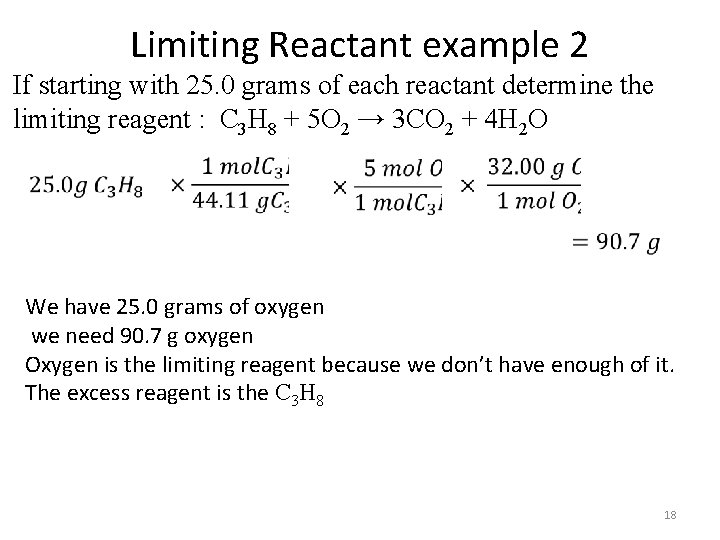
Limiting Reactant example 2 If starting with 25. 0 grams of each reactant determine the limiting reagent : C 3 H 8 + 5 O 2 → 3 CO 2 + 4 H 2 O We have 25. 0 grams of oxygen we need 90. 7 g oxygen Oxygen is the limiting reagent because we don’t have enough of it. The excess reagent is the C 3 H 8 18
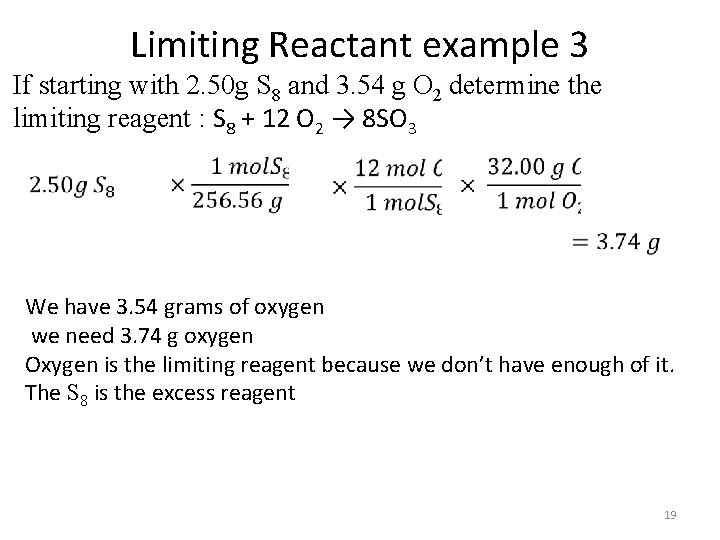
Limiting Reactant example 3 If starting with 2. 50 g S 8 and 3. 54 g O 2 determine the limiting reagent : S 8 + 12 O 2 → 8 SO 3 We have 3. 54 grams of oxygen we need 3. 74 g oxygen Oxygen is the limiting reagent because we don’t have enough of it. The S 8 is the excess reagent 19
Limiting Reactant (Reagent) • Just by looking at the starting masses it is IMPOSSIBLE to determine the limiting reactant • Just by looking at the coefficients it is IMPOSSIBLE to determine the limiting reactant • You can only determine limiting reactant IF you are comparing the same COMPOUND and same UNIT. 20
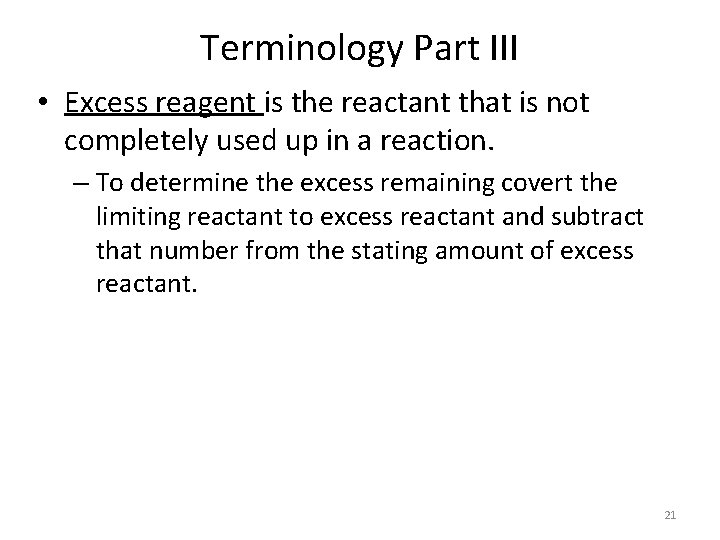
Terminology Part III • Excess reagent is the reactant that is not completely used up in a reaction. – To determine the excess remaining covert the limiting reactant to excess reactant and subtract that number from the stating amount of excess reactant. 21
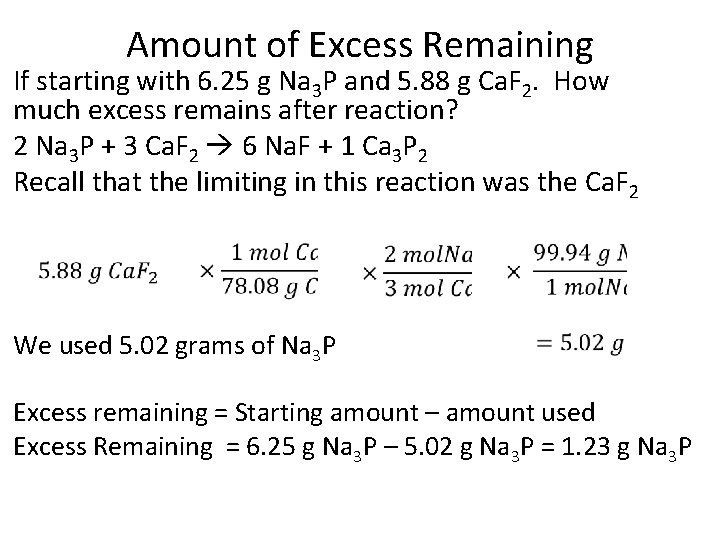
Amount of Excess Remaining If starting with 6. 25 g Na 3 P and 5. 88 g Ca. F 2. How much excess remains after reaction? 2 Na 3 P + 3 Ca. F 2 6 Na. F + 1 Ca 3 P 2 Recall that the limiting in this reaction was the Ca. F 2 We used 5. 02 grams of Na 3 P Excess remaining = Starting amount – amount used Excess Remaining = 6. 25 g Na 3 P – 5. 02 g Na 3 P = 1. 23 g Na 3 P
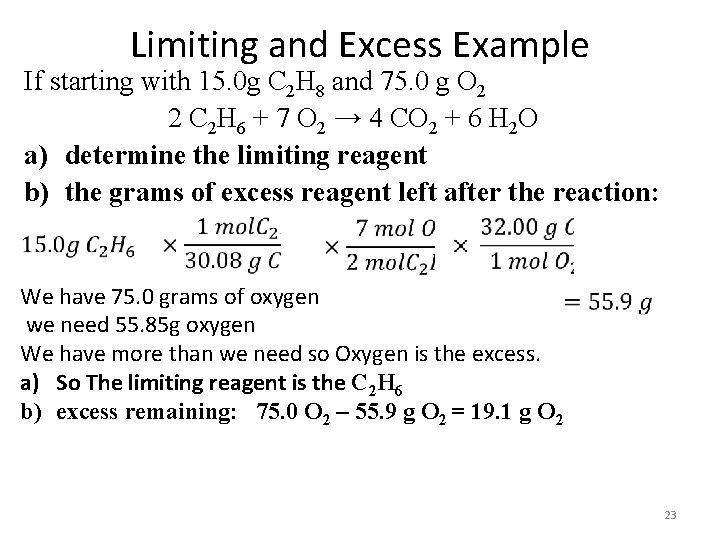
Limiting and Excess Example If starting with 15. 0 g C 2 H 8 and 75. 0 g O 2 2 C 2 H 6 + 7 O 2 → 4 CO 2 + 6 H 2 O a) determine the limiting reagent b) the grams of excess reagent left after the reaction: We have 75. 0 grams of oxygen we need 55. 85 g oxygen We have more than we need so Oxygen is the excess. a) So The limiting reagent is the C 2 H 6 b) excess remaining: 75. 0 O 2 – 55. 9 g O 2 = 19. 1 g O 2 23
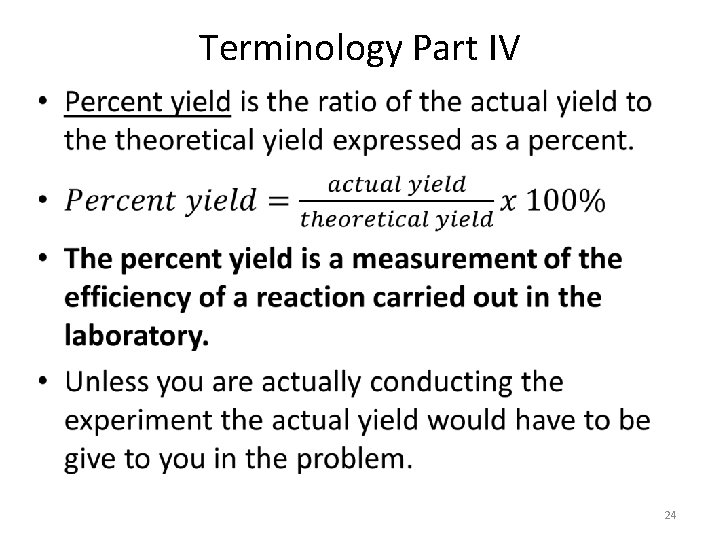
Terminology Part IV • 24
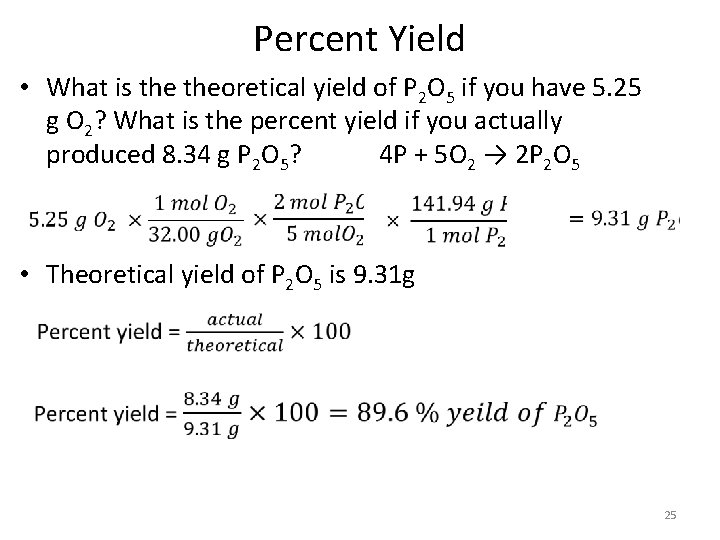
Percent Yield • What is theoretical yield of P 2 O 5 if you have 5. 25 g O 2? What is the percent yield if you actually produced 8. 34 g P 2 O 5? 4 P + 5 O 2 → 2 P 2 O 5 • Theoretical yield of P 2 O 5 is 9. 31 g 25
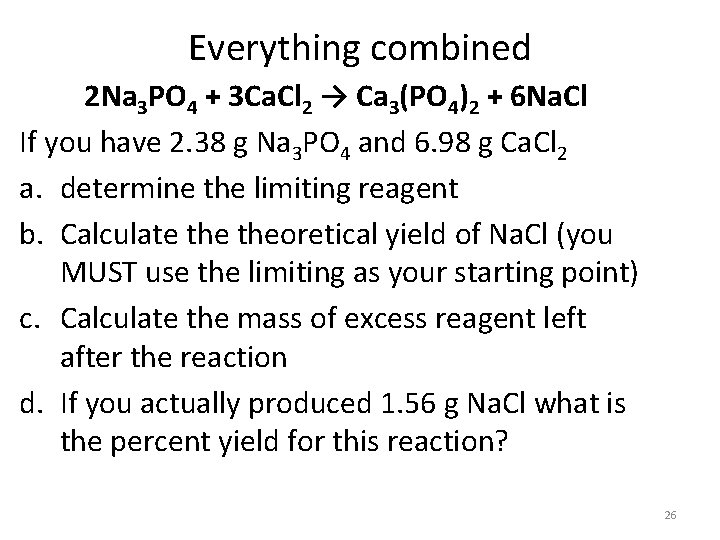
Everything combined 2 Na 3 PO 4 + 3 Ca. Cl 2 → Ca 3(PO 4)2 + 6 Na. Cl If you have 2. 38 g Na 3 PO 4 and 6. 98 g Ca. Cl 2 a. determine the limiting reagent b. Calculate theoretical yield of Na. Cl (you MUST use the limiting as your starting point) c. Calculate the mass of excess reagent left after the reaction d. If you actually produced 1. 56 g Na. Cl what is the percent yield for this reaction? 26
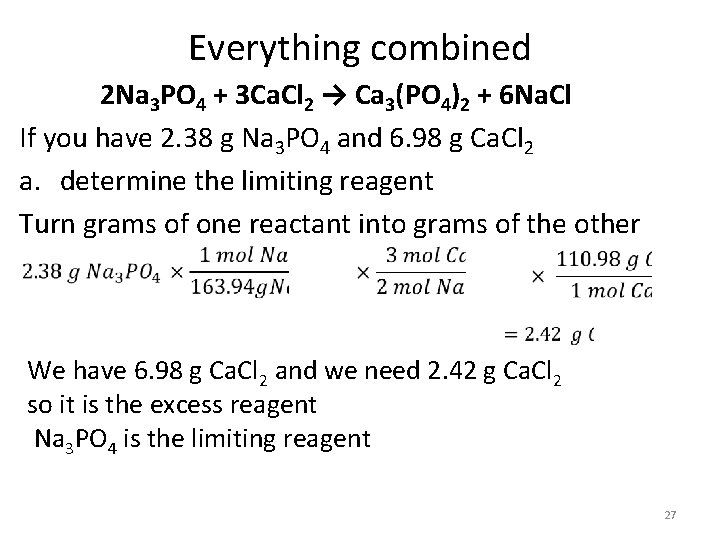
Everything combined 2 Na 3 PO 4 + 3 Ca. Cl 2 → Ca 3(PO 4)2 + 6 Na. Cl If you have 2. 38 g Na 3 PO 4 and 6. 98 g Ca. Cl 2 a. determine the limiting reagent Turn grams of one reactant into grams of the other We have 6. 98 g Ca. Cl 2 and we need 2. 42 g Ca. Cl 2 so it is the excess reagent Na 3 PO 4 is the limiting reagent 27
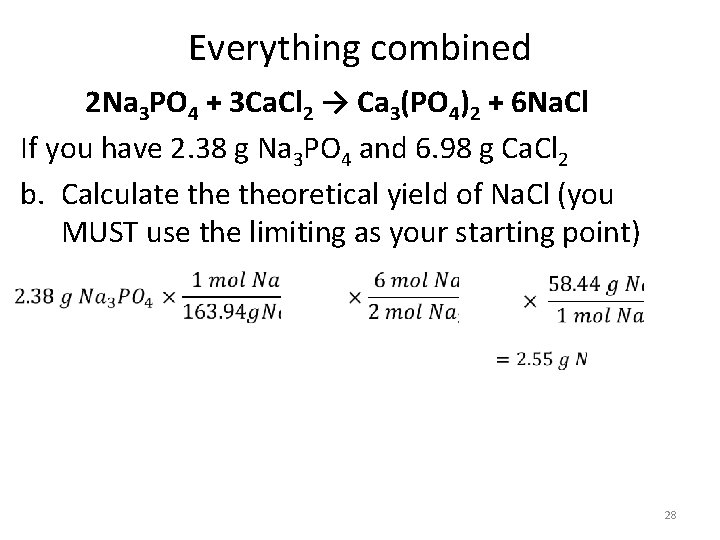
Everything combined 2 Na 3 PO 4 + 3 Ca. Cl 2 → Ca 3(PO 4)2 + 6 Na. Cl If you have 2. 38 g Na 3 PO 4 and 6. 98 g Ca. Cl 2 b. Calculate theoretical yield of Na. Cl (you MUST use the limiting as your starting point) 28
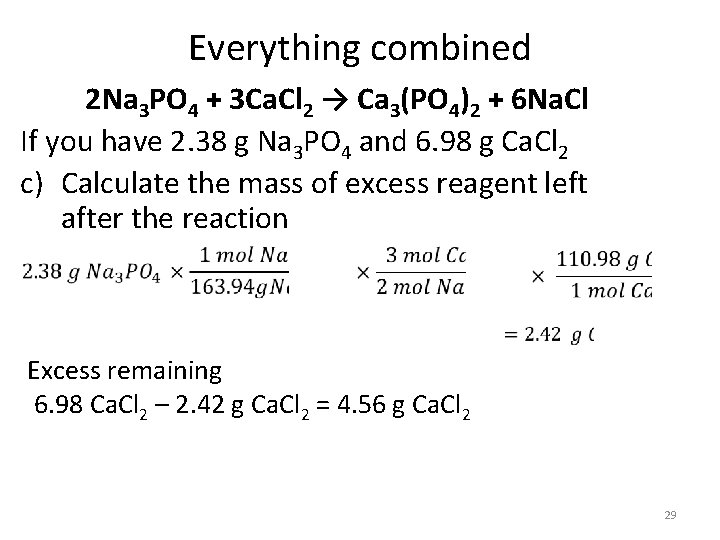
Everything combined 2 Na 3 PO 4 + 3 Ca. Cl 2 → Ca 3(PO 4)2 + 6 Na. Cl If you have 2. 38 g Na 3 PO 4 and 6. 98 g Ca. Cl 2 c) Calculate the mass of excess reagent left after the reaction Excess remaining 6. 98 Ca. Cl 2 – 2. 42 g Ca. Cl 2 = 4. 56 g Ca. Cl 2 29
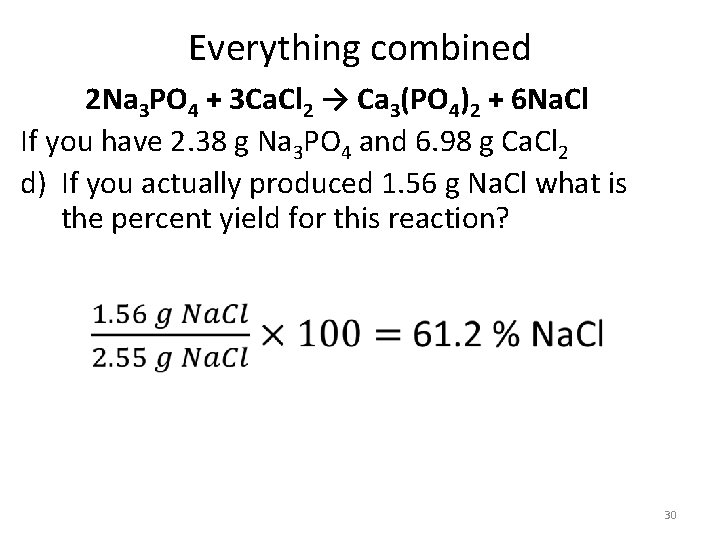
Everything combined 2 Na 3 PO 4 + 3 Ca. Cl 2 → Ca 3(PO 4)2 + 6 Na. Cl If you have 2. 38 g Na 3 PO 4 and 6. 98 g Ca. Cl 2 d) If you actually produced 1. 56 g Na. Cl what is the percent yield for this reaction? 30