
Chapter 12 Standards CHEM B 1 1 1
Chapter 12 Standards � CHEM. B. 1. 1. 1 Apply the mole concept to representative particles (e. g. , counting, determining mass of atoms, ions, molecules, and/or formula units). � CHEM. B. 2. 1. 2 Use stoichiometric relationships to calculate the amounts of reactants and products involved in a chemical reaction. � CHEM. B. 2. 1. 1 Describe the roles of limiting and excess reactants in chemical reactions. � CHEM. B. 2. 1. 4 Predict products of simple chemical reactions (e. g. , synthesis, decomposition, single replacement, double replacement, combustion).
Stoichiometry What is Stoichiometry? Section 12. 1
Objectives � Define stoichiometry � Identify mole ratios in a balanced chemical equation
Key Terms � Stoichiometry � Mole ratios
Stoichiometry � Study of quantitative relationships between amounts of reactants used and products formed by a chemical reaction � Based on law of conservation of mass
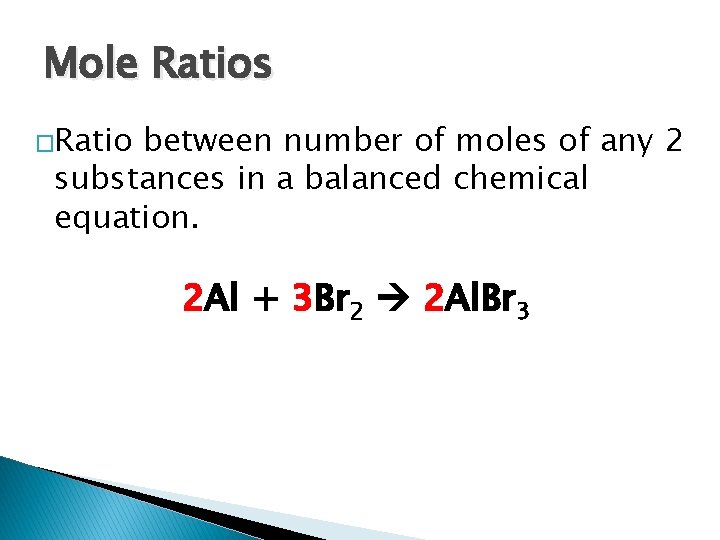
Mole Ratios �Ratio between number of moles of any 2 substances in a balanced chemical equation. 2 Al + 3 Br 2 2 Al. Br 3
Stoichiometry Stoichiometric Calculations Section 12. 2
Objectives � Identify and apply the steps to solving stoichiometry problems
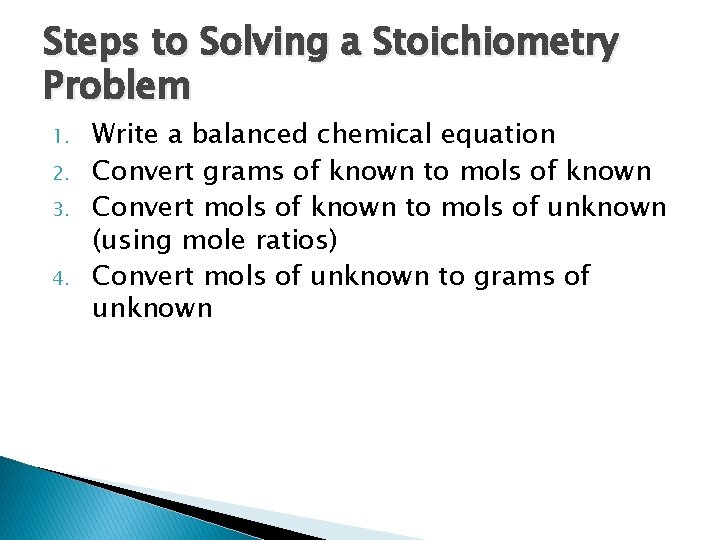
Steps to Solving a Stoichiometry Problem 1. 2. 3. 4. Write a balanced chemical equation Convert grams of known to mols of known Convert mols of known to mols of unknown (using mole ratios) Convert mols of unknown to grams of unknown
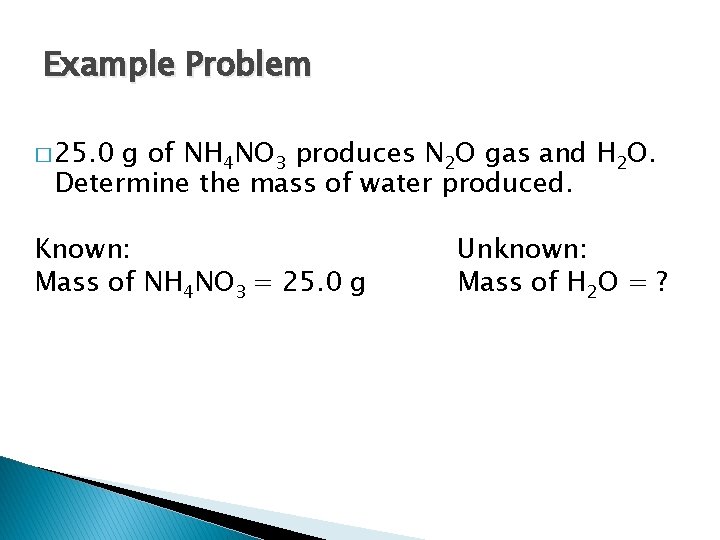
Example Problem � 25. 0 g of NH 4 NO 3 produces N 2 O gas and H 2 O. Determine the mass of water produced. Known: Mass of NH 4 NO 3 = 25. 0 g Unknown: Mass of H 2 O = ?
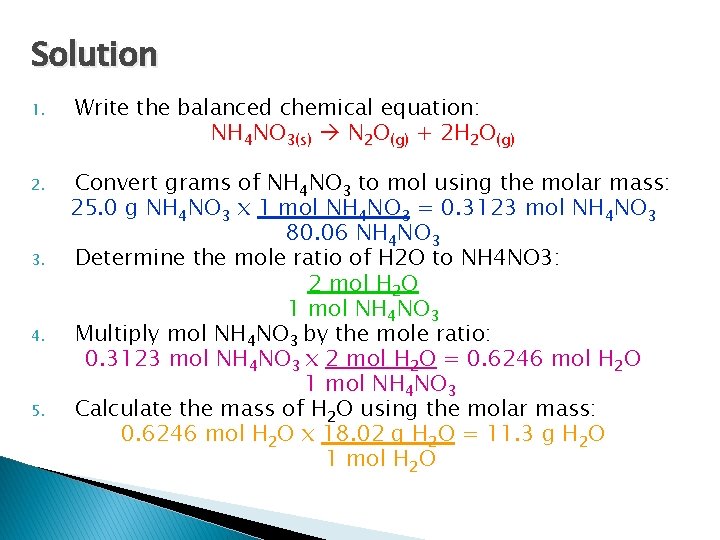
Solution 1. 2. 3. 4. 5. Write the balanced chemical equation: NH 4 NO 3(s) N 2 O(g) + 2 H 2 O(g) Convert grams of NH 4 NO 3 to mol using the molar mass: 25. 0 g NH 4 NO 3 x 1 mol NH 4 NO 3 = 0. 3123 mol NH 4 NO 3 80. 06 NH 4 NO 3 Determine the mole ratio of H 2 O to NH 4 NO 3: 2 mol H 2 O 1 mol NH 4 NO 3 Multiply mol NH 4 NO 3 by the mole ratio: 0. 3123 mol NH 4 NO 3 x 2 mol H 2 O = 0. 6246 mol H 2 O 1 mol NH 4 NO 3 Calculate the mass of H 2 O using the molar mass: 0. 6246 mol H 2 O x 18. 02 g H 2 O = 11. 3 g H 2 O 1 mol H 2 O
Practice problems � Page 363 #13
Homework �Stoichiometry worksheet
Stoichiometry Limiting Reactants Section 12. 3
Objective � Define limiting reactant � Solve stoichiometry problems that incorporate limiting reactants
Key Terms � Limiting reactant: ◦ totally consumed during a chemical reaction ◦ limits the extent of the reaction ◦ determines the amount of product � Excess reactant: ◦ NOT completely consumed in reaction ◦ Some remains after the reaction stops (limiting reactant runs out)
Steps to determining LR 1. 2. 3. 4. Convert grams of each reactant to mols Divide mols by stoichiometric coefficient The smaller number is the LR Use the LR to do stoichiometric calculations
Example S 8+ 4 Cl 2 4 S 2 Cl 2 If 200. g of S reacts with 100. g of Cl, what mass of S 2 Cl 2 is produced? 1. Convert both masses to moles: 200. g S 8 x 1 mol S 8 = 0. 7795 mol S 8 256. 56 g S 8 100. g Cl 2 x 1 mol Cl 2 = 1. 4104 mol Cl 2 70. 90 g Cl 2

2. Divide mols by coefficient from the equation: 1. 4104 mol Cl 2 = 0. 3526 4 mol Cl 2 3. 0. 7795 mol S 8 = 0. 7795 1 mol S 8 The smaller one is the limiting reactant (Cl 2)
4. Use the limiting reactant to determine the mass of S 2 Cl 2 as a stoichiometry problem from section 12. 2: 100. g Cl 2 x 1 mol Cl 2 x 4 mol S 2 Cl 2 x 135. 04 g S 2 Cl 2 70. 90 g Cl 2 4 mol Cl 2 1 mol S 2 Cl 2 = 190. g S 2 Cl 2
Example Problem The reaction between phosphorus and oxygen produced tetraphosphorus decaoxide. a. Determine the mass of P 4 O 10 formed if 25. 0 g of P 4 and 50. 0 g of O 2 are combined. b. How much of the excess reactant remains after the reaction stops?
Homework � Limiting Reactants Worksheet
Stoichiometry Percent Yield Section 12. 4
Objectives � Define theoretical, actual, and percent yield � Solve stoichiometry problems for percent yields
Key Terms � Theoretical Yield: The maximum amount of product that can mathematically be produced � Actual Yield: The amount of product produced in an experiment � Percent Yield: The ratio of actual yield to theoretical yield
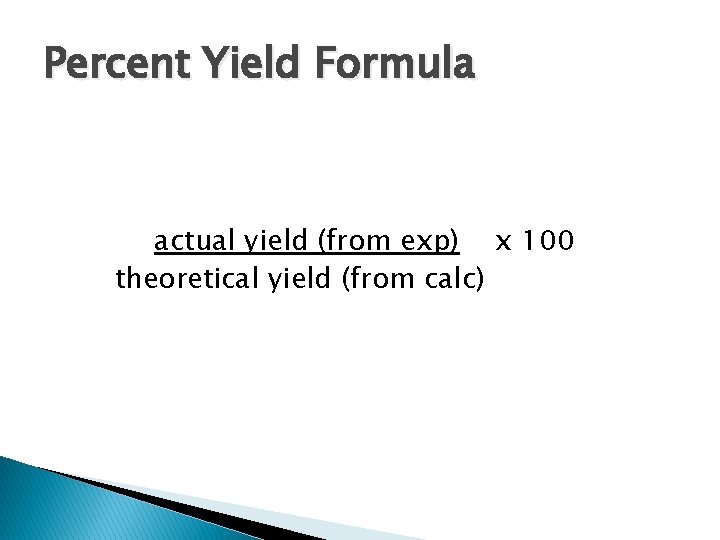
Percent Yield Formula actual yield (from exp) x 100 theoretical yield (from calc)
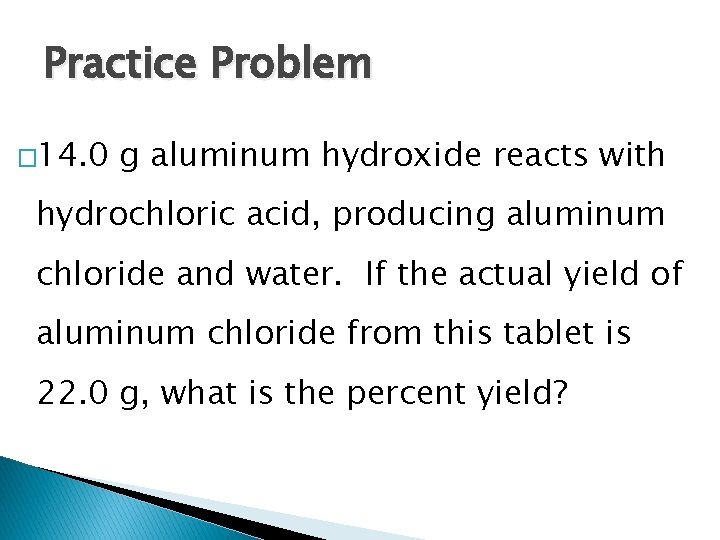
Practice Problem � 14. 0 g aluminum hydroxide reacts with hydrochloric acid, producing aluminum chloride and water. If the actual yield of aluminum chloride from this tablet is 22. 0 g, what is the percent yield?
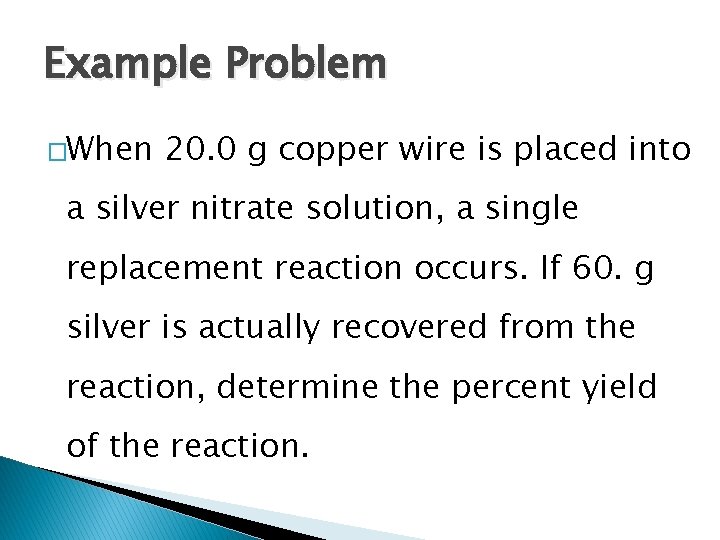
Example Problem �When 20. 0 g copper wire is placed into a silver nitrate solution, a single replacement reaction occurs. If 60. g silver is actually recovered from the reaction, determine the percent yield of the reaction.
Homework � Percent Yield Worksheet
- Slides: 29