
Chapter 12 Speed Agility and Quickness Objectives After
Chapter 12 Speed, Agility, and Quickness
Objectives • After this presentation, the participant will be able to: – Describe speed, agility, and quickness training and its purpose. – Discuss the importance of speed, agility, and quickness training. – Design a speed, agility, and quickness training program for clients in any level of training. – Perform, describe, and instruct various speed, agility, and quickness training exercises.
Concepts • Often viewed as being beneficial only for the athlete. • Can also be used with a typical health club member to: – Add intensity and complexity – Increase the cardiorespiratory demand – Provide a simple and exciting variety to a routine workout • Allows a client to enhance his or her ability to accelerate, decelerate, and dynamically stabilize the entire body during higher velocity in multiple planes.
Speed • The ability to move the body in one intended direction as fast as possible • The product of stride rate and stride length – Stride Rate • The number of strides taken in a given amount of time (or distance). – Stride Length • The distance covered in one stride, during running.
Speed • Proper Sprint Mechanics – Allow the client to maximize forces generated by muscles, so that maximum velocity can be achieved in the shortest possible time. – Frontside mechanics is the emphasis on triple flexion of the front leg: • • Ankle dorsiflexion Knee flexion Hip flexion Neutral lumbar spine
Speed • Proper Sprint Mechanics – Backside mechanics is the emphasis on triple extension of the back leg: • • Ankle plantarflexion Knee extension Hip extension Neutral lumbar spine
Agility • The ability to start (or accelerate), stop (or decelerate and stabilize), and change direction quickly, while maintaining proper posture • Requires high levels of neuromuscular efficiency – Constantly regaining a center of gravity over a base of support, while changing directions, at various speeds • Can also help to prevent injury – Enhances the body’s ability to effectively control eccentric forces in all planes of motion – Improves the structural integrity of the connective tissue – An example of an agility exercise from the book would be One-ins, which is a speed ladder stepping combination. *
Quickness • The ability to react and change body position with maximum rate of force production, in all planes of motion and from all body positions, during functional activities. • The ability to react to visual, auditory, and kinesthetic feedback during functional activities with minimal hesitation.
Kinetic Chain Checkpoints • Foot and Ankle Complex – Pointing straight ahead – Dorsiflexed when it hits the ground – Excessive flattening or external rotation of the foot will create abnormal stress throughout the rest of the kinetic chain and decrease overall performance • Knee Complex – Must remain straight ahead – Excessive adduction and internal rotation of the femur during the stance phase decreases force production and leads to overuse injuries
Kinetic Chain Checkpoints • Lumbo-Pelvic-Hip Complex – The body should have a slight lean during acceleration. – During maximum velocity, should be fairly neutral, without excessive extension or flexion, unless to reach for an object. • Head Position – The head should remain in line with the lumbo-pelvic-hip complex and legs. – Should not compensate and move into extension, unless necessary to track an object (such as a ball). – Can affect the position of the lumbo-pelvic-hip complex (pelvo-occular reflex).
SAQ Training for Youth – SAQ training for youth is an effective way of providing a variety of exposures to various physiologic, neuromuscular, and biomechanical demands, resulting in the further development of physical ability. – SAQ programs for youth have been found to decrease the likelihood of athletic injury, increase the likelihood of exercise participation later in life, and improve physical fitness. – Speed and Agility is the most relevant to the progression of a youth training program. *
SAQ Training for Weight Loss – High-intensity, short-duration programs have been found to match or surpass results for functional capacity, muscular power, fat and weight loss, and other metabolic adaptations when compared with moderate-intensity, longduration exercise protocols. – The high-intensity, short bouts of SAQ drills make them a valid choice for interval training modalities with appropriate nonathletic populations.
SAQ Training for Seniors – A primary function of SAQ training in seniors is to prevent age-related decreases in bone density, coordinative ability, and muscular power. This aids in the prevention of injury and an increase in the quality of life. – SAQ-based programs have been found to increase coordinative ability and movement confidence, eliciting a decreased likelihood of falling or other movement-related injury.
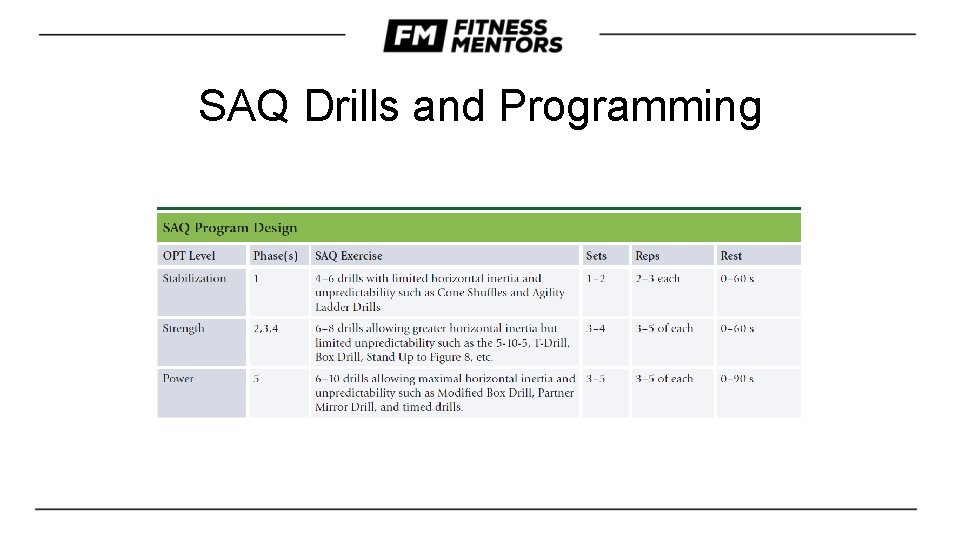
SAQ Drills and Programming
Summary • SAQ training can be used by athletic and nonathletic populations and does not need to be reserved for athletes. • Precise technique and kinetic chain control are required to minimize risk of injury. • Programming guidelines must be gauged on the total volume of training for all components in a workout.
- Slides: 15