
Chapter 12 Skin Hair and Nails Copyright 2016


- Slides: 61
Chapter 12 Skin, Hair, and Nails Copyright © 2016 by Elsevier, Inc. All rights reserved. Copyright © 2012, 2008, 2004, 2000, 1996, 1993 by Saunders, an affiliate of Elsevier Inc.
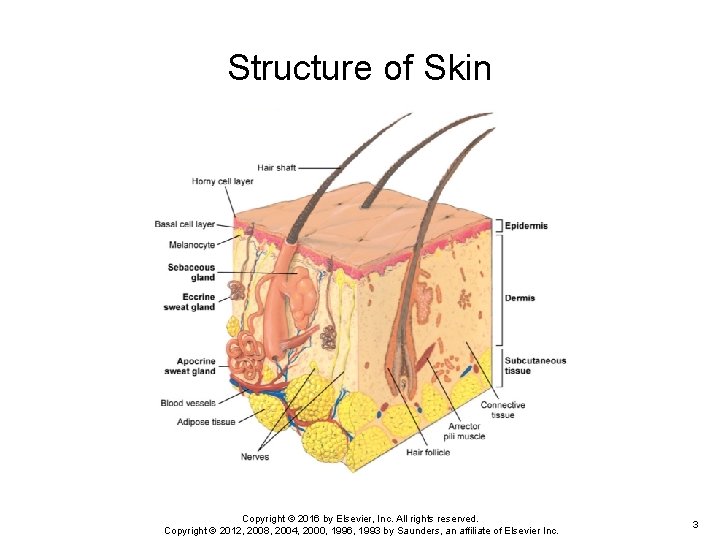
Structure: Skin Think of skin as body’s largest organ system Covers 20 square feet of surface area in adults Ø Skin is the sentry that guards body Ø Skin has two layers Ø Epidermis: outer highly differentiated layer • Basal cell layer forms new skin cells • Outer horny cell layer of dead keratinized cells Ø Dermis: inner supportive layer • Connective tissue or collagen • Elastic tissue Beneath these layers is a subcutaneous layer of adipose tissue Copyright © 2016 by Elsevier, Inc. All rights reserved. Copyright © 2012, 2008, 2004, 2000, 1996, 1993 by Saunders, an affiliate of Elsevier Inc. 2
Structure of Skin Copyright © 2016 by Elsevier, Inc. All rights reserved. Copyright © 2012, 2008, 2004, 2000, 1996, 1993 by Saunders, an affiliate of Elsevier Inc. 3
Structure: Epidermal Appendages Structures formed by tubular invagination of epidermis down into underlying dermis Ø Hair Ø Sebaceous glands Ø Sweat glands: important for fluid balance and thermoregulation Ø • Eccrine glands • Apocrine glands Copyright © 2016 by Elsevier, Inc. All rights reserved. Copyright © 2012, 2008, 2004, 2000, 1996, 1993 by Saunders, an affiliate of Elsevier Inc. 4
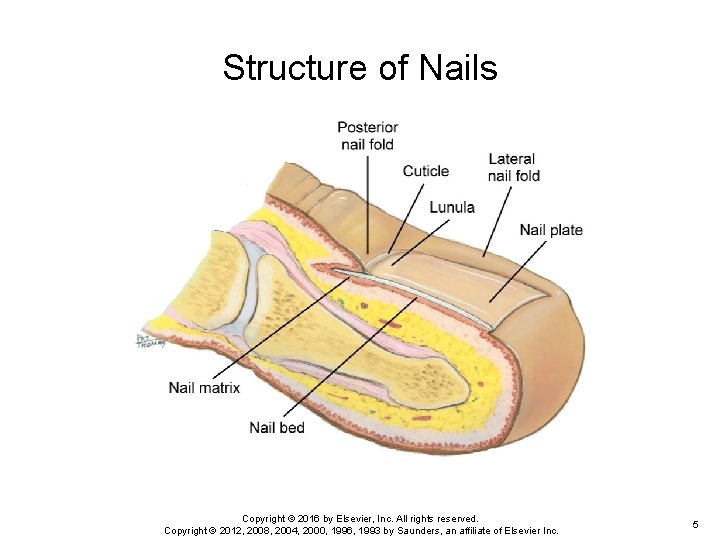
Structure of Nails Copyright © 2016 by Elsevier, Inc. All rights reserved. Copyright © 2012, 2008, 2004, 2000, 1996, 1993 by Saunders, an affiliate of Elsevier Inc. 5
Skin Function Skin is waterproof, protective, and adaptive Ø Ø Ø Ø Ø Protection from environment Prevents penetration Perception Temperature regulation Identification Communication Wound repair Absorption and excretion Production of vitamin D Copyright © 2016 by Elsevier, Inc. All rights reserved. Copyright © 2012, 2008, 2004, 2000, 1996, 1993 by Saunders, an affiliate of Elsevier Inc. 6
Developmental Competence: Infants, Children, and Adolescents Newborn infants Lanugo: fine downy hair of newborn infant Ø Vernix caseosa: thick, cheesy substance Ø Sebum: holding water in the skin producing milia Ø Children Epidermis thickens, darkens, and becomes lubricated Ø Hair growth accelerates Ø Adolescents Secretions from apocrine sweat glands increase Ø Subcutaneous fat deposits increase Ø Secondary sex characteristics Ø Copyright © 2016 by Elsevier, Inc. All rights reserved. Copyright © 2012, 2008, 2004, 2000, 1996, 1993 by Saunders, an affiliate of Elsevier Inc. 7
Developmental Competence: The Pregnant Woman Linea nigra Ø Chloasma Ø Increased pigmentation midline of abdomen Discoloration changes on face representing the “mask of pregnancy” Striae gravidarum Ø Stretch marks, which can develop over the abdomen, breast, and thighs Copyright © 2016 by Elsevier, Inc. All rights reserved. Copyright © 2012, 2008, 2004, 2000, 1996, 1993 by Saunders, an affiliate of Elsevier Inc. 8
Developmental Competence: The Aging Adult Elasticity Ø Sweat and sebaceous glands Ø Discoloration due to increasing capillary fragility Skin breakdown due to multiple factors Ø Decrease in number and function, leaving skin dry Senile purpura Ø Loses elasticity; skin folds and sags Cell replacement is slower and wound healing is delayed Hair matrix Ø Functioning melanocytes decrease, leading to gray fine hair Copyright © 2016 by Elsevier, Inc. All rights reserved. Copyright © 2012, 2008, 2004, 2000, 1996, 1993 by Saunders, an affiliate of Elsevier Inc. 9
Culture and Genetics Genetic attributes of dark-skinned individuals afford protection against skin cancer due to melanin Increased likelihood of skin cancer in Whites than in Black and Hispanic populations Most important environmental risk factor for skin cancer is exposure to ultraviolet (UV) radiation both from sun and tanning sources Increased risk for melanoma related to increased number of sunburns during one’s lifetime Certain skin presentations associated with different ethnic groups Copyright © 2016 by Elsevier, Inc. All rights reserved. Copyright © 2012, 2008, 2004, 2000, 1996, 1993 by Saunders, an affiliate of Elsevier Inc. 10
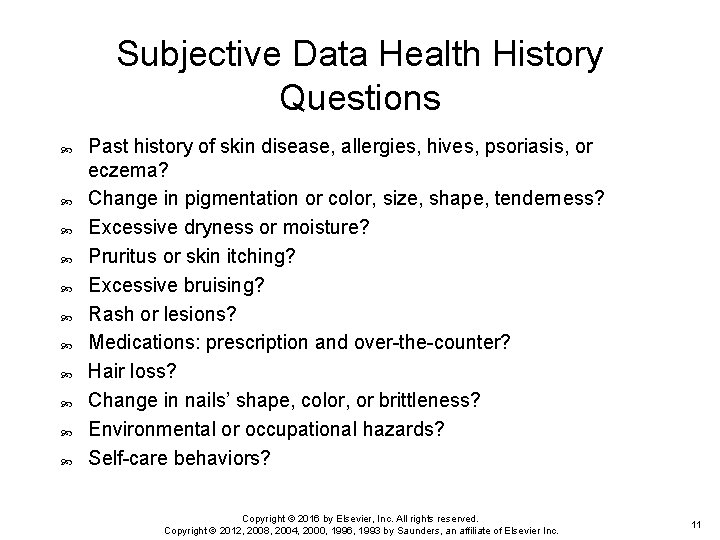
Subjective Data Health History Questions Past history of skin disease, allergies, hives, psoriasis, or eczema? Change in pigmentation or color, size, shape, tenderness? Excessive dryness or moisture? Pruritus or skin itching? Excessive bruising? Rash or lesions? Medications: prescription and over-the-counter? Hair loss? Change in nails’ shape, color, or brittleness? Environmental or occupational hazards? Self-care behaviors? Copyright © 2016 by Elsevier, Inc. All rights reserved. Copyright © 2012, 2008, 2004, 2000, 1996, 1993 by Saunders, an affiliate of Elsevier Inc. 11
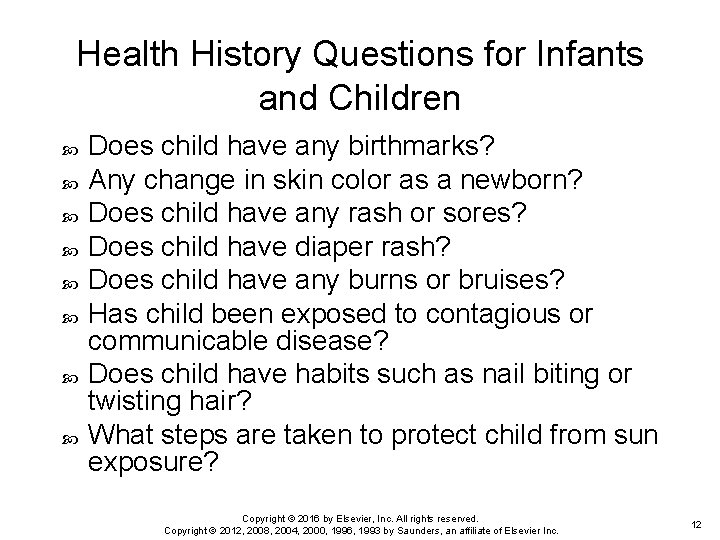
Health History Questions for Infants and Children Does child have any birthmarks? Any change in skin color as a newborn? Does child have any rash or sores? Does child have diaper rash? Does child have any burns or bruises? Has child been exposed to contagious or communicable disease? Does child have habits such as nail biting or twisting hair? What steps are taken to protect child from sun exposure? Copyright © 2016 by Elsevier, Inc. All rights reserved. Copyright © 2012, 2008, 2004, 2000, 1996, 1993 by Saunders, an affiliate of Elsevier Inc. 12
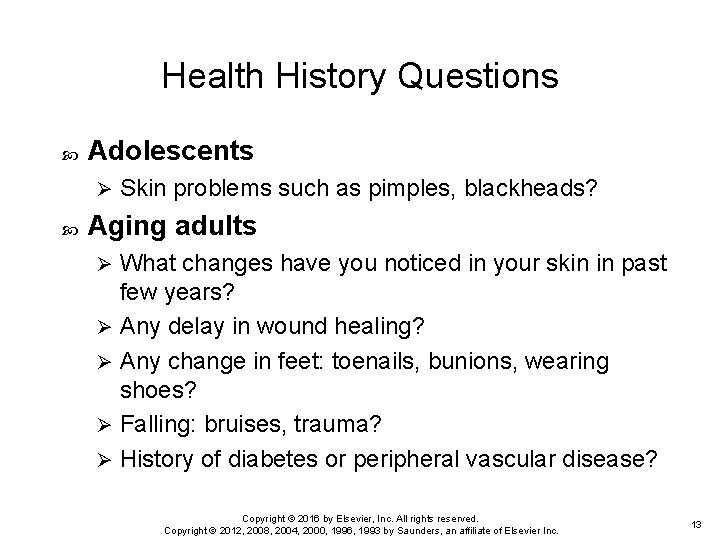
Health History Questions Adolescents Ø Skin problems such as pimples, blackheads? Aging adults What changes have you noticed in your skin in past few years? Ø Any delay in wound healing? Ø Any change in feet: toenails, bunions, wearing shoes? Ø Falling: bruises, trauma? Ø History of diabetes or peripheral vascular disease? Ø Copyright © 2016 by Elsevier, Inc. All rights reserved. Copyright © 2012, 2008, 2004, 2000, 1996, 1993 by Saunders, an affiliate of Elsevier Inc. 13
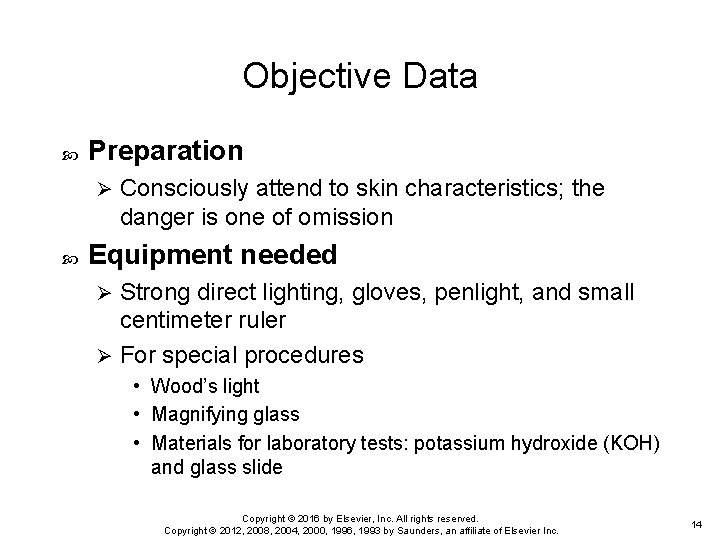
Objective Data Preparation Ø Consciously attend to skin characteristics; the danger is one of omission Equipment needed Strong direct lighting, gloves, penlight, and small centimeter ruler Ø For special procedures Ø • Wood’s light • Magnifying glass • Materials for laboratory tests: potassium hydroxide (KOH) and glass slide Copyright © 2016 by Elsevier, Inc. All rights reserved. Copyright © 2012, 2008, 2004, 2000, 1996, 1993 by Saunders, an affiliate of Elsevier Inc. 14
Complete Physical Examination Skin assessment integrated throughout examination Scrutinize the outer skin surface first before you concentrate on underlying structures Separate intertriginous areas (areas with skinfolds) such as under large breasts, obese abdomen, and groin, and inspect them thoroughly Ø These areas are dark, warm, and moist and provide perfect conditions for irritation or infection Always inspect feet, toenails, and between toes Copyright © 2016 by Elsevier, Inc. All rights reserved. Copyright © 2012, 2008, 2004, 2000, 1996, 1993 by Saunders, an affiliate of Elsevier Inc. 15
Regional Examination Individuals may seek health care for skin problems and assessment focused on skin alone Assess skin as one entity; getting overall impression helps reveal distribution patterns Inspect lesions carefully With a rash, check all areas of body as you cannot rely on the history that rash is in only one location Skills used are inspection and palpation because some skin changes have accompanying signs that can be felt Copyright © 2016 by Elsevier, Inc. All rights reserved. Copyright © 2012, 2008, 2004, 2000, 1996, 1993 by Saunders, an affiliate of Elsevier Inc. 16
Inspection and Palpation: Skin Color Ø Ø General pigmentation, freckles, moles, birthmarks Widespread color change • Note color change over entire body skin, such as pallor (pale), erythema (red), cyanosis (blue), or jaundice (yellow) • Note if color change transient or due to pathology Temperature Use backs of hands to palpate person Skin should be warm, and temperature equal bilaterally; warmth suggests normal circulatory status Ø Hands and feet may be slightly cooler in a cool environment Ø Ø • Hypothermia • Hyperthermia Copyright © 2016 by Elsevier, Inc. All rights reserved. Copyright © 2012, 2008, 2004, 2000, 1996, 1993 by Saunders, an affiliate of Elsevier Inc. 17
Inspection and Palpation: Skin (Cont. ) Moisture Ø Ø Diaphoresis Dehydration Texture Thickness Edema Mobility and turgor Vascularity or bruising Multiple bruises at different stages of healing and excessive bruises above knees or elbows should raise concern about physical abuse Ø Needle marks or tracks from intravenous injection of street drugs may be visible on antecubital fossae, forearms, or on any available vein Ø Copyright © 2016 by Elsevier, Inc. All rights reserved. Copyright © 2012, 2008, 2004, 2000, 1996, 1993 by Saunders, an affiliate of Elsevier Inc. 18
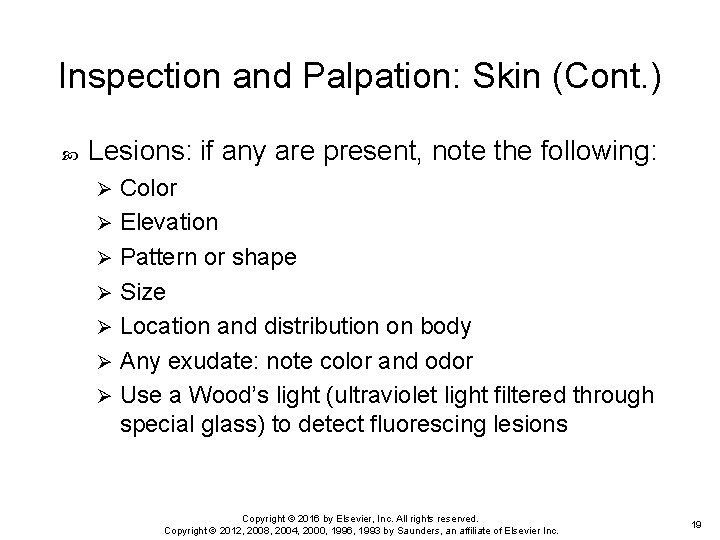
Inspection and Palpation: Skin (Cont. ) Lesions: if any are present, note the following: Color Ø Elevation Ø Pattern or shape Ø Size Ø Location and distribution on body Ø Any exudate: note color and odor Ø Use a Wood’s light (ultraviolet light filtered through special glass) to detect fluorescing lesions Ø Copyright © 2016 by Elsevier, Inc. All rights reserved. Copyright © 2012, 2008, 2004, 2000, 1996, 1993 by Saunders, an affiliate of Elsevier Inc. 19
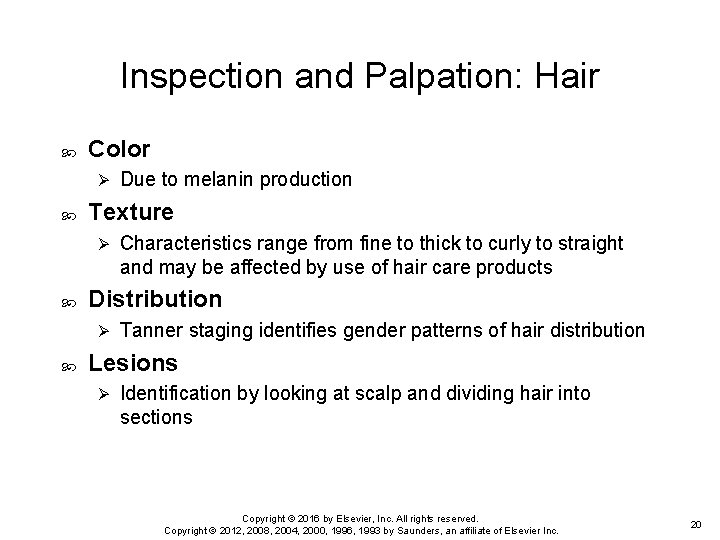
Inspection and Palpation: Hair Color Ø Texture Ø Characteristics range from fine to thick to curly to straight and may be affected by use of hair care products Distribution Ø Due to melanin production Tanner staging identifies gender patterns of hair distribution Lesions Ø Identification by looking at scalp and dividing hair into sections Copyright © 2016 by Elsevier, Inc. All rights reserved. Copyright © 2012, 2008, 2004, 2000, 1996, 1993 by Saunders, an affiliate of Elsevier Inc. 20
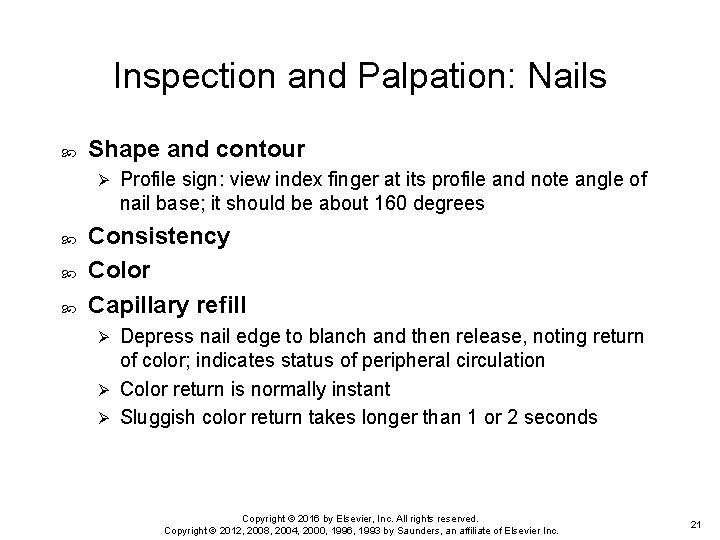
Inspection and Palpation: Nails Shape and contour Ø Profile sign: view index finger at its profile and note angle of nail base; it should be about 160 degrees Consistency Color Capillary refill Depress nail edge to blanch and then release, noting return of color; indicates status of peripheral circulation Ø Color return is normally instant Ø Sluggish color return takes longer than 1 or 2 seconds Ø Copyright © 2016 by Elsevier, Inc. All rights reserved. Copyright © 2012, 2008, 2004, 2000, 1996, 1993 by Saunders, an affiliate of Elsevier Inc. 21
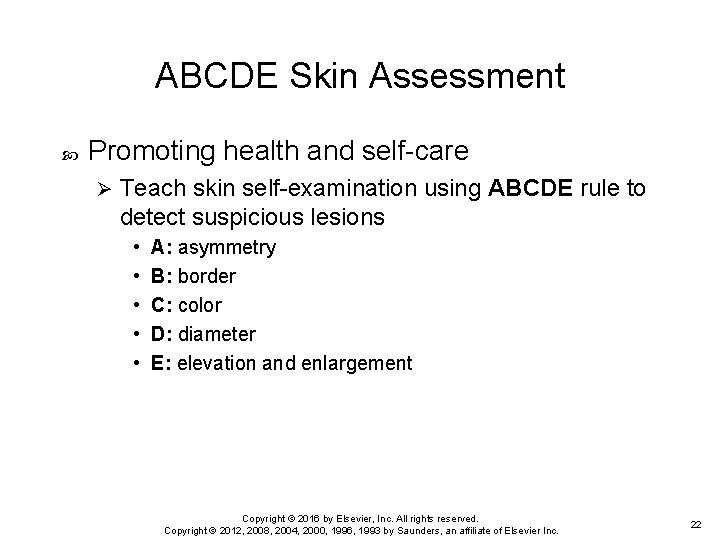
ABCDE Skin Assessment Promoting health and self-care Ø Teach skin self-examination using ABCDE rule to detect suspicious lesions • • • A: asymmetry B: border C: color D: diameter E: elevation and enlargement Copyright © 2016 by Elsevier, Inc. All rights reserved. Copyright © 2012, 2008, 2004, 2000, 1996, 1993 by Saunders, an affiliate of Elsevier Inc. 22
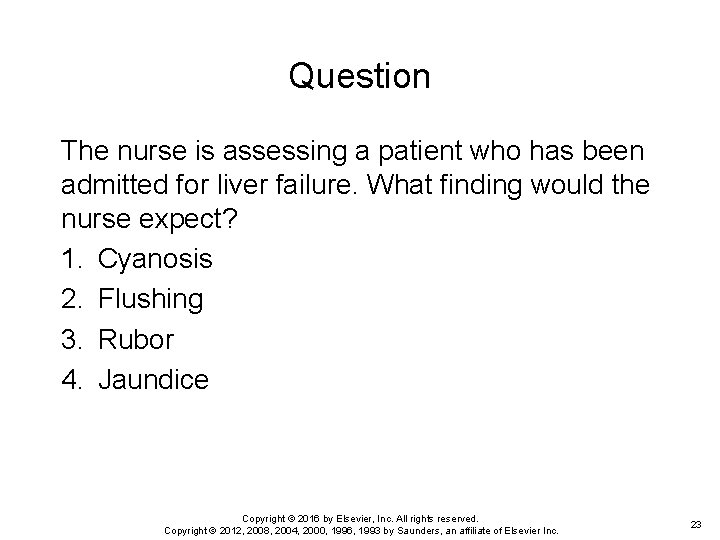
Question The nurse is assessing a patient who has been admitted for liver failure. What finding would the nurse expect? 1. Cyanosis 2. Flushing 3. Rubor 4. Jaundice Copyright © 2016 by Elsevier, Inc. All rights reserved. Copyright © 2012, 2008, 2004, 2000, 1996, 1993 by Saunders, an affiliate of Elsevier Inc. 23
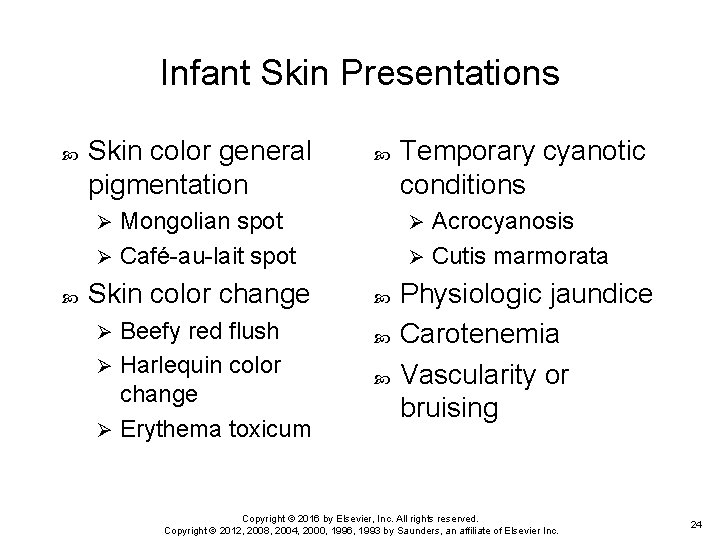
Infant Skin Presentations Skin color general pigmentation Mongolian spot Ø Café-au-lait spot Acrocyanosis Ø Cutis marmorata Ø Skin color change Beefy red flush Ø Harlequin color change Ø Erythema toxicum Ø Temporary cyanotic conditions Ø Physiologic jaundice Carotenemia Vascularity or bruising Copyright © 2016 by Elsevier, Inc. All rights reserved. Copyright © 2012, 2008, 2004, 2000, 1996, 1993 by Saunders, an affiliate of Elsevier Inc. 24
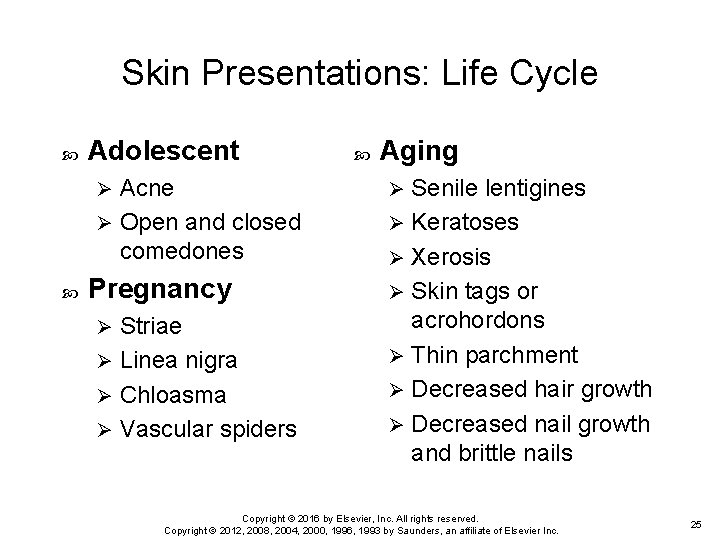
Skin Presentations: Life Cycle Adolescent Acne Ø Open and closed comedones Ø Pregnancy Striae Ø Linea nigra Ø Chloasma Ø Vascular spiders Ø Aging Senile lentigines Ø Keratoses Ø Xerosis Ø Skin tags or acrohordons Ø Thin parchment Ø Decreased hair growth Ø Decreased nail growth and brittle nails Ø Copyright © 2016 by Elsevier, Inc. All rights reserved. Copyright © 2012, 2008, 2004, 2000, 1996, 1993 by Saunders, an affiliate of Elsevier Inc. 25
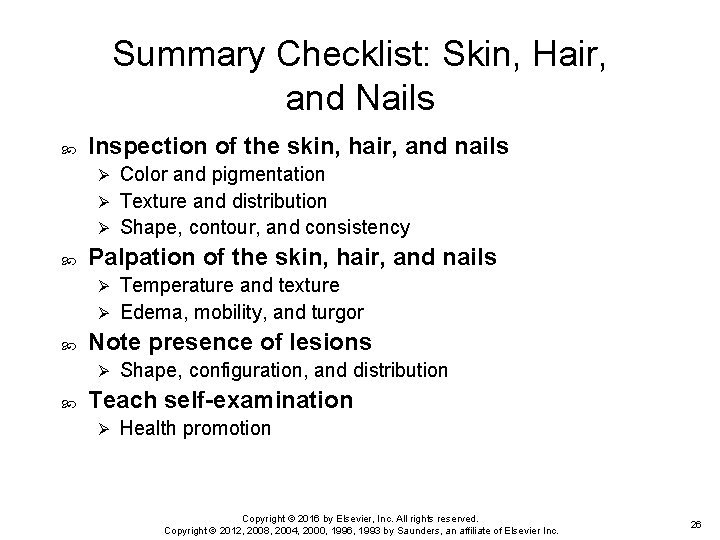
Summary Checklist: Skin, Hair, and Nails Inspection of the skin, hair, and nails Color and pigmentation Ø Texture and distribution Ø Shape, contour, and consistency Ø Palpation of the skin, hair, and nails Temperature and texture Ø Edema, mobility, and turgor Ø Note presence of lesions Ø Shape, configuration, and distribution Teach self-examination Ø Health promotion Copyright © 2016 by Elsevier, Inc. All rights reserved. Copyright © 2012, 2008, 2004, 2000, 1996, 1993 by Saunders, an affiliate of Elsevier Inc. 26
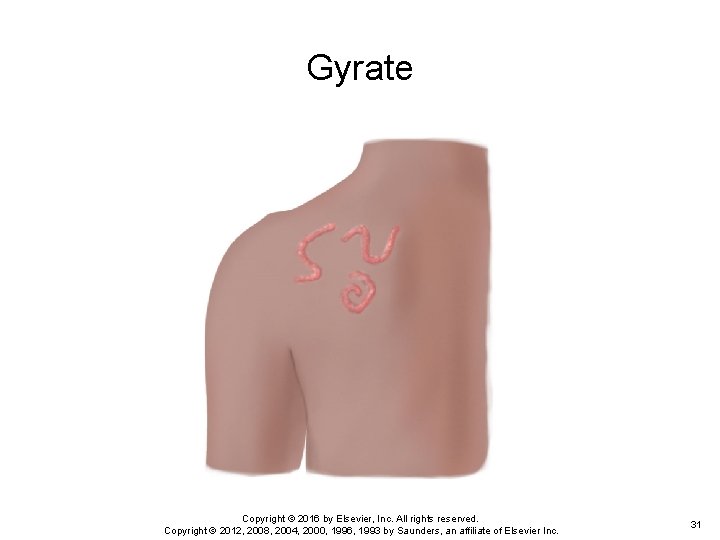
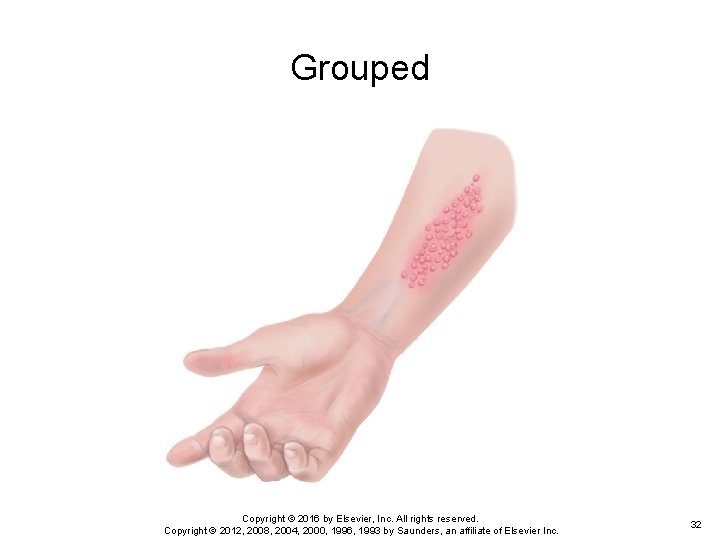
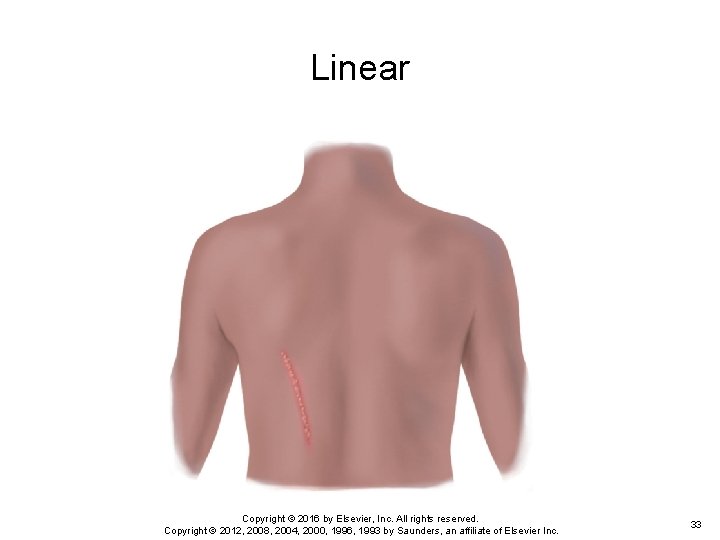
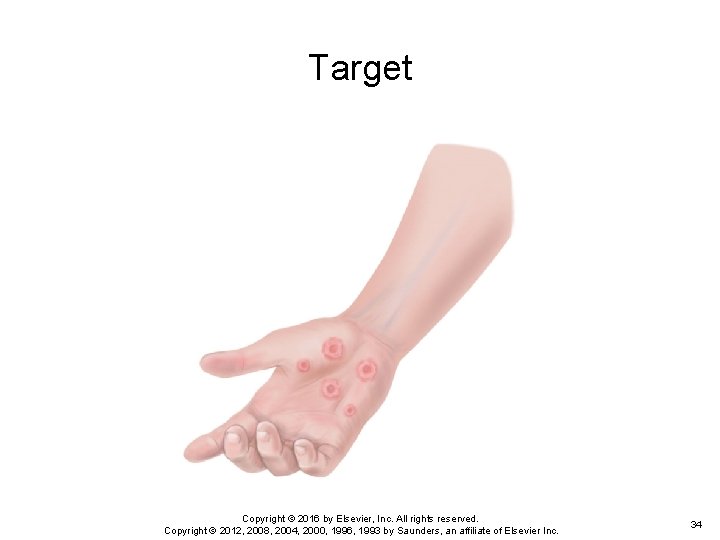
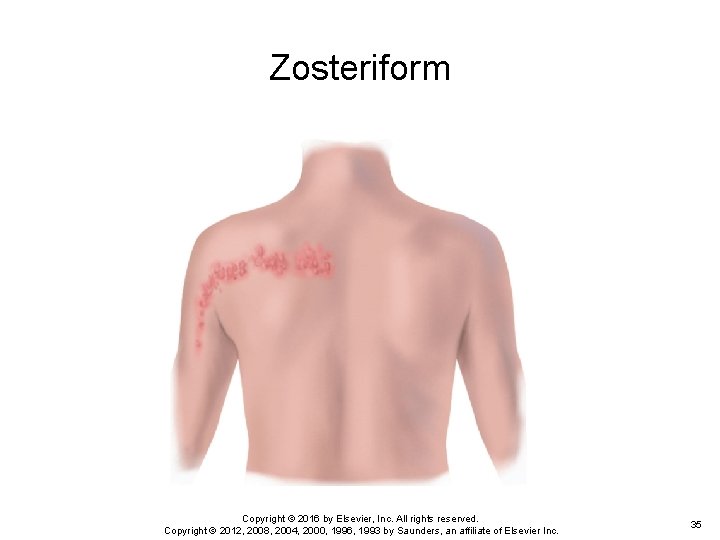
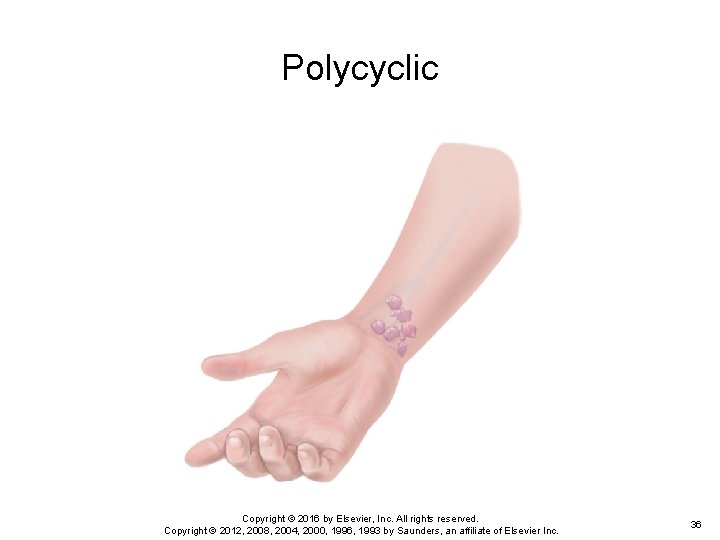
Shapes and Configurations of Lesions Annular or circular Confluent Discrete Grouped Gyrate Target or iris Linear Polycyclic Zosteriform Copyright © 2016 by Elsevier, Inc. All rights reserved. Copyright © 2012, 2008, 2004, 2000, 1996, 1993 by Saunders, an affiliate of Elsevier Inc. 27
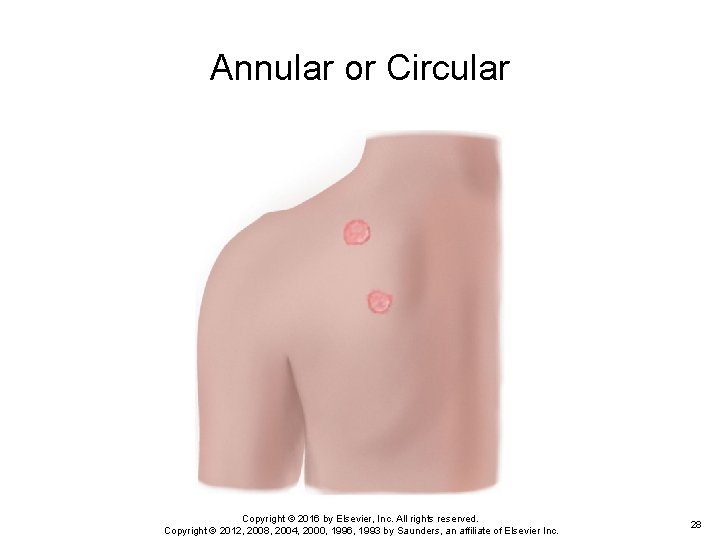
Annular or Circular Copyright © 2016 by Elsevier, Inc. All rights reserved. Copyright © 2012, 2008, 2004, 2000, 1996, 1993 by Saunders, an affiliate of Elsevier Inc. 28
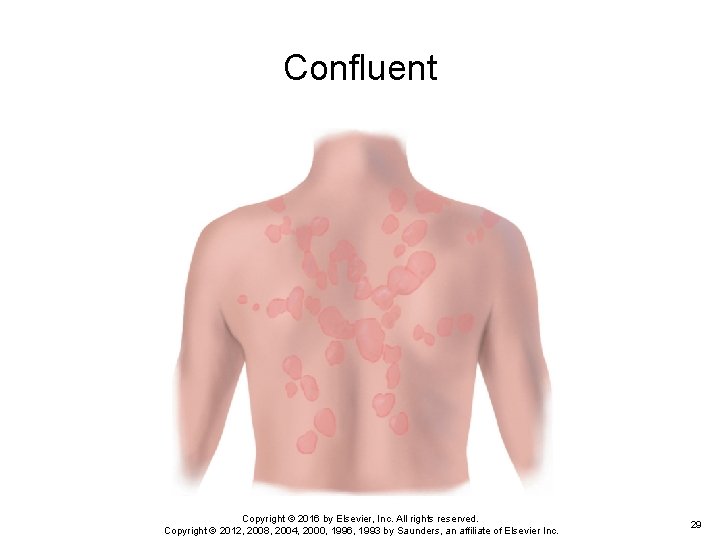
Confluent Copyright © 2016 by Elsevier, Inc. All rights reserved. Copyright © 2012, 2008, 2004, 2000, 1996, 1993 by Saunders, an affiliate of Elsevier Inc. 29
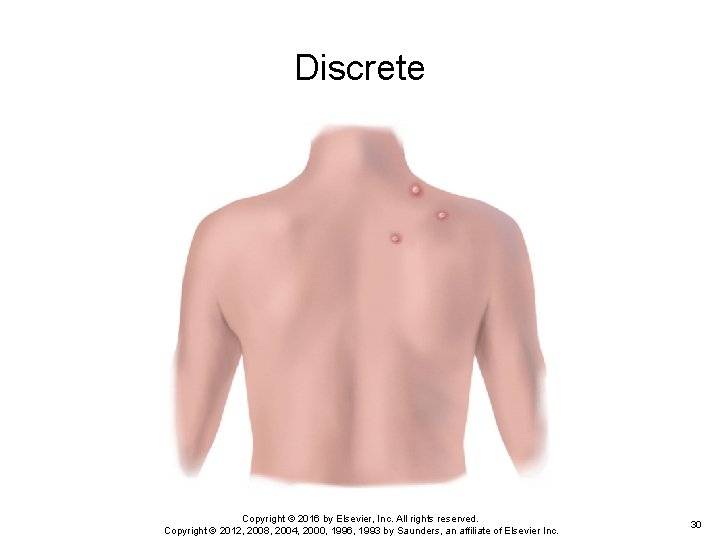
Discrete Copyright © 2016 by Elsevier, Inc. All rights reserved. Copyright © 2012, 2008, 2004, 2000, 1996, 1993 by Saunders, an affiliate of Elsevier Inc. 30
Gyrate Copyright © 2016 by Elsevier, Inc. All rights reserved. Copyright © 2012, 2008, 2004, 2000, 1996, 1993 by Saunders, an affiliate of Elsevier Inc. 31
Grouped Copyright © 2016 by Elsevier, Inc. All rights reserved. Copyright © 2012, 2008, 2004, 2000, 1996, 1993 by Saunders, an affiliate of Elsevier Inc. 32
Linear Copyright © 2016 by Elsevier, Inc. All rights reserved. Copyright © 2012, 2008, 2004, 2000, 1996, 1993 by Saunders, an affiliate of Elsevier Inc. 33
Target Copyright © 2016 by Elsevier, Inc. All rights reserved. Copyright © 2012, 2008, 2004, 2000, 1996, 1993 by Saunders, an affiliate of Elsevier Inc. 34
Zosteriform Copyright © 2016 by Elsevier, Inc. All rights reserved. Copyright © 2012, 2008, 2004, 2000, 1996, 1993 by Saunders, an affiliate of Elsevier Inc. 35
Polycyclic Copyright © 2016 by Elsevier, Inc. All rights reserved. Copyright © 2012, 2008, 2004, 2000, 1996, 1993 by Saunders, an affiliate of Elsevier Inc. 36
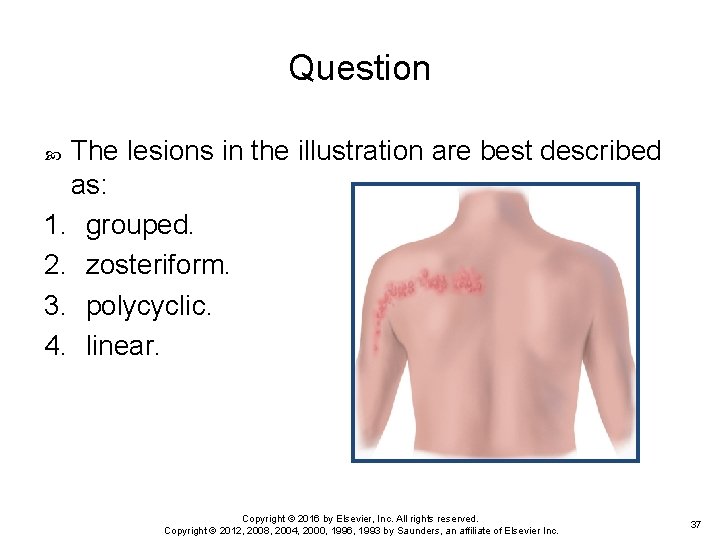
Question The lesions in the illustration are best described as: 1. grouped. 2. zosteriform. 3. polycyclic. 4. linear. Copyright © 2016 by Elsevier, Inc. All rights reserved. Copyright © 2012, 2008, 2004, 2000, 1996, 1993 by Saunders, an affiliate of Elsevier Inc. 37
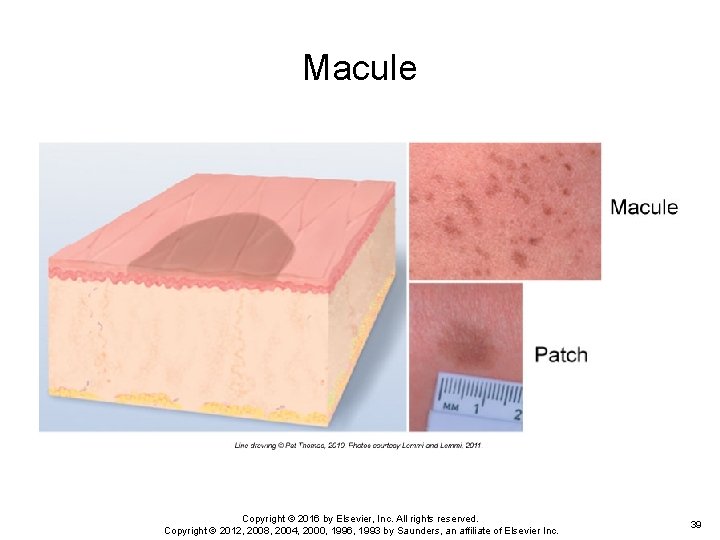
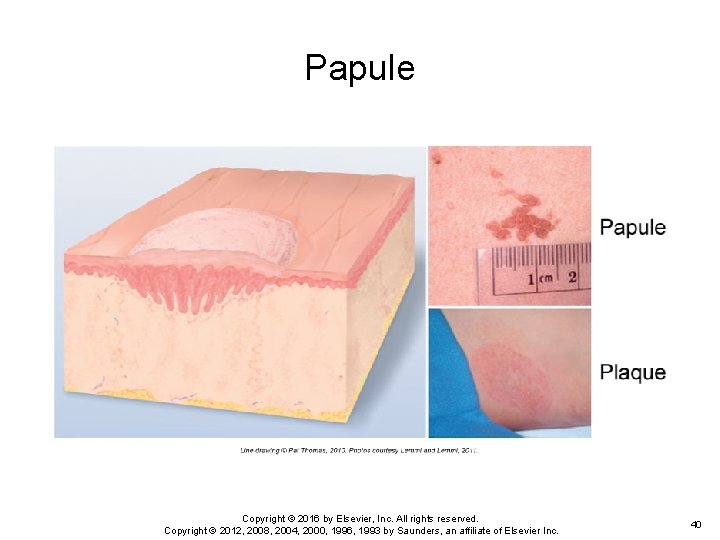
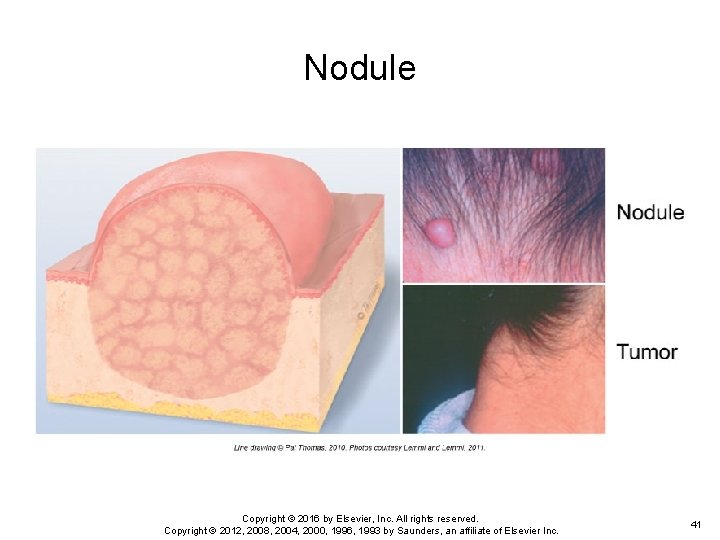
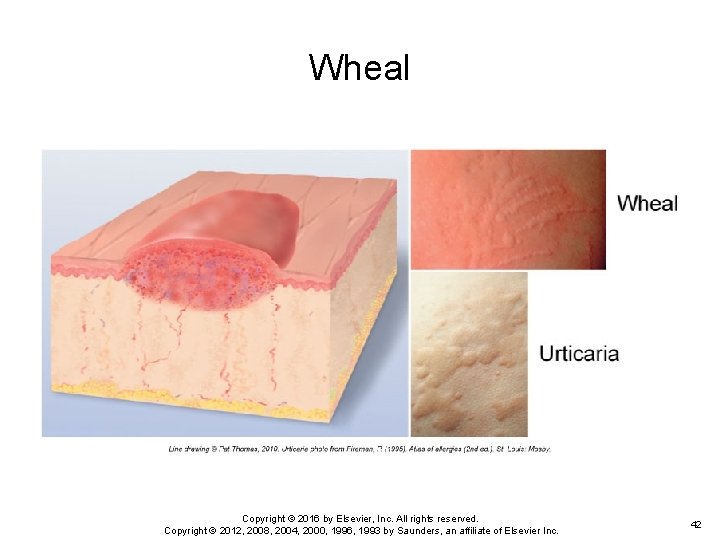
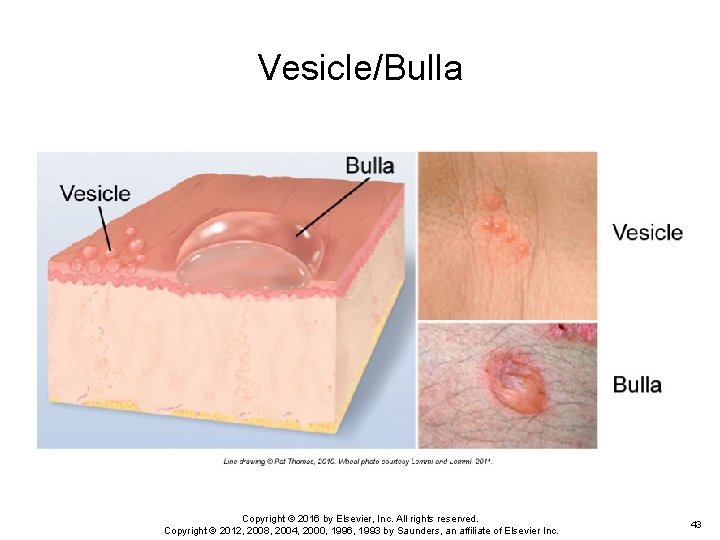
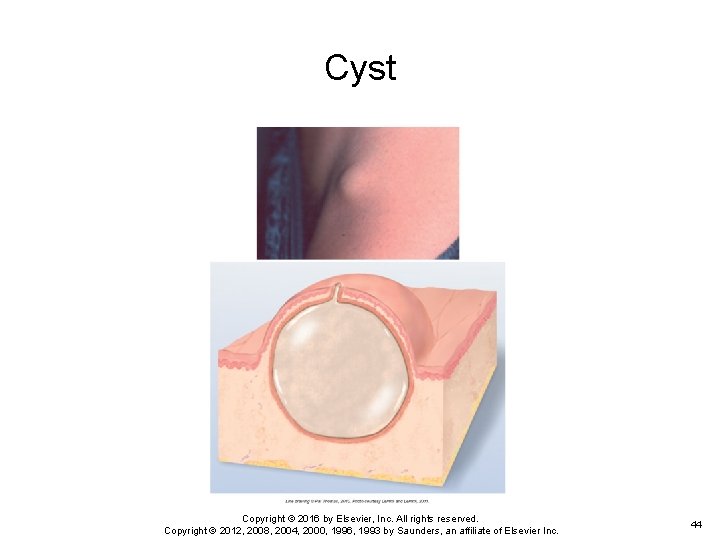
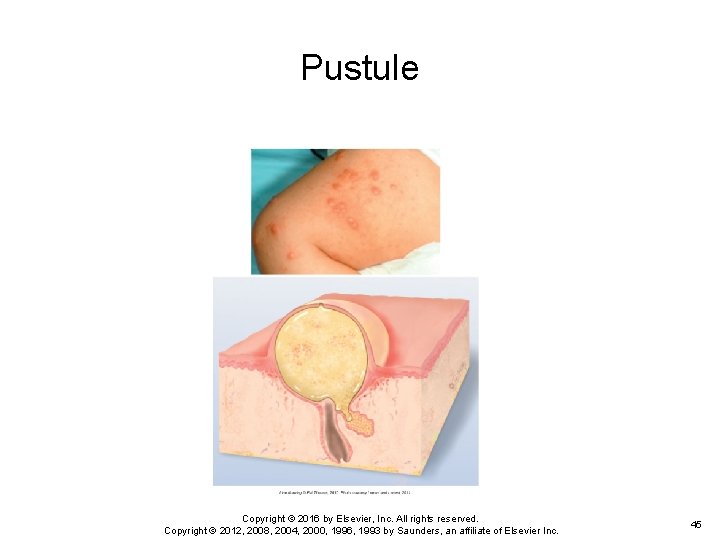
Primary Skin Lesions Macules Papules Patches Plaques Nodules Wheals Tumors Urticaria (hives) Vesicles Cysts Bullas Pustules Copyright © 2016 by Elsevier, Inc. All rights reserved. Copyright © 2012, 2008, 2004, 2000, 1996, 1993 by Saunders, an affiliate of Elsevier Inc. 38
Macule Copyright © 2016 by Elsevier, Inc. All rights reserved. Copyright © 2012, 2008, 2004, 2000, 1996, 1993 by Saunders, an affiliate of Elsevier Inc. 39
Papule Copyright © 2016 by Elsevier, Inc. All rights reserved. Copyright © 2012, 2008, 2004, 2000, 1996, 1993 by Saunders, an affiliate of Elsevier Inc. 40
Nodule Copyright © 2016 by Elsevier, Inc. All rights reserved. Copyright © 2012, 2008, 2004, 2000, 1996, 1993 by Saunders, an affiliate of Elsevier Inc. 41
Wheal Copyright © 2016 by Elsevier, Inc. All rights reserved. Copyright © 2012, 2008, 2004, 2000, 1996, 1993 by Saunders, an affiliate of Elsevier Inc. 42
Vesicle/Bulla Copyright © 2016 by Elsevier, Inc. All rights reserved. Copyright © 2012, 2008, 2004, 2000, 1996, 1993 by Saunders, an affiliate of Elsevier Inc. 43
Cyst Copyright © 2016 by Elsevier, Inc. All rights reserved. Copyright © 2012, 2008, 2004, 2000, 1996, 1993 by Saunders, an affiliate of Elsevier Inc. 44
Pustule Copyright © 2016 by Elsevier, Inc. All rights reserved. Copyright © 2012, 2008, 2004, 2000, 1996, 1993 by Saunders, an affiliate of Elsevier Inc. 45
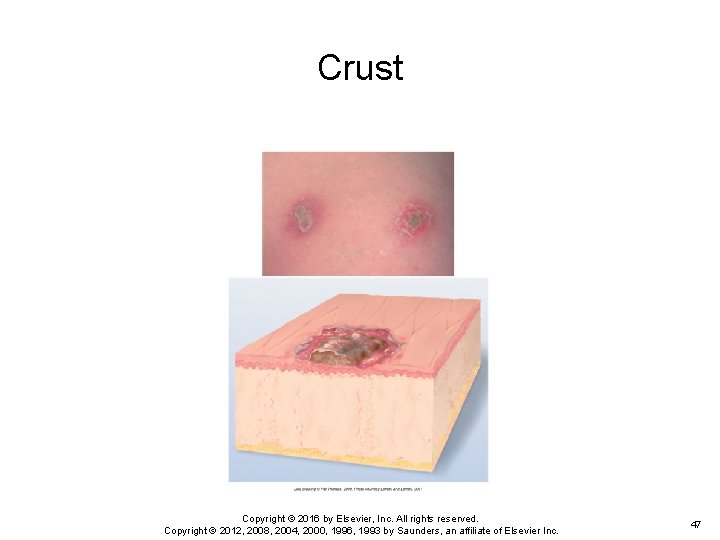
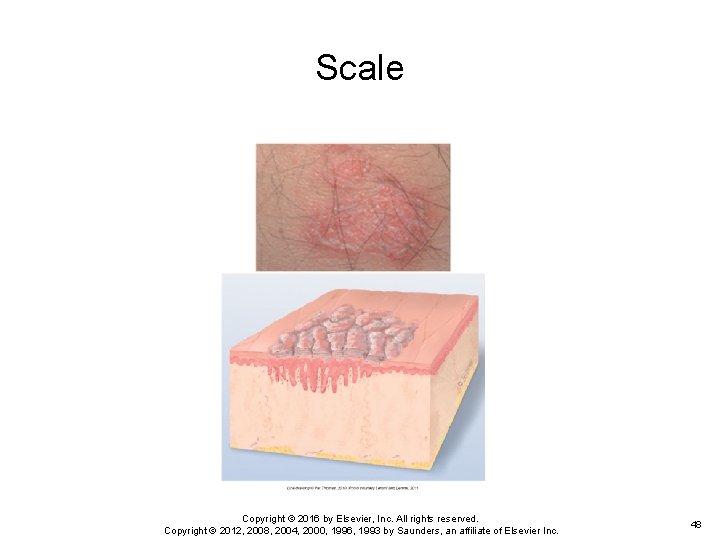
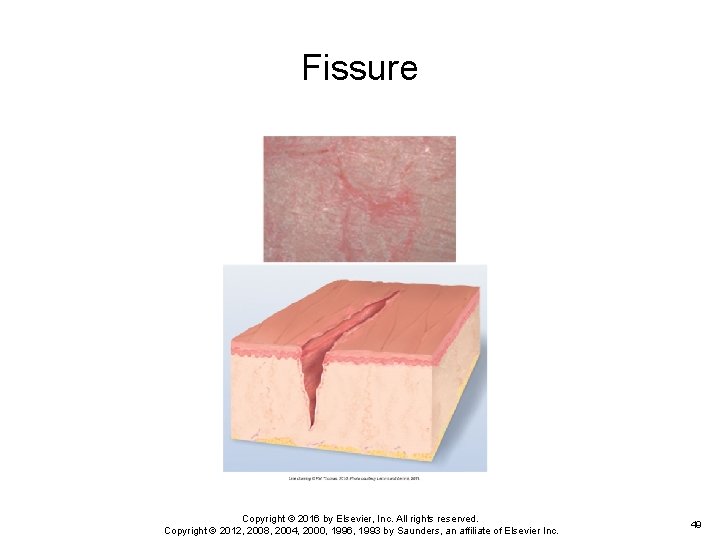
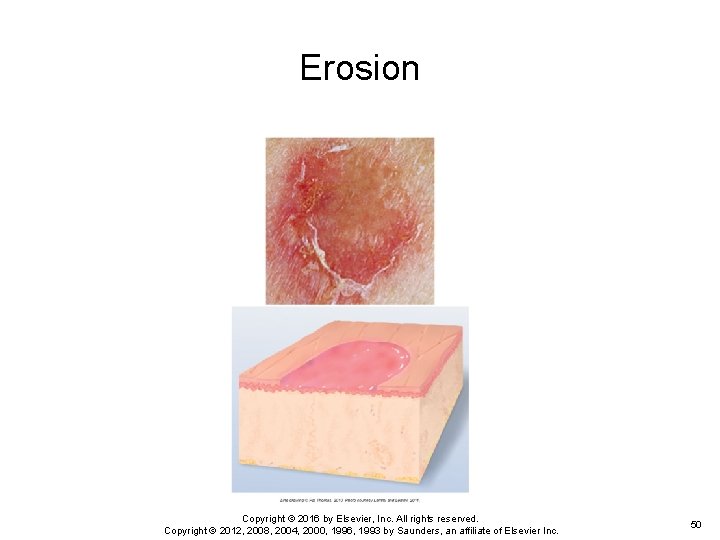
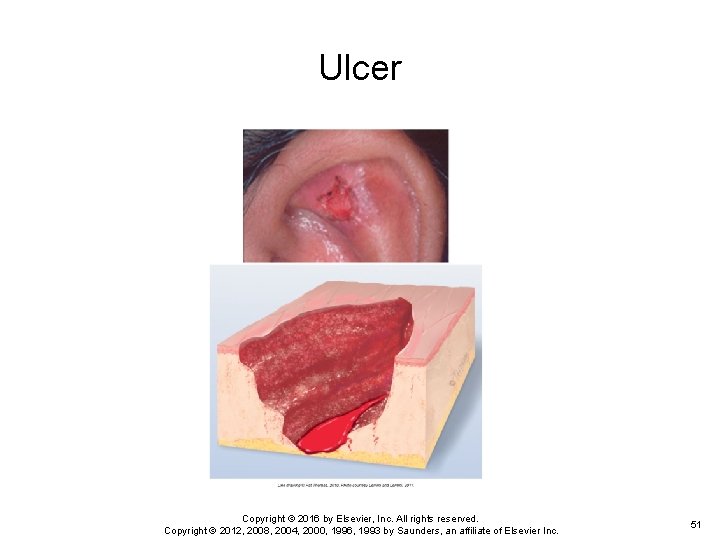
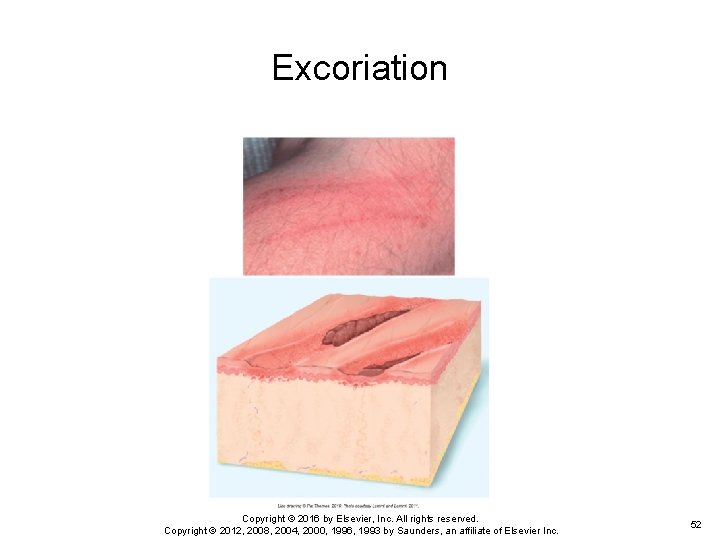
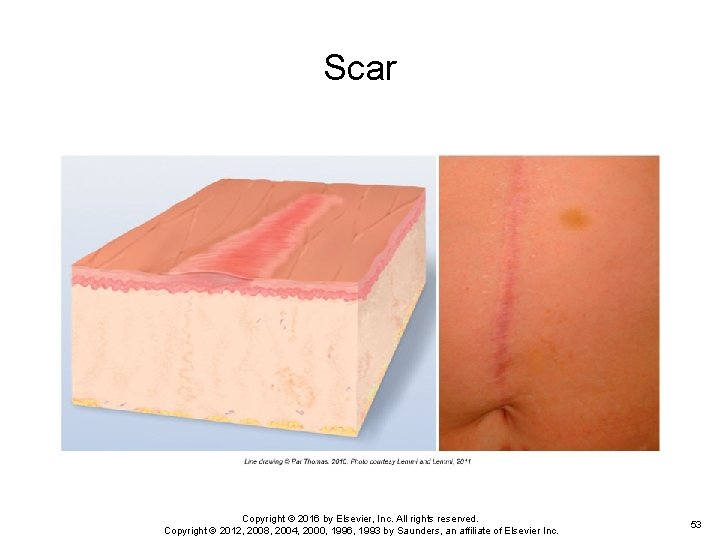
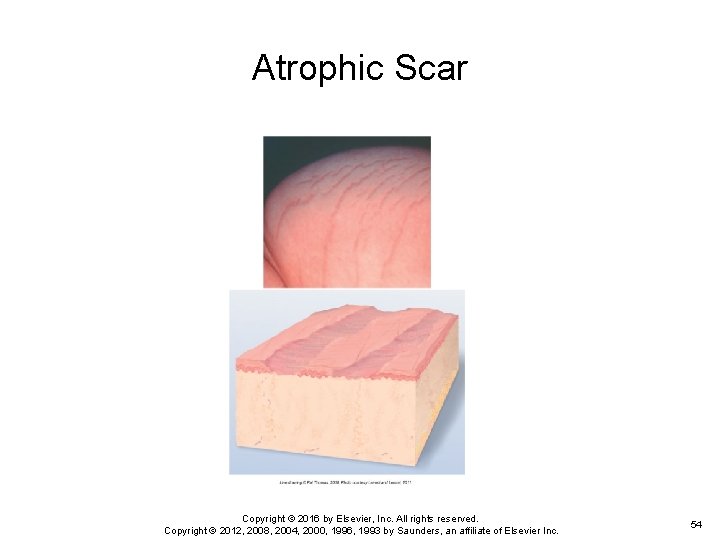
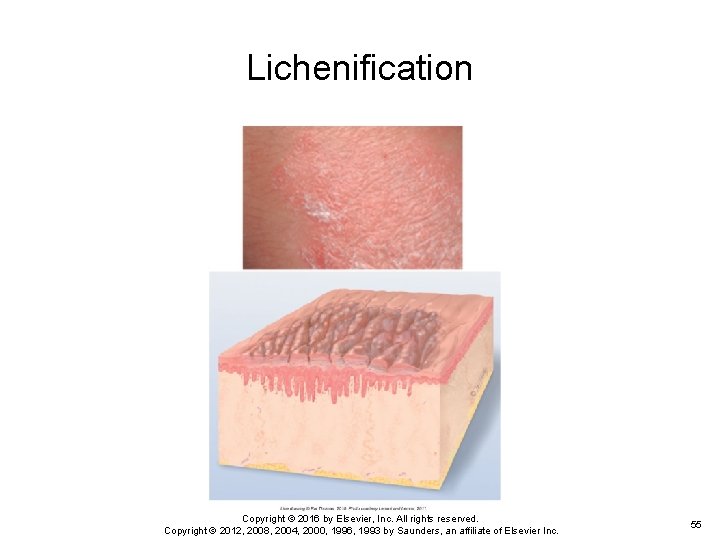
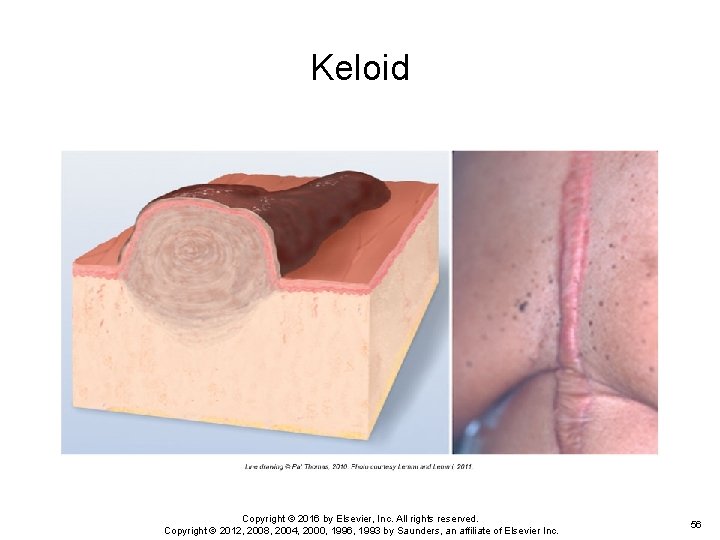
Secondary Skin Lesions Debris on skin surface Crusts Ø Scales Ø Break in continuity of skin surface Fissures Ø Erosions Ø Ulcers Ø Excoriations Ø Scars Ø Atrophic scars Ø Lichenifications Ø Keloids Ø Copyright © 2016 by Elsevier, Inc. All rights reserved. Copyright © 2012, 2008, 2004, 2000, 1996, 1993 by Saunders, an affiliate of Elsevier Inc. 46
Crust Copyright © 2016 by Elsevier, Inc. All rights reserved. Copyright © 2012, 2008, 2004, 2000, 1996, 1993 by Saunders, an affiliate of Elsevier Inc. 47
Scale Copyright © 2016 by Elsevier, Inc. All rights reserved. Copyright © 2012, 2008, 2004, 2000, 1996, 1993 by Saunders, an affiliate of Elsevier Inc. 48
Fissure Copyright © 2016 by Elsevier, Inc. All rights reserved. Copyright © 2012, 2008, 2004, 2000, 1996, 1993 by Saunders, an affiliate of Elsevier Inc. 49
Erosion Copyright © 2016 by Elsevier, Inc. All rights reserved. Copyright © 2012, 2008, 2004, 2000, 1996, 1993 by Saunders, an affiliate of Elsevier Inc. 50
Ulcer Copyright © 2016 by Elsevier, Inc. All rights reserved. Copyright © 2012, 2008, 2004, 2000, 1996, 1993 by Saunders, an affiliate of Elsevier Inc. 51
Excoriation Copyright © 2016 by Elsevier, Inc. All rights reserved. Copyright © 2012, 2008, 2004, 2000, 1996, 1993 by Saunders, an affiliate of Elsevier Inc. 52
Scar Copyright © 2016 by Elsevier, Inc. All rights reserved. Copyright © 2012, 2008, 2004, 2000, 1996, 1993 by Saunders, an affiliate of Elsevier Inc. 53
Atrophic Scar Copyright © 2016 by Elsevier, Inc. All rights reserved. Copyright © 2012, 2008, 2004, 2000, 1996, 1993 by Saunders, an affiliate of Elsevier Inc. 54
Lichenification Copyright © 2016 by Elsevier, Inc. All rights reserved. Copyright © 2012, 2008, 2004, 2000, 1996, 1993 by Saunders, an affiliate of Elsevier Inc. 55
Keloid Copyright © 2016 by Elsevier, Inc. All rights reserved. Copyright © 2012, 2008, 2004, 2000, 1996, 1993 by Saunders, an affiliate of Elsevier Inc. 56
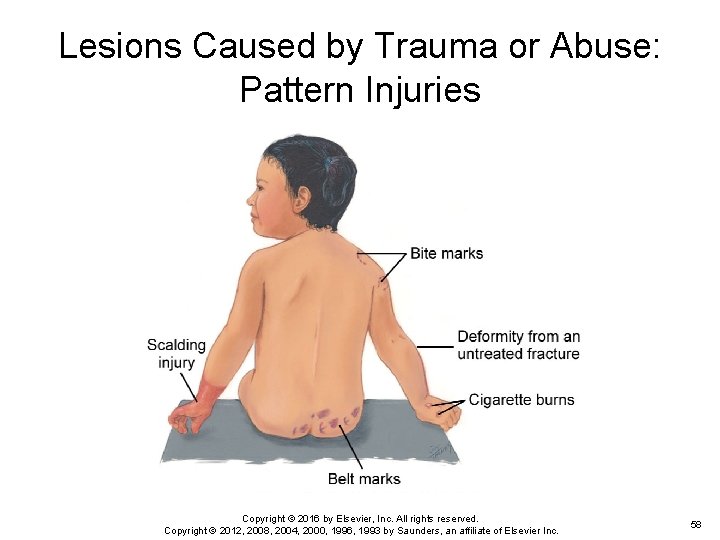
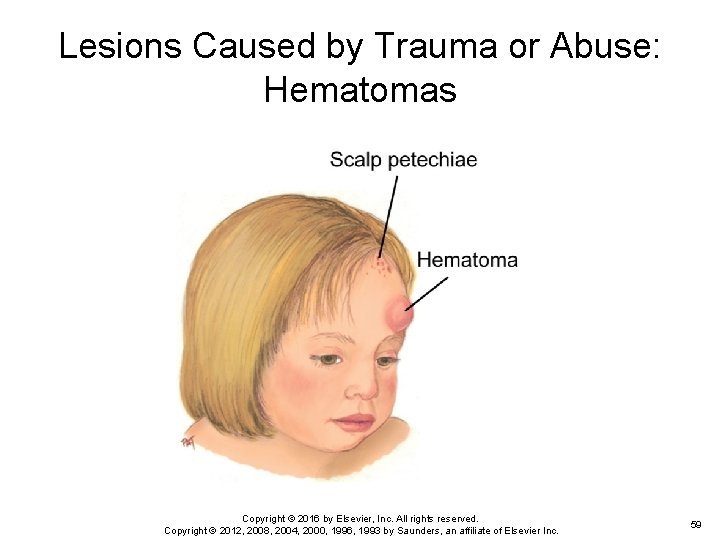
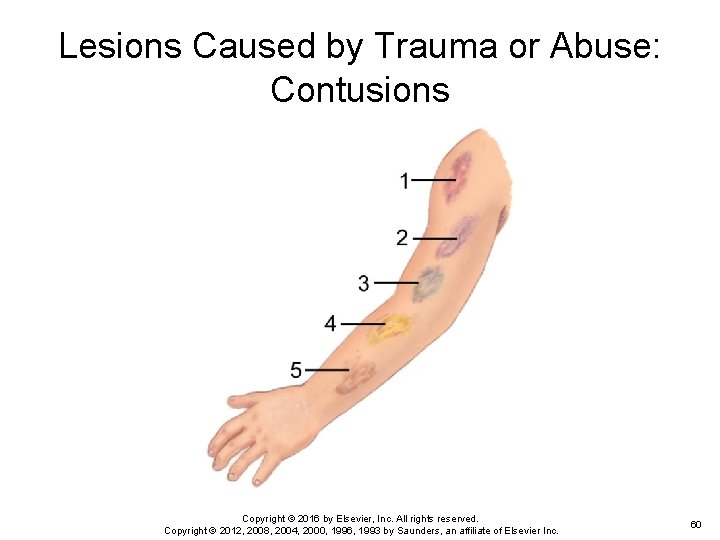
Vascular Lesions Hemangiomas Ø Port-wine stain (nevus flammeus) Ø Strawberry mark (immature hemangioma) Ø Cavernous hemangioma (mature) Telangiectases Ø Spider or star angioma Ø Venous lake Purpuric lesions Ø Petechiae Ø Purpura Lesions caused by trauma or abuse Ø Pattern injury Ø Hematoma Ø Contusion (bruise) Copyright © 2016 by Elsevier, Inc. All rights reserved. Copyright © 2012, 2008, 2004, 2000, 1996, 1993 by Saunders, an affiliate of Elsevier Inc. 57
Lesions Caused by Trauma or Abuse: Pattern Injuries Copyright © 2016 by Elsevier, Inc. All rights reserved. Copyright © 2012, 2008, 2004, 2000, 1996, 1993 by Saunders, an affiliate of Elsevier Inc. 58
Lesions Caused by Trauma or Abuse: Hematomas Copyright © 2016 by Elsevier, Inc. All rights reserved. Copyright © 2012, 2008, 2004, 2000, 1996, 1993 by Saunders, an affiliate of Elsevier Inc. 59
Lesions Caused by Trauma or Abuse: Contusions Copyright © 2016 by Elsevier, Inc. All rights reserved. Copyright © 2012, 2008, 2004, 2000, 1996, 1993 by Saunders, an affiliate of Elsevier Inc. 60
Common Skin Lesions in Children Diaper dermatitis Intertrigo (candidiasis) Impetigo Atopic dermatitis (eczema) Measles (rubeola) German measles (rubella) Chickenpox (varicella) Copyright © 2016 by Elsevier, Inc. All rights reserved. Copyright © 2012, 2008, 2004, 2000, 1996, 1993 by Saunders, an affiliate of Elsevier Inc. 61