
Chapter 12 Simple Machines A Power Point Presentation

- Slides: 37
Chapter 12 – Simple Machines A Power. Point Presentation by Paul E. Tippens, Professor of Physics Southern Polytechnic State University © 2007
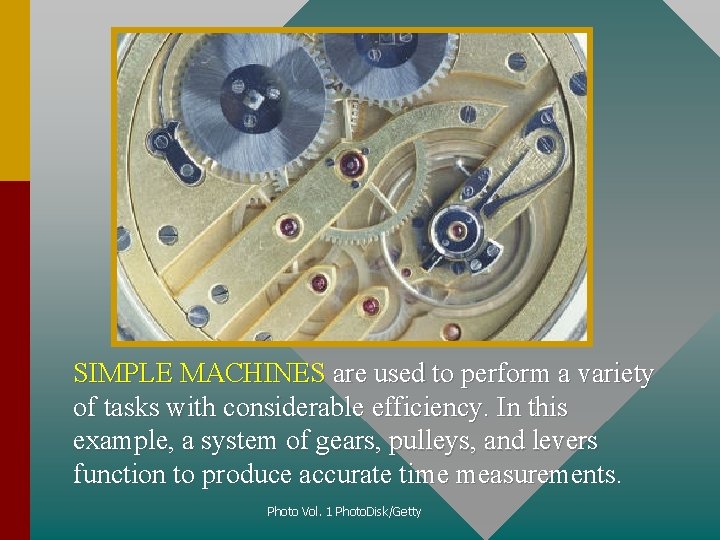
SIMPLE MACHINES are used to perform a variety of tasks with considerable efficiency. In this example, a system of gears, pulleys, and levers function to produce accurate time measurements. Photo Vol. 1 Photo. Disk/Getty
Objectives: After completing this module, you should be able to: • Describe a simple machine in general terms and apply the concepts of efficiency, energy conservation, work, and power. • Distinguish by definition and example between the concepts of the ideal and actual mechanical advantages. • Describe and apply formulas for the mechanical advantage and efficiency of the following devices: (a) levers, (b) inclined planes, (c) wedges, (d) gears, (e) pulley systems, (f) wheel and axel, (g) screw jacks, and (h) the belt drive.
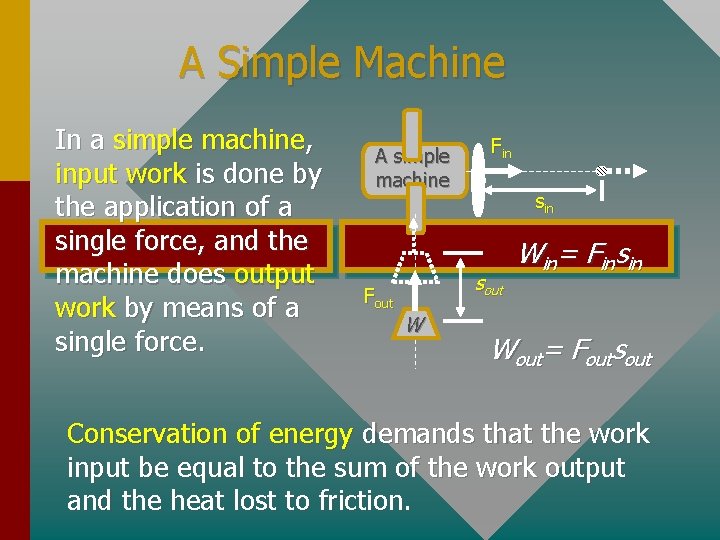
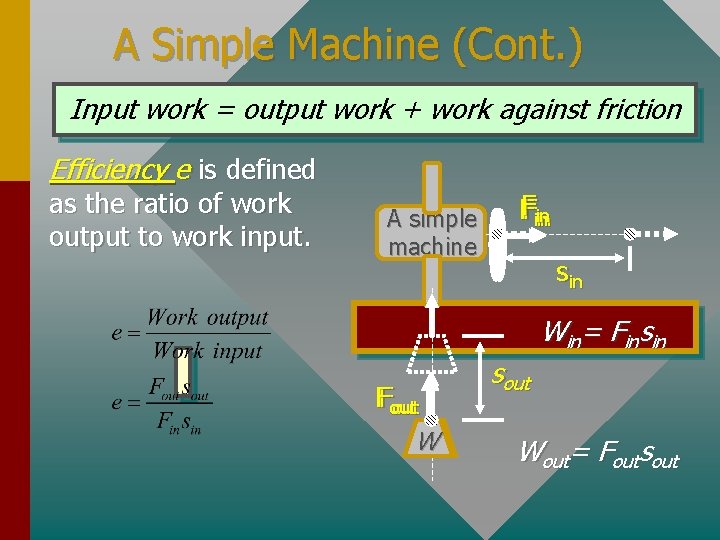
A Simple Machine In a simple machine, input work is done by the application of a single force, and the machine does output work by means of a single force. A simple machine Fout Fin sout W Win= Finsin Wout= Foutsout Conservation of energy demands that the work input be equal to the sum of the work output and the heat lost to friction.
A Simple Machine (Cont. ) Input work = output work + work against friction Efficiency e is defined as the ratio of work output to work input. A simple machine Fininin sin Win= Finsin FFout W W sout Wout= Foutsout
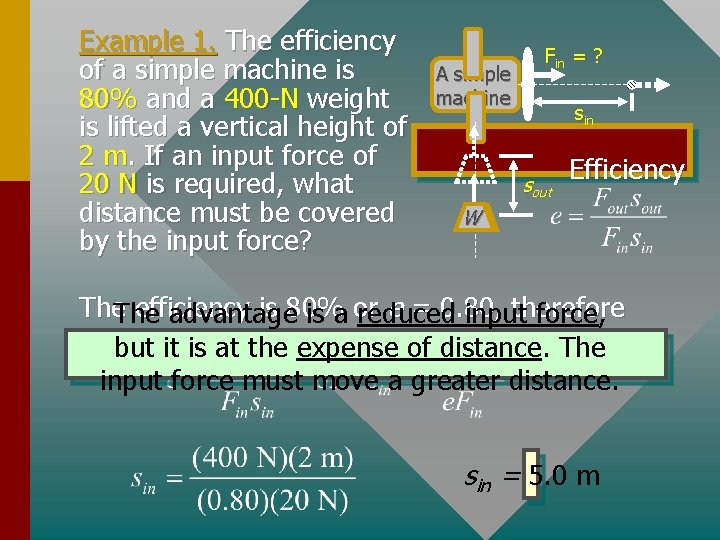
Example 1. The efficiency of a simple machine is 80% and a 400 -N weight is lifted a vertical height of 2 m. If an input force of 20 N is required, what distance must be covered by the input force? A simple machine Fin = ? sin sout Efficiency W W The efficiency is 80% e = 0. 80, therefore advantage is a or reduced input force, but it is at the expense of distance. The input force must move a greater distance. sin = 5. 0 m
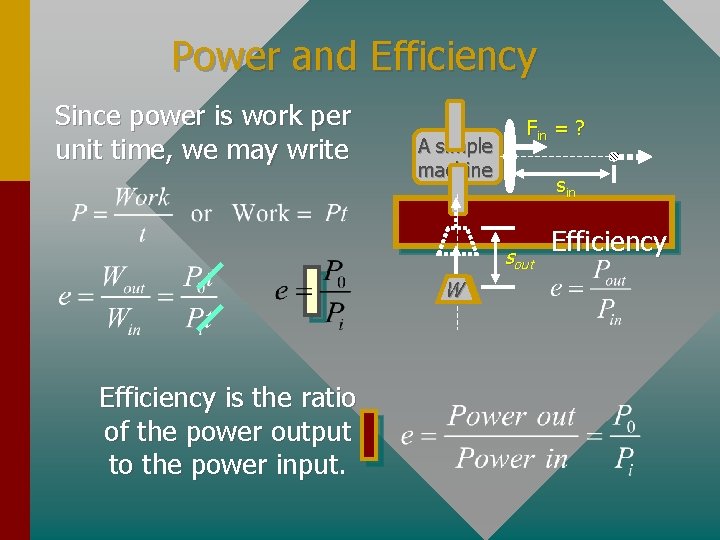
Power and Efficiency Since power is work per unit time, we may write A simple machine Fin = ? sin sout W W Efficiency is the ratio of the power output to the power input. Efficiency
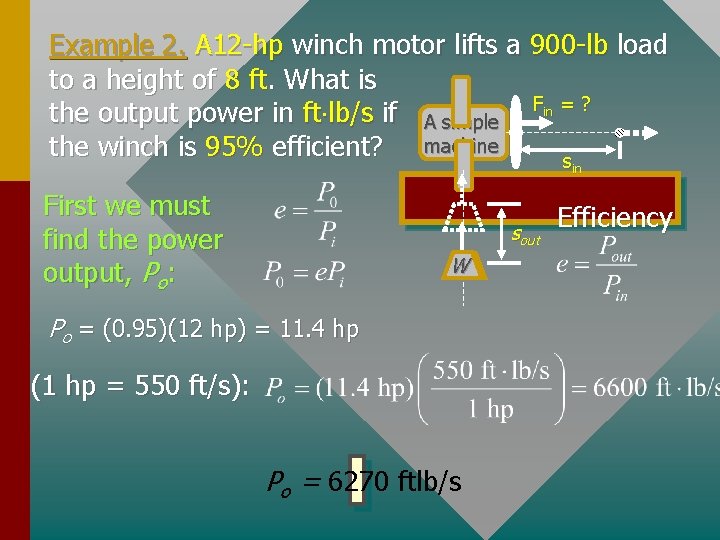
Example 2. A 12 -hp winch motor lifts a 900 -lb load to a height of 8 ft. What is the output power in ft lb/s if A simple Fin = ? the winch is 95% efficient? machine s in First we must find the power output, Po: sout W W Po = (0. 95)(12 hp) = 11. 4 hp (1 hp = 550 ft/s): Po = 6270 ftlb/s Efficiency
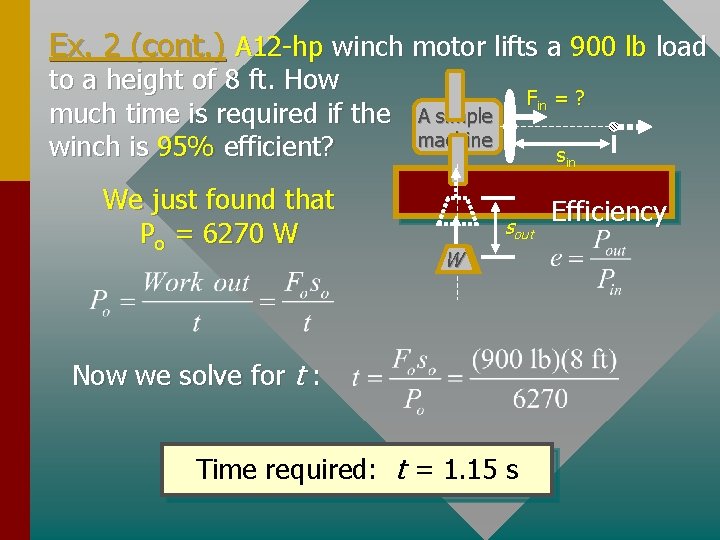
Ex. 2 (cont. ) A 12 -hp winch motor lifts a 900 lb load to a height of 8 ft. How much time is required if the winch is 95% efficient? We just found that Po = 6270 W Fin = ? A simple machine sin sout W W Now we solve for t : Time required: t = 1. 15 s Efficiency
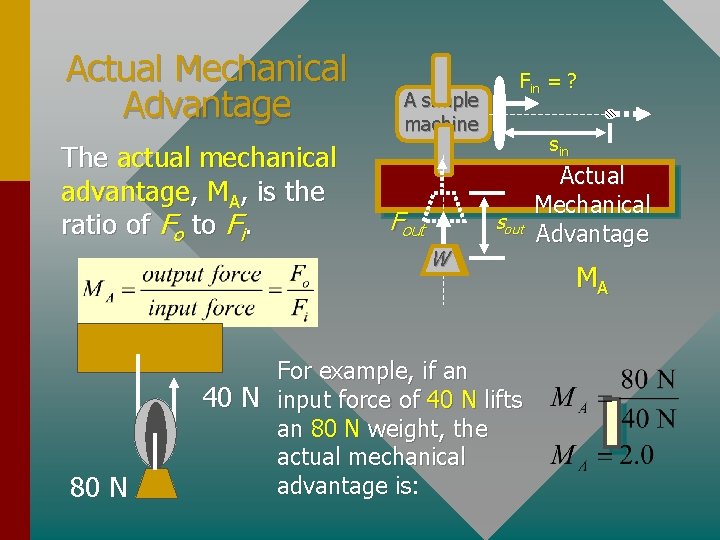
Actual Mechanical Advantage The actual mechanical advantage, MA, is the ratio of Fo to Fi. 80 N A simple machine Fout Fin = ? sin sout W W For example, if an 40 N input force of 40 N lifts an 80 N weight, the actual mechanical advantage is: Actual Mechanical Advantage MA
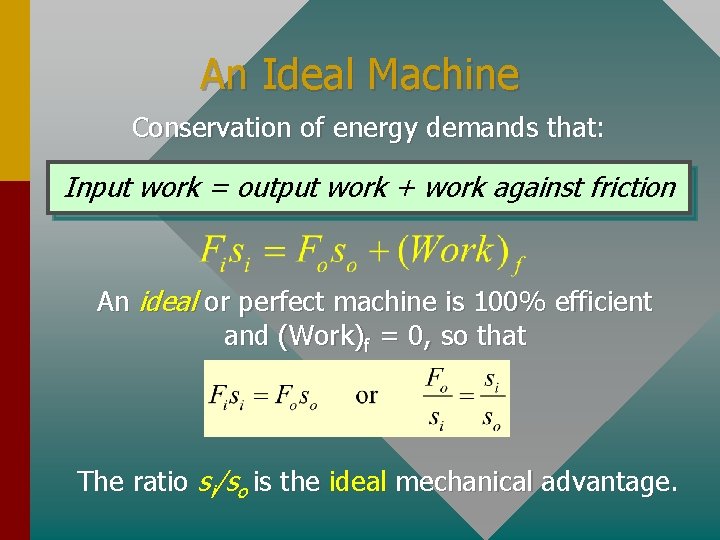
An Ideal Machine Conservation of energy demands that: Input work = output work + work against friction An ideal or perfect machine is 100% efficient and (Work)f = 0, so that The ratio si/so is the ideal mechanical advantage.
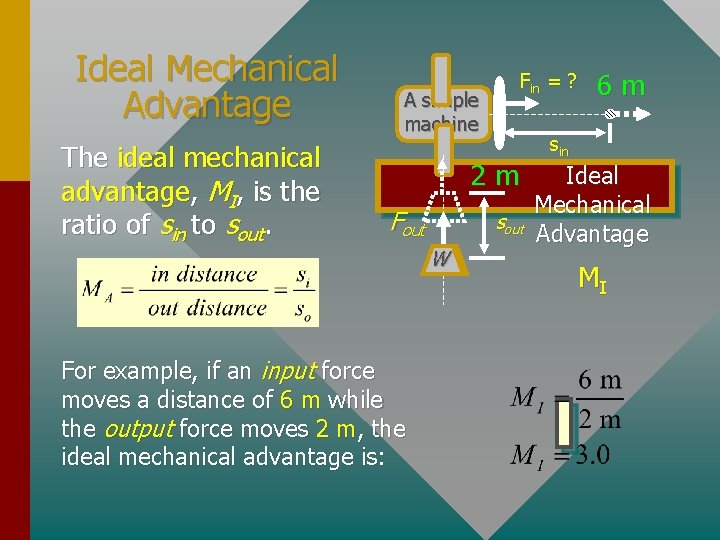
Ideal Mechanical Advantage The ideal mechanical advantage, MI, is the ratio of sin to sout. A simple machine Fin = ? 2 m Fout For example, if an input force moves a distance of 6 m while the output force moves 2 m, the ideal mechanical advantage is: sout W W 6 m sin Ideal Mechanical Advantage MI
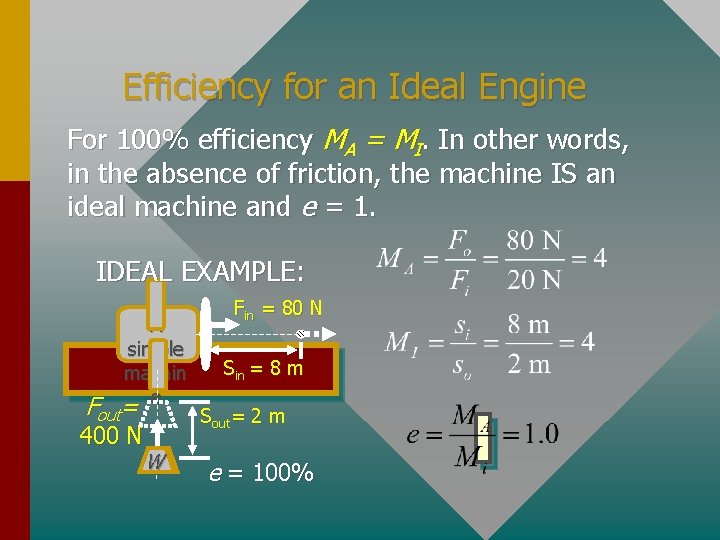
Efficiency for an Ideal Engine For 100% efficiency MA = MI. In other words, in the absence of friction, the machine IS an ideal machine and e = 1. IDEAL EXAMPLE: A simple machin e Fout= 400 N W W Fin = 80 N Sin = 8 m Sout= 2 m e = 100%
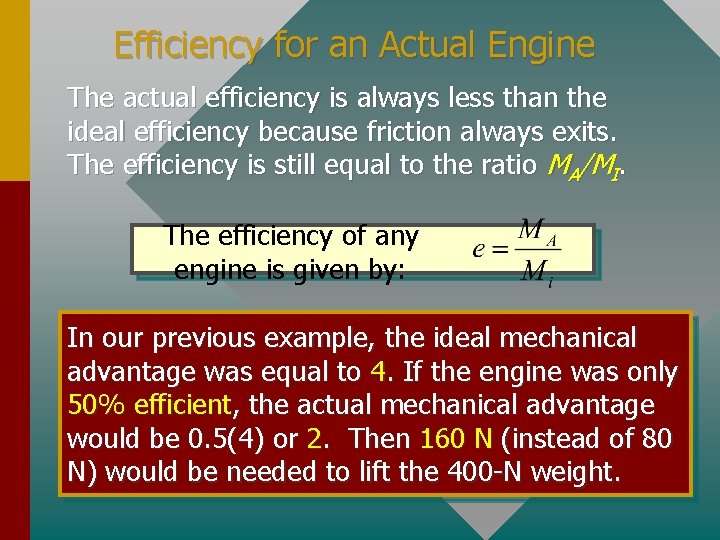
Efficiency for an Actual Engine The actual efficiency is always less than the ideal efficiency because friction always exits. The efficiency is still equal to the ratio MA/MI. The efficiency of any engine is given by: In our previous example, the ideal mechanical advantage was equal to 4. If the engine was only 50% efficient, the actual mechanical advantage would be 0. 5(4) or 2. Then 160 N (instead of 80 N) would be needed to lift the 400 -N weight.
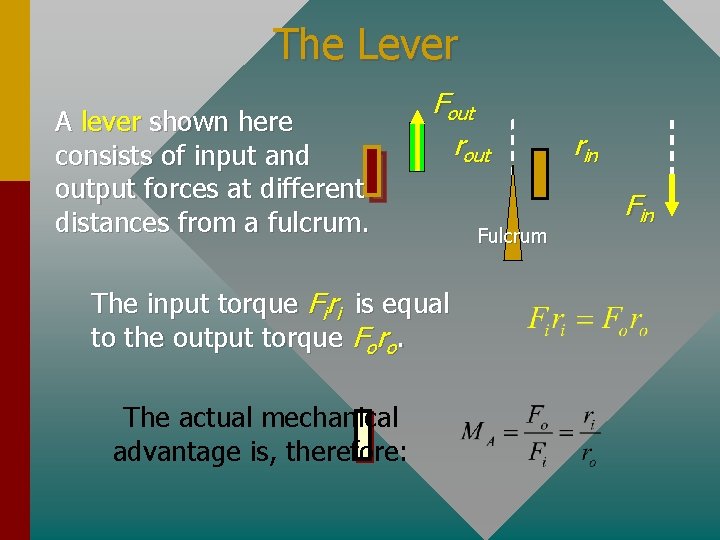
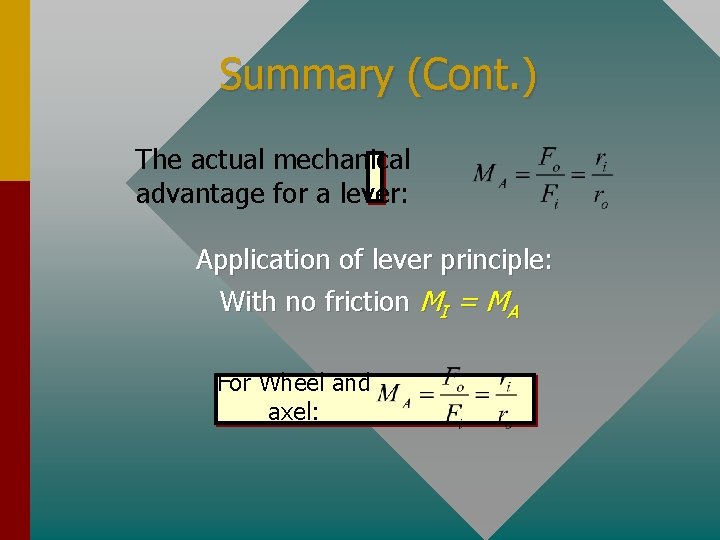
The Lever A lever shown here consists of input and output forces at different distances from a fulcrum. Fout rout The input torque Firi is equal to the output torque Foro. The actual mechanical advantage is, therefore: Fulcrum rin Fin
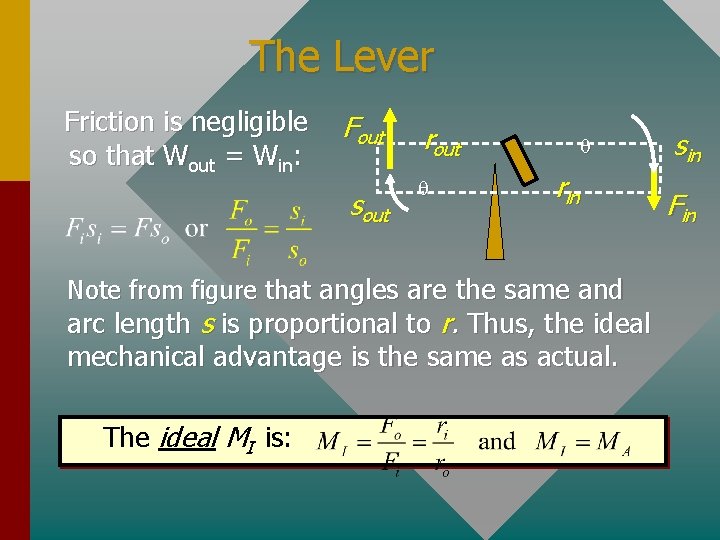
The Lever Friction is negligible so that Wout = Win: Fout sout rout q q rin Note from figure that angles are the same and arc length s is proportional to r. Thus, the ideal mechanical advantage is the same as actual. The ideal MI is: sin Fin
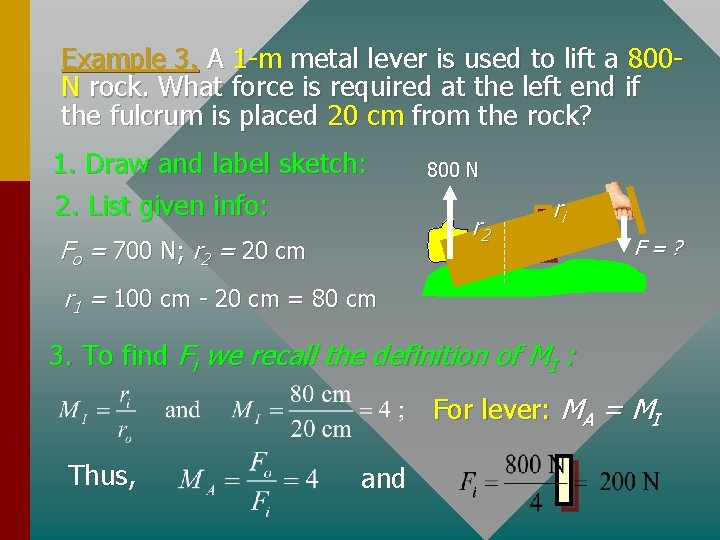
Example 3. A 1 -m metal lever is used to lift a 800 N rock. What force is required at the left end if the fulcrum is placed 20 cm from the rock? 1. Draw and label sketch: 2. List given info: Fo = 700 N; r 2 = 20 cm 800 N r 2 ri F=? r 1 = 100 cm - 20 cm = 80 cm 3. To find Fi we recall the definition of MI : For lever: MA = MI Thus, and
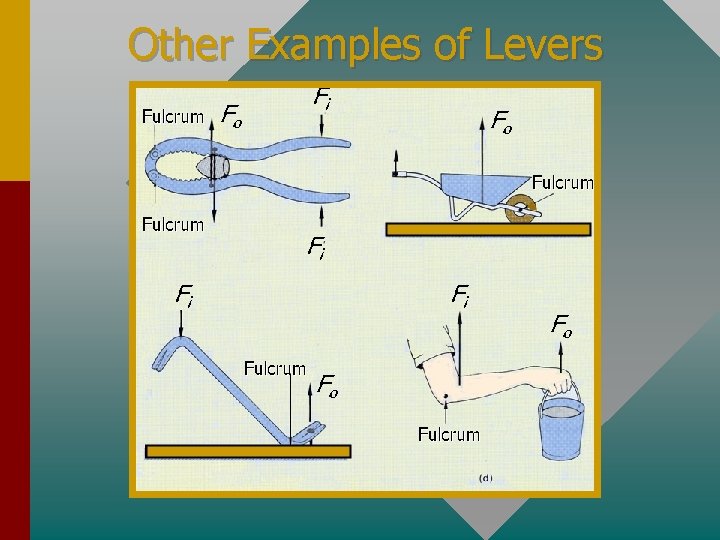
Other Examples of Levers
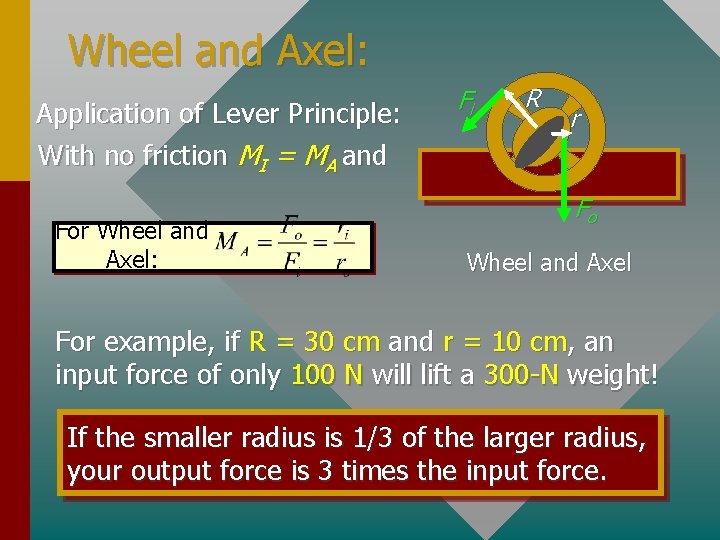
Wheel and Axel: Application of Lever Principle: With no friction MI = MA and For Wheel and Axel: Fi R r Fo Wheel and Axel For example, if R = 30 cm and r = 10 cm, an input force of only 100 N will lift a 300 -N weight! If the smaller radius is 1/3 of the larger radius, your output force is 3 times the input force.
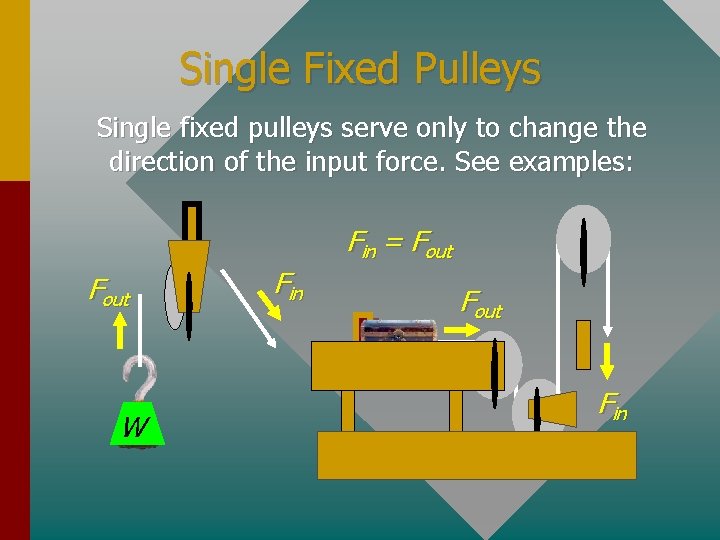
Single Fixed Pulleys Single fixed pulleys serve only to change the direction of the input force. See examples: Fin = Fout W Fin Fout Fin
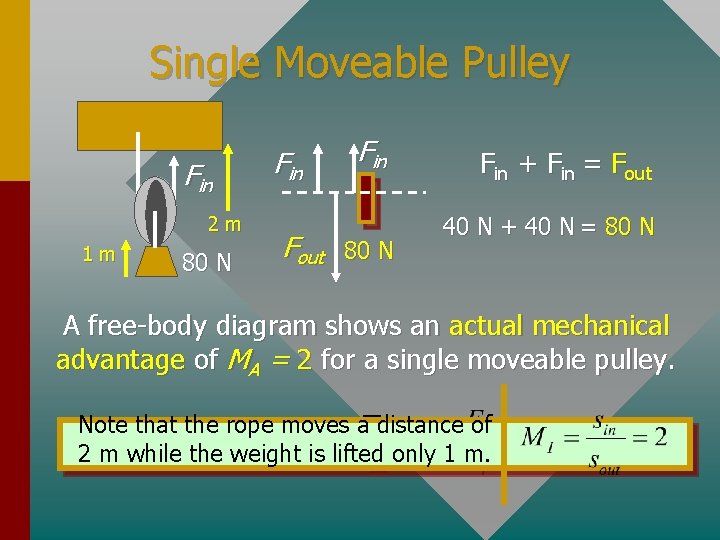
Single Moveable Pulley Fin 2 m 1 m 80 N Fin Fout 80 N Fin + Fin = Fout 40 N + 40 N = 80 N A free-body diagram shows an actual mechanical advantage of MA = 2 for a single moveable pulley. Note that the rope moves a distance of 2 m while the weight is lifted only 1 m.
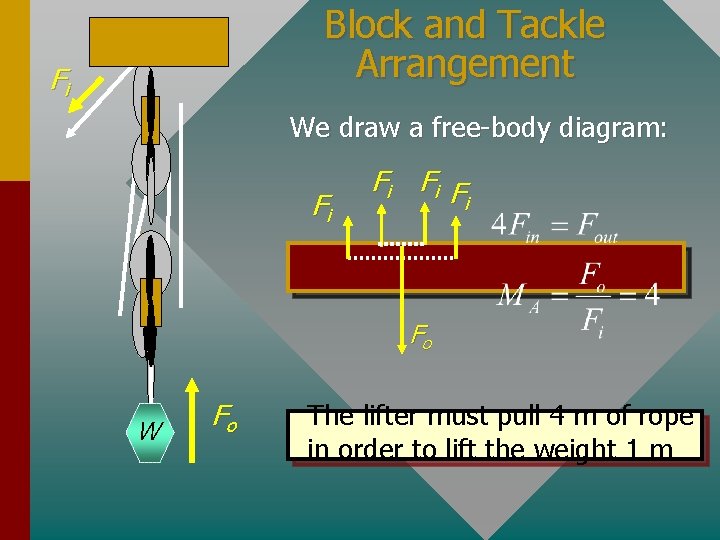
Block and Tackle Arrangement Fi We draw a free-body diagram: Fi Fi Fi F i Fo W Fo The lifter must pull 4 m of rope in order to lift the weight 1 m
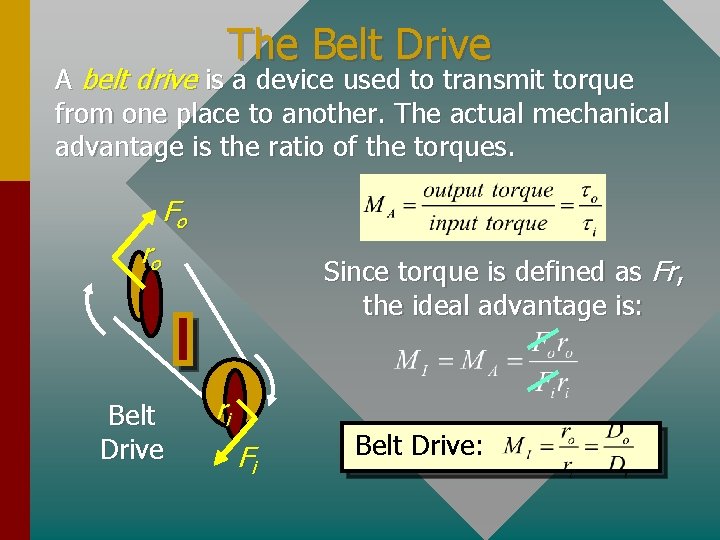
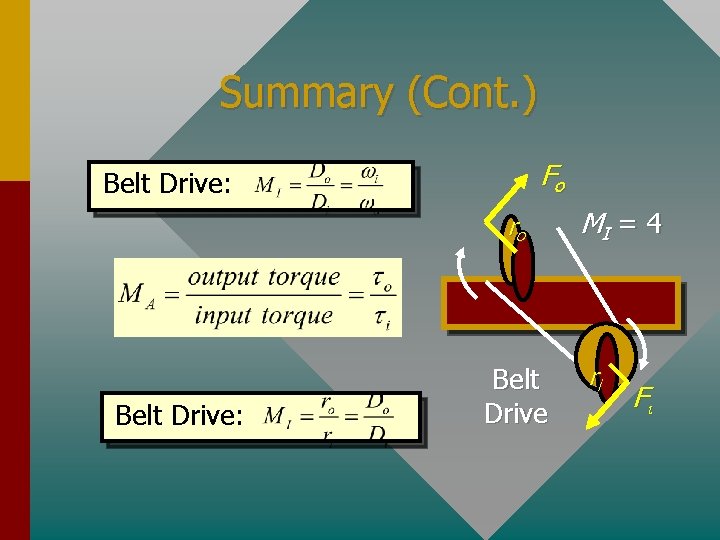
The Belt Drive A belt drive is a device used to transmit torque from one place to another. The actual mechanical advantage is the ratio of the torques. Fo ro Belt Drive Since torque is defined as Fr, the ideal advantage is: ri Fi Belt Drive:
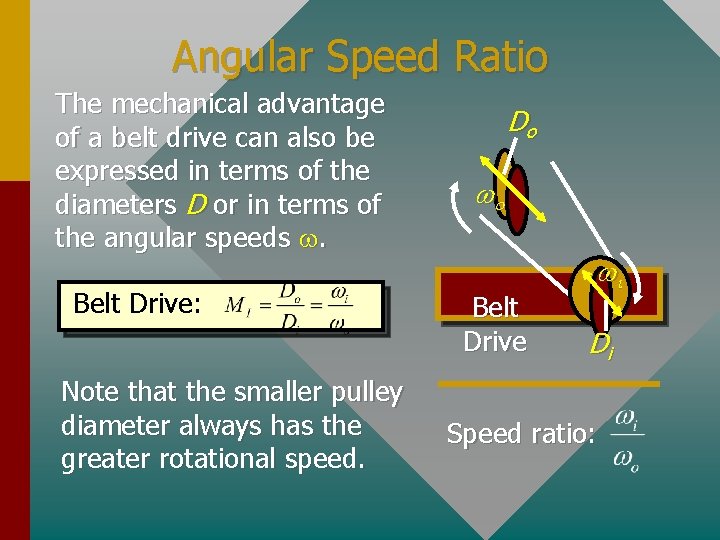
Angular Speed Ratio The mechanical advantage of a belt drive can also be expressed in terms of the diameters D or in terms of the angular speeds w. Belt Drive: Note that the smaller pulley diameter always has the greater rotational speed. Do wo Belt Drive wi Di Speed ratio:
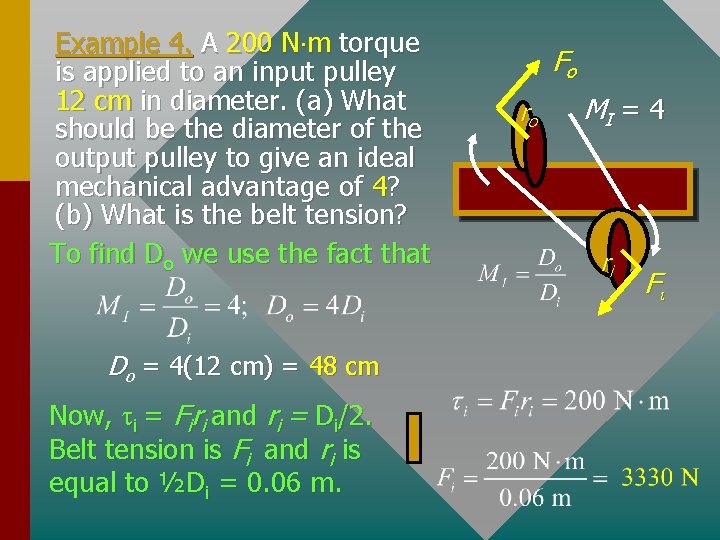
Example 4. A 200 N m torque is applied to an input pulley 12 cm in diameter. (a) What should be the diameter of the output pulley to give an ideal mechanical advantage of 4? (b) What is the belt tension? To find Do we use the fact that Do = 4(12 cm) = 48 cm Now, ti = Firi and ri = Di/2. Belt tension is Fi and ri is equal to ½Di = 0. 06 m. Fo ro MI = 4 ri Fi
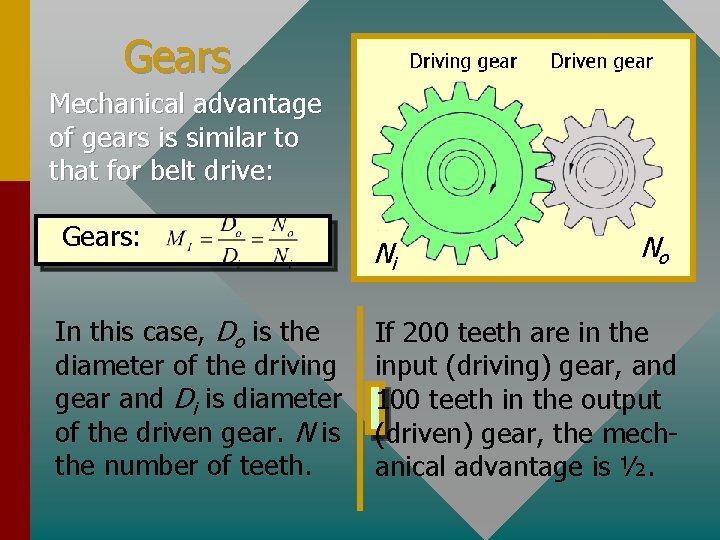
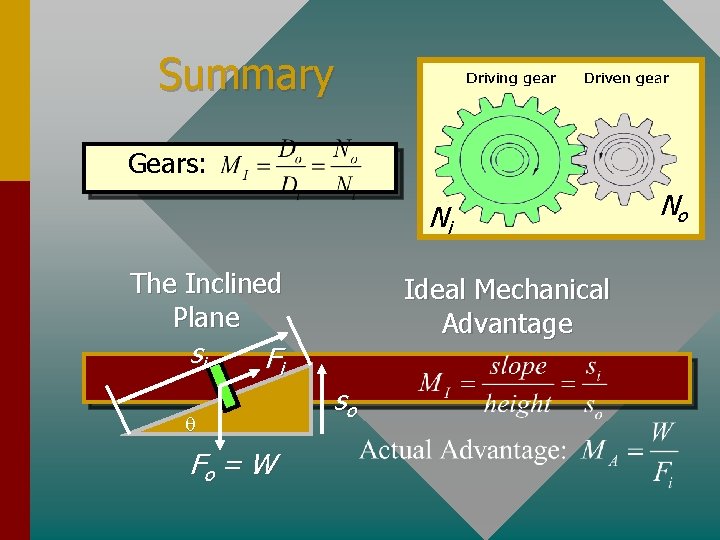
Gears Mechanical advantage of gears is similar to that for belt drive: Gears: In this case, Do is the diameter of the driving gear and Di is diameter of the driven gear. N is the number of teeth. Ni No If 200 teeth are in the input (driving) gear, and 100 teeth in the output (driven) gear, the mechanical advantage is ½.
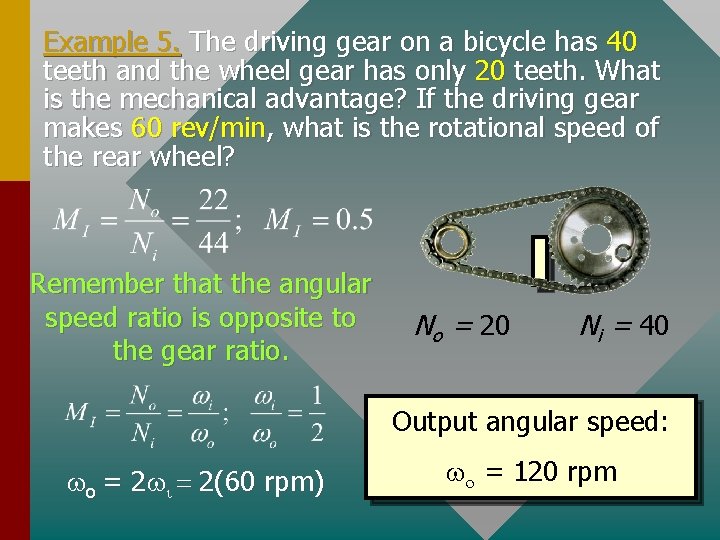
Example 5. The driving gear on a bicycle has 40 teeth and the wheel gear has only 20 teeth. What is the mechanical advantage? If the driving gear makes 60 rev/min, what is the rotational speed of the rear wheel? Remember that the angular speed ratio is opposite to the gear ratio. No = 20 Ni = 40 Output angular speed: wo = 2 wi = 2(60 rpm) wo = 120 rpm
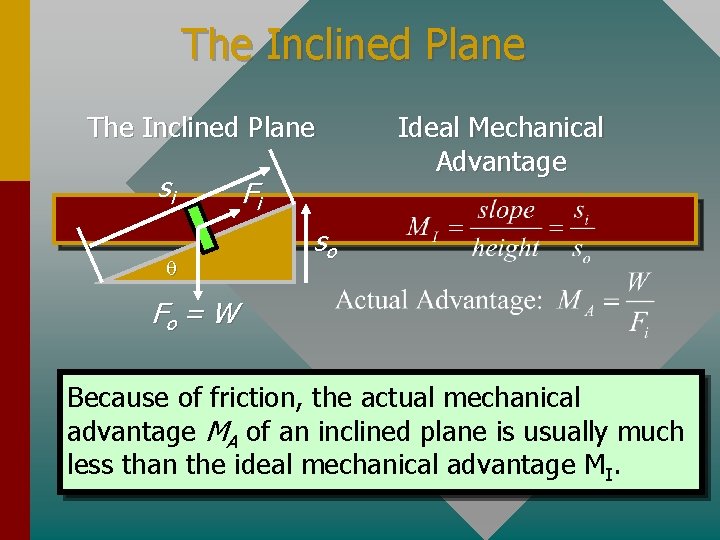
The Inclined Plane si q Fi Ideal Mechanical Advantage so Fo = W Because of friction, the actual mechanical advantage MA of an inclined plane is usually much less than the ideal mechanical advantage MI.
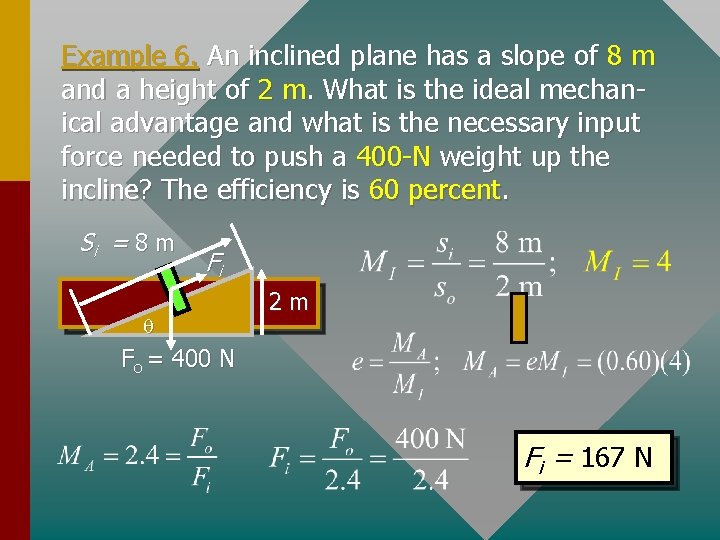
Example 6. An inclined plane has a slope of 8 m and a height of 2 m. What is the ideal mechanical advantage and what is the necessary input force needed to push a 400 -N weight up the incline? The efficiency is 60 percent. Si = 8 m Fi q 2 m Fo = 400 N Fi = 167 N
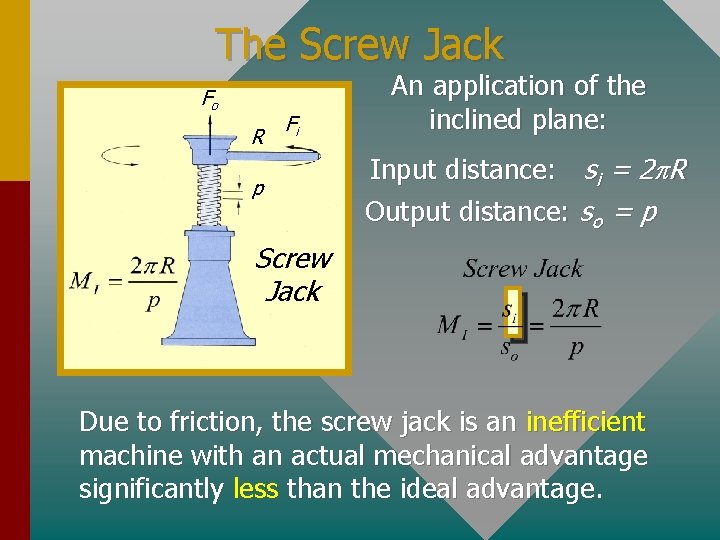
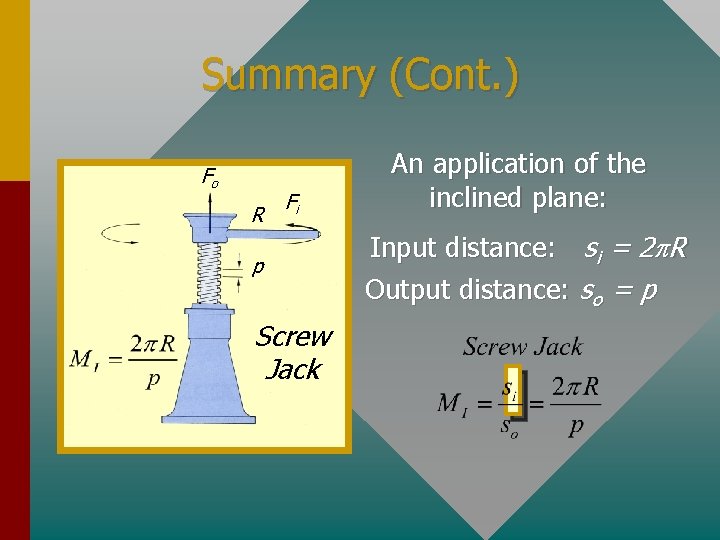
The Screw Jack Fo R Fi p An application of the inclined plane: Input distance: si = 2 p. R Output distance: so = p Screw Jack Due to friction, the screw jack is an inefficient machine with an actual mechanical advantage significantly less than the ideal advantage.
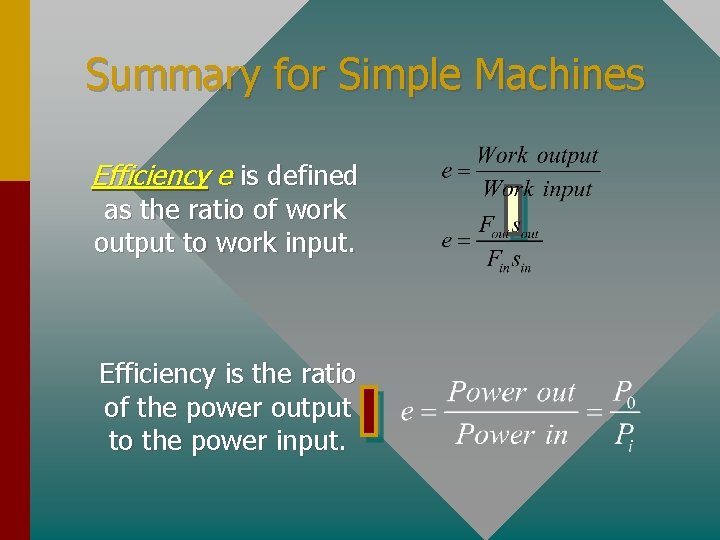
Summary for Simple Machines Efficiency e is defined as the ratio of work output to work input. Efficiency is the ratio of the power output to the power input.
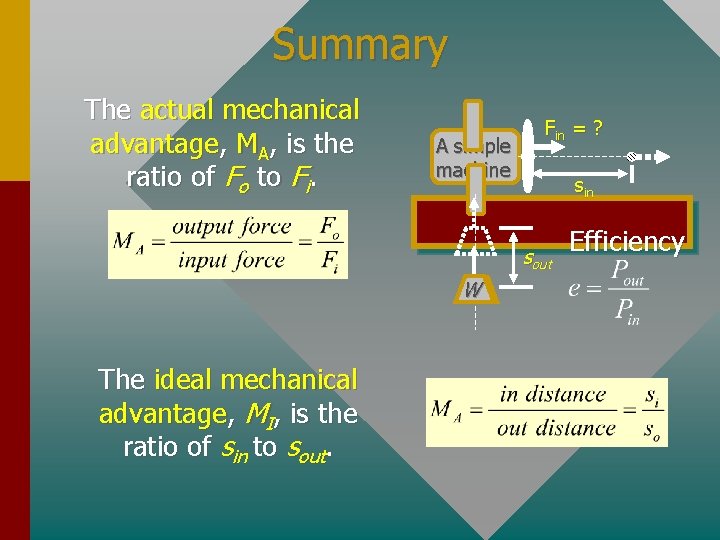
Summary The actual mechanical advantage, MA, is the ratio of Fo to Fi. A simple machine Fin = ? sin sout W W The ideal mechanical advantage, MI, is the ratio of sin to sout. Efficiency
Summary (Cont. ) The actual mechanical advantage for a lever: Application of lever principle: With no friction MI = MA For Wheel and axel:
Summary (Cont. ) Fo Belt Drive: ro Belt Drive: Belt Drive MI = 4 ri Fi
Summary Gears: Ni The Inclined Plane si Ideal Mechanical Advantage Fi q Fo = W so No
Summary (Cont. ) Fo R Fi p Screw Jack An application of the inclined plane: Input distance: si = 2 p. R Output distance: so = p
CONCLUSION: Chapter 12 Simple Machines