
Chapter 12 Roof Framing Objectives List and describe
Chapter 12 Roof Framing
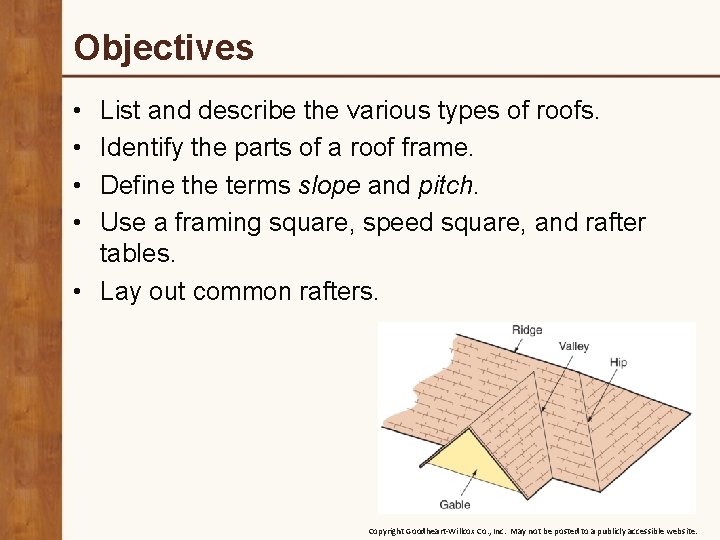
Objectives • • List and describe the various types of roofs. Identify the parts of a roof frame. Define the terms slope and pitch. Use a framing square, speed square, and rafter tables. • Lay out common rafters. Copyright Goodheart-Willcox Co. , Inc. May not be posted to a publicly accessible website.
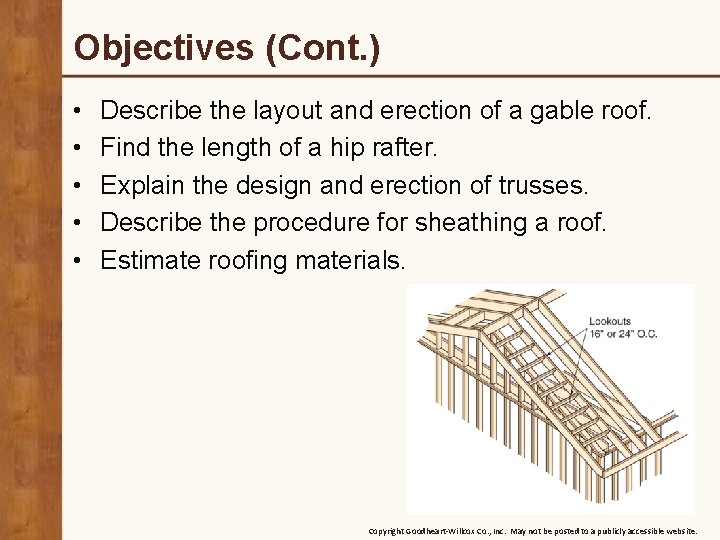
Objectives (Cont. ) • • • Describe the layout and erection of a gable roof. Find the length of a hip rafter. Explain the design and erection of trusses. Describe the procedure for sheathing a roof. Estimate roofing materials. Copyright Goodheart-Willcox Co. , Inc. May not be posted to a publicly accessible website.
Roof Frames • Provide base to which roofing materials will be attached • Must be strong and rigid • Can add distinctive and decorative character to structure • Both live loads and dead loads must be considered in roof design Copyright Goodheart-Willcox Co. , Inc. May not be posted to a publicly accessible website.
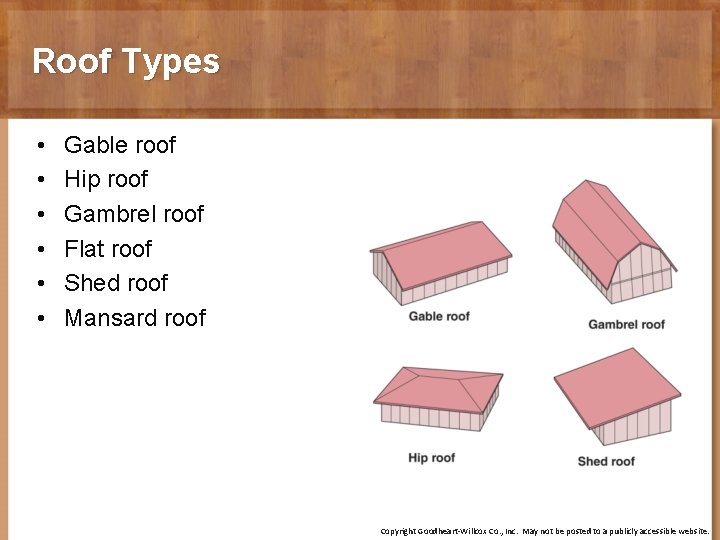
Roof Types • • • Gable roof Hip roof Gambrel roof Flat roof Shed roof Mansard roof Copyright Goodheart-Willcox Co. , Inc. May not be posted to a publicly accessible website.
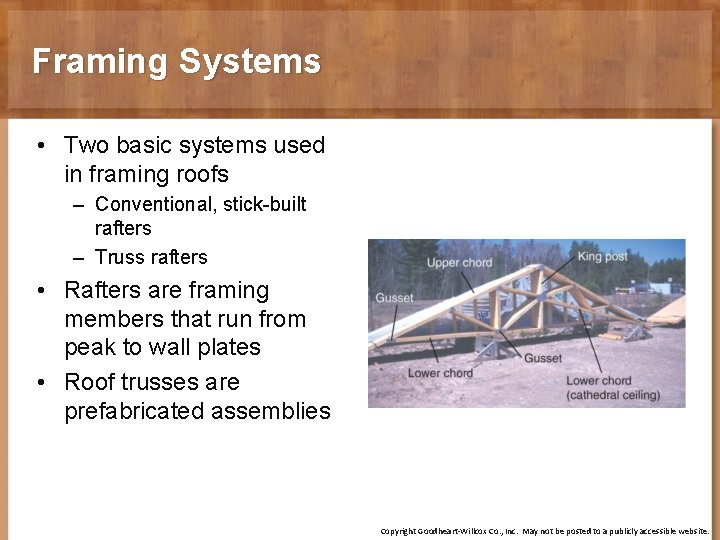
Framing Systems • Two basic systems used in framing roofs – Conventional, stick-built rafters – Truss rafters • Rafters are framing members that run from peak to wall plates • Roof trusses are prefabricated assemblies Copyright Goodheart-Willcox Co. , Inc. May not be posted to a publicly accessible website.
Roof Supports • Supports depend on type of rafter design – Outside walls – Ceiling joists (beams that hold ceiling materials) – Interior bearing walls (partitions that support structures above) Copyright Goodheart-Willcox Co. , Inc. May not be posted to a publicly accessible website.
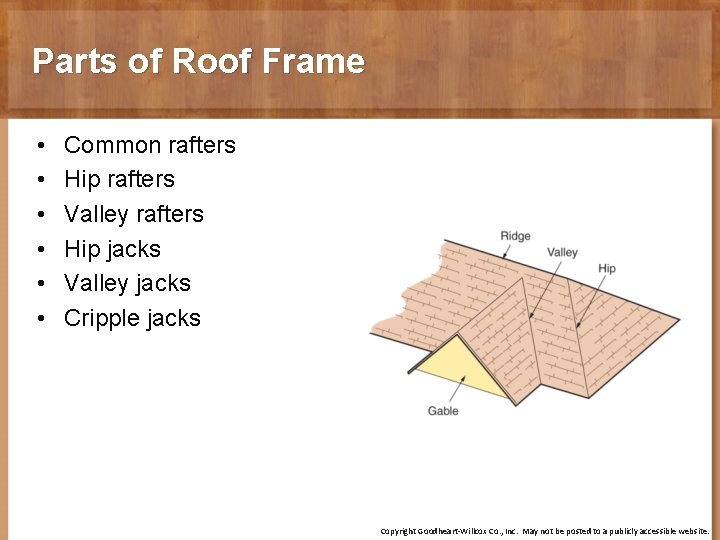
Parts of Roof Frame • • • Common rafters Hip rafters Valley rafters Hip jacks Valley jacks Cripple jacks Copyright Goodheart-Willcox Co. , Inc. May not be posted to a publicly accessible website.

Roof Frame in Plan View Copyright Goodheart-Willcox Co. , Inc. May not be posted to a publicly accessible website.
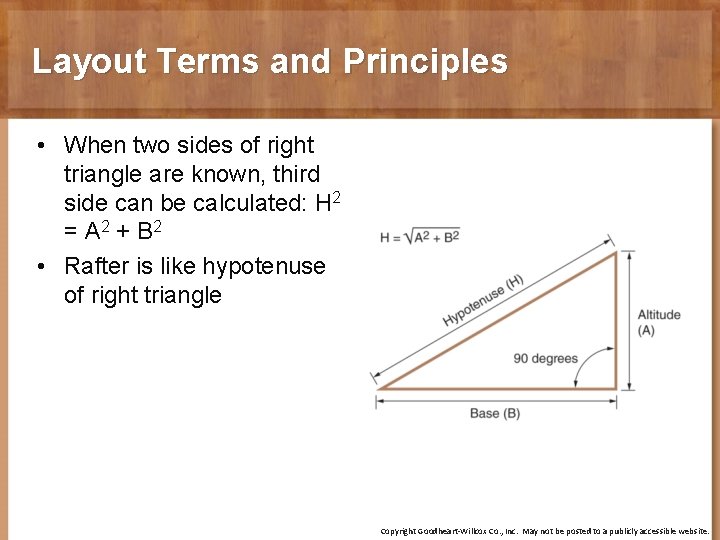
Layout Terms and Principles • When two sides of right triangle are known, third side can be calculated: H 2 = A 2 + B 2 • Rafter is like hypotenuse of right triangle Copyright Goodheart-Willcox Co. , Inc. May not be posted to a publicly accessible website.
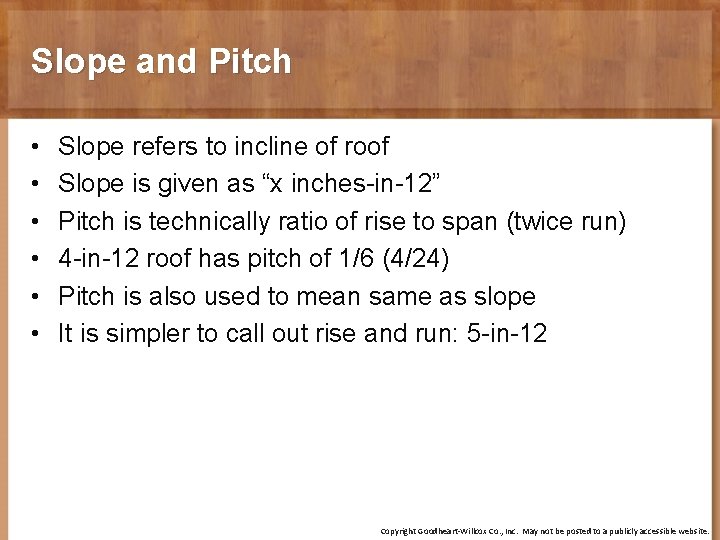
Slope and Pitch • • • Slope refers to incline of roof Slope is given as “x inches-in-12” Pitch is technically ratio of rise to span (twice run) 4 -in-12 roof has pitch of 1/6 (4/24) Pitch is also used to mean same as slope It is simpler to call out rise and run: 5 -in-12 Copyright Goodheart-Willcox Co. , Inc. May not be posted to a publicly accessible website.
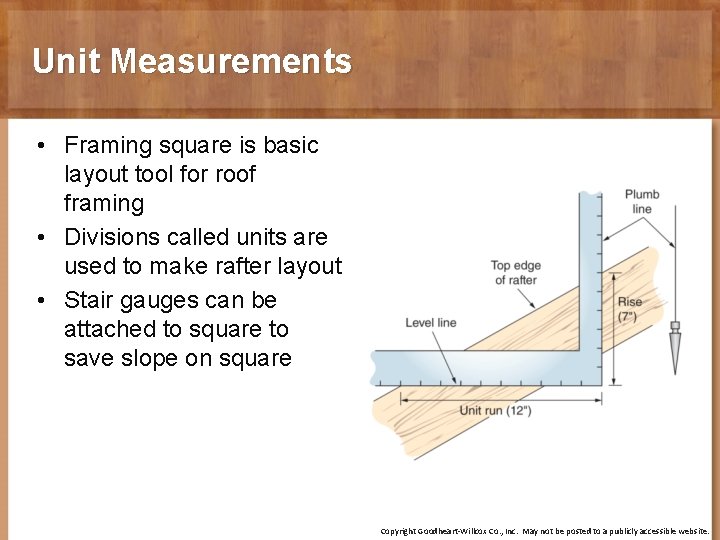
Unit Measurements • Framing square is basic layout tool for roof framing • Divisions called units are used to make rafter layout • Stair gauges can be attached to square to save slope on square Copyright Goodheart-Willcox Co. , Inc. May not be posted to a publicly accessible website.
Framing Plans • Roof framing information found in plans – – – Rise and run of roof Required overhang Subfascia and type of fascia Type of ridge Other information for roof construction Copyright Goodheart-Willcox Co. , Inc. May not be posted to a publicly accessible website.
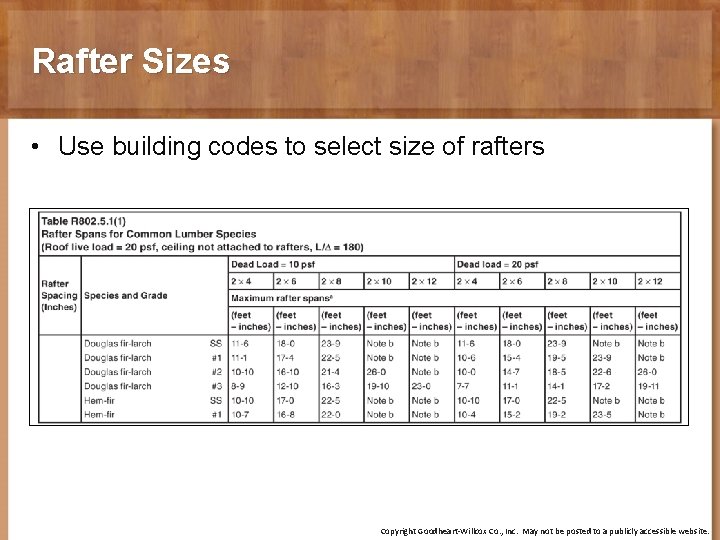
Rafter Sizes • Use building codes to select size of rafters Copyright Goodheart-Willcox Co. , Inc. May not be posted to a publicly accessible website.
Code Note • IRC includes rafter span tables for – Roof live load of 20 psf or ground snow load of 30 psf, 50 psf, or 70 psf – Ceiling not attached to or attached to rafters – Dead load of 10 psf or 20 psf – Rafter spacing of 12″, 16″, 19. 2″, or 24″ – Wood species and grade – Nominal rafter size: 2 × 4, 2 × 6, 2 × 8, 2 × 10, or 2 × 12 Copyright Goodheart-Willcox Co. , Inc. May not be posted to a publicly accessible website.
Laying Out Common Rafters • Rafters can be laid out using – Step-off method – Rafter table on framing square – Construction calculator • First lay out, check, and cut pattern rafter • Use pattern to mark other rafters of same size and type Copyright Goodheart-Willcox Co. , Inc. May not be posted to a publicly accessible website.
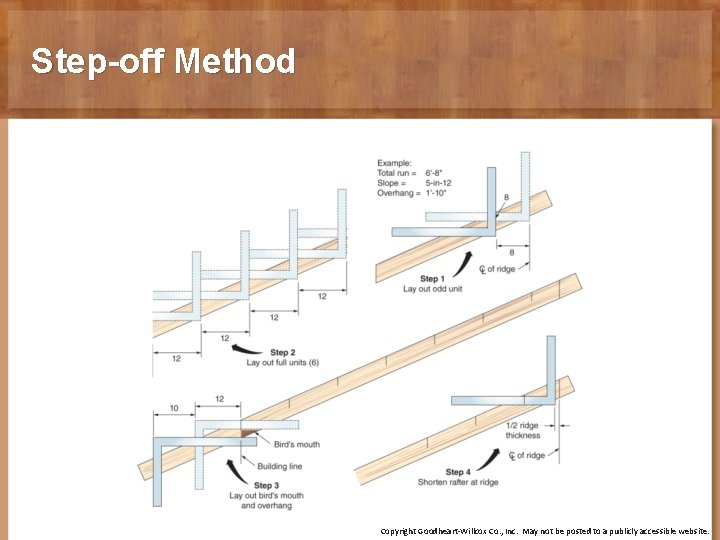
Step-off Method Copyright Goodheart-Willcox Co. , Inc. May not be posted to a publicly accessible website.
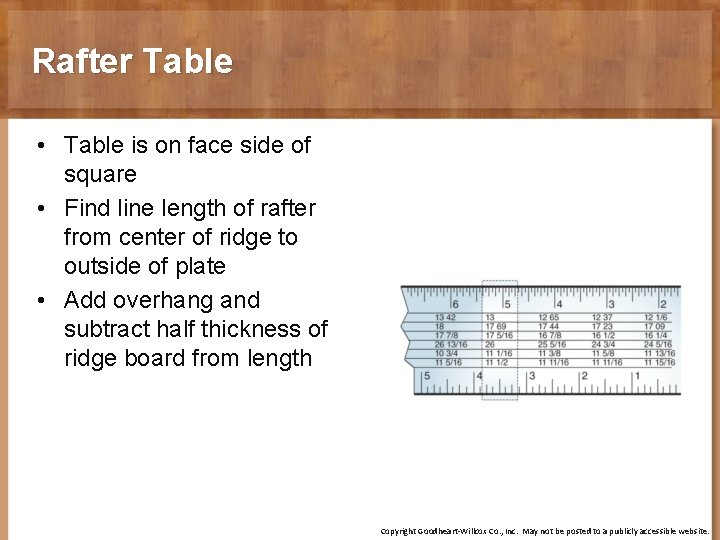
Rafter Table • Table is on face side of square • Find line length of rafter from center of ridge to outside of plate • Add overhang and subtract half thickness of ridge board from length Copyright Goodheart-Willcox Co. , Inc. May not be posted to a publicly accessible website.
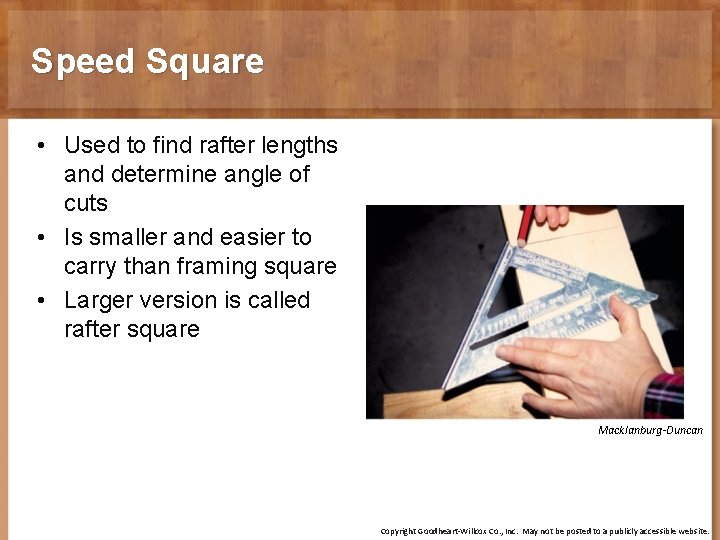
Speed Square • Used to find rafter lengths and determine angle of cuts • Is smaller and easier to carry than framing square • Larger version is called rafter square Macklanburg-Duncan Copyright Goodheart-Willcox Co. , Inc. May not be posted to a publicly accessible website.
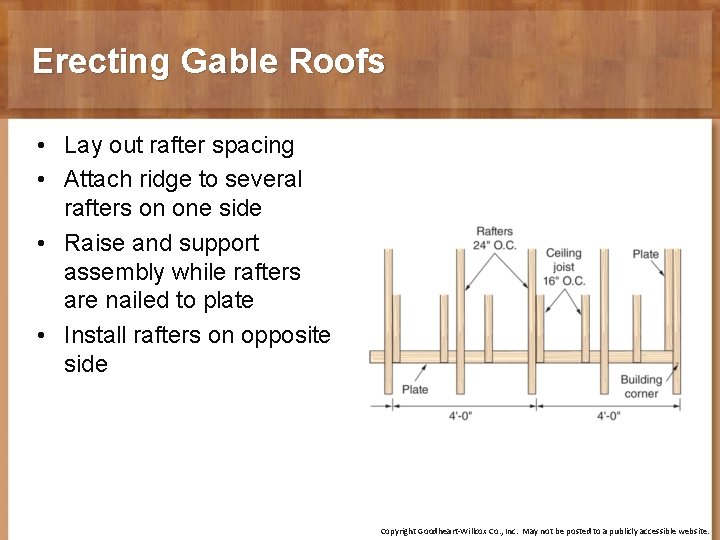
Erecting Gable Roofs • Lay out rafter spacing • Attach ridge to several rafters on one side • Raise and support assembly while rafters are nailed to plate • Install rafters on opposite side Copyright Goodheart-Willcox Co. , Inc. May not be posted to a publicly accessible website.
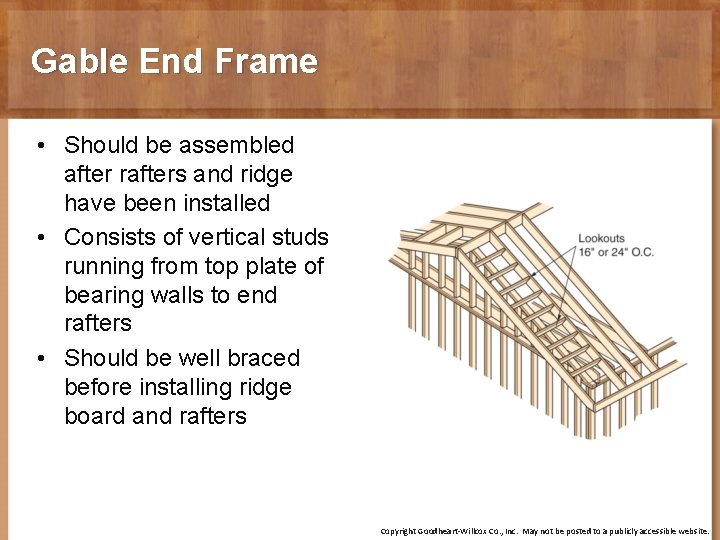
Gable End Frame • Should be assembled after rafters and ridge have been installed • Consists of vertical studs running from top plate of bearing walls to end rafters • Should be well braced before installing ridge board and rafters Copyright Goodheart-Willcox Co. , Inc. May not be posted to a publicly accessible website.

Hip and Valley Rafters • Hip rafters support intersection of two roof surfaces slanting upward • Use common rafters to calculate length of hip rafter, including overhang • Valley rafters used where two pitched roofs meet to form inside corner Copyright Goodheart-Willcox Co. , Inc. May not be posted to a publicly accessible website.
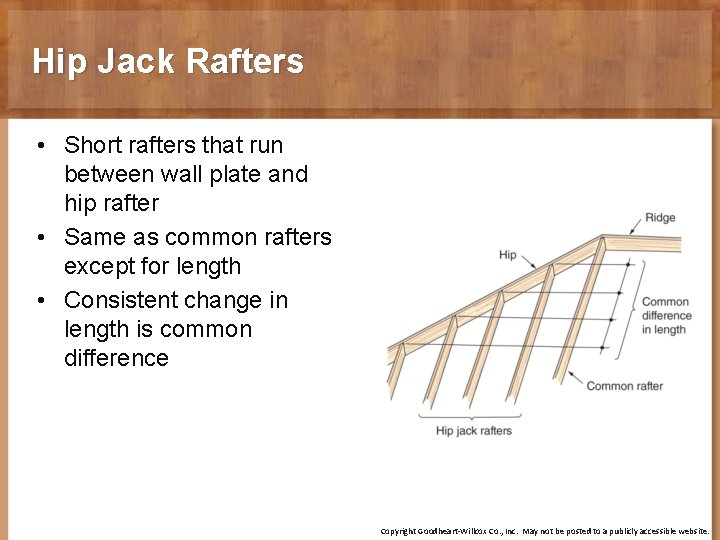
Hip Jack Rafters • Short rafters that run between wall plate and hip rafter • Same as common rafters except for length • Consistent change in length is common difference Copyright Goodheart-Willcox Co. , Inc. May not be posted to a publicly accessible website.
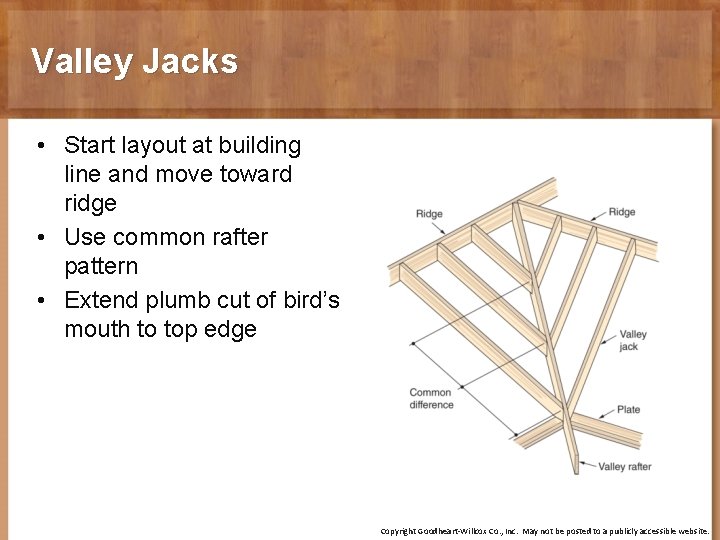
Valley Jacks • Start layout at building line and move toward ridge • Use common rafter pattern • Extend plumb cut of bird’s mouth to top edge Copyright Goodheart-Willcox Co. , Inc. May not be posted to a publicly accessible website.
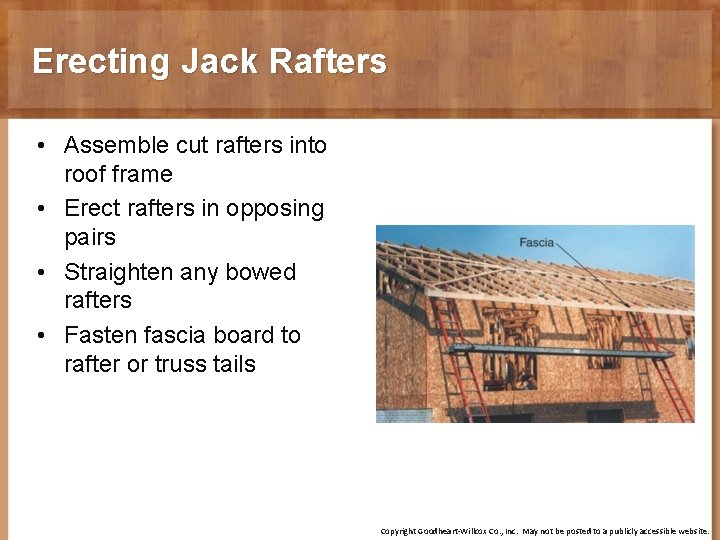
Erecting Jack Rafters • Assemble cut rafters into roof frame • Erect rafters in opposing pairs • Straighten any bowed rafters • Fasten fascia board to rafter or truss tails Copyright Goodheart-Willcox Co. , Inc. May not be posted to a publicly accessible website.

Special Problems • To support ridge of narrow roof section, valley rafter is run to main ridge • Valley cripple jack is rafter framed between two valley rafters • Hip-valley cripple jacks run between hips and valleys Copyright Goodheart-Willcox Co. , Inc. May not be posted to a publicly accessible website.

Roof Openings • May be required for chimneys, skylights, and other structures • First complete entire framework • Then, lay out and frame openings Copyright Goodheart-Willcox Co. , Inc. May not be posted to a publicly accessible website.
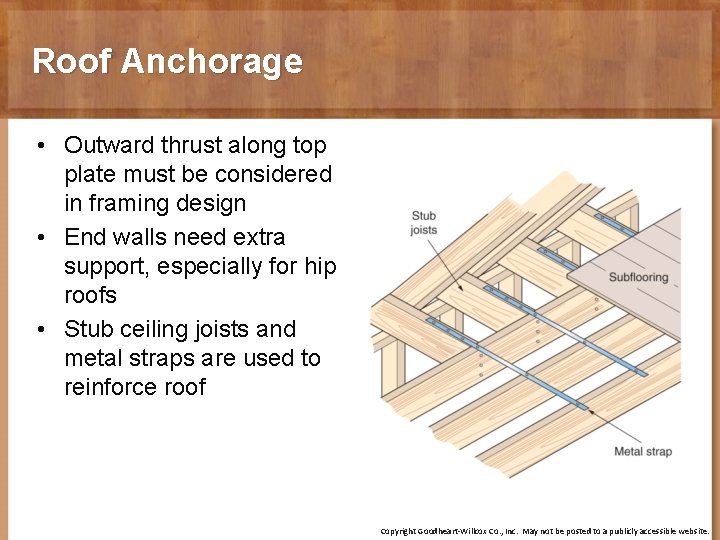
Roof Anchorage • Outward thrust along top plate must be considered in framing design • End walls need extra support, especially for hip roofs • Stub ceiling joists and metal straps are used to reinforce roof Copyright Goodheart-Willcox Co. , Inc. May not be posted to a publicly accessible website.
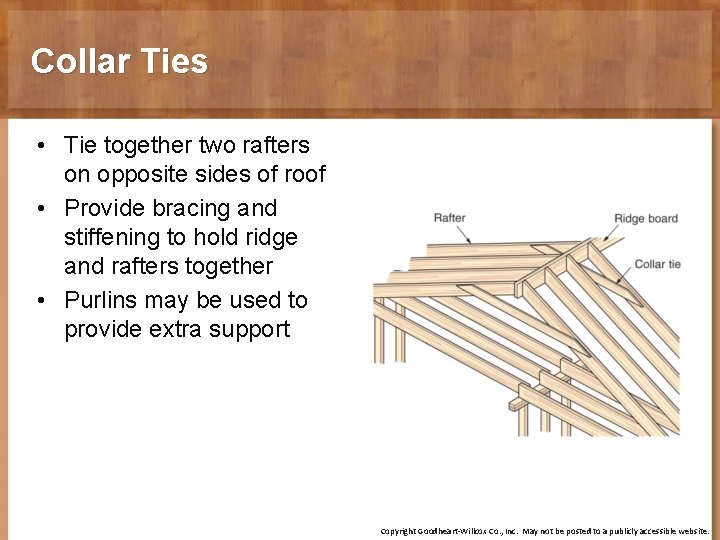
Collar Ties • Tie together two rafters on opposite sides of roof • Provide bracing and stiffening to hold ridge and rafters together • Purlins may be used to provide extra support Copyright Goodheart-Willcox Co. , Inc. May not be posted to a publicly accessible website.
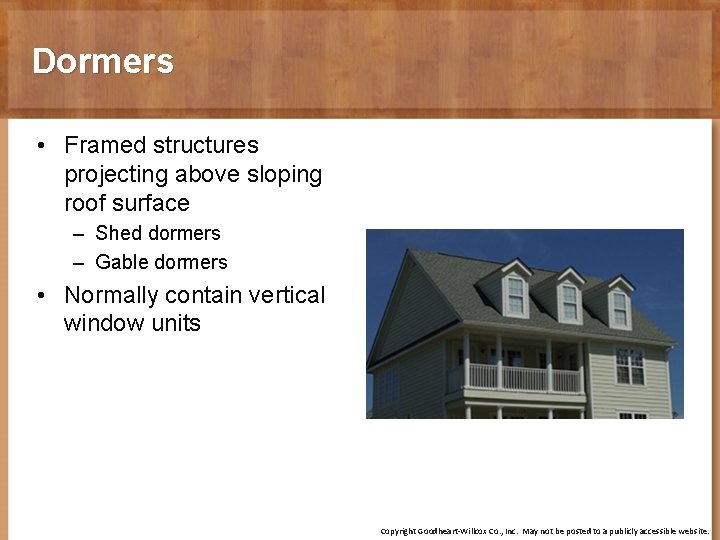
Dormers • Framed structures projecting above sloping roof surface – Shed dormers – Gable dormers • Normally contain vertical window units Copyright Goodheart-Willcox Co. , Inc. May not be posted to a publicly accessible website.
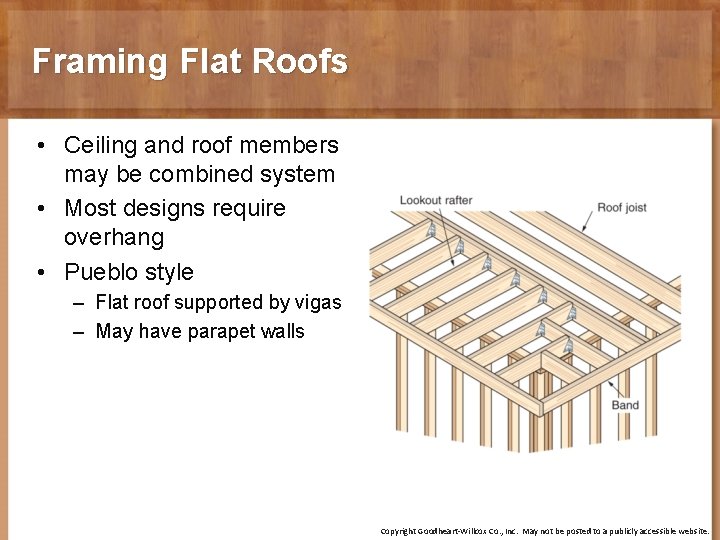
Framing Flat Roofs • Ceiling and roof members may be combined system • Most designs require overhang • Pueblo style – Flat roof supported by vigas – May have parapet walls Copyright Goodheart-Willcox Co. , Inc. May not be posted to a publicly accessible website.
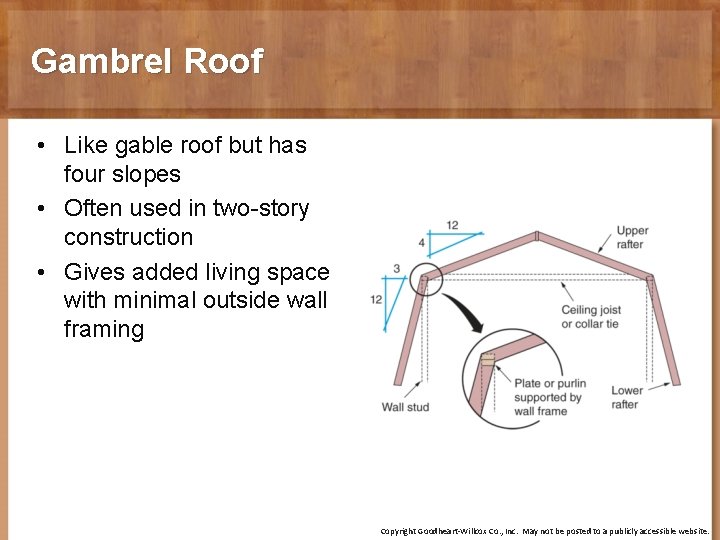
Gambrel Roof • Like gable roof but has four slopes • Often used in two-story construction • Gives added living space with minimal outside wall framing Copyright Goodheart-Willcox Co. , Inc. May not be posted to a publicly accessible website.
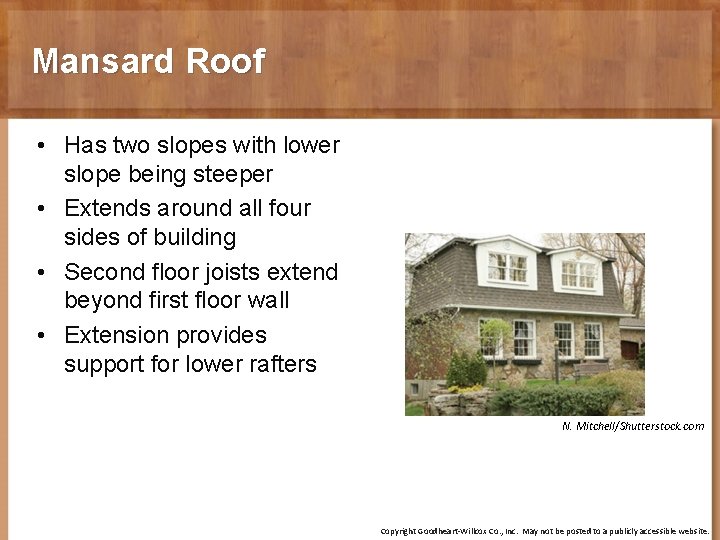
Mansard Roof • Has two slopes with lower slope being steeper • Extends around all four sides of building • Second floor joists extend beyond first floor wall • Extension provides support for lower rafters N. Mitchell/Shutterstock. com Copyright Goodheart-Willcox Co. , Inc. May not be posted to a publicly accessible website.
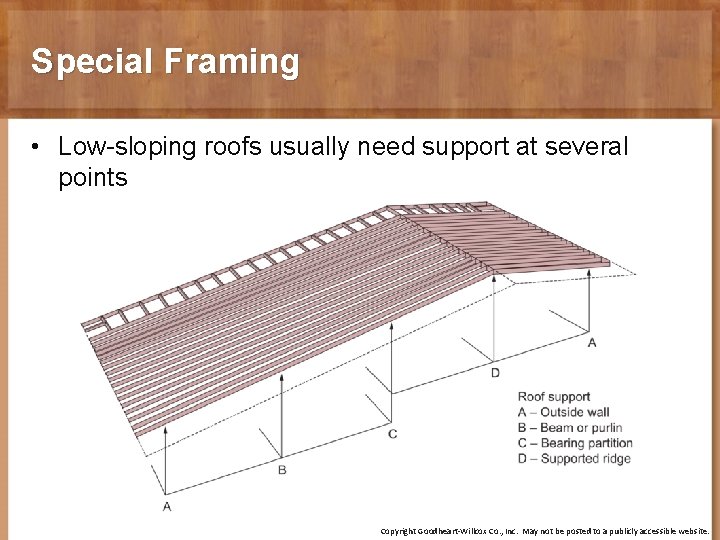
Special Framing • Low-sloping roofs usually need support at several points Copyright Goodheart-Willcox Co. , Inc. May not be posted to a publicly accessible website.
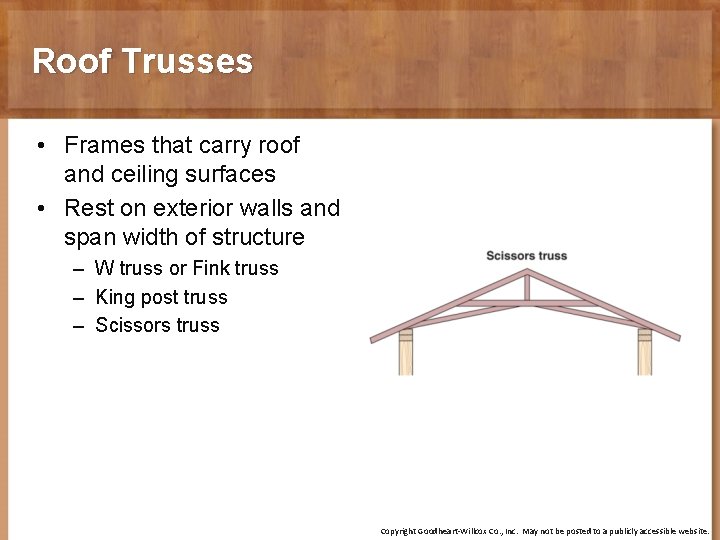
Roof Trusses • Frames that carry roof and ceiling surfaces • Rest on exterior walls and span width of structure – W truss or Fink truss – King post truss – Scissors truss Copyright Goodheart-Willcox Co. , Inc. May not be posted to a publicly accessible website.
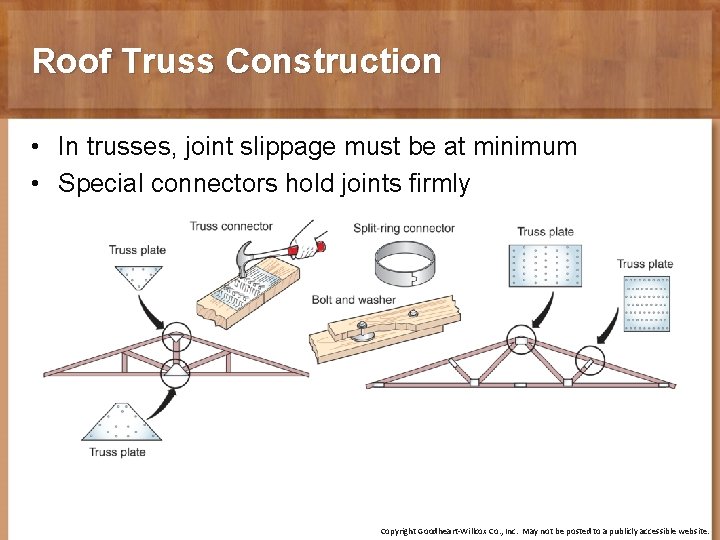
Roof Truss Construction • In trusses, joint slippage must be at minimum • Special connectors hold joints firmly Copyright Goodheart-Willcox Co. , Inc. May not be posted to a publicly accessible website.
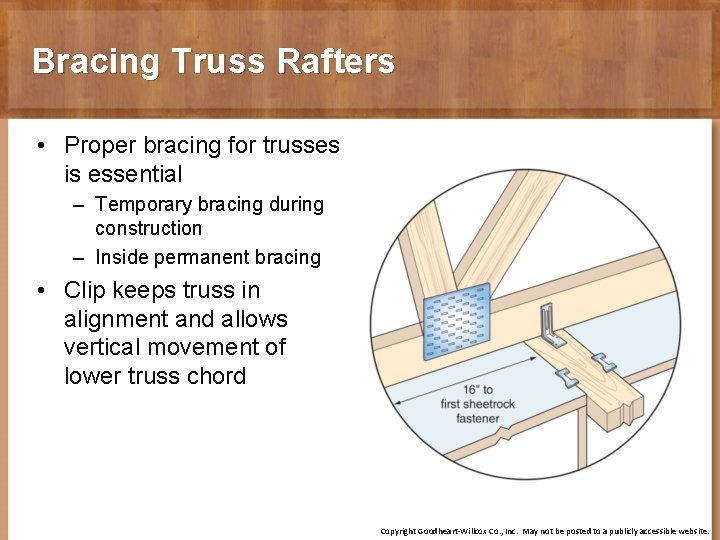
Bracing Truss Rafters • Proper bracing for trusses is essential – Temporary bracing during construction – Inside permanent bracing • Clip keeps truss in alignment and allows vertical movement of lower truss chord Copyright Goodheart-Willcox Co. , Inc. May not be posted to a publicly accessible website.
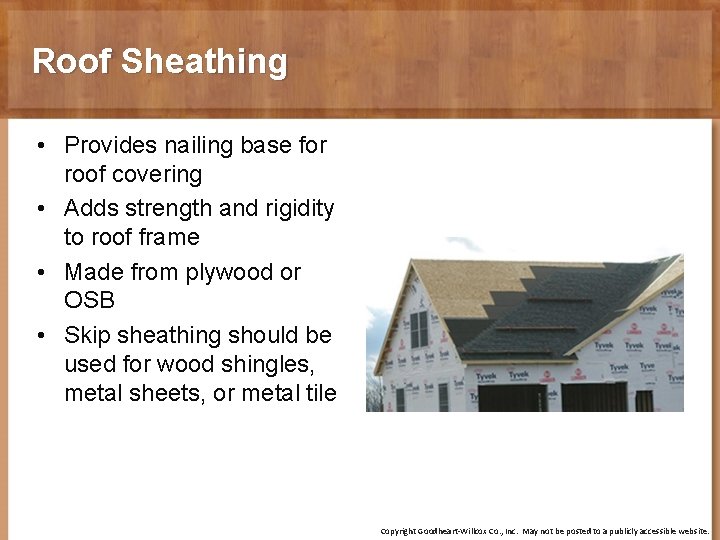
Roof Sheathing • Provides nailing base for roof covering • Adds strength and rigidity to roof frame • Made from plywood or OSB • Skip sheathing should be used for wood shingles, metal sheets, or metal tile Copyright Goodheart-Willcox Co. , Inc. May not be posted to a publicly accessible website.
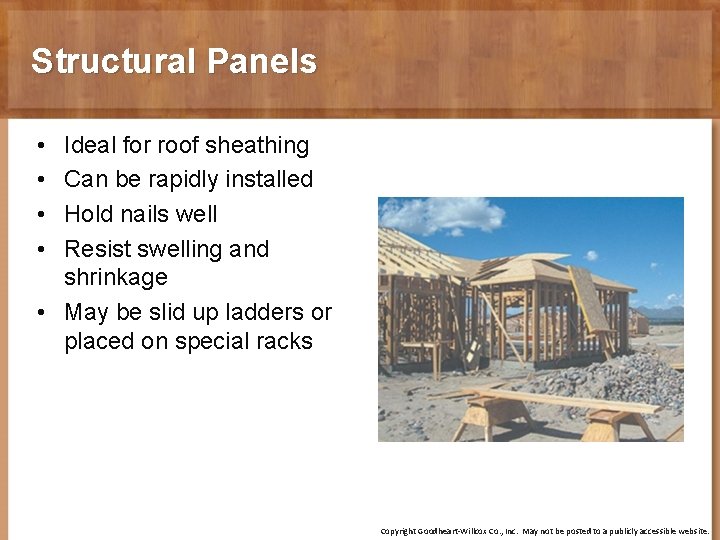
Structural Panels • • Ideal for roof sheathing Can be rapidly installed Hold nails well Resist swelling and shrinkage • May be slid up ladders or placed on special racks Copyright Goodheart-Willcox Co. , Inc. May not be posted to a publicly accessible website.
Installing Sheathing • Start at eaves and work up toward ridge • Use temporary fasteners at corners to keep panels square • Lay down rows of panels from edge to edge of roof • Stagger end joints between rows of panels • Trim extra overhang at ends of gable roof Copyright Goodheart-Willcox Co. , Inc. May not be posted to a publicly accessible website.
Panel Clips • Used to strengthen roof sheathing panels between rafters • Eliminate need for blocking on long truss or rafter spans • Two clips should be used where supports are 48″ O. C. The Panel Clip Co. Copyright Goodheart-Willcox Co. , Inc. May not be posted to a publicly accessible website.
Safety Note • Work from scaffold to install fascia and lay first row of roof sheathing • Never place tools, materials, or debris where they can slide off roof • Follow OSHA rules that require fall protection, guardrails on scaffolding, and hard hats Copyright Goodheart-Willcox Co. , Inc. May not be posted to a publicly accessible website.
Estimating Materials • Number of rafters required for plain gable roof – Multiply length of building by 3/4 for spacing 16″ O. C. – Round up and add one more – Double figure to include other side of roof • For complex roof frames, work from complete framing plan Copyright Goodheart-Willcox Co. , Inc. May not be posted to a publicly accessible website.
Model and Small-Scale Construction • Working with models requires much time • Often best to construct only part of building • Small buildings, such as storage sheds, can be sold to recover cost of materials • Scale of 1 1/2″ = 1′-0″ usually makes it possible to apply regular framing procedures Copyright Goodheart-Willcox Co. , Inc. May not be posted to a publicly accessible website.
- Slides: 45