
Chapter 12 Recursion Java Software Solutions Foundations of
![continued if (done) // this location is part of the final path grid[row][column] =](https://slidetodoc.com/presentation_image_h2/04a4182c68c3a62895faf69345e63dac/image-26.jpg "continued if (done) // this location is part of the final path grid[row][column] =")
- Slides: 55
Chapter 12 Recursion Java Software Solutions Foundations of Program Design 9 th Edition John Lewis William Loftus Copyright © 2017 Pearson Education, Inc.
Recursion • Recursion is a fundamental programming technique that can provide an elegant solution certain kinds of problems • Chapter 12 focuses on: – – – thinking in a recursive manner programming in a recursive manner the correct use of recursion examples recursion in graphics fractals Copyright © 2017 Pearson Education, Inc.
Outline Recursive Thinking Recursive Programming Traversing a Maze The Towers of Hanoi Tiled Images Fractals Copyright © 2017 Pearson Education, Inc.
Recursive Thinking • A recursive definition is one which uses the word or concept being defined in the definition itself • When defining an English word, a recursive definition is often not helpful • But in other situations, a recursive definition can be an appropriate way to express a concept • Before applying recursion to programming, it is best to practice thinking recursively Copyright © 2017 Pearson Education, Inc.
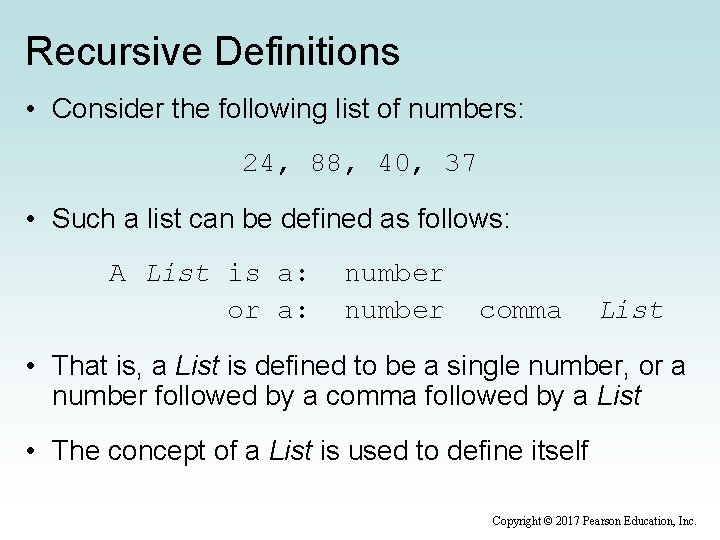
Recursive Definitions • Consider the following list of numbers: 24, 88, 40, 37 • Such a list can be defined as follows: A List is a: or a: number comma List • That is, a List is defined to be a single number, or a number followed by a comma followed by a List • The concept of a List is used to define itself Copyright © 2017 Pearson Education, Inc.
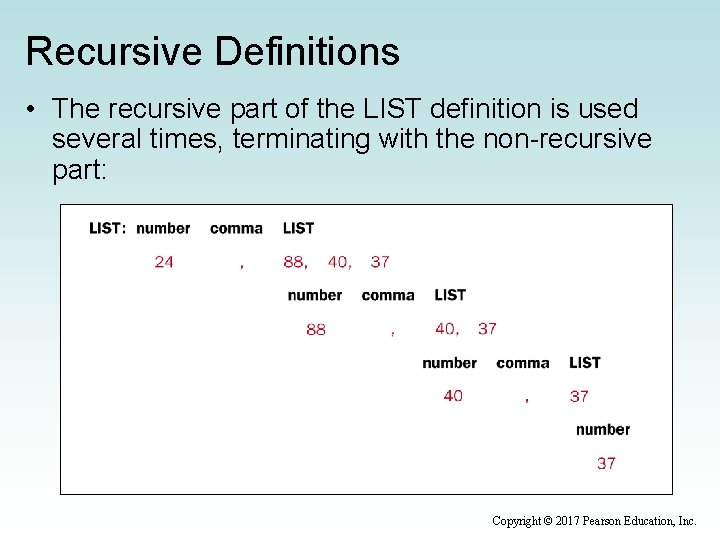
Recursive Definitions • The recursive part of the LIST definition is used several times, terminating with the non-recursive part: Copyright © 2017 Pearson Education, Inc.
Infinite Recursion • All recursive definitions have to have a nonrecursive part called the base case • If they didn't, there would be no way to terminate the recursive path • Such a definition would cause infinite recursion • This problem is similar to an infinite loop, but the non-terminating "loop" is part of the definition itself Copyright © 2017 Pearson Education, Inc.
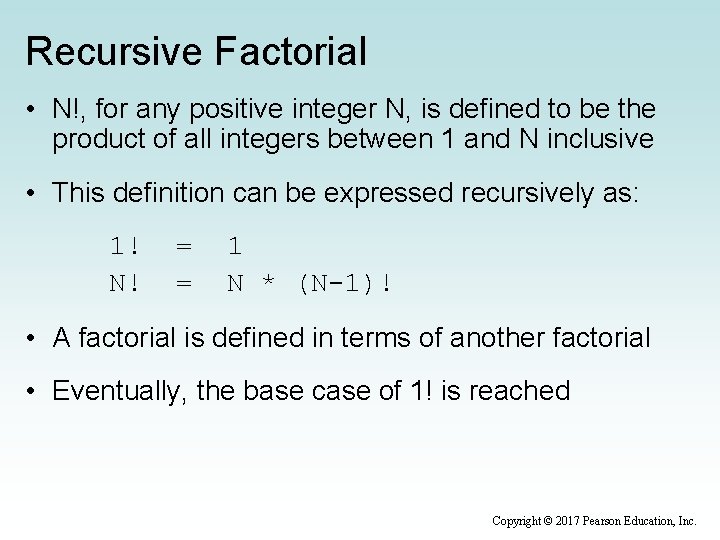
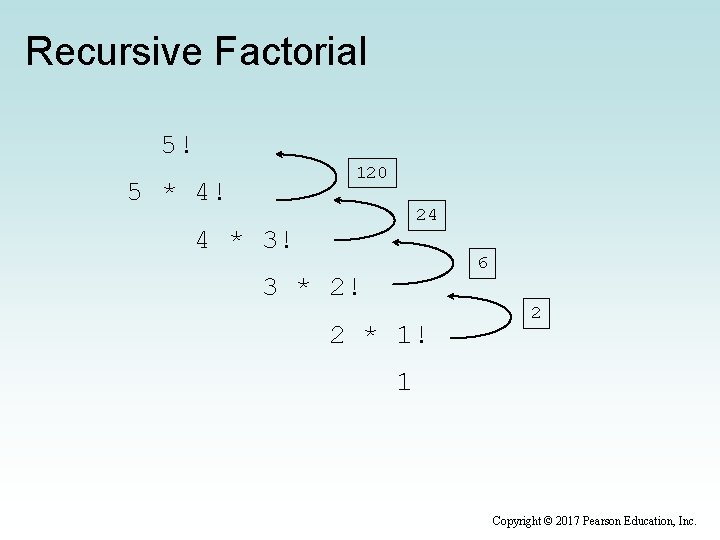
Recursive Factorial • N!, for any positive integer N, is defined to be the product of all integers between 1 and N inclusive • This definition can be expressed recursively as: 1! N! = = 1 N * (N-1)! • A factorial is defined in terms of another factorial • Eventually, the base case of 1! is reached Copyright © 2017 Pearson Education, Inc.
Recursive Factorial 5! 120 5 * 4! 24 4 * 3! 6 3 * 2! 2 * 1! 2 1 Copyright © 2017 Pearson Education, Inc.
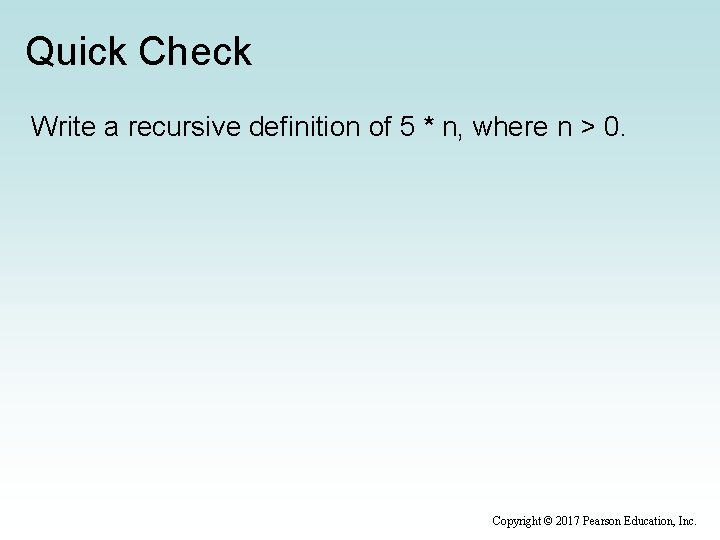
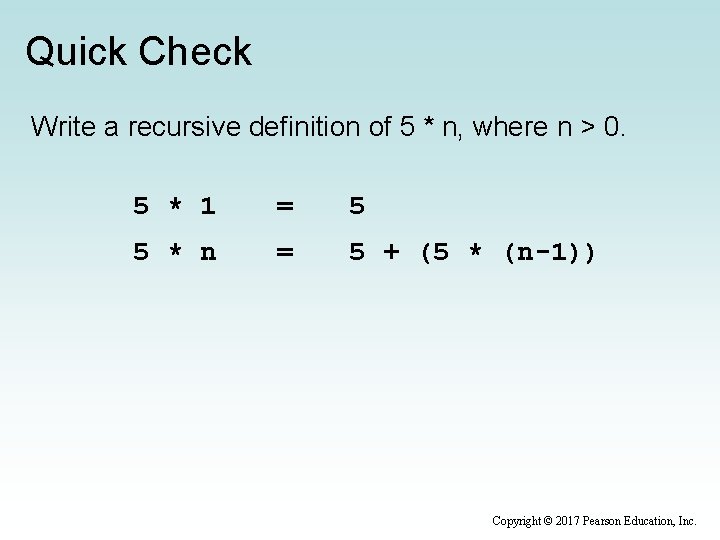
Quick Check Write a recursive definition of 5 * n, where n > 0. Copyright © 2017 Pearson Education, Inc.
Quick Check Write a recursive definition of 5 * n, where n > 0. 5 * 1 = 5 5 * n = 5 + (5 * (n-1)) Copyright © 2017 Pearson Education, Inc.
Outline Recursive Thinking Recursive Programming Traversing a Maze The Towers of Hanoi Tiled Images Fractals Copyright © 2017 Pearson Education, Inc.
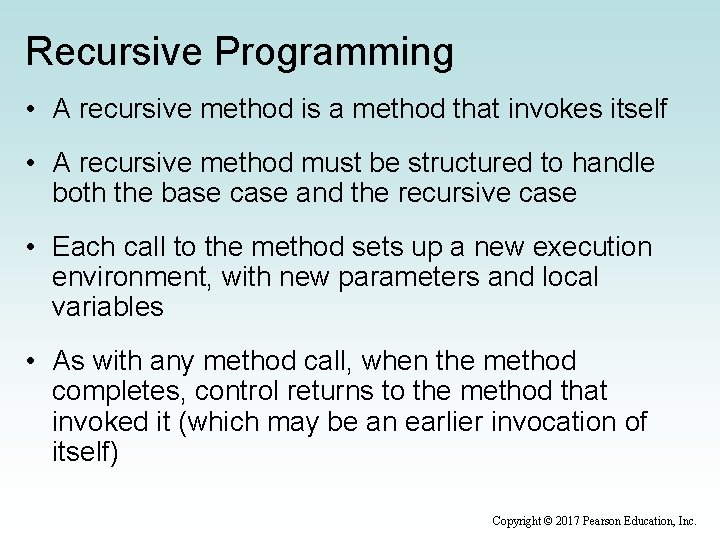
Recursive Programming • A recursive method is a method that invokes itself • A recursive method must be structured to handle both the base case and the recursive case • Each call to the method sets up a new execution environment, with new parameters and local variables • As with any method call, when the method completes, control returns to the method that invoked it (which may be an earlier invocation of itself) Copyright © 2017 Pearson Education, Inc.
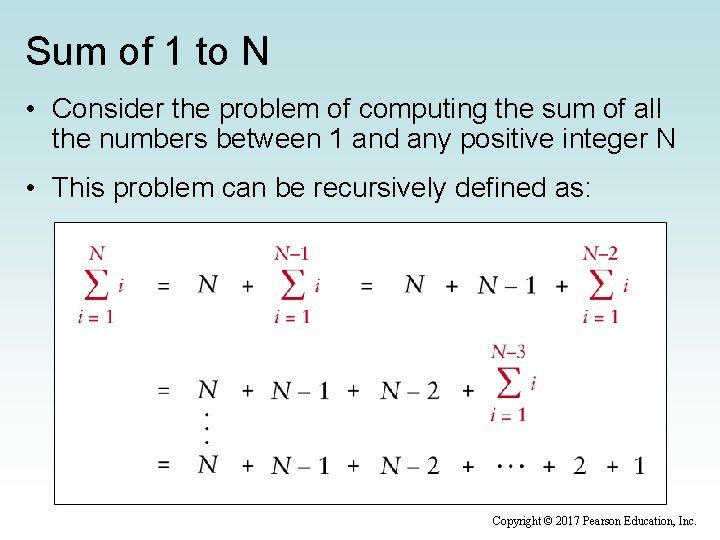
Sum of 1 to N • Consider the problem of computing the sum of all the numbers between 1 and any positive integer N • This problem can be recursively defined as: Copyright © 2017 Pearson Education, Inc.
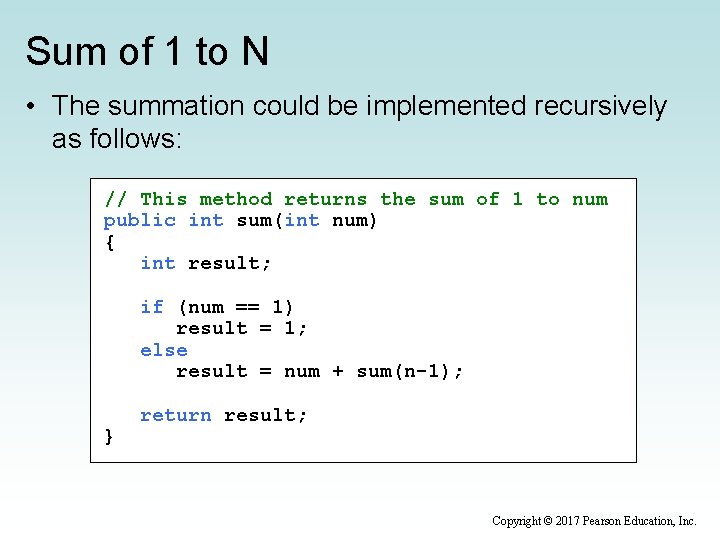
Sum of 1 to N • The summation could be implemented recursively as follows: // This method returns the sum of 1 to num public int sum(int num) { int result; if (num == 1) result = 1; else result = num + sum(n-1); } return result; Copyright © 2017 Pearson Education, Inc.
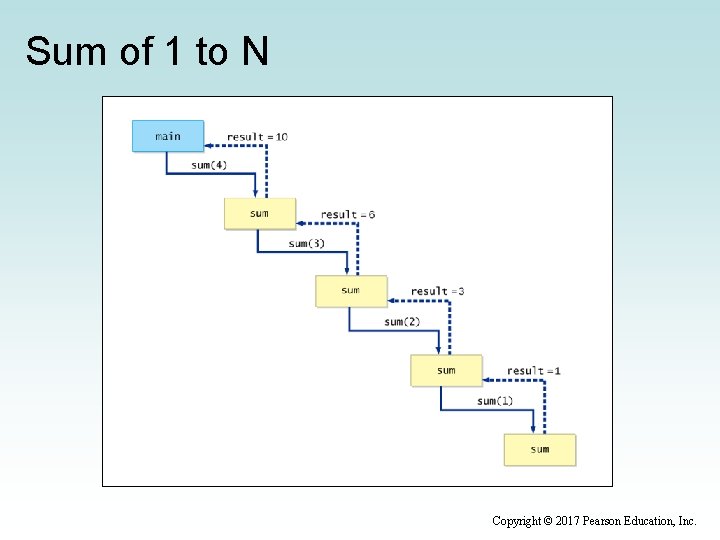
Sum of 1 to N Copyright © 2017 Pearson Education, Inc.
Recursive Programming • Note that just because we can use recursion to solve a problem, doesn't mean we should • We usually would not use recursion to solve the summation problem, because the iterative version is easier to understand • However, for some problems, recursion provides an elegant solution, often cleaner than an iterative version • You must carefully decide whether recursion is the correct technique for any problem Copyright © 2017 Pearson Education, Inc.
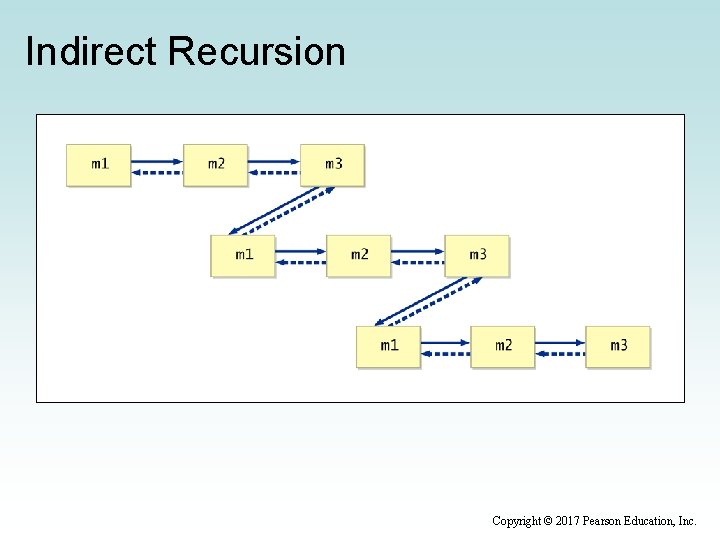
Indirect Recursion • A method invoking itself is considered to be direct recursion • A method could invoke another method, which invokes another, etc. , until eventually the original method is invoked again • For example, method m 1 could invoke m 2, which invokes m 3, which in turn invokes m 1 again • This is called indirect recursion, and requires all the same care as direct recursion • It is often more difficult to trace and debug Copyright © 2017 Pearson Education, Inc.
Indirect Recursion Copyright © 2017 Pearson Education, Inc.
Outline Recursive Thinking Recursive Programming Traversing a Maze The Towers of Hanoi Tiled Images Fractals Copyright © 2017 Pearson Education, Inc.
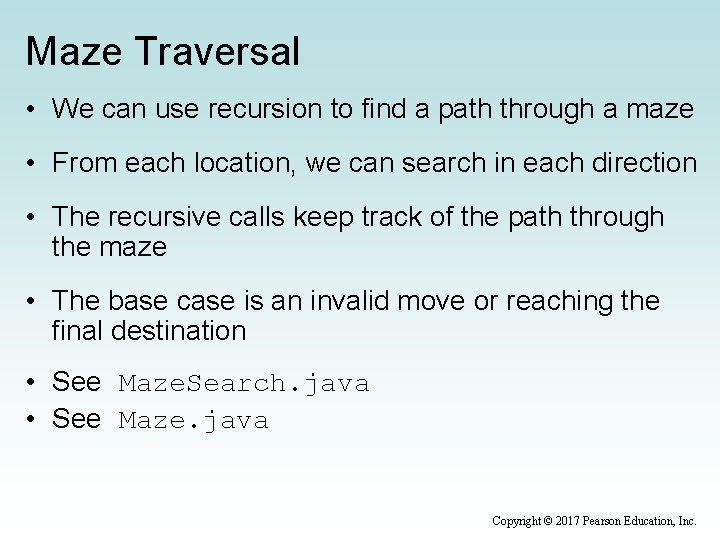
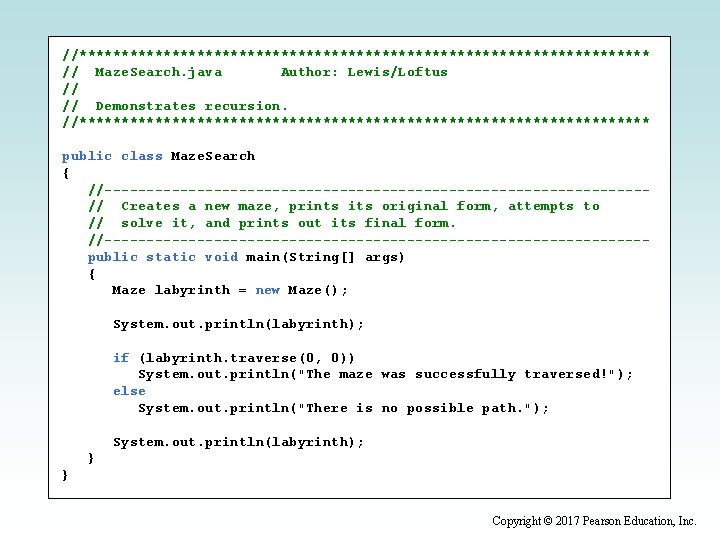
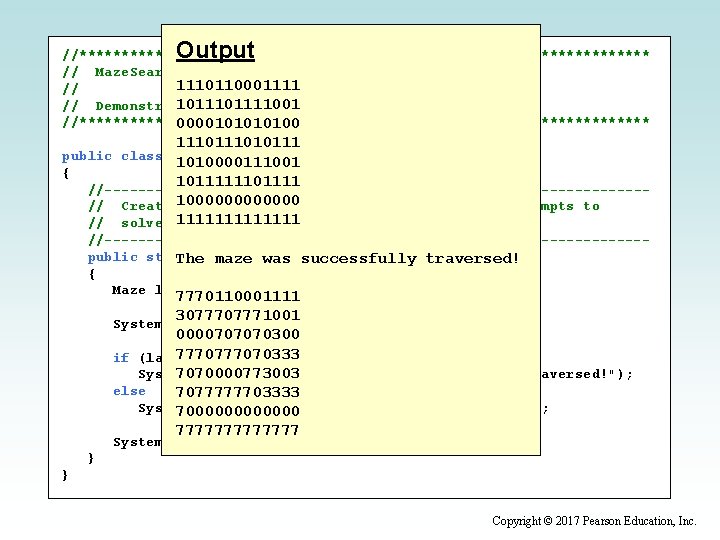
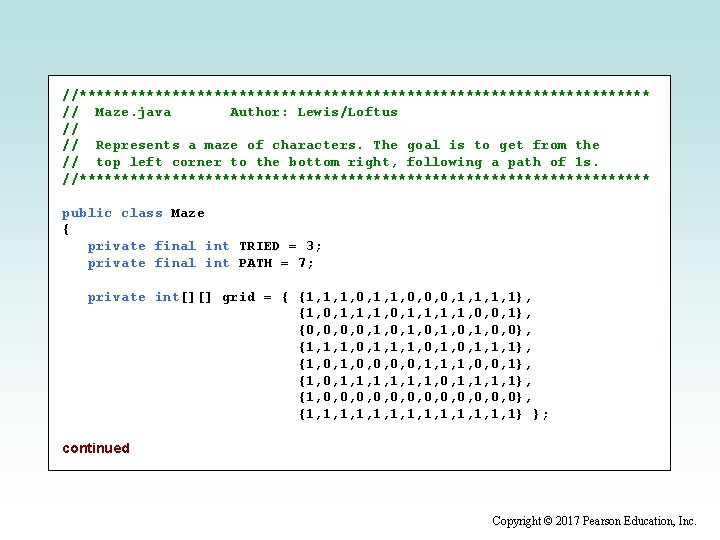
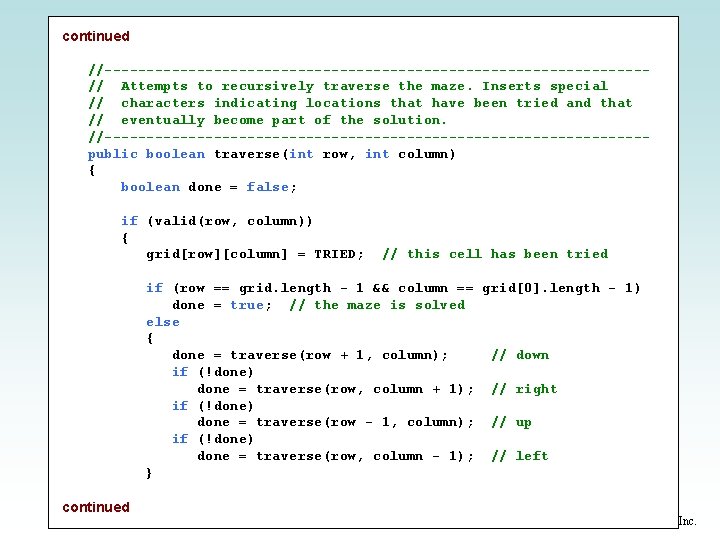
Maze Traversal • We can use recursion to find a path through a maze • From each location, we can search in each direction • The recursive calls keep track of the path through the maze • The base case is an invalid move or reaching the final destination • See Maze. Search. java • See Maze. java Copyright © 2017 Pearson Education, Inc.
//********************************** // Maze. Search. java Author: Lewis/Loftus // // Demonstrates recursion. //********************************** public class Maze. Search { //--------------------------------// Creates a new maze, prints its original form, attempts to // solve it, and prints out its final form. //--------------------------------public static void main(String[] args) { Maze labyrinth = new Maze(); System. out. println(labyrinth); if (labyrinth. traverse(0, 0)) System. out. println("The maze was successfully traversed!"); else System. out. println("There is no possible path. "); System. out. println(labyrinth); } } Copyright © 2017 Pearson Education, Inc.
Output //********************************** // Maze. Search. java Author: Lewis/Loftus 1110110001111 // 101111001 // Demonstrates recursion. //********************************** 000010100 111010111 public class Maze. Search 1010000111001 { 1011111101111 //--------------------------------// Creates 1000000 a new maze, prints its original form, attempts to 1111111 // solve it, and prints out its final form. //--------------------------------public static args) traversed! Thevoid mazemain(String[] was successfully { Maze labyrinth = new Maze(); 7770110001111 307771001 0000707070300 777070333 if (labyrinth. traverse(0, 0)) 7070000773003 System. out. println("The maze was successfully traversed!"); else 7077777703333 System. out. println("There is no possible path. "); 7000000 7777777 System. out. println(labyrinth); } } Copyright © 2017 Pearson Education, Inc.
//********************************** // Maze. java Author: Lewis/Loftus // // Represents a maze of characters. The goal is to get from the // top left corner to the bottom right, following a path of 1 s. //********************************** public class Maze { private final int TRIED = 3; private final int PATH = 7; private int[][] grid = { {1, 1, 1, 0, 0, 0, 1, 1}, {1, 0, 1, 1, 0, 0, 1}, {0, 0, 1, 0, 0}, {1, 1, 1, 0, 1, 1, 1}, {1, 0, 0, 1, 1, 1, 0, 0, 1}, {1, 0, 1, 1, 1, 0, 1, 1}, {1, 0, 0, 0, 0}, {1, 1, 1, 1} }; continued Copyright © 2017 Pearson Education, Inc.
continued //--------------------------------// Attempts to recursively traverse the maze. Inserts special // characters indicating locations that have been tried and that // eventually become part of the solution. //--------------------------------public boolean traverse(int row, int column) { boolean done = false; if (valid(row, column)) { grid[row][column] = TRIED; // this cell has been tried if (row == grid. length - 1 && column == grid[0]. length - 1) done = true; // the maze is solved else { done = traverse(row + 1, column); // down if (!done) done = traverse(row, column + 1); // right if (!done) done = traverse(row - 1, column); // up if (!done) done = traverse(row, column - 1); // left } continued Copyright © 2017 Pearson Education, Inc.
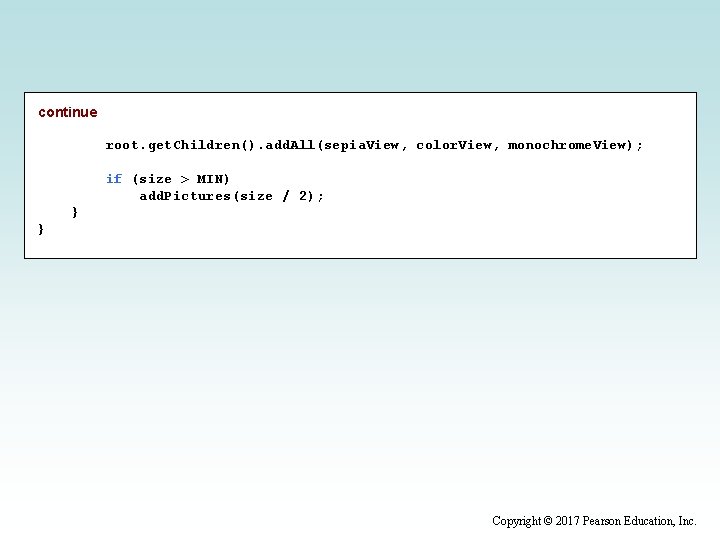
continued if (done) // this location is part of the final path grid[row][column] = PATH; } return done; } //--------------------------------// Determines if a specific location is valid. //--------------------------------private boolean valid(int row, int column) { boolean result = false; // check if cell is in the bounds of the matrix if (row >= 0 && row < grid. length && column >= 0 && column < grid[row]. length) // check if cell is not blocked and not previously tried if (grid[row][column] == 1) result = true; return result; } continued Copyright © 2017 Pearson Education, Inc.
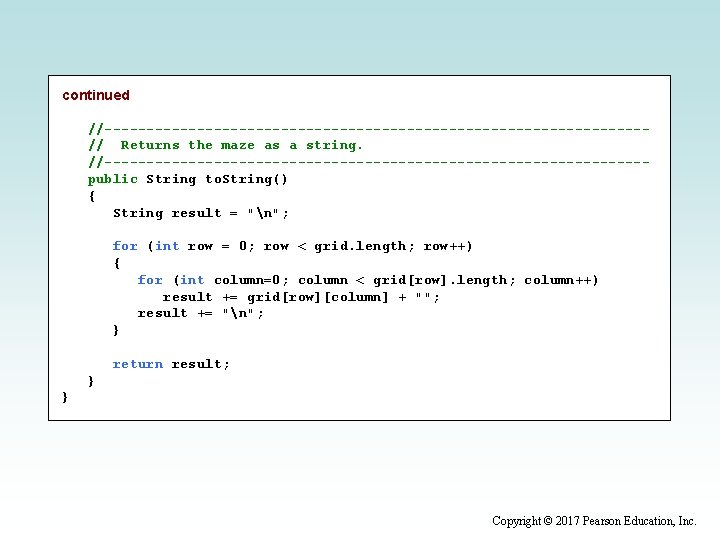
continued //--------------------------------// Returns the maze as a string. //--------------------------------public String to. String() { String result = "n"; for (int row = 0; row < grid. length; row++) { for (int column=0; column < grid[row]. length; column++) result += grid[row][column] + ""; result += "n"; } return result; } } Copyright © 2017 Pearson Education, Inc.
Outline Recursive Thinking Recursive Programming Traversing a Maze The Towers of Hanoi Tiled Images Fractals Copyright © 2017 Pearson Education, Inc.
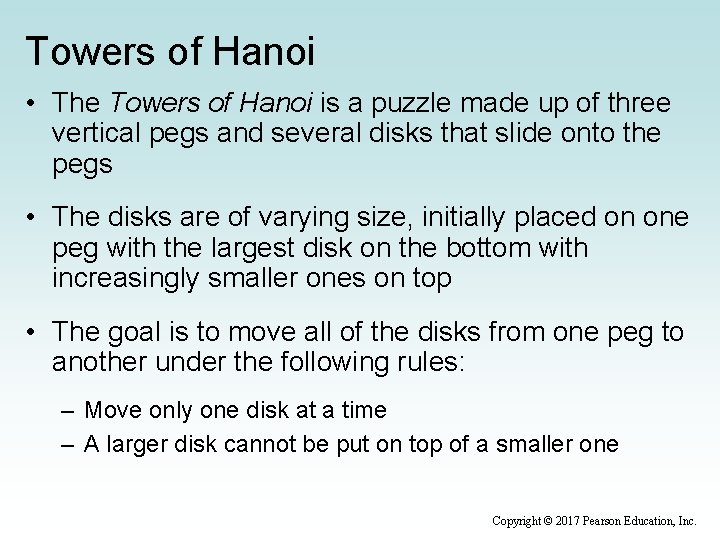
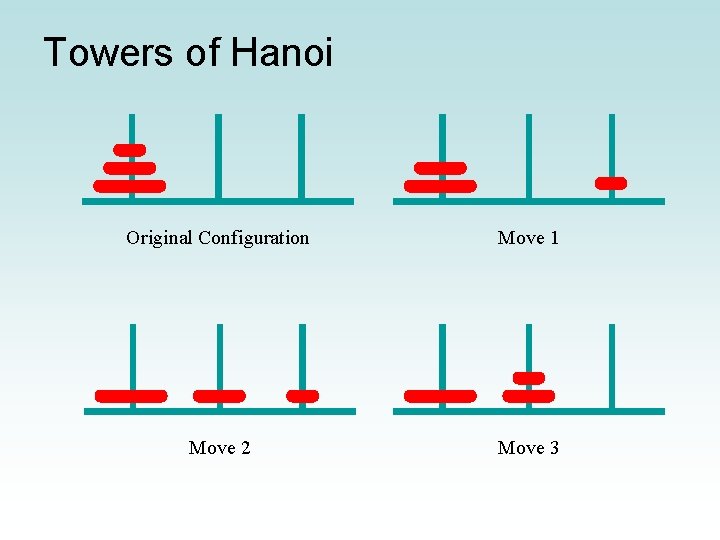
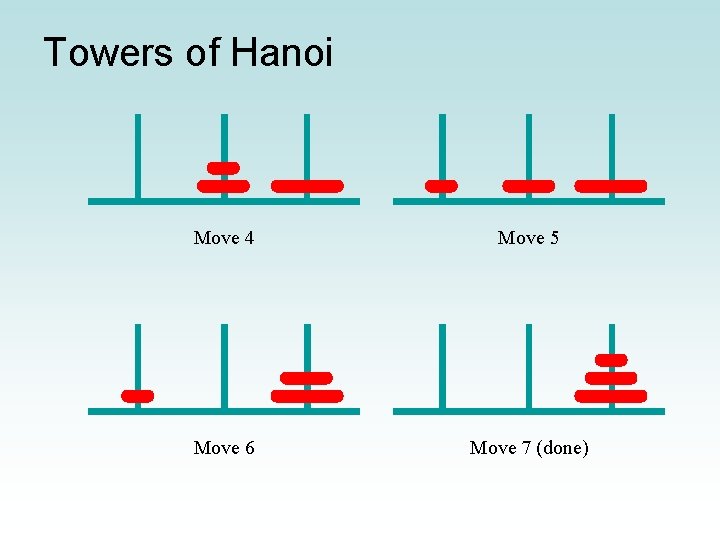
Towers of Hanoi • The Towers of Hanoi is a puzzle made up of three vertical pegs and several disks that slide onto the pegs • The disks are of varying size, initially placed on one peg with the largest disk on the bottom with increasingly smaller ones on top • The goal is to move all of the disks from one peg to another under the following rules: – Move only one disk at a time – A larger disk cannot be put on top of a smaller one Copyright © 2017 Pearson Education, Inc.
Towers of Hanoi Original Configuration Move 1 Move 2 Move 3
Towers of Hanoi Move 4 Move 5 Move 6 Move 7 (done)
Towers of Hanoi • An iterative solution to the Towers of Hanoi is quite complex • A recursive solution is much shorter and more elegant • See Solve. Towers. java • See Towers. Of. Hanoi. java Copyright © 2017 Pearson Education, Inc.
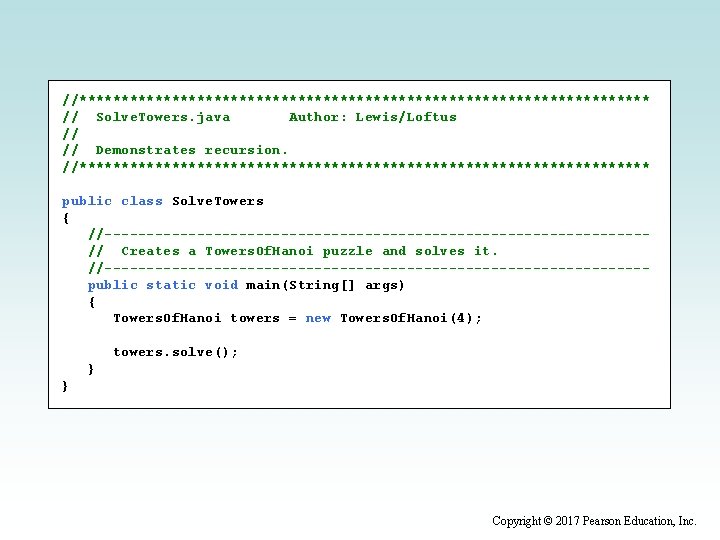
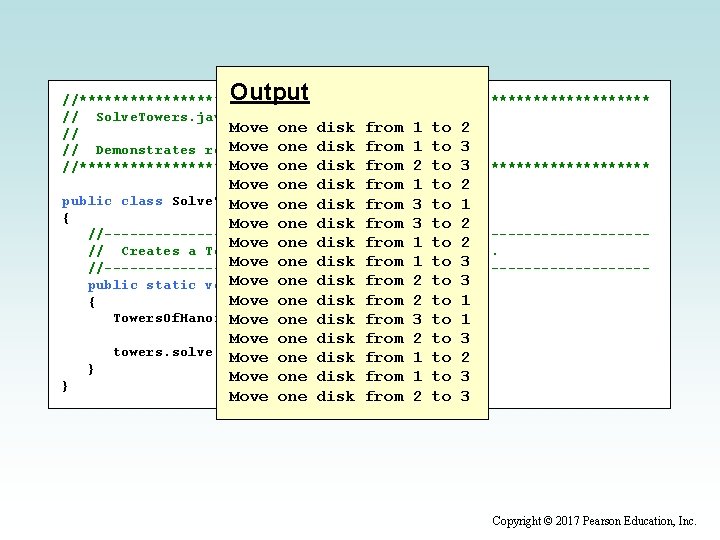
//********************************** // Solve. Towers. java Author: Lewis/Loftus // // Demonstrates recursion. //********************************** public class Solve. Towers { //--------------------------------// Creates a Towers. Of. Hanoi puzzle and solves it. //--------------------------------public static void main(String[] args) { Towers. Of. Hanoi towers = new Towers. Of. Hanoi(4); towers. solve(); } } Copyright © 2017 Pearson Education, Inc.
Output //********************************** // Solve. Towers. java Author: Lewis/Loftus Move one disk from 1 to 2 // Move one disk from 1 to 3 // Demonstrates recursion. Move one disk from 2 to 3 //********************************** Move one disk from 1 to 2 public class Solve. Towers Move one disk from 3 to 1 { Move one disk from 3 to 2 //--------------------------------Move one disk from 1 to 2 // Creates a Towers. Of. Hanoi puzzle and solves it. Move one disk from 1 to 3 //--------------------------------Move one disk from public static void main(String[] args) 2 to 3 Move one disk from 2 to 1 { Towers. Of. Hanoi Move towersone = new Towers. Of. Hanoi(4); disk from 3 to 1 Move one disk from 2 to 3 towers. solve(); Move one disk from 1 to 2 } Move one disk from 1 to 3 } Move one disk from 2 to 3 Copyright © 2017 Pearson Education, Inc.
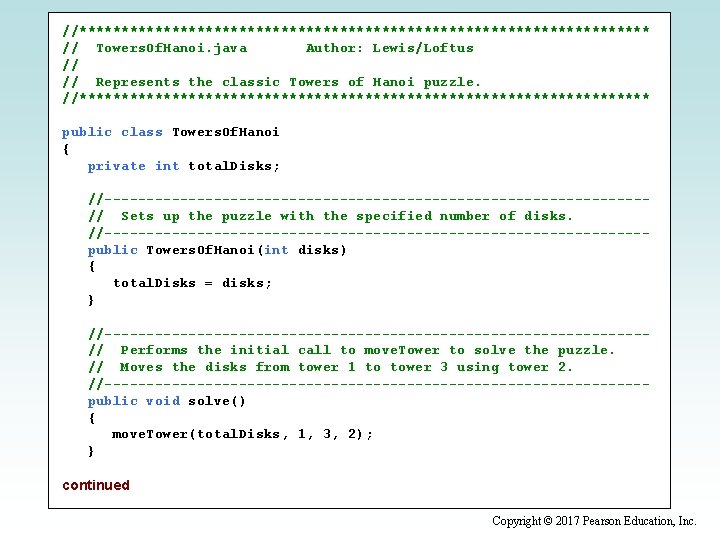
//********************************** // Towers. Of. Hanoi. java Author: Lewis/Loftus // // Represents the classic Towers of Hanoi puzzle. //********************************** public class Towers. Of. Hanoi { private int total. Disks; //--------------------------------// Sets up the puzzle with the specified number of disks. //--------------------------------public Towers. Of. Hanoi(int disks) { total. Disks = disks; } //--------------------------------// Performs the initial call to move. Tower to solve the puzzle. // Moves the disks from tower 1 to tower 3 using tower 2. //--------------------------------public void solve() { move. Tower(total. Disks, 1, 3, 2); } continued Copyright © 2017 Pearson Education, Inc.
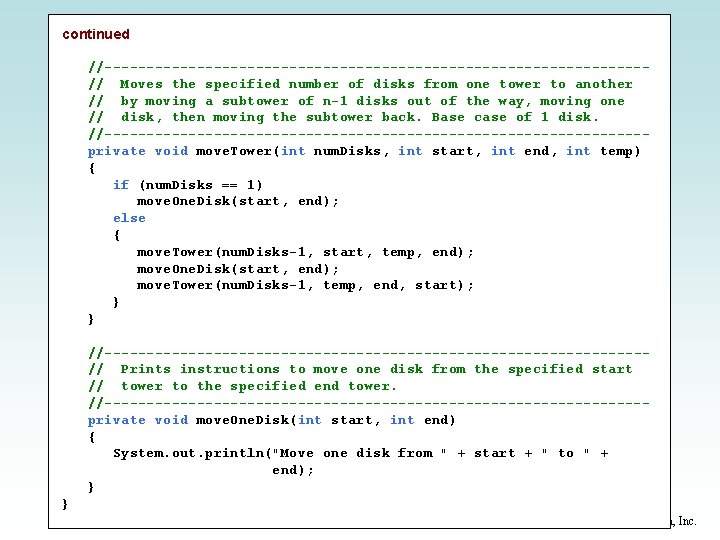
continued //--------------------------------// Moves the specified number of disks from one tower to another // by moving a subtower of n-1 disks out of the way, moving one // disk, then moving the subtower back. Base case of 1 disk. //--------------------------------private void move. Tower(int num. Disks, int start, int end, int temp) { if (num. Disks == 1) move. One. Disk(start, end); else { move. Tower(num. Disks-1, start, temp, end); move. One. Disk(start, end); move. Tower(num. Disks-1, temp, end, start); } } //--------------------------------// Prints instructions to move one disk from the specified start // tower to the specified end tower. //--------------------------------private void move. One. Disk(int start, int end) { System. out. println("Move one disk from " + start + " to " + end); } } Copyright © 2017 Pearson Education, Inc.
Outline Recursive Thinking Recursive Programming Traversing a Maze The Towers of Hanoi Tiled Images Fractals Copyright © 2017 Pearson Education, Inc.
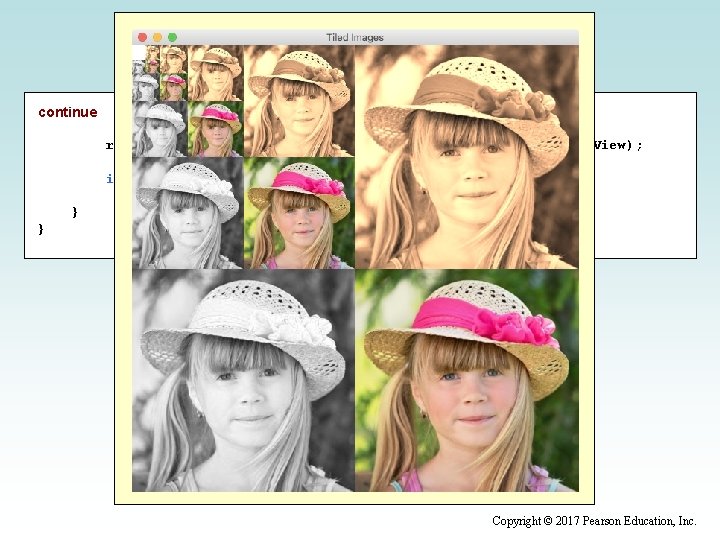
Tiled Images • Consider the task of repeatedly displaying a set of images in a mosaic – Three quadrants contain individual images – Upper-left quadrant repeats pattern • The base case is reached when the area for the images shrinks to a certain size • See Tiled. Images. java Copyright © 2017 Pearson Education, Inc.
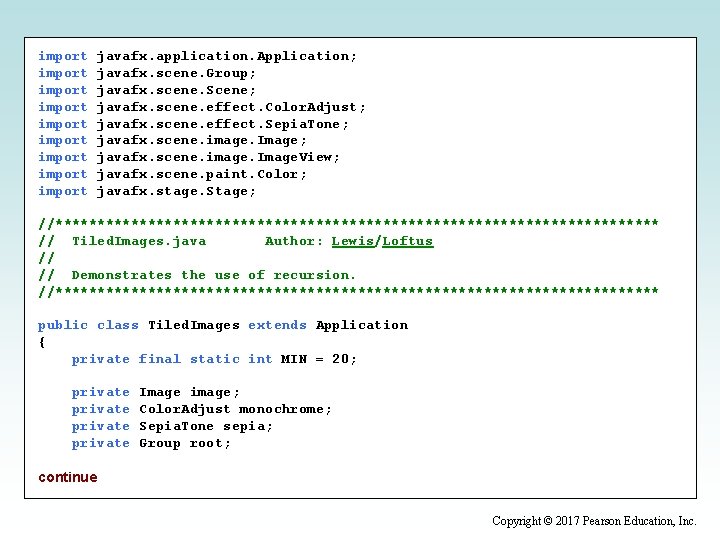
import import import javafx. application. Application; javafx. scene. Group; javafx. scene. Scene; javafx. scene. effect. Color. Adjust; javafx. scene. effect. Sepia. Tone; javafx. scene. image. Image. View; javafx. scene. paint. Color; javafx. stage. Stage; //************************************ // Tiled. Images. java Author: Lewis/Loftus // // Demonstrates the use of recursion. //************************************ public class Tiled. Images extends Application { private final static int MIN = 20; private Image image; Color. Adjust monochrome; Sepia. Tone sepia; Group root; continue Copyright © 2017 Pearson Education, Inc.
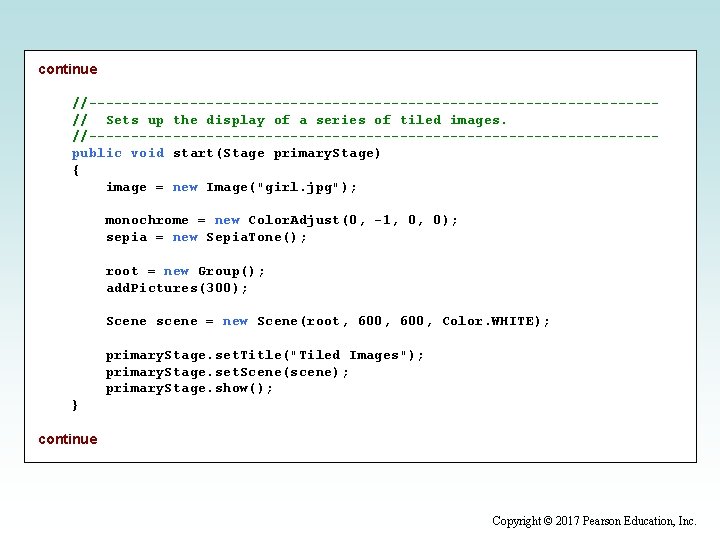
continue //----------------------------------// Sets up the display of a series of tiled images. //----------------------------------public void start(Stage primary. Stage) { image = new Image("girl. jpg"); monochrome = new Color. Adjust(0, -1, 0, 0); sepia = new Sepia. Tone(); root = new Group(); add. Pictures(300); Scene scene = new Scene(root, 600, Color. WHITE); primary. Stage. set. Title("Tiled Images"); primary. Stage. set. Scene(scene); primary. Stage. show(); } continue Copyright © 2017 Pearson Education, Inc.
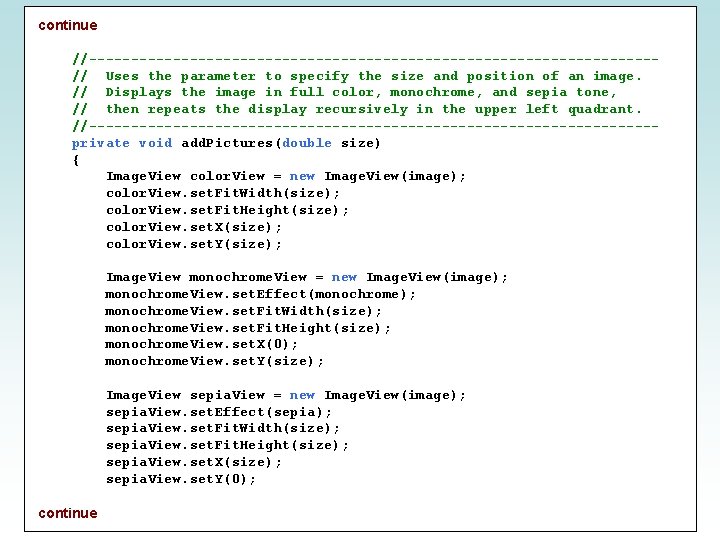
continue //----------------------------------// Uses the parameter to specify the size and position of an image. // Displays the image in full color, monochrome, and sepia tone, // then repeats the display recursively in the upper left quadrant. //----------------------------------private void add. Pictures(double size) { Image. View color. View = new Image. View(image); color. View. set. Fit. Width(size); color. View. set. Fit. Height(size); color. View. set. X(size); color. View. set. Y(size); Image. View monochrome. View = new Image. View(image); monochrome. View. set. Effect(monochrome); monochrome. View. set. Fit. Width(size); monochrome. View. set. Fit. Height(size); monochrome. View. set. X(0); monochrome. View. set. Y(size); Image. View sepia. View = new Image. View(image); sepia. View. set. Effect(sepia); sepia. View. set. Fit. Width(size); sepia. View. set. Fit. Height(size); sepia. View. set. X(size); sepia. View. set. Y(0); continue Copyright © 2017 Pearson Education, Inc.
continue root. get. Children(). add. All(sepia. View, color. View, monochrome. View); if (size > MIN) add. Pictures(size / 2); } } Copyright © 2017 Pearson Education, Inc.
continue root. get. Children(). add. All(sepia. View, color. View, monochrome. View); if (size > MIN) add. Pictures(size / 2); } } Copyright © 2017 Pearson Education, Inc.
Outline Recursive Thinking Recursive Programming Traversing a Maze The Towers of Hanoi Tiled Images Fractals Copyright © 2017 Pearson Education, Inc.
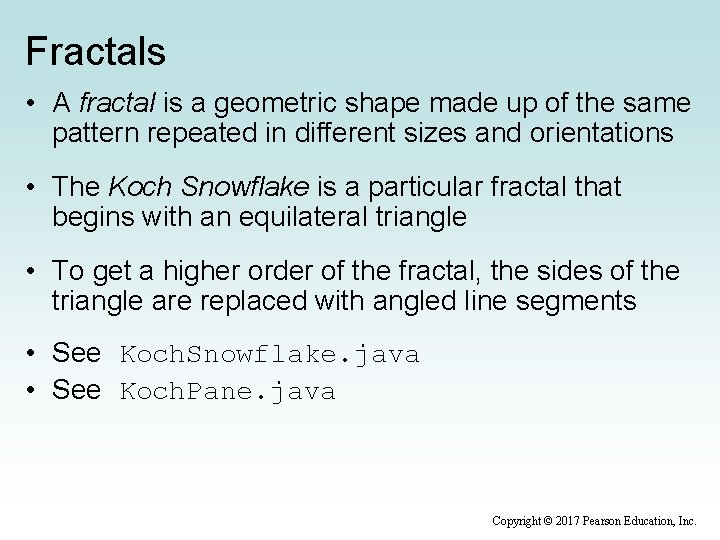
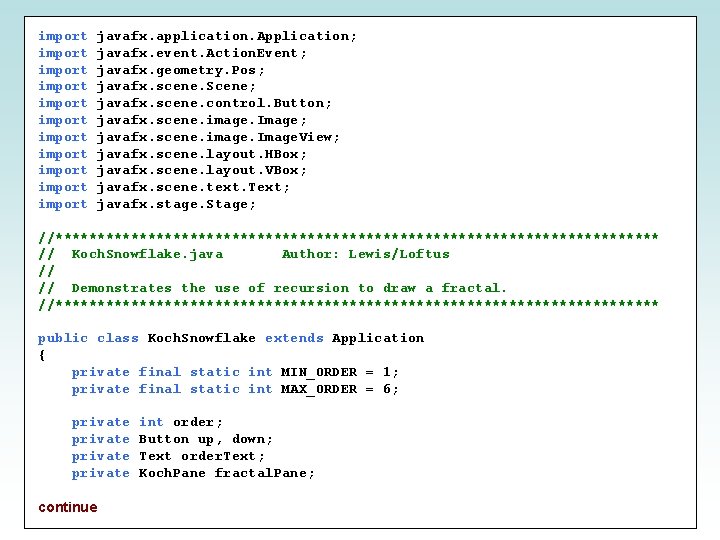
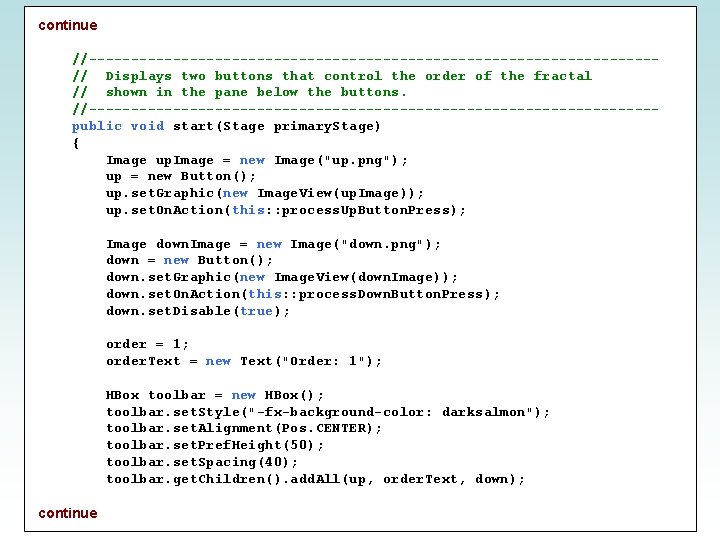
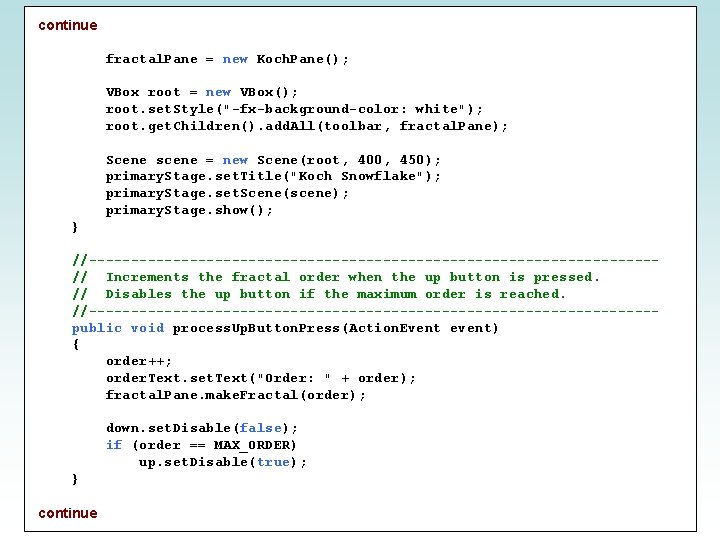
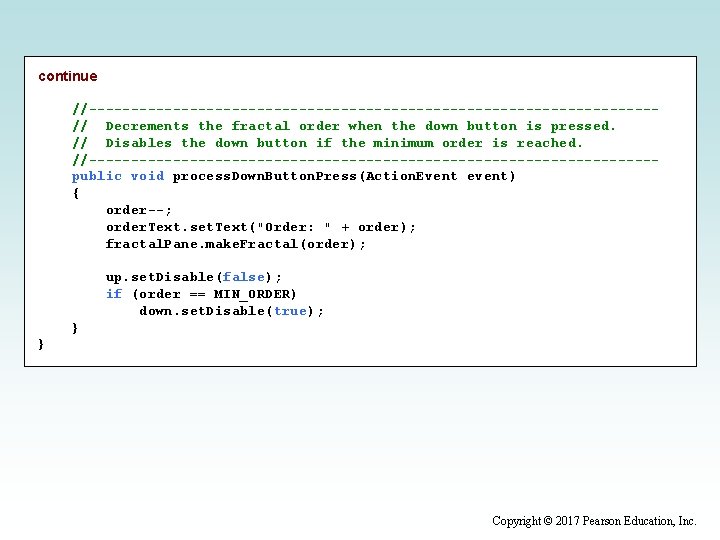
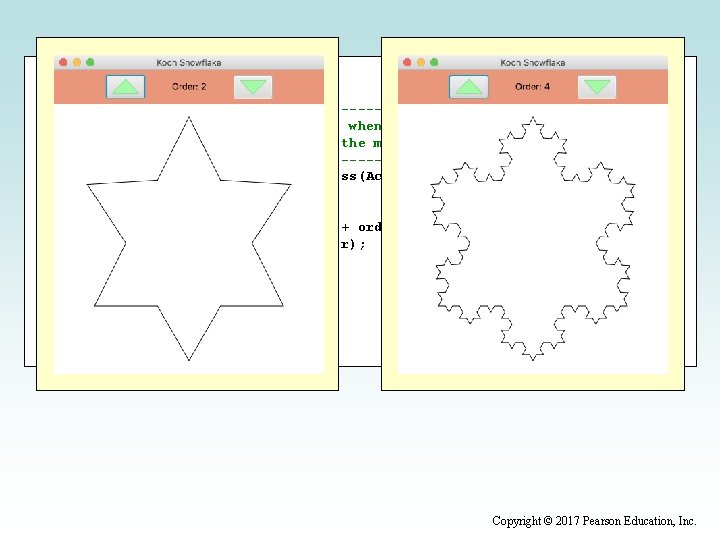
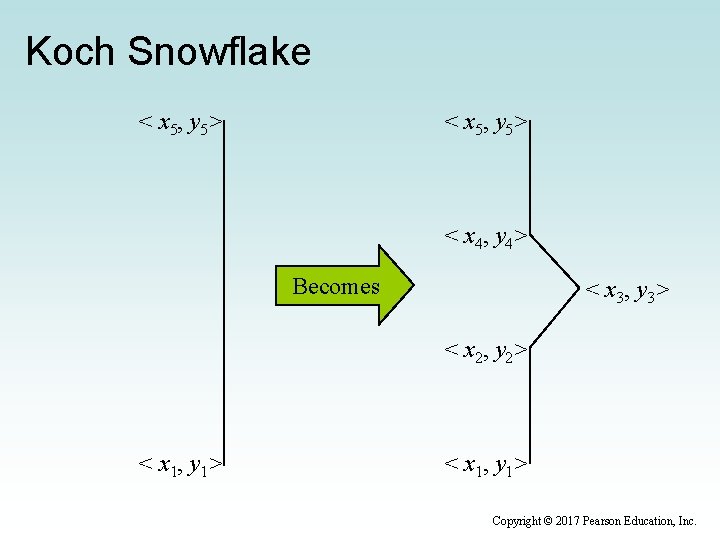
Fractals • A fractal is a geometric shape made up of the same pattern repeated in different sizes and orientations • The Koch Snowflake is a particular fractal that begins with an equilateral triangle • To get a higher order of the fractal, the sides of the triangle are replaced with angled line segments • See Koch. Snowflake. java • See Koch. Pane. java Copyright © 2017 Pearson Education, Inc.
import import import javafx. application. Application; javafx. event. Action. Event; javafx. geometry. Pos; javafx. scene. Scene; javafx. scene. control. Button; javafx. scene. image. Image. View; javafx. scene. layout. HBox; javafx. scene. layout. VBox; javafx. scene. text. Text; javafx. stage. Stage; //************************************ // Koch. Snowflake. java Author: Lewis/Loftus // // Demonstrates the use of recursion to draw a fractal. //************************************ public class Koch. Snowflake extends Application { private final static int MIN_ORDER = 1; private final static int MAX_ORDER = 6; private continue int order; Button up, down; Text order. Text; Koch. Pane fractal. Pane; Copyright © 2017 Pearson Education, Inc.
continue //----------------------------------// Displays two buttons that control the order of the fractal // shown in the pane below the buttons. //----------------------------------public void start(Stage primary. Stage) { Image up. Image = new Image("up. png"); up = new Button(); up. set. Graphic(new Image. View(up. Image)); up. set. On. Action(this: : process. Up. Button. Press); Image down. Image = new Image("down. png"); down = new Button(); down. set. Graphic(new Image. View(down. Image)); down. set. On. Action(this: : process. Down. Button. Press); down. set. Disable(true); order = 1; order. Text = new Text("Order: 1"); HBox toolbar = new HBox(); toolbar. set. Style("-fx-background-color: darksalmon"); toolbar. set. Alignment(Pos. CENTER); toolbar. set. Pref. Height(50); toolbar. set. Spacing(40); toolbar. get. Children(). add. All(up, order. Text, down); continue Copyright © 2017 Pearson Education, Inc.
continue fractal. Pane = new Koch. Pane(); VBox root = new VBox(); root. set. Style("-fx-background-color: white"); root. get. Children(). add. All(toolbar, fractal. Pane); Scene scene = new Scene(root, 400, 450); primary. Stage. set. Title("Koch Snowflake"); primary. Stage. set. Scene(scene); primary. Stage. show(); } //----------------------------------// Increments the fractal order when the up button is pressed. // Disables the up button if the maximum order is reached. //----------------------------------public void process. Up. Button. Press(Action. Event event) { order++; order. Text. set. Text("Order: " + order); fractal. Pane. make. Fractal(order); down. set. Disable(false); if (order == MAX_ORDER) up. set. Disable(true); } continue Copyright © 2017 Pearson Education, Inc.
continue //----------------------------------// Decrements the fractal order when the down button is pressed. // Disables the down button if the minimum order is reached. //----------------------------------public void process. Down. Button. Press(Action. Event event) { order--; order. Text. set. Text("Order: " + order); fractal. Pane. make. Fractal(order); up. set. Disable(false); if (order == MIN_ORDER) down. set. Disable(true); } } Copyright © 2017 Pearson Education, Inc.
continue //----------------------------------// Decrements the fractal order when the down button is pressed. // Disables the down button if the minimum order is reached. //----------------------------------public void process. Down. Button. Press(Action. Event event) { order--; order. Text. set. Text("Order: " + order); fractal. Pane. make. Fractal(order); up. set. Disable(false); if (order == MIN_ORDER) down. set. Disable(true); } } Copyright © 2017 Pearson Education, Inc.
Koch Snowflake < x 5, y 5> < x 4, y 4> Becomes < x 3, y 3> < x 2, y 2> < x 1, y 1> Copyright © 2017 Pearson Education, Inc.
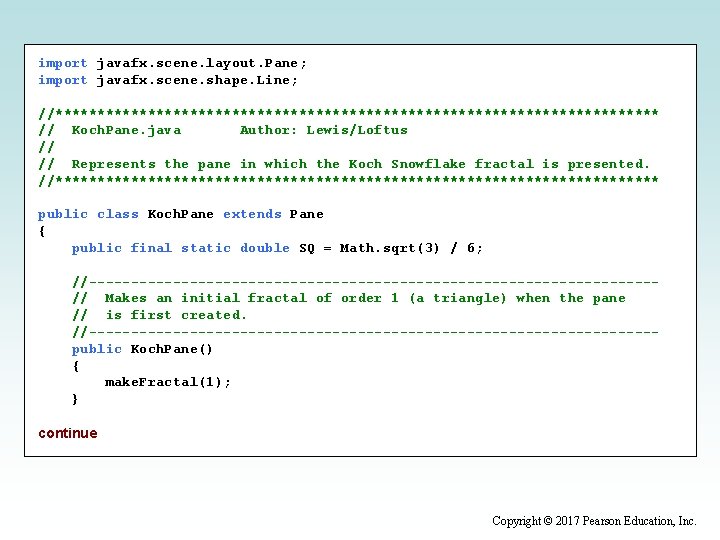
import javafx. scene. layout. Pane; import javafx. scene. shape. Line; //************************************ // Koch. Pane. java Author: Lewis/Loftus // // Represents the pane in which the Koch Snowflake fractal is presented. //************************************ public class Koch. Pane extends Pane { public final static double SQ = Math. sqrt(3) / 6; //----------------------------------// Makes an initial fractal of order 1 (a triangle) when the pane // is first created. //----------------------------------public Koch. Pane() { make. Fractal(1); } continue Copyright © 2017 Pearson Education, Inc.
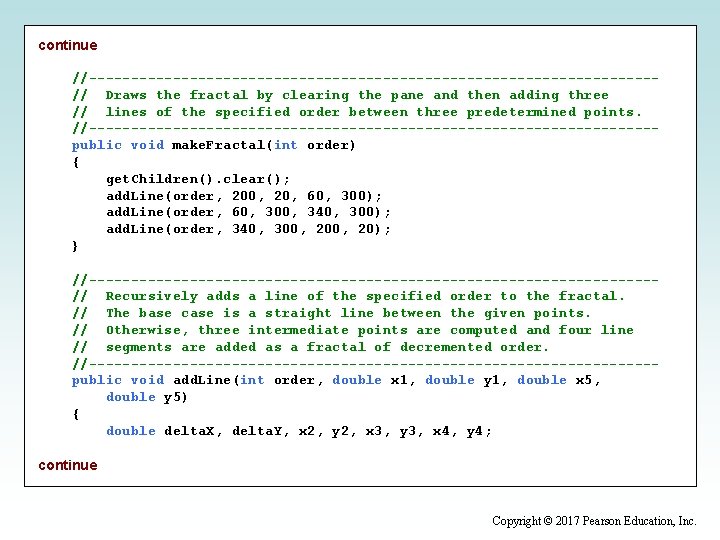
continue //----------------------------------// Draws the fractal by clearing the pane and then adding three // lines of the specified order between three predetermined points. //----------------------------------public void make. Fractal(int order) { get. Children(). clear(); add. Line(order, 200, 20, 60, 300); add. Line(order, 60, 300, 340, 300); add. Line(order, 340, 300, 20); } //----------------------------------// Recursively adds a line of the specified order to the fractal. // The base case is a straight line between the given points. // Otherwise, three intermediate points are computed and four line // segments are added as a fractal of decremented order. //----------------------------------public void add. Line(int order, double x 1, double y 1, double x 5, double y 5) { double delta. X, delta. Y, x 2, y 2, x 3, y 3, x 4, y 4; continue Copyright © 2017 Pearson Education, Inc.
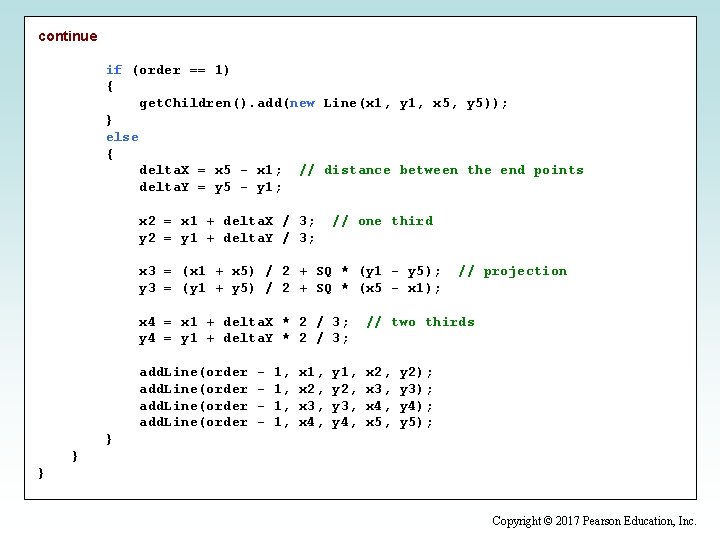
continue if (order == 1) { get. Children(). add(new Line(x 1, y 1, x 5, y 5)); } else { delta. X = x 5 - x 1; // distance between the end points delta. Y = y 5 - y 1; x 2 = x 1 + delta. X / 3; y 2 = y 1 + delta. Y / 3; // one third x 3 = (x 1 + x 5) / 2 + SQ * (y 1 - y 5); y 3 = (y 1 + y 5) / 2 + SQ * (x 5 - x 1); // projection x 4 = x 1 + delta. X * 2 / 3; y 4 = y 1 + delta. Y * 2 / 3; // two thirds add. Line(order x 2, x 3, x 4, x 5, - 1, 1, x 1, x 2, x 3, x 4, y 1, y 2, y 3, y 4, y 2); y 3); y 4); y 5); } } } Copyright © 2017 Pearson Education, Inc.
Summary • Chapter 12 has focused on: – – – thinking in a recursive manner programming in a recursive manner the correct use of recursion examples recursion in graphics fractals Copyright © 2017 Pearson Education, Inc.