
Chapter 12 Recursion Copyright 2009 Pearson Education Inc
- Slides: 25
Chapter 12 Recursion Copyright © 2009 Pearson Education, Inc. Publishing as Pearson Addison-Wesley
Recursion • Recursion is a fundamental programming technique that can provide an elegant solution certain kinds of problems • Chapter 12 focuses on: – – thinking in a recursive manner programming in a recursive manner the correct use of recursion examples Copyright © 2009 Pearson Education, Inc. Publishing as Pearson Addison-Wesley
Outline Recursive Thinking Recursive Programming Using Recursion Copyright © 2009 Pearson Education, Inc. Publishing as Pearson Addison-Wesley
Recursive Thinking • A recursive definition is one which uses the word or concept being defined in the definition itself • When defining an English word, a recursive definition is often not helpful • But in other situations, a recursive definition can be an appropriate way to express a concept • Before applying recursion to programming, it is best to practice thinking recursively Copyright © 2009 Pearson Education, Inc. Publishing as Pearson Addison-Wesley
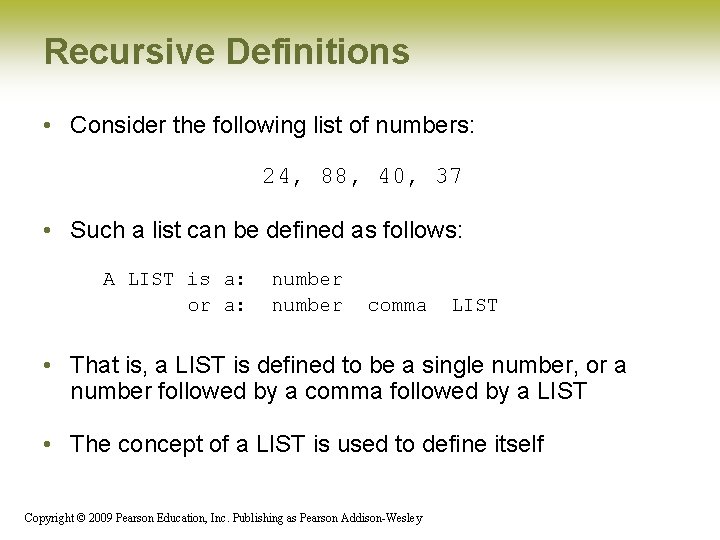
Recursive Definitions • Consider the following list of numbers: 24, 88, 40, 37 • Such a list can be defined as follows: A LIST is a: or a: number comma LIST • That is, a LIST is defined to be a single number, or a number followed by a comma followed by a LIST • The concept of a LIST is used to define itself Copyright © 2009 Pearson Education, Inc. Publishing as Pearson Addison-Wesley
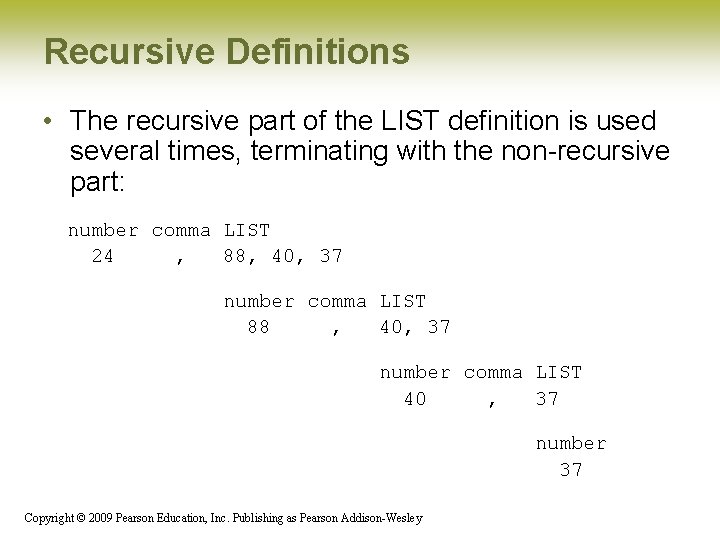
Recursive Definitions • The recursive part of the LIST definition is used several times, terminating with the non-recursive part: number comma LIST 24 , 88, 40, 37 number comma LIST 88 , 40, 37 number comma LIST 40 , 37 number 37 Copyright © 2009 Pearson Education, Inc. Publishing as Pearson Addison-Wesley
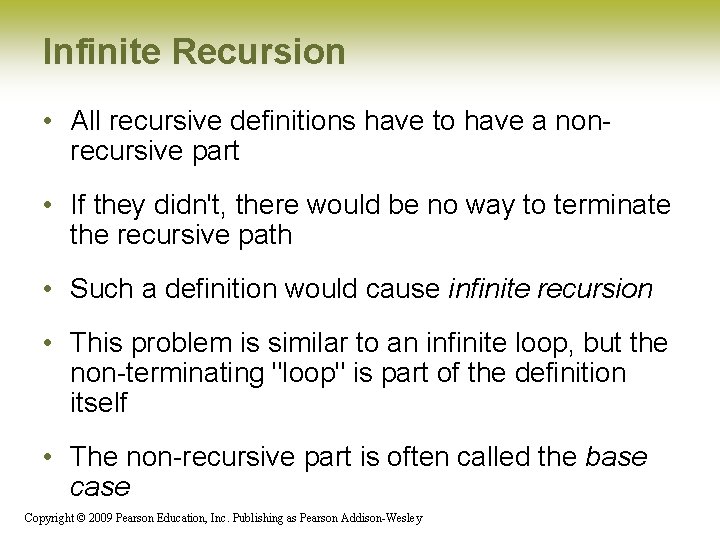
Infinite Recursion • All recursive definitions have to have a nonrecursive part • If they didn't, there would be no way to terminate the recursive path • Such a definition would cause infinite recursion • This problem is similar to an infinite loop, but the non-terminating "loop" is part of the definition itself • The non-recursive part is often called the base case Copyright © 2009 Pearson Education, Inc. Publishing as Pearson Addison-Wesley
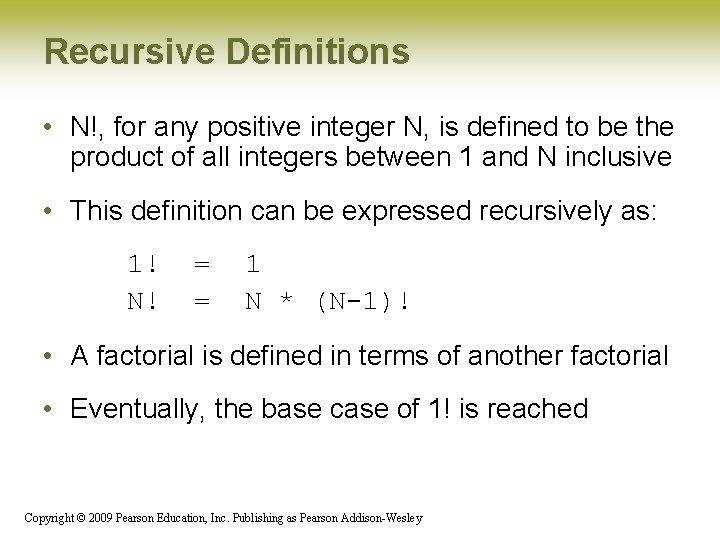
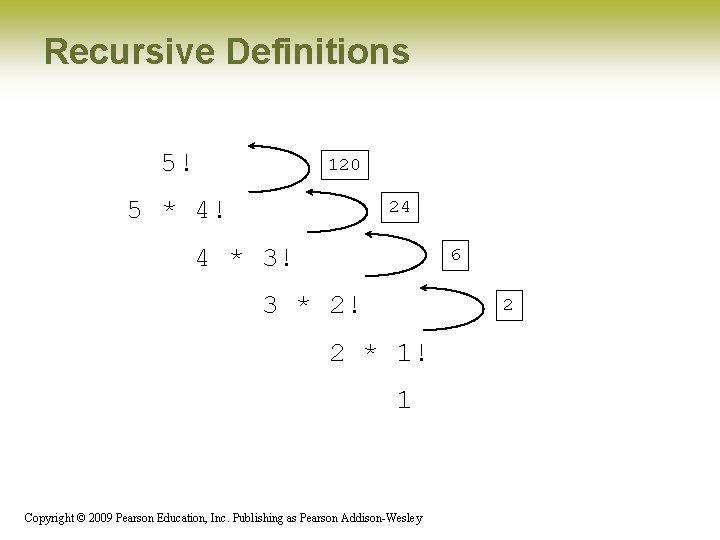
Recursive Definitions • N!, for any positive integer N, is defined to be the product of all integers between 1 and N inclusive • This definition can be expressed recursively as: 1! N! = = 1 N * (N-1)! • A factorial is defined in terms of another factorial • Eventually, the base case of 1! is reached Copyright © 2009 Pearson Education, Inc. Publishing as Pearson Addison-Wesley
Recursive Definitions 5! 120 5 * 4! 24 4 * 3! 6 3 * 2! 2 2 * 1! 1 Copyright © 2009 Pearson Education, Inc. Publishing as Pearson Addison-Wesley
Outline Recursive Thinking Recursive Programming Using Recursion Copyright © 2009 Pearson Education, Inc. Publishing as Pearson Addison-Wesley
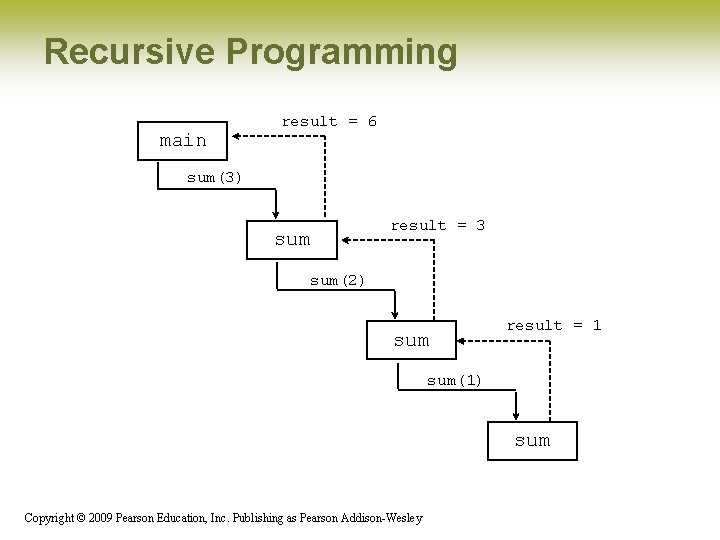
Recursive Programming • A method in Java can invoke itself; if set up that way, it is called a recursive method • The code of a recursive method must be structured to handle both the base case and the recursive case • Each call to the method sets up a new execution environment, with new parameters and local variables • As with any method call, when the method completes, control returns to the method that invoked it (which may be an earlier invocation of itself) Copyright © 2009 Pearson Education, Inc. Publishing as Pearson Addison-Wesley
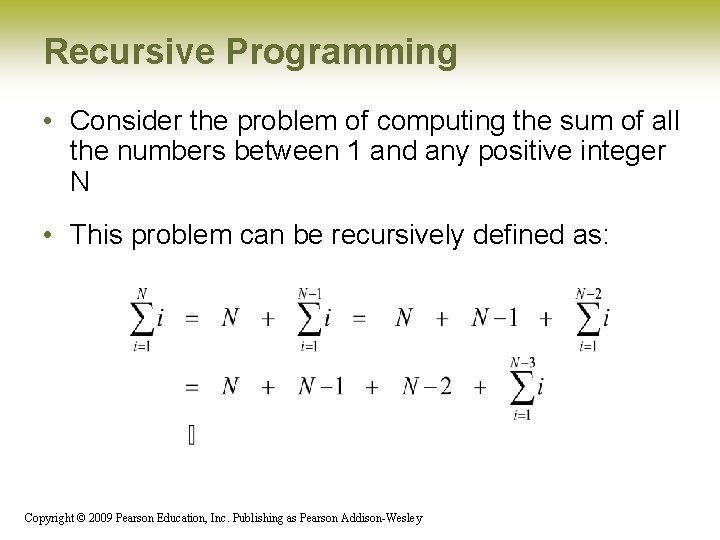
Recursive Programming • Consider the problem of computing the sum of all the numbers between 1 and any positive integer N • This problem can be recursively defined as: Copyright © 2009 Pearson Education, Inc. Publishing as Pearson Addison-Wesley
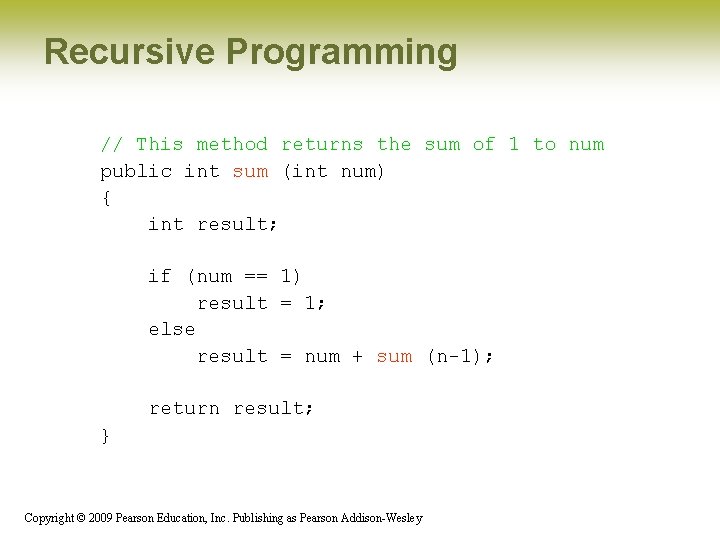
Recursive Programming // This method returns the sum of 1 to num public int sum (int num) { int result; if (num == 1) result = 1; else result = num + sum (n-1); return result; } Copyright © 2009 Pearson Education, Inc. Publishing as Pearson Addison-Wesley
Recursive Programming main result = 6 sum(3) sum result = 3 sum(2) sum result = 1 sum(1) sum Copyright © 2009 Pearson Education, Inc. Publishing as Pearson Addison-Wesley
Recursive Programming • Note that just because we can use recursion to solve a problem, doesn't mean we should • For instance, we usually would not use recursion to solve the sum of 1 to N problem, because the iterative version is easier to understand • However, for some problems, recursion provides an elegant solution, often cleaner than an iterative version • You must carefully decide whether recursion is the correct technique for any problem Copyright © 2009 Pearson Education, Inc. Publishing as Pearson Addison-Wesley
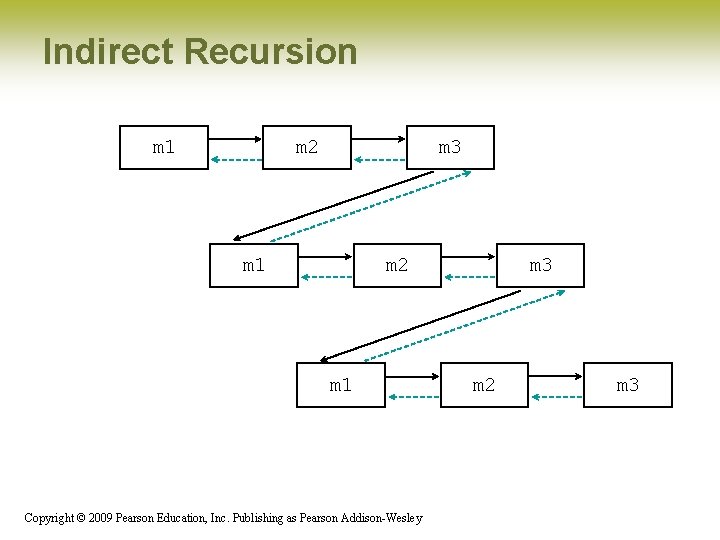
Indirect Recursion • A method invoking itself is considered to be direct recursion • A method could invoke another method, which invokes another, etc. , until eventually the original method is invoked again • For example, method m 1 could invoke m 2, which invokes m 3, which in turn invokes m 1 again • This is called indirect recursion, and requires all the same care as direct recursion • It is often more difficult to trace and debug Copyright © 2009 Pearson Education, Inc. Publishing as Pearson Addison-Wesley
Indirect Recursion m 1 m 2 m 3 m 1 m 2 m 1 Copyright © 2009 Pearson Education, Inc. Publishing as Pearson Addison-Wesley m 3 m 2 m 3
Outline Recursive Thinking Recursive Programming Using Recursion Copyright © 2009 Pearson Education, Inc. Publishing as Pearson Addison-Wesley
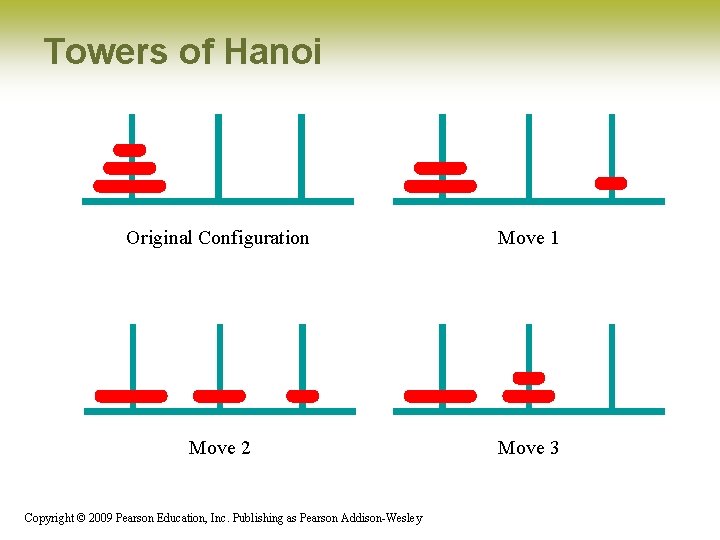
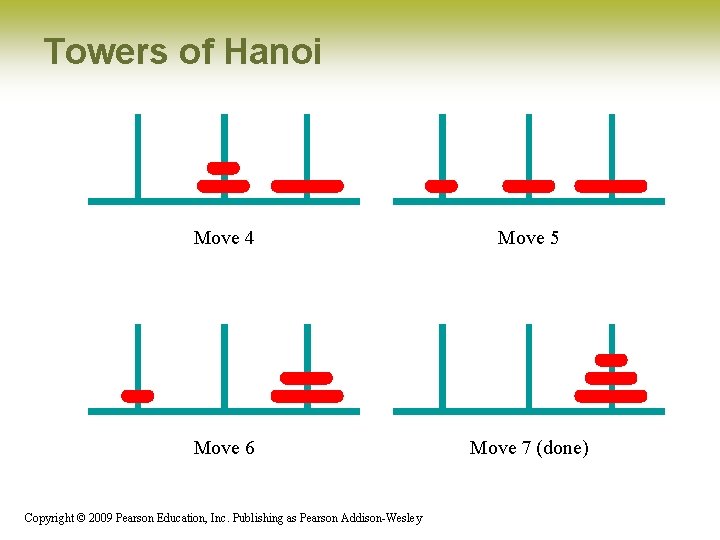
Towers of Hanoi • The Towers of Hanoi is a puzzle made up of three vertical pegs and several disks that slide on the pegs • The disks are of varying size, initially placed on one peg with the largest disk on the bottom with increasingly smaller ones on top • The goal is to move all of the disks from one peg to another under the following rules: – We can move only one disk at a time – We cannot move a larger disk on top of a smaller one Copyright © 2009 Pearson Education, Inc. Publishing as Pearson Addison-Wesley
Towers of Hanoi Original Configuration Move 1 Move 2 Move 3 Copyright © 2009 Pearson Education, Inc. Publishing as Pearson Addison-Wesley
Towers of Hanoi Move 4 Move 5 Move 6 Move 7 (done) Copyright © 2009 Pearson Education, Inc. Publishing as Pearson Addison-Wesley
Towers of Hanoi • An iterative solution to the Towers of Hanoi is quite complex • A recursive solution is much shorter and more elegant • See Solve. Towers. java • See Towers. Of. Hanoi. java Copyright © 2009 Pearson Education, Inc. Publishing as Pearson Addison-Wesley
Maze Traversal • We can use recursion to find a path through a maze • From each location, we can search in each direction • Recursion keeps track of the path through the maze • The base case is an invalid move or reaching the final destination • See Maze. Search. java • See Maze. java Copyright © 2009 Pearson Education, Inc. Publishing as Pearson Addison-Wesley
Exercises • EX 11. 3 Write a recursive definition of i*j( integer multiplication), where i>0. Define the multiplication process in terms of integer addition, for example, 4*7 is equal to 7 added to itself 4 times. If i=0 , i*j=j If i>0, i*j=j+((i-1)*j) Copyright © 2009 Pearson Education, Inc. Publishing as Pearson Addison-Wesley
Exercises • EX 11. 6 Write a recursive method that returns the value of N!(N factorial) using the definition given in this chapter, Explain why you would not normally use recursion to solve this problem. Copyright © 2009 Pearson Education, Inc. Publishing as Pearson Addison-Wesley