
Chapter 12 Reconstitution of Solutions Copyright 2016 Cengage









- Slides: 44
Chapter 12 Reconstitution of Solutions Copyright © 2016 Cengage Learning. ALL RIGHTS RESERVED.
Reconstitution • Process of mixing and diluting solutions is referred to as reconstitution • Some medications supplied in powder form and must be mixed with liquid before administration Copyright © 2016 Cengage Learning. ALL RIGHTS RESERVED.
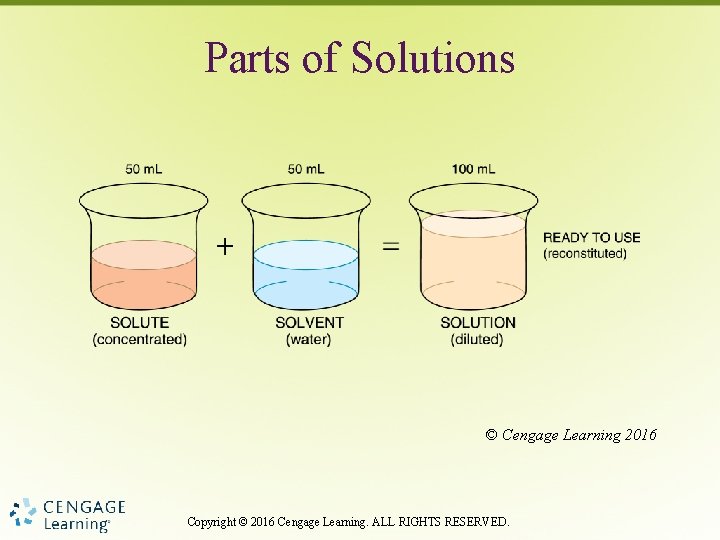
Parts of Solutions © Cengage Learning 2016 Copyright © 2016 Cengage Learning. ALL RIGHTS RESERVED.
Terms Need to know! • Solute – Substance to be dissolved or diluted – Can be either solid or liquid • Solvent – Substance (liquid) that dissolves another substance to prepare solution – Often referred to as diluent • Solution – Resulting mixture of solute plus solvent Copyright © 2016 Cengage Learning. ALL RIGHTS RESERVED.
Rules • When reconstituting injectable medications, must determine both type and amount of diluent to be used – Sterile water and 0. 9 percent Na. Cl commonly used – Some drugs supplied with special diluent Copyright © 2016 Cengage Learning. ALL RIGHTS RESERVED.
Rules • When reconstituting injectable medications: – Determine volume in m. L of diluent to be used – Check that route noted on drug label matches route ordered (IM vs. IV) – Reconstitute drug and note resulting supply dosage on vial* – Note if single-dose or multiple-dose vial Copyright © 2016 Cengage Learning. ALL RIGHTS RESERVED.
Reconstituted Parenteral Solutions • Two types: 1. Single strength – simplest type to dilute 2. Multiple strength – several directions for dilution Copyright © 2016 Cengage Learning. ALL RIGHTS RESERVED.
Reconstituting Parenteral Solutions: Single Strength • Order: Zithromax 400 mg IV daily for 2 days • Available: Zithromax 500 mg vial for IV infusion – Drug is in powder form with directions on label that state, “Constitute to 100 mg/m. L with 4. 8 m. L of Sterile Water for Injection” Copyright © 2016 Cengage Learning. ALL RIGHTS RESERVED.
1. How much and what type of diluent is needed? 2. What is the dosage concentration after reconstitution? Copyright © 2016 Cengage Learning. ALL RIGHTS RESERVED.
Reconstituting Parenteral Solutions: Single Strength • Procedure: 1. How much and what type of diluent is needed? • 4. 8 m. L of sterile water 2. What is the dosage concentration after reconstitution? • 100 mg per m. L Copyright © 2016 Cengage Learning. ALL RIGHTS RESERVED.
Reconstituting Parenteral Solutions: Single Strength • Procedure: 3. What is the total volume after reconstitution? • 5 m. L 4. Given the ordered dose, how many doses are available in the vial? • One Copyright © 2016 Cengage Learning. ALL RIGHTS RESERVED.
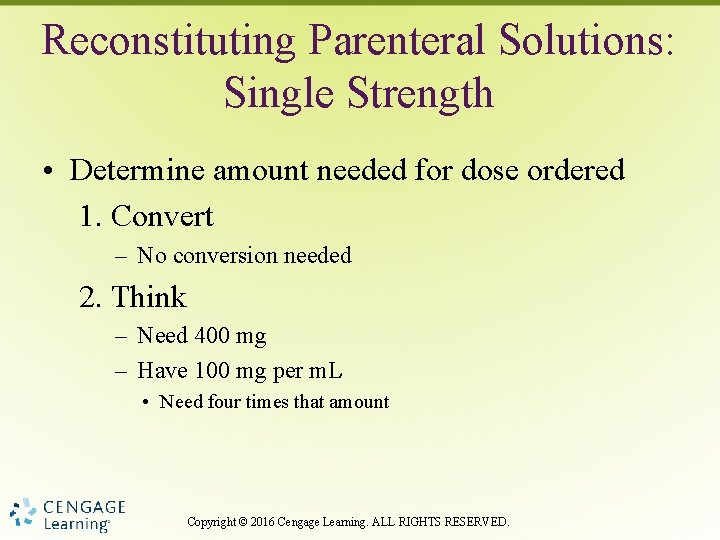
Reconstituting Parenteral Solutions: Single Strength • Determine amount needed for dose ordered 1. Convert – No conversion needed 2. Think – Need 400 mg – Have 100 mg per m. L • Need four times that amount Copyright © 2016 Cengage Learning. ALL RIGHTS RESERVED.
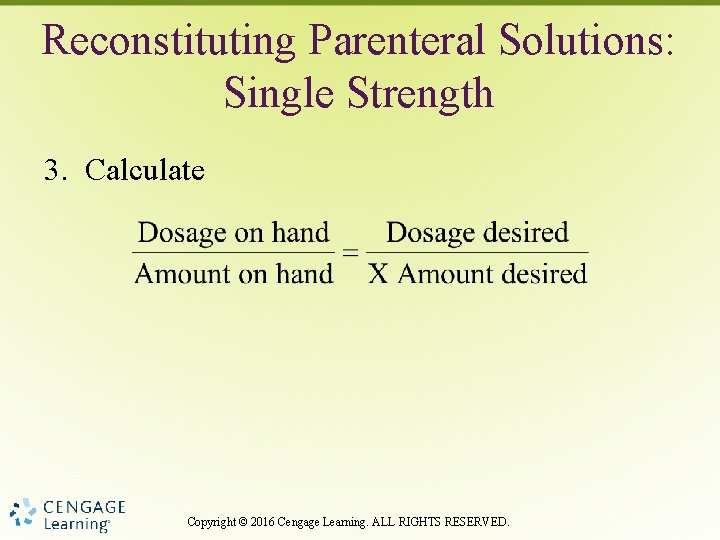
Reconstituting Parenteral Solutions: Single Strength 3. Calculate Copyright © 2016 Cengage Learning. ALL RIGHTS RESERVED.
Reconstituting Parenteral Solutions: Single Strength 3. Calculate Cross-multiply Simplify Copyright © 2016 Cengage Learning. ALL RIGHTS RESERVED.
Reconstituting Parenteral Solutions: Single Strength • To reconstitute Zithromax: – Choose 5 m. L syringe – Put 4. 8 m. L of air in bottle of diluent • Sterile water for injection – Withdraw 4. 8 m. L of sterile water – Add 4. 8 m. L of sterile water to Zithromax powder and shake well Copyright © 2016 Cengage Learning. ALL RIGHTS RESERVED.
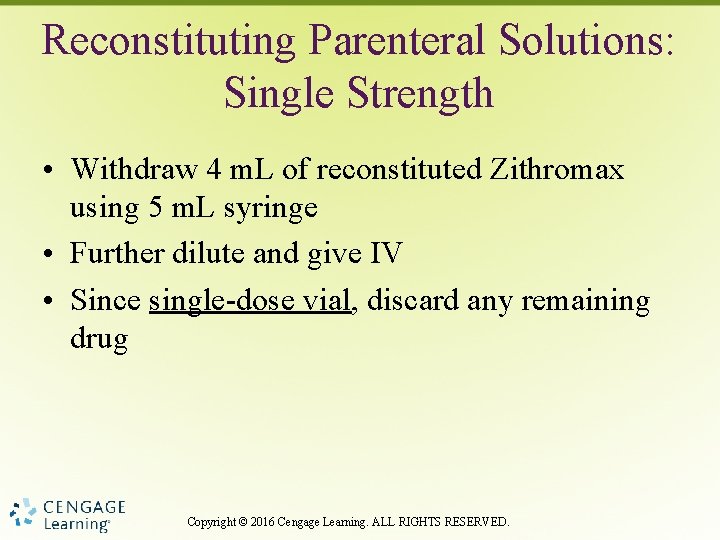
Reconstituting Parenteral Solutions: Single Strength • Withdraw 4 m. L of reconstituted Zithromax using 5 m. L syringe • Further dilute and give IV • Since single-dose vial, discard any remaining drug Copyright © 2016 Cengage Learning. ALL RIGHTS RESERVED.
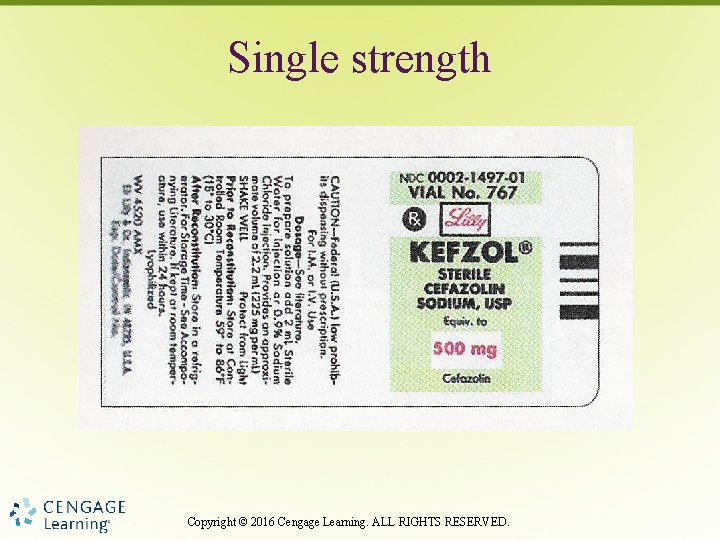
Single strength Copyright © 2016 Cengage Learning. ALL RIGHTS RESERVED.
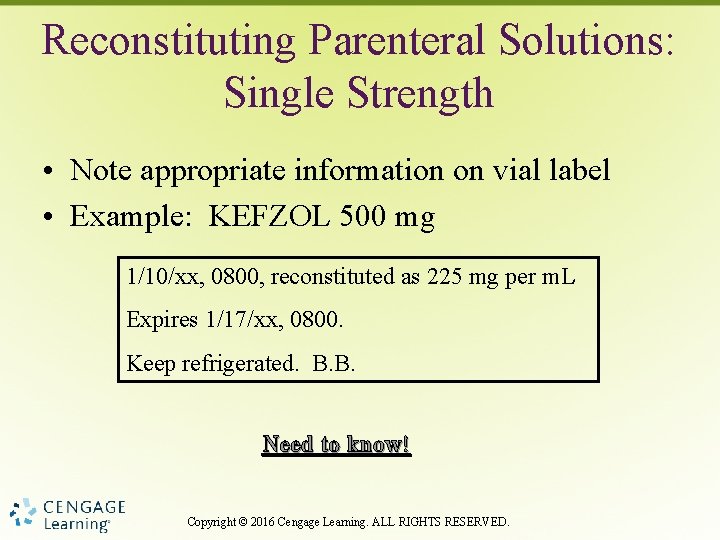
Reconstituting Parenteral Solutions: Single Strength • Note appropriate information on vial label • Example: KEFZOL 500 mg 1/10/xx, 0800, reconstituted as 225 mg per m. L Expires 1/17/xx, 0800. Keep refrigerated. B. B. Need to know! Copyright © 2016 Cengage Learning. ALL RIGHTS RESERVED.
Reconstituting Parenteral Solutions: Multiple Strength • Some parenteral powdered medications have directions for preparing several different solution strengths – E. g. , Penicillin G potassium 1, 000 units vial Copyright © 2016 Cengage Learning. ALL RIGHTS RESERVED.
Multiple strength solution Copyright © 2016 Cengage Learning. ALL RIGHTS RESERVED.
Reconstituting Parenteral Solutions: Multiple Strength • Reconstitution instructions note four different solution concentrations as determined by amount of diluent added m. L Diluent Units per m. L 20 m. L 50, 000 10 m. L 100, 000 4 m. L 250, 000 1. 8 m. L 500, 000 • Copyright © 2016 Cengage Learning. ALL RIGHTS RESERVED.
Reconstituting Parenteral Solutions: Multiple Strength • Order: Penicillin G potassium 300, 000 units IM every 6 h for adult patient • Available: Penicillin G potassium 1, 000 unit vial • Given the reconstitution concentrations on the previous slide, which should you use when preparing to administer the ordered dose? Copyright © 2016 Cengage Learning. ALL RIGHTS RESERVED.
Reconstituting Parenteral Solutions: Multiple Strength • Consider: – Dose ordered – Patient receiving dose Copyright © 2016 Cengage Learning. ALL RIGHTS RESERVED.
Reconstituting Parenteral Solutions: Multiple Strength • Consider: – Volume and concentration that results with each noted diluent volume • Smaller the amount of diluent added, stronger the resulting solution concentration • Consider maximum recommended volumes for injection by patient and parenteral route Copyright © 2016 Cengage Learning. ALL RIGHTS RESERVED.
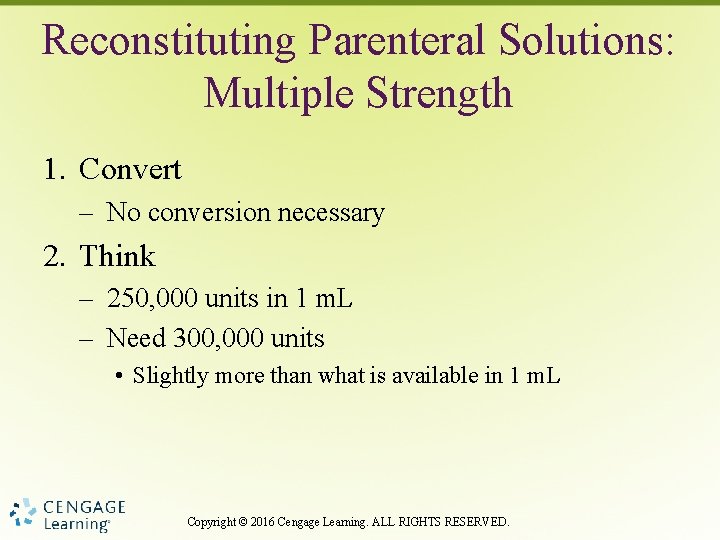
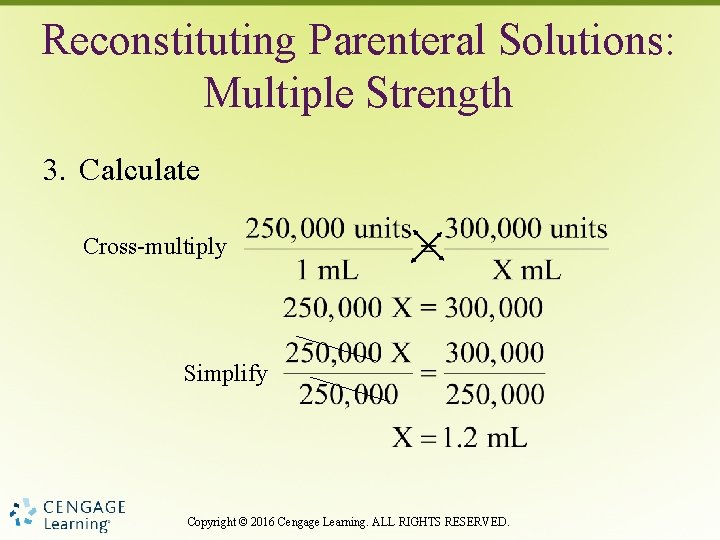
Reconstituting Parenteral Solutions: Multiple Strength • Considering previously mentioned factors, adding 4 m. L of diluent results is reasonable volume and medication concentration – Results in concentration of 250, 000 units per m. L – How many m. L are needed to deliver ordered dose of 300, 000 units? Copyright © 2016 Cengage Learning. ALL RIGHTS RESERVED.
Reconstituting Parenteral Solutions: Multiple Strength 1. Convert – No conversion necessary 2. Think – 250, 000 units in 1 m. L – Need 300, 000 units • Slightly more than what is available in 1 m. L Copyright © 2016 Cengage Learning. ALL RIGHTS RESERVED.
Reconstituting Parenteral Solutions: Multiple Strength 3. Calculate Cross-multiply Simplify Copyright © 2016 Cengage Learning. ALL RIGHTS RESERVED.
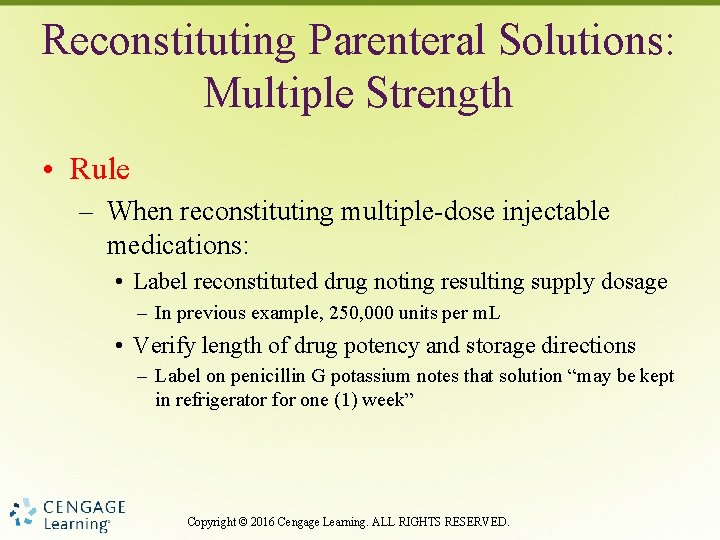
Reconstituting Parenteral Solutions: Multiple Strength • Rule – When reconstituting multiple-dose injectable medications: • Label reconstituted drug noting resulting supply dosage – In previous example, 250, 000 units per m. L • Verify length of drug potency and storage directions – Label on penicillin G potassium notes that solution “may be kept in refrigerator for one (1) week” Copyright © 2016 Cengage Learning. ALL RIGHTS RESERVED.
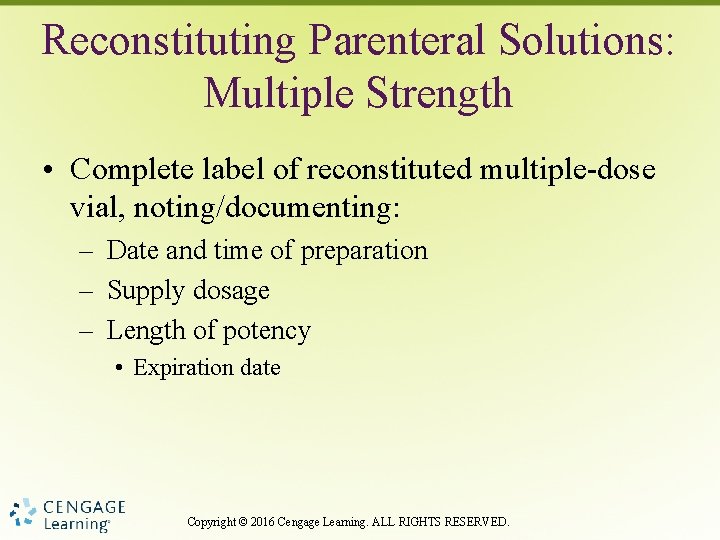
Reconstituting Parenteral Solutions: Multiple Strength • Complete label of reconstituted multiple-dose vial, noting/documenting: – Date and time of preparation – Supply dosage – Length of potency • Expiration date Copyright © 2016 Cengage Learning. ALL RIGHTS RESERVED.
Reconstituting Parenteral Solutions: Multiple Strength • Complete label of reconstituted multiple-dose vial, noting: – Storage directions – Own initials Note: When multiple directions for diluting are given, the smaller the amount of diluent added, the greater or stronger the resulting solution concentration will be. Copyright © 2016 Cengage Learning. ALL RIGHTS RESERVED.
Different IM and IV Reconstitution Instructions Remember: • Reconstitution instructions can differ in amount and/or type of diluent based on administration route • Must carefully check route ordered and related reconstitution directions on label or insert Copyright © 2016 Cengage Learning. ALL RIGHTS RESERVED.
Reconstitution of Non-Injectable Solutions • Examples: – Nutritional formulas – Irrigating solutions • Usually need to dilute liquid concentrate to weaker solution Copyright © 2016 Cengage Learning. ALL RIGHTS RESERVED.
Solution Concentration Important Concept! • Amount of solvent used determines final solution concentration or strength • Fraction expresses strength of solution made from liquid concentrate Copyright © 2016 Cengage Learning. ALL RIGHTS RESERVED.
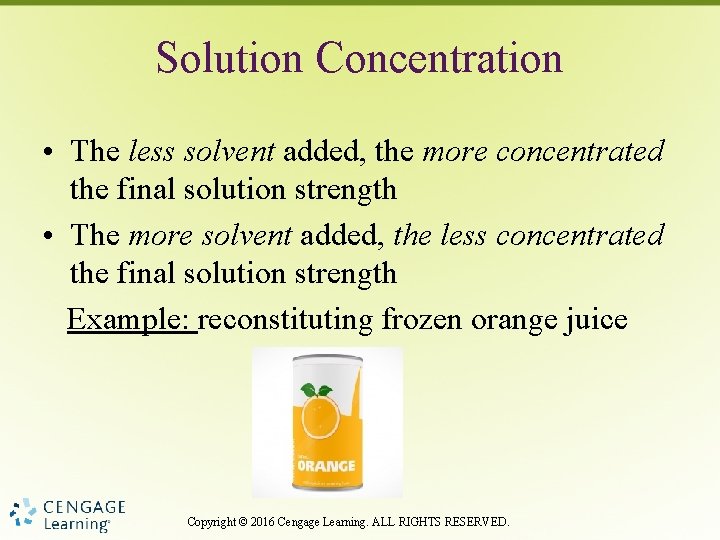
Solution Concentration • The less solvent added, the more concentrated the final solution strength • The more solvent added, the less concentrated the final solution strength Example: reconstituting frozen orange juice Copyright © 2016 Cengage Learning. ALL RIGHTS RESERVED.
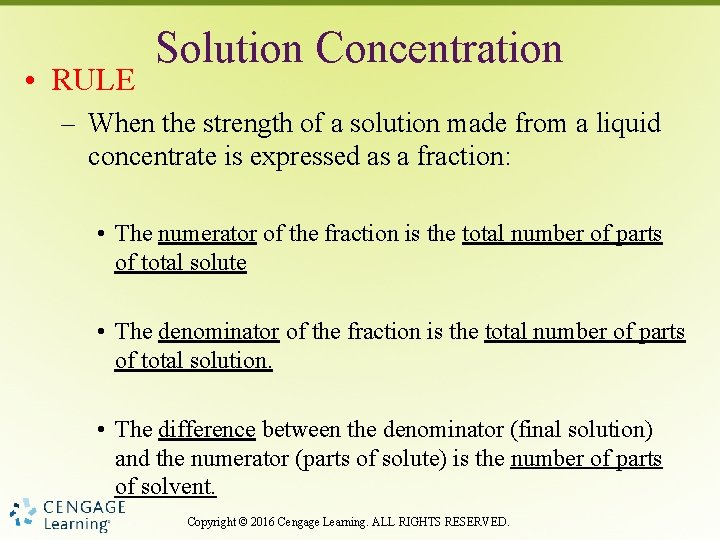
• RULE Solution Concentration – When the strength of a solution made from a liquid concentrate is expressed as a fraction: • The numerator of the fraction is the total number of parts of total solute • The denominator of the fraction is the total number of parts of total solution. • The difference between the denominator (final solution) and the numerator (parts of solute) is the number of parts of solvent. Copyright © 2016 Cengage Learning. ALL RIGHTS RESERVED.
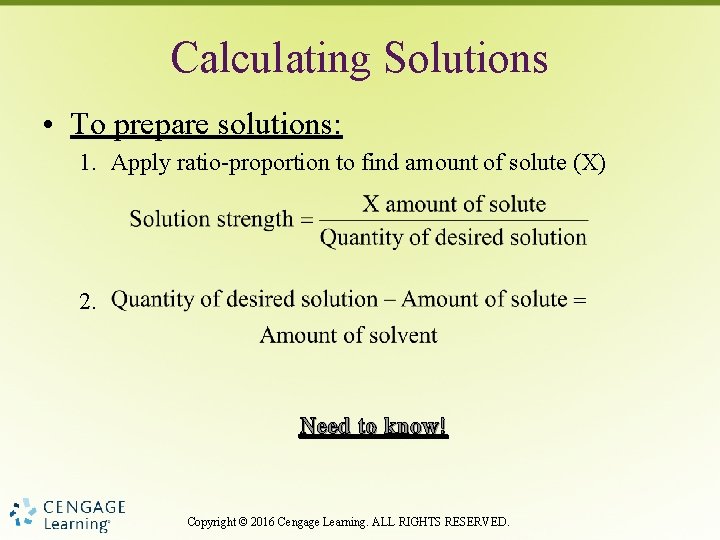
Calculating Solutions • To prepare solutions: 1. Apply ratio-proportion to find amount of solute (X) 2. Need to know! Copyright © 2016 Cengage Learning. ALL RIGHTS RESERVED.
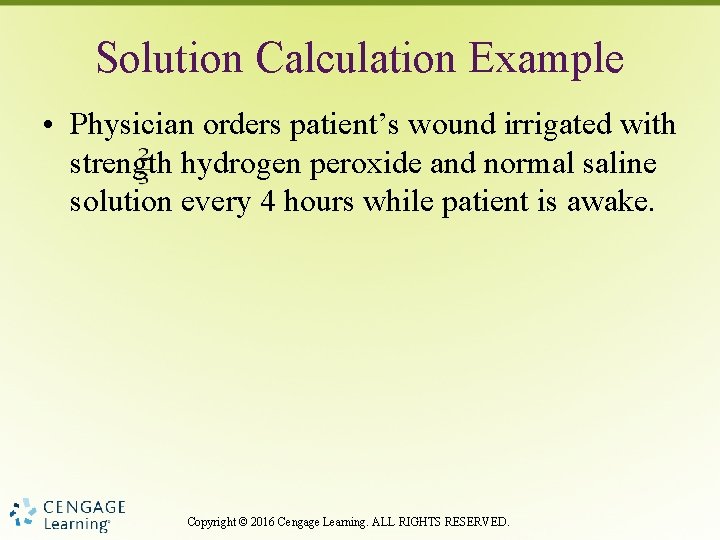
Solution Calculation Example • Physician orders patient’s wound irrigated with strength hydrogen peroxide and normal saline solution every 4 hours while patient is awake. Copyright © 2016 Cengage Learning. ALL RIGHTS RESERVED.
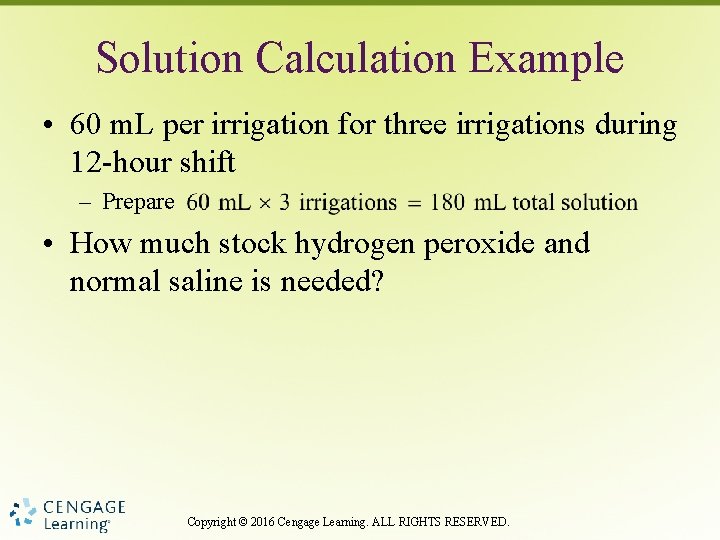
Solution Calculation Example • 60 m. L per irrigation for three irrigations during 12 -hour shift – Prepare • How much stock hydrogen peroxide and normal saline is needed? Copyright © 2016 Cengage Learning. ALL RIGHTS RESERVED.
Solution Calculation Example 1. Convert – No conversion necessary Copyright © 2016 Cengage Learning. ALL RIGHTS RESERVED.
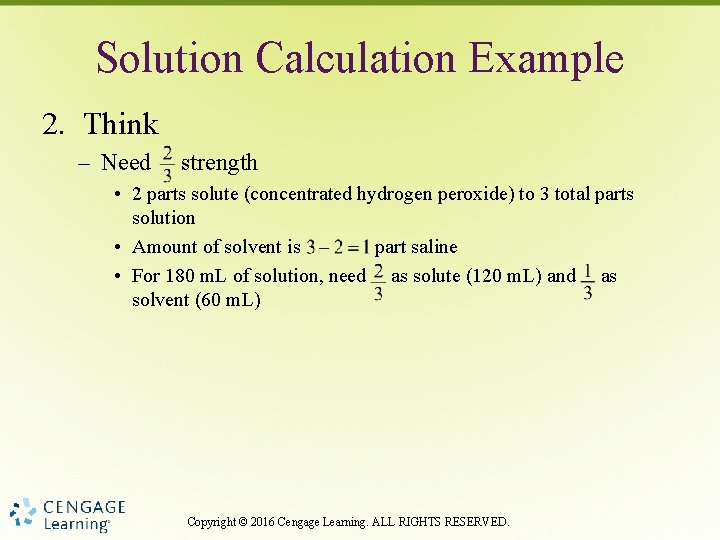
Solution Calculation Example 2. Think – Need strength • 2 parts solute (concentrated hydrogen peroxide) to 3 total parts solution • Amount of solvent is part saline • For 180 m. L of solution, need as solute (120 m. L) and as solvent (60 m. L) Copyright © 2016 Cengage Learning. ALL RIGHTS RESERVED.
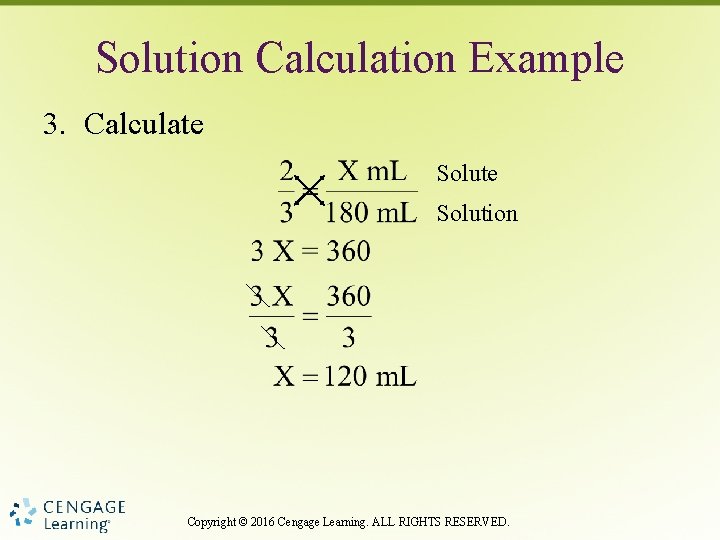
Solution Calculation Example 3. Calculate Solution Copyright © 2016 Cengage Learning. ALL RIGHTS RESERVED.
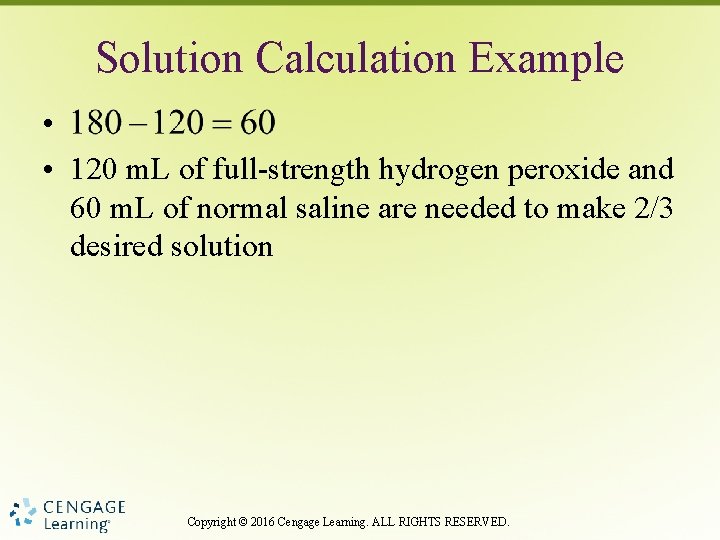
Solution Calculation Example • • 120 m. L of full-strength hydrogen peroxide and 60 m. L of normal saline are needed to make 2/3 desired solution Copyright © 2016 Cengage Learning. ALL RIGHTS RESERVED.
Diluting Ready-to-Use Nutritional Liquids • Oral and enteral feedings • MD will order specific strength • Use same formula for calculation Copyright © 2016 Cengage Learning. ALL RIGHTS RESERVED.
Practice Copyright © 2016 Cengage Learning. ALL RIGHTS RESERVED.