
Chapter 12 Reading Research Reference and Collateral Assignments

- Slides: 17
Chapter 12: Reading Research, Reference, and Collateral Assignments Academic Reading, Fifth Edition by Kathleen T. Mc. Whorter © 2004 Pearson Education, Inc. , publishing as Longman Publishers
Learning Objectives: ® To learn a systematic approach for reading research materials ® To develop alternative reading strategies ® To learn note taking ® To develop skills for reading collateral reading assignments ® To learn to evaluate sources ® To learn to synthesize and compare sources © 2004 Pearson Education, Inc. , publishing as Longman Publishers
Reading Research Materials ® Define and Focus Your Topic Consult with your reference librarian. ® Read an encyclopedia entry on your topic. ® Check the Reader’s Guide to Periodical Literature for topic listings. ® Check the on-line card catalog ® Consult your instructor. ® ® Devise a Search Strategy ® Preview Sources ® Define Your Purpose for Reading © 2004 Pearson Education, Inc. , publishing as Longman Publishers
Alternative Reading Strategies ® Skimming - a rapid reading technique that enables you quickly to obtain main ideas only. ® Scanning - a process of searching for a specific piece of information. © 2004 Pearson Education, Inc. , publishing as Longman Publishers
How to Skim ® Read the title. ® Read the subtitle or introductory byline. ® Read the introductory paragraph. ® Read the headings. ® Read the first sentence of each paragraph. © 2004 Pearson Education, Inc. , publishing as Longman Publishers
How to Skim ® Read the remainder of the paragraph ® Read the title or legend of any maps, graphs, charts, or diagrams. ® Read the last paragraph (conclusion or summary). © 2004 Pearson Education, Inc. , publishing as Longman Publishers
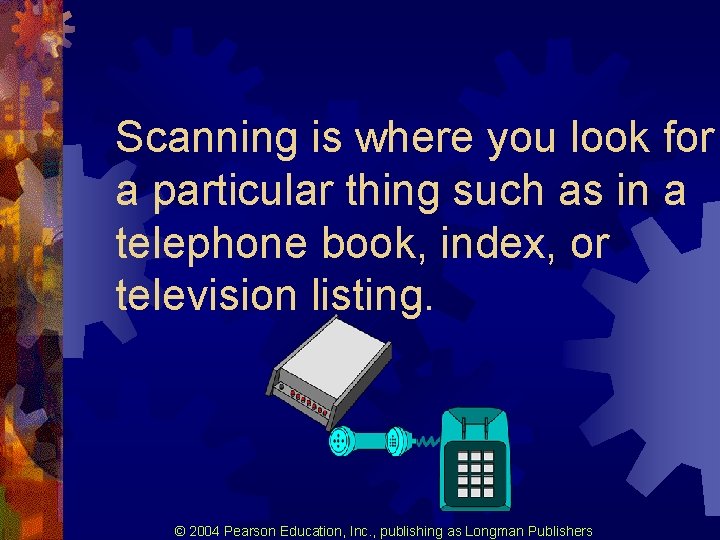
Scanning is where you look for a particular thing such as in a telephone book, index, or television listing. © 2004 Pearson Education, Inc. , publishing as Longman Publishers
How to Scan ® Know Your Purpose ® Check the Organization ® Anticipate Clue Words ® Identify Probable Answer Locations ® Use a Systematic Pattern ® Confirm Your Answer View Figure 12 -1 in your book for scanning pattern © 2004 Pearson Education, Inc. , publishing as Longman Publishers
Scanning Lists and Tables ® Become familiar with how the writer has arranged the information. ® Scan for a specific word, phrase, name, date, or place name, and it may not be necessary to guess at the form of your answer. © 2004 Pearson Education, Inc. , publishing as Longman Publishers
Scanning Prose Materials ® Rely on identifying clue words and predicting the form of your answer. ® Then let your eyes float through a passage searching for clue words and phrases. © 2004 Pearson Education, Inc. , publishing as Longman Publishers
Documentation and Note Taking ® Documentation format includes title, author, publisher, place, date, and pages referred to. ® Make sure you have the correct documentation form requested by your instructor. ® MLA ® APA © 2004 Pearson Education, Inc. , publishing as Longman Publishers
Documentation and Note Taking ® Note-Taking Cards ® Use 5 x 8 or 4 x 6 index cards. ® See Figure 12 -4 for examples. ® Record the information in your own words to avoid plagiarism. © 2004 Pearson Education, Inc. , publishing as Longman Publishers
Reading Collateral Assignments ® Analyze the assignment. ® Choose Your Reading and Study Strategies (See Table 12 -3) ® Use Nonprint Collateral Assignments (videos, films, lectures, television documentaries) Sample assignments include other textbooks, paperba newspapers, magazines, journals, and reference book © 2004 Pearson Education, Inc. , publishing as Longman Publishers
Evaluating Sources ® Assess the authority of the author. ® Check the copyright date. ® Evaluate the fulfillment of the work’s purpose. ® Assess the intended audience. © 2004 Pearson Education, Inc. , publishing as Longman Publishers
Evaluating Sources ® Verify one source against another. ® Look for a consensus of opinion. ® Evaluate statistics carefully. ® Consider whether the article is fact or opinion. (See Chapter 4) © 2004 Pearson Education, Inc. , publishing as Longman Publishers
Summary Questions ® What are the steps in reading research sources? ® What is skimming? ® What is scanning? ® How do you read and study collateral reading assignments? © 2004 Pearson Education, Inc. , publishing as Longman Publishers
Read the English and music selections and complete the activities following the article. “Lessons in the School of Cut and Paste” by Katie Hafner “Bolton Loses Court Fight with Isleys” by Frank Saxe © 2004 Pearson Education, Inc. , publishing as Longman Publishers