
Chapter 12 Probation Parole and Intermediate Sanctions 2015
Chapter 12 Probation, Parole, and Intermediate Sanctions © 2015 Cengage Learning
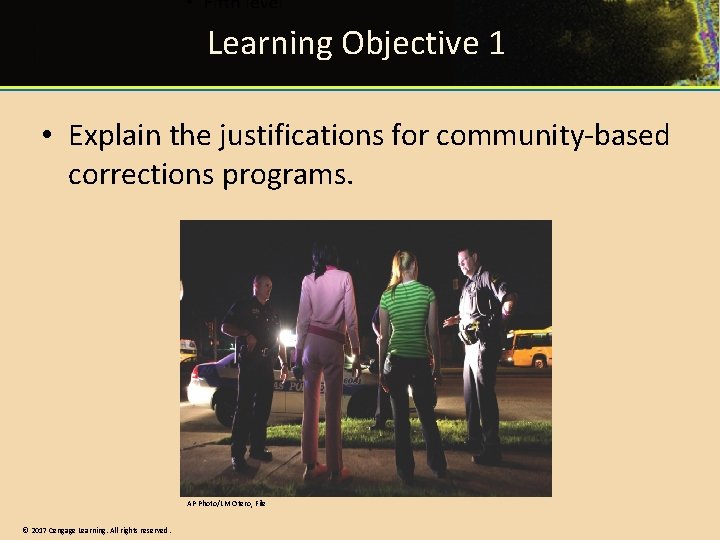
Learning Objective 1 • Explain the justifications for community-based corrections programs. AP Photo/LM Otero, File © 2017 Cengage Learning. All rights reserved.
The Justification for Community Corrections • Reintegration – Preparing offenders to return to the community with incentives to follow the rules of society • Diversion – Diverting those who qualify away from prison and jail and toward community-based corrections and intermediate sanctions • The “low-cost alternative” – The lack of funds is a strong motivator for recent expansion of community-based corrections. © 2017 Cengage Learning. All rights reserved.
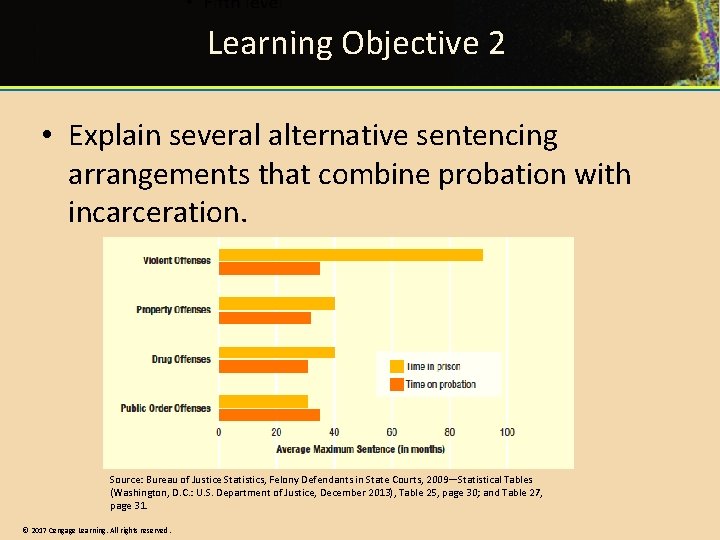
Learning Objective 2 • Explain several alternative sentencing arrangements that combine probation with incarceration. Source: Bureau of Justice Statistics, Felony Defendants in State Courts, 2009—Statistical Tables (Washington, D. C. : U. S. Department of Justice, December 2013), Table 25, page 30; and Table 27, page 31. © 2017 Cengage Learning. All rights reserved.
Probation: Doing Time in the Community • Sentencing and probation: – Probation is a criminal sanction in which a convict is allowed to remain in the community rather than be imprisoned, as long as she or he follows certain conditions set by the court – Suspended sentences—defendant is not required to serve the sentence – Alternative sentencing choices • Split sentences: e. g. , shock probation; jail time and probation • Shock incarceration: jail time, but must petition for probation • Intermittent incarceration: work in a jail, workhouse, or government facility on weekends © 2017 Cengage Learning. All rights reserved.
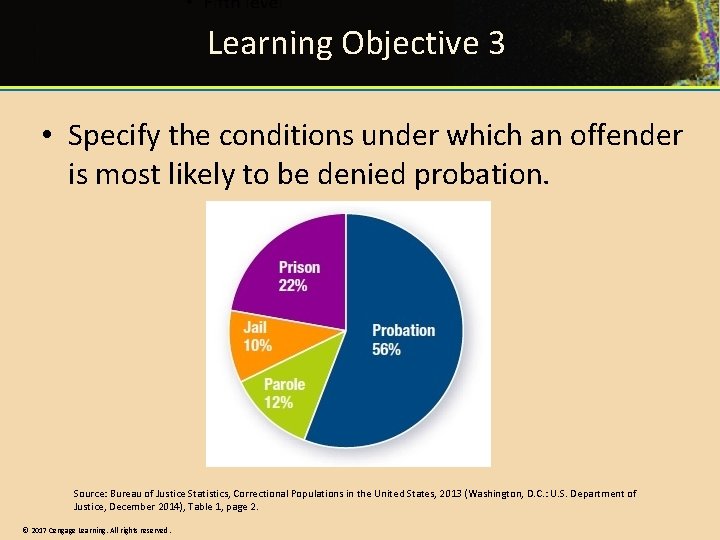
Learning Objective 3 • Specify the conditions under which an offender is most likely to be denied probation. Source: Bureau of Justice Statistics, Correctional Populations in the United States, 2013 (Washington, D. C. : U. S. Department of Justice, December 2014), Table 1, page 2. © 2017 Cengage Learning. All rights reserved.
Probation: Doing Time in the Community • Offenders are most likely denied probation if they: – Are convicted on multiple charges – Were on probation or parole at the time of arrest – Have two or more prior convictions – Are addicted to narcotics – Seriously injured the victim of the crime – Used a weapon in the commission of the crime © 2017 Cengage Learning. All rights reserved.
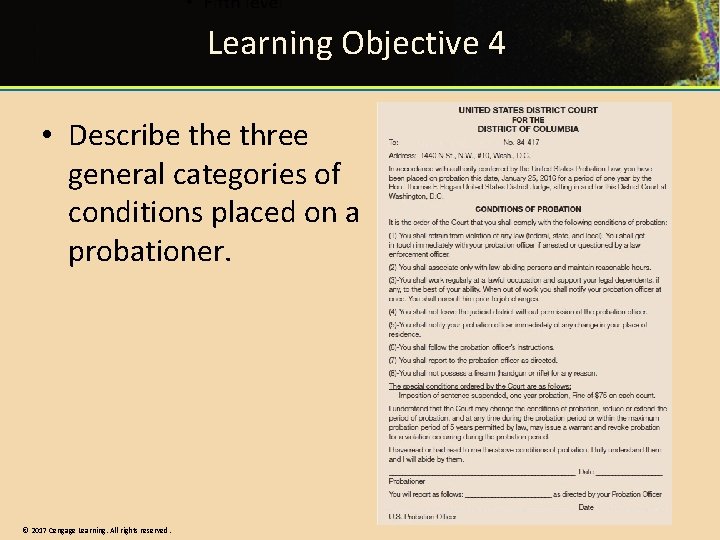
Learning Objective 4 • Describe three general categories of conditions placed on a probationer. © 2017 Cengage Learning. All rights reserved.
Probation: Doing Time in the Community • Conditions of probation: – Standard conditions • Imposed on all probationers – Punitive conditions • Designed to reflect the seriousness of the offense and increase punishment – Treatment conditions • Designed to help the offender with issues that may contribute to criminal activity – Failure to comply may result in revocation © 2017 Cengage Learning. All rights reserved.
Probation: Doing Time in the Community • The role of the probation officer: – Conducting the presentence investigation (investigative officers) – Supervising offenders (line officers) • Centralized versus decentralized probation services • The ideal relationship between probationer and probation officer is based on trust. – In the absence of trust, this relationship is based on authority. © 2017 Cengage Learning. All rights reserved.
Probation: Doing Time in the Community • Revocation of probation: – Probation ends in one of two ways. • The probationer successfully fulfills the conditions of the sentence. • Probationer misbehaves and probation is revoked. © 2017 Cengage Learning. All rights reserved.
Probation: Doing Time in the Community • The revocation process – The preliminary hearing – The revocation sentencing • Probationer rights – Mempa v. Ray (1967) – Morrisey v. Brewer (1972) – Gagnon v. Scarpelli (1973) © 2017 Cengage Learning. All rights reserved.
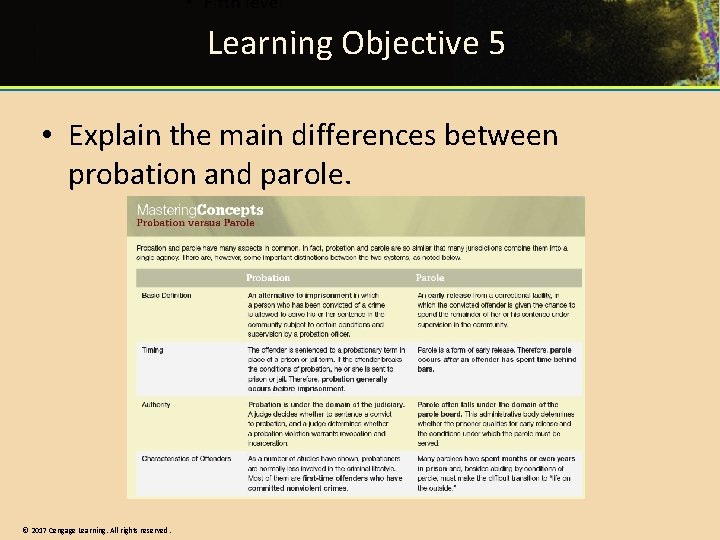
Learning Objective 5 • Explain the main differences between probation and parole. © 2017 Cengage Learning. All rights reserved.
The Parole Picture • Probation – The offender is sentenced to a probationary term in place of a prison or jail term. • Therefore, probation generally occurs before imprisonment. • Parole – Parole is a form of early release. • Therefore, parole occurs after an offender has spent time behind bars. © 2017 Cengage Learning. All rights reserved.
The Parole Picture • Probation – If the offender breaks the conditions of probation, he or she is sent to prison or jail. • Parole – In many ways, parole supervision is similar to probation supervision. – Violation of conditions may result in revocation and return to prison. • About a quarter of parolees return to prison before the end of their parole period, most because they were convicted of a new offense or had their parole revoked. © 2017 Cengage Learning. All rights reserved.
The Parole Picture • Probation – Under the domain of the judiciary • A judge decides whether to sentence a convict to probation, and a judge determines whether a probation violation warrants revocation and incarceration. • Parole – Parole often falls under the domain of the parole board. • This administrative body determines whether the prisoner qualifies for early release and the conditions under which the parole must be served. © 2017 Cengage Learning. All rights reserved.
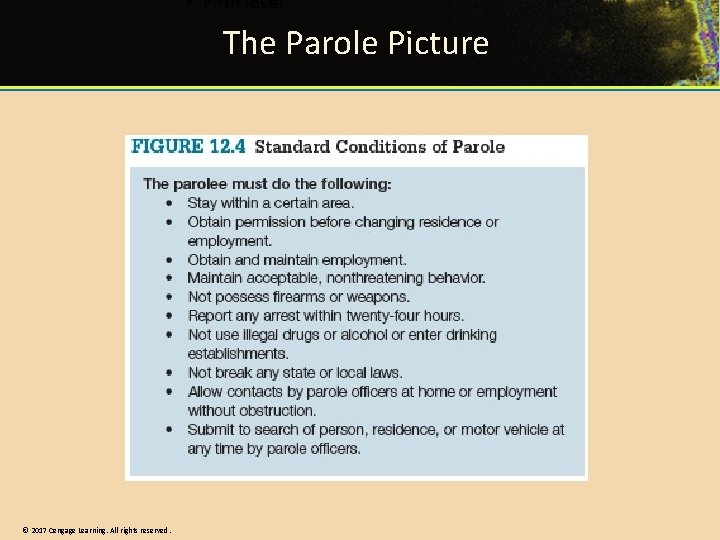
The Parole Picture © 2017 Cengage Learning. All rights reserved.
Discussion Questions • Discuss the effectiveness of parole as well as probation. – Do you believe that probation deters criminals from committing crimes? If yes, why and if no, why not? – What about parole? Do you think it is more or less effective, and under what circumstances? © 2017 Cengage Learning. All rights reserved.
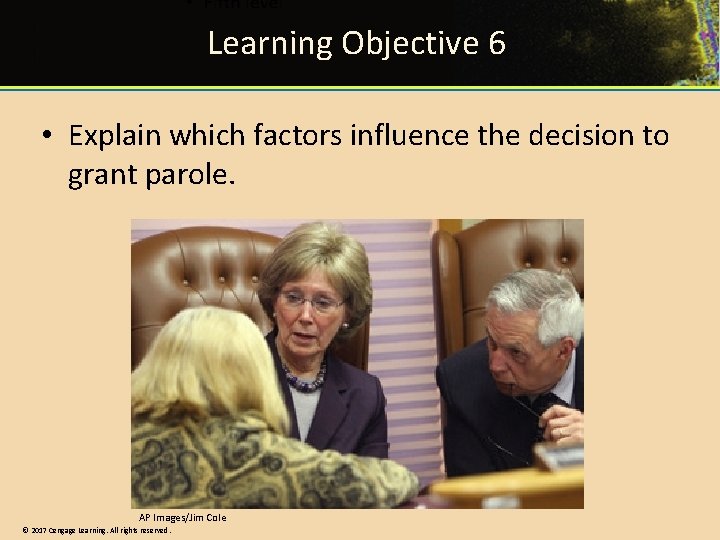
Learning Objective 6 • Explain which factors influence the decision to grant parole. AP Images/Jim Cole © 2017 Cengage Learning. All rights reserved.
The Parole Picture • Roles of the parole board: – To decide which offenders should be placed on parole – To determine the conditions of parole and aid in the continuing supervision of the parolee – To discharge the offender when the conditions of parole have been met – If a violation occurs, to determine whether parole privileges should be revoked © 2017 Cengage Learning. All rights reserved.
The Parole Picture • The parole board uses a number of criteria to determine release – The nature and circumstances of the underlying offense and the offender’s current attitude toward it – The offender’s prior criminal record – The offender’s attitude toward the victim and the victim’s family members – The offender’s physical, mental, and emotional health – The offender’s behavior behind bars, including his or her participation in programs for self-improvement © 2017 Cengage Learning. All rights reserved.
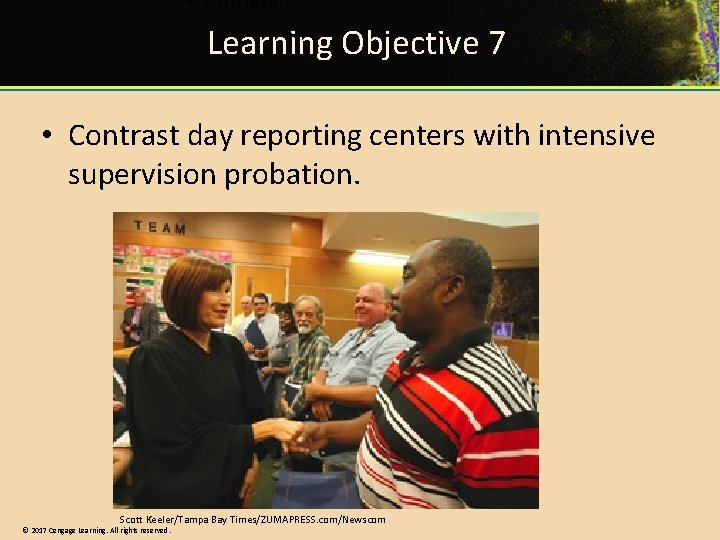
Learning Objective 7 • Contrast day reporting centers with intensive supervision probation. Scott Keeler/Tampa Bay Times/ZUMAPRESS. com/Newscom © 2017 Cengage Learning. All rights reserved.
The Parole Picture • Judicially administered intermediate sanctions – Fines – Community service – Restitution – Forfeiture – Pretrial diversion programs © 2017 Cengage Learning. All rights reserved.
Intermediate Sanctions • Day reporting centers – Tools to reduce jail and prison overcrowding – Offenders allowed to remain in community • Intensive supervision probation – More restrictive alternative to regular probation – Higher levels of face-to-face contact between offenders and officers – Frequent modes of control, such as urine tests for drugs © 2017 Cengage Learning. All rights reserved.
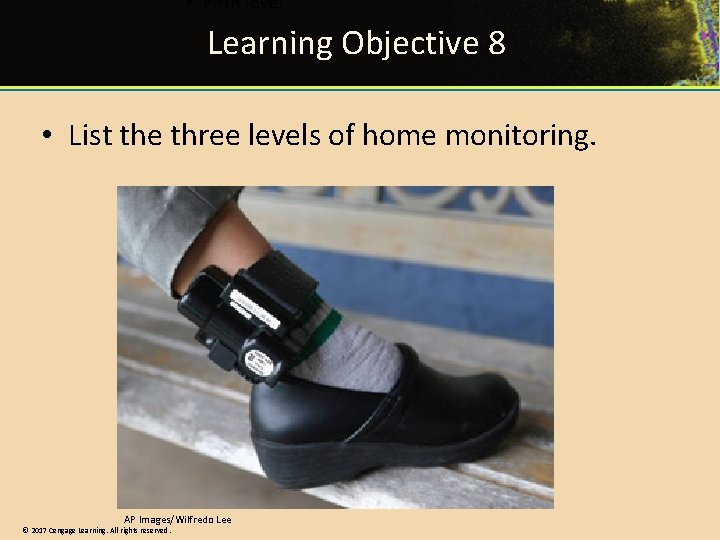
Learning Objective 8 • List the three levels of home monitoring. AP Images/Wilfredo Lee © 2017 Cengage Learning. All rights reserved.
Intermediate Sanctions • Levels of home monitoring: – Curfew – Home detention – Home incarceration • Types of electronic monitoring: – Programmed contact – Continuously signaling © 2017 Cengage Learning. All rights reserved.
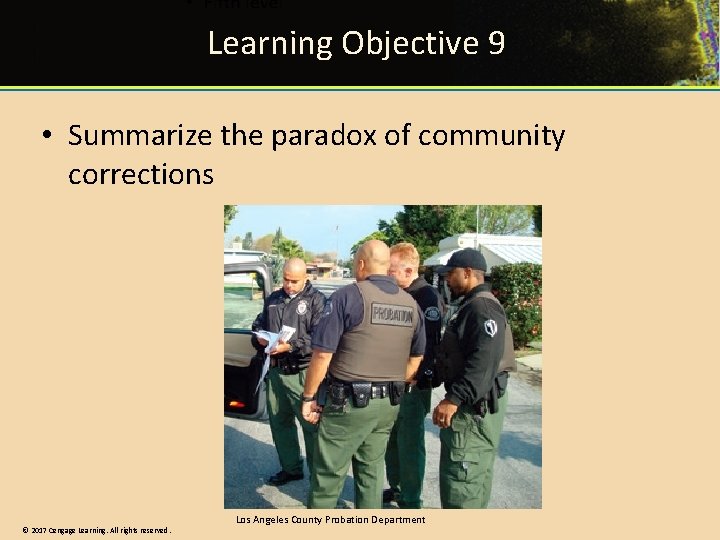
Learning Objective 9 • Summarize the paradox of community corrections © 2017 Cengage Learning. All rights reserved. Los Angeles County Probation Department
Intermediate Sanctions • The “quicksand effect” of increased surveillance – The more effectively offenders are controlled, the more likely they are to be caught violating the terms of their conditional release. © 2017 Cengage Learning. All rights reserved.
- Slides: 28