
Chapter 12 pp 211 232 Chapter 12 Sections
- Slides: 36
Chapter 12: pp. 211 - 232 Chapter 12 Sections 12. 3, 12. 4 and 12. 5 Power. Point® Lecture Slides are prepared by Dr. Isaac Barjis, Biology Instructor Copyright © The Mc. Graw Hill Companies Inc. Permission required for reproduction or display 10 th Edition Sylvia S. Mader Molecular Biology of the Gene BIOLOGY 1
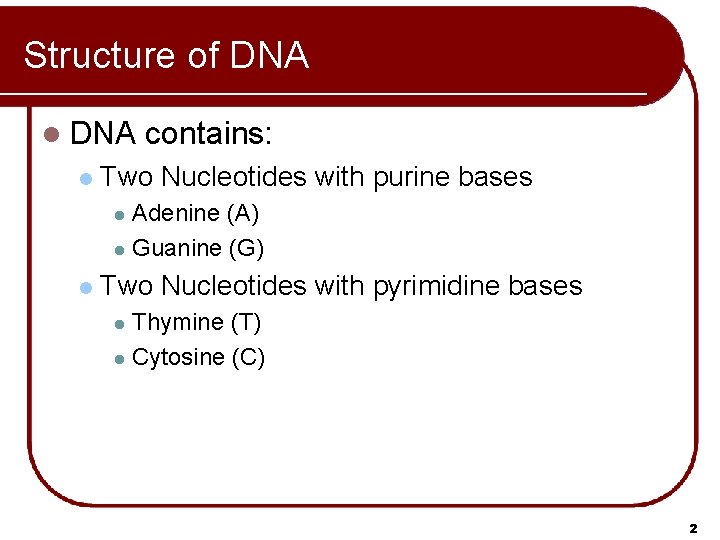
Structure of DNA l contains: Two Nucleotides with purine bases Adenine (A) l Guanine (G) l l Two Nucleotides with pyrimidine bases Thymine (T) l Cytosine (C) l 2
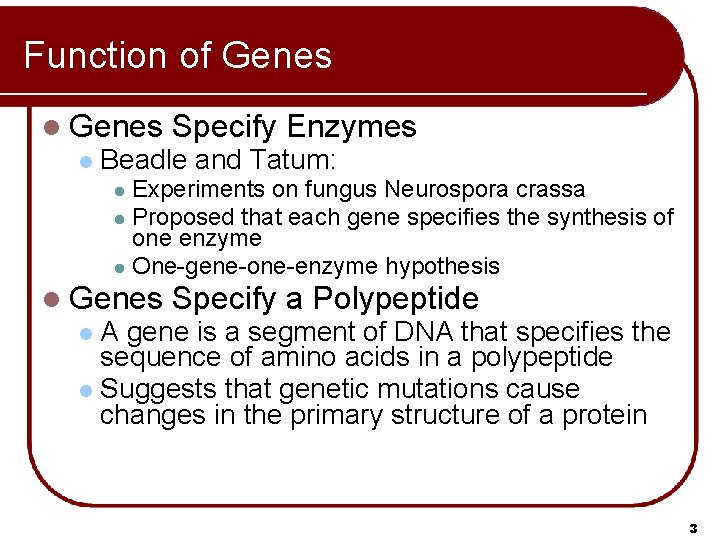
Function of Genes l Specify Enzymes Beadle and Tatum: Experiments on fungus Neurospora crassa l Proposed that each gene specifies the synthesis of one enzyme l One-gene-one-enzyme hypothesis l l Genes Specify a Polypeptide A gene is a segment of DNA that specifies the sequence of amino acids in a polypeptide l Suggests that genetic mutations cause changes in the primary structure of a protein l 3
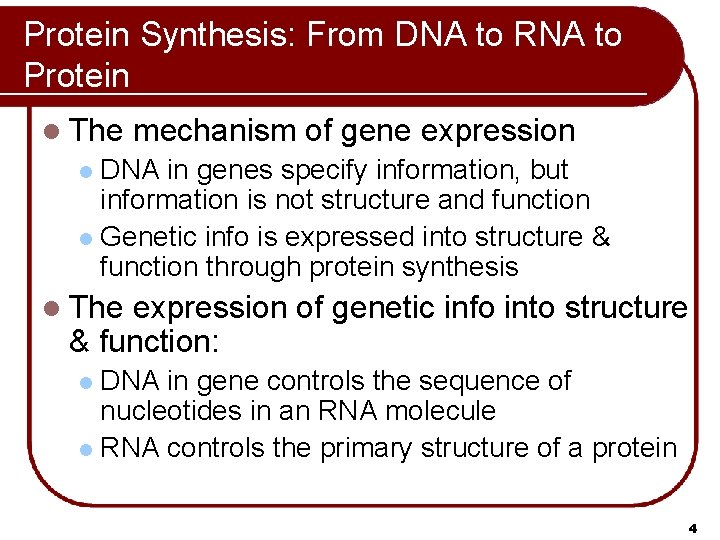
Protein Synthesis: From DNA to RNA to Protein l The mechanism of gene expression DNA in genes specify information, but information is not structure and function l Genetic info is expressed into structure & function through protein synthesis l l The expression of genetic info into structure & function: DNA in gene controls the sequence of nucleotides in an RNA molecule l RNA controls the primary structure of a protein l 4
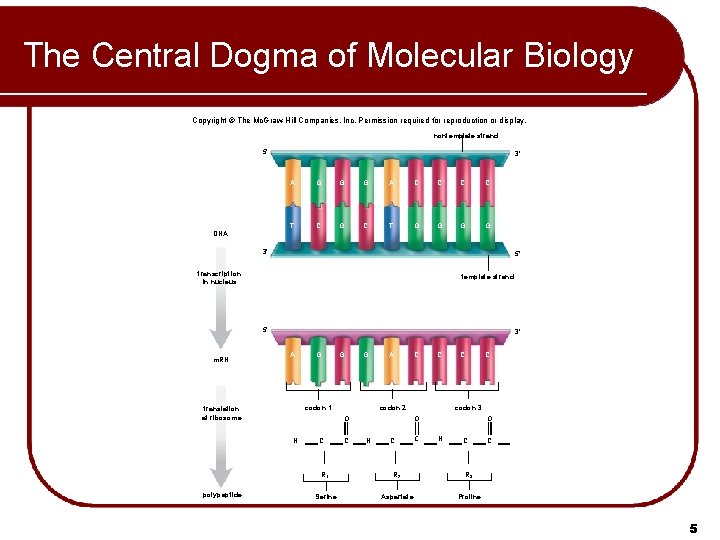
The Central Dogma of Molecular Biology Copyright © The Mc. Graw-Hill Companies, Inc. Permission required for reproduction or display. nontemplate strand 5' 3' A G G G A C C T C G C T G G DNA 3' 5' transcription in nucleus template strand 5' m. RN 3' A G G codon 1 translation at ribosome A C C C codon 2 O N polypeptide G C C codon 3 O N C C C O N C R 1 R 2 R 3 Serine Aspartate Proline C 5
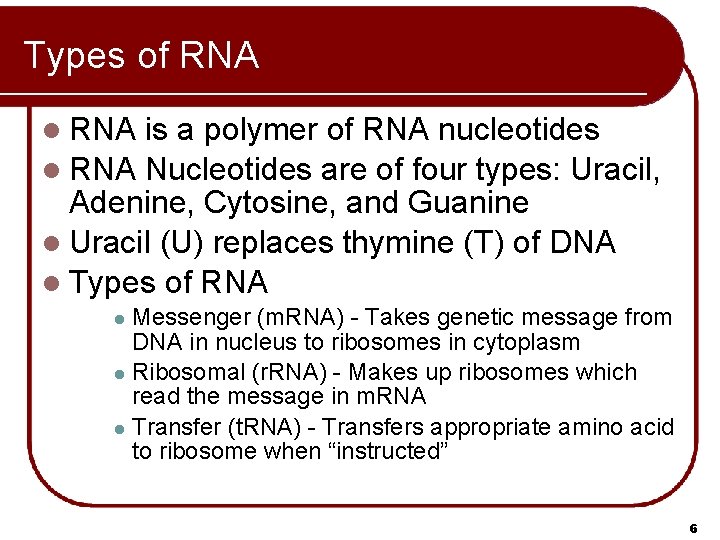
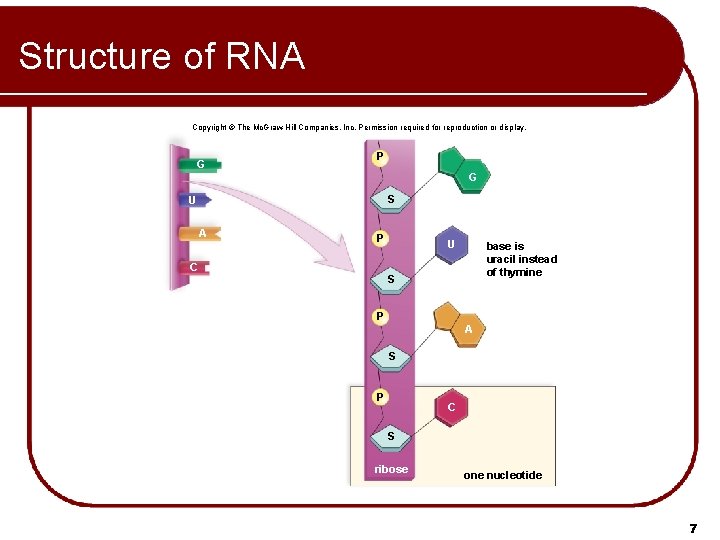
Types of RNA l RNA is a polymer of RNA nucleotides l RNA Nucleotides are of four types: Uracil, Adenine, Cytosine, and Guanine l Uracil (U) replaces thymine (T) of DNA l Types of RNA Messenger (m. RNA) - Takes genetic message from DNA in nucleus to ribosomes in cytoplasm l Ribosomal (r. RNA) - Makes up ribosomes which read the message in m. RNA l Transfer (t. RNA) - Transfers appropriate amino acid to ribosome when “instructed” l 6
Structure of RNA Copyright © The Mc. Graw-Hill Companies, Inc. Permission required for reproduction or display. G P G S U A P C U base is uracil instead of thymine S P A S P C S ribose one nucleotide 7
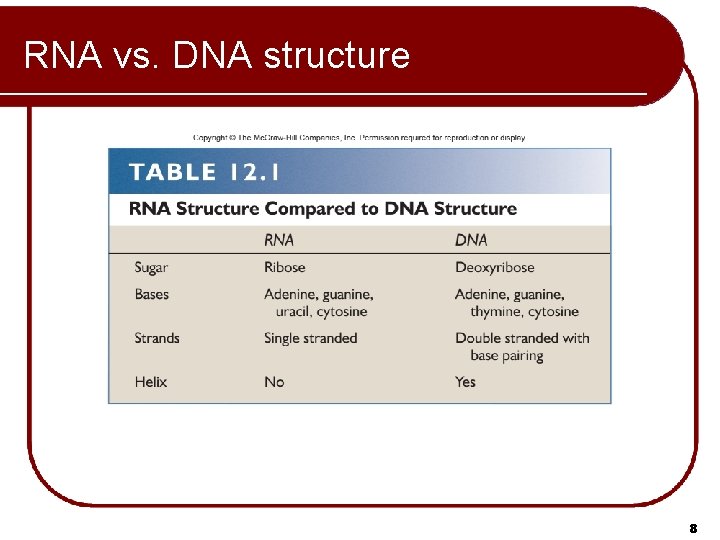
RNA vs. DNA structure 8
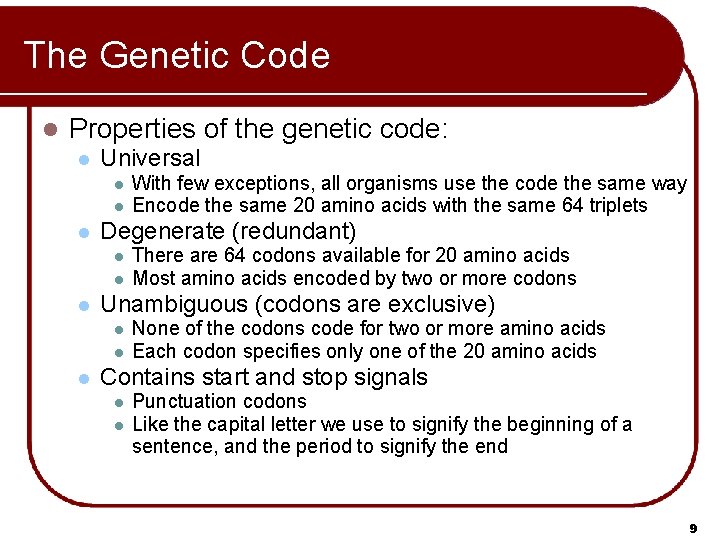
The Genetic Code l Properties of the genetic code: l Universal l Degenerate (redundant) l l l There are 64 codons available for 20 amino acids Most amino acids encoded by two or more codons Unambiguous (codons are exclusive) l l l With few exceptions, all organisms use the code the same way Encode the same 20 amino acids with the same 64 triplets None of the codons code for two or more amino acids Each codon specifies only one of the 20 amino acids Contains start and stop signals l l Punctuation codons Like the capital letter we use to signify the beginning of a sentence, and the period to signify the end 9
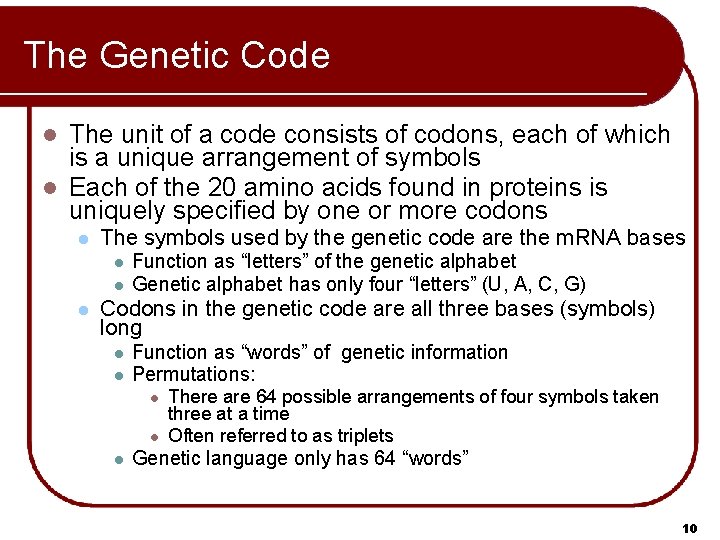
The Genetic Code The unit of a code consists of codons, each of which is a unique arrangement of symbols l Each of the 20 amino acids found in proteins is uniquely specified by one or more codons l l The symbols used by the genetic code are the m. RNA bases l l l Function as “letters” of the genetic alphabet Genetic alphabet has only four “letters” (U, A, C, G) Codons in the genetic code are all three bases (symbols) long l l Function as “words” of genetic information Permutations: l l l There are 64 possible arrangements of four symbols taken three at a time Often referred to as triplets Genetic language only has 64 “words” 10
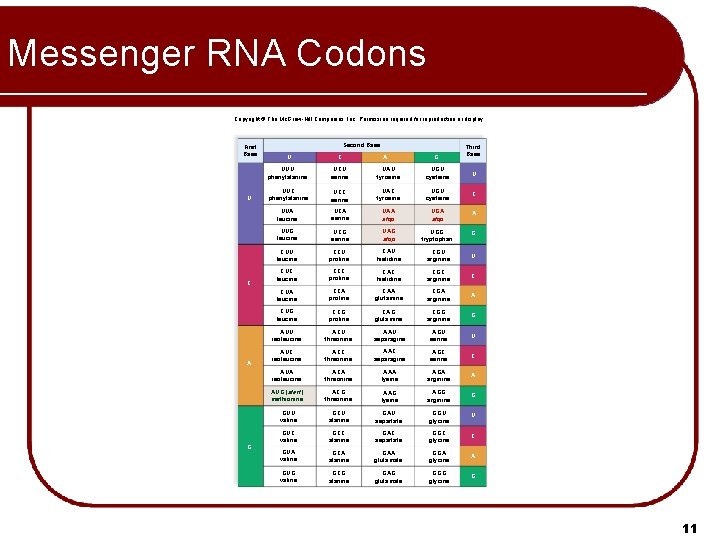
Messenger RNA Codons Copyright © The Mc. Graw-Hill Companies, Inc. Permission required for reproduction or display. First Base U C A G Second Base A G Third Base U C UUU phenylalanine UCU serine UAU tyrosine UGU cysteine U UUC phenylalanine UCC serine UAC tyrosine UGU cysteine C UUA leucine UCA serine UAA stop UGA stop A UUG leucine UCG serine UAG stop UGG tryptophan G CUU leucine CCU proline CAU histidine CGU arginine U CUC leucine CCC proline CAC histidine CGC arginine C CUA leucine CCA proline CAA glutamine CGA arginine A CUG leucine CCG proline CAG glutamine CGG arginine G AUU isoleucine ACU threonine AAU asparagine AGU serine U AUC isoleucine ACC threonine AAC asparagine AGC serine C AUA isoleucine ACA threonine AAA lysine AGA arginine A AUG (start) methionine ACG threonine AAG lysine AGG arginine G GUU valine GCU alanine GAU aspartate GGU glycine U GUC valine GCC alanine GAC aspartate GGC glycine C GUA valine GCA alanine GAA glutamate GGA glycine A GUG valine GCG alanine GAG glutamate GGG glycine G 11
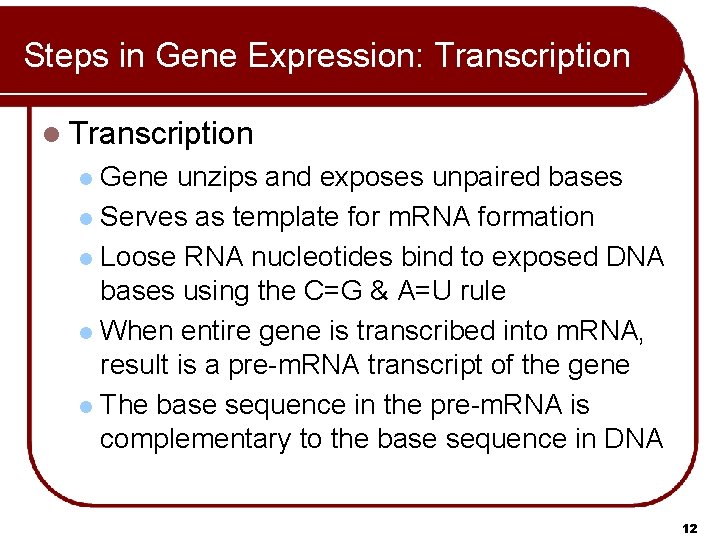
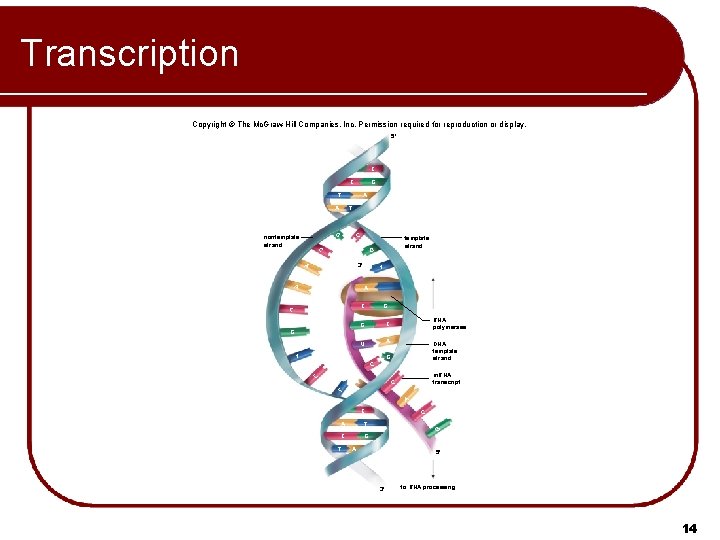
Steps in Gene Expression: Transcription l Transcription Gene unzips and exposes unpaired bases l Serves as template for m. RNA formation l Loose RNA nucleotides bind to exposed DNA bases using the C=G & A=U rule l When entire gene is transcribed into m. RNA, result is a pre-m. RNA transcript of the gene l The base sequence in the pre-m. RNA is complementary to the base sequence in DNA l 12
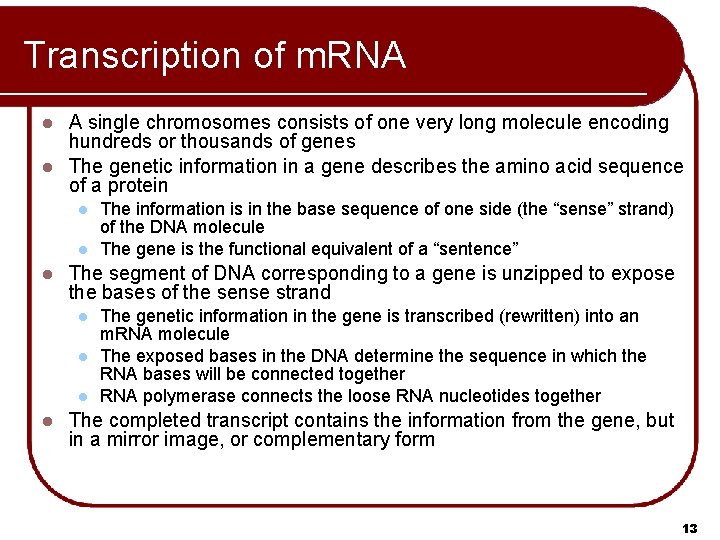
Transcription of m. RNA A single chromosomes consists of one very long molecule encoding hundreds or thousands of genes l The genetic information in a gene describes the amino acid sequence of a protein l l The segment of DNA corresponding to a gene is unzipped to expose the bases of the sense strand l l The information is in the base sequence of one side (the “sense” strand) of the DNA molecule The gene is the functional equivalent of a “sentence” The genetic information in the gene is transcribed (rewritten) into an m. RNA molecule The exposed bases in the DNA determine the sequence in which the RNA bases will be connected together RNA polymerase connects the loose RNA nucleotides together The completed transcript contains the information from the gene, but in a mirror image, or complementary form 13
Transcription Copyright © The Mc. Graw-Hill Companies, Inc. Permission required for reproduction or display. 5' C C G A T G nontemplate strand C C template strand G A 3' A T A C C G RNA polymerase C G G A U DNA template strand G T C C m. RNA transcript T C A T C G A 5' 3' to RNA processing 14
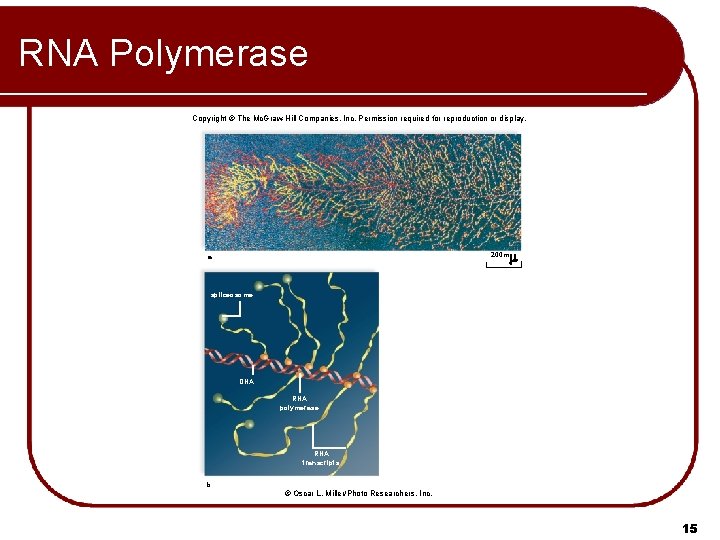
RNA Polymerase Copyright © The Mc. Graw-Hill Companies, Inc. Permission required for reproduction or display. 200 m a. spliceosome DNA RNA polymerase RNA transcripts b. © Oscar L. Miller/Photo Researchers, Inc. 15
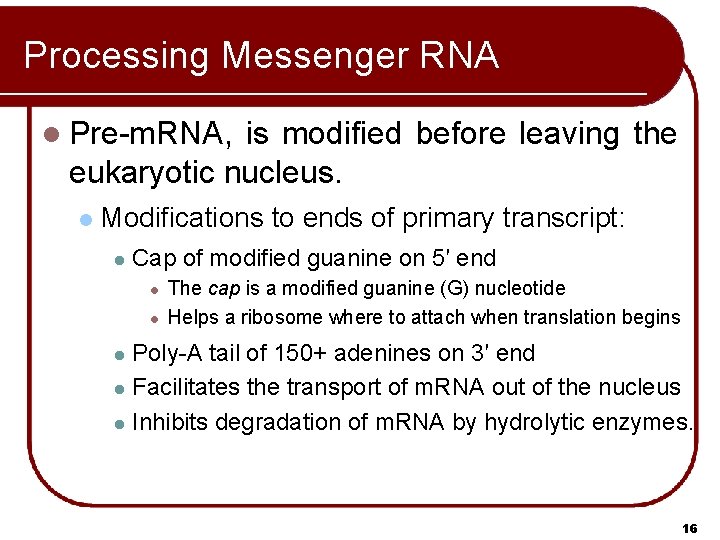
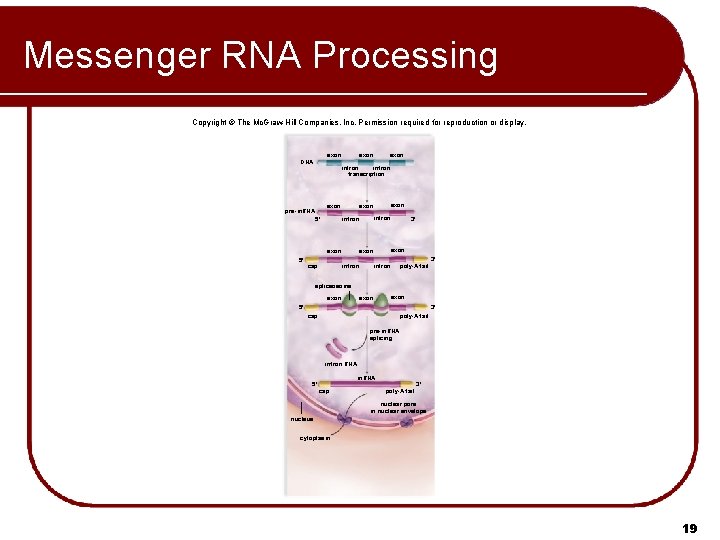
Processing Messenger RNA l Pre-m. RNA, is modified before leaving the eukaryotic nucleus. l Modifications to ends of primary transcript: l Cap of modified guanine on 5′ end l l The cap is a modified guanine (G) nucleotide Helps a ribosome where to attach when translation begins Poly-A tail of 150+ adenines on 3′ end l Facilitates the transport of m. RNA out of the nucleus l Inhibits degradation of m. RNA by hydrolytic enzymes. l 16
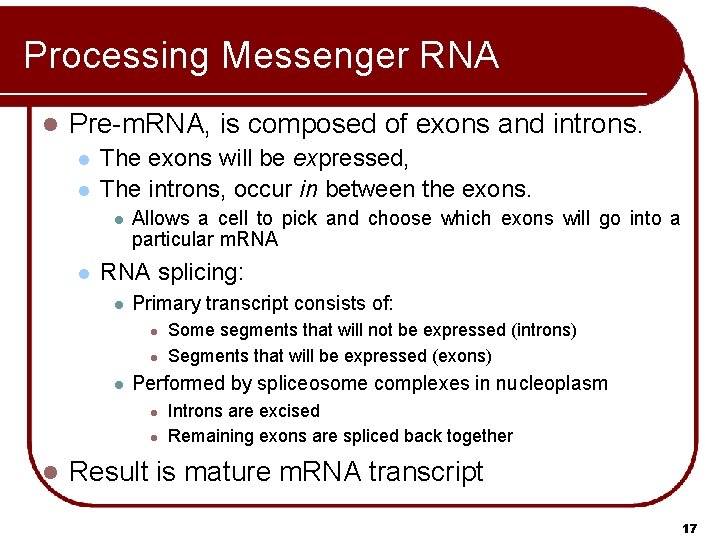
Processing Messenger RNA l Pre-m. RNA, is composed of exons and introns. l l The exons will be expressed, The introns, occur in between the exons. l l Allows a cell to pick and choose which exons will go into a particular m. RNA splicing: l Primary transcript consists of: l l l Performed by spliceosome complexes in nucleoplasm l l l Some segments that will not be expressed (introns) Segments that will be expressed (exons) Introns are excised Remaining exons are spliced back together Result is mature m. RNA transcript 17
RNA Splicing l In prokaryotes, introns are removed by “self -splicing”—that is, the intron itself has the capability of enzymatically splicing itself out of a pre-m. RNA 18
Messenger RNA Processing Copyright © The Mc. Graw-Hill Companies, Inc. Permission required for reproduction or display. exon DNA exon pre-m. RNA exon cap exon intron 5' 5' exon intron transcription 3' exon poly-A tail intron 3' spliceosome exon 3' 5' cap poly-A tail pre-m. RNA splicing intron RNA m. RNA 5' cap 3' poly-A tail nuclear pore in nuclear envelope nucleus cytoplasm 19
Functions of Introns l As organismal complexity increases; l l l Number of protein-coding genes does not keep pace But the proportion of the genome that is introns increases Humans: l l l Possible functions of introns: l More bang for buck l l Genome has only about 25, 000 coding genes Up to 95% of this DNA genes is introns Exons might combine in various combinations Would allow different m. RNAs to result from one segment of DNA Introns might regulate gene expression Exciting new picture of the genome is emerging 20
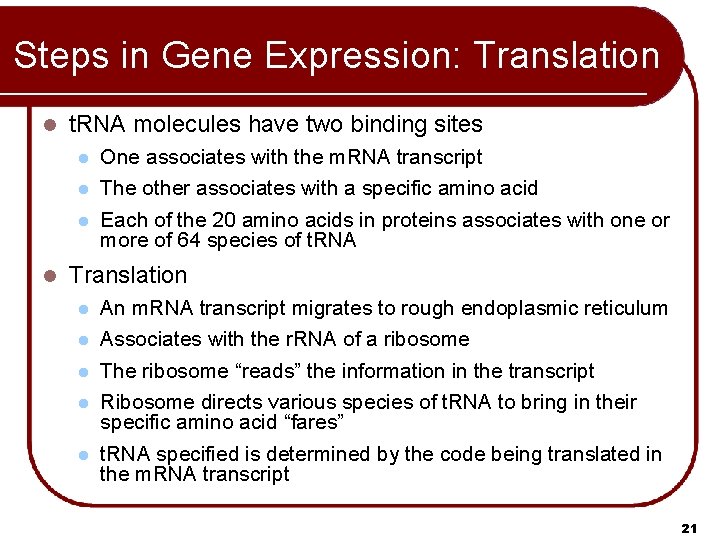
Steps in Gene Expression: Translation l t. RNA molecules have two binding sites l l One associates with the m. RNA transcript The other associates with a specific amino acid Each of the 20 amino acids in proteins associates with one or more of 64 species of t. RNA Translation l l l An m. RNA transcript migrates to rough endoplasmic reticulum Associates with the r. RNA of a ribosome The ribosome “reads” the information in the transcript Ribosome directs various species of t. RNA to bring in their specific amino acid “fares” t. RNA specified is determined by the code being translated in the m. RNA transcript 21
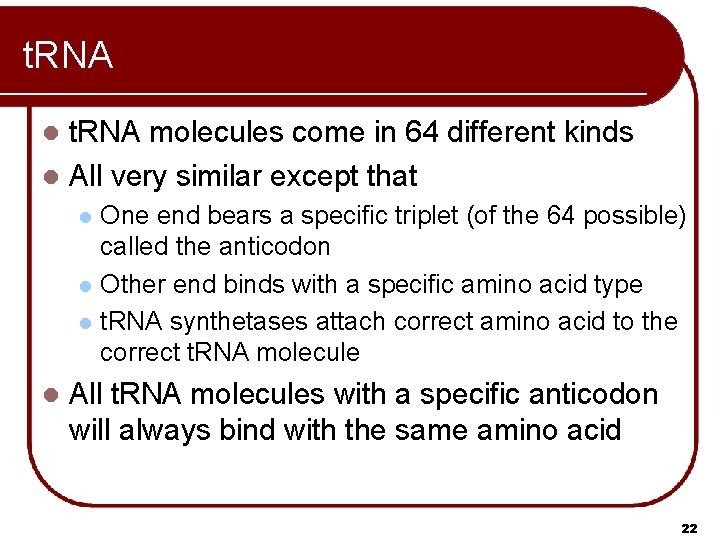
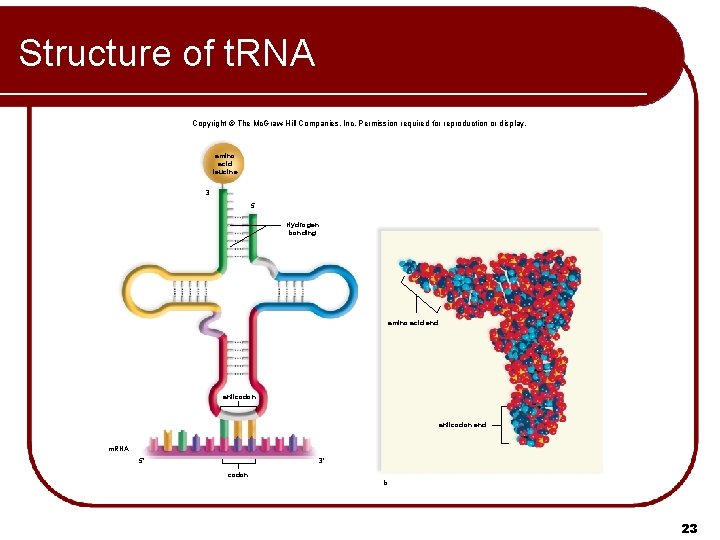
t. RNA molecules come in 64 different kinds l All very similar except that l l l One end bears a specific triplet (of the 64 possible) called the anticodon Other end binds with a specific amino acid type t. RNA synthetases attach correct amino acid to the correct t. RNA molecule All t. RNA molecules with a specific anticodon will always bind with the same amino acid 22
Structure of t. RNA Copyright © The Mc. Graw-Hill Companies, Inc. Permission required for reproduction or display. amino acid leucine 3 5 Hydrogen bonding amino acid end anticodon end m. RNA 5' 3' codon b. 23
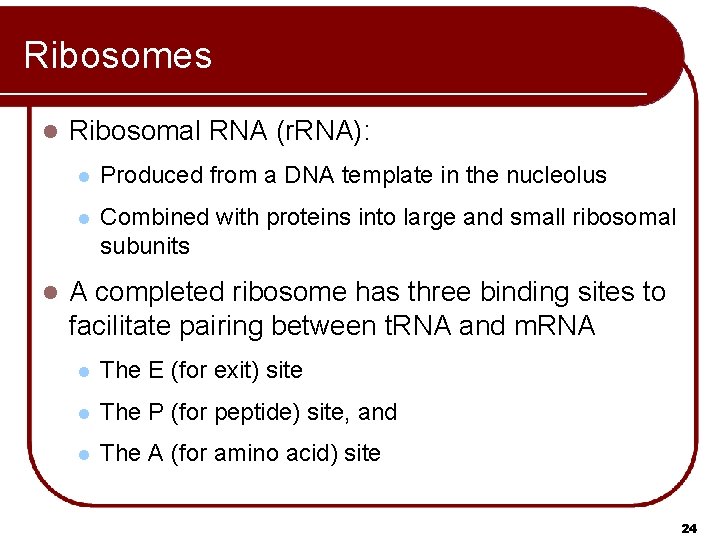
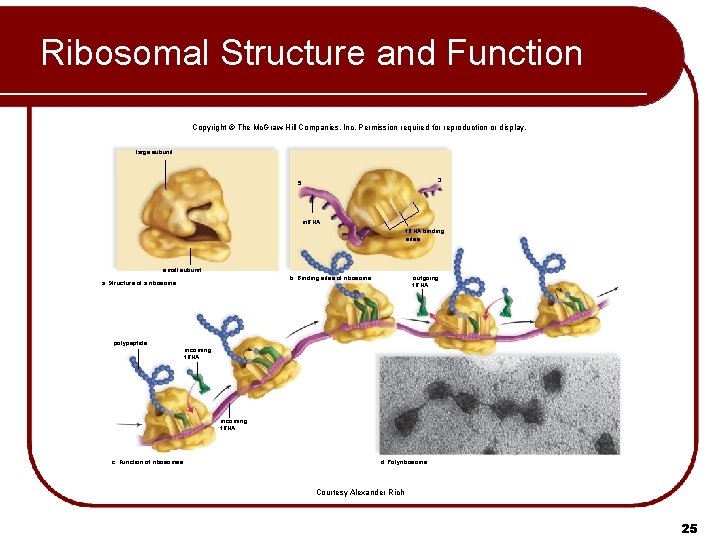
Ribosomes l l Ribosomal RNA (r. RNA): l Produced from a DNA template in the nucleolus l Combined with proteins into large and small ribosomal subunits A completed ribosome has three binding sites to facilitate pairing between t. RNA and m. RNA l The E (for exit) site l The P (for peptide) site, and l The A (for amino acid) site 24
Ribosomal Structure and Function Copyright © The Mc. Graw-Hill Companies, Inc. Permission required for reproduction or display. large subunit 3 5 m. RNA t. RNA binding sites small subunit polypeptide outgoing t. RNA b. Binding sites of ribosome a. Structure of a ribosome incoming t. RNA c. Function of ribosomes d. Polyribosome Courtesy Alexander Rich 25
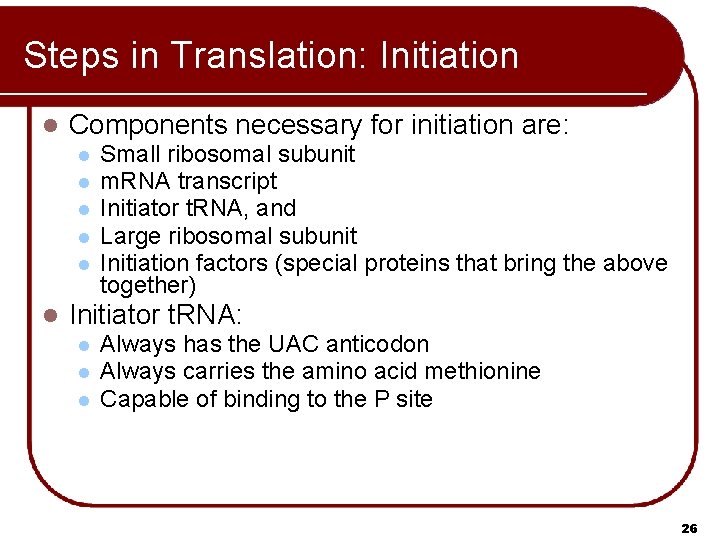
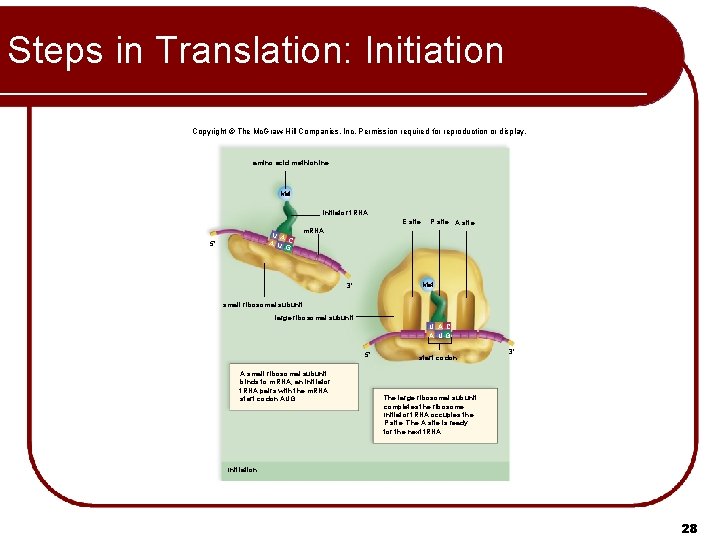
Steps in Translation: Initiation l Components necessary for initiation are: l l l Small ribosomal subunit m. RNA transcript Initiator t. RNA, and Large ribosomal subunit Initiation factors (special proteins that bring the above together) Initiator t. RNA: l l l Always has the UAC anticodon Always carries the amino acid methionine Capable of binding to the P site 26
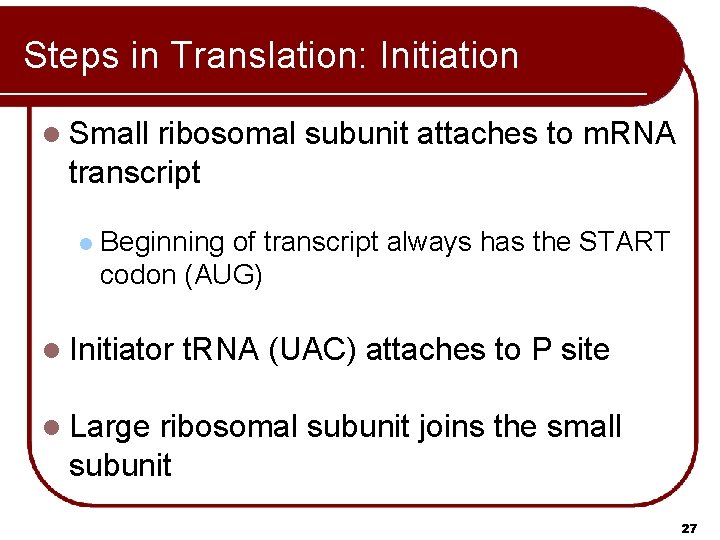
Steps in Translation: Initiation l Small ribosomal subunit attaches to m. RNA transcript l Beginning of transcript always has the START codon (AUG) l Initiator t. RNA (UAC) attaches to P site l Large ribosomal subunit joins the small subunit 27
Steps in Translation: Initiation Copyright © The Mc. Graw-Hill Companies, Inc. Permission required for reproduction or display. amino acid methionine Met initiator t. RNA E site U A A U C G 5' P site A site m. RNA Met 3' small ribosomal subunit large ribosomal subunit U A C A UG 5' A small ribosomal subunit binds to m. RNA; an initiator t. RNA pairs with the m. RNA start codon AUG. start codon 3' The large ribosomal subunit completes the ribosome. Initiator t. RNA occupies the P site. The A site is ready for the next t. RNA. Initiation 28
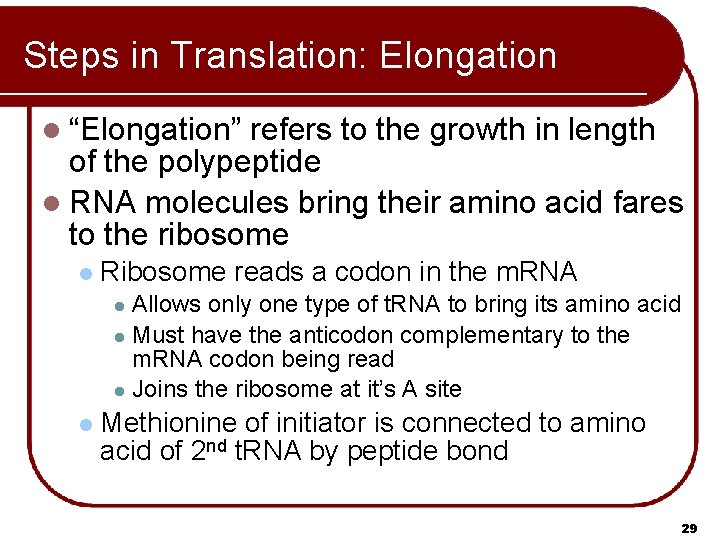
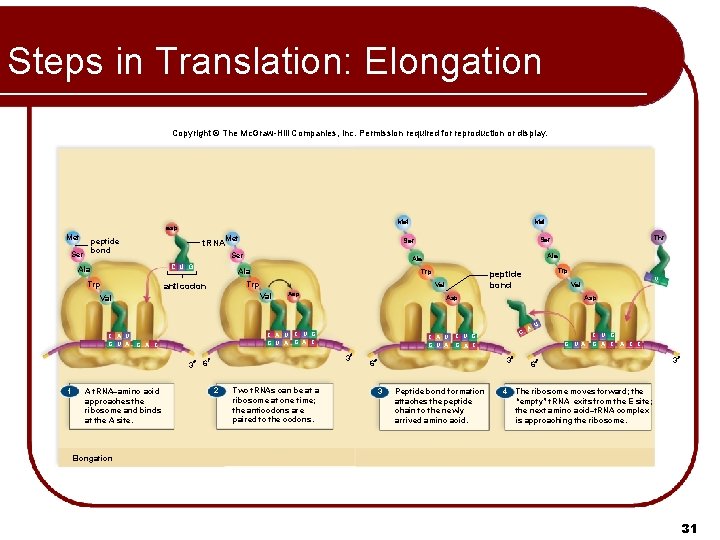
Steps in Translation: Elongation l “Elongation” refers to the growth in length of the polypeptide l RNA molecules bring their amino acid fares to the ribosome l Ribosome reads a codon in the m. RNA Allows only one type of t. RNA to bring its amino acid l Must have the anticodon complementary to the m. RNA codon being read l Joins the ribosome at it’s A site l l Methionine of initiator is connected to amino acid of 2 nd t. RNA by peptide bond 29
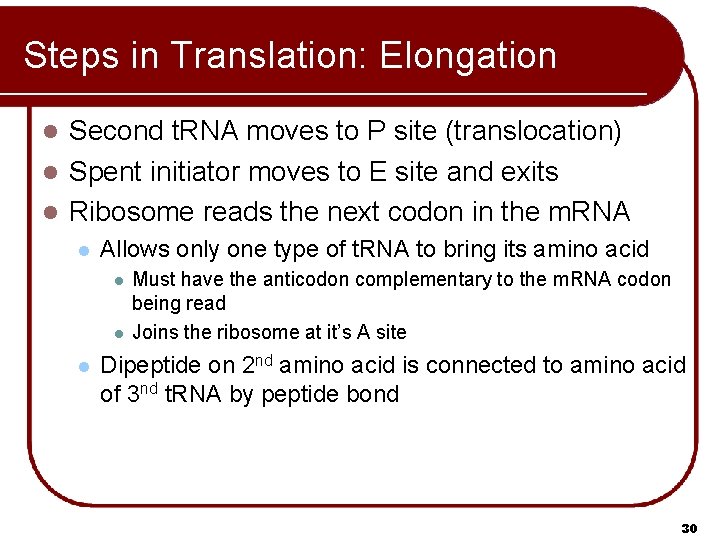
Steps in Translation: Elongation Second t. RNA moves to P site (translocation) l Spent initiator moves to E site and exits l Ribosome reads the next codon in the m. RNA l l Allows only one type of t. RNA to bring its amino acid l l l Must have the anticodon complementary to the m. RNA codon being read Joins the ribosome at it’s A site Dipeptide on 2 nd amino acid is connected to amino acid of 3 nd t. RNA by peptide bond 30
Steps in Translation: Elongation Copyright © The Mc. Graw-Hill Companies, Inc. Permission required for reproduction or display. Met asp Met peptide Ser bond Ser C U G Trp G A C A t. RNA–amino acid approaches the ribosome and binds at the A site. C A U G U A 3 6 2 Two t. RNAs can be at a ribosome at one time; the anticodons are paired to the codons. C Peptide bond formation attaches the peptide chain to the newly arrived amino acid. A U C U G G U A 3 3 G G Asp C U G G A C 6 U Val Asp C A U C U G G U A G A C 3 1 Asp Trp peptide bond Val Val C A U G U A Trp anticodon Ala Ala Thr Ser t. RNA Ala Met 4 G A C C 6 3 The ribosome moves forward; the “empty” t. RNA exits from the E site; the next amino acid–t. RNA complex is approaching the ribosome. Elongation 31
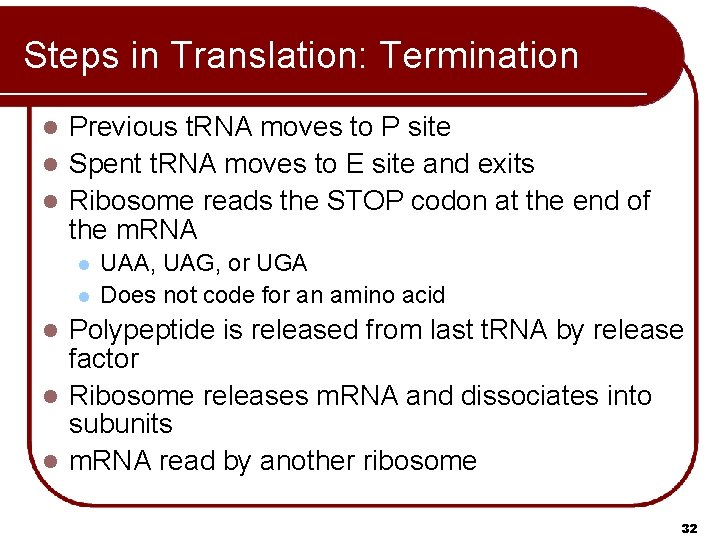
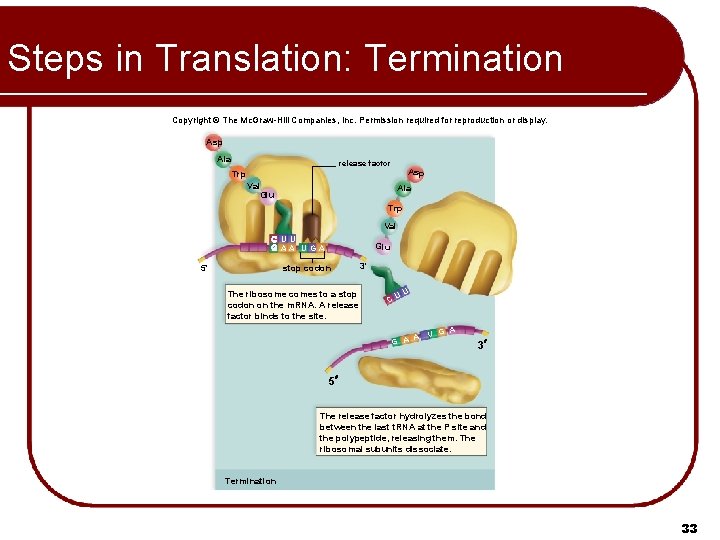
Steps in Translation: Termination Previous t. RNA moves to P site l Spent t. RNA moves to E site and exits l Ribosome reads the STOP codon at the end of the m. RNA l l l UAA, UAG, or UGA Does not code for an amino acid Polypeptide is released from last t. RNA by release factor l Ribosome releases m. RNA and dissociates into subunits l m. RNA read by another ribosome l 32
Steps in Translation: Termination Copyright © The Mc. Graw-Hill Companies, Inc. Permission required for reproduction or display. Asp Ala release factor Asp Trp Val Glu Ala Trp Val U U AA UGA Glu stop codon 5' The ribosome comes to a stop codon on the m. RNA. A release factor binds to the site. 3' U CU A G A A U G 3 5 The release factor hydrolyzes the bond between the last t. RNA at the P site and the polypeptide, releasing them. The ribosomal subunits dissociate. Termination 33
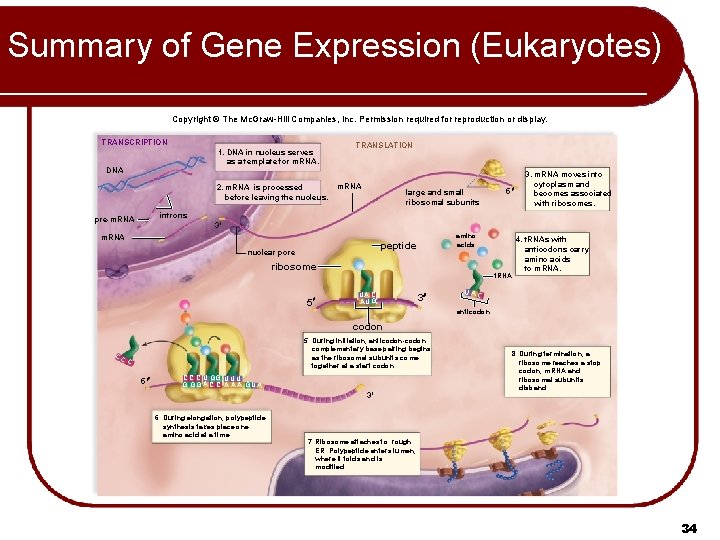
Summary of Gene Expression (Eukaryotes) Copyright © The Mc. Graw-Hill Companies, Inc. Permission required for reproduction or display. TRANSCRIPTION 1. DNA in nucleus serves as a template for m. RNA. TRANSLATION DNA 2. m. RNA is processed before leaving the nucleus. m. RNA large and small ribosomal subunits 3. m. RNA moves into cytoplasm and becomes associated with ribosomes. 5 introns pre-m. RNA 3' m. RNA amino acids peptide nuclear pore ribosome 5 t. RNA UA C A UG 3 UA 4. t. RNAs with anticodons carry amino acids to m. RNA. C anticodon CC 5. During initiation, anticodon-codon complementary base pairing begins as the ribosomal subunits come together at a start codon. C 5 C C C U GG U U U G GG A C C A A A G U A 3' 6. During elongation, polypeptide synthesis takes place one amino acid at a time. 8. During termination, a ribosome reaches a stop codon; m. RNA and ribosomal subunits disband. 7. Ribosome attaches to rough ER. Polypeptide enters lumen, where it folds and is modified. 34
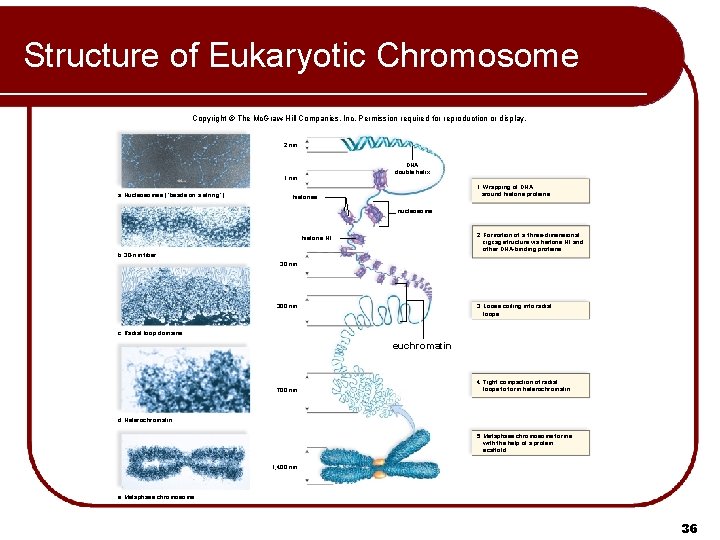
Structure of Eukaryotic Chromosome l Contains a single linear DNA molecule, but is composed of more than 50% protein. l Some of these proteins are concerned with DNA and RNA synthesis, l Histones, play primarily a structural role l l Five primary types of histone molecules Responsible for packaging the DNA double helix is wound at intervals around a core of eight histone molecules (called nucleosome) l Nucleosomes are joined by “linker” DNA. l 35
Structure of Eukaryotic Chromosome Copyright © The Mc. Graw-Hill Companies, Inc. Permission required for reproduction or display. 2 nm DNA double helix 1 nm a. Nucleosomes (“beads on a string”) 1. Wrapping of DNA around histone proteins. histones nucleosome 2. Formation of a three-dimensional zigzag structure via histone H 1 and other DNA-binding proteins. histone H 1 b. 30 -nm fiber 30 nm 300 nm 3. Loose coiling into radial loops. c. Radial loop domains euchromatin 700 nm 4. Tight compaction of radial loops to form heterochromatin. d. Heterochromatin 5. Metaphase chromosome forms with the help of a protein scaffold. 1, 400 nm e. Metaphase chromosome 36