
CHAPTER 12 Planning Instruction and Technology 2009 Mc
- Slides: 32
CHAPTER 12 Planning, Instruction, and Technology © 2009 Mc. Graw-Hill Higher Education. All rights reserved.
Learning Goals 1. Explain what is involved in classroom planning. 2. Identify important forms of teachercentered instruction. 3. Discuss important forms of learnercentered instruction. 4. Summarize how to effectively use technology to help children learn. © 2009 Mc. Graw-Hill Higher Education. All rights reserved.
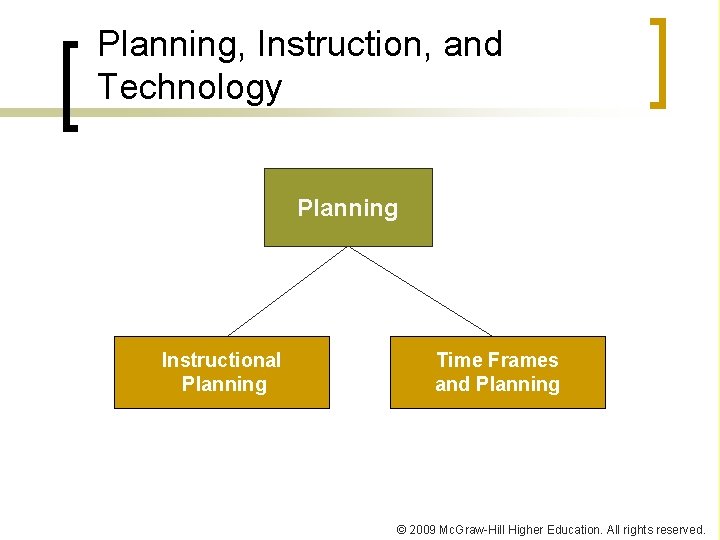
Planning, Instruction, and Technology Planning Instructional Planning Time Frames and Planning © 2009 Mc. Graw-Hill Higher Education. All rights reserved.
Planning Instructional planning involves developing a systematic, organized strategy for planning lessons. Planning will give instructors confidence, guide content coverage, and help make good use of class time. © 2009 Mc. Graw-Hill Higher Education. All rights reserved.
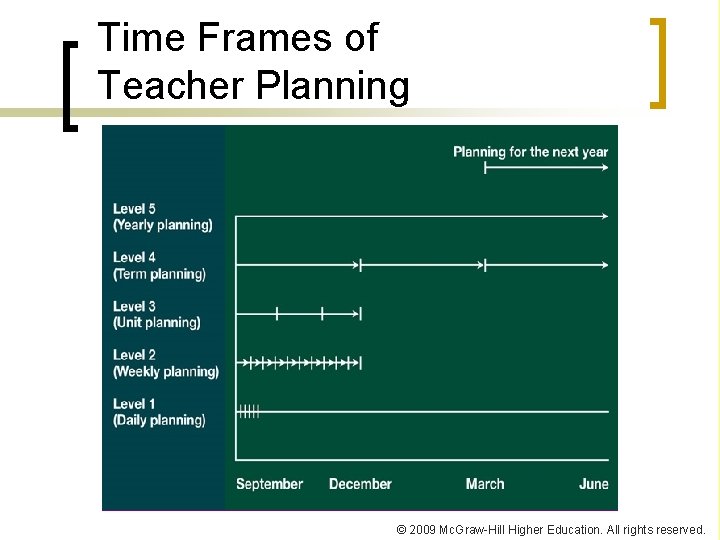
Time Frames of Teacher Planning © 2009 Mc. Graw-Hill Higher Education. All rights reserved.
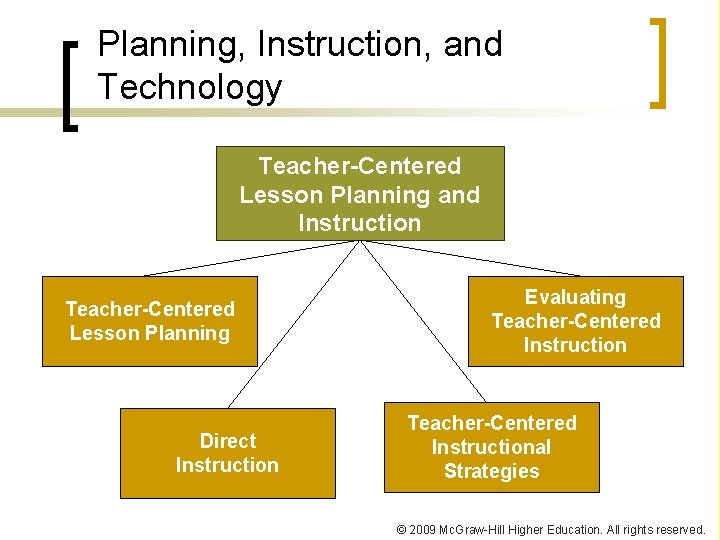
Planning, Instruction, and Technology Teacher-Centered Lesson Planning and Instruction Teacher-Centered Lesson Planning Direct Instruction Evaluating Teacher-Centered Instructional Strategies © 2009 Mc. Graw-Hill Higher Education. All rights reserved.
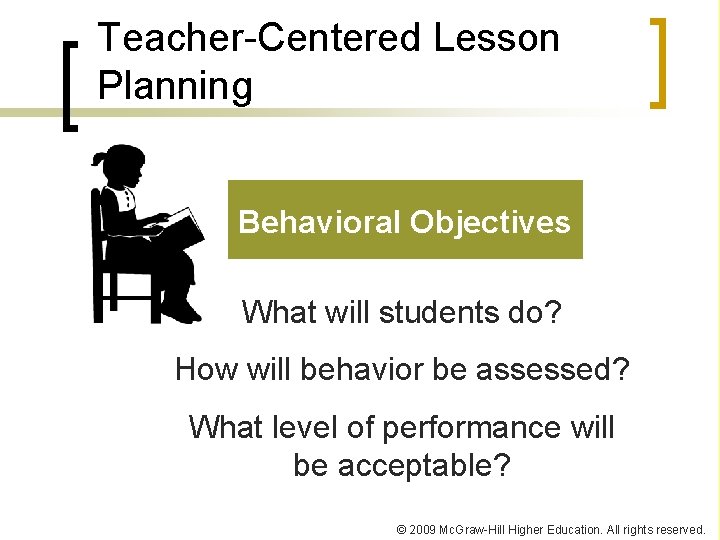
Teacher-Centered Lesson Planning Behavioral Objectives What will students do? How will behavior be assessed? What level of performance will be acceptable? © 2009 Mc. Graw-Hill Higher Education. All rights reserved.
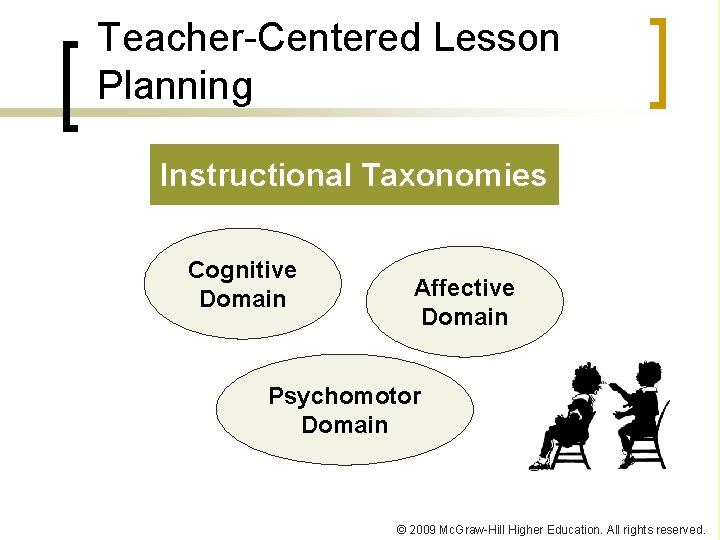
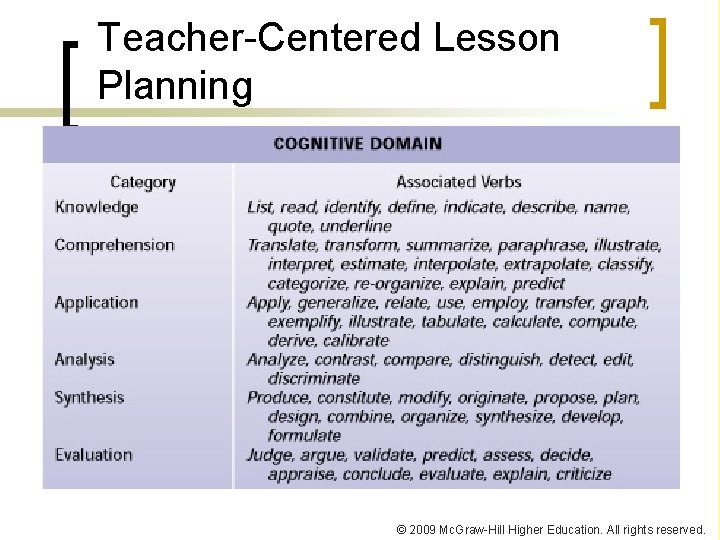
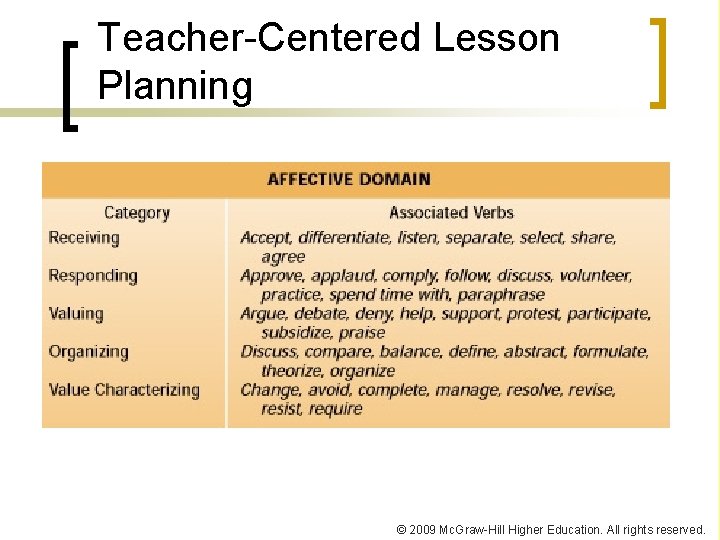
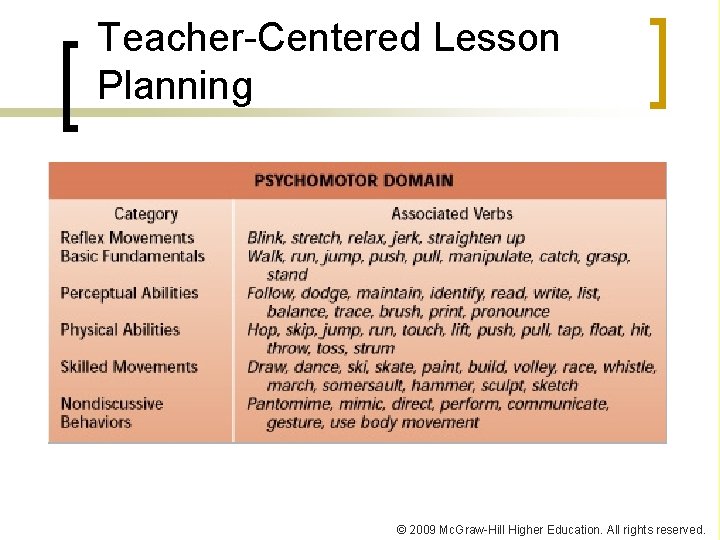
Teacher-Centered Lesson Planning Instructional Taxonomies Cognitive Domain Affective Domain Psychomotor Domain © 2009 Mc. Graw-Hill Higher Education. All rights reserved.
Teacher-Centered Lesson Planning © 2009 Mc. Graw-Hill Higher Education. All rights reserved.
Teacher-Centered Lesson Planning © 2009 Mc. Graw-Hill Higher Education. All rights reserved.
Teacher-Centered Lesson Planning © 2009 Mc. Graw-Hill Higher Education. All rights reserved.
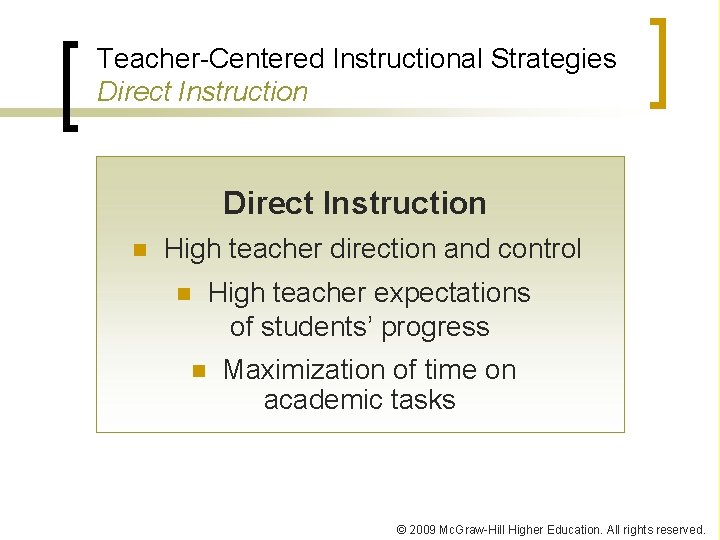
Teacher-Centered Instructional Strategies Direct Instruction n High teacher direction and control n n High teacher expectations of students’ progress Maximization of time on academic tasks © 2009 Mc. Graw-Hill Higher Education. All rights reserved.
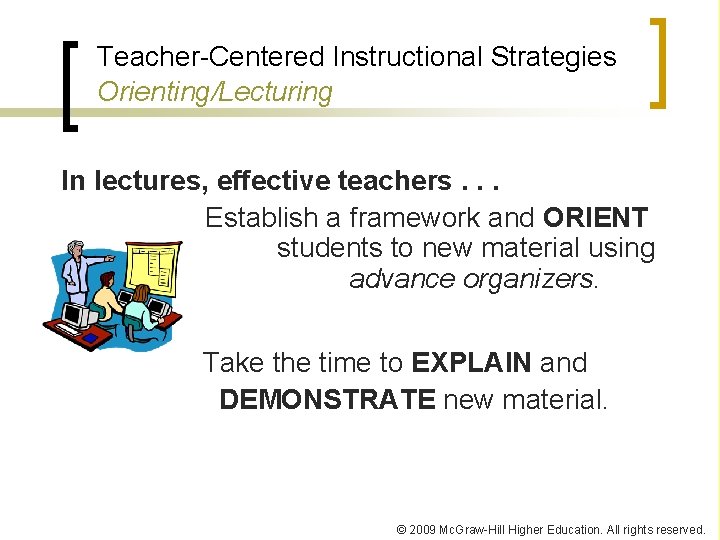
Teacher-Centered Instructional Strategies Orienting/Lecturing In lectures, effective teachers. . . Establish a framework and ORIENT students to new material using advance organizers. Take the time to EXPLAIN and DEMONSTRATE new material. © 2009 Mc. Graw-Hill Higher Education. All rights reserved.
Teacher-Centered Instructional Strategies Questions and Discussion § Use fact-based questions before thinkingbased questions § Avoid yes/no and leading questions § Give students time to think § Ask clear, purposeful, brief, and sequenced questions § Monitor your response to students’ answers § Pose questions to whole class or individual students appropriately § Encourage students to ask questions © 2009 Mc. Graw-Hill Higher Education. All rights reserved.
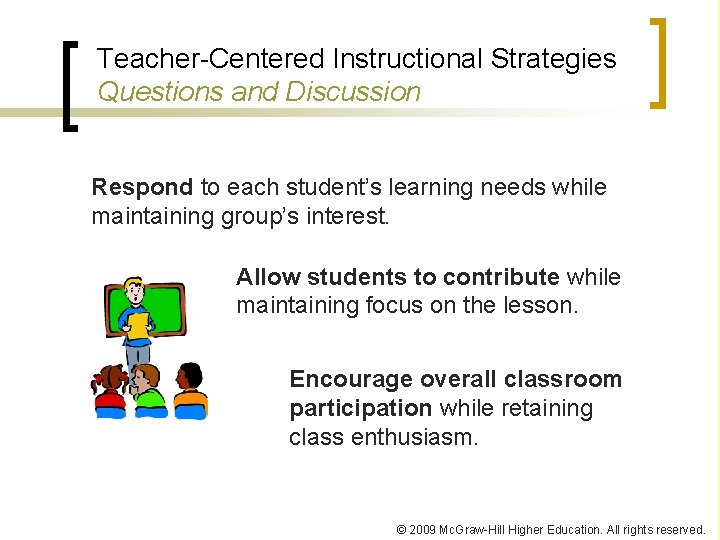
Teacher-Centered Instructional Strategies Questions and Discussion Respond to each student’s learning needs while maintaining group’s interest. Allow students to contribute while maintaining focus on the lesson. Encourage overall classroom participation while retaining class enthusiasm. © 2009 Mc. Graw-Hill Higher Education. All rights reserved.
Teacher-Centered Instructional Strategies Mastery Learning 1. 2. 3. 4. Specify the task Design learning units based on instructional objectives Plan instruction to include corrective feedback Evaluate mastery level at the end of the unit/course © 2009 Mc. Graw-Hill Higher Education. All rights reserved.
Enter the Debate Should teachers assign homework to elementary students? YES NO © 2009 Mc. Graw-Hill Higher Education. All rights reserved.
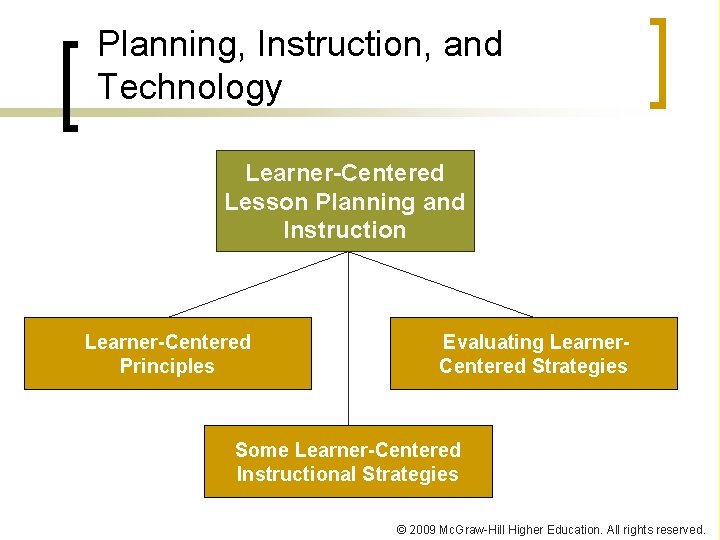
Planning, Instruction, and Technology Learner-Centered Lesson Planning and Instruction Learner-Centered Principles Evaluating Learner. Centered Strategies Some Learner-Centered Instructional Strategies © 2009 Mc. Graw-Hill Higher Education. All rights reserved.
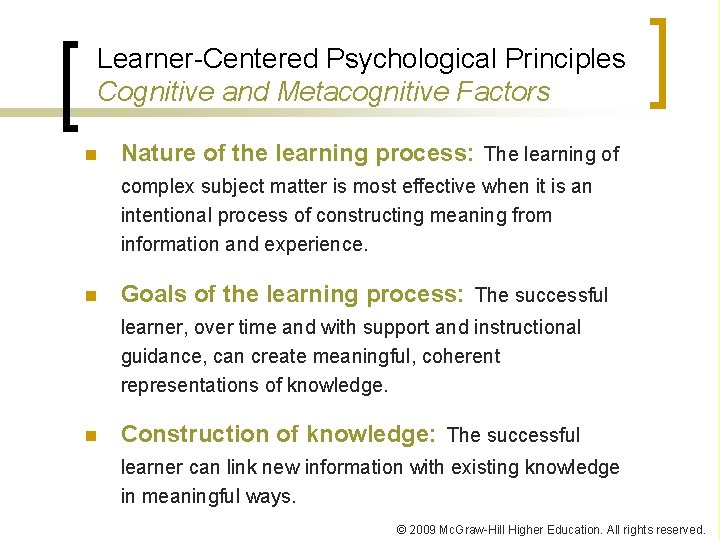
Learner-Centered Psychological Principles Cognitive and Metacognitive Factors n Nature of the learning process: The learning of complex subject matter is most effective when it is an intentional process of constructing meaning from information and experience. n Goals of the learning process: The successful learner, over time and with support and instructional guidance, can create meaningful, coherent representations of knowledge. n Construction of knowledge: The successful learner can link new information with existing knowledge in meaningful ways. © 2009 Mc. Graw-Hill Higher Education. All rights reserved.
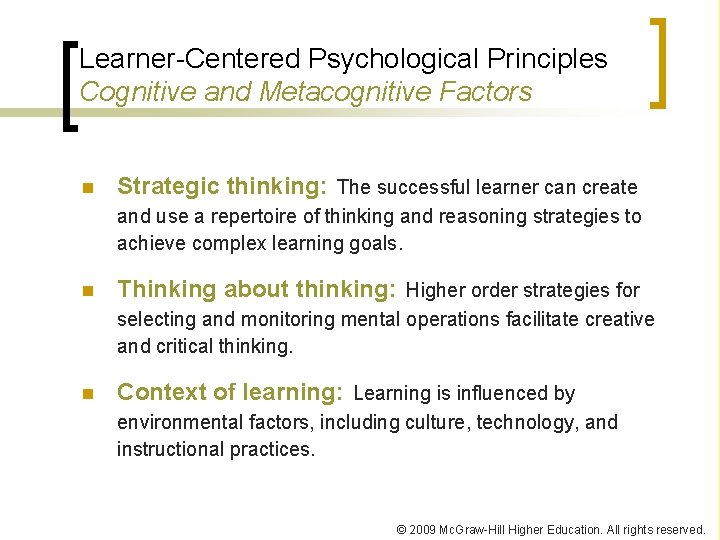
Learner-Centered Psychological Principles Cognitive and Metacognitive Factors n Strategic thinking: The successful learner can create and use a repertoire of thinking and reasoning strategies to achieve complex learning goals. n Thinking about thinking: Higher order strategies for selecting and monitoring mental operations facilitate creative and critical thinking. n Context of learning: Learning is influenced by environmental factors, including culture, technology, and instructional practices. © 2009 Mc. Graw-Hill Higher Education. All rights reserved.
Learner-Centered Psychological Principles Motivational and Affective Factors n Motivational and emotional influences on learning: What and how much is learned is influenced by the learner’s motivation. Motivation to learn, in turn, is influenced by the individual's emotional states, beliefs, interests, and goals, and habits of thinking. n Intrinsic motivation to learn: The learner’s creativity, higher order thinking, and natural curiosity all contribute to motivation to learn. Intrinsic motivation is stimulated by tasks of optimal novelty and difficulty, relevant to personal interests and providing for personal choice and control. © 2009 Mc. Graw-Hill Higher Education. All rights reserved.
Learner-Centered Psychological Principles Motivational and Affective Factors n Effects of motivation on effort: Acquisition of complex knowledge and skills requires extended learner effort and guided practice. Without learners’ motivation to learn, the willingness to exert this effort is unlikely without coercion. © 2009 Mc. Graw-Hill Higher Education. All rights reserved.
Learner-Centered Psychological Principles Developmental and Social Factors n Developmental influence on learning: As individuals develop, they encounter different opportunities and experience different constraints for learning. Learning is most effective when differential development within and across physical, intellectual, emotional, and social domains is taken into account. n Social influences on learning: Learning is influenced by social interactions, interpersonal relations, and communication with others. © 2009 Mc. Graw-Hill Higher Education. All rights reserved.
Learner-Centered Psychological Principles Individual Differences Factors n Individual differences in learning: Learners have different strategies, approaches, and capabilities for learning that are a function of prior experience and heredity. n Learning and diversity: Learning is most effective when differences in learners’ linguistic, cultural, and social backgrounds are taken into account. n Standards and assessment: Setting appropriately high and challenging standards and assessing the learner and learning progress - including diagnostic, process, and outcome assessment - are integral parts of the learning process. © 2009 Mc. Graw-Hill Higher Education. All rights reserved.
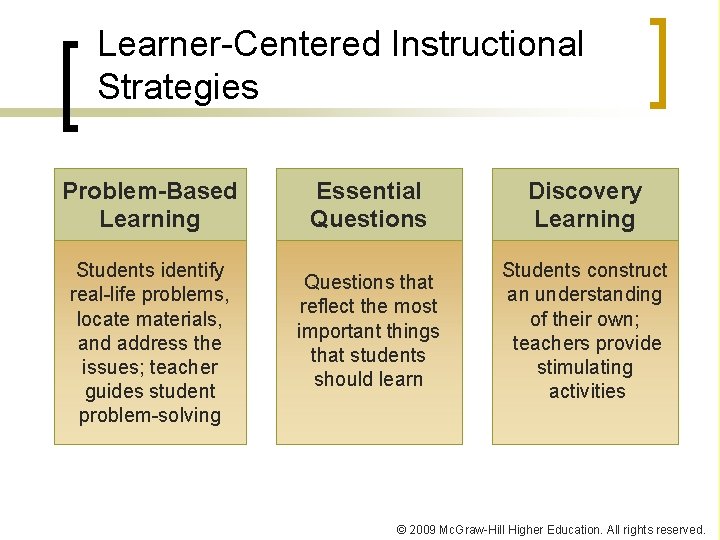
Learner-Centered Instructional Strategies Problem-Based Learning Students identify real-life problems, locate materials, and address the issues; teacher guides student problem-solving Essential Questions Discovery Learning Questions that reflect the most important things that students should learn Students construct an understanding of their own; teachers provide stimulating activities © 2009 Mc. Graw-Hill Higher Education. All rights reserved.
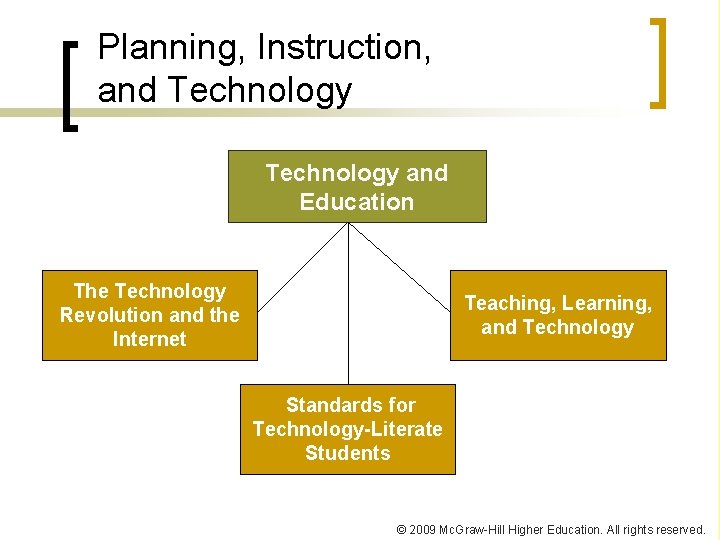
Planning, Instruction, and Technology and Education The Technology Revolution and the Internet Teaching, Learning, and Technology Standards for Technology-Literate Students © 2009 Mc. Graw-Hill Higher Education. All rights reserved.
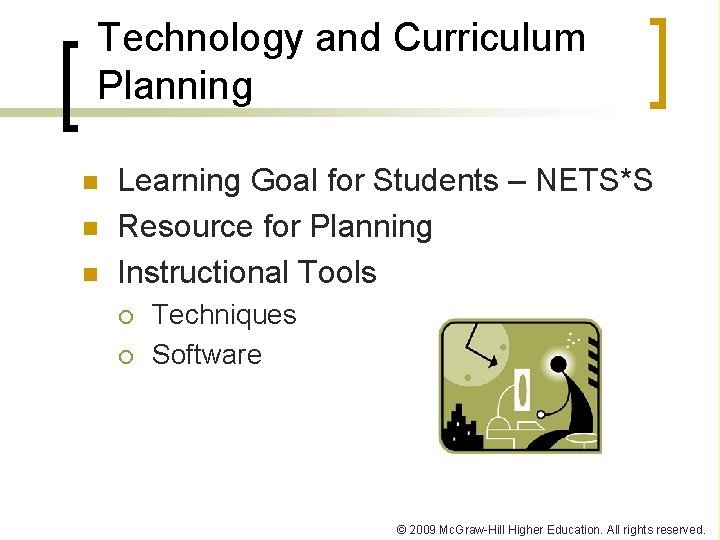
Technology and Curriculum Planning n n n Learning Goal for Students – NETS*S Resource for Planning Instructional Tools ¡ ¡ Techniques Software © 2009 Mc. Graw-Hill Higher Education. All rights reserved.
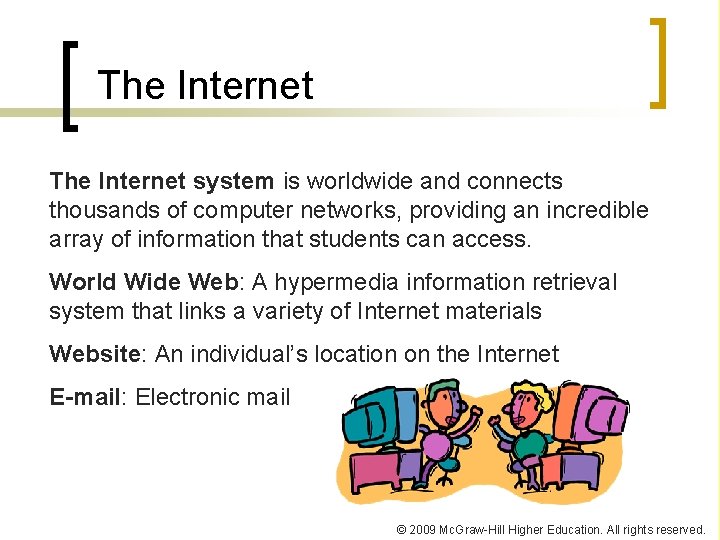
The Internet system is worldwide and connects thousands of computer networks, providing an incredible array of information that students can access. World Wide Web: A hypermedia information retrieval system that links a variety of Internet materials Website: An individual’s location on the Internet E-mail: Electronic mail © 2009 Mc. Graw-Hill Higher Education. All rights reserved.
Standards for Technology. Literate Students – NETS*S n n n Creativity and innovation Communication and collaboration Research and information fluency n Critical thinking, problem solving, and decision making n Digital citizenship n Technology operations and concepts © 2009 Mc. Graw-Hill Higher Education. All rights reserved.
Teaching, Learning, and Technology n n n Evaluate which topics are worth understanding Think about what students should understand about a topic Pay attention to how students develop and demonstrate understanding Consider how students and teachers assess learning Reflect on how students and teachers can learn together © 2009 Mc. Graw-Hill Higher Education. All rights reserved.
Crack the Case The Big Debate 1. 2. 3. 4. What are the issues in this case? Where should Mrs. Rumer go from here? How can she take a curriculum that has been taught in a teacher-centered manner and convert it to a learner-centered curriculum? Should she? Why or why not? How can she incorporate technology into the curriculum so that the computers don’t become mere electronic flash cards? © 2009 Mc. Graw-Hill Higher Education. All rights reserved.
Reflection & Observation Reflection: n In your educational experiences, how have teachers used technology? n How has it affected your learning? Explain. © 2009 Mc. Graw-Hill Higher Education. All rights reserved.