
Chapter 12 Organizational Behavior 15 th Ed Robbins
Chapter 12 Organizational Behavior 15 th Ed Robbins and Judge Leadership Copyright © 2013 Pearson Education, Inc. publishing as Prentice Hall 12 -1
Chapter 12 Learning Objectives After studying this chapter you should be able to: 1. Define leadership and contrast leadership and management. 2. Summarize the conclusions of trait theories of leadership. 3. Identify the central tenets and main limitations of behavioral theories. 4. Assess contingency theories of leadership by their level of support. 5. Compare and contrast charismatic and transformational leadership. 6. Define authentic leadership and show why effective leaders exemplify ethics and trust. 7. Demonstrate the role mentoring plays in our understanding of leadership. 8. Address challenges to the effectiveness of leadership. Copyright © 2013 Pearson Education, Inc. publishing as Prentice Hall 12 -2
LO 1 Define leadership and contrast leadership and management Leadership is the ability to influence a group toward the achievement of a vision or set of goals. Not all leaders are managers nor are all managers leaders. Nonsanctioned leadership is often as important or more important than formal influence. Copyright © 2013 Pearson Education, Inc. publishing as Prentice Hall 12 -3
LO 1 Define leadership and contrast leadership and management Strong leadership and strong management are needed for optimal effectiveness. Leaders are needed today to challenge the status quo, create visions of the future, and inspire organizational members to want to achieve the visions. Managers formulate detailed plans, create efficient organizational structures, and oversee day-to-day operations. Copyright © 2013 Pearson Education, Inc. publishing as Prentice Hall 12 -4
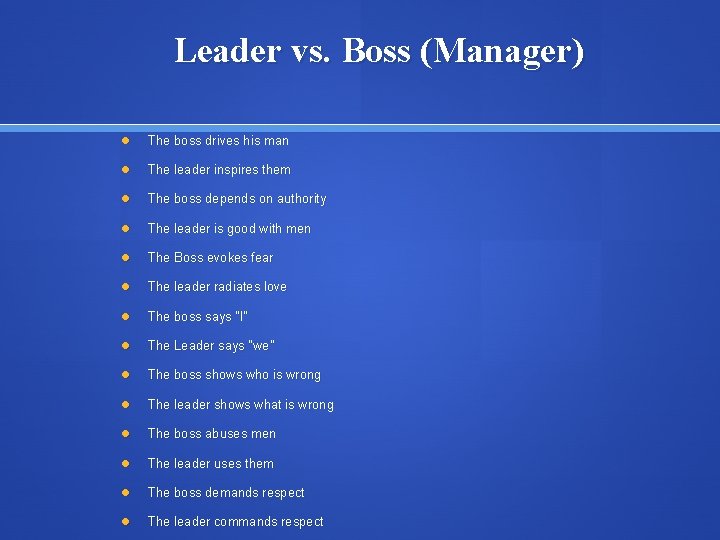
Leader vs. Boss (Manager) The boss drives his man The leader inspires them The boss depends on authority The leader is good with men The Boss evokes fear The leader radiates love The boss says “I” The Leader says “we” The boss shows who is wrong The leader shows what is wrong The boss abuses men The leader uses them The boss demands respect The leader commands respect
LO 2 Summarize the conclusions of trait theories of leadership Trait theories of leadership focus on personal qualities and characteristics. The search for personality, social, physical, or intellectual attributes that differentiate leaders from nonleaders goes back to the earliest stages of leadership research. Copyright © 2013 Pearson Education, Inc. publishing as Prentice Hall 12 -6
LO 2 Summarize the conclusions of trait theories of leadership A breakthrough, of sorts, came when researchers began organizing traits around the Big Five personality framework (see Chapter 5). Most of the dozens of traits in various leadership reviews fit under one of the Big Five (ambition and energy are part of extraversion, for instance), giving strong support to traits as predictors of leadership. Copyright © 2013 Pearson Education, Inc. publishing as Prentice Hall 12 -7
LO 2 Summarize the conclusions of trait theories of leadership The trait approach does have something to offer. Leaders who like being around people and are able to assert themselves (extraverted), who are disciplined and able to keep commitments they make (conscientious), and who are creative and flexible (open) do have an apparent advantage when it comes to leadership, suggesting good leaders do have key traits in common. Copyright © 2013 Pearson Education, Inc. publishing as Prentice Hall 12 -8
LO 2 Summarize the conclusions of trait theories of leadership Another trait that may indicate effective leadership is emotional intelligence (EI). Advocates of EI argue that without it, a person can have outstanding training, a highly analytical mind, a compelling vision, and an endless supply of terrific ideas but still not make a great leader. A core component of EI is empathy. Copyright © 2013 Pearson Education, Inc. publishing as Prentice Hall 12 -9
LO 2 Summarize the conclusions of trait theories of leadership Conclusions based on the latest findings. Contrary to what we believed 20 years ago and thanks to the Big Five, we can say that traits can predict leadership. Traits do a better job predicting the emergence of leaders and the appearance of leadership than actually distinguishing between effective and ineffective leaders. Copyright © 2013 Pearson Education, Inc. publishing as Prentice Hall 12 -10
Identify the central tenets and LO main 3 limitations of behavioral theories Ohio State Studies found two behaviors that accounted for leadership behavior Initiating structure-the extent to which a leader is likely to define and structure his or her role and those of employees in the search for goal attainment. Consideration is the extent to which a person’s job relationships are characterized by mutual trust, respect for employees’ ideas, and regard for their feelings. Copyright © 2013 Pearson Education, Inc. publishing as Prentice Hall 12 -11
Identify the central tenets and LO main 3 limitations of behavioral theories University of Michigan’s objectives also came up with two behavioral dimensions The employee-oriented leader emphasized interpersonal relationships by taking a personal interest in the needs of employees and accepting individual differences among them. The production-oriented leader emphasized the technical or task aspects of the job, focusing on accomplishing the group’s tasks. Copyright © 2013 Pearson Education, Inc. publishing as Prentice Hall 12 -12
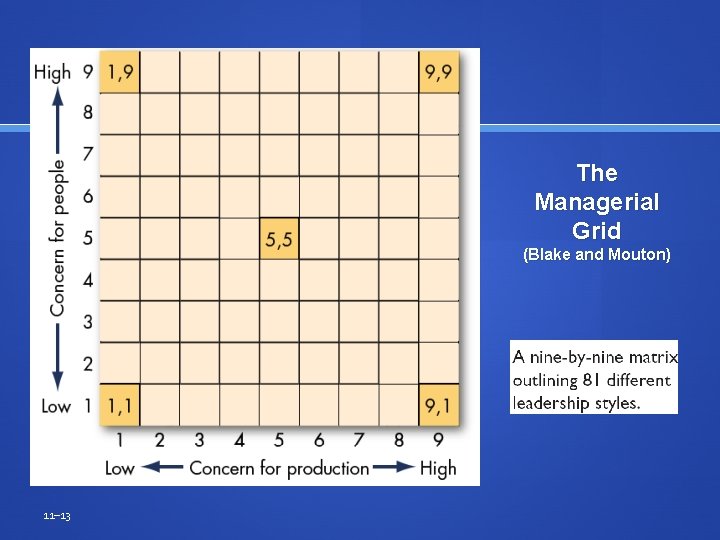
The Managerial Grid (Blake and Mouton) 11– 13
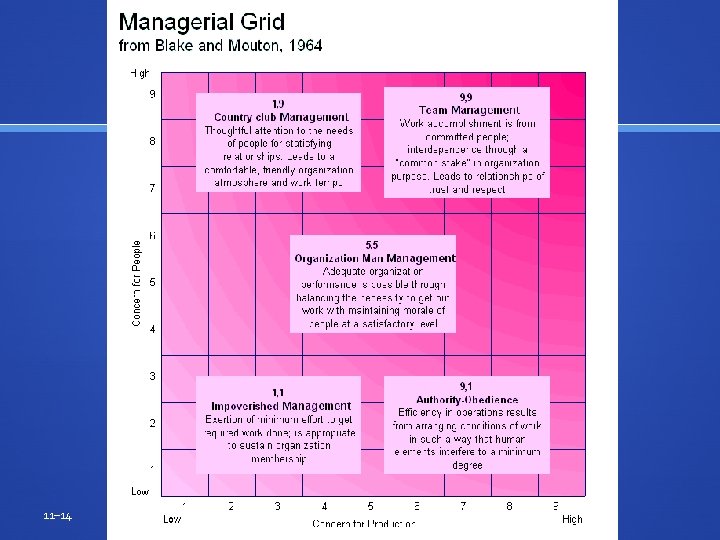
11– 14
Identify the central tenets and LO main 3 limitations of behavioral theories Summary of Trait Theories and Behavioral Theories Leaders who have certain traits and who display consideration and structuring behaviors do appear to be more effective. As important as traits and behaviors are in identifying effective or ineffective leaders, they do not guarantee success. The context matters, too. Copyright © 2013 Pearson Education, Inc. publishing as Prentice Hall 12 -15
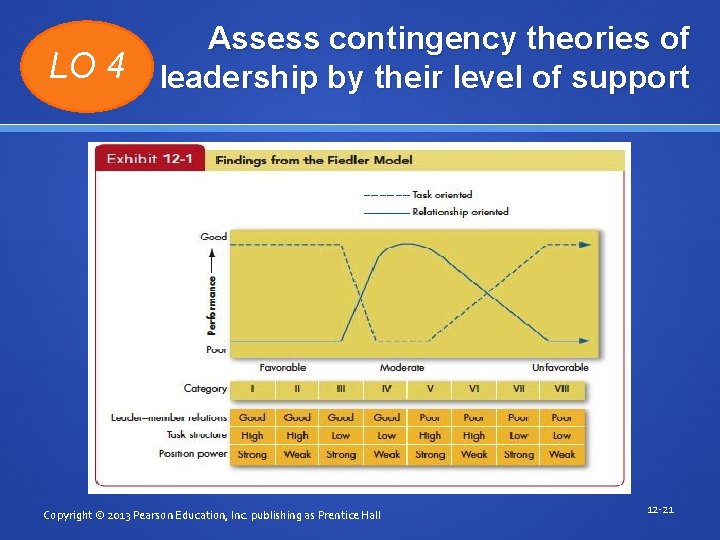
LO 4 Assess contingency theories of leadership by their level of support Contingency Theory-Fiedler Model Key factor is individual’s leadership style Task or Relationship oriented Assumes leadership style is fixed Copyright © 2013 Pearson Education, Inc. publishing as Prentice Hall 12 -16
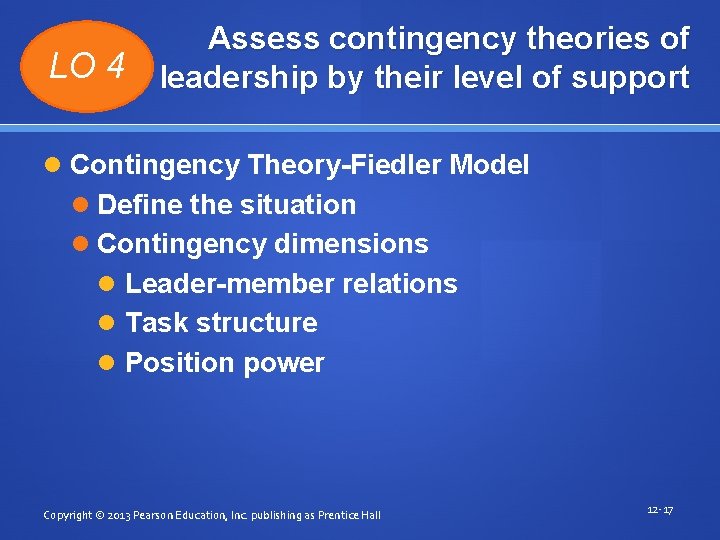
LO 4 Assess contingency theories of leadership by their level of support Contingency Theory-Fiedler Model Define the situation Contingency dimensions Leader-member relations Task structure Position power Copyright © 2013 Pearson Education, Inc. publishing as Prentice Hall 12 -17
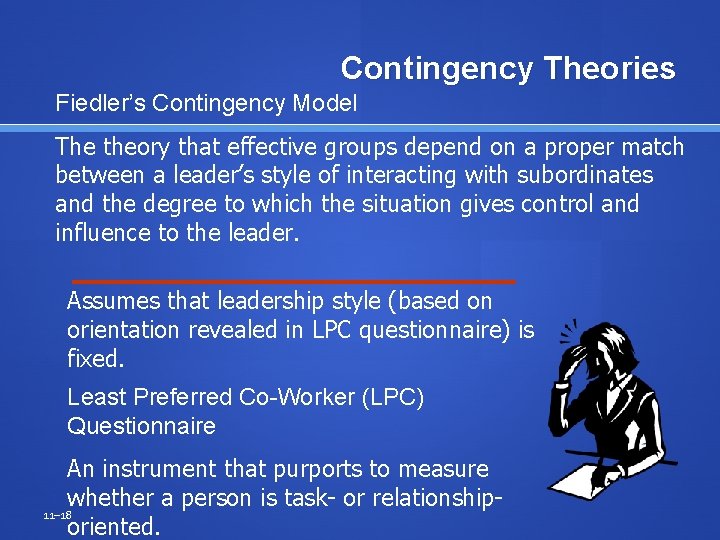
Contingency Theories Fiedler’s Contingency Model The theory that effective groups depend on a proper match between a leader’s style of interacting with subordinates and the degree to which the situation gives control and influence to the leader. Assumes that leadership style (based on orientation revealed in LPC questionnaire) is fixed. Least Preferred Co-Worker (LPC) Questionnaire An instrument that purports to measure whether a person is task- or relationship 11– 18 oriented.
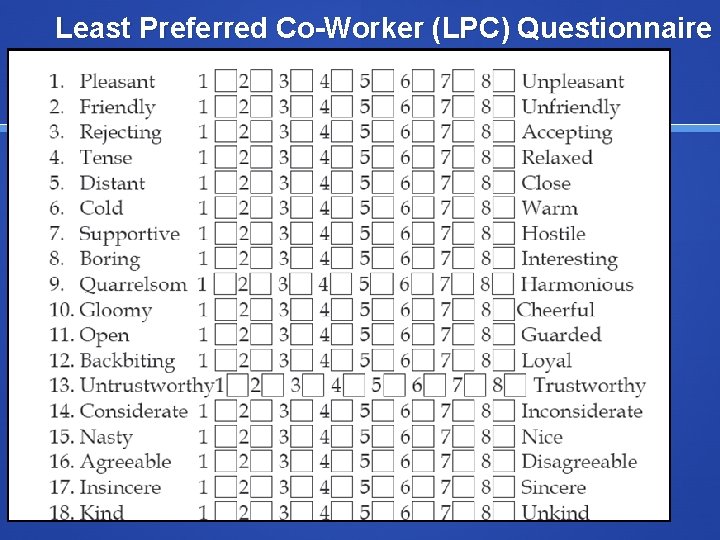
Least Preferred Co-Worker (LPC) Questionnaire 11– 19
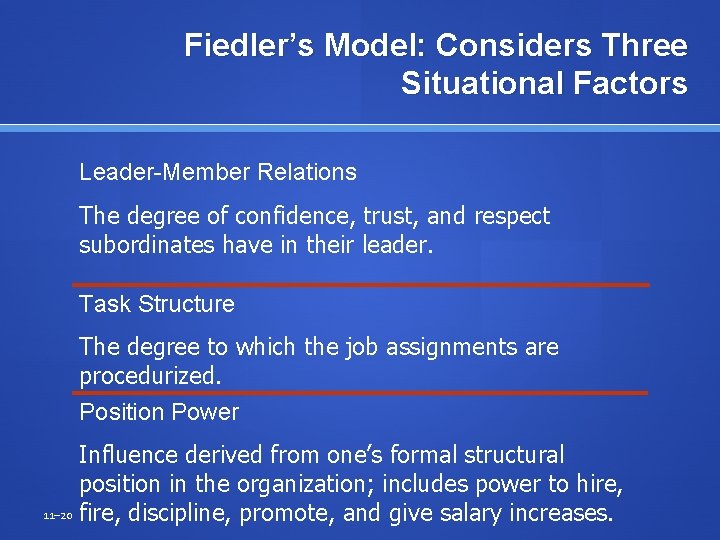
Fiedler’s Model: Considers Three Situational Factors Leader-Member Relations The degree of confidence, trust, and respect subordinates have in their leader. Task Structure The degree to which the job assignments are procedurized. Position Power Influence derived from one’s formal structural position in the organization; includes power to hire, 11– 20 fire, discipline, promote, and give salary increases.
LO 4 Assess contingency theories of leadership by their level of support Copyright © 2013 Pearson Education, Inc. publishing as Prentice Hall 12 -21
Fiedler Model For effective leadership: must change to a leader who fits the situation or change the situational variables to fit the current leader Copyright © 2011 Pearson Education 12 -22
LO 5 Charismatic leadership Copyright © 2013 Pearson Education, Inc. publishing as Prentice Hall 12 -23
Charismatic Leadership How do charismatic leaders influence followers? Articulate a Vision Create a Vision Statement Create a new set of Values Demonstrate the Vision trough unconventional behavior 12 -24
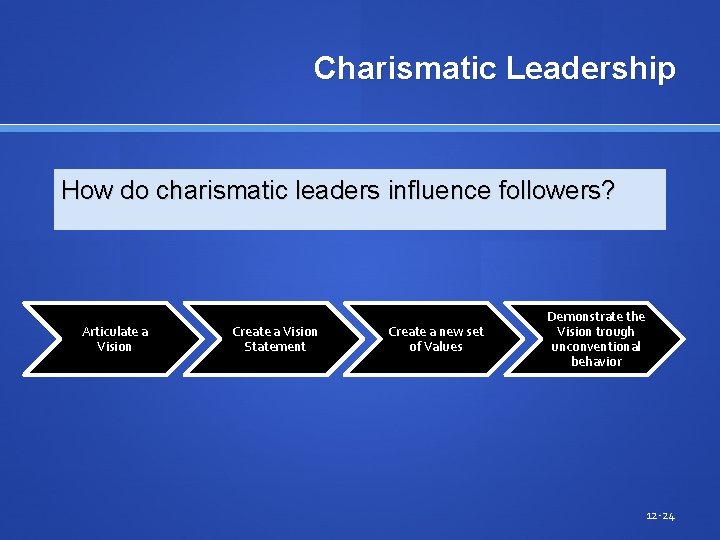
Does Effective Charismatic leadership Depends on the Situation? Impressive correlation observed between charismatic leadership and high performance and satisfaction. Organizations with charismatic CEOs are found more profitable. Charismatic leadership works better when High degree of stress or uncertainty The leader has high position in the hierarchy. Copyright © 2013 Pearson Education, Inc. publishing as Prentice Hall 1 -25
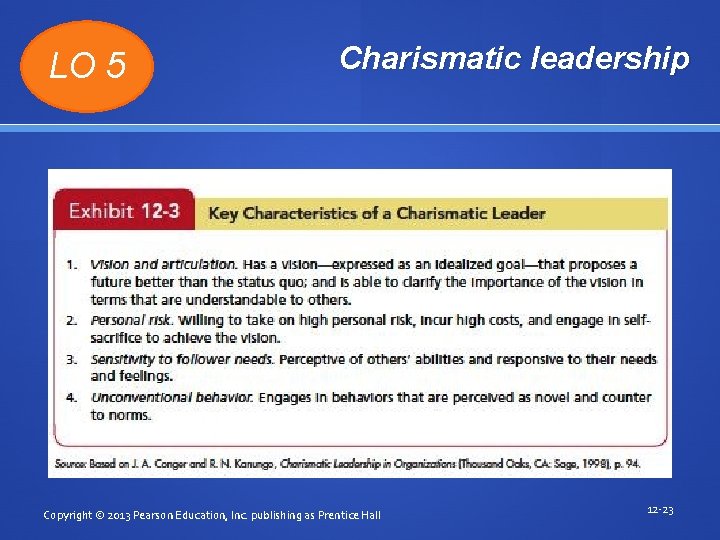
LO 5 Charismatic leadership The Dark Side of Charismatic Leadership Dark Side Charismatic can affect all types of organizations. Many have allowed their personal goals to override the goals of the organization. Research has shown that individuals who are narcissistic are also higher in some behaviors associated with charismatic leadership. Some charismatic leaders are too successful convincing followers to pursue a vision that can be disastrous. Copyright © 2013 Pearson Education, Inc. publishing as Prentice Hall 12 -26
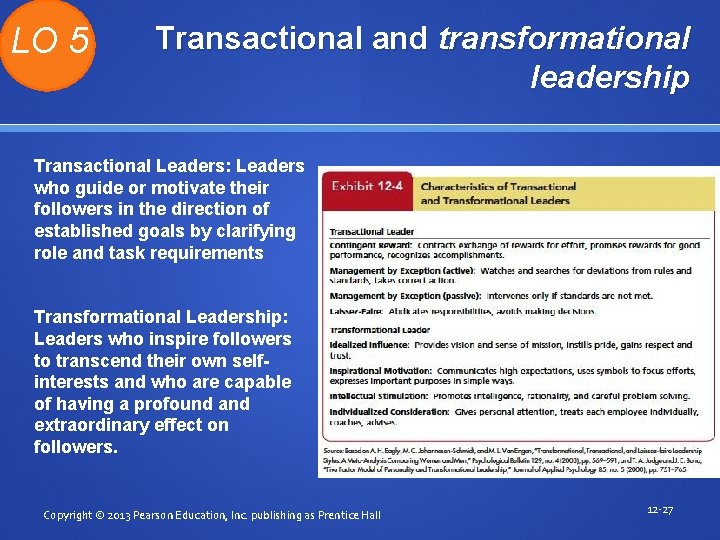
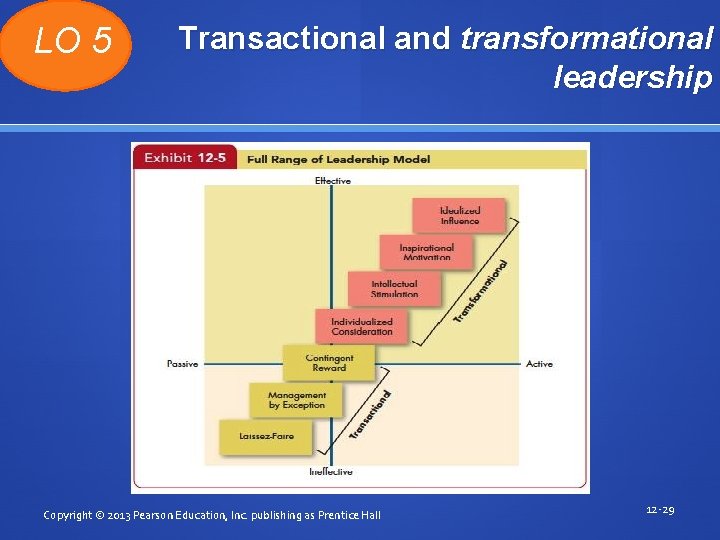
LO 5 Transactional and transformational leadership Transactional Leaders: Leaders who guide or motivate their followers in the direction of established goals by clarifying role and task requirements Transformational Leadership: Leaders who inspire followers to transcend their own selfinterests and who are capable of having a profound and extraordinary effect on followers. Copyright © 2013 Pearson Education, Inc. publishing as Prentice Hall 12 -27
Transactional and transformational leadership aren’t opposing approaches to getting things done. They complement each other. The best leaders are transactional and transformational. Copyright © 2013 Pearson Education, Inc. publishing as Prentice Hall 1 -28
LO 5 Transactional and transformational leadership Copyright © 2013 Pearson Education, Inc. publishing as Prentice Hall 12 -29
LO 5 Transactional and transformational leadership How Transformational Leadership works: Creativity, theirs and others. Decentralization of responsibility. Propensity to take risks. Compensation is geared toward long-term results. Greater agreement among top managers about the organization’s goals. Increase follower self-efficacy, giving the group a “can do” spirit. Copyright © 2013 Pearson Education, Inc. publishing as Prentice Hall 12 -30
LO 5 Transactional and transformational leadership Transformational leadership has been impressively supported at diverse job levels and occupations (school principals, teachers, marine commanders, ministers, presidents of MBA associations, military cadets, union shop stewards, sales reps). Copyright © 2013 Pearson Education, Inc. publishing as Prentice Hall 12 -31
LO 5 Transactional and transformational leadership Transformational leadership isn’t equally effective in all situations. It has a greater impact on the bottom line in smaller, privately held firms than in more complex organizations. It may be more effective when leaders can directly interact with the workforce and make decisions than when they report to an external board of directors or deal with a complex structure. Copyright © 2013 Pearson Education, Inc. publishing as Prentice Hall 12 -32
Summary and Implications for Managers Knowing what makes a good leader should thus be valuable in improving group performance. Search for universal leadership traits failed. However, recent effort using Big Five model shows conscientiousness, extroversion and openness to experience along with emotional intelligence have consistent relationship with leadership. Behavioral approach’s contribution was narrowing leadership into task-oriented (initiating structure) and people-oriented (consideration) styles. Organizations are increasingly searching for managers who can exhibit transformational leadership qualities. Copyright © 2013 Pearson Education, Inc. publishing as Prentice Hall 12 -33

All rights reserved. No part of this publication may be reproduced, stored in a retrieval system, or transmitted, in any form or by any means, electronic, mechanical, photocopying, recording, or otherwise, without the prior written permission of the publisher. Printed in the United States of America. Copyright © 2013 Pearson Education, Inc. publishing as Prentice Hall Copyright © 2013 Pearson Education, Inc. publishing as Prentice Hall 12 -34
- Slides: 34