
Chapter 12 Organization of the Nervous System and


- Slides: 25
Chapter 12 Organization of the Nervous System and Neural Tissue The Nervous System maintains homeostasis and responds to stimuli faster than any other system! Part A. Organization Part B. Neural Tissue
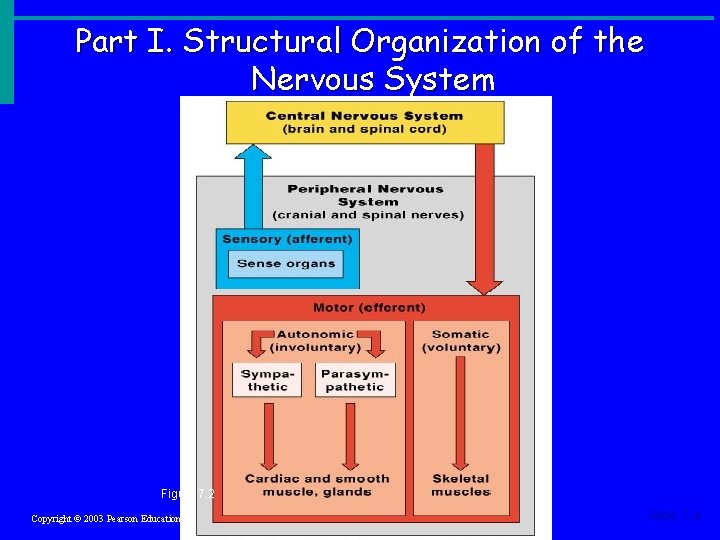
Part I. Structural Organization of the Nervous System Figure 7. 2 Copyright © 2003 Pearson Education, Inc. publishing as Benjamin Cummings Slide 7. 4
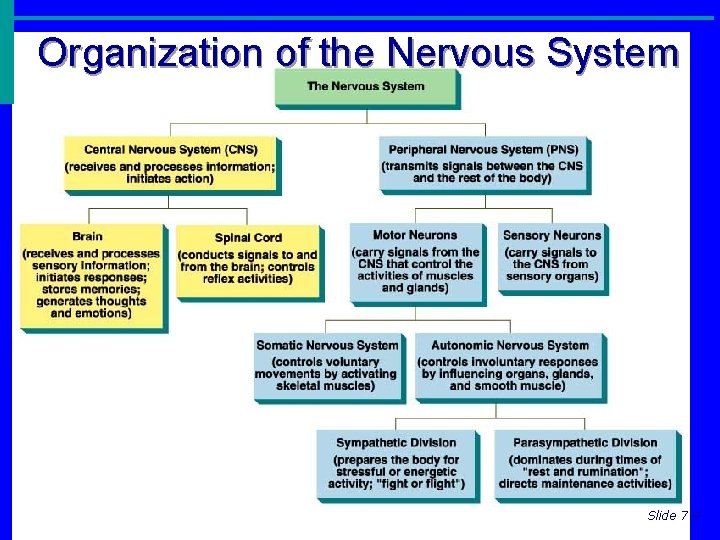
Organization of the Nervous System Copyright © 2003 Pearson Education, Inc. publishing as Benjamin Cummings Slide 7. 4
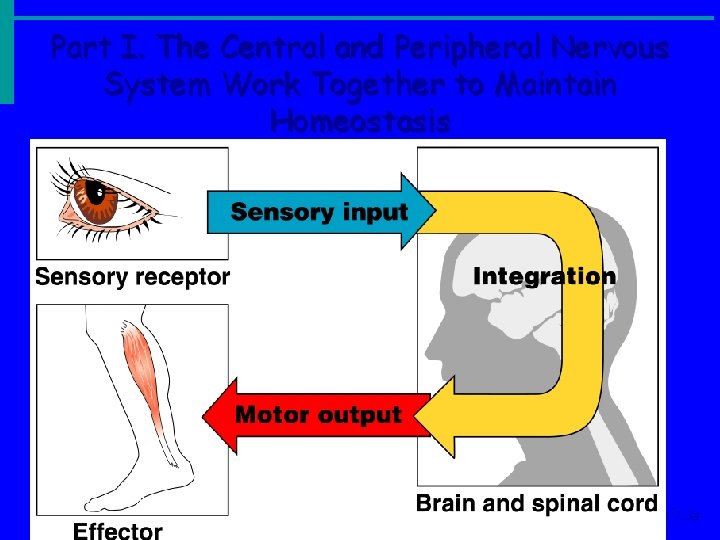
Part I. The Central and Peripheral Nervous System Work Together to Maintain Homeostasis Figure 7. 1 Copyright © 2003 Pearson Education, Inc. publishing as Benjamin Cummings Slide 7. 3 a
Part I. The CNS (brain, spinal cord) Performs Two Basic Functions 1. Integrates, Processes and Coordinates Sensory Information from inside and outside the body 2. It conducts all higher functions: intelligence, learning, memory, and emotion
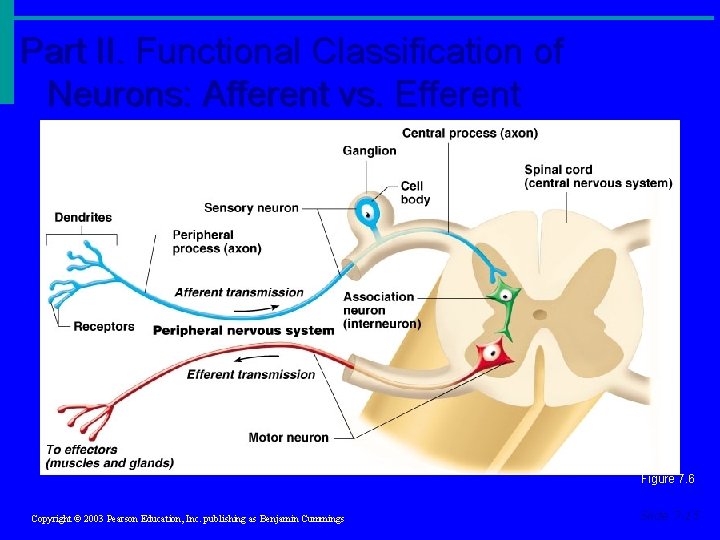
Part I. The PNS is divided into Two Basic Parts: 1. Sensory Neurons- carry signals from sensory receptors (eye, ear, nose, etc) to CNS. AFFERENT 2. Motor Neurons- carry signals from CNS to muscles and glands EFFERENT
The Motor Division of the PNS is further divided: · Somatic Nervous System = voluntary, i. e. skeletal muscles · Autonomic Nervous System = involuntary, i. e. smooth muscle, cardiac muscle, and glands Slide 7. 3 c
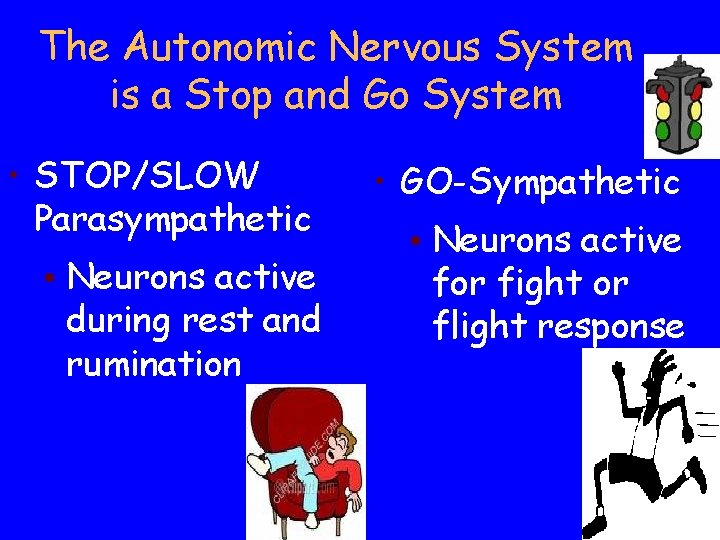
The Autonomic Nervous System is a Stop and Go System • STOP/SLOW Parasympathetic • Neurons active during rest and rumination • GO-Sympathetic • Neurons active for fight or flight response
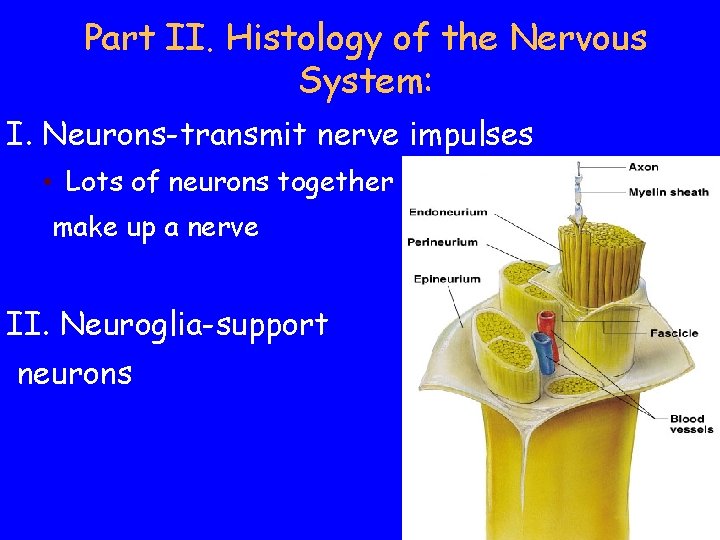
Part II. Histology of the Nervous System: I. Neurons-transmit nerve impulses • Lots of neurons together make up a nerve II. Neuroglia-support neurons
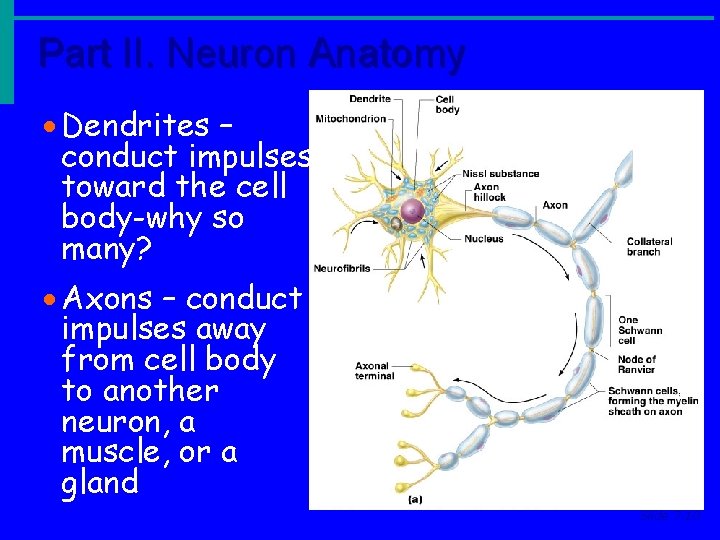
Neurons transmit signals chemically and electrically · How does their structure enable them to perform this function? · Three Major Parts of Neurons: · Cell body (soma) · Dendrites · Axon Copyright © 2003 Pearson Education, Inc. publishing as Benjamin Cummings Slide 7. 8
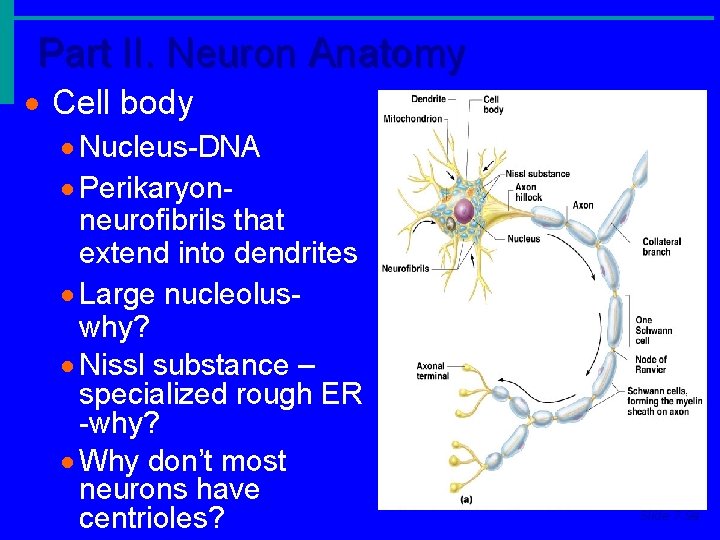
Part II. Neuron Anatomy · Dendrites – conduct impulses toward the cell body-why so many? · Axons – conduct impulses away from cell body to another neuron, a muscle, or a gland Figure 7. 4 a Slide 7. 10
Part II. Dendrites and Axons Terminals · Dendrites- lots of dendritic spines-why? · Axons-Contain fibrils, tubules, vesicles, mitochondria · Axons end in Synaptic Terminals · separated from the next neuron by a gap called Synaptic cleft – · Synapse – junction between nerves Copyright © 2003 Pearson Education, Inc. publishing as Benjamin Cummings Slide 7. 11
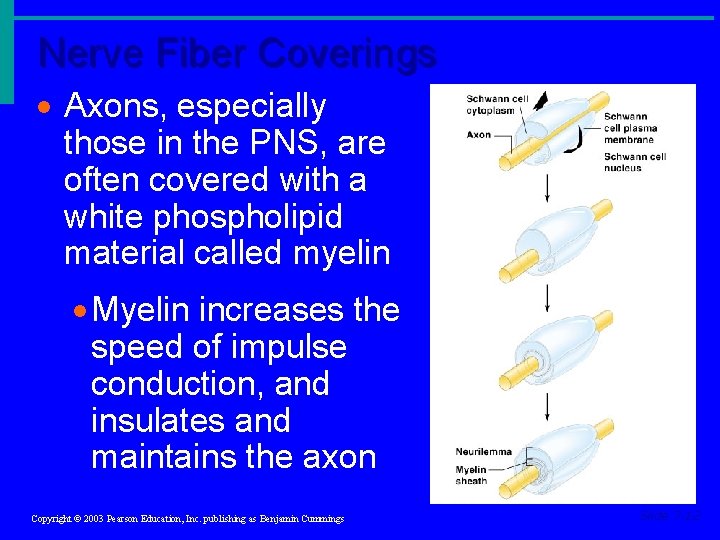
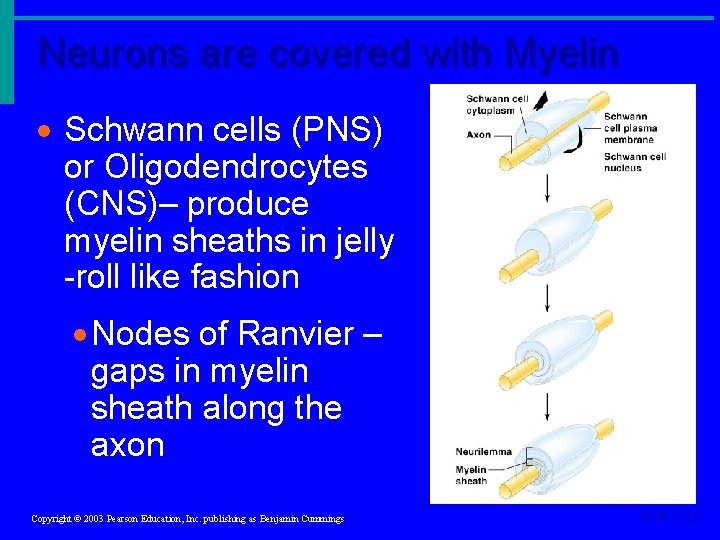
Nerve Fiber Coverings · Axons, especially those in the PNS, are often covered with a white phospholipid material called myelin · Myelin increases the speed of impulse conduction, and insulates and maintains the axon Figure 7. 5 Copyright © 2003 Pearson Education, Inc. publishing as Benjamin Cummings Slide 7. 12
Part II. Neuron Anatomy · Cell body · Nucleus-DNA · Perikaryonneurofibrils that extend into dendrites · Large nucleoluswhy? · Nissl substance – specialized rough ER -why? · Why don’t most neurons have centrioles? Figure 7. 4 a Slide 7. 9 a
Neurons are covered with Myelin · Schwann cells (PNS) or Oligodendrocytes (CNS)– produce myelin sheaths in jelly -roll like fashion · Nodes of Ranvier – gaps in myelin sheath along the axon Figure 7. 5 Copyright © 2003 Pearson Education, Inc. publishing as Benjamin Cummings Slide 7. 12
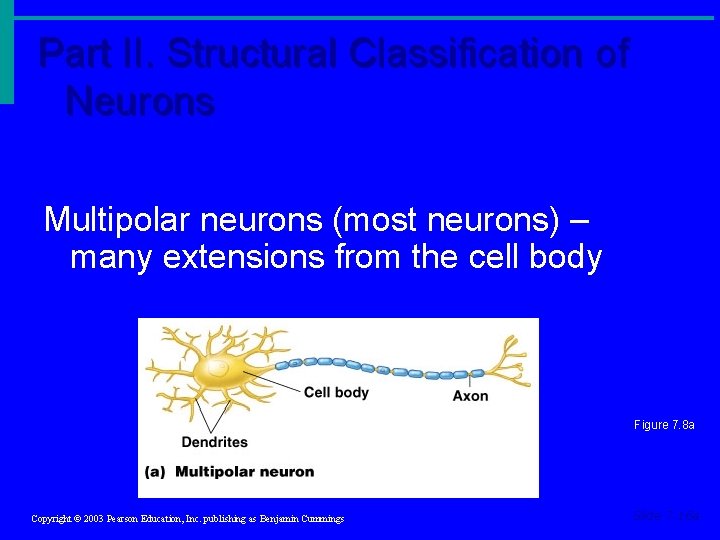
Part II. Structural Classification of Neurons Multipolar neurons (most neurons) – many extensions from the cell body Figure 7. 8 a Copyright © 2003 Pearson Education, Inc. publishing as Benjamin Cummings Slide 7. 16 a
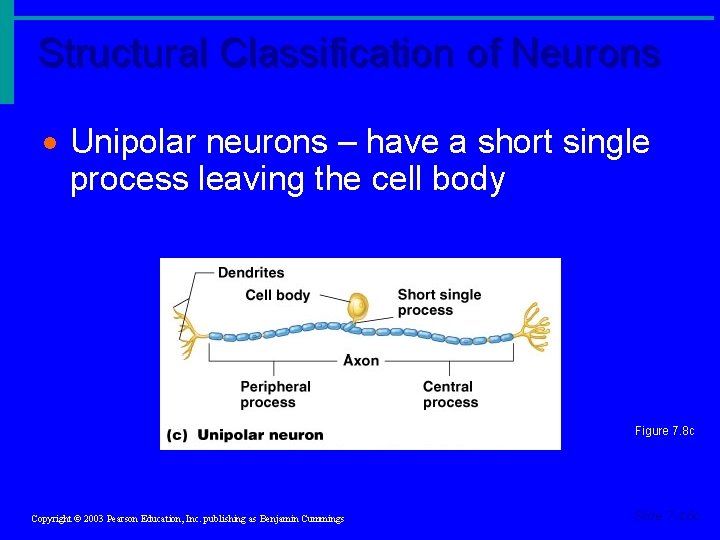
Structural Classification of Neurons · Unipolar neurons – have a short single process leaving the cell body Figure 7. 8 c Copyright © 2003 Pearson Education, Inc. publishing as Benjamin Cummings Slide 7. 16 c
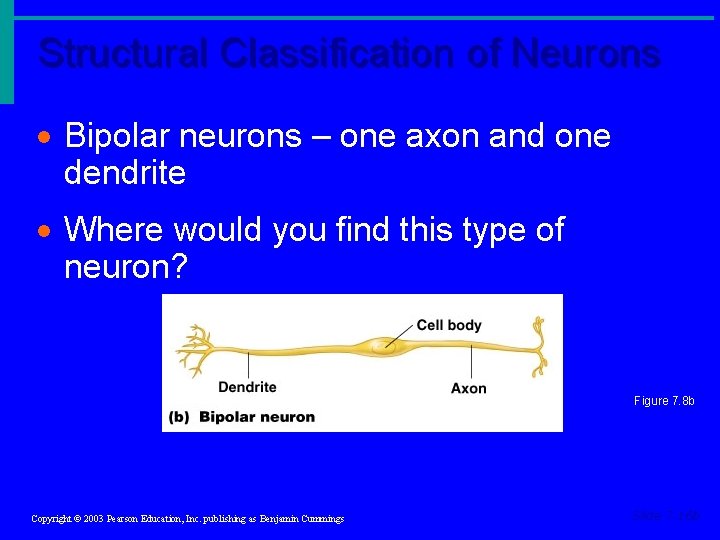
Structural Classification of Neurons · Bipolar neurons – one axon and one dendrite · Where would you find this type of neuron? Figure 7. 8 b Copyright © 2003 Pearson Education, Inc. publishing as Benjamin Cummings Slide 7. 16 b
Part II. Functional Classification of Neurons: Afferent vs. Efferent Figure 7. 6 Copyright © 2003 Pearson Education, Inc. publishing as Benjamin Cummings Slide 7. 15
Part III. Neuroglial Cells Support Neurons 1. produce the blood-brain barrier 2. produce the myelin sheath around axons of the CNS 3. carry out phagocytosis 4. line cavities of brain and spinal cord, produce CSF 5. produce myelin around neurons in PNS 6. protect neuron cell bodies
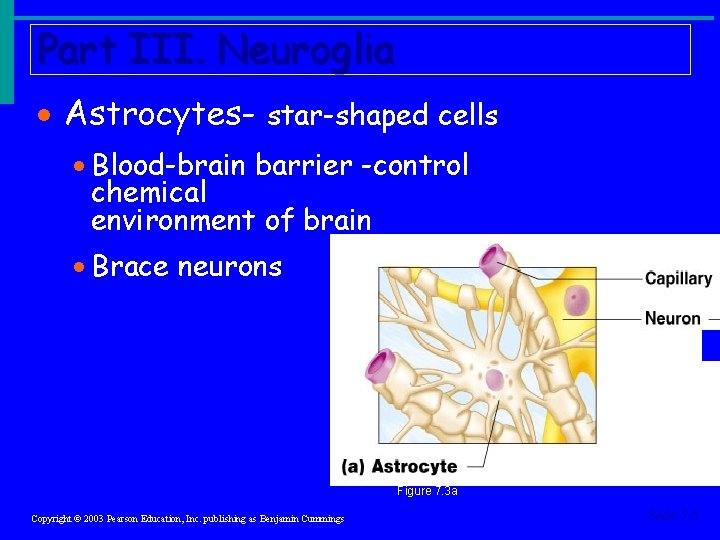
Part III. Neuroglia · Astrocytes- star-shaped cells · Blood-brain barrier -control chemical environment of brain · Brace neurons Figure 7. 3 a Copyright © 2003 Pearson Education, Inc. publishing as Benjamin Cummings Slide 7. 5
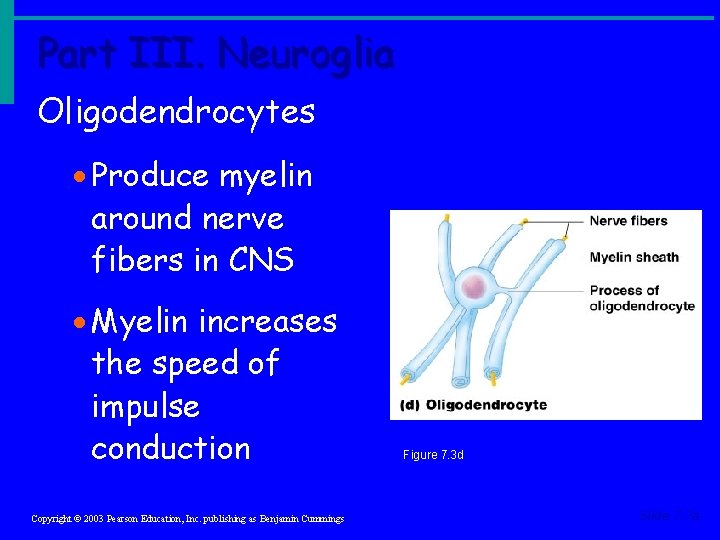
Part III. Neuroglia Oligodendrocytes · Produce myelin around nerve fibers in CNS · Myelin increases the speed of impulse conduction Copyright © 2003 Pearson Education, Inc. publishing as Benjamin Cummings Figure 7. 3 d Slide 7. 7 a
Part III. Neuroglia · Microglia · Phagocytes-dispose of debris · Ependymal cells · Line cavities of the brain and spinal cord · Circulate cerebrospinal fluid Figure 7. 3 b, c Copyright © 2003 Pearson Education, Inc. publishing as Benjamin Cummings Slide 7. 6
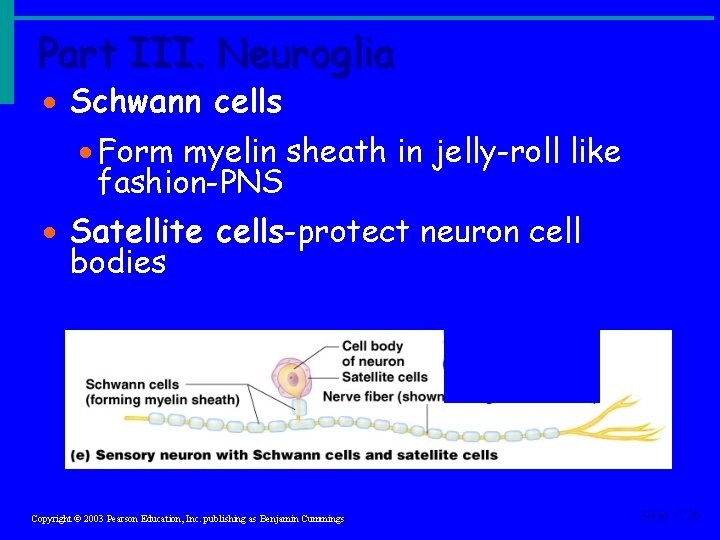
Part III. Neuroglia · Schwann cells · Form myelin sheath in jelly-roll like fashion-PNS · Satellite cells-protect neuron cell bodies Figure 7. 3 e Copyright © 2003 Pearson Education, Inc. publishing as Benjamin Cummings Slide 7. 7 b
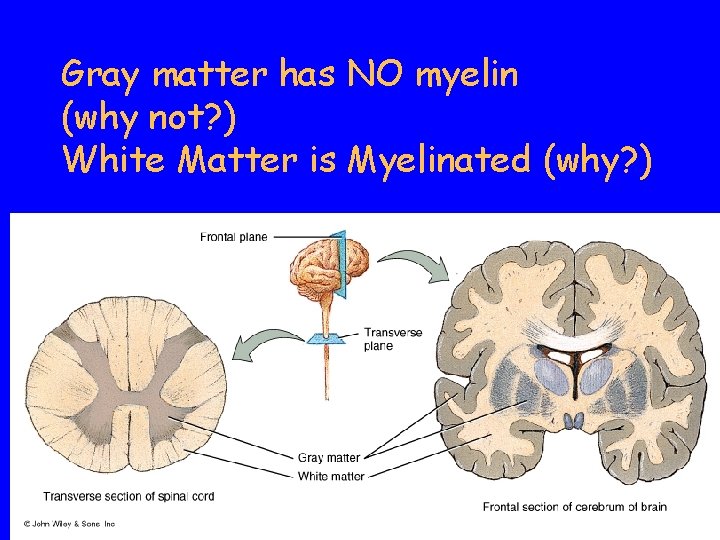
Gray matter has NO myelin (why not? ) White Matter is Myelinated (why? )