
Chapter 12 ObjectOriented Design Chapter Goals To learn
Chapter 12 – Object-Oriented Design
Chapter Goals § To learn how to discover new classes and methods To use CRC cards for class discovery § To identify inheritance, aggregation, and dependency relationships between classes § To describe class relationships using UML class diagrams § To apply object-oriented design techniques to building complex programs
Discovering Classes When designing a program, you work from a requirements specification The designer’s task is to discover structures that make it possible to implement the requirements To discover classes, look for nouns in the problem description. Find methods by looking for verbs in the task description.
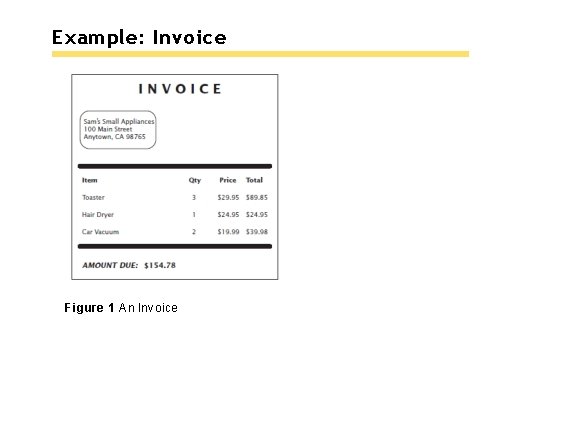
Example: Invoice Figure 1 An Invoice
Example: Invoice Classes that come to mind: Invoice Line. Item Customer Good idea to keep a list of candidate classes. Brainstorm: put all ideas for classes onto the list. Cross not useful ones later. Concepts from the problem domain are good candidates for classes. Not all classes can be discovered from the program requirements: Most programs need tactical classes
The CRC Card Method In a class scheduling system, potential classes from the problem domain include Class, Lecture. Hall, Instructor, and Student.
The CRC Card Method After you have a set of classes Define the behavior (methods) of each class Look for verbs in the task description Match the verbs to the appropriate objects The invoice program needs to compute the amount due Which class is responsible for this method? Invoice class
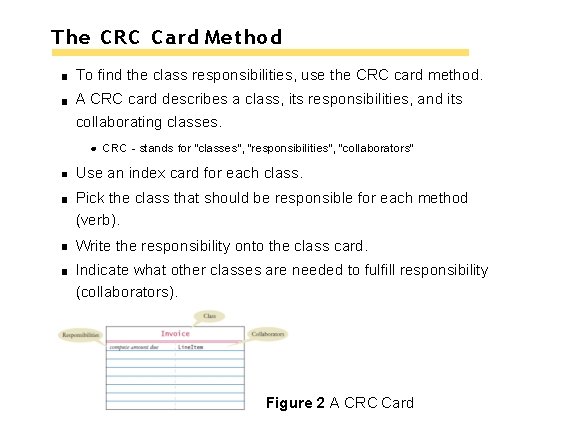
The CRC Card Method To find the class responsibilities, use the CRC card method. A CRC card describes a class, its responsibilities, and its collaborating classes. CRC - stands for “classes”, “responsibilities”, “collaborators” Use an index card for each class. Pick the class that should be responsible for each method (verb). Write the responsibility onto the class card. Indicate what other classes are needed to fulfill responsibility (collaborators). Figure 2 A CRC Card
Self Check 12. 1 What is the rule of thumb for finding classes? Answer: Look for nouns in the problem description.
Self Check 12. 2 Your job is to write a program that plays chess. Might Chess. Boardbe an appropriate class? How about Move. Piece? Answer: Yes (Chess. Board) and no (Move. Piece).
Self Check 12. 3 Suppose the invoice is to be saved to a file. Name a likely collaborator. Answer: Print. Stream
Self Check 12. 4 Looking at the invoice in Figure 1, what is a likely responsibility of the Customer class? Answer: To produce the shipping address of the customer.
Self Check 12. 5 What do you do if a CRC card has ten responsibilities? Answer: Reword the responsibilities so that they are at a higher level, or come up with more classes to handle the responsibilities.
Relationships Between Classes The most common types of relationships: Dependency Aggregation Inheritance
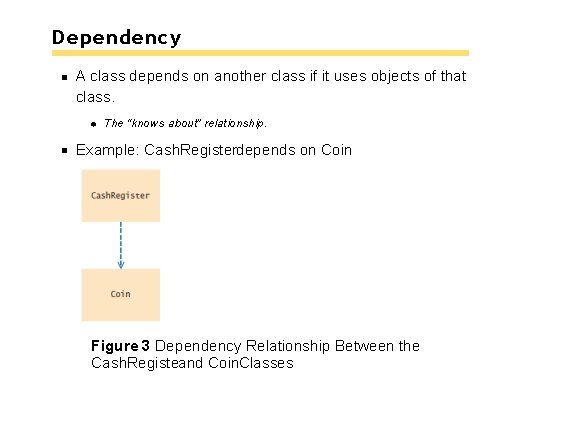
Dependency A class depends on another class if it uses objects of that class. The “knows about” relationship. Example: Cash. Registerdepends on Coin Figure 3 Dependency Relationship Between the Cash. Registeand Coin. Classes
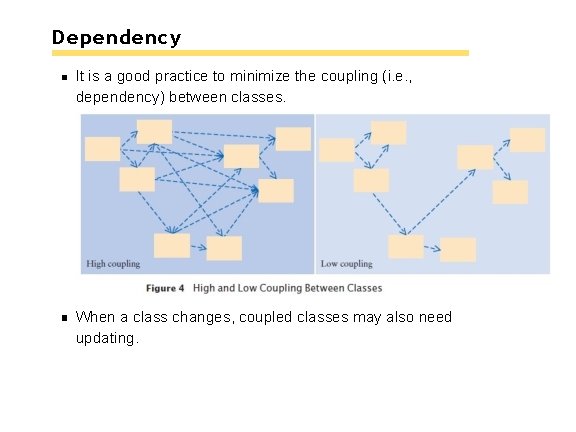
Dependency It is a good practice to minimize the coupling (i. e. , dependency) between classes. When a class changes, coupled classes may also need updating.
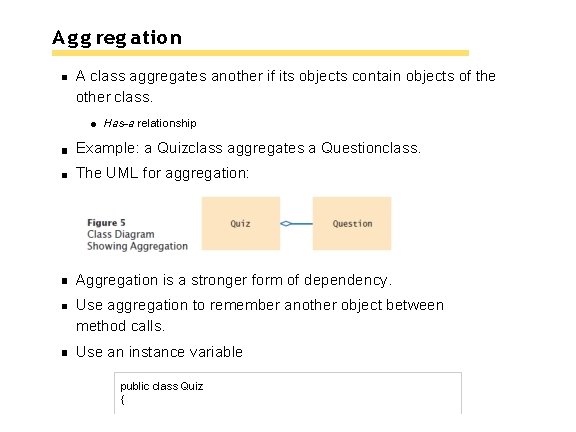
A g g reg ation A class aggregates another if its objects contain objects of the other class. Has-a relationship Example: a Quizclass aggregates a Questionclass. The UML for aggregation: Aggregation is a stronger form of dependency. Use aggregation to remember another object between method calls. Use an instance variable public class Quiz {
private Array. List<Question> questions; . . . } A class may use the Scannerclass without ever declaring an instance variable of class Scanner. This is dependency NOT aggregation
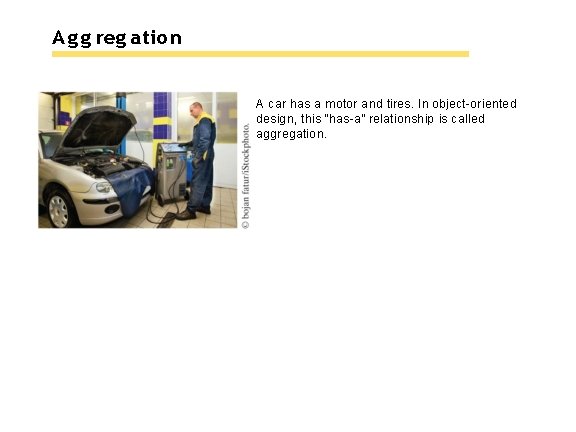
A g g reg ation A car has a motor and tires. In object-oriented design, this “has-a” relationship is called aggregation.
Inheritance is a relationship between a more general class (the superclass) and a more specialized class (the subclass). The “is-a” relationship. Example: Every truck is a vehicle. Inheritance is sometimes inappropriately used when the has-a relationship would be more appropriate. Should the class Tirebe a subclass of a class Circle? No A tire has a circle as its boundary Use aggregation public class Tire { private String rating; private Circle boundary; . . . }
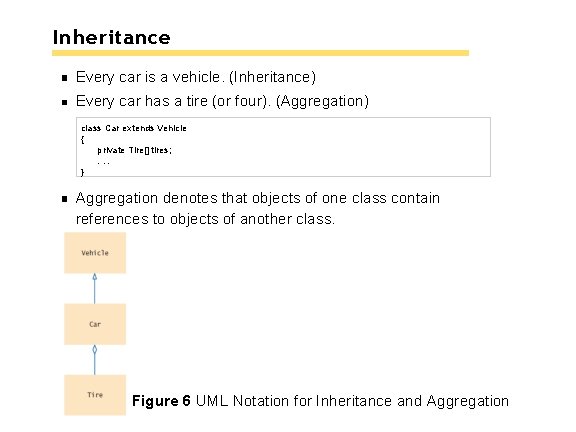
Inheritance Every car is a vehicle. (Inheritance) Every car has a tire (or four). (Aggregation) class Car extends Vehicle { private Tire[] tires; . . . } Aggregation denotes that objects of one class contain references to objects of another class. Figure 6 UML Notation for Inheritance and Aggregation
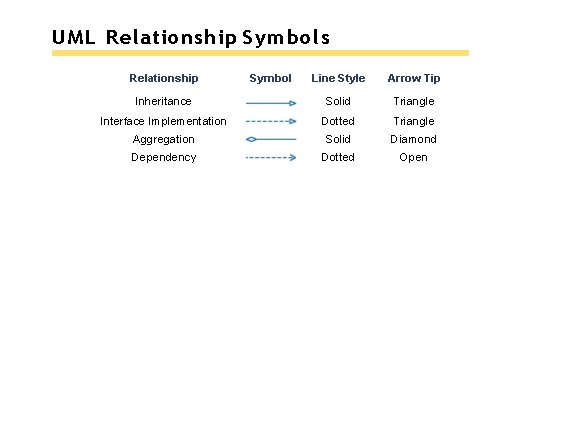
UML Relationship Symbols Relationship Symbol Line Style Arrow Tip Inheritance Solid Triangle Interface Implementation Dotted Triangle Aggregation Solid Diamond Dependency Dotted Open
Self Check 12. 6 Consider the Cash. Register. Testerclass of Section 8. 2. On which classes does it depend? Answer: The Cash. Register. Testerclass depends on the Cash. Register, Coin, and Systemclasses.
Self Check 12. 7 Consider the Questionand Choice. Questionobjects of Chapter 9. How are they related? Answer: The Choice. Questionclass inherits from the Questionclass.
Self Check 12. 8 Consider the Quizclass described in Section 12. 2. 2. Suppose a quizcontains a mixture of Question and Choice. Question objects. Which classes does the Quiz class depend on? Answer: The Quizclass depends on the Questionclass but probably not Choice. Question, if we assume that the methods of the Quiz class manipulate generic Question objects, as they did in Chapter 9.
Self Check 12. 9 Why should coupling be minimized between classes? Answer: If a class doesn’t depend on another, it is not affected by interface changes in the other class.
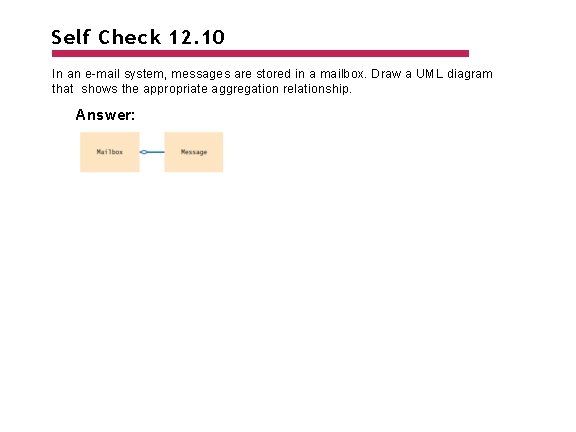
Self Check 12. 10 In an e-mail system, messages are stored in a mailbox. Draw a UML diagram that shows the appropriate aggregation relationship. Answer:
Self Check 12. 11 You are implementing a system to manage a library, keeping track of which books are checked out by whom. Should the Book class aggregate Patron or the other way around? Answer: Typically, a library system wants to track which books a patron has checked out, so it makes more sense to have Patronaggregate Book. However, there is not always one true answer in design. If you feel strongly that it is important to identify the patron who checked out a particular book (perhaps to notify the patron to return it because it was requested by someone else), then you can argue that the aggregation should go the other way around.
Self Check 12. 12 In a library management system, what would be the relationship between classes Patronand Author? Answer: There would be no relationship.
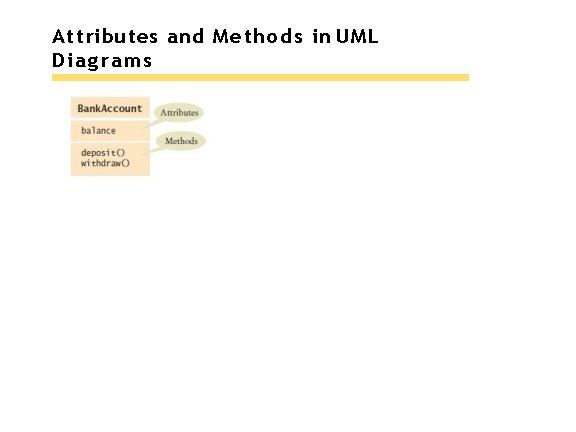
Attributes and Methods in UML Diagrams
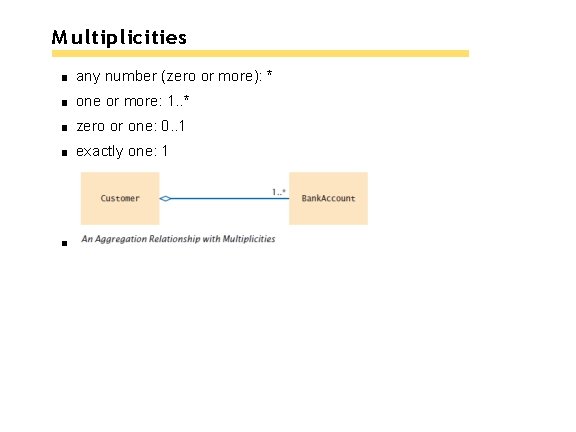
M ultiplicities any number (zero or more): * one or more: 1. . * zero or one: 0. . 1 exactly one: 1
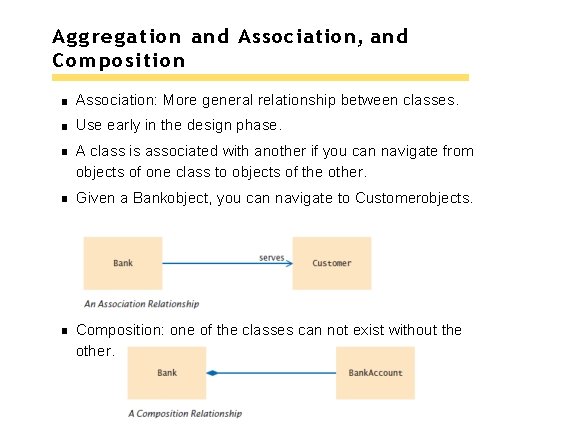
Aggregation and Association, and Composition Association: More general relationship between classes. Use early in the design phase. A class is associated with another if you can navigate from objects of one class to objects of the other. Given a Bankobject, you can navigate to Customerobjects. Composition: one of the classes can not exist without the other.
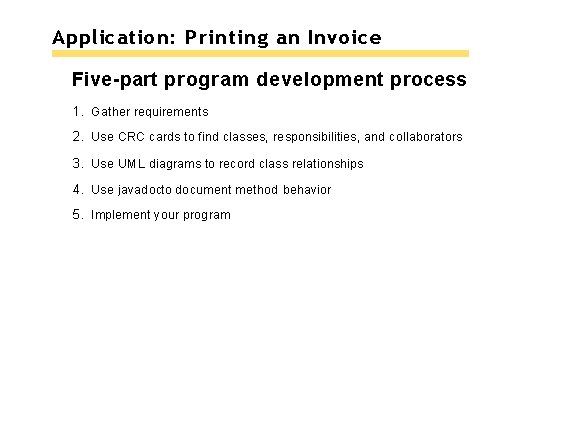
Application: Printing an Invoice Five-part program development process 1. Gather requirements 2. Use CRC cards to find classes, responsibilities, and collaborators 3. Use UML diagrams to record class relationships 4. Use javadocto document method behavior 5. Implement your program
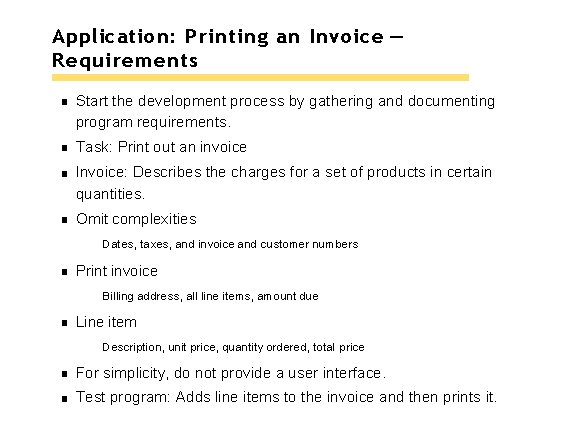
Application: Printing an Invoice — Requirements Start the development process by gathering and documenting program requirements. Task: Print out an invoice Invoice: Describes the charges for a set of products in certain quantities. Omit complexities Dates, taxes, and invoice and customer numbers Print invoice Billing address, all line items, amount due Line item Description, unit price, quantity ordered, total price For simplicity, do not provide a user interface. Test program: Adds line items to the invoice and then prints it.
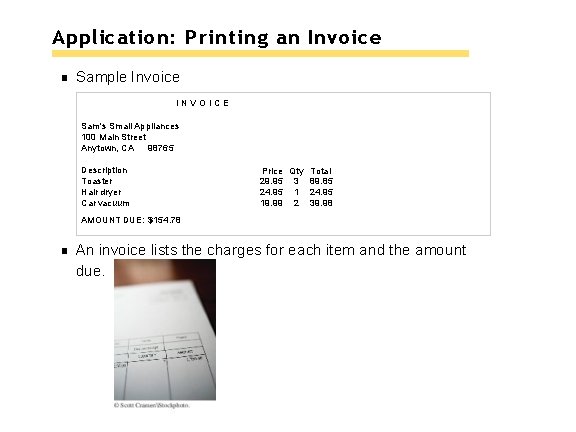
Application: Printing an Invoice Sample Invoice I N V O I CE Sam's Small Appliances 100 Main Street Anytown, CA 98765 Description Toaster Hair dryer Car vacuum Price Qty Total 29. 95 3 89. 85 24. 95 19. 99 2 39. 98 AMOUNT DUE: $154. 78 An invoice lists the charges for each item and the amount due.
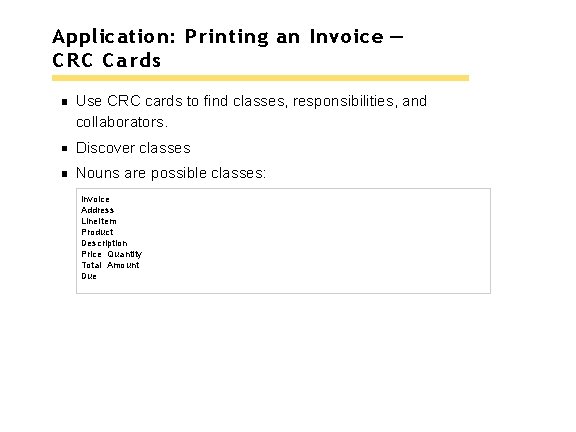
Application: Printing an Invoice — CRC Cards Use CRC cards to find classes, responsibilities, and collaborators. Discover classes Nouns are possible classes: Invoice Address Line. Item Product Description Price Quantity Total Amount Due
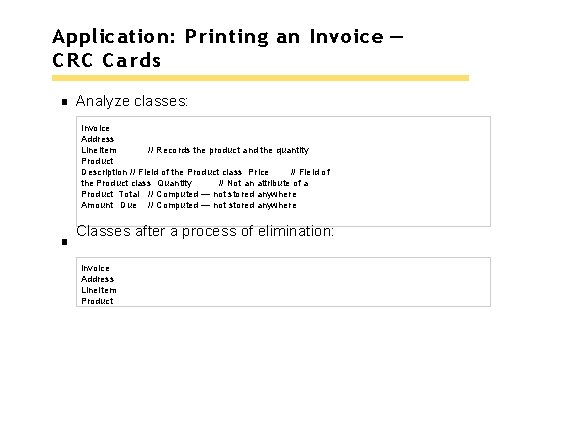
Application: Printing an Invoice — CRC Cards Analyze classes: Invoice Address // Records the product and the quantity Line. Item Product Description // Field of the Product class Price // Field of the Product class Quantity // Not an attribute of a Product Total // Computed — not stored anywhere Amount Due // Computed — not stored anywhere Classes after a process of elimination: Invoice Address Line. Item Product
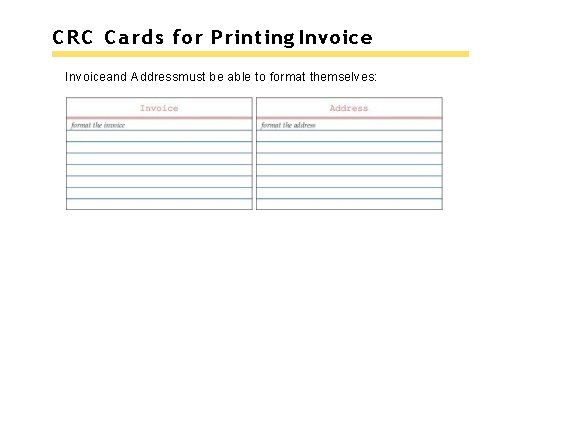
CRC Cards for Printing Invoiceand Addressmust be able to format themselves:
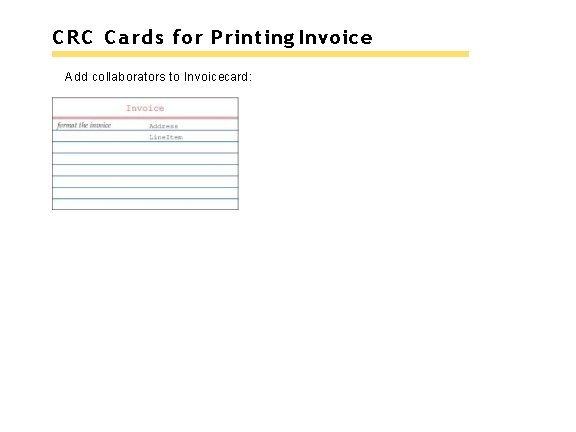
CRC Cards for Printing Invoice Add collaborators to Invoicecard:
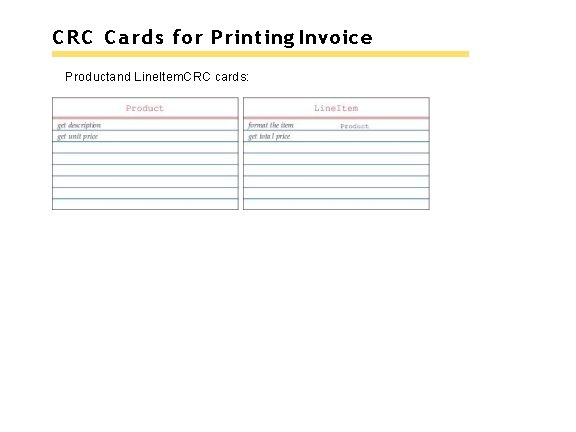
CRC Cards for Printing Invoice Productand Line. Item. CRC cards:
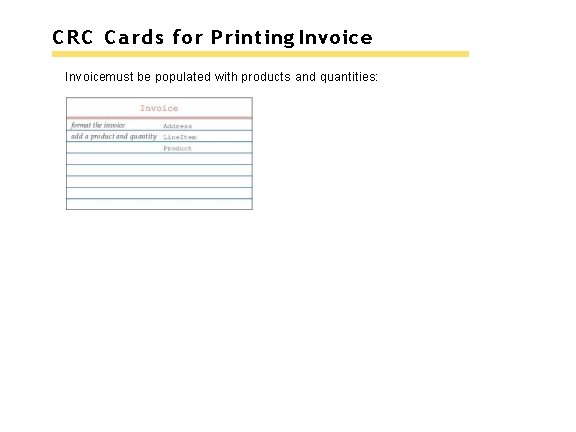
CRC Cards for Printing Invoicemust be populated with products and quantities:
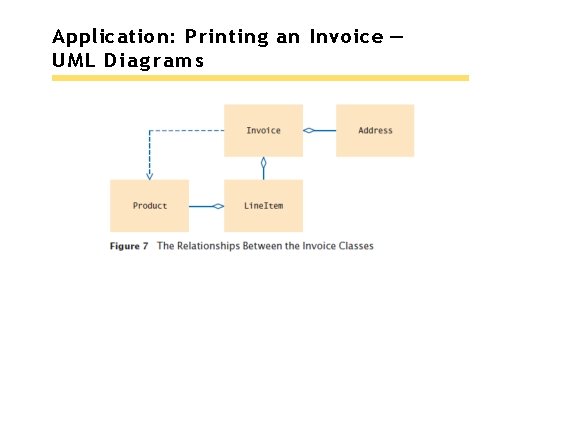
Application: Printing an Invoice — UML Diagrams
Printing an Invoice — Method Documentation Use javadoccomments (with the method bodies left blank) to record the behavior of the classes. Write a Java source file for each class: Write the method comments for those methods that you have discovered, Leave the body of the methods blank Run javadocto obtain formatted version of documentation in HTML format. Advantages: Share HTML documentation with other team members Format is immediately useful: Java source files Supply the comments of the key methods
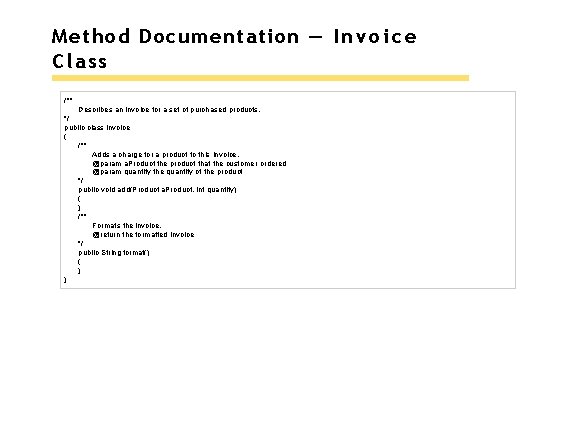
Method Documentation — I n v o i c e Class /** Describes an invoice for a set of purchased products. */ public class Invoice { /** Adds a charge for a product to this invoice. @param a. Product the product that the customer ordered @param quantity the quantity of the product */ public void add(Product a. Product, int quantity) { } /** Formats the invoice. @return the formatted invoice */ public String format() { } }
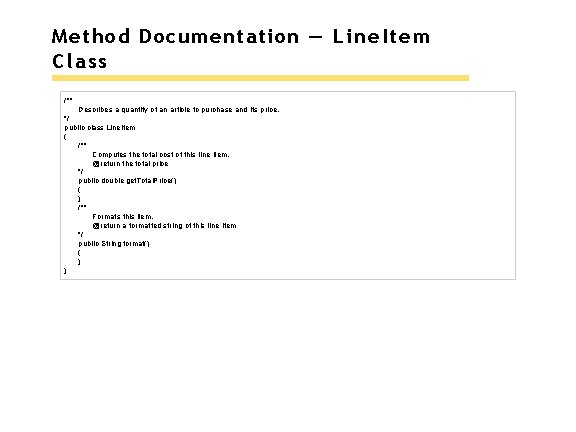
Method Documentation — Line. Item Class /** Describes a quantity of an article to purchase and its price. */ public class Line. Item { /** Computes the total cost of this line item. @return the total price */ public double get. Total. Price() { } /** Formats this item. @return a formatted string of this line item */ public String format() { } }
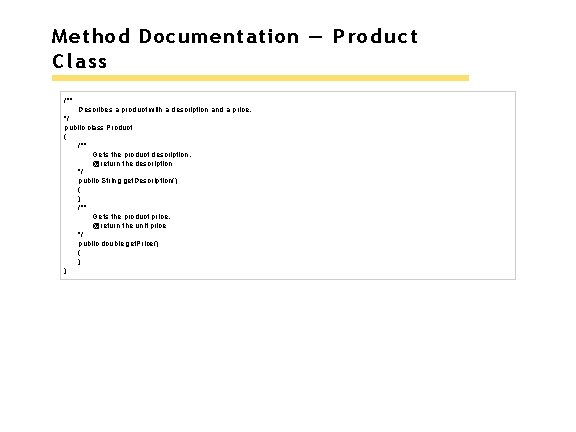
Method Documentation — Product Class /** Describes a product with a description and a price. */ public class Product { /** Gets the product description. @return the description */ public String get. Description() { } /** Gets the product price. @return the unit price */ public double get. Price() { } }
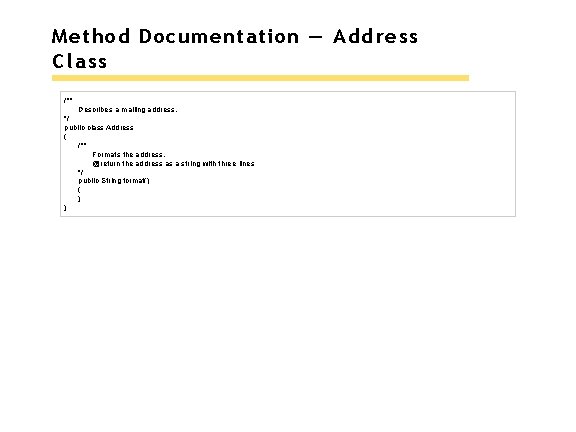
Method Documentation — Address Class /** Describes a mailing address. */ public class Address { /** Formats the address. @return the address as a string with three lines */ public String format() { } }
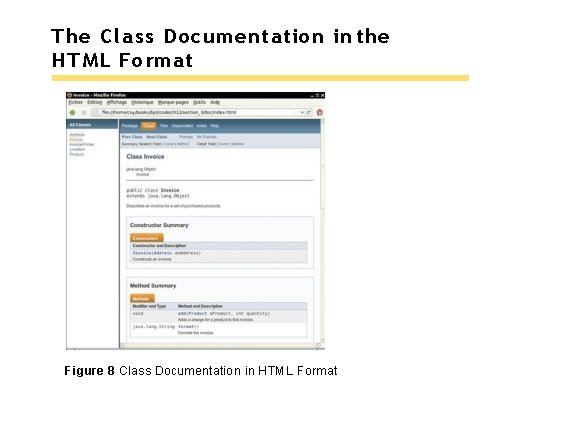
The Class Documentation in the HTML Format Figure 8 Class Documentation in HTML Format
Printing an Invoice — Implementation After completing the design, implement your classes. The UML diagram will give instance variables: Look for aggregated classes They yield instance variables
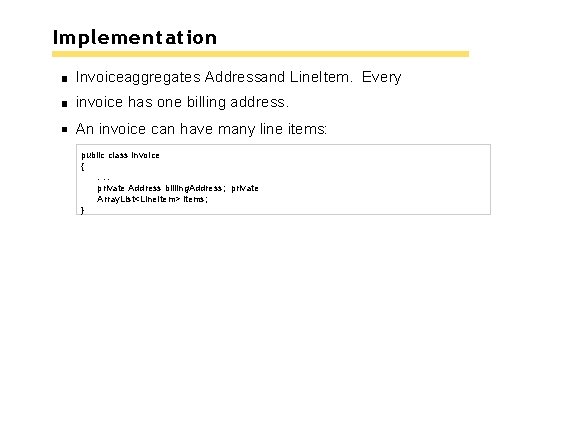
Implementation Invoiceaggregates Addressand Line. Item. Every invoice has one billing address. An invoice can have many line items: public class Invoice {. . . private Address billing. Address; private Array. List<Line. Item> items; }
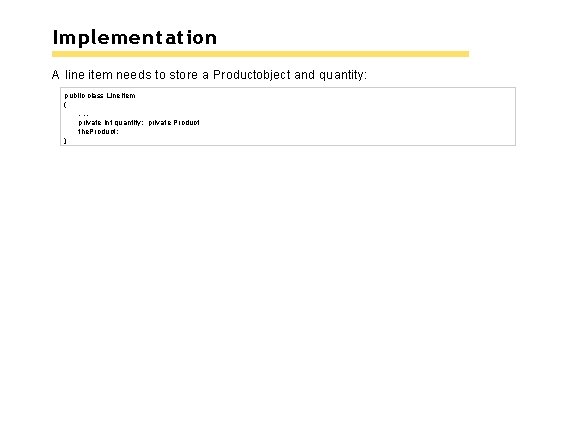
Implementation A line item needs to store a Productobject and quantity: public class Line. Item {. . . private int quantity; private Product the. Product; }
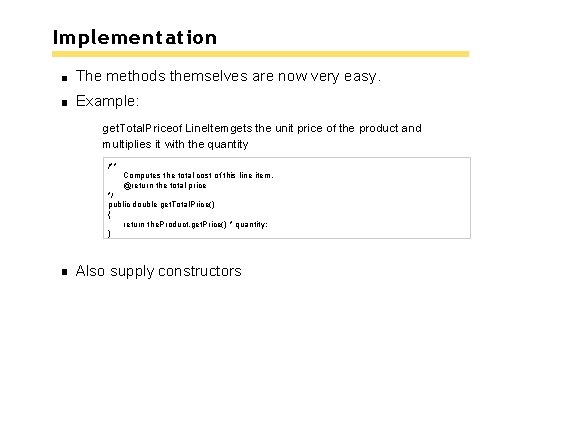
Implementation The methods themselves are now very easy. Example: get. Total. Priceof Line. Itemgets the unit price of the product and multiplies it with the quantity /** Computes the total cost of this line item. @return the total price */ public double get. Total. Price() { return the. Product. get. Price() * quantity; } Also supply constructors
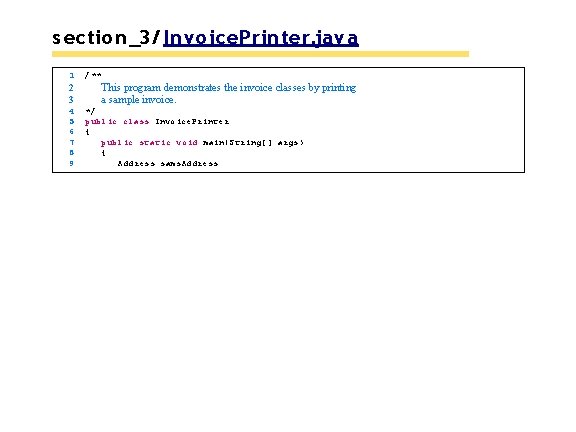
s ection_3/ Invoice. Printer. java 1 2 3 4 5 6 7 8 9 /** This program demonstrates the invoice classes by printing a sample invoice. */ public class Invoice. Printer { public static void main(String[] args) { Address sams. Address
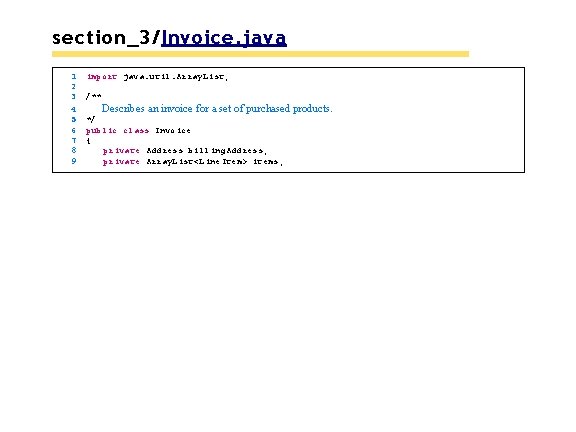
section_3/Invoice. java 1 2 3 4 5 6 7 8 9 import java. util. Array. List; /** Describes an invoice for a set of purchased products. */ public class Invoice { private Address billing. Address; private Array. List<Line. Item> items;
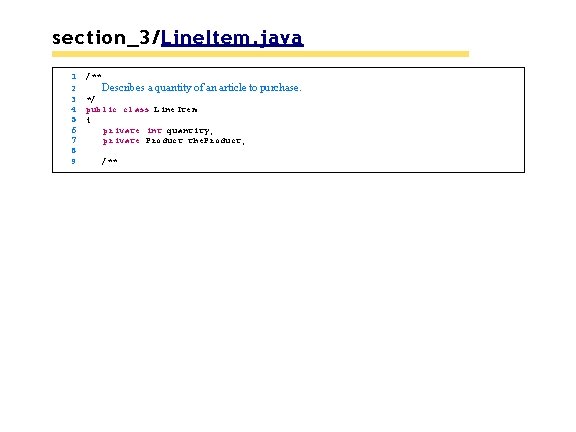
section_3/Line. Item. java 1 2 3 4 5 6 7 8 9 /** Describes a quantity of an article to purchase. */ public class Line. Item { private int quantity; private Product the. Product; /**
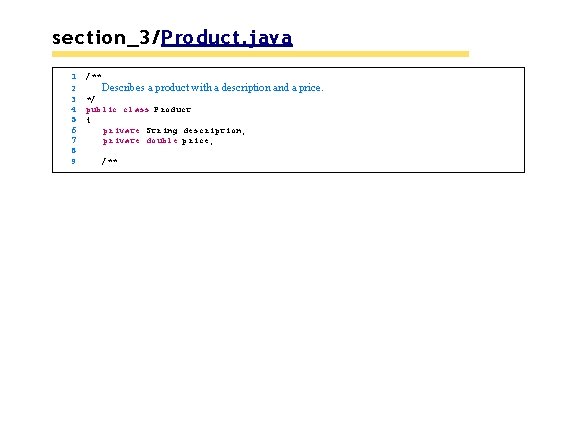
section_3/Product. java 1 2 3 4 5 6 7 8 9 /** Describes a product with a description and a price. */ public class Product { private String description; private double price; /**
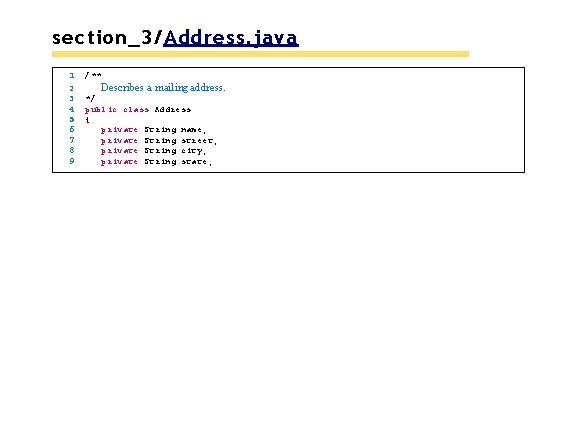
section_3/Address. java 1 2 3 4 5 6 7 8 9 /** Describes a mailing address. */ public class Address { private String name; private String street; private String city; private String state;
Self Check 12. 13 Which class is responsible for computing the amount due? What are its collaborators for this task? Answer: The Invoiceclass is responsible for computing the amount due. It collaborates with the Line. Itemclass.
Self Check 12. 14 Why do the format methods return Stringobjects instead of directly printing to System. out? Answer: This design decision reduces coupling. It enables us to reuse the classes when we want to show the invoice in a dialog box or on a web page.
- Slides: 59