
Chapter 12 Monopolistic Competition Third of the four
- Slides: 14
Chapter 12: Monopolistic Competition Third of the four “Market Structures” in Microeconomics Most firms in the U. S. Business Sector can be classified in M. C.
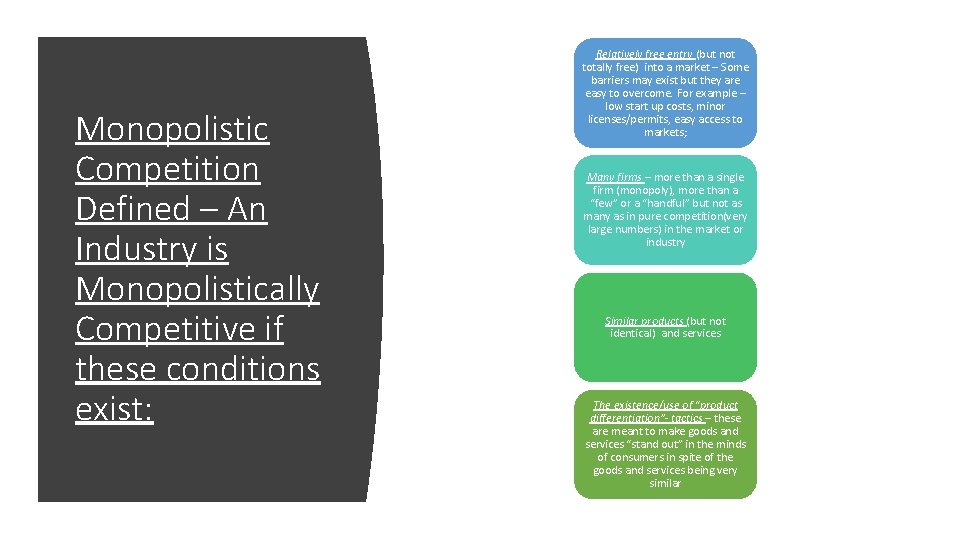
Monopolistic Competition Defined – An Industry is Monopolistically Competitive if these conditions exist: Relatively free entry (but not totally free) into a market – Some barriers may exist but they are easy to overcome. For example – low start up costs, minor licenses/permits, easy access to markets; Many firms – more than a single firm (monopoly), more than a “few” or a “handful” but not as many as in pure competition(very large numbers) in the market or industry Similar products (but not identical) and services The existence/use of “product differentiation”- tactics – these are meant to make goods and services “stand out” in the minds of consumers in spite of the goods and services being very similar
Why Do Firms in Monopolistic Competition Use ”Non-price Competitive Tactics” to Differentiate Their Products • Firms use these tactics because products/services they make available to the market are not identical but rather, they are very similar. • From the perspective of buyers/consumers – because of the similarities the product/service is, for all sakes and purposes, the same. • From the perspective of the firm – firms/sellers MUST make the product/service DIFFERENT in the eyes of consumers. • Use of the tactics say to the buyer: “Pick Me”, ”Buy Me” or “I’m different from all the rest. ”
Why Don’t Firms in Monopolistically Competitive Industries Simply Practice “Price Competition? • Price Competition simply refers to firms beating each other over the head by undercutting competitor’s prices • These types of price wars tend to benefit buyers and consumers at the expense of firms. This “blood letting” is unacceptable. • Firms would prefer using these “non-price competitive practices” instead of price competition.
Types of Non-Price Competitive Practices (Meant to Make a Product “Appear Different” • If the firm is successful in “differentiating” the product/service in the minds of the consumer it sets the product apart from all others in the market. These include: • Style, Location, Quality (pp. 365 -6 of the text) and others • Flexible return/exchange policies • Free delivery • Flexible credit terms • Guarantees and warranties • Online sales, Sales Promotions, Advertising by celebrities
Consumer Loyalty is “The Goal” • If the non-price competitive practices work, the product is now “different” in the minds of the consumer • The product is now “different” when compared to other product/services sold by competitors (when in fact the differences are relatively insignificant) • Establishing consumer loyalty is the objective (even though prices might be higher elsewhere)
The Impact of Using Non-Price Competitive Practices/Tactics • If they work, consumer loyalty is firmly established • Using these tactics INCREASES PRODUCTION COSTS. • Firms using these tactics must charge HIGHER PRICES • But…. because consumer loyalty is firmly established, buyers might pay those HIGHER PRICES. (despite product similarities) • Firms using these tactics might be in possession of monopoly -like “power” over firms that don’t use them. • Impact on profits? Economic/Pure profits ---But, the scenario is extremely “FRAGILE”….
HUGE PROBLEM FOR THE MONOPOLISTICALLY COMPETITIVE FIRM: The “LINK” using a mix of non-price competitive tactics, establishing consumer loyalty, paying higher costs, and extracting higher prices from consumers is extremely FRAGILE, SENSITIVE and SHORT-LIVED. • An established firm will use these tactics. • The minute another innovative competing firm develops or implements a new, innovative or unique set of nonprice competitive practices, the proverbial “house of cards” comes falling down around the established firm and it will see profits disappear. • Still ANOTHER firm enters the discussion and continues innovation and the process above continues indefinitely. • Focus on Innovation
Short-Run Implications for Monopolistically Competitive Firms Use of Non-Price tactics – If successful, the result is usually economic or pure profits. But recall the “fragility” concept where an innovator steps in and upsets the consumer loyalty/higher selling prices model. Conclusions: • Profits, if they are earned, don’t last long because of the fragility issues. • Economic profits (where Total Revenue is greater than Total Cost) might be earned but they don’t last very long because of innovations from competitors.
Long-run Implications for Monopolistically Competitive Firms In the long-run, the tendency is for firms in Monopolistically Competitive industries to earn only normal profits (where total revenues exactly equal total costs) If they can’t earn at least a normal profit where TC=TR, they leave the industry.
“Wastes” Associated with Monopolistic Competition The ”wastes” are simply part of the consequences when discussing Monopolistic Competition ( these are not good or positive consequences ) They include: • Product prices are higher because of the focus on using non-price competitive practices/tactics. Because of the higher costs associated with using these the firm must charge higher prices for its products, but it can get away with charging higher prices because of consumer loyalty. …continued on next slide
“Wastes” Associated with Monopolistic Competition, continued…. Excess capacity – Assume that a firm implements successful non-price competition model and it earns an economic/pure profit. Ask: What would a firm do with these profits? The answer: Invest in new plants, factories, and other forms of capital (long-run investments). Suppose this is YOU! YOU are doing all of the right things and you plan to do even better by investing in new plants, factories, opening new stores, etc. – These are long-term activities However, a new innovator/firm introduces new more successful non-price tactics and your profit model disintegrates. BUT YOU ARE STUCK WITH IDLE PLANTS, FACTORIES, EMPTY STORES --- EXCESS CAPACITY.
Advertising and Monopolistic Competition • The firm in monopolistic competition spends quite a lot on advertising to convey information about prices, new products, location of products, special services provided to buyers, product quality etc. These expenditures increase production costs significantly. • In the real world it is not always the fact that advertising works towards these ends. To the extent that advertising is ineffective or without much positive impact----this is also considered a “waste” associated with monopolistic competition.
Q’s to Ask About. The Structure/Characteristics of the Monopolistically Competitive Industry: 1. The Number of Firms 2. Do Barriers to entry exist? What kinds? 3. The Types of Competitive Practices Firms Implement? 4. The Extent to Which Individual Firms Can Control Prices 5. The Type of Product Produced? 6. EXAMPLES: See text