
CHAPTER 12 Metapopulation In fact suitable habitat forms
CHAPTER 12 Metapopulation In fact, suitable habitat forms a network of patches, and be enough to support local breeding populations.
CHAPTER 12 Metapopulation
CHAPTER 12 Metapopulations = network of populations that interact occasionally by exchanging individuals. The spatially discrete subpopulations are coined metapopulation.
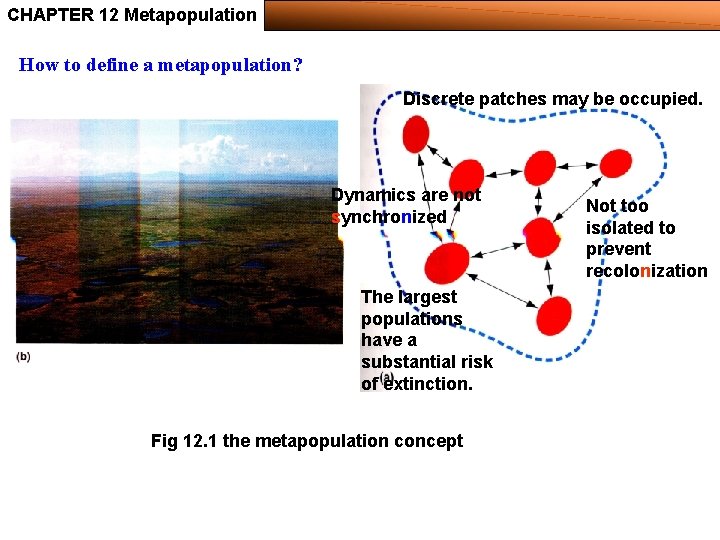
CHAPTER 12 Metapopulation How to define a metapopulation? Discrete patches may be occupied. Dynamics are not synchronized The largest populations have a substantial risk of extinction. Fig 12. 1 the metapopulation concept Not too isolated to prevent recolonization
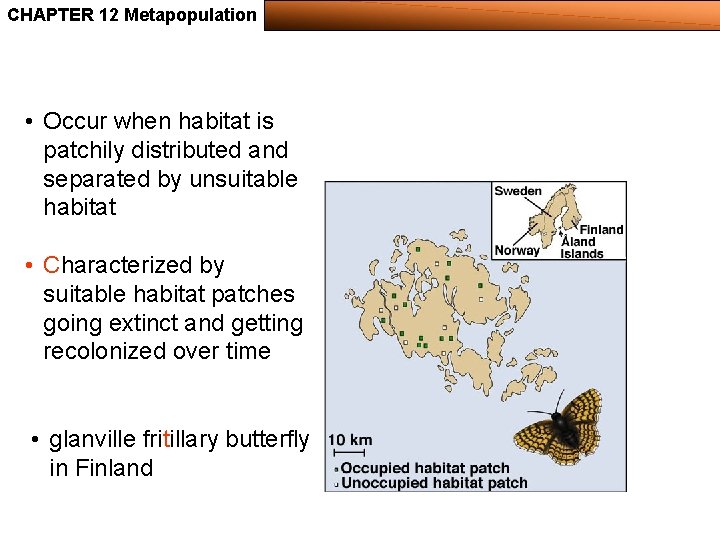
CHAPTER 12 Metapopulation • Occur when habitat is patchily distributed and separated by unsuitable habitat • Characterized by suitable habitat patches going extinct and getting recolonized over time • glanville fritillary butterfly in Finland
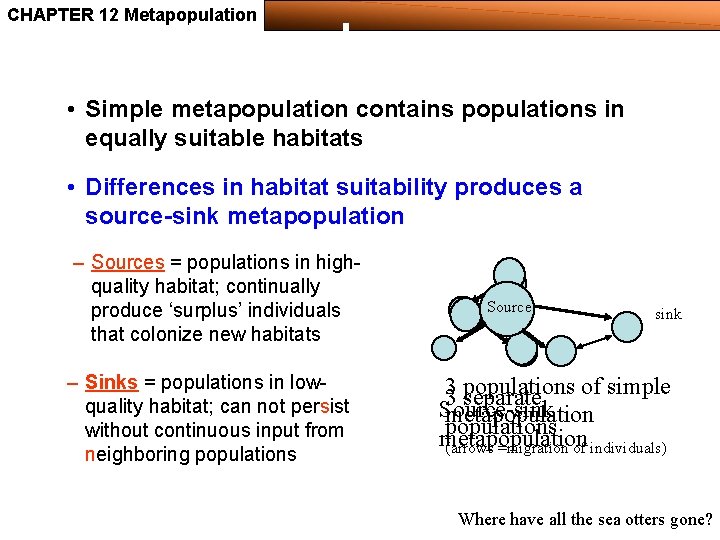
CHAPTER 12 Metapopulation Population ecology • Simple metapopulation contains populations in equally suitable habitats • Differences in habitat suitability produces a source-sink metapopulation – Sources = populations in highquality habitat; continually produce ‘surplus’ individuals that colonize new habitats – Sinks = populations in lowquality habitat; can not persist without continuous input from neighboring populations Source sink 33 populations of simple separate Source-sink metapopulations metapopulation (arrows =migration of individuals) Where have all the sea otters gone?
CHAPTER 12 Metapopulation Study questions How does the risk of local extinction apparently be influenced with the patch size and patch isolation? And who is the dominant? How to determine which size category has the largest of for occupancy? How to determine which patch size represents a threshold for the long-term persistence of local populations? Further Reading Thomas M. Smith and Robert Leo Smith. Elements of Ecology. pp: 238 -253
- Slides: 7