
CHAPTER 12 MERGERS ACQUISITIONS AND OTHER CHANGES TO
- Slides: 16
CHAPTER 12 MERGERS, ACQUISITIONS, AND OTHER CHANGES TO THE CORPORATE STRUCTURE © 2013 Delmar Cengage Learning
Statutory Mergers and Share Exchanges • A merger is a combination of two or more corporations whereby one merging corporation merges into a surviving corporation, with the result being one surviving corporation. • Shareholders of the merging corporation receive shares of the surviving corporation in exchange for their shares and they become shareholders of the surviving corporation. • All liabilities of both the merging and the surviving corporations become the responsibility of the surviving corporation. • Statutory mergers and share exchanges may be between corporations or corporations and noncorporate entities. • When a subsidiary corporation merges into its parent corporation, it is referred to as an upstream merger. • When a parent corporation merges into a subsidiary corporation, it is referred to as a downstream merger. © 2013 Delmar Cengage Learning
Statutory Mergers and Share Exchanges • Triangle mergers involve 3 corporations: parent, subsidiary, and target corporation, which is merged into the subsidiary. • A reverse triangle merger involves 3 corporations: parent, target, and subsidiary corporation that is merged into the target. • In a share exchange, the acquiring corporation acquires all of the outstanding shares of the target corporation by an exchange that is compulsory on the shareholders of the target corporation. • With a share exchange, both the acquiring corporation and the target corporation survive, with the target corporation becoming the subsidiary of the acquiring corporation. • A consolidation involves the merger of two or more corporations into a newly formed corporation with neither of the merging corporations surviving. © 2013 Delmar Cengage Learning
Laws Governing Mergers and Share Exchanges • Mergers and share exchanges may be subject to both state and federal law. – All parties to a merger or share exchange are subject to the laws of their state of domicile. – The parties to a merger or share exchange may also be subject to federal securities laws and antitrust laws. • The FTC is responsible for overseeing mergers and acquisitions to ensure they comply with antitrust laws. • The primary antitrust laws are: – The Sherman Act, passed in 1890 – The Clayton Act, passed in 1914 – The Hart-Scott-Rodino Antitrust Improvements Act of 1976. © 2013 Delmar Cengage Learning
Planning the Statutory Merger or Share Exchange • Successful negotiations often lead to a letter of intent that sets forth the preliminary understanding of all parties. – – The basics of the proposed transaction A deadline for entering a formal agreement Procedures concerning the due diligence process A statement concerning confidentiality of the parties involved • The plan of merger sets forth the agreement between the proposed merging and surviving corporations. • The plan of exchange sets forth the agreement for the share exchange between the proposed subsidiary and parent corporations. © 2013 Delmar Cengage Learning
Board of Director and Shareholder Approval of the Merger or Share Exchange • Mergers and share exchanges require the approval of the board of directors and the shareholders. • After board recommendation, the shareholders are entitled to vote on the plan of merger or plan of share exchange. • Mergers and share exchanges may be subject to class voting and special voting requirements under state statutes. • Shareholder approval of the surviving corporation is not always required. • Shareholder approval is not always required for upstream mergers. • Shareholders entitled to vote on a merger or plan of exchange may have the right to dissent and obtain payment of the fair value of their shares from the corporation. • State statutes usually include very specific requirements that must be met by dissenting shareholders. © 2013 Delmar Cengage Learning
Articles of Merger • The articles of share exchange must set forth the information required by state statutes, which include: – The names of the parties to the share exchange – The terms and conditions of the share exchange – The manner and basis of the share exchange – A statement concerning the shareholder approval of the plan of exchange – A copy of any amendments to articles of incorporation that may be required under the plan of exchange © 2013 Delmar Cengage Learning
Articles of Share Exchange • The articles of merger must include the information required by state statutes, which include: – The names of all parties to the merger – Any amendments to the articles of incorporation or new articles of incorporation of the surviving corporation – A statement concerning the shareholder approval of the merger – A statement indicating that a foreign corporation involved in the merger has approved the merger pursuant to the laws of its state of domicile © 2013 Delmar Cengage Learning
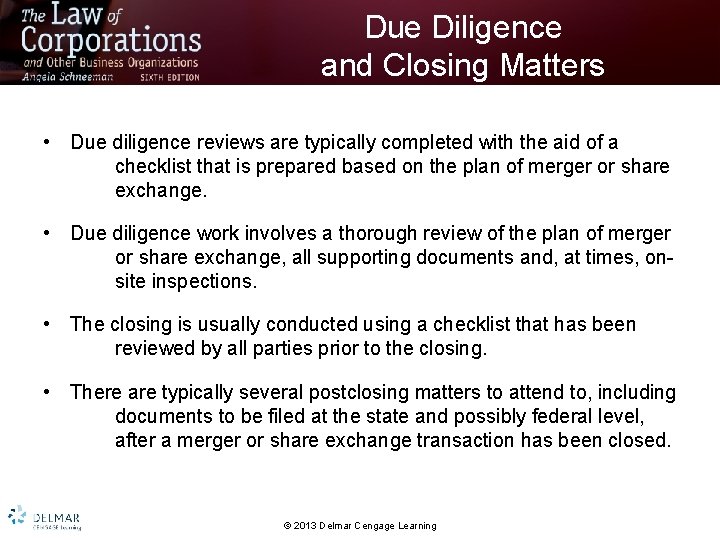
Due Diligence and Closing Matters • Due diligence reviews are typically completed with the aid of a checklist that is prepared based on the plan of merger or share exchange. • Due diligence work involves a thorough review of the plan of merger or share exchange, all supporting documents and, at times, onsite inspections. • The closing is usually conducted using a checklist that has been reviewed by all parties prior to the closing. • There are typically several postclosing matters to attend to, including documents to be filed at the state and possibly federal level, after a merger or share exchange transaction has been closed. © 2013 Delmar Cengage Learning
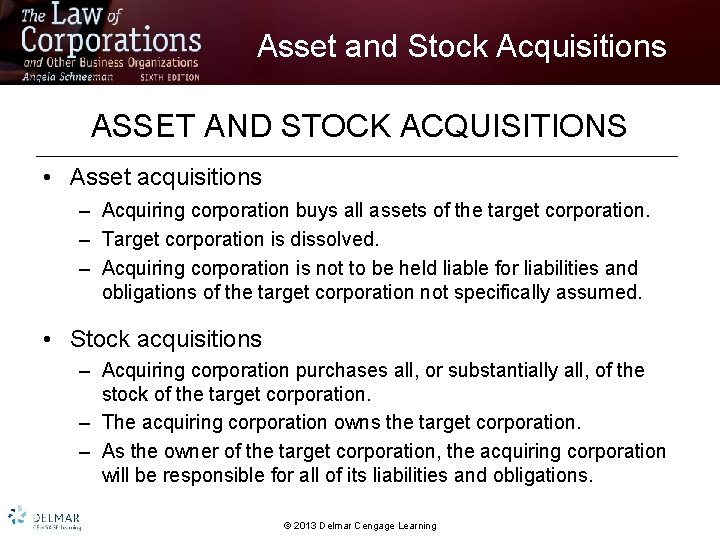
Asset and Stock Acquisitions ASSET AND STOCK ACQUISITIONS • Asset acquisitions – Acquiring corporation buys all assets of the target corporation. – Target corporation is dissolved. – Acquiring corporation is not to be held liable for liabilities and obligations of the target corporation not specifically assumed. • Stock acquisitions – Acquiring corporation purchases all, or substantially all, of the stock of the target corporation. – The acquiring corporation owns the target corporation. – As the owner of the target corporation, the acquiring corporation will be responsible for all of its liabilities and obligations. © 2013 Delmar Cengage Learning
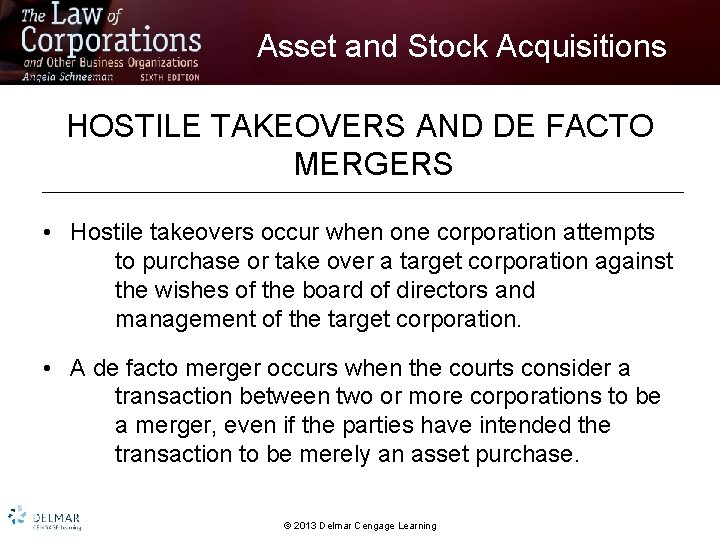
Asset and Stock Acquisitions HOSTILE TAKEOVERS AND DE FACTO MERGERS • Hostile takeovers occur when one corporation attempts to purchase or take over a target corporation against the wishes of the board of directors and management of the target corporation. • A de facto merger occurs when the courts consider a transaction between two or more corporations to be a merger, even if the parties have intended the transaction to be merely an asset purchase. © 2013 Delmar Cengage Learning
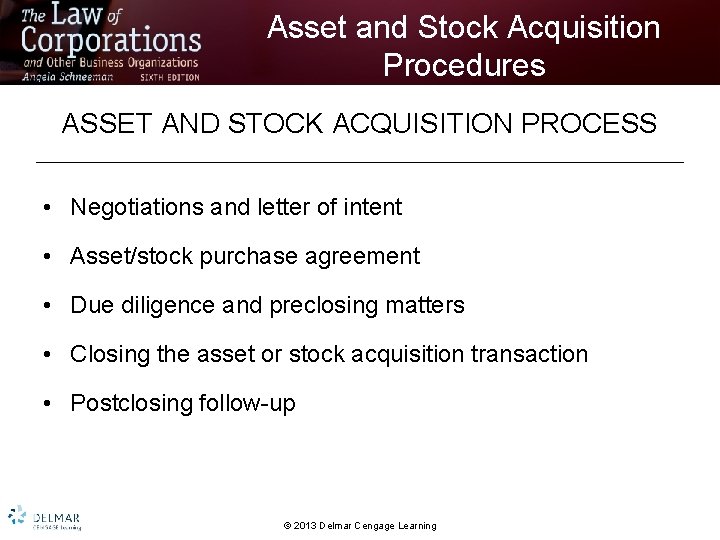
Asset and Stock Acquisition Procedures ASSET AND STOCK ACQUISITION PROCESS • Negotiations and letter of intent • Asset/stock purchase agreement • Due diligence and preclosing matters • Closing the asset or stock acquisition transaction • Postclosing follow-up © 2013 Delmar Cengage Learning
Entity Conversions DOMESTICATION Procedure to change a corporation’s state of domicile CONVERSION Convert a corporation to a noncorporate entity or convert a noncorporate entity to a corporation © 2013 Delmar Cengage Learning
Amendments to Articles of Incorporation • When information in the articles of incorporation changes, the articles should be amended as provided in the statutes of the corporation’s state of domicile. • Most amendments to articles of incorporation require the approval of the board of directors and shareholders. • Shareholders can dissent and be paid fair value of their shares by the corporation if articles of incorporation are amended in a manner that adversely affects them. • Articles of amendment must be prepared pursuant to state statutes and filed with the secretary of state in the same manner the articles of incorporation were filed. • A corporation may restate its articles of incorporation to incorporate several amendments. © 2013 Delmar Cengage Learning
The Paralegal’s Role • Assist in preparing letter of intent, agreement for merger, share exchange, stock purchase, or asset purchase • Assist in complying with federal antitrust laws • Review agreement; prepare closing checklist • Prepare supplementary documents • Collect documents from the client for review by opposing counsel; review documents supplied by other party • Prepare plan of merger and articles of merger or plan of exchange and articles of exchange © 2013 Delmar Cengage Learning
The Paralegal’s Role (Continued) • Prepare necessary corporate resolutions • Prepare articles of amendment to articles of incorporation • Prepare consents to assignment of leases and other contracts • Prepare new stock certificates • Prepare documents transferring assets • Assemble all documents for closing and attend the closing and assist with postclosing filings © 2013 Delmar Cengage Learning