
CHAPTER 12 Managing Organization Design Power Point Presentation
- Slides: 31
CHAPTER 12 Managing Organization Design Power. Point Presentation by Charlie Cook Copyright © by Houghton Mifflin Company. All rights reserved.
Learning Objectives After studying this chapter, you should be able to: – Identify the basic nature of organization design. – Identify the two basic universal perspectives on organization design. – Identify and explain several situational influences on organization design. – Discuss how an organization’s strategy and its design are interrelated. – Describe the basic forms of organization design that characterize many organizations. – Describe emerging issues in organization design. Copyright © by Houghton Mifflin Company. All rights reserved. 2
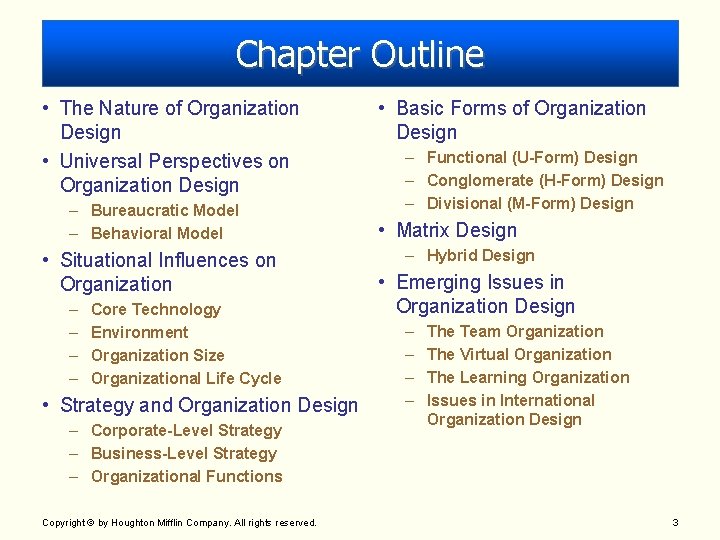
Chapter Outline • The Nature of Organization Design • Universal Perspectives on Organization Design – Bureaucratic Model – Behavioral Model • Situational Influences on Organization – – Core Technology Environment Organization Size Organizational Life Cycle • Strategy and Organization Design – Corporate-Level Strategy – Business-Level Strategy – Organizational Functions Copyright © by Houghton Mifflin Company. All rights reserved. • Basic Forms of Organization Design – Functional (U-Form) Design – Conglomerate (H-Form) Design – Divisional (M-Form) Design • Matrix Design – Hybrid Design • Emerging Issues in Organization Design – – The Team Organization The Virtual Organization The Learning Organization Issues in International Organization Design 3
The Nature of Organization Design • Organization Design – The overall set of structural elements and the relationships among those elements used to manage the total organization. – A means to implement strategies and plans to achieve organizational goals. • Organization Design Concepts – Organizations are not designed and then left intact. Organizations are in a continuous state of change. – Organization design for larger organizations is extremely complex and has many nuances and variations. Copyright © by Houghton Mifflin Company. All rights reserved. 4
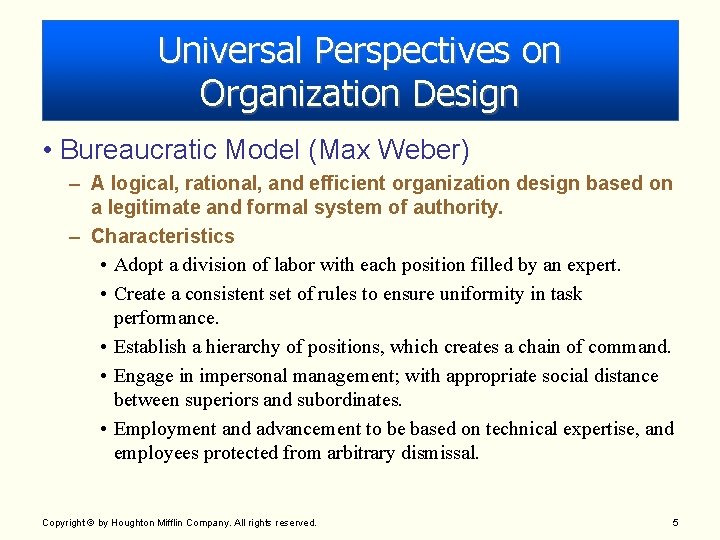
Universal Perspectives on Organization Design • Bureaucratic Model (Max Weber) – A logical, rational, and efficient organization design based on a legitimate and formal system of authority. – Characteristics • Adopt a division of labor with each position filled by an expert. • Create a consistent set of rules to ensure uniformity in task performance. • Establish a hierarchy of positions, which creates a chain of command. • Engage in impersonal management; with appropriate social distance between superiors and subordinates. • Employment and advancement to be based on technical expertise, and employees protected from arbitrary dismissal. Copyright © by Houghton Mifflin Company. All rights reserved. 5
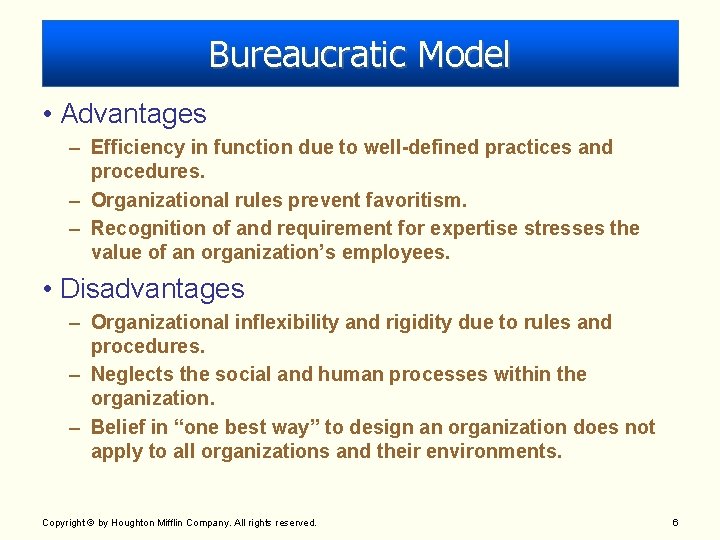
Bureaucratic Model • Advantages – Efficiency in function due to well-defined practices and procedures. – Organizational rules prevent favoritism. – Recognition of and requirement for expertise stresses the value of an organization’s employees. • Disadvantages – Organizational inflexibility and rigidity due to rules and procedures. – Neglects the social and human processes within the organization. – Belief in “one best way” to design an organization does not apply to all organizations and their environments. Copyright © by Houghton Mifflin Company. All rights reserved. 6
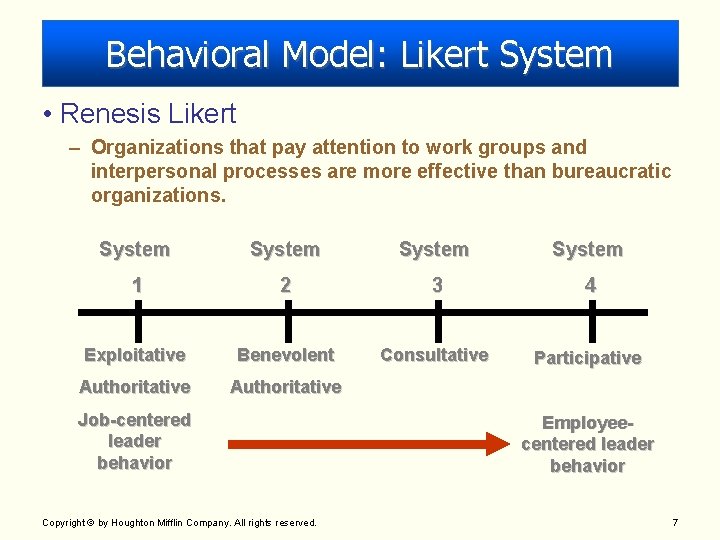
Behavioral Model: Likert System • Renesis Likert – Organizations that pay attention to work groups and interpersonal processes are more effective than bureaucratic organizations. System 1 2 3 4 Exploitative Benevolent Consultative Participative Authoritative Job-centered leader behavior Copyright © by Houghton Mifflin Company. All rights reserved. Employeecentered leader behavior 7
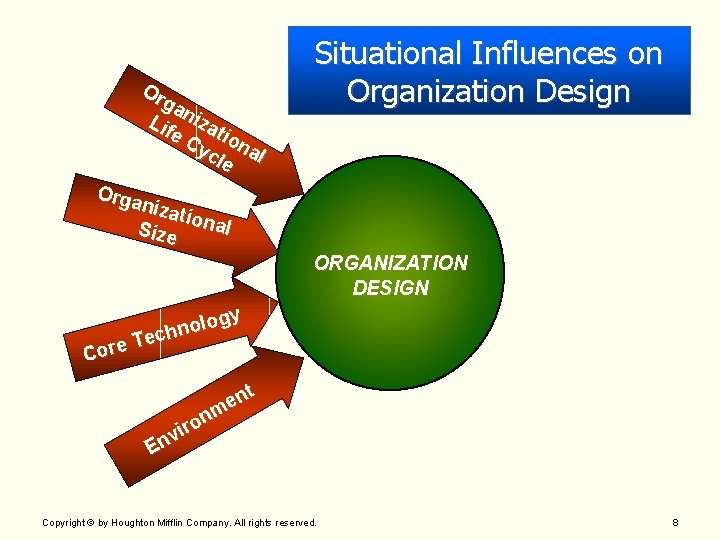
Or ga Lif niza e C tio yc nal le Situational Influences on Organization Design Orga niza tio Size nal ORGANIZATION DESIGN gy o l o chn e T Core nt e m n o ir v En Copyright © by Houghton Mifflin Company. All rights reserved. 8
Situational Influences on Organization Design (cont’d) • Core Technology – Technology is the conversion processes used to transform inputs into outputs. – A core technology is an organization’s most important technology. – Joan Woodward initially sought a correlation between organization size and design; instead, she found a potential relationship between technology and design. – As the complexity of technology increases, so do the number of levels of management. Copyright © by Houghton Mifflin Company. All rights reserved. 9
Situational Influences on Organization Design (cont’d) • Woodward’s Basic Forms of Technology – Unit or Small-Batch Technology • Produce custom-made products to customer specifications, or else produce in small quantities, similar to Likert’s System 4 organization. – Large Batch/Mass Production • Uses assembly-line production methods to manufacture large quantities of products; resembles Likert’s System 1. – Continuous Process • Use continuous-flow processes to convert raw materials by process or machine into finished products; resembles Likert’s System 4. Copyright © by Houghton Mifflin Company. All rights reserved. 10
Situational Influences on Organization Design (cont’d) • Burns and Stalker – Forms of the organizational environment • Stable environments that remain constant over time. • Unstable environments subject to uncertainty and rapid change. – Organization Designs • Mechanistic organizations that are similar to bureaucratic or System 1 models; found most frequently in stable environments. • Organic organizations that are flexible and informal models; usually found in unstable and unpredictable environments. Copyright © by Houghton Mifflin Company. All rights reserved. 11
Situational Influences on Organization Design (cont’d) • Lawrence and Lorsch – Differentiation • The extent to which the organization is broken down into subunits. – Integration • The degree to which the various subunits must work together in a coordinated fashion. Copyright © by Houghton Mifflin Company. All rights reserved. 12
Situational Influences on Organization Design (cont’d) • Organizational Size – Defined as the total number of full-time or full-time equivalent employees – Research findings: • Small firms tend to focus on their core technology. • Large firms have more job specialization, standard operating procedures, more rules and regulations, and are more decentralized. • Organizational Life Cycle – A progression through which organizations evolve as they grow and mature—birth, youth, midlife, and maturity. Copyright © by Houghton Mifflin Company. All rights reserved. 13
Strategy and Organization Design • Corporate-Level Strategy – Single-product strategy – Related or unrelated diversification – Portfolio approach to managing strategic business units Copyright © by Houghton Mifflin Company. All rights reserved. 14
Strategy and Organization Design (cont’d) • Business-Level Strategy – Defender – Prospecting – Analyzer • Generic Competitive Strategies – Differentiation – Cost leadership – Focus Copyright © by Houghton Mifflin Company. All rights reserved. 15
Strategy and Organization Design (cont’d) • Organizational Functions – Major functions of the organization (e. g. , marketing, finance, research and development, and manufacturing) influence an organization’s design. Copyright © by Houghton Mifflin Company. All rights reserved. 16
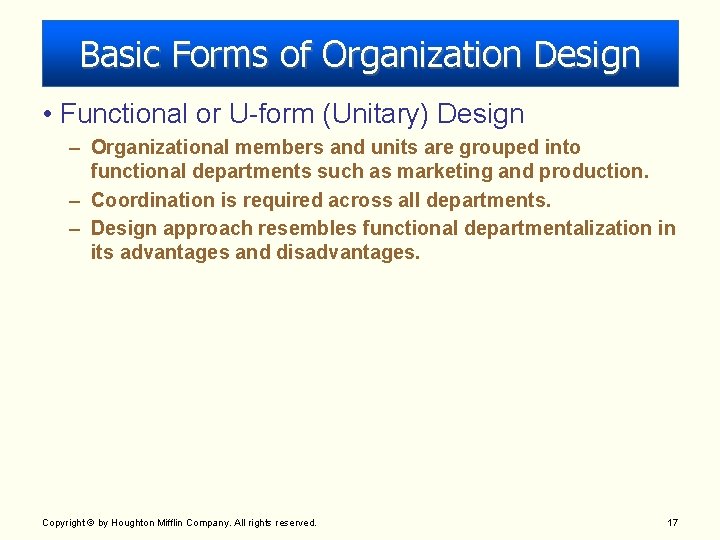
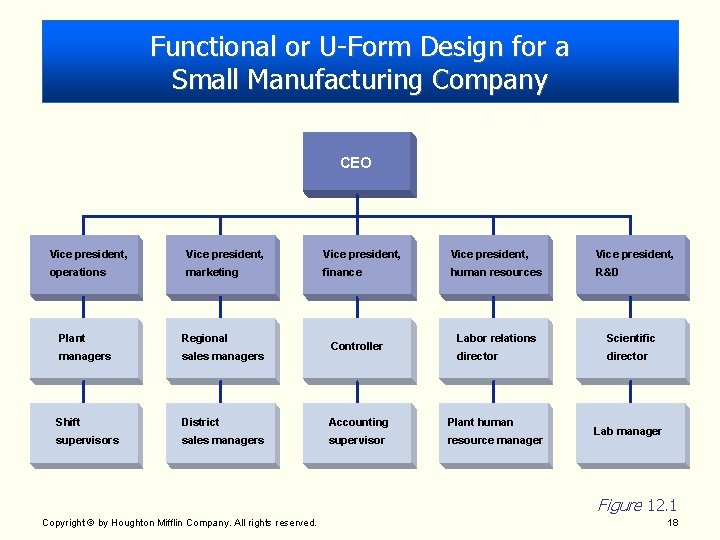
Basic Forms of Organization Design • Functional or U-form (Unitary) Design – Organizational members and units are grouped into functional departments such as marketing and production. – Coordination is required across all departments. – Design approach resembles functional departmentalization in its advantages and disadvantages. Copyright © by Houghton Mifflin Company. All rights reserved. 17
Functional or U-Form Design for a Small Manufacturing Company CEO Vice president, Vice president, operations marketing finance human resources R&D Plant Regional managers sales managers Shift District Accounting Plant human supervisors sales managers supervisor resource manager Controller Labor relations Scientific director Lab manager Figure 12. 1 Copyright © by Houghton Mifflin Company. All rights reserved. 18
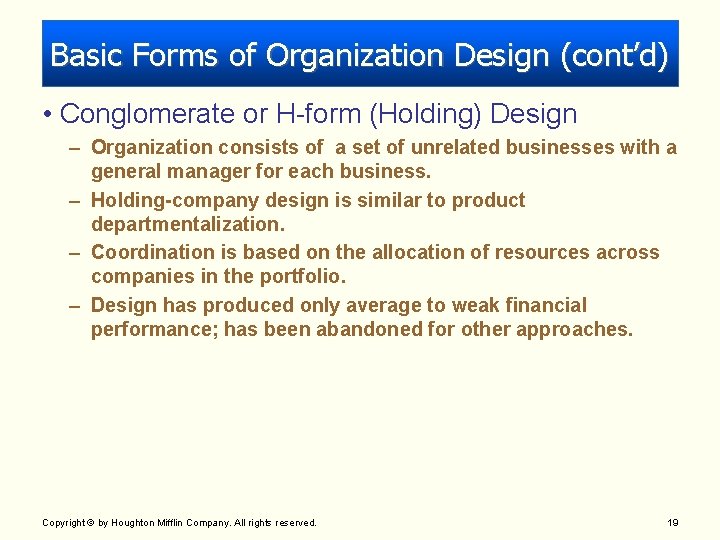
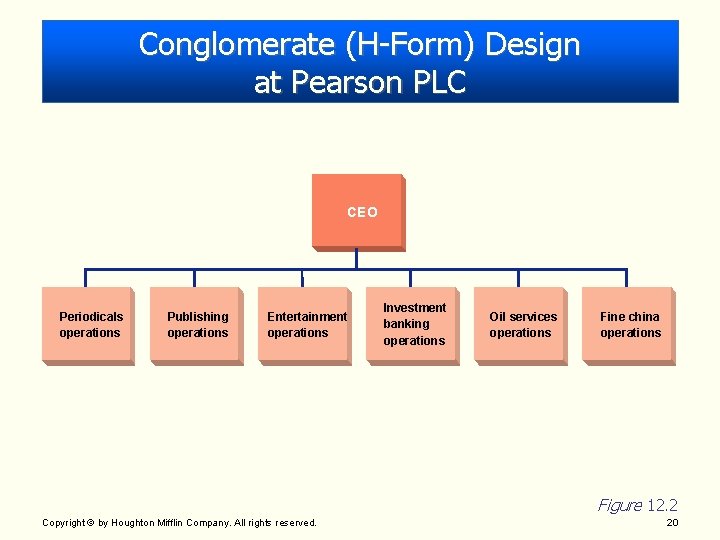
Basic Forms of Organization Design (cont’d) • Conglomerate or H-form (Holding) Design – Organization consists of a set of unrelated businesses with a general manager for each business. – Holding-company design is similar to product departmentalization. – Coordination is based on the allocation of resources across companies in the portfolio. – Design has produced only average to weak financial performance; has been abandoned for other approaches. Copyright © by Houghton Mifflin Company. All rights reserved. 19
Conglomerate (H-Form) Design at Pearson PLC CEO Periodicals operations Publishing operations Entertainment operations Investment banking operations Oil services operations Fine china operations Figure 12. 2 Copyright © by Houghton Mifflin Company. All rights reserved. 20
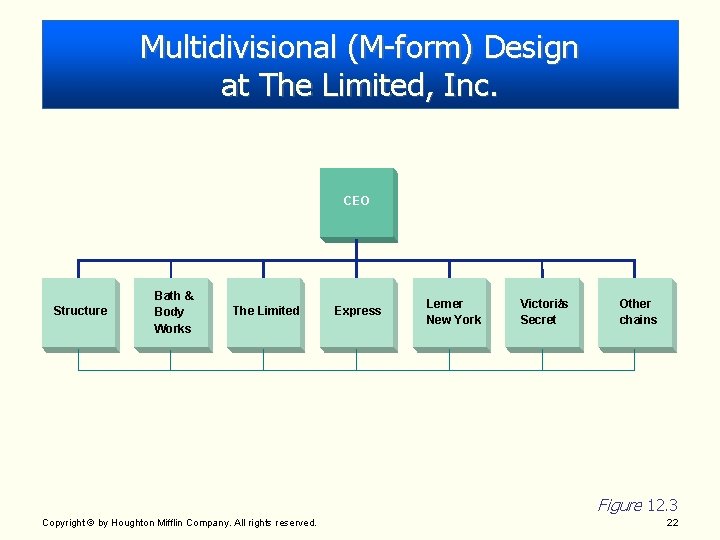
Basic Forms of Organization Design (cont’d) • Divisional or M-form (Multidivisional) Design – An organizational arrangement based on multiple businesses in related areas operating within a larger organizational framework. – The design results from a strategy of related diversification. – Some activities are extremely decentralized down to the divisional level; others are centralized at the corporate level. – The largest advantages of the M-form design are the opportunities for coordination and sharing of resources. – Successful M-form organizations can out perform U-form and H-form organizations. Copyright © by Houghton Mifflin Company. All rights reserved. 21
Multidivisional (M-form) Design at The Limited, Inc. CEO Structure Bath & Body Works The Limited Express Lerner New York Victoria’s Secret Other chains Figure 12. 3 Copyright © by Houghton Mifflin Company. All rights reserved. 22
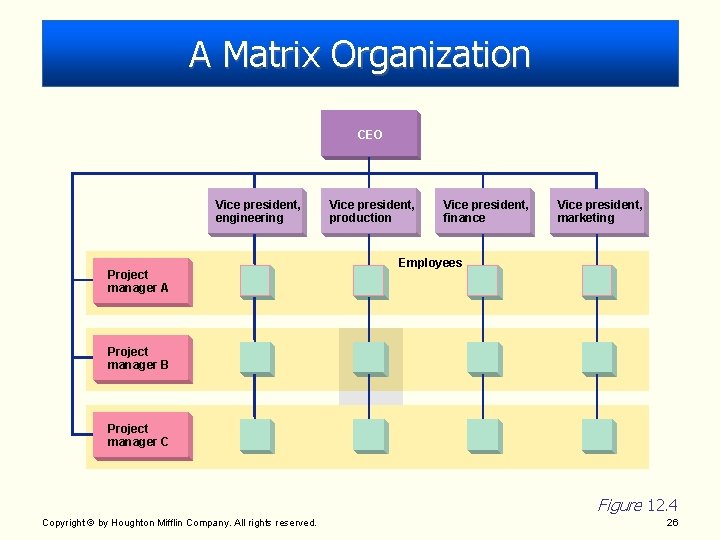
Basic Forms of Organization Design (cont’d) • Matrix Design – An organizational arrangement based on two overlapping bases of departmentalization (e. g. , functional departments and product categories). – A set of product groups or temporary departments are superimposed across the functional departments. – Employees in the resulting matrix are members of both their departments and a project team under a project manager. – The matrix creates a multiple command structure in which an employee reports to both departmental and project managers. – A matrix design is useful when: • There is strong environmental pressure. • There are large amounts of information to be processed. • There is pressure for shared resources. Copyright © by Houghton Mifflin Company. All rights reserved. 23
Basic Forms of Organization Design (cont’d) • Matrix Design Advantages – Enhances organizational flexibility. – Involvement creates high motivation and increased organizational commitment. – Team members have the opportunity to learn new skills. – Provides an efficient way for the organization to use its human resources. – Team members serve as bridges to their departments for the team. – Useful as a vehicle for decentralization. Copyright © by Houghton Mifflin Company. All rights reserved. 24
Basic Forms of Organization Design (cont’d) • Matrix Design Disadvantages – Employees are uncertain about reporting relationships. – Managers may view design as an anarchy in which they have unlimited freedom. – The dynamics of group behavior may lead to slower decision making, one-person domination, compromise decisions, or a loss of focus. – More time may be required for coordinating task-related activities. Copyright © by Houghton Mifflin Company. All rights reserved. 25
A Matrix Organization CEO Vice president, engineering Project manager A Vice president, production Vice president, finance Vice president, marketing Employees Project manager B Project manager C Figure 12. 4 Copyright © by Houghton Mifflin Company. All rights reserved. 26
Basic Forms of Organization Design (cont’d) • Hybrid Designs – An organizational arrangement based on two or more common forms of organization design. – An organization may have a mixture of related divisions and a single unrelated division. – Most organizations use a modified form of organization design that permits it to have sufficient flexibility to make adjustments for strategic purposes. Copyright © by Houghton Mifflin Company. All rights reserved. 27
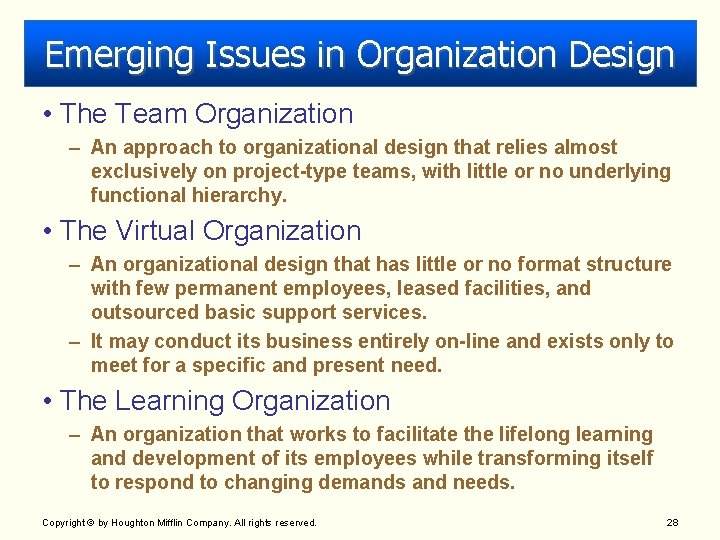
Emerging Issues in Organization Design • The Team Organization – An approach to organizational design that relies almost exclusively on project-type teams, with little or no underlying functional hierarchy. • The Virtual Organization – An organizational design that has little or no format structure with few permanent employees, leased facilities, and outsourced basic support services. – It may conduct its business entirely on-line and exists only to meet for a specific and present need. • The Learning Organization – An organization that works to facilitate the lifelong learning and development of its employees while transforming itself to respond to changing demands and needs. Copyright © by Houghton Mifflin Company. All rights reserved. 28
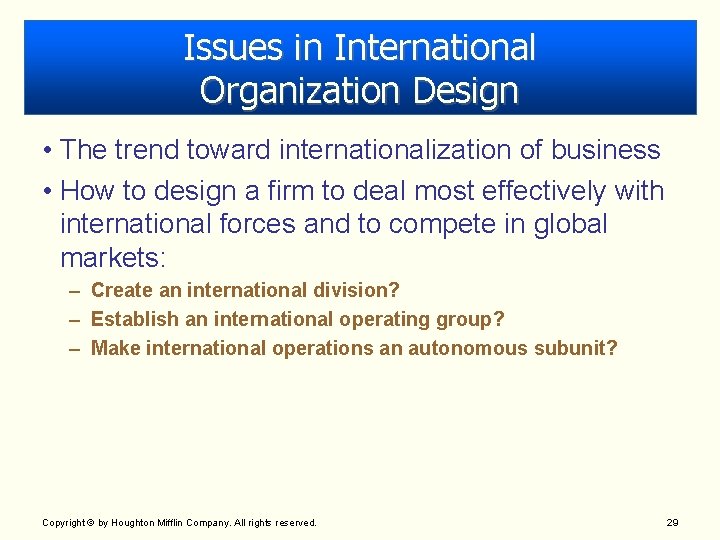
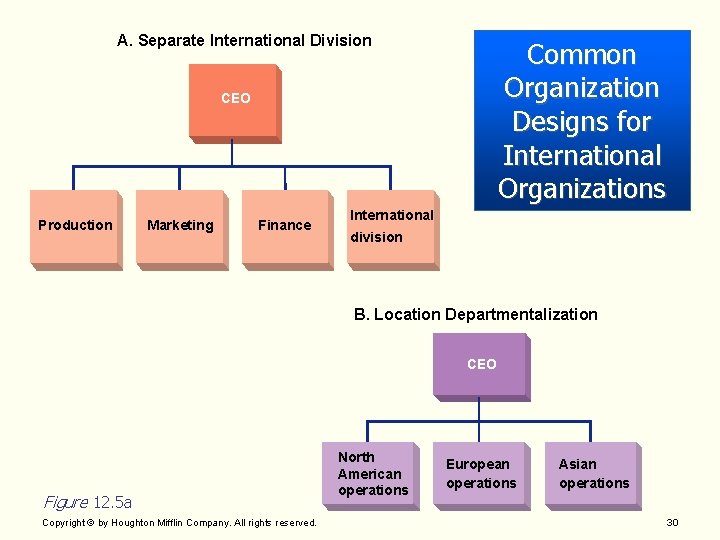
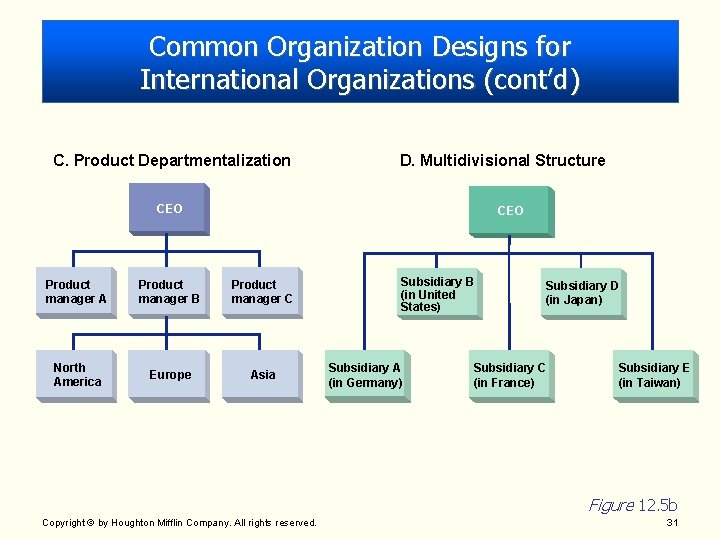
Issues in International Organization Design • The trend toward internationalization of business • How to design a firm to deal most effectively with international forces and to compete in global markets: – Create an international division? – Establish an international operating group? – Make international operations an autonomous subunit? Copyright © by Houghton Mifflin Company. All rights reserved. 29
A. Separate International Division Common Organization Designs for International Organizations CEO Production Marketing Finance International division B. Location Departmentalization CEO Figure 12. 5 a Copyright © by Houghton Mifflin Company. All rights reserved. North American operations European operations Asian operations 30
Common Organization Designs for International Organizations (cont’d) C. Product Departmentalization D. Multidivisional Structure CEO Product manager A Product manager B Product manager C North America Europe Asia Subsidiary B (in United States) Subsidiary A (in Germany) Subsidiary D (in Japan) Subsidiary C (in France) Subsidiary E (in Taiwan) Figure 12. 5 b Copyright © by Houghton Mifflin Company. All rights reserved. 31