
Chapter 12 Lecture Outline See Power Point Image
- Slides: 37
Chapter 12 Lecture Outline See Power. Point Image Slides for all figures and tables pre-inserted into Power. Point without notes. 12 -1 Copyright © The Mc. Graw-Hill Companies, Inc. Permission required for reproduction or display.
Populations vs. Species l l 12 -2 A species is all the organisms potentially capable of naturally breeding among themselves and having offspring that could successfully interbreed. A population is a group of organisms in the same species in the same geographical area. Copyright © The Mc. Graw-Hill Companies, Inc. Permission required for reproduction or display.
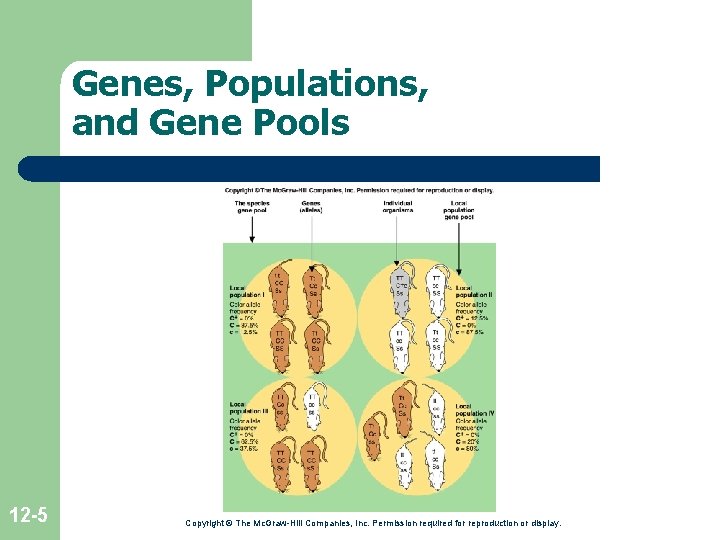
Population Genetics and Gene Pools l Population genetics is the study of the kinds of genes (alleles) within a population. – – – 12 -3 Also accounts for the numbers of alleles in a population Predicts and observes how those numbers will change over time This data is used to classify organisms and study evolutionary change. Copyright © The Mc. Graw-Hill Companies, Inc. Permission required for reproduction or display.
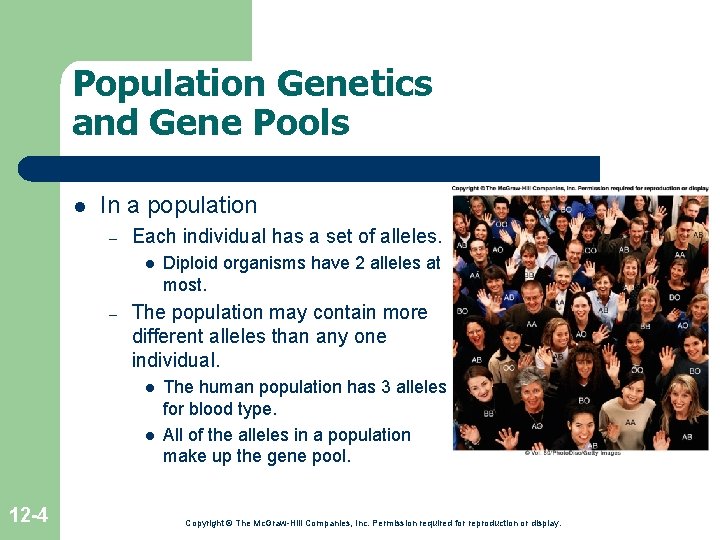
Population Genetics and Gene Pools l In a population – Each individual has a set of alleles. l – The population may contain more different alleles than any one individual. l l 12 -4 Diploid organisms have 2 alleles at most. The human population has 3 alleles for blood type. All of the alleles in a population make up the gene pool. Copyright © The Mc. Graw-Hill Companies, Inc. Permission required for reproduction or display.
Genes, Populations, and Gene Pools 12 -5 Copyright © The Mc. Graw-Hill Companies, Inc. Permission required for reproduction or display.
Biological Species Concept l According to the biological species concept, species is a group of organisms – – That share a common gene pool That are reproductively isolated from other populations l l 12 -6 They do not exchange genetic information. Local populations of a single species may have slightly different allele combinations. Copyright © The Mc. Graw-Hill Companies, Inc. Permission required for reproduction or display.
Gene and Allele Frequencies l l Differences in gene frequencies reflect genetic differences between populations. Allele frequency is a measure of how often an allele is found in a population. – – 12 -7 Expressed as a decimal or percentage # of times an allele appears in a population/the total number of alleles in the population Copyright © The Mc. Graw-Hill Companies, Inc. Permission required for reproduction or display.
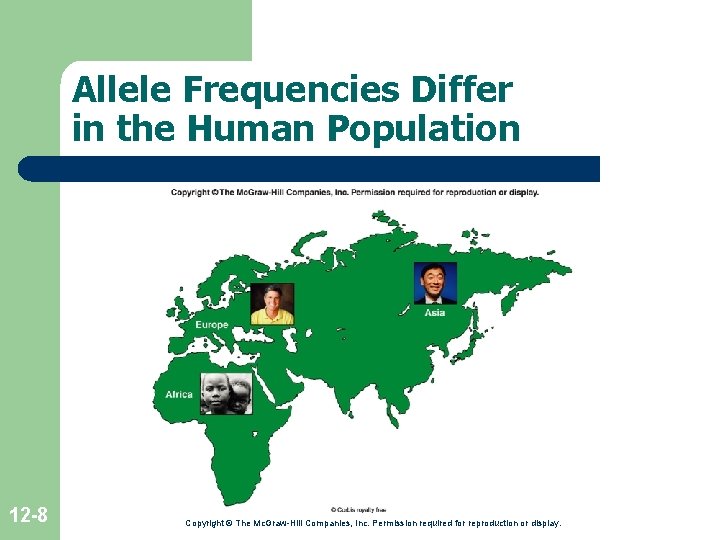
Allele Frequencies Differ in the Human Population 12 -8 Copyright © The Mc. Graw-Hill Companies, Inc. Permission required for reproduction or display.
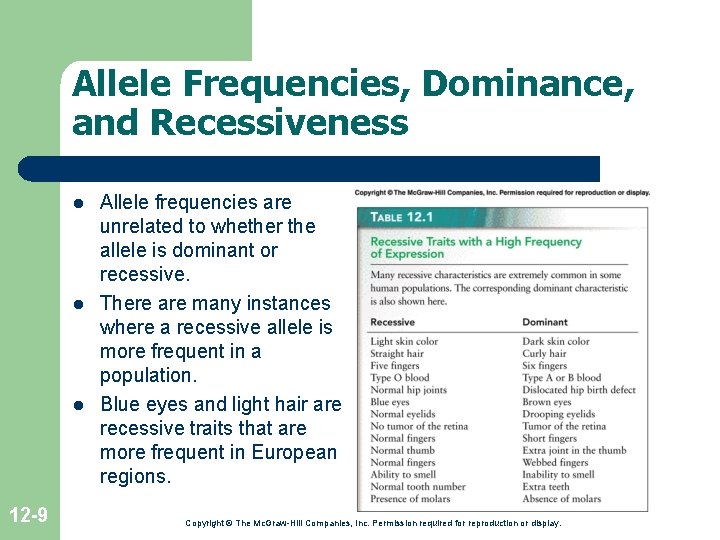
Allele Frequencies, Dominance, and Recessiveness l l l 12 -9 Allele frequencies are unrelated to whether the allele is dominant or recessive. There are many instances where a recessive allele is more frequent in a population. Blue eyes and light hair are recessive traits that are more frequent in European regions. Copyright © The Mc. Graw-Hill Companies, Inc. Permission required for reproduction or display.
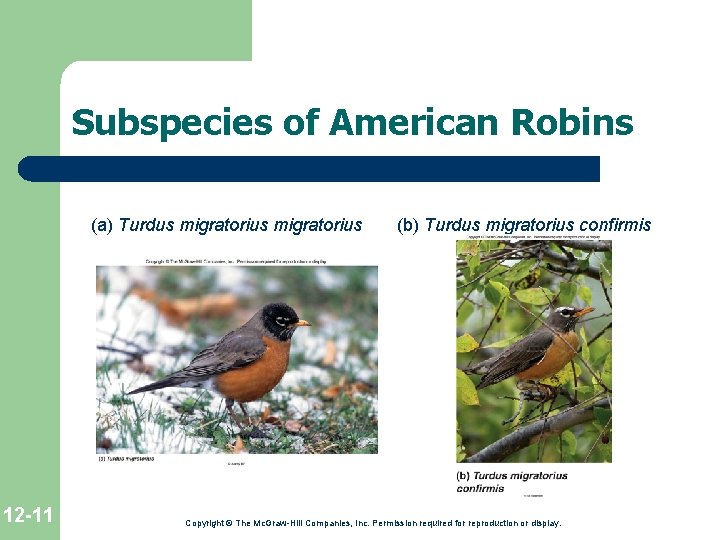
Subspecies, Breeds, Varieties, Strains, and Races l These all describe different forms of organisms that are all members of the same species. – – l 12 -10 Dogs have different breeds. Plants have different varieties. Bacteria have different strains. Humans have different races. All of these are types of subspecies. Copyright © The Mc. Graw-Hill Companies, Inc. Permission required for reproduction or display.
Subspecies of American Robins (a) Turdus migratorius 12 -11 (b) Turdus migratorius confirmis Copyright © The Mc. Graw-Hill Companies, Inc. Permission required for reproduction or display.
How Genetic Diversity Comes About l Genetic diversity describes genetic differences among members of a population. – – l 12 -12 High genetic diversity implies that many different alleles exist in a population. Low genetic diversity implies that all of the individuals in the population have the same alleles. A gene pool with greater diversity is likely to contain combinations of alleles that will allow the individuals to adapt to a changing environment. Copyright © The Mc. Graw-Hill Companies, Inc. Permission required for reproduction or display.
Mutations l l Mutations are changes in the base sequence of DNA. Mutations are the source of new alleles. – – – All alleles originated with mutations. Most mutations are harmful. Occasionally a mutation will change a gene so that the protein works differently or better. l 12 -13 Example: Insecticide resistance in mosquitoes Copyright © The Mc. Graw-Hill Companies, Inc. Permission required for reproduction or display.
Sexual Reproduction l Sexual reproduction generates new genetic combinations. – l May not necessarily change the frequency of alleles in a population – l 12 -14 New combinations of alleles in individuals However, the new combination of alleles in an individual may create a combination of traits that allows the individual to survive and reproduce more successfully than other individuals. Example: Corn plants that inherit resistance to corn blight and resistance to insects Copyright © The Mc. Graw-Hill Companies, Inc. Permission required for reproduction or display.
Migration l The migration is the movement of individuals into and out of populations. – – l Artificial migration is used in zoos to generate genetic diversity. – – 12 -15 Results in alleles being added or subtracted from a population May change allele frequencies in the population Inbreeding has reduced genetic diversity in small zoo populations. Zoos are exchanging animals for breeding to introduce new alleles into their populations. Copyright © The Mc. Graw-Hill Companies, Inc. Permission required for reproduction or display.
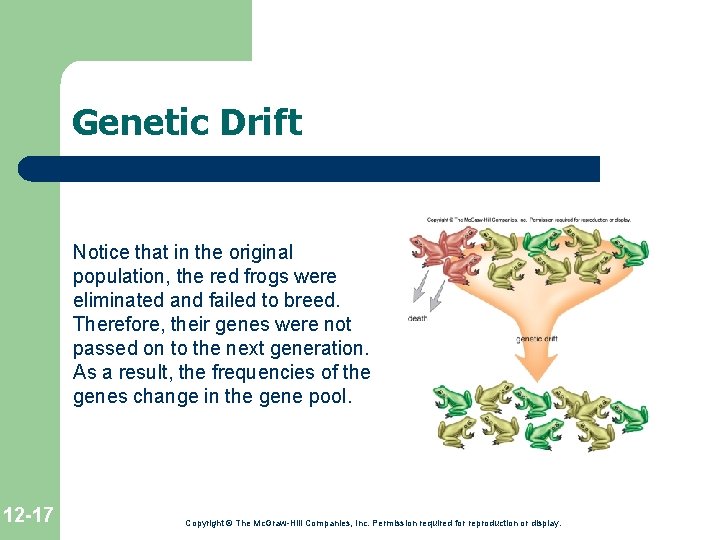
The Importance of Population Size l Population size is directly related to genetic diversity. – 12 -16 The smaller the population, the less genetic diversity a population can contain. l Mutations, migrations, and death can have dramatic effects on the genetic make-up of a population. l Frequently, random events will significantly change the gene pool. – This is called genetic drift. Copyright © The Mc. Graw-Hill Companies, Inc. Permission required for reproduction or display.
Genetic Drift Notice that in the original population, the red frogs were eliminated and failed to breed. Therefore, their genes were not passed on to the next generation. As a result, the frequencies of the genes change in the gene pool. 12 -17 Copyright © The Mc. Graw-Hill Companies, Inc. Permission required for reproduction or display.
Why Genetically Distinct Populations Exist l l 12 -18 Many species have wide geographic distribution with reasonable distinct subspecies. This occurs for several reasons. Copyright © The Mc. Graw-Hill Companies, Inc. Permission required for reproduction or display.
Adaptation to Local Environmental Conditions l Genetic diversity allows populations to adapt to their specific environments. – Some individuals will have combinations of alleles that allow them to survive and successfully reproduce in hostile conditions. l – 12 -19 Death and migration remove or reduce the alleles that do not contribute to survival. Example: Lizards in the desert have lighter coloration than those that live in other environments. Copyright © The Mc. Graw-Hill Companies, Inc. Permission required for reproduction or display.
Founder Effect l The founder effect is a type of genetic drift that occurs when a new population is established by a few colonizing individuals. – – 12 -20 The small colonizing group may have different allele frequencies than the original population. When the colonizing individuals mate and multiply, their allele frequencies will tend to persist, making the new population different from the parent population. Copyright © The Mc. Graw-Hill Companies, Inc. Permission required for reproduction or display.
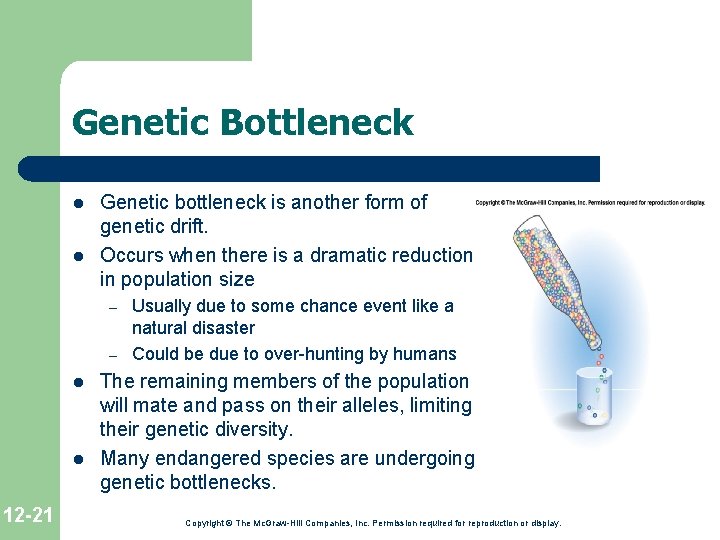
Genetic Bottleneck l l Genetic bottleneck is another form of genetic drift. Occurs when there is a dramatic reduction in population size – – l l 12 -21 Usually due to some chance event like a natural disaster Could be due to over-hunting by humans The remaining members of the population will mate and pass on their alleles, limiting their genetic diversity. Many endangered species are undergoing genetic bottlenecks. Copyright © The Mc. Graw-Hill Companies, Inc. Permission required for reproduction or display.
Barriers to Movement l When migration is limited, populations become geographically and reproductively isolated. – – 12 -22 Perpetuates the effects of genetic drift caused by founder effect and bottleneck Limits genetic diversity and generates subspecies Copyright © The Mc. Graw-Hill Companies, Inc. Permission required for reproduction or display.
Genetic Diversity in Domesticated Plants and Animals l l Domesticated plants and animals are populations maintained by humans for human purposes. Several techniques are used to produce plants and animals with specific characteristics. – l 12 -23 High productivity, disease resistance, etc. Low genetic diversity is an undesirable side effect. Copyright © The Mc. Graw-Hill Companies, Inc. Permission required for reproduction or display.
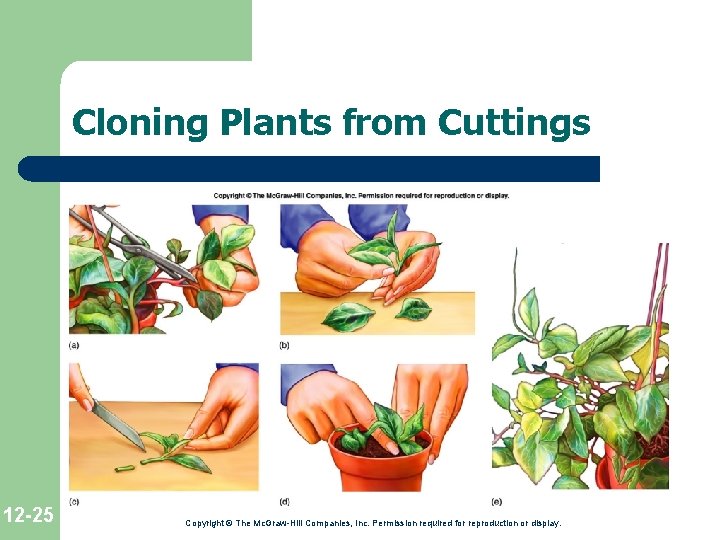
Cloning l Cloning is the process of reproducing organisms asexually so that they are all genetically identical. – – – 12 -24 Generates clones In plants, cuttings are used for this process. Animals have recently been cloned by somatic cell nuclear transfer. Copyright © The Mc. Graw-Hill Companies, Inc. Permission required for reproduction or display.
Cloning Plants from Cuttings 12 -25 Copyright © The Mc. Graw-Hill Companies, Inc. Permission required for reproduction or display.
Selective Breeding l Humans can bring together certain desired alleles by selective breeding. – l Selective breeding has been used to – 12 -26 Involves the careful selection of individuals with specific desirable traits and their controlled mating Generate chicken breeds that grow quickly and generate a lot of meat or lay a lot of eggs Copyright © The Mc. Graw-Hill Companies, Inc. Permission required for reproduction or display.
Selective Breeding l l Intraspecific hybrids result from the crossing of two different varieties of the same species. Interspecific hybrids result from the crossing of two species. – – 12 -27 Tangelos come from crosses of tangerines and oranges. Mules come from crosses between horses and donkeys. Copyright © The Mc. Graw-Hill Companies, Inc. Permission required for reproduction or display.
Genetic Engineering l l Recombinant DNA technology has given us the ability to introduce alleles and modify the characteristics of domesticated species. This has allowed agricultural scientists to engineer specific, valuable characteristics into certain species. – 12 -28 Generates genetically modified organisms (GMOs) Copyright © The Mc. Graw-Hill Companies, Inc. Permission required for reproduction or display.
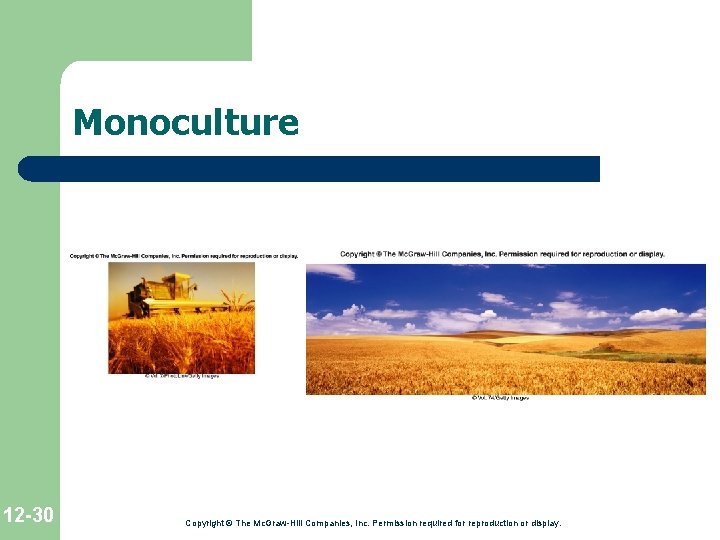
The Impact of Monoculture l Generates domesticated populations that are all similar with specific desirable traits. – l Necessarily limits genetic diversity Planting large crops of identical plants is called monoculture. – These are easy to maintain until a new disease comes along. l 12 -29 It may kill the entire crop because they are all identical. Copyright © The Mc. Graw-Hill Companies, Inc. Permission required for reproduction or display.
Monoculture 12 -30 Copyright © The Mc. Graw-Hill Companies, Inc. Permission required for reproduction or display.
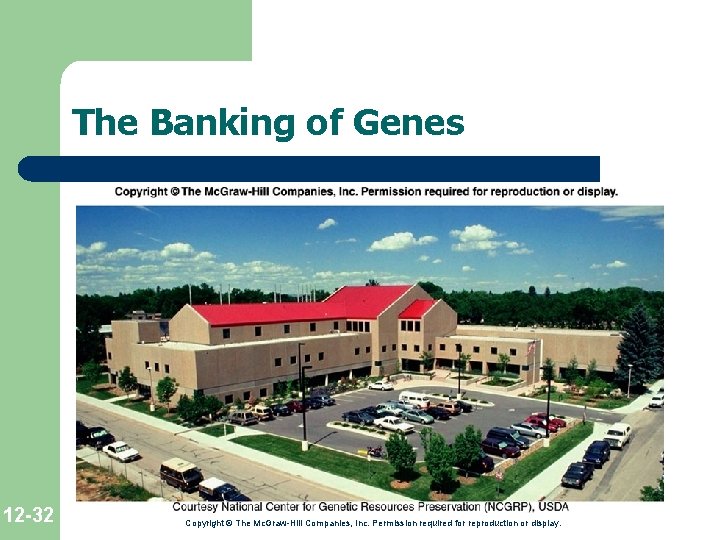
The Impact of Monoculture l As a solution, scientists have generated gene banks. – – 12 -31 These contain populations of primitive ancestors of domesticated species. If a disease eliminated a given domesticated variety, then the ancestor could be used to regenerate the domesticated variety. Copyright © The Mc. Graw-Hill Companies, Inc. Permission required for reproduction or display.
The Banking of Genes 12 -32 Copyright © The Mc. Graw-Hill Companies, Inc. Permission required for reproduction or display.
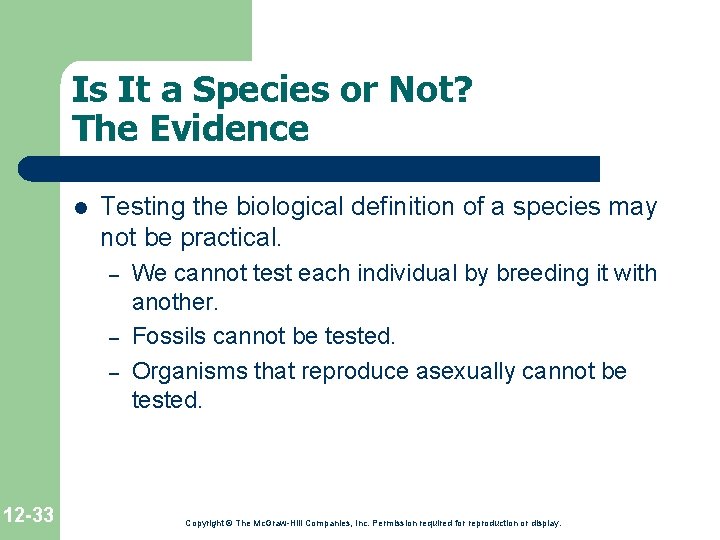
Is It a Species or Not? The Evidence l Testing the biological definition of a species may not be practical. – – – 12 -33 We cannot test each individual by breeding it with another. Fossils cannot be tested. Organisms that reproduce asexually cannot be tested. Copyright © The Mc. Graw-Hill Companies, Inc. Permission required for reproduction or display.
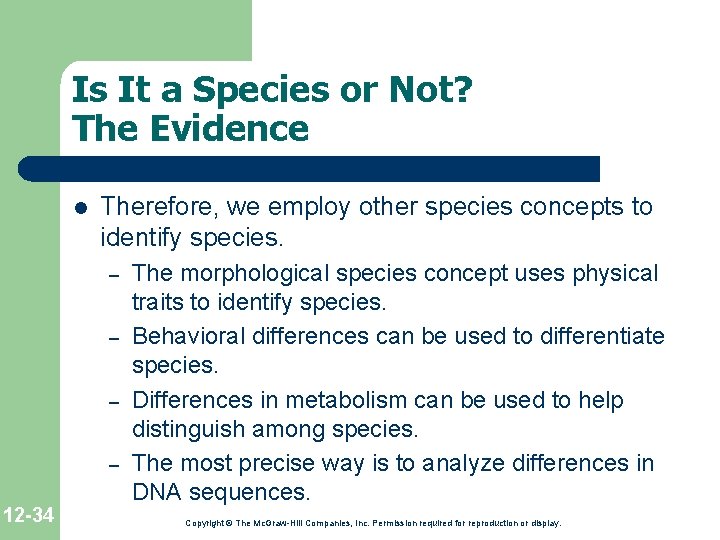
Is It a Species or Not? The Evidence l Therefore, we employ other species concepts to identify species. – – 12 -34 The morphological species concept uses physical traits to identify species. Behavioral differences can be used to differentiate species. Differences in metabolism can be used to help distinguish among species. The most precise way is to analyze differences in DNA sequences. Copyright © The Mc. Graw-Hill Companies, Inc. Permission required for reproduction or display.
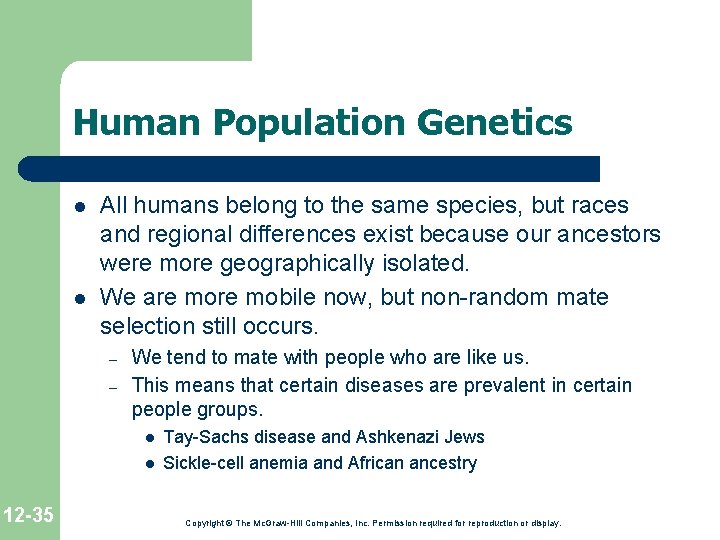
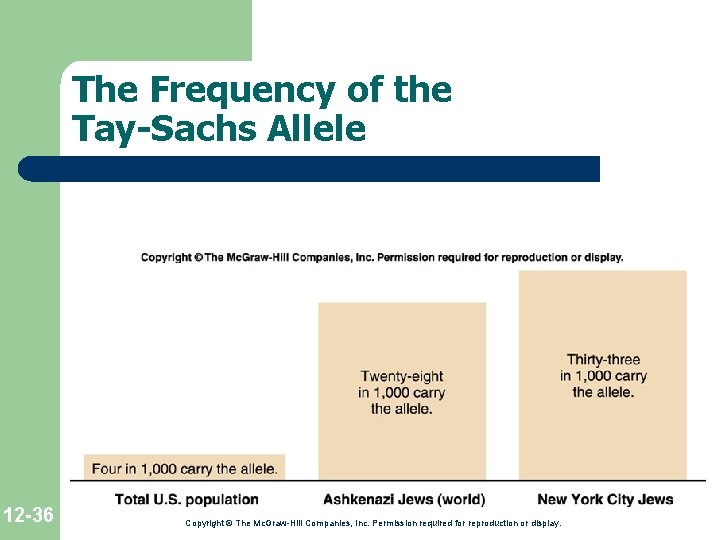
Human Population Genetics l l All humans belong to the same species, but races and regional differences exist because our ancestors were more geographically isolated. We are mobile now, but non-random mate selection still occurs. – – We tend to mate with people who are like us. This means that certain diseases are prevalent in certain people groups. l l 12 -35 Tay-Sachs disease and Ashkenazi Jews Sickle-cell anemia and African ancestry Copyright © The Mc. Graw-Hill Companies, Inc. Permission required for reproduction or display.
The Frequency of the Tay-Sachs Allele 12 -36 Copyright © The Mc. Graw-Hill Companies, Inc. Permission required for reproduction or display.
Ethics and Human Population Genetics l Understanding inheritance patterns has led to both bad and good human responses. – Eugenics (bad) l l – Disease treatment (good) l l 12 -37 A movement motivated to purge the “bad” genes from society Based on a fundamental misunderstanding of the power of inheritance Understanding genetic diseases has allowed us to develop treatments. PKU does not have to lead to mental retardation, if foods with phenylalanine are avoided. Copyright © The Mc. Graw-Hill Companies, Inc. Permission required for reproduction or display.