
Chapter 12 Layered Mafic Intrusions n Super Laboratories

Chapter 12 Layered Mafic Intrusions n Super Laboratories for the study of fractionation • Initially hot • Initially low viscosity • Slow cooling - deep n Mafic intrusions come in all sizes – from thin dikes and sills – up to the huge 66, 000 km 2 x 9 km thick Bushveld intrusion of South Africa n Can occur in any tectonic environment where basaltic magma is generated
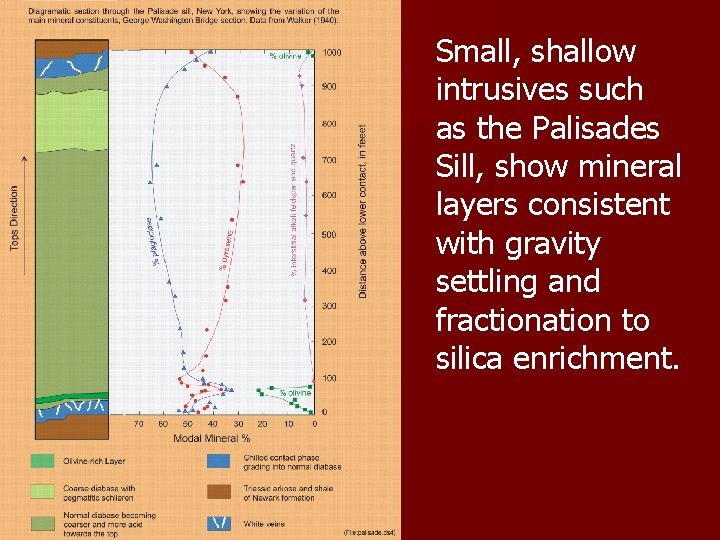
Small, shallow intrusives such as the Palisades Sill, show mineral layers consistent with gravity settling and fractionation to silica enrichment.
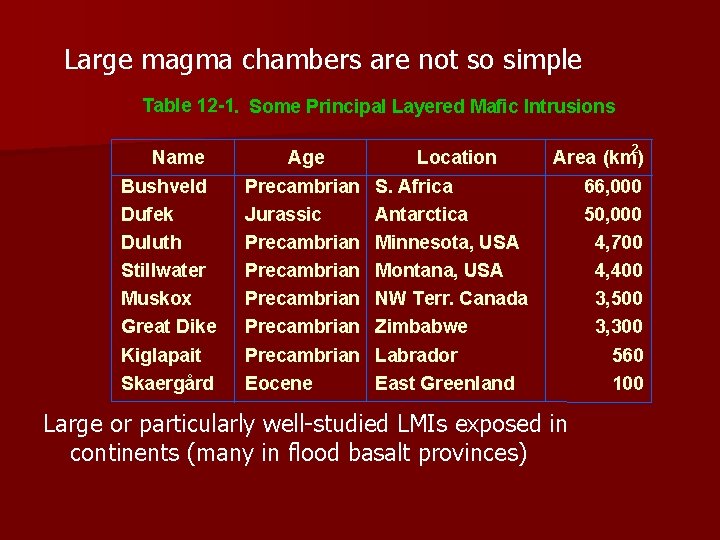
Large magma chambers are not so simple Table 12 -1. Some Principal Layered Mafic Intrusions Name Bushveld Dufek Duluth Stillwater Muskox Great Dike Kiglapait Skaergård Age Precambrian Jurassic Precambrian Precambrian Eocene Location S. Africa Antarctica Minnesota, USA Montana, USA NW Terr. Canada Zimbabwe Labrador East Greenland 2 Area (km ) 66, 000 50, 000 4, 700 4, 400 3, 500 3, 300 560 100 Large or particularly well-studied LMIs exposed in continents (many in flood basalt provinces)

The funnel shape of a typical LMI (lopolith, etc. ) The Muskox Intrusion Figure 12 -1. From Irvine and Smith (1967), In P. J. Wyllie (ed. ), Ultramafic and Related Rocks. Wiley. New York, pp. 38 -49.
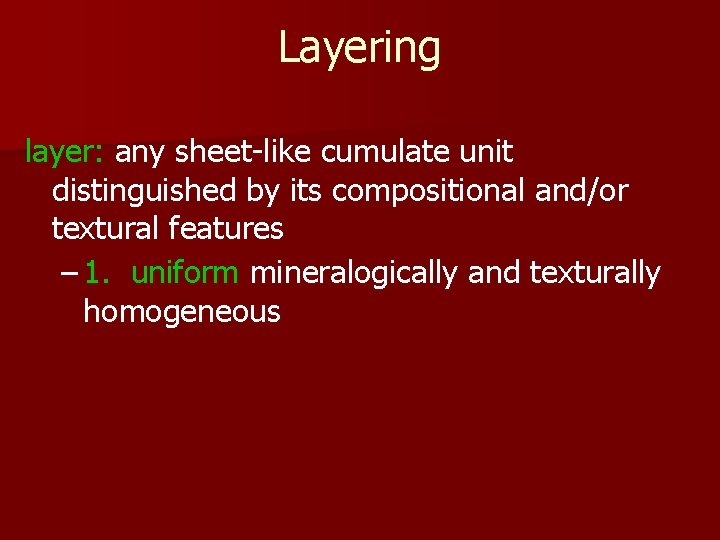
Layering layer: any sheet-like cumulate unit distinguished by its compositional and/or textural features – 1. uniform mineralogically and texturally homogeneous

Uniform Layering Figure 12 -3 b. Uniform Chromite layers alternate with plagioclase-rich layers, Bushveld Complex, S. Africa. From Mc. Birney and Noyes (1979) J. Petrol. , 20, 487 -554.
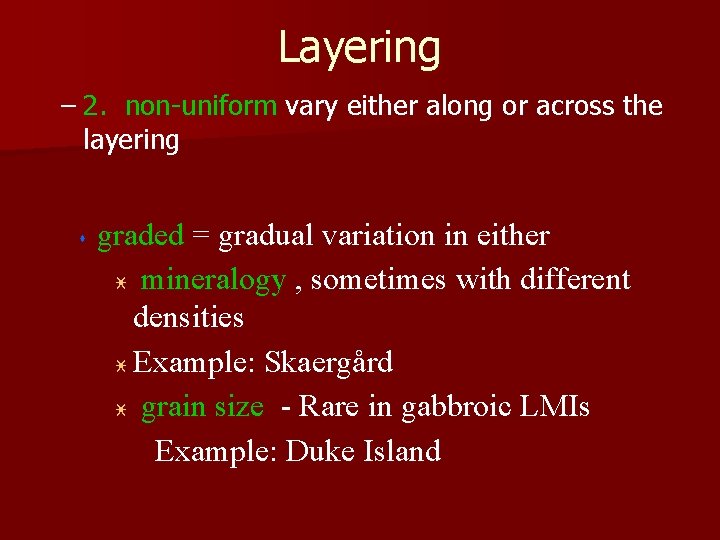
Layering – 2. non-uniform vary either along or across the layering s graded = gradual variation in either i mineralogy , sometimes with different densities i Example: Skaergård i grain size - Rare in gabbroic LMIs Example: Duke Island
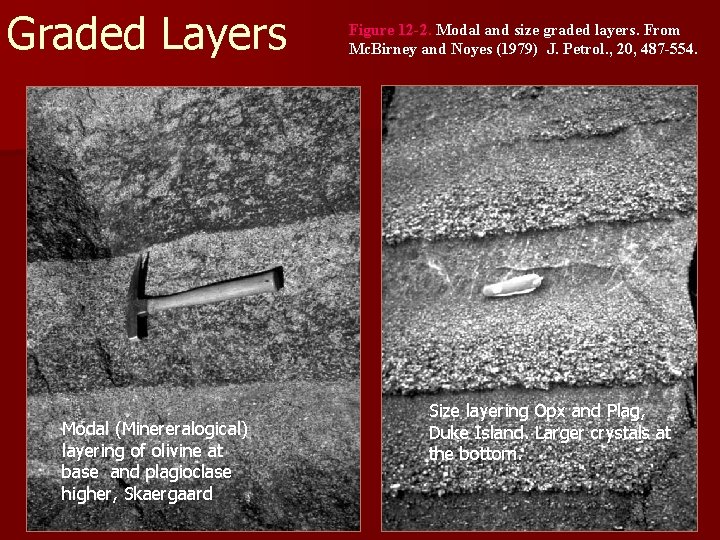
Graded Layers Modal (Minereralogical) layering of olivine at base and plagioclase higher, Skaergaard Figure 12 -2. Modal and size graded layers. From Mc. Birney and Noyes (1979) J. Petrol. , 20, 487 -554. Size layering Opx and Plag, Duke Island. Larger crystals at the bottom.
The regularity of layering Rhythmic: layers systematically repeat n – Macrorhythmic: several meters thick – Microrhythmic: only a few cm thick Example: Stillwater n Intermittent: less regular patterns – A common type consists of rhythmic graded layers punctuated by occasional uniform layers: Skaergård
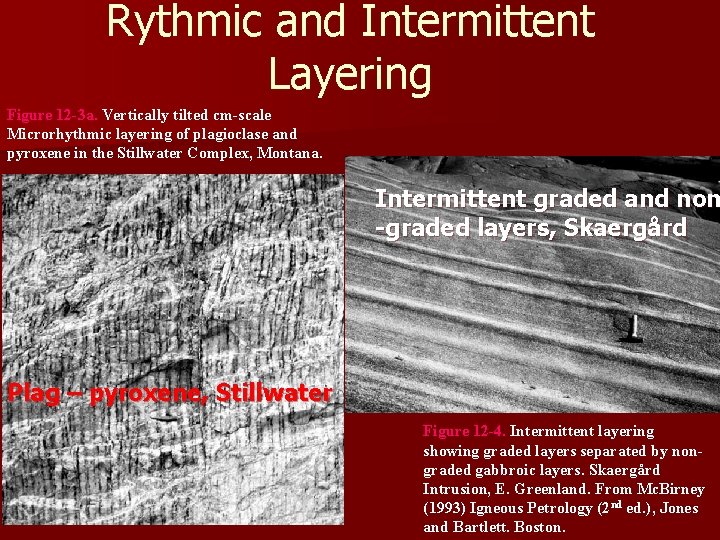
Rythmic and Intermittent Layering Figure 12 -3 a. Vertically tilted cm-scale Microrhythmic layering of plagioclase and pyroxene in the Stillwater Complex, Montana. Intermittent graded and non -graded layers, Skaergård Plag – pyroxene, Stillwater Figure 12 -4. Intermittent layering showing graded layers separated by nongraded gabbroic layers. Skaergård Intrusion, E. Greenland. From Mc. Birney (1993) Igneous Petrology (2 nd ed. ), Jones and Bartlett. Boston.
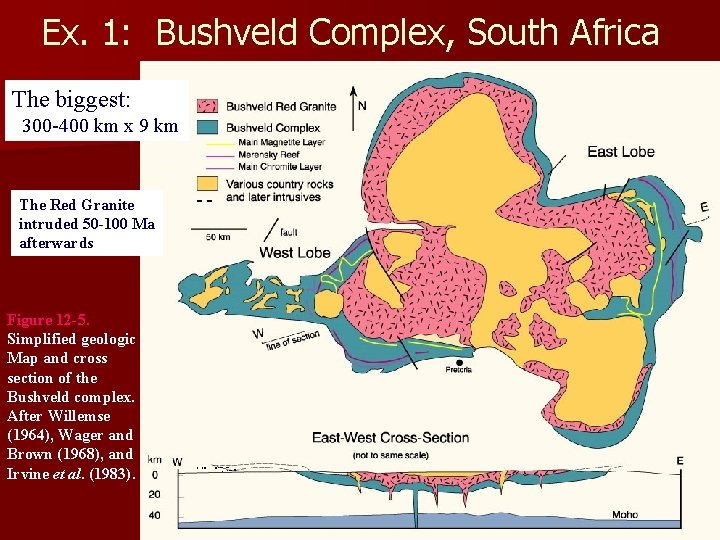
Ex. 1: Bushveld Complex, South Africa The biggest: 300 -400 km x 9 km The Red Granite intruded 50 -100 Ma afterwards Figure 12 -5. Simplified geologic Map and cross section of the Bushveld complex. After Willemse (1964), Wager and Brown (1968), and Irvine et al. (1983).
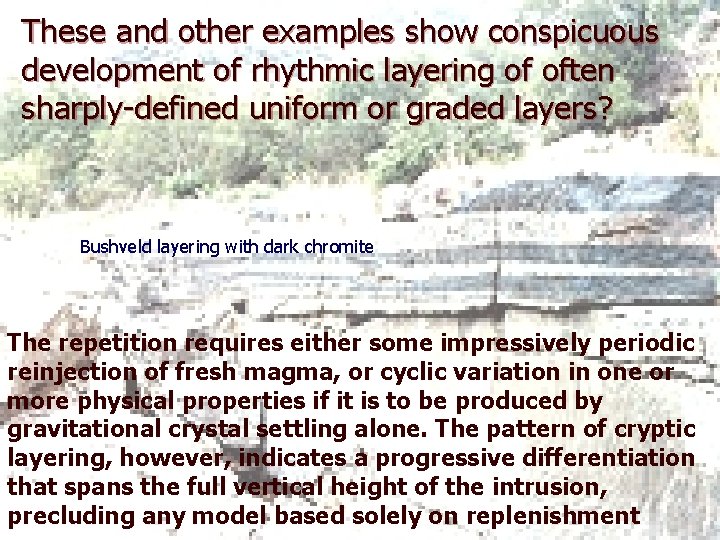
These and other examples show conspicuous development of rhythmic layering of often sharply-defined uniform or graded layers? Bushveld layering with dark chromite The repetition requires either some impressively periodic reinjection of fresh magma, or cyclic variation in one or more physical properties if it is to be produced by gravitational crystal settling alone. The pattern of cryptic layering, however, indicates a progressive differentiation that spans the full vertical height of the intrusion, precluding any model based solely on replenishment
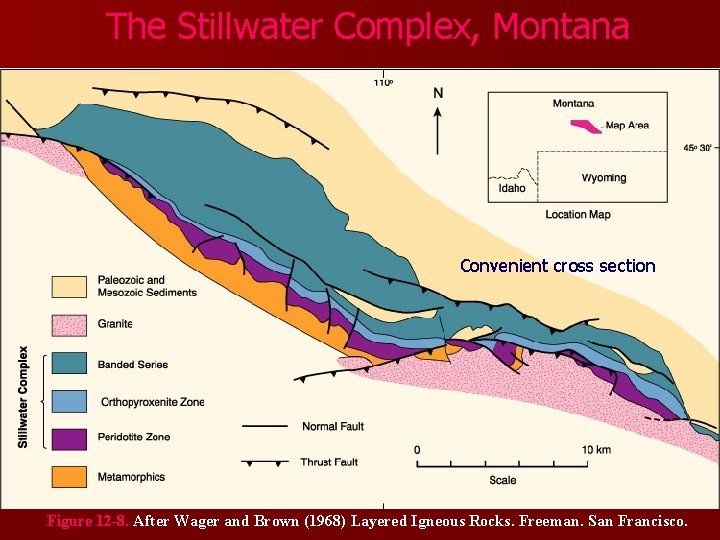
The Stillwater Complex, Montana Convenient cross section Figure 12 -8. After Wager and Brown (1968) Layered Igneous Rocks. Freeman. San Francisco.
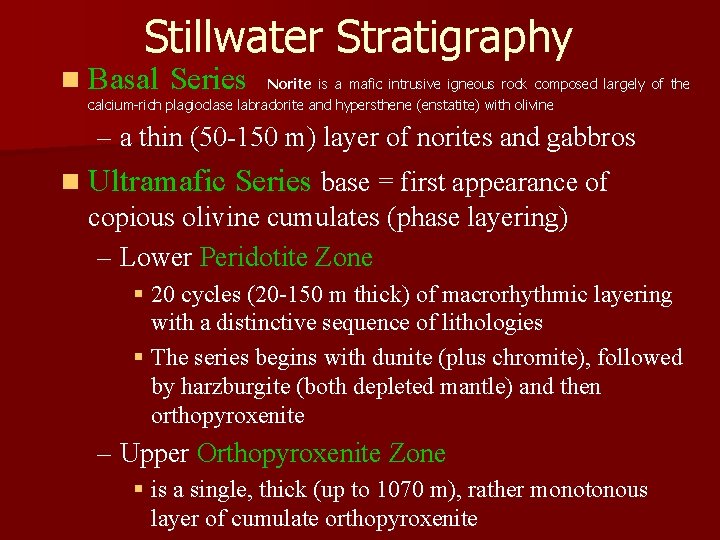
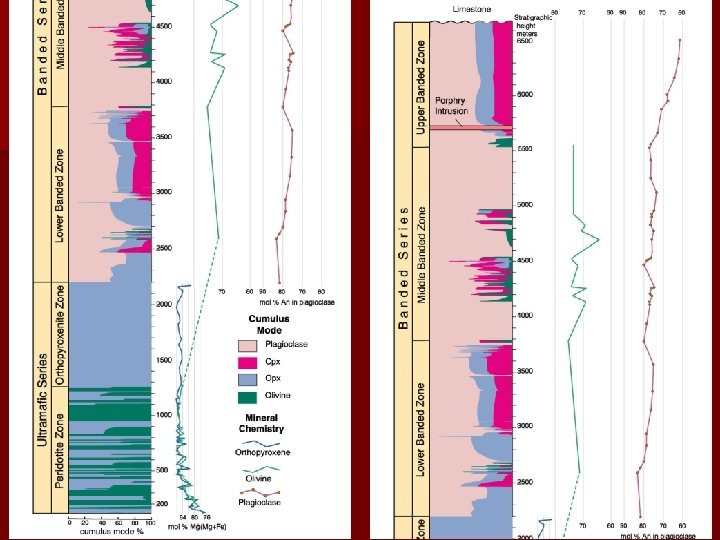
Stillwater Stratigraphy n Basal Series Norite is a mafic intrusive igneous rock composed largely of the calcium-rich plagioclase labradorite and hypersthene (enstatite) with olivine – a thin (50 -150 m) layer of norites and gabbros n Ultramafic Series base = first appearance of copious olivine cumulates (phase layering) – Lower Peridotite Zone § 20 cycles (20 -150 m thick) of macrorhythmic layering with a distinctive sequence of lithologies § The series begins with dunite (plus chromite), followed by harzburgite (both depleted mantle) and then orthopyroxenite – Upper Orthopyroxenite Zone § is a single, thick (up to 1070 m), rather monotonous layer of cumulate orthopyroxenite
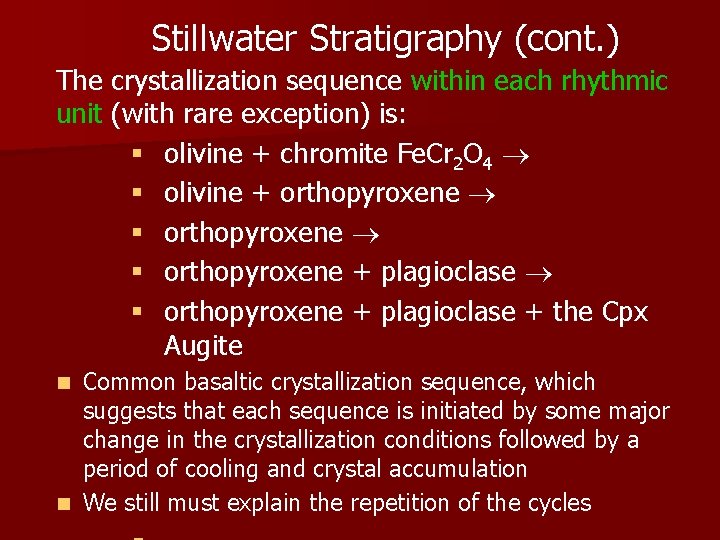
Stillwater Stratigraphy (cont. ) The crystallization sequence within each rhythmic unit (with rare exception) is: § olivine + chromite Fe. Cr 2 O 4 § olivine + orthopyroxene § orthopyroxene + plagioclase + the Cpx Augite Common basaltic crystallization sequence, which suggests that each sequence is initiated by some major change in the crystallization conditions followed by a period of cooling and crystal accumulation n We still must explain the repetition of the cycles n

Stillwater (cont) The Banded Series – Sudden cumulus plagioclase significant change from ultramafic rock types (phase layering again) – The most common lithologies are anorthosite, norite, gabbro, and troctolite (olivine-rich and pyroxene-poor gabbro) – Winter thinks such a sudden and dramatic change suggests the introduction of a second principal magma type into the Stillwater magma chamber – Let’s take a look
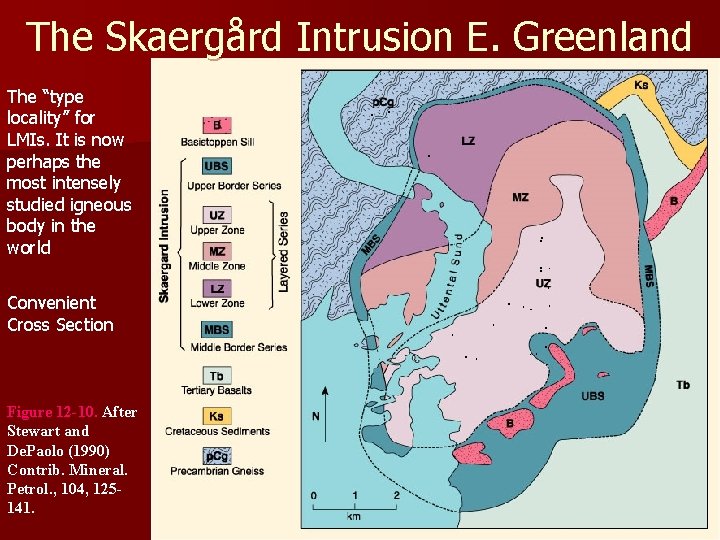
The Skaergård Intrusion E. Greenland The “type locality” for LMIs. It is now perhaps the most intensely studied igneous body in the world Convenient Cross Section Figure 12 -10. After Stewart and De. Paolo (1990) Contrib. Mineral. Petrol. , 104, 125141.
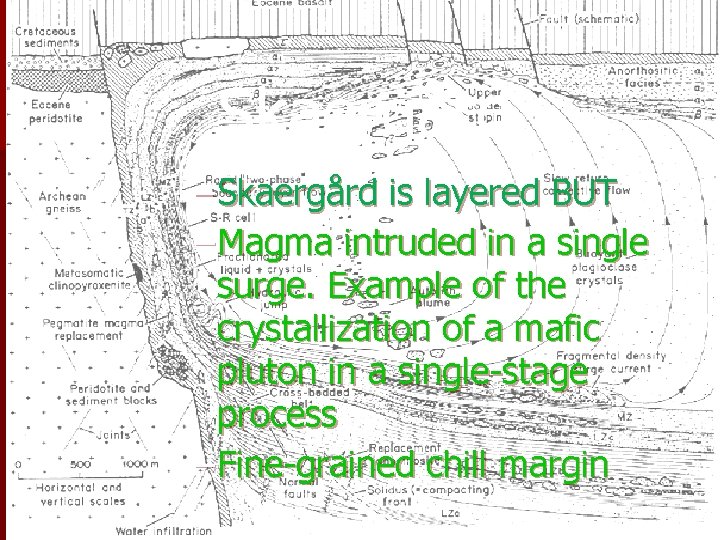
Skaergård – Skaergård is layered BUT – Magma intruded in a single surge. Example of the crystallization of a mafic pluton in a single-stage process – Fine-grained chill margin
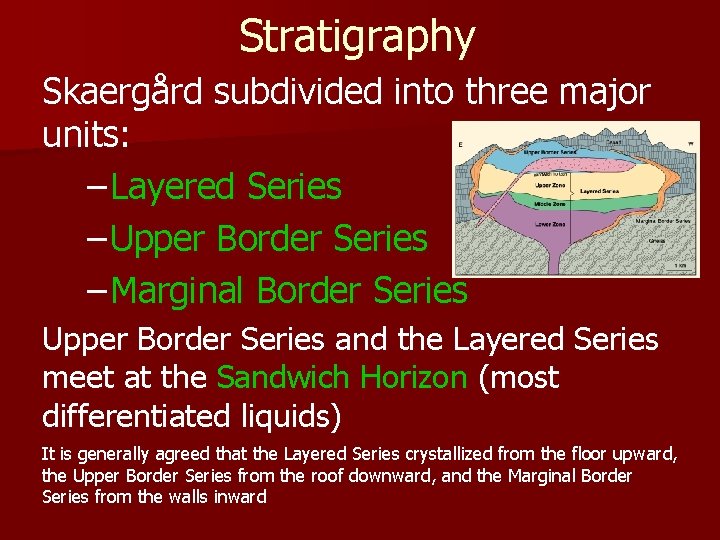
Stratigraphy Skaergård subdivided into three major units: – Layered Series – Upper Border Series – Marginal Border Series Upper Border Series and the Layered Series meet at the Sandwich Horizon (most differentiated liquids) It is generally agreed that the Layered Series crystallized from the floor upward, the Upper Border Series from the roof downward, and the Marginal Border Series from the walls inward
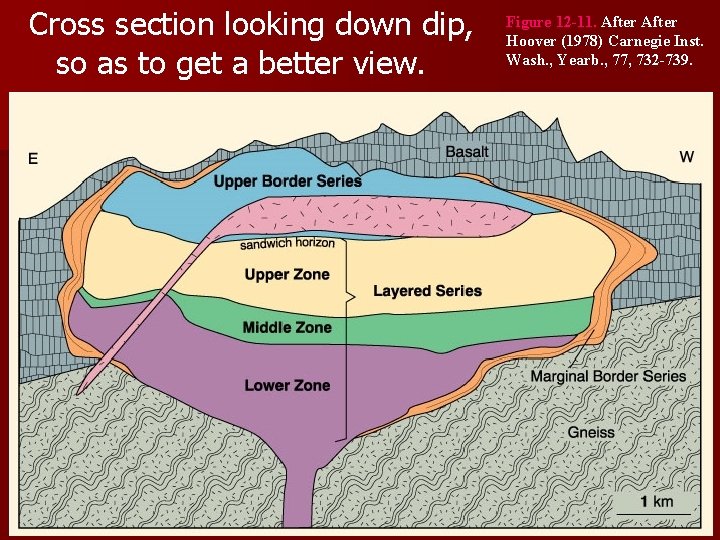
Cross section looking down dip, so as to get a better view. Figure 12 -11. After Hoover (1978) Carnegie Inst. Wash. , Yearb. , 77, 732 -739.
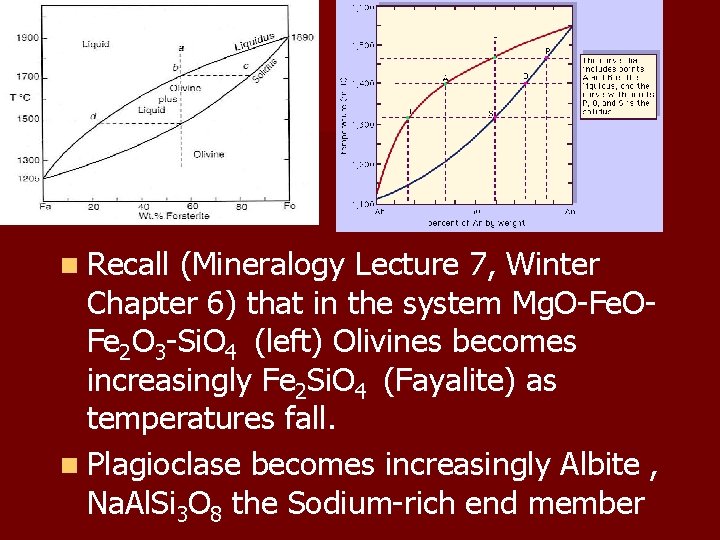
n Recall (Mineralogy Lecture 7, Winter Chapter 6) that in the system Mg. O-Fe. OFe 2 O 3 -Si. O 4 (left) Olivines becomes increasingly Fe 2 Si. O 4 (Fayalite) as temperatures fall. n Plagioclase becomes increasingly Albite , Na. Al. Si 3 O 8 the Sodium-rich end member
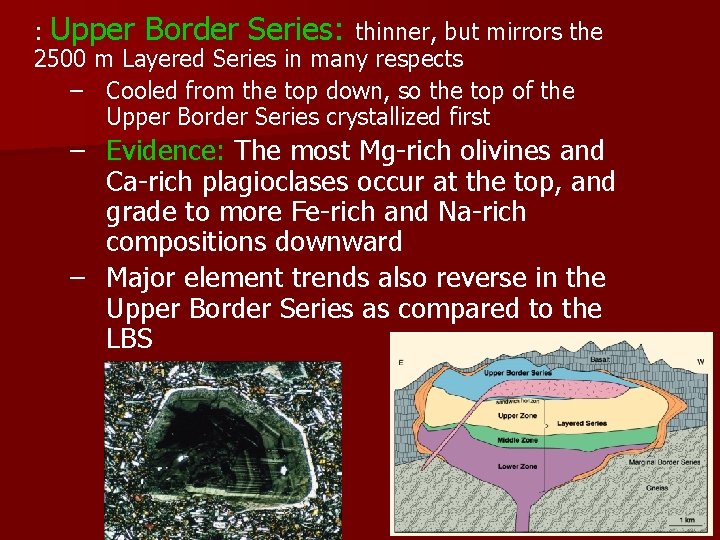
: Upper Border Series: thinner, but mirrors the 2500 m Layered Series in many respects – Cooled from the top down, so the top of the Upper Border Series crystallized first – Evidence: The most Mg-rich olivines and Ca-rich plagioclases occur at the top, and grade to more Fe-rich and Na-rich compositions downward – Major element trends also reverse in the Upper Border Series as compared to the LBS
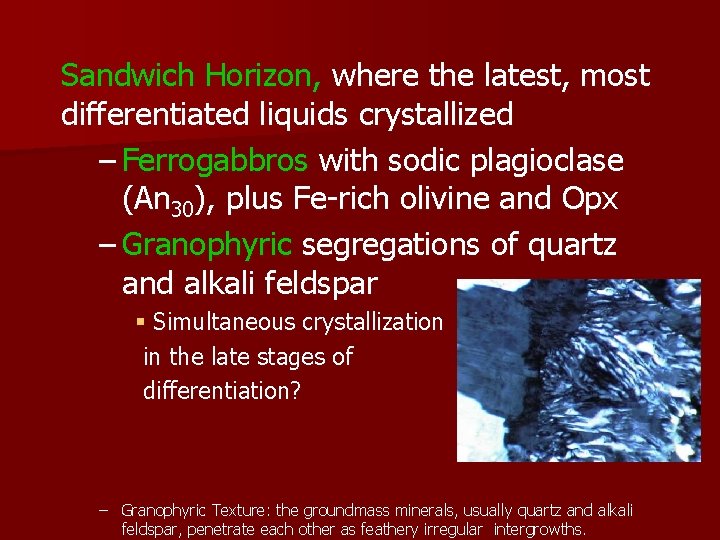
Sandwich Horizon, where the latest, most differentiated liquids crystallized – Ferrogabbros with sodic plagioclase (An 30), plus Fe-rich olivine and Opx – Granophyric segregations of quartz and alkali feldspar § Simultaneous crystallization in the late stages of differentiation? – Granophyric Texture: the groundmass minerals, usually quartz and alkali feldspar, penetrate each other as feathery irregular intergrowths.
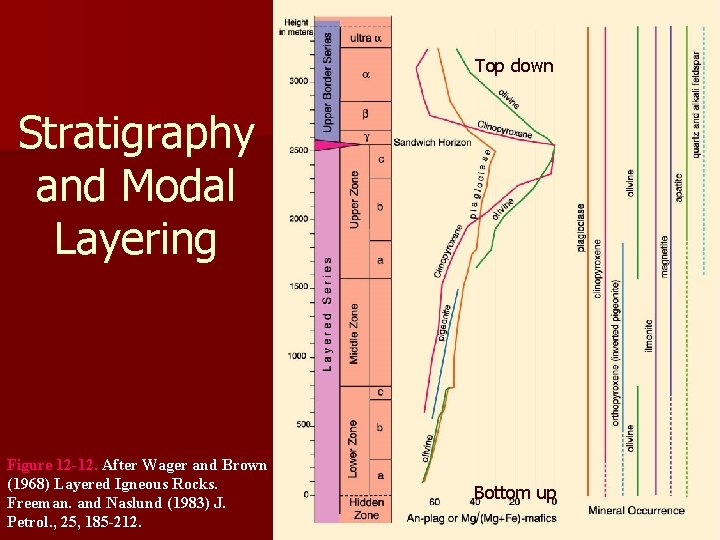
Top down Stratigraphy and Modal Layering Figure 12 -12. After Wager and Brown (1968) Layered Igneous Rocks. Freeman. and Naslund (1983) J. Petrol. , 25, 185 -212. Bottom up
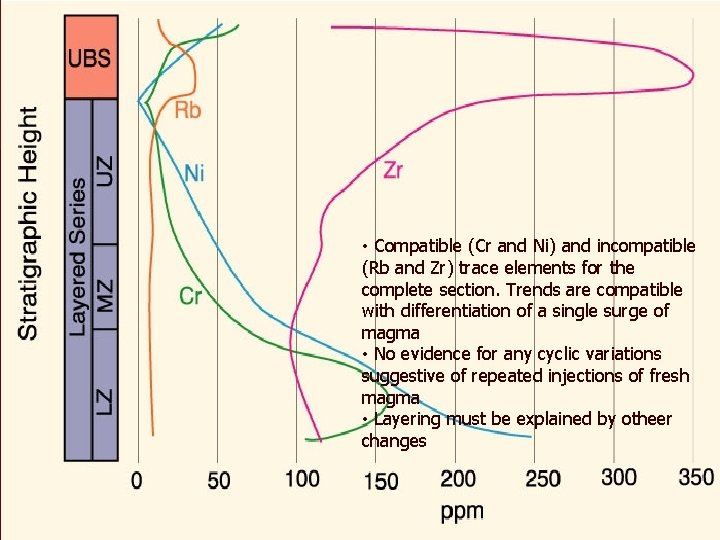
• Compatible (Cr and Ni) and incompatible (Rb and Zr) trace elements for the complete section. Trends are compatible with differentiation of a single surge of magma • No evidence for any cyclic variations suggestive of repeated injections of fresh magma • Layering must be explained by otheer changes
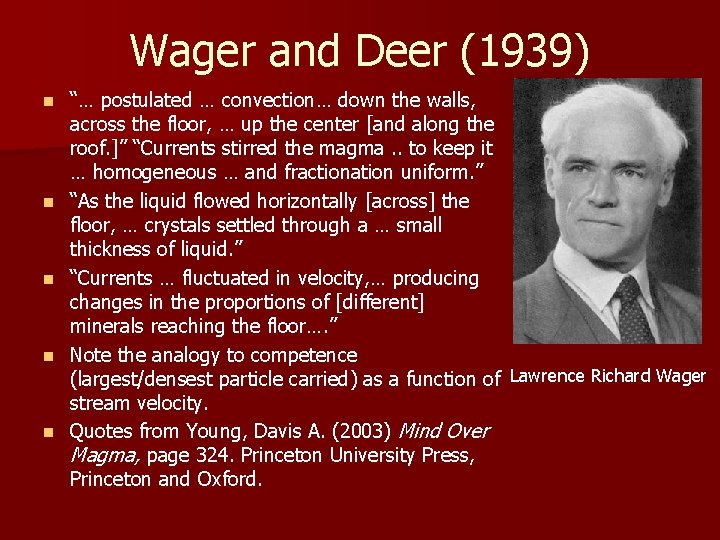
Wager and Deer (1939) n n n “… postulated … convection… down the walls, across the floor, … up the center [and along the roof. ]” “Currents stirred the magma. . to keep it … homogeneous … and fractionation uniform. ” “As the liquid flowed horizontally [across] the floor, … crystals settled through a … small thickness of liquid. ” “Currents … fluctuated in velocity, … producing changes in the proportions of [different] minerals reaching the floor…. ” Note the analogy to competence (largest/densest particle carried) as a function of Lawrence Richard Wager stream velocity. Quotes from Young, Davis A. (2003) Mind Over Magma, page 324. Princeton University Press, Princeton and Oxford.
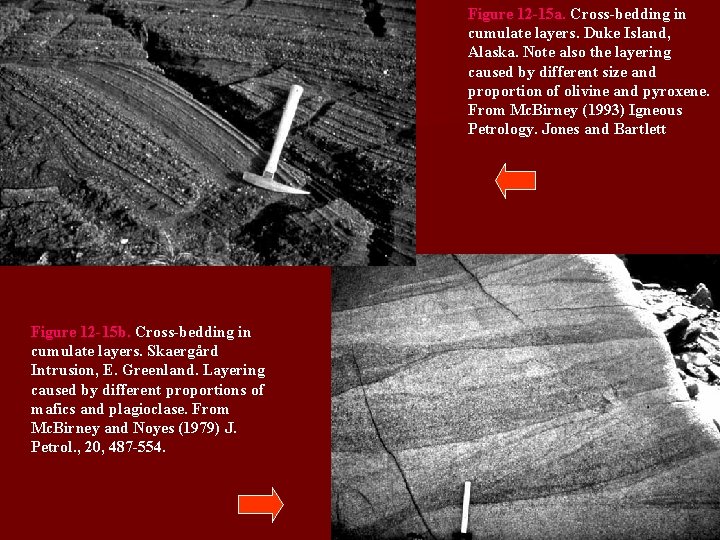
Figure 12 -15 a. Cross-bedding in cumulate layers. Duke Island, Alaska. Note also the layering caused by different size and proportion of olivine and pyroxene. From Mc. Birney (1993) Igneous Petrology. Jones and Bartlett Figure 12 -15 b. Cross-bedding in cumulate layers. Skaergård Intrusion, E. Greenland. Layering caused by different proportions of mafics and plagioclase. From Mc. Birney and Noyes (1979) J. Petrol. , 20, 487 -554.
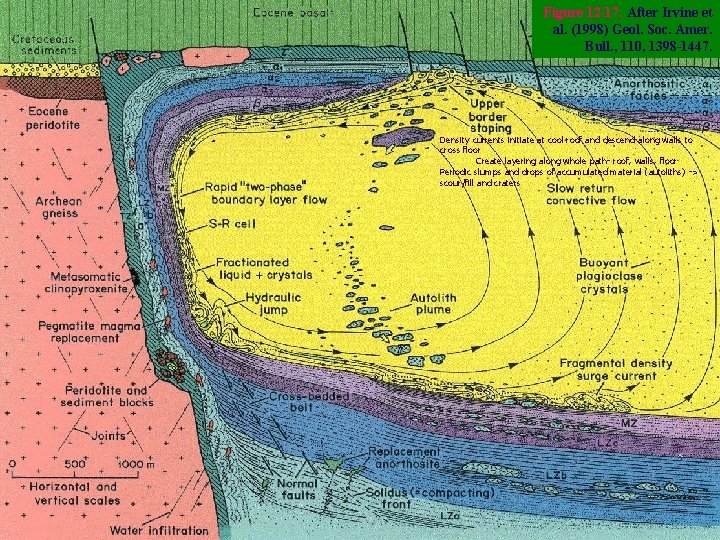
Figure 12 -17. After Irvine et al. (1998) Geol. Soc. Amer. Bull. , 110, 1398 -1447. Density currents initiate at cool roof and descend along walls to cross floor Create layering along whole path- roof, walls, floor Periodic slumps and drops of accumulated material (autoliths) -> scour/fill and craters
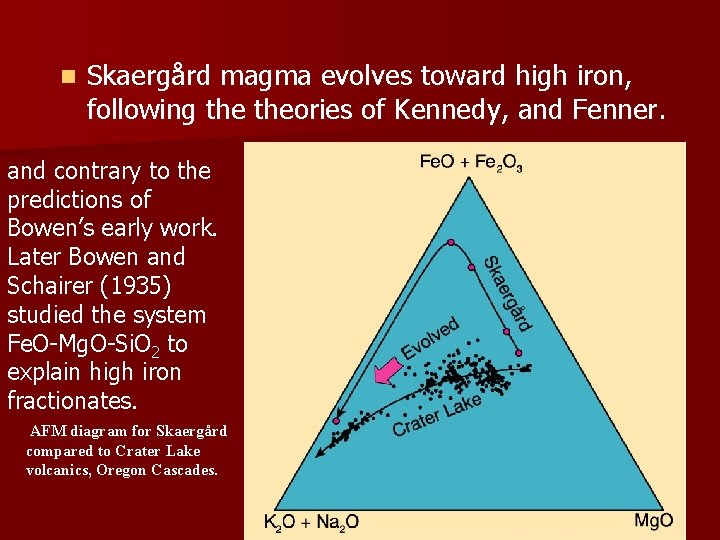
n Skaergård magma evolves toward high iron, following theories of Kennedy, and Fenner. and contrary to the predictions of Bowen’s early work. Later Bowen and Schairer (1935) studied the system Fe. O-Mg. O-Si. O 2 to explain high iron fractionates. AFM diagram for Skaergård compared to Crater Lake volcanics, Oregon Cascades.
- Slides: 30