
Chapter 12 Inventory planning and control Source Corbis
Chapter 12 Inventory planning and control Source: Corbis Slack, Chambers and Johnston, Operations Management 5 th Edition © Nigel Slack, Stuart Chambers, and Robert Johnston 2007
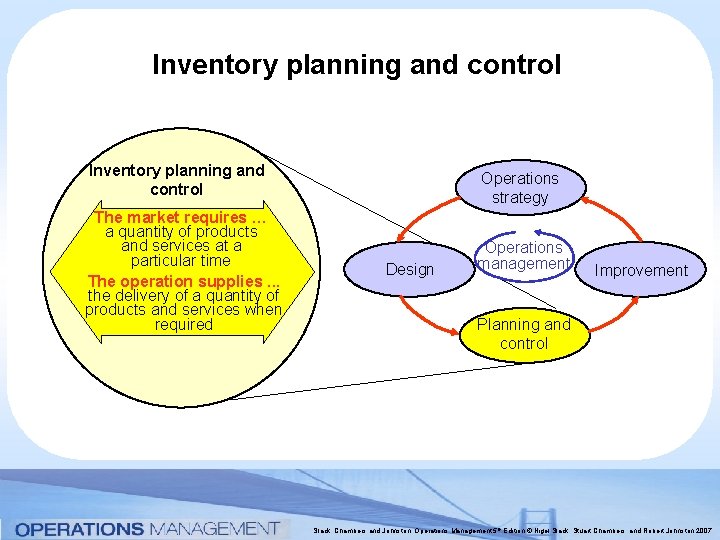
Inventory planning and control The market requires … a quantity of products and services at a particular time The operation supplies. . . the delivery of a quantity of products and services when required Operations strategy Design Operations management Improvement Planning and control Slack, Chambers and Johnston, Operations Management 5 th Edition © Nigel Slack, Stuart Chambers, and Robert Johnston 2007
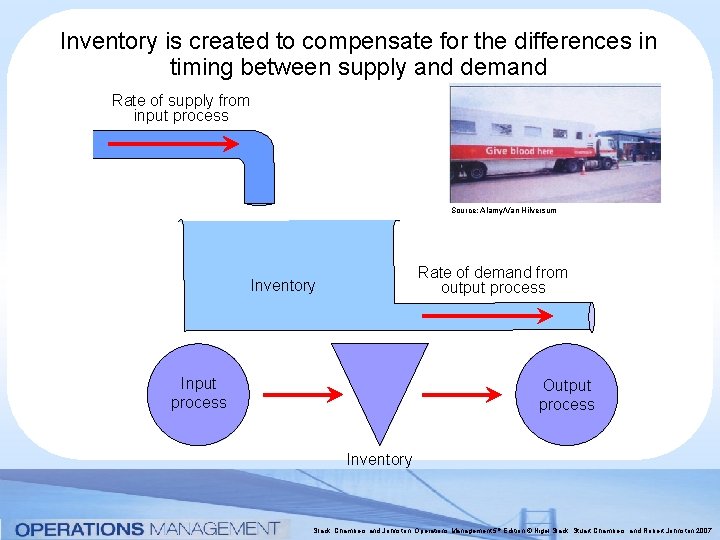
Inventory is created to compensate for the differences in timing between supply and demand Rate of supply from input process Source: Alamy/Van Hilversum Rate of demand from output process Inventory Input process Output process Inventory Slack, Chambers and Johnston, Operations Management 5 th Edition © Nigel Slack, Stuart Chambers, and Robert Johnston 2007

Single-stage and two-stage inventory systems Single-stage inventory system Stock Two-stage inventory system Central depot Distribution Sales operation Suppliers e. g. Local retail store Local distribution point Sales operation Suppliers e. g. Automotive parts distributor Slack, Chambers and Johnston, Operations Management 5 th Edition © Nigel Slack, Stuart Chambers, and Robert Johnston 2007
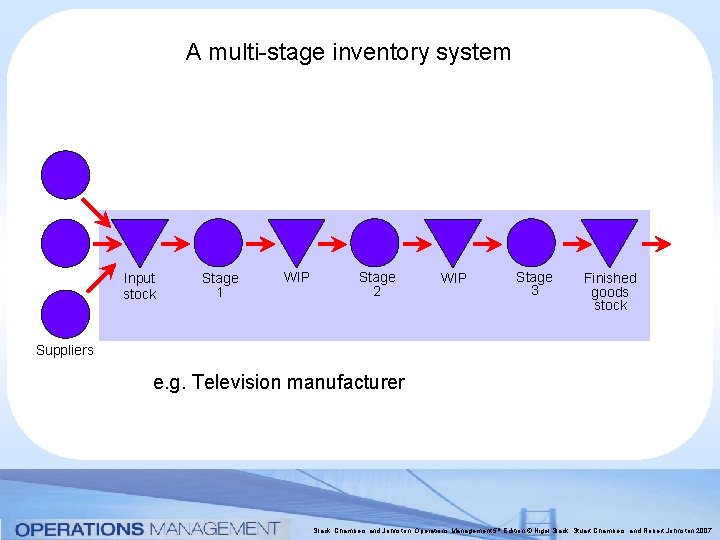
A multi-stage inventory system Input stock Stage 1 WIP Stage 2 WIP Stage 3 Finished goods stock Suppliers e. g. Television manufacturer Slack, Chambers and Johnston, Operations Management 5 th Edition © Nigel Slack, Stuart Chambers, and Robert Johnston 2007
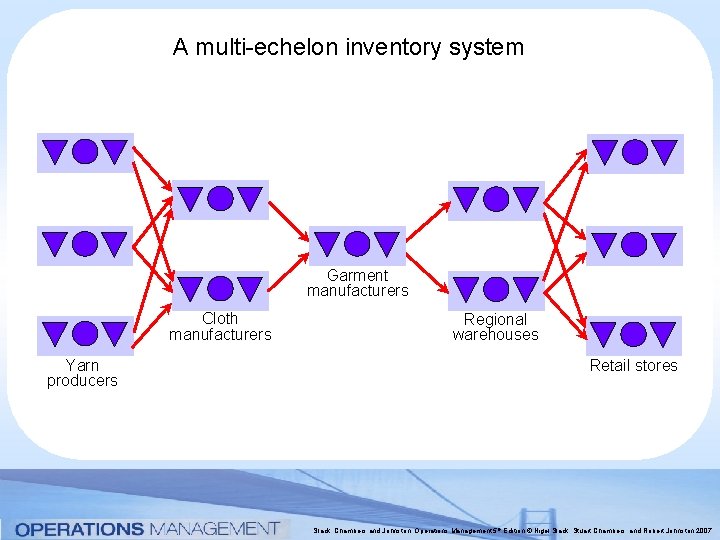
A multi-echelon inventory system Garment manufacturers Cloth manufacturers Yarn producers Regional warehouses Retail stores Slack, Chambers and Johnston, Operations Management 5 th Edition © Nigel Slack, Stuart Chambers, and Robert Johnston 2007
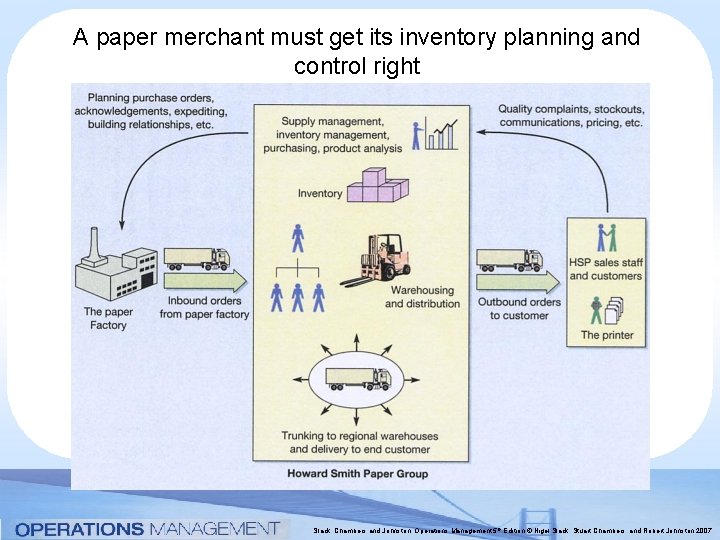
A paper merchant must get its inventory planning and control right Slack, Chambers and Johnston, Operations Management 5 th Edition © Nigel Slack, Stuart Chambers, and Robert Johnston 2007

Inventory profiles chart the variation in inventory level Order quantity =Q Steady and predictable demand (D) Slope = demand rate (D) Inventory level Average inventory =Q 2 Time Q D Instantaneous deliveries at a rate of D period Q Slack, Chambers and Johnston, Operations Management 5 th Edition © Nigel Slack, Stuart Chambers, and Robert Johnston 2007
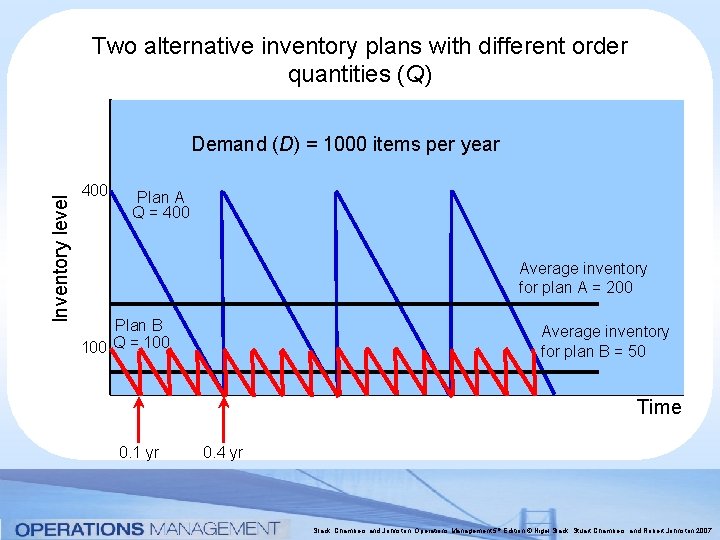
Two alternative inventory plans with different order quantities (Q) Inventory level Demand (D) = 1000 items per year 400 Plan A Q = 400 Average inventory for plan A = 200 Plan B 100 Q = 100 Average inventory for plan B = 50 Time 0. 1 yr 0. 4 yr Slack, Chambers and Johnston, Operations Management 5 th Edition © Nigel Slack, Stuart Chambers, and Robert Johnston 2007

Traditional view of inventory-related costs 400 350 300 Total costs Costs 250 200 150 Holding costs 100 Order costs 50 Economic order quantity (EOQ) 50 100 150 200 250 Order quantity 300 350 400 Slack, Chambers and Johnston, Operations Management 5 th Edition © Nigel Slack, Stuart Chambers, and Robert Johnston 2007

Inventory level Cycle inventory in a bakery Produce A Produce B Produce C Produce A Deliver B Deliver C Deliver A Produce B Produce C Deliver B Deliver C Time Slack, Chambers and Johnston, Operations Management 5 th Edition © Nigel Slack, Stuart Chambers, and Robert Johnston 2007

Inventory level Order quantity Q Slope = P – D Source: Alamy/Archiv. Berlin Fotoagentur Gmb. H Inventory profile for gradual replacement of inventory Slope = D M Q P Time Slack, Chambers and Johnston, Operations Management 5 th Edition © Nigel Slack, Stuart Chambers, and Robert Johnston 2007

Inventory level Inventory planning allowing for shortages Time Shortages Slack, Chambers and Johnston, Operations Management 5 th Edition © Nigel Slack, Stuart Chambers, and Robert Johnston 2007
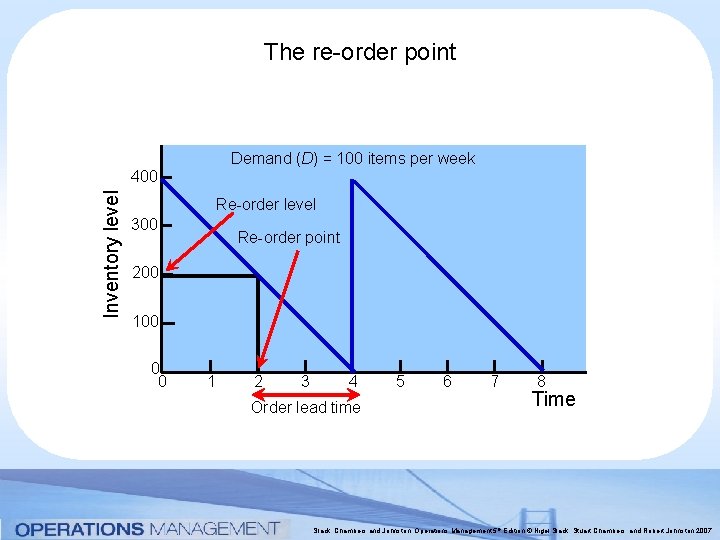
The re-order point Demand (D) = 100 items per week Inventory level 400 Re-order level 300 Re-order point 200 100 0 0 1 2 3 4 Order lead time 5 6 7 8 Time Slack, Chambers and Johnston, Operations Management 5 th Edition © Nigel Slack, Stuart Chambers, and Robert Johnston 2007
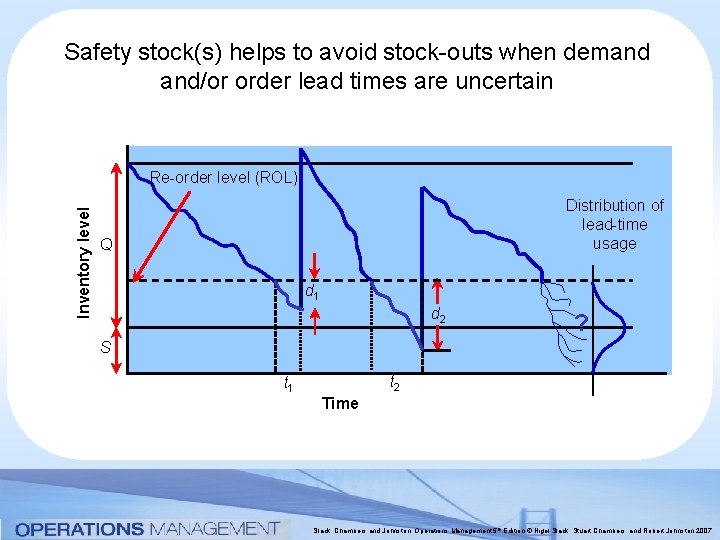
Safety stock(s) helps to avoid stock-outs when demand and/or order lead times are uncertain Inventory level Re-order level (ROL) Distribution of lead-time usage Q d 1 d 2 ? S t 2 t 1 Time Slack, Chambers and Johnston, Operations Management 5 th Edition © Nigel Slack, Stuart Chambers, and Robert Johnston 2007
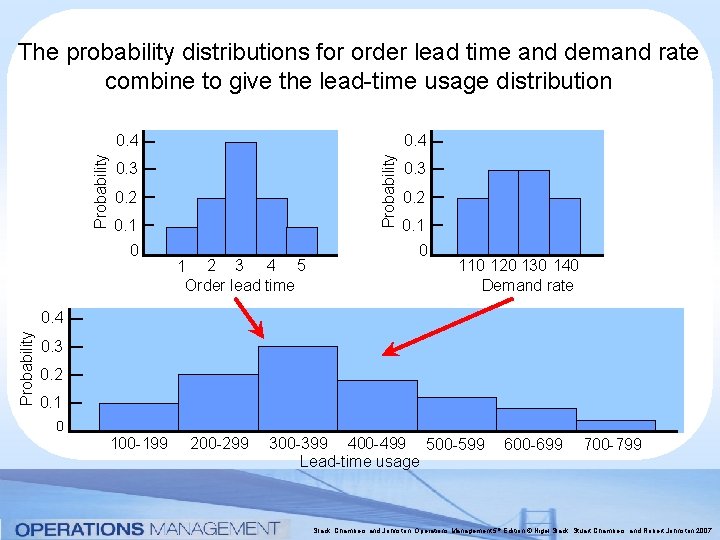
The probability distributions for order lead time and demand rate combine to give the lead-time usage distribution 0. 4 Probability 0. 4 0. 3 0. 2 0. 1 0 1 2 3 4 5 Order lead time 0. 3 0. 2 0. 1 0 110 120 130 140 Demand rate Probability 0. 4 0. 3 0. 2 0. 1 0 100 -199 200 -299 300 -399 400 -499 500 -599 Lead-time usage 600 -699 700 -799 Slack, Chambers and Johnston, Operations Management 5 th Edition © Nigel Slack, Stuart Chambers, and Robert Johnston 2007
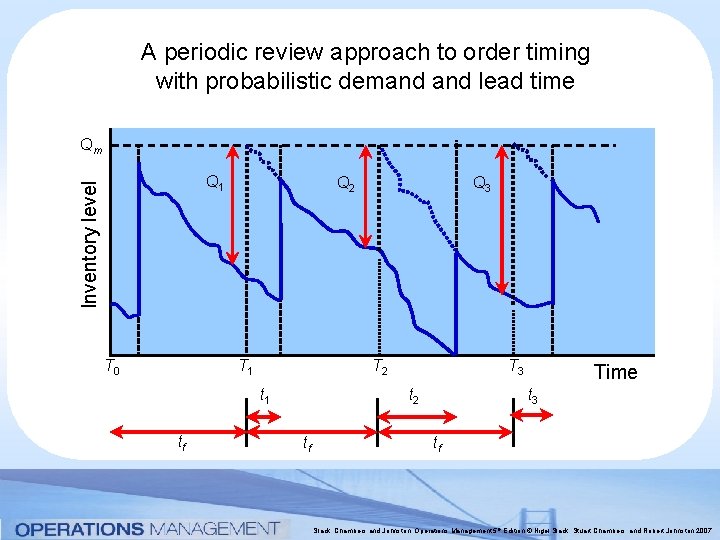
A periodic review approach to order timing with probabilistic demand lead time Qm Inventory level Q 1 T 0 Q 2 T 1 T 2 t 1 tf Q 3 T 3 t 2 tf Time t 3 tf Slack, Chambers and Johnston, Operations Management 5 th Edition © Nigel Slack, Stuart Chambers, and Robert Johnston 2007
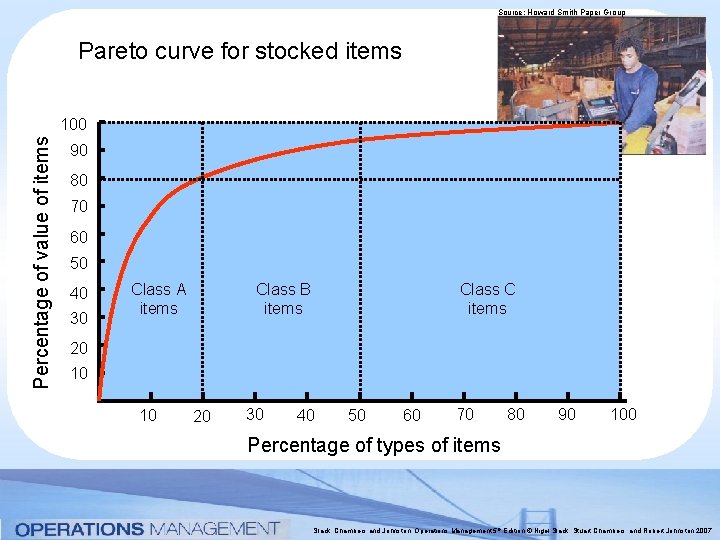
Source: Howard Smith Paper Group Pareto curve for stocked items Percentage of value of items 100 90 80 70 60 50 40 30 Class A items Class B items Class C items 20 10 10 20 30 40 50 60 70 80 90 100 Percentage of types of items Slack, Chambers and Johnston, Operations Management 5 th Edition © Nigel Slack, Stuart Chambers, and Robert Johnston 2007
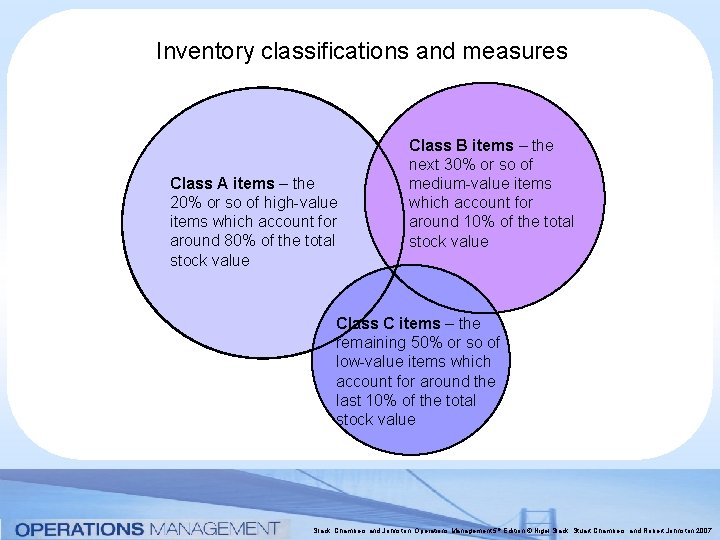
Inventory classifications and measures Class A items – the 20% or so of high-value items which account for around 80% of the total stock value Class B items – the next 30% or so of medium-value items which account for around 10% of the total stock value Class C items – the remaining 50% or so of low-value items which account for around the last 10% of the total stock value Slack, Chambers and Johnston, Operations Management 5 th Edition © Nigel Slack, Stuart Chambers, and Robert Johnston 2007
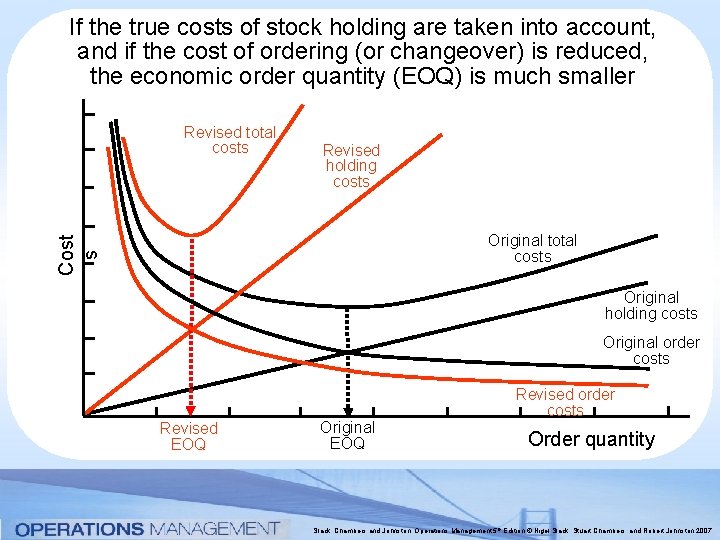
If the true costs of stock holding are taken into account, and if the cost of ordering (or changeover) is reduced, the economic order quantity (EOQ) is much smaller Revised total costs Revised holding costs Cost s Original total costs Original holding costs Original order costs Revised EOQ Original EOQ Revised order costs Order quantity Slack, Chambers and Johnston, Operations Management 5 th Edition © Nigel Slack, Stuart Chambers, and Robert Johnston 2007
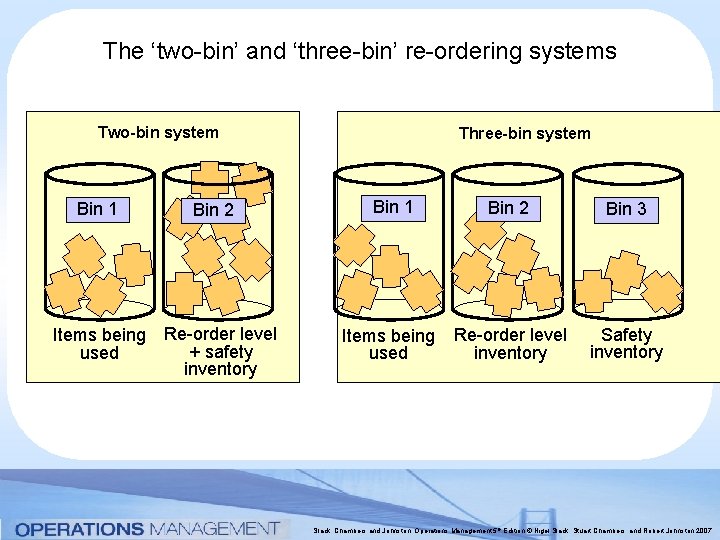
The ‘two-bin’ and ‘three-bin’ re-ordering systems Two-bin system Bin 1 Items being used Bin 2 Re-order level + safety inventory Three-bin system Bin 1 Bin 2 Bin 3 Items being used Re-order level inventory Safety inventory Slack, Chambers and Johnston, Operations Management 5 th Edition © Nigel Slack, Stuart Chambers, and Robert Johnston 2007
Key Terms Test Inventory (also known as stock) The stored accumulation of transformed resources in a process; usually applies to material resources but may also be used for inventories of information; inventories of customers (or customers of customers) are usually called queues. Buffer inventory An inventory that compensates for unexpected fluctuations in supply and demand; can also be called a safety inventory. Cycle inventory Inventory that occurs when one stage in a process cannot supply all the items it produces simultaneously and so has to build up inventory of one item while it processes the others. Slack, Chambers and Johnston, Operations Management 5 th Edition © Nigel Slack, Stuart Chambers, and Robert Johnston 2007
Key Terms Test De-coupling inventory The inventory that is used to allow work centres or processes to operate relatively independently. Anticipation inventory Inventory that is accumulated to cope with expected future demand or interruptions in supply. Pipeline inventory The inventory that exists because material cannot be transported instantaneously. Slack, Chambers and Johnston, Operations Management 5 th Edition © Nigel Slack, Stuart Chambers, and Robert Johnston 2007
Key Terms Test Work-in-process (WIP) The number of units within a process waiting to be processed further (also called work-in-progress). Economic order quantity (EOQ) The quantity of items to order that supposedly minimizes the total cost of inventory management, derived from various formulae. Economic batch quantity (EBQ) The amount of items to be produced by a machine or process that supposedly minimizes the costs associated with production and inventory holding. Slack, Chambers and Johnston, Operations Management 5 th Edition © Nigel Slack, Stuart Chambers, and Robert Johnston 2007
Key Terms Test Re-order point The point in time at which more items are ordered, usually calculated to ensure that inventory does not run out before the next batch of inventory arrives. Re-order level The level of inventory at which more items are ordered, usually calculated to ensure that inventory does not run out before the next batch of inventory arrives. Lead-time usage The amount of inventory that will be used between ordering replenishment and the inventory arriving, usually described by a probability distribution to account for uncertainty in demand lead time. Slack, Chambers and Johnston, Operations Management 5 th Edition © Nigel Slack, Stuart Chambers, and Robert Johnston 2007
Key Terms Test Continuous review An approach to managing inventory that makes inventory-related decisions when inventory reaches a particular level, as opposed to periodic review. Periodic review An approach to making inventory decisions that defines points in time for examining inventory levels and then makes decisions accordingly, as opposed to continuous review. Usage value A term used in inventory control to indicate the quantity of items used or sold multiplied by their value or price. Slack, Chambers and Johnston, Operations Management 5 th Edition © Nigel Slack, Stuart Chambers, and Robert Johnston 2007
Key Terms Test Pareto law A general law found to operate in many situations that indicates that 20% of something causes 80% of something else, often used in inventory management (20% of products produce 80% of sales value) and improvement activities (20% of types of problems produce 80% of disruption). ABC inventory control An approach to inventory control that classes inventory by its usage value and varies the approach to managing it accordingly. Perpetual inventory principle A principle used in inventory control that inventory records should be automatically updated every time items are received or taken out of stock. Slack, Chambers and Johnston, Operations Management 5 th Edition © Nigel Slack, Stuart Chambers, and Robert Johnston 2007
- Slides: 27