
Chapter 12 Introduction to the Nervous System Organization

- Slides: 66
Chapter 12 – Introduction to the Nervous System • Organization • Cell Types
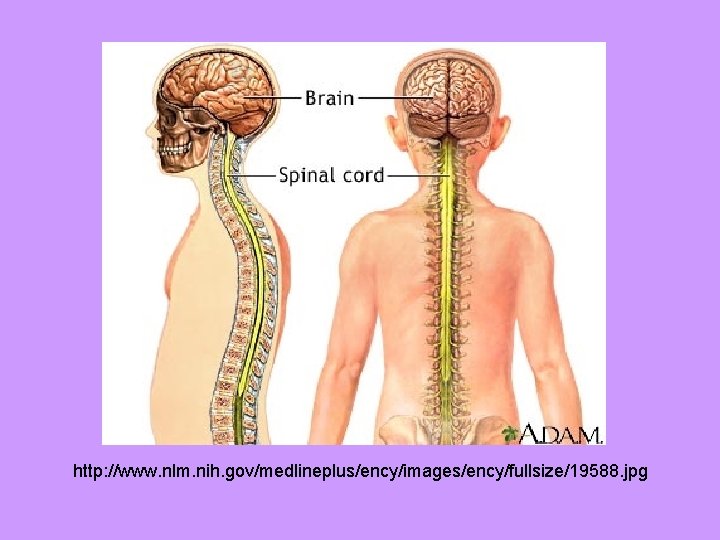
Review What 3 parts make up the nervous system? 1. Brain 2. Spinal cord 3. Nerves
http: //www. nlm. nih. gov/medlineplus/ency/images/ency/fullsize/19588. jpg
Functions of the Nervous System • Detect changes (stimuli) in the internal or external environment • Evaluate the information • Initiate a change in muscles or glands Goal – maintain homeostasis What does this remind you of? ?
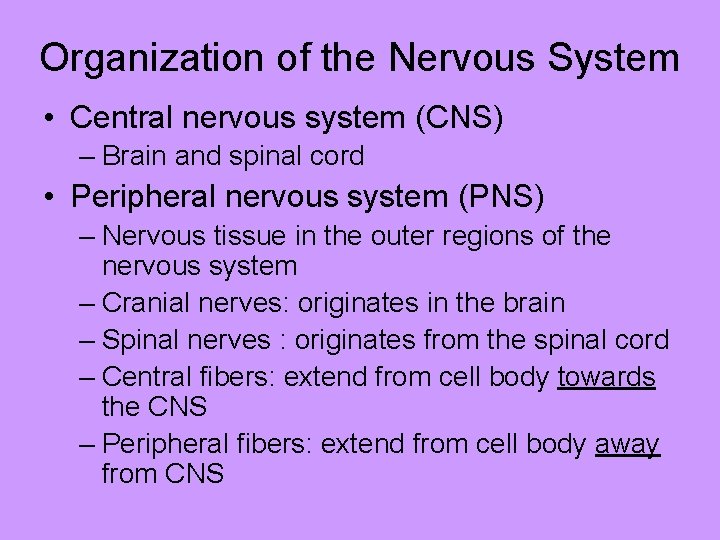
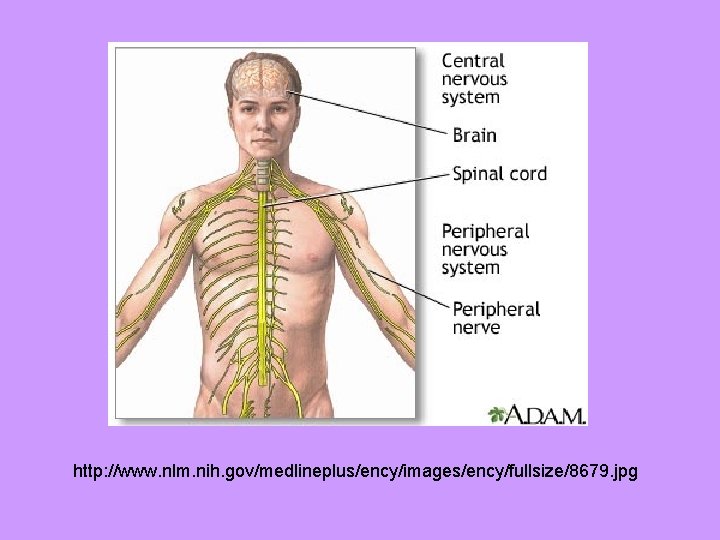
Organization of the Nervous System • Central nervous system (CNS) – Brain and spinal cord • Peripheral nervous system (PNS) – Nervous tissue in the outer regions of the nervous system – Cranial nerves: originates in the brain – Spinal nerves : originates from the spinal cord – Central fibers: extend from cell body towards the CNS – Peripheral fibers: extend from cell body away from CNS
http: //www. nlm. nih. gov/medlineplus/ency/images/ency/fullsize/8679. jpg
Afferent vs Efferent Nervous pathways are organized into division based on the direction they carry information • Afferent division: incoming information (sensory) • Efferent division: outgoing information (motor) (Efferent = Exit)
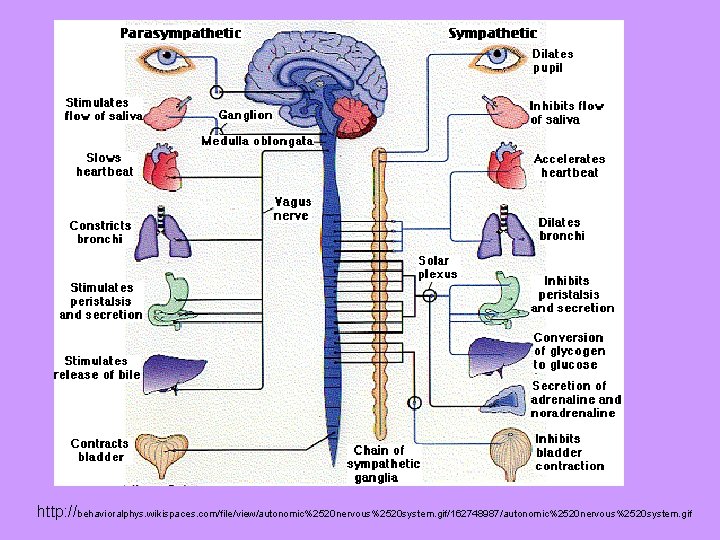
Somatic & Autonomic Nervous Systems Nervous pathways are also organized according to the type of effectors (organs) they regulate • Somatic nervous system (SNS) – Somatic sensory division (afferent) – Somatic motor division (efferent)
Somatic & Autonomic Nervous Systems cont… • Autonomic nervous system (ANS): Carry information to the autonomic or visceral effectors (smooth & cardiac muscles and glands) – Visceral sensory division (afferent) – Efferent pathways • Sympathetic division – “fight or flight” • Parasympathic division – “rest and repair”
Figure 12 -2
http: //behavioralphys. wikispaces. com/file/view/autonomic%2520 nervous%2520 system. gif/162748987/autonomic%2520 nervous%2520 system. gif
Review What are the two main cell types in the nervous system? (Hint: we talked about this when we covered tissue types) Answer: neurons and glia
Cells of the Nervous System Neurons: excitable cells that conduct information Glia (also neuroglia or glial cells): support cells, do not conduct information – Most numerous – Glia = glue
Types of Glia Five major types: 1. Astrocytes 2. Microglia 3. Ependymal cells 4. Oligodendrocytes 5. Schwann cells
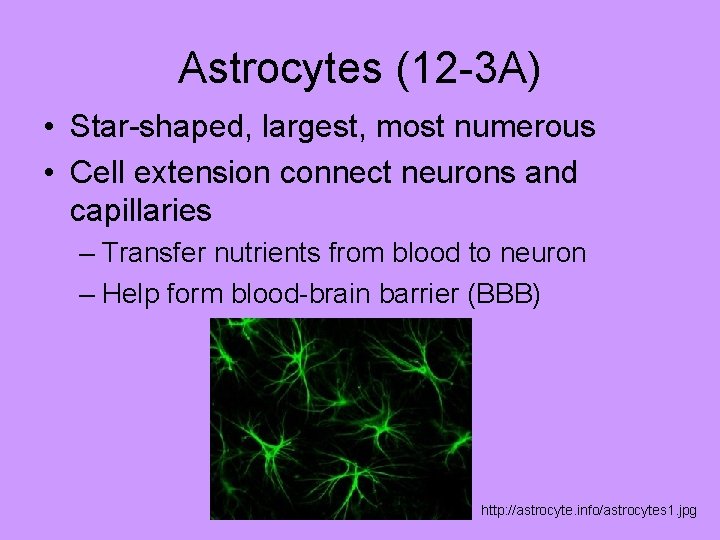
Astrocytes (12 -3 A) • Star-shaped, largest, most numerous • Cell extension connect neurons and capillaries – Transfer nutrients from blood to neuron – Help form blood-brain barrier (BBB) http: //astrocyte. info/astrocytes 1. jpg
Blood-Brain Barrier • Helps maintain stable environment for normal brain function • “feet” of astrocytes wrap around capillaries in brain • Regulates passage of ions • Water, oxygen, CO 2, glucose and alcohol pass freely • Important for drug research – Parkinson’s Disease
Microglia (12 -3 B) • Engulf and destroy cellular debris (phagocytosis) • Enlarge during times of inflammation and degeneration
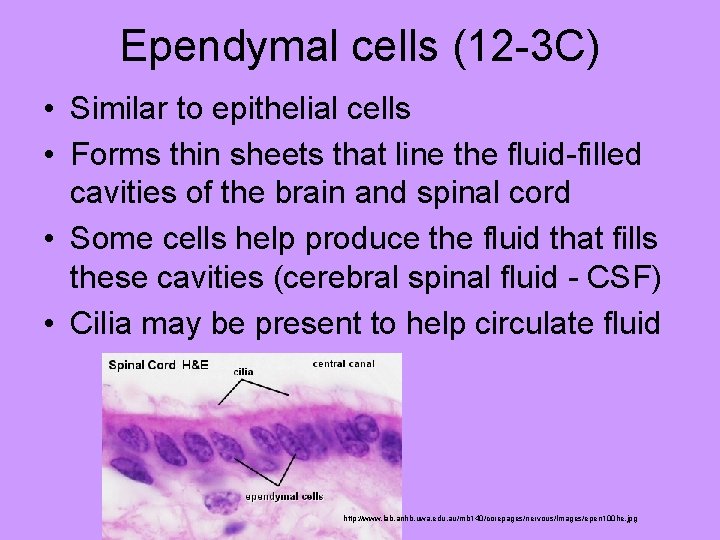
Ependymal cells (12 -3 C) • Similar to epithelial cells • Forms thin sheets that line the fluid-filled cavities of the brain and spinal cord • Some cells help produce the fluid that fills these cavities (cerebral spinal fluid - CSF) • Cilia may be present to help circulate fluid http: //www. lab. anhb. uwa. edu. au/mb 140/corepages/nervous/Images/epen 100 he. jpg
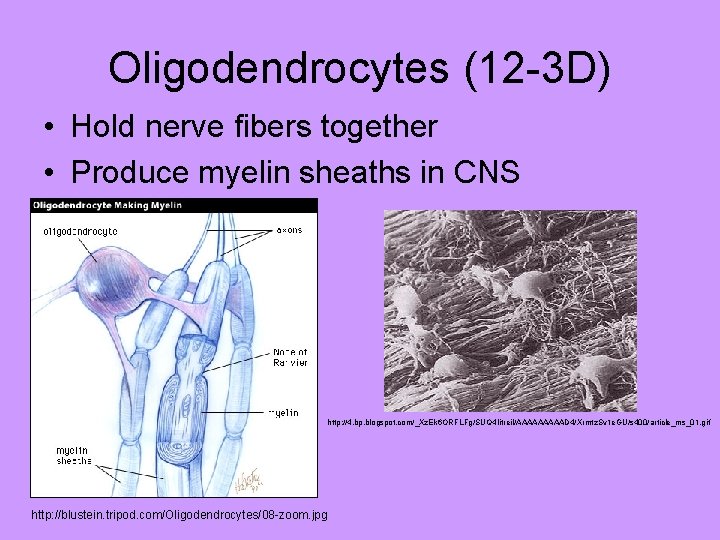
Oligodendrocytes (12 -3 D) • Hold nerve fibers together • Produce myelin sheaths in CNS http: //4. bp. blogspot. com/_Xz. Ek 6 ORFLFg/SUQ 4 Iitrei. I/AAAAAD 4/Xrmtz. Sv 1 e. GU/s 400/article_ms_01. gif http: //blustein. tripod. com/Oligodendrocytes/08 -zoom. jpg
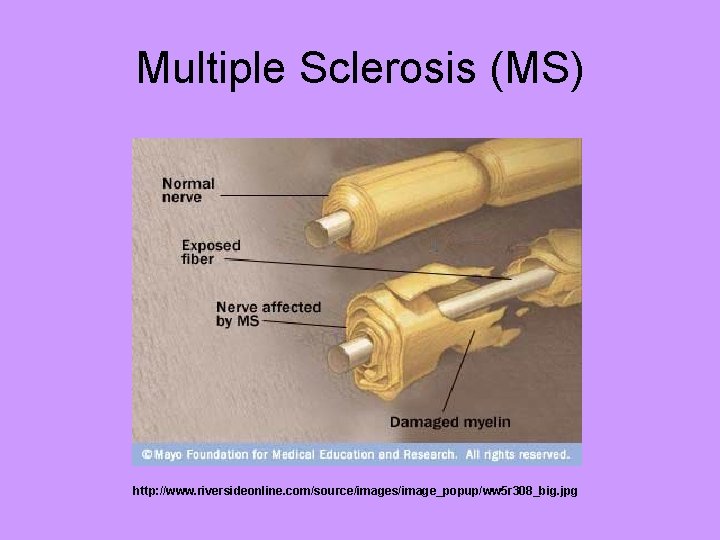
Multiple Sclerosis (MS) • Most common myelin disorder • Characterized by: – myelin loss and destruction injury and death plaque like lesions – Impaired nerve conduction weakness, loss of coordination, vision and speech problems – Remissions & relapses • Autoimmune or viral infection • Women 20 -40 yrs • No known cure
Multiple Sclerosis (MS) http: //www. riversideonline. com/source/images/image_popup/ww 5 r 308_big. jpg
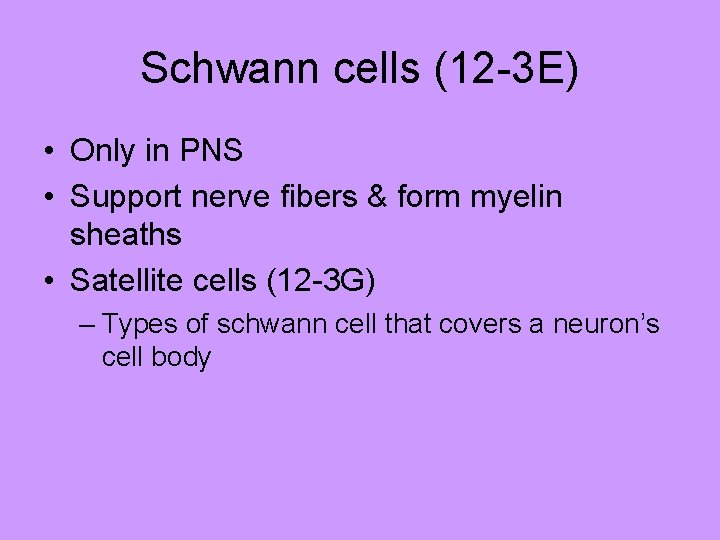
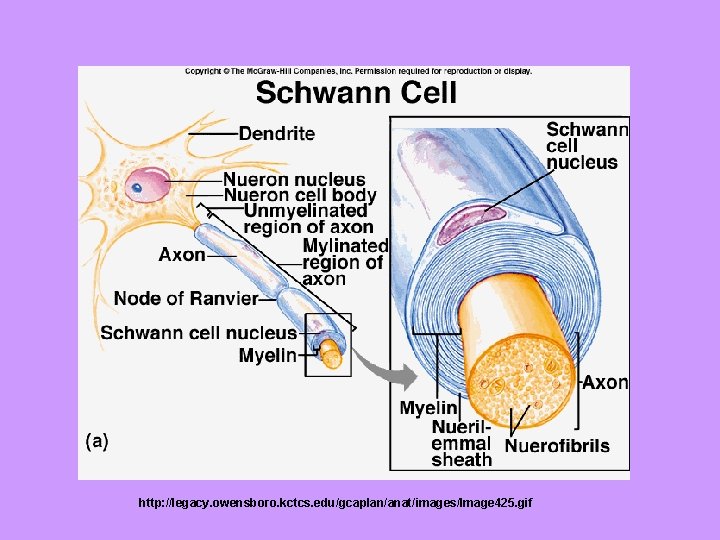
Schwann cells (12 -3 E) • Only in PNS • Support nerve fibers & form myelin sheaths • Satellite cells (12 -3 G) – Types of schwann cell that covers a neuron’s cell body
http: //legacy. owensboro. kctcs. edu/gcaplan/anat/images/Image 425. gif
Neurons All neurons have 3 parts: 1. Cell body (soma) 2. Axon 3. One or more dendrites
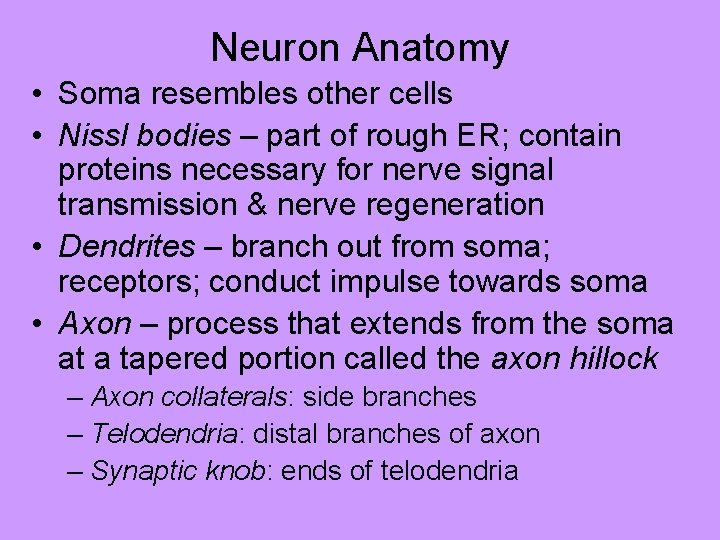
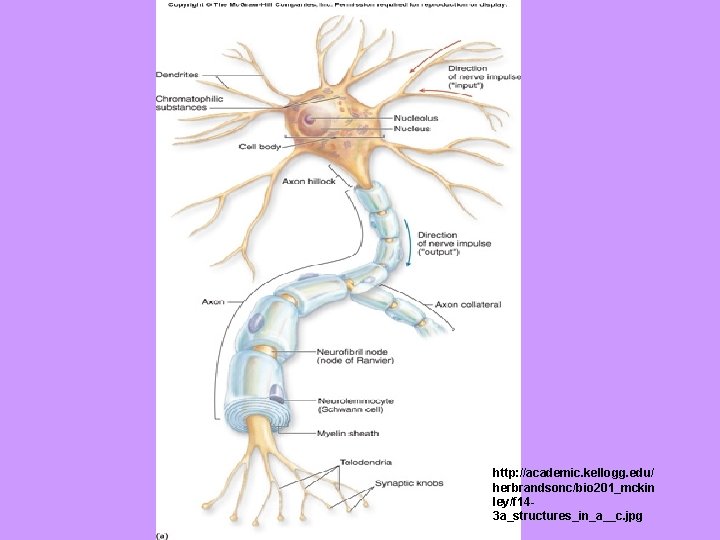
Neuron Anatomy • Soma resembles other cells • Nissl bodies – part of rough ER; contain proteins necessary for nerve signal transmission & nerve regeneration • Dendrites – branch out from soma; receptors; conduct impulse towards soma • Axon – process that extends from the soma at a tapered portion called the axon hillock – Axon collaterals: side branches – Telodendria: distal branches of axon – Synaptic knob: ends of telodendria
http: //academic. kellogg. edu/ herbrandsonc/bio 201_mckin ley/f 143 a_structures_in_a__c. jpg
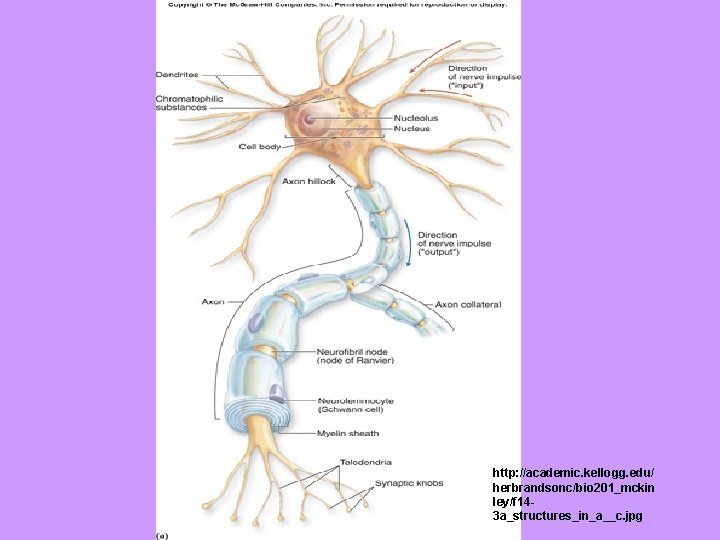
Neuron Anatomy • Myelin sheaths: areas of insulation produced by Schwann cells; increases speed of nerve impulse – Myelinated = white matter – Unmyelinated = gray matter • Nodes of Ranvier: breaks in myelin sheath btwn Schwann cells • Synapse: junction btwn two neurons or btwn a neuron and an effector
http: //academic. kellogg. edu/ herbrandsonc/bio 201_mckin ley/f 143 a_structures_in_a__c. jpg
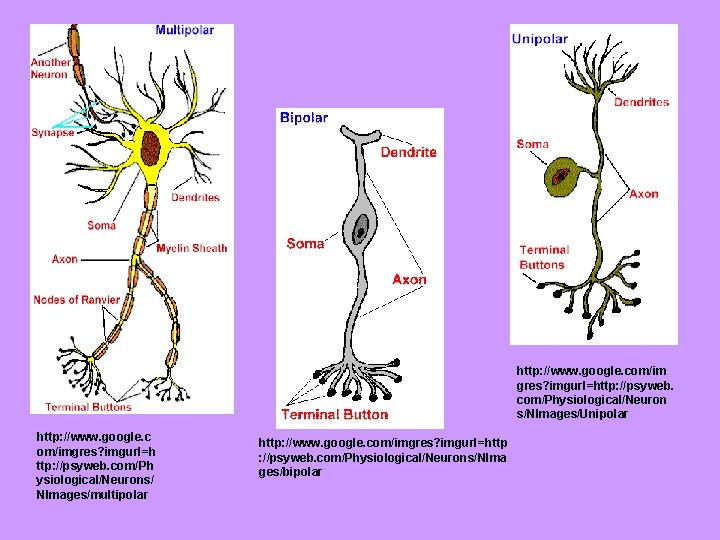
Structural Classification of Neurons • Multipolar – One axon, several dendrites – Most numerous • Bipolar – One axon, one dendrite – Least numerous – Retina, inner ear, olfactory pathway • Unipolar – Axon is a single process that branches into a central process (towards CNS) and a peripheral process (towards PNS) – Dendrites at distal end of peripheral process – Always sensory neurons
http: //www. google. com/im gres? imgurl=http: //psyweb. com/Physiological/Neuron s/NImages/Unipolar http: //www. google. c om/imgres? imgurl=h ttp: //psyweb. com/Ph ysiological/Neurons/ NImages/multipolar http: //www. google. com/imgres? imgurl=http : //psyweb. com/Physiological/Neurons/NIma ges/bipolar
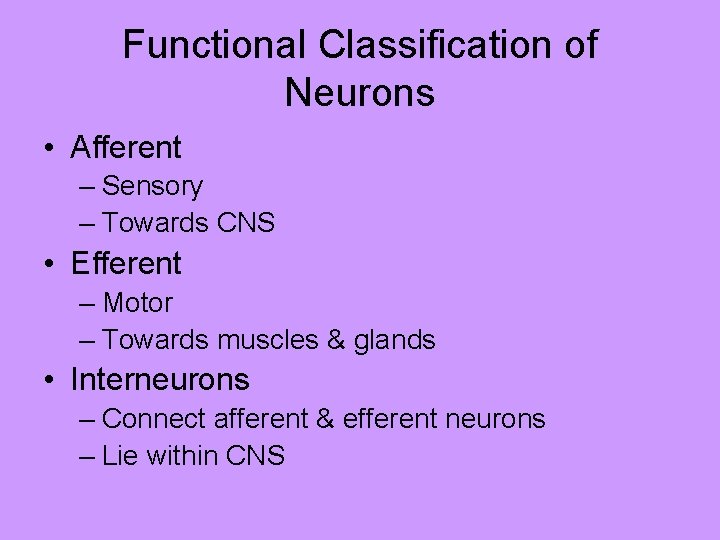
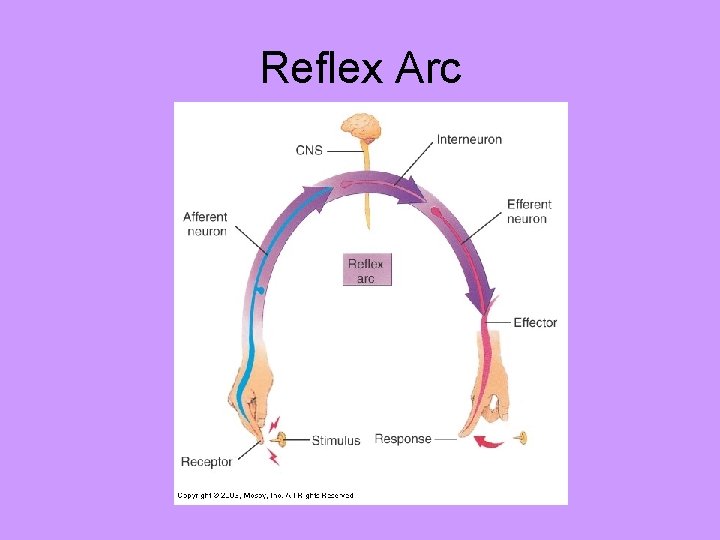
Functional Classification of Neurons • Afferent – Sensory – Towards CNS • Efferent – Motor – Towards muscles & glands • Interneurons – Connect afferent & efferent neurons – Lie within CNS
Reflex Arc
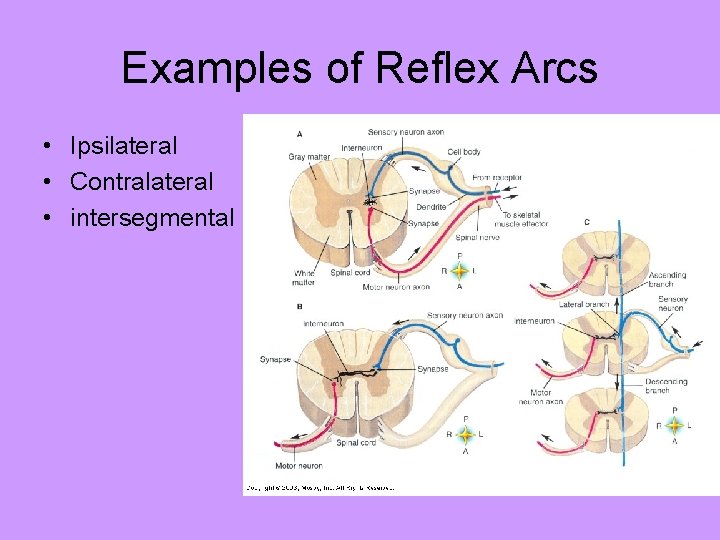
Examples of Reflex Arcs • Ipsilateral • Contralateral • intersegmental
Nerves vs Tracts • Nerves – bundles of parallel neurons held together by fibrous CT in the PNS • Tracts – bundles of parallel neurons in the CNS
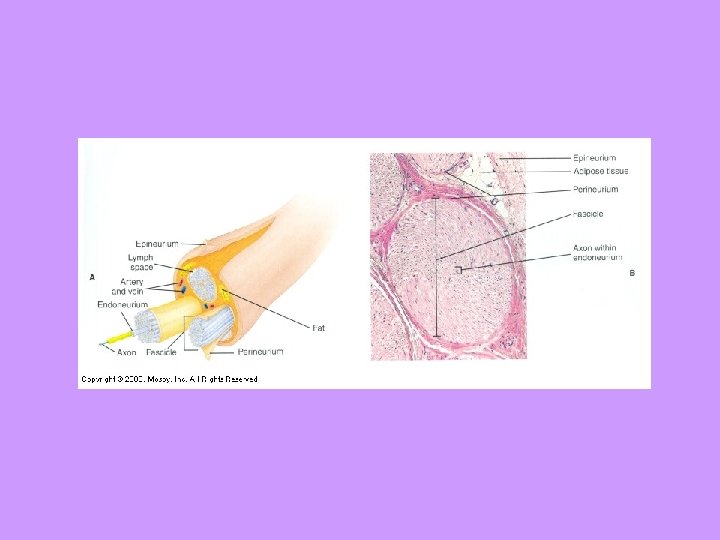
Nerve Fibers • Remember the difference between nerves and tracts? – Endoneurium: surrounds each nerve fiber – Perineurium: surrounds fascicles (bundles of nerve fibers – Epineurium: surrounds a complete nerve (PNS) or tract (CNS)
Review: Gray vs White Matter • White matter – myelinated nerve fibers – Myelin sheaths help increase the speed of an action potential • Gray matter – unmyelinated nerve fibers & cell bodies – Ganglia: regions of gray matter in PNS
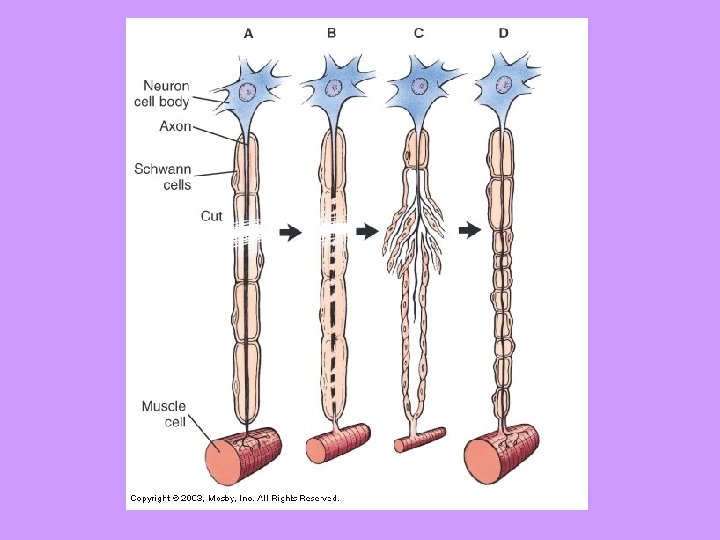
Nerve Fiber Repair • • Nervous tissue has a limited repair capacity b/c mature neurons are incapable of cell division Repair can take place if soma and neurilemma remain intact
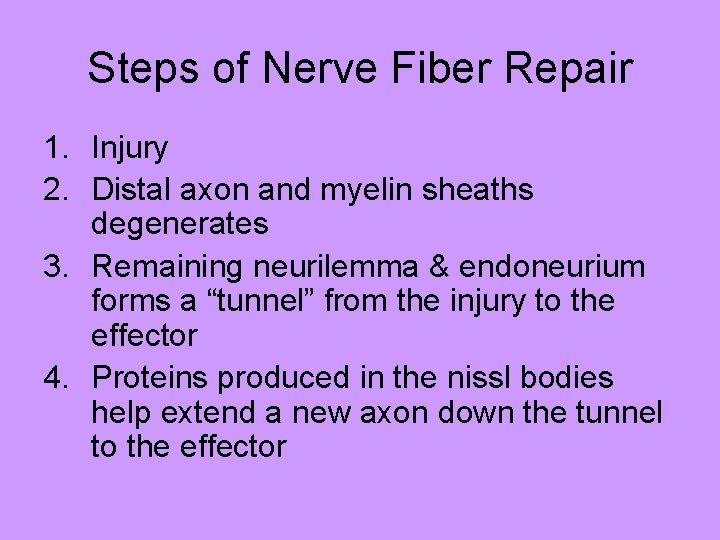
Steps of Nerve Fiber Repair 1. Injury 2. Distal axon and myelin sheaths degenerates 3. Remaining neurilemma & endoneurium forms a “tunnel” from the injury to the effector 4. Proteins produced in the nissl bodies help extend a new axon down the tunnel to the effector
Nerve Impulses • Neurons are specialized to initiate and conduct signals nerve impulses – Exhibit excitability & conductivity – Nerve impulse wave of electrical fluctuation that travels along the plasma membrane
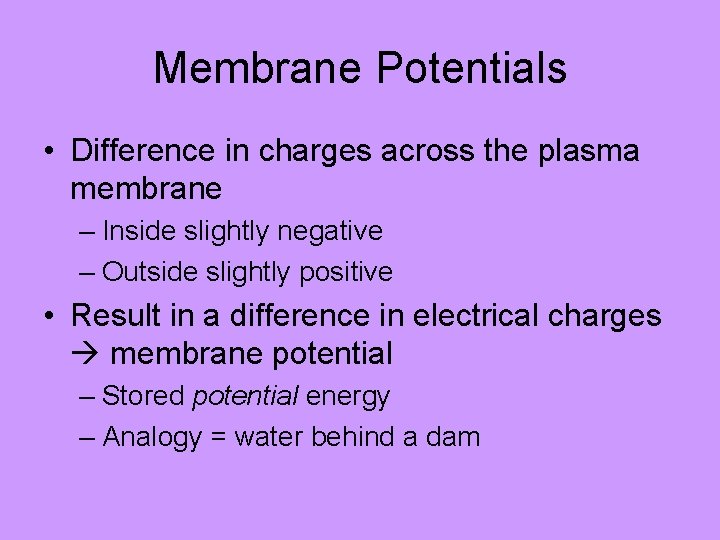
Membrane Potentials • Difference in charges across the plasma membrane – Inside slightly negative – Outside slightly positive • Result in a difference in electrical charges membrane potential – Stored potential energy – Analogy = water behind a dam
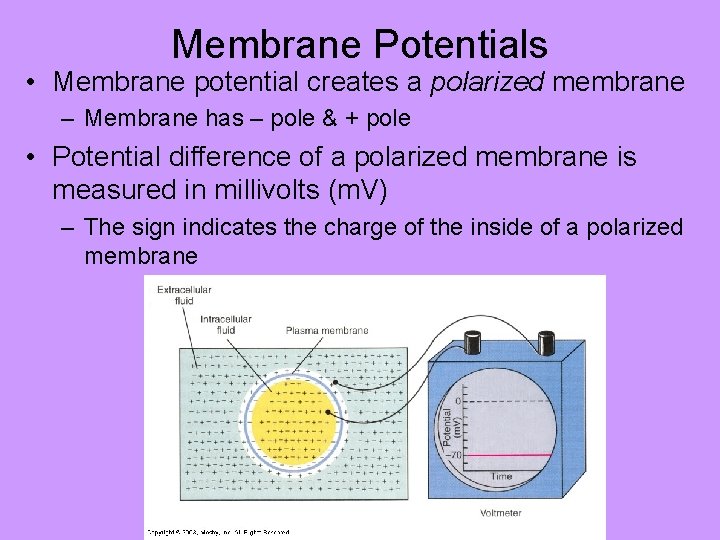
Membrane Potentials • Membrane potential creates a polarized membrane – Membrane has – pole & + pole • Potential difference of a polarized membrane is measured in millivolts (m. V) – The sign indicates the charge of the inside of a polarized membrane
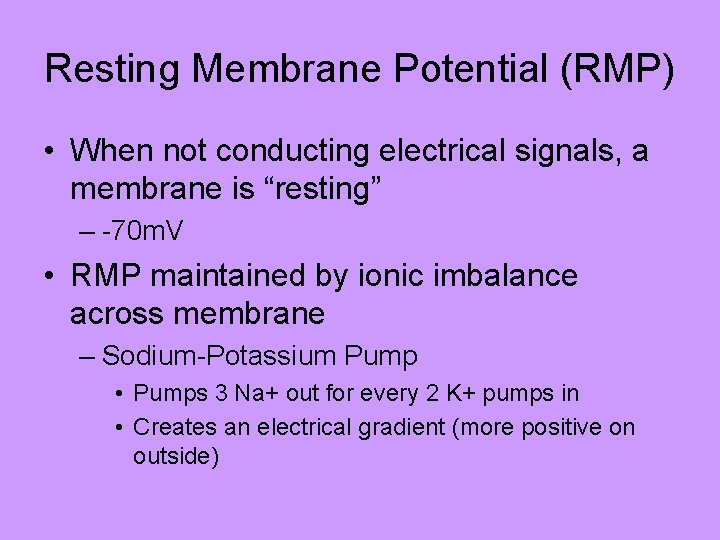
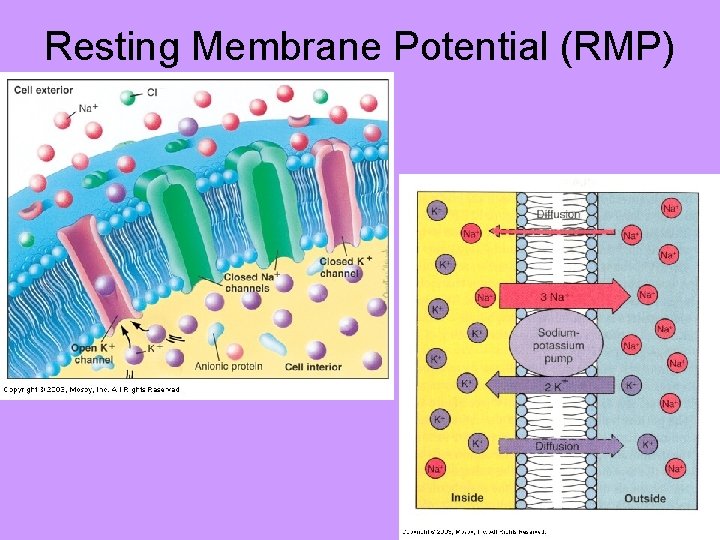
Resting Membrane Potential (RMP) • When not conducting electrical signals, a membrane is “resting” – -70 m. V • RMP maintained by ionic imbalance across membrane – Sodium-Potassium Pump • Pumps 3 Na+ out for every 2 K+ pumps in • Creates an electrical gradient (more positive on outside)
Resting Membrane Potential (RMP)
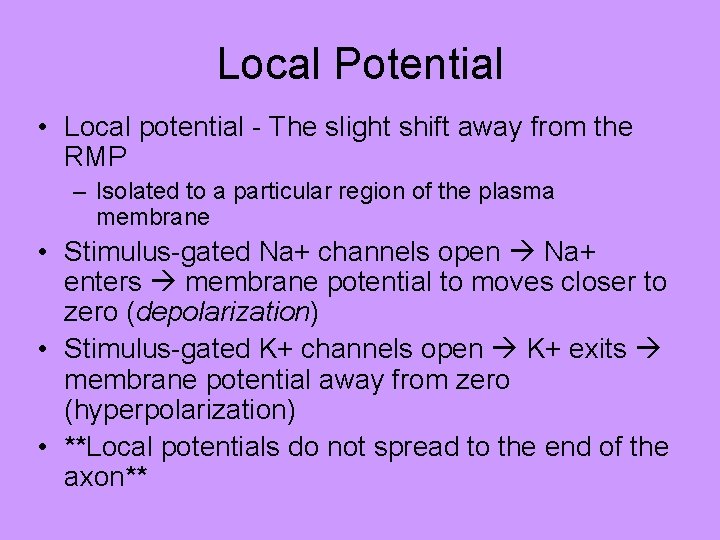
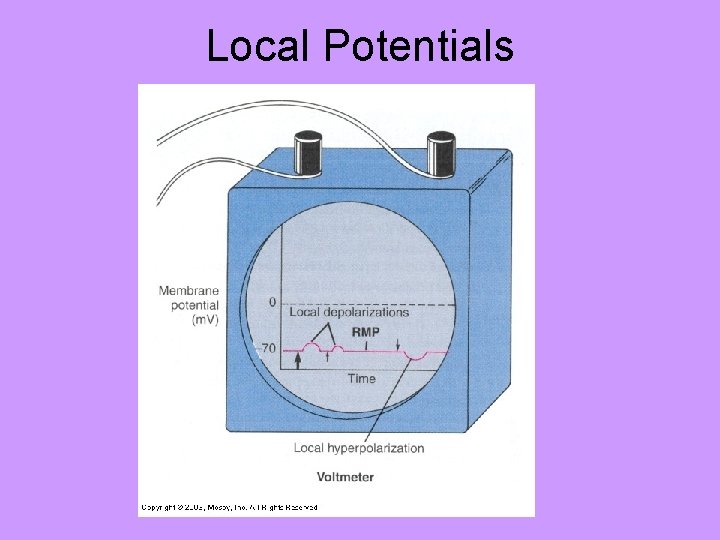
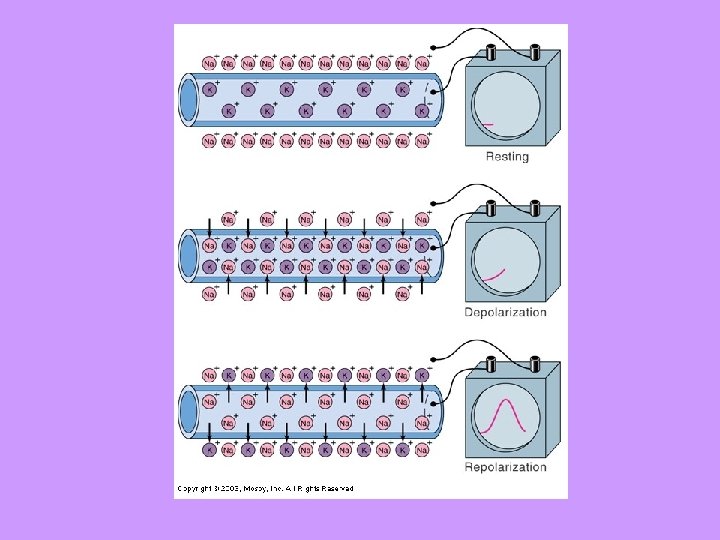
Local Potential • Local potential - The slight shift away from the RMP – Isolated to a particular region of the plasma membrane • Stimulus-gated Na+ channels open Na+ enters membrane potential to moves closer to zero (depolarization) • Stimulus-gated K+ channels open K+ exits membrane potential away from zero (hyperpolarization) • **Local potentials do not spread to the end of the axon**
Local Potentials
Action Potentials Definitions: • Membrane potential of an active neuron (one that is conducting an impulse • Action potential = nerve impulse • An electrical fluctuation that travels along the plasma membrane
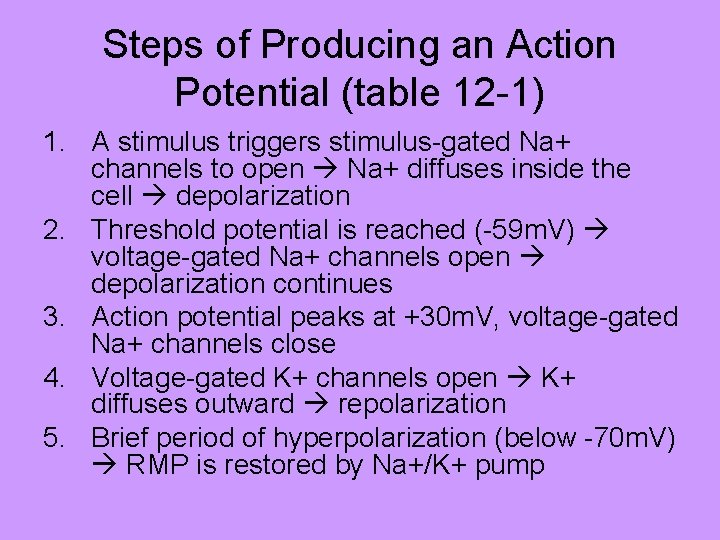
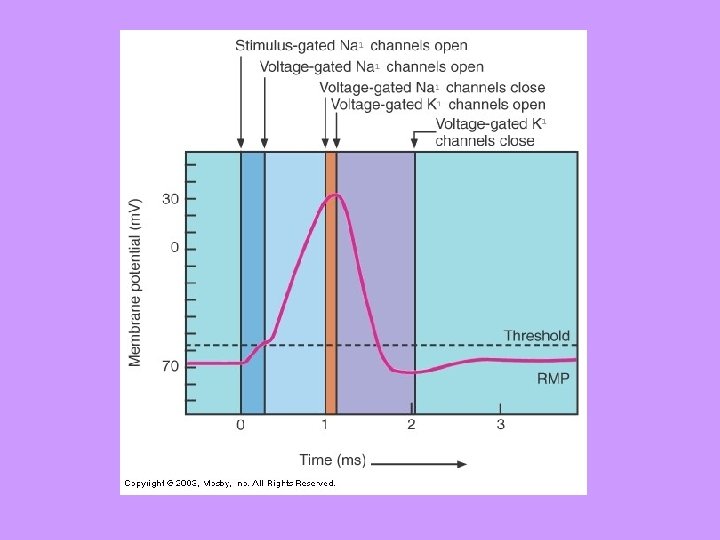
Steps of Producing an Action Potential (table 12 -1) 1. A stimulus triggers stimulus-gated Na+ channels to open Na+ diffuses inside the cell depolarization 2. Threshold potential is reached (-59 m. V) voltage-gated Na+ channels open depolarization continues 3. Action potential peaks at +30 m. V, voltage-gated Na+ channels close 4. Voltage-gated K+ channels open K+ diffuses outward repolarization 5. Brief period of hyperpolarization (below -70 m. V) RMP is restored by Na+/K+ pump
Refractory Period
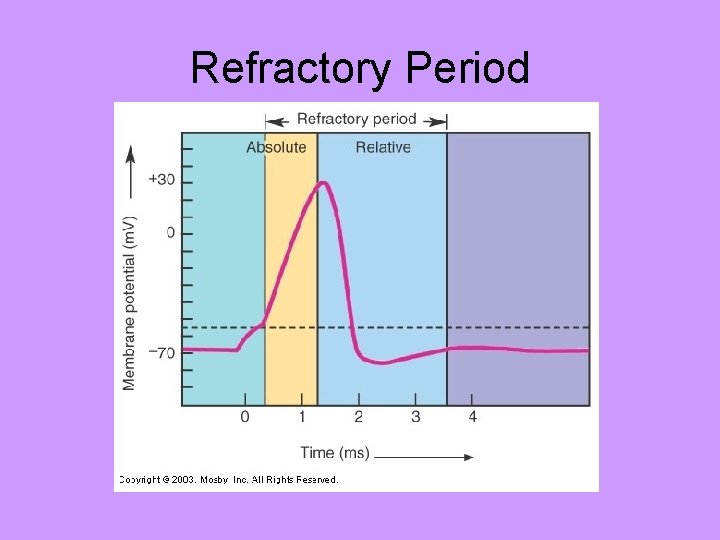
Refractory Period • Period of time where the neuron resists restimulation (AP cannot fire) – Absolute refractory period: half a millisecond after membrane reaches threshold potential • Will not respond to ANY stimulus – Relative refractory period: few milliseconds after absolute refractory period (during repolarization) • Only respond to VERY strong stimulus
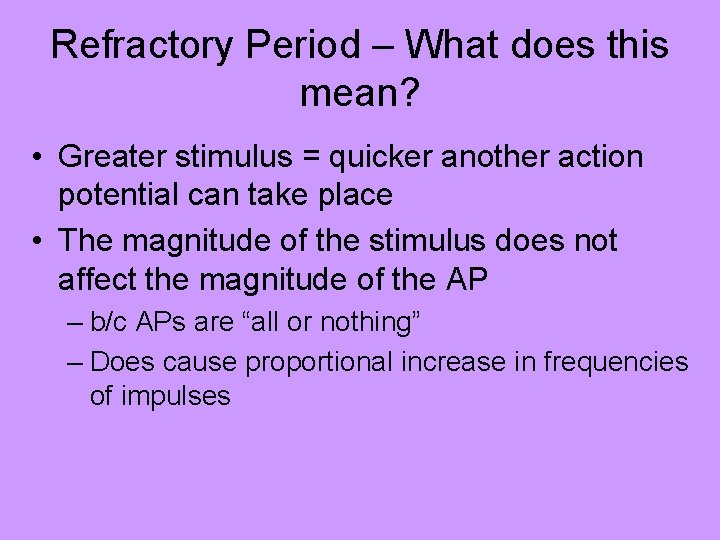
Refractory Period – What does this mean? • Greater stimulus = quicker another action potential can take place • The magnitude of the stimulus does not affect the magnitude of the AP – b/c APs are “all or nothing” – Does cause proportional increase in frequencies of impulses
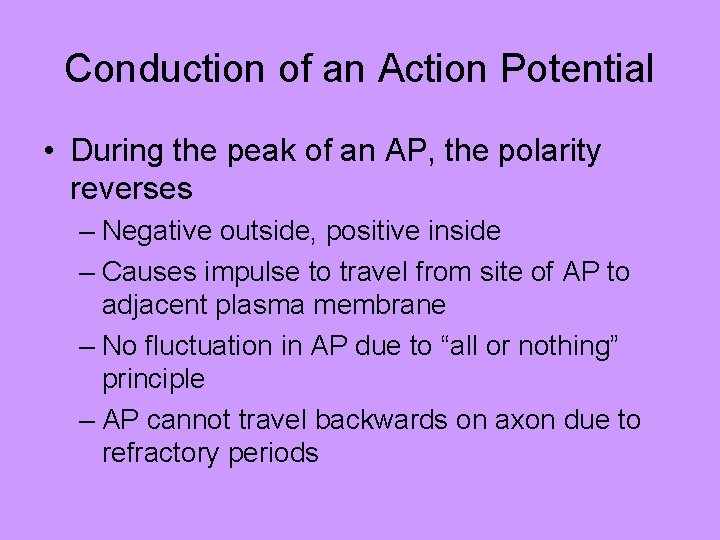
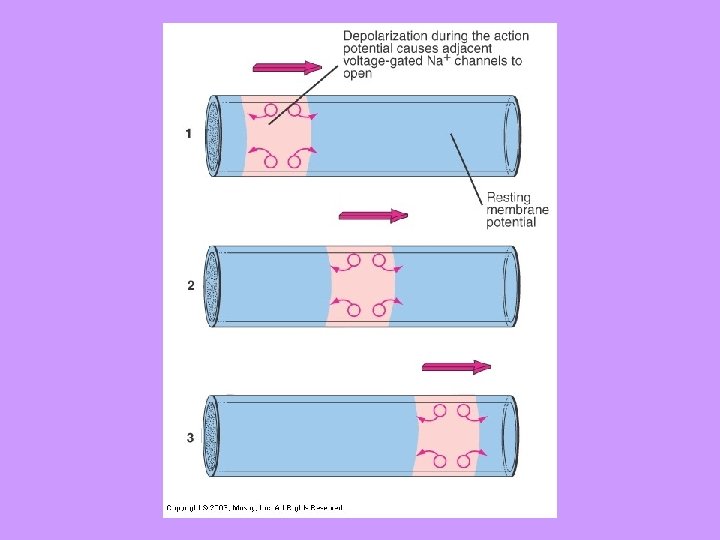
Conduction of an Action Potential • During the peak of an AP, the polarity reverses – Negative outside, positive inside – Causes impulse to travel from site of AP to adjacent plasma membrane – No fluctuation in AP due to “all or nothing” principle – AP cannot travel backwards on axon due to refractory periods
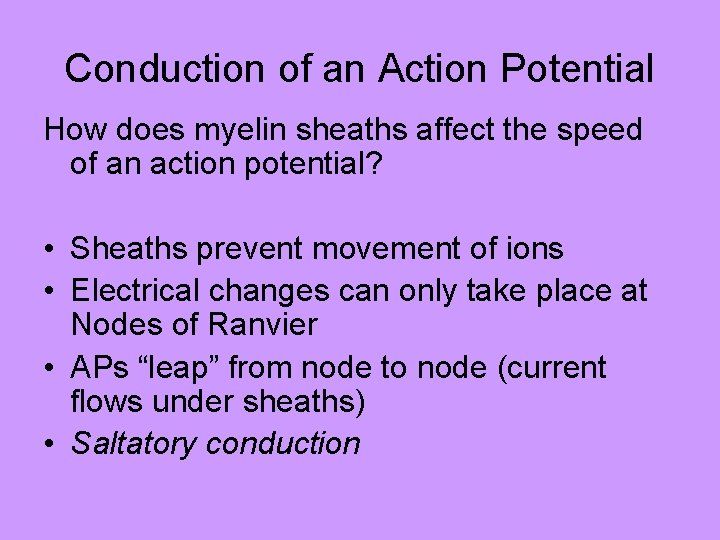
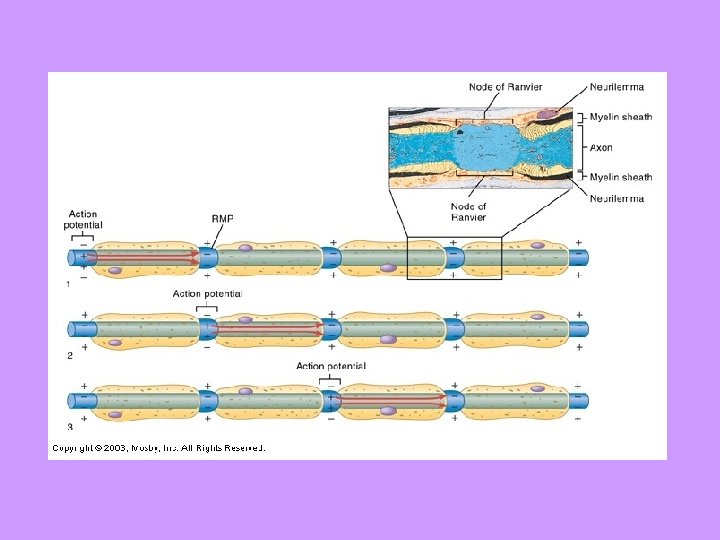
Conduction of an Action Potential How does myelin sheaths affect the speed of an action potential? • Sheaths prevent movement of ions • Electrical changes can only take place at Nodes of Ranvier • APs “leap” from node to node (current flows under sheaths) • Saltatory conduction
Random Facts • In nerve fibers that innervate skeletal muscle, impulses travel up to 130 m/s (300 mph) • Sensory pathways from skin 0. 5 m/s (<1 mph) • Many anesthetics block the sensation of pain by inhibiting opening of Na+ channels
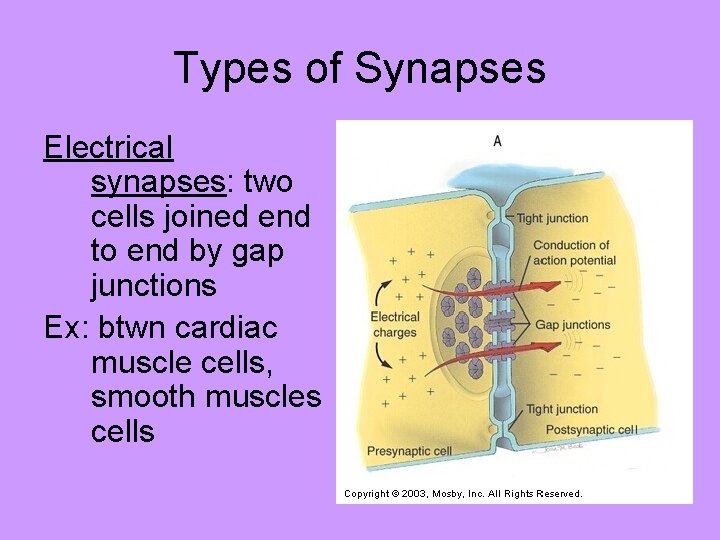
Types of Synapses Electrical synapses: two cells joined end to end by gap junctions Ex: btwn cardiac muscle cells, smooth muscles cells
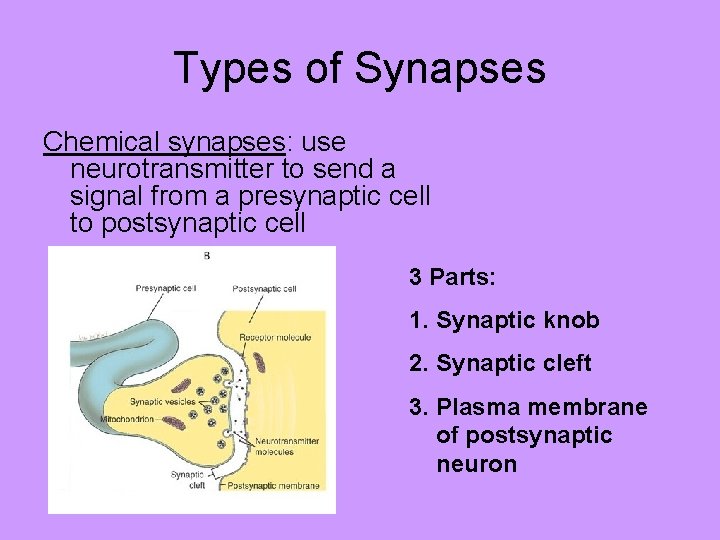
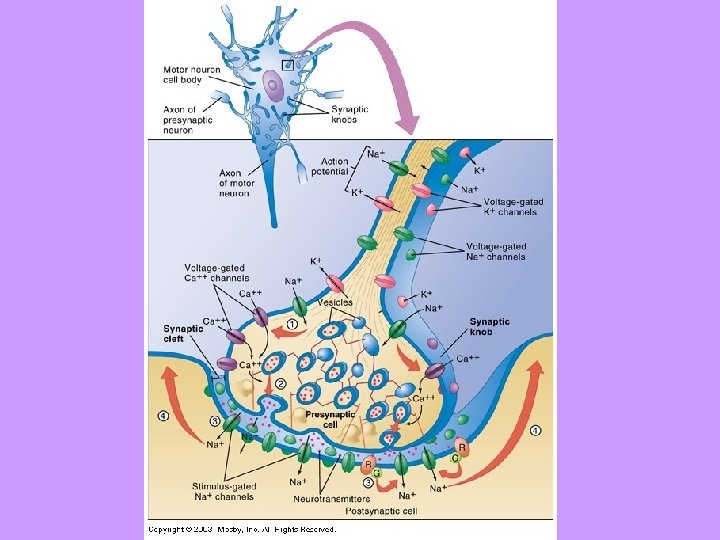
Types of Synapses Chemical synapses: use neurotransmitter to send a signal from a presynaptic cell to postsynaptic cell 3 Parts: 1. Synaptic knob 2. Synaptic cleft 3. Plasma membrane of postsynaptic neuron
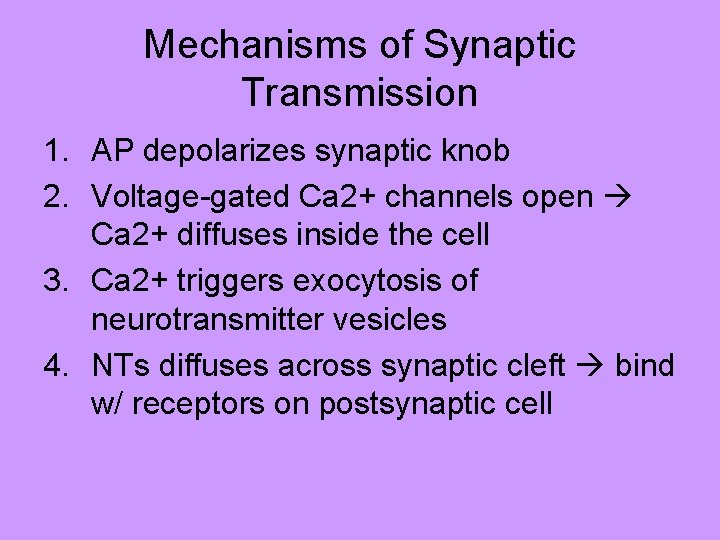
Mechanisms of Synaptic Transmission 1. AP depolarizes synaptic knob 2. Voltage-gated Ca 2+ channels open Ca 2+ diffuses inside the cell 3. Ca 2+ triggers exocytosis of neurotransmitter vesicles 4. NTs diffuses across synaptic cleft bind w/ receptors on postsynaptic cell
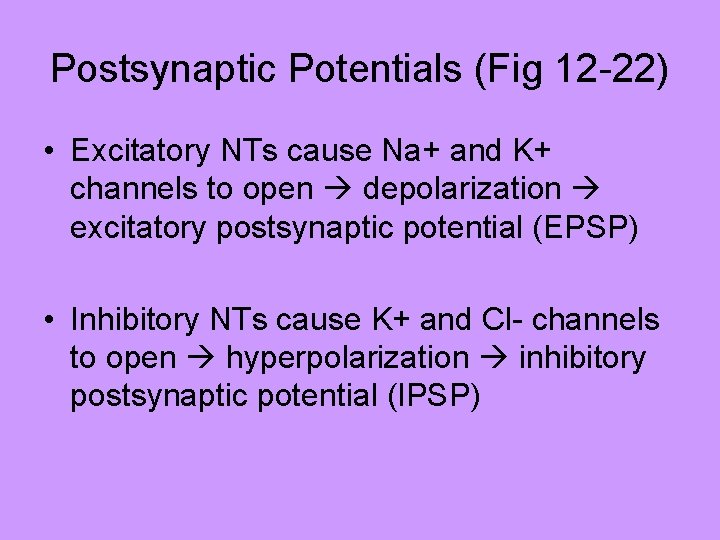
Postsynaptic Potentials (Fig 12 -22) • Excitatory NTs cause Na+ and K+ channels to open depolarization excitatory postsynaptic potential (EPSP) • Inhibitory NTs cause K+ and Cl- channels to open hyperpolarization inhibitory postsynaptic potential (IPSP)
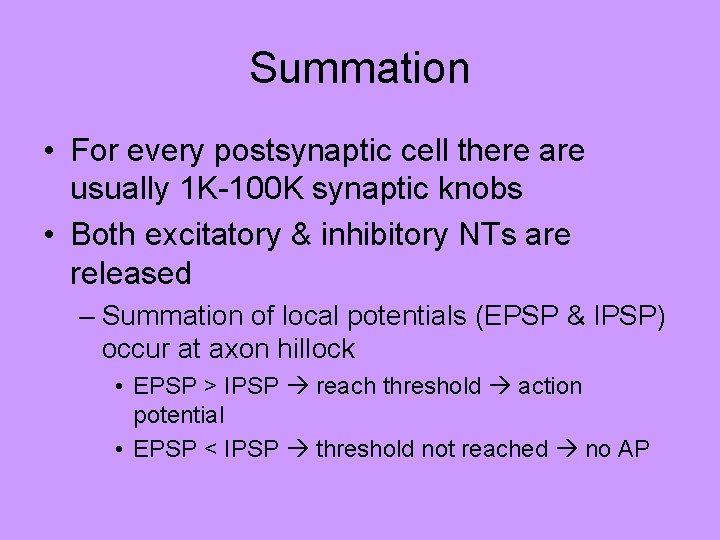
Summation • For every postsynaptic cell there are usually 1 K-100 K synaptic knobs • Both excitatory & inhibitory NTs are released – Summation of local potentials (EPSP & IPSP) occur at axon hillock • EPSP > IPSP reach threshold action potential • EPSP < IPSP threshold not reached no AP
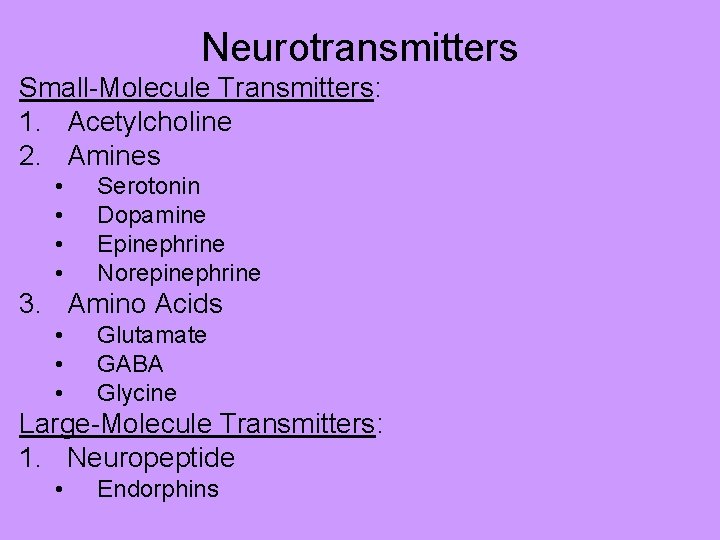
Neurotransmitters Small-Molecule Transmitters: 1. Acetylcholine 2. Amines • • Serotonin Dopamine Epinephrine Norepinephrine 3. Amino Acids • • • Glutamate GABA Glycine Large-Molecule Transmitters: 1. Neuropeptide • Endorphins