
CHAPTER 12 Interpersonal Relations Relationships and Work Interpersonal




- Slides: 22
CHAPTER 12 Interpersonal Relations: Relationships and Work
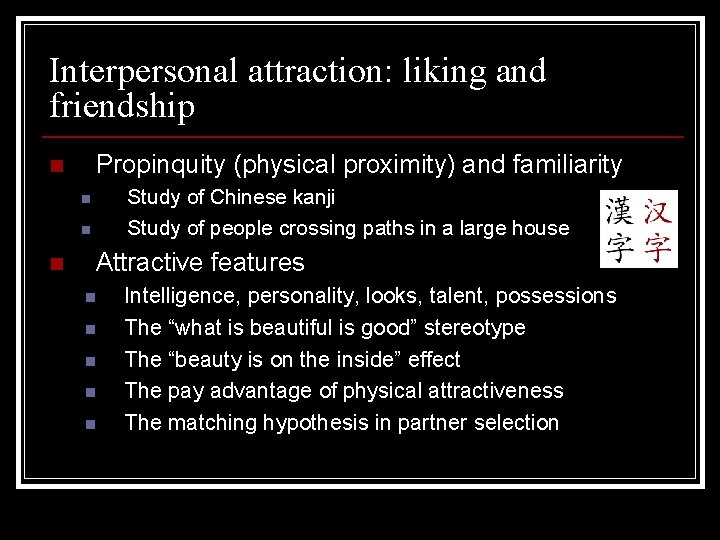
Interpersonal attraction: liking and friendship Propinquity (physical proximity) and familiarity n Study of Chinese kanji Study of people crossing paths in a large house n n n Attractive features n n n Intelligence, personality, looks, talent, possessions The “what is beautiful is good” stereotype The “beauty is on the inside” effect The pay advantage of physical attractiveness The matching hypothesis in partner selection
Interpersonal attraction: liking and friendship n n Propinquity (physical proximity) and familiarity Attractive features n n n Intelligence, personality, looks, talent, possessions The “what is beautiful is good” stereotype The “beauty is on the inside” effect The pay advantage of physical attractiveness (study of MBA graduates using their yearbook photos) The matching hypothesis in partner selection
Interpersonal attraction: liking and friendship Similarity and interpersonal attraction: Do birds of a feather flock together? n n Assortative mating on age, race, religious affiliation, SES, education, interests, sexual attitudes, background, and some personality traits Do opposites attract? The complementarity notion n Examples of when opposites (usually) don’t attract: introversion/extraversion, sensation seeking, sociosexuality Examples of when opposites (rarely) do attract: neuroticism, sadism/masochism, complementary interests
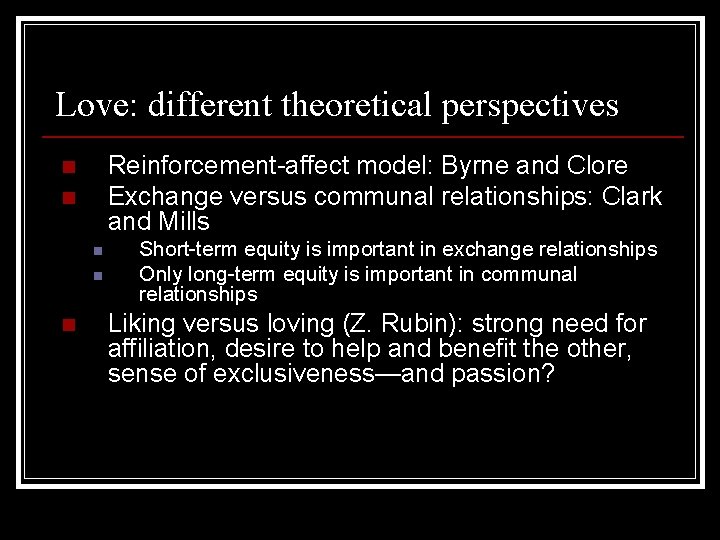
Love: different theoretical perspectives Reinforcement-affect model: Byrne and Clore Exchange versus communal relationships: Clark and Mills n n n Short-term equity is important in exchange relationships Only long-term equity is important in communal relationships Liking versus loving (Z. Rubin): strong need for affiliation, desire to help and benefit the other, sense of exclusiveness—and passion?
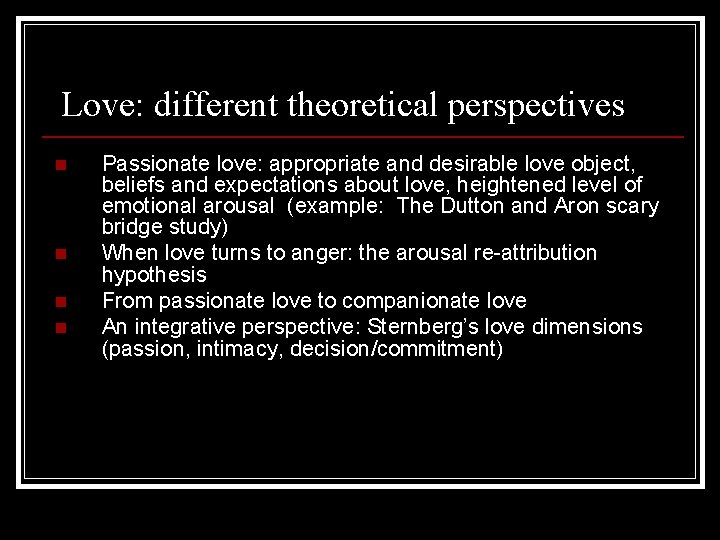
Love: different theoretical perspectives n n Passionate love: appropriate and desirable love object, beliefs and expectations about love, heightened level of emotional arousal (example: the Dutton and Aron scary bridge study) When love turns to anger: the arousal re-attribution hypothesis From passionate love to companionate love An integrative perspective: Sternberg’s love dimensions (passion, intimacy, decision/commitment)
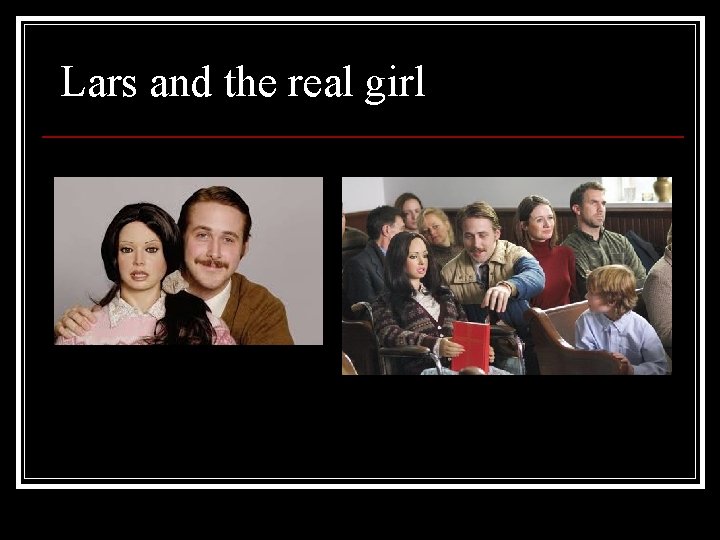
Lars and the real girl
Passionate love: a three-factor model Presence of an appropriate and attractive individual Cultural beliefs and expectations about love Physiological arousal that is interpreted and labeled as love Passionate Love
Dutton and Aron’s (1974) Two Bridges study Walk on the high suspension bridge Walk on the low stable bridge Height induces fast heart rate Heart rate is normal, not elevated Encounter the attractive woman High heart rate seems to indicate attraction No heightened arousal to misattribute as attraction to her 60% use her number to call her back Only 30% use her number to call her back
Love: different theoretical perspectives n n Passionate love: appropriate and desirable love object, beliefs and expectations about love, heightened level of emotional arousal (example: The Dutton and Aron scary bridge study) When love turns to anger: the arousal re-attribution hypothesis From passionate love to companionate love An integrative perspective: Sternberg’s love dimensions (passion, intimacy, decision/commitment)
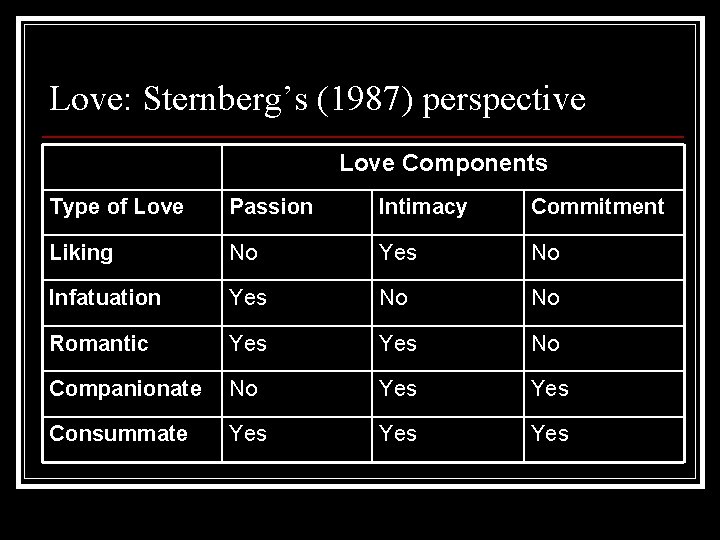
Love: Sternberg’s (1987) perspective Love Components Type of Love Passion Intimacy Commitment Liking No Yes No Infatuation Yes No No Romantic Yes No Companionate No Yes Consummate Yes Yes
Romance in the workplace n Office romances n n n The proximity factor and assortative mating Trading attributes: youth and beauty for education, status, resources, age Mixed motives: love motivation, ego motivation, job motivation Romance and job performance: plusses and minuses Guidelines for handling workplace romance
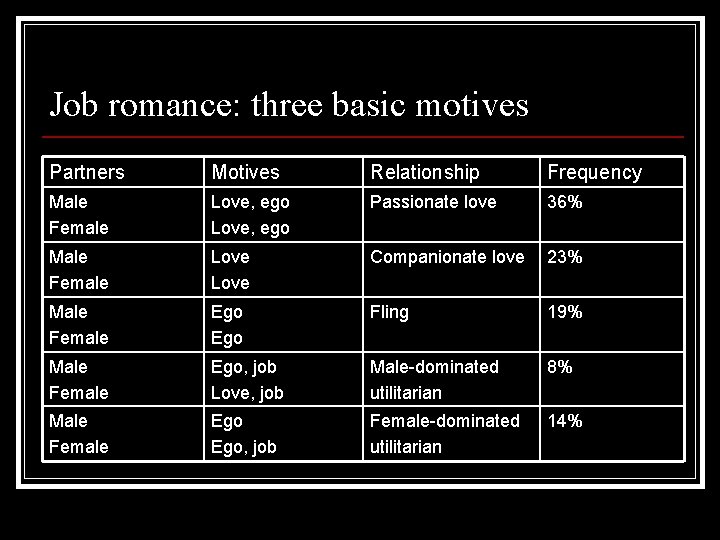
Job romance: three basic motives Partners Motives Relationship Frequency Male Female Love, ego Passionate love 36% Male Female Love Companionate love 23% Male Female Ego Fling 19% Male Female Ego, job Love, job Male-dominated utilitarian 8% Male Female Ego, job Female-dominated utilitarian 14%
Romance in the workplace n Office romances n n n The proximity factor Trading attributes: youth and beauty for education, status, resources, age Mixed motives: love motivation, ego motivation, job motivation Romance and job performance: plusses and minuses Guidelines for handling workplace romance
Sexual harassment in the workplace n Sexual harassment n n n Five categories: gender harassment, seductive behaviors, sexual bribery, sexual coercion, sexual assault Factors that inhibit reporting: confusing social norms, giving the offender the benefit of the doubt, desire for social acceptance, ease of ignoring minor infractions Consequences of sexual harassment: low job satisfaction, psychological problems, health problems, absenteeism, desire to leave the job
Sexual harassment in the workplace n Sexual harassment n n n The organizational climate: the gender context, the tolerance context (ambient sexual harassment) Dealing with sexual harassment: most companies have a written policy. Typical outcomes: 80% reprimand, 20% firing Clear policy statement, procedures for filing and acting on complaints, procedures to protect privacy and confidentiality, use of third-parties, procedures for fact finding and action, counseling, prevention
Work and family relationships Dual career couples n n Distribution of household chores Stress, mental and physical health concerns, daycare, guilt Job sharing Marital status and quality of life: married couples versus singles n n n Social support, mutual monitoring of health concerns More stable lives with fewer risks Less loneliness Exceptions: distressed marriages, extreme lifestyles, unusual job demands
Work and family relationships n Single parents: extra demands n n More than 6% of the workforce are single parents Extra demands: divorced or widowed status, reduced income, added responsibilities and stress, lack of social support, time constraints, child care issues Solutions: after-school programs, single-partner support groups, flex time, telecommuting, job sharing Work and home: the spillover effect
Aggression at work: destructive relationships Homicides are the number-one cause of traumatic death at work (jealous husbands, disgruntled employees, rapes, theft). About 15% of all violent crime occurs in the workplace. The causes of violence: frustration, failure to achieve a desired goal, stress, personal conflicts, rejection, anger and hostility n n n n Need to appraise the situation Need to evaluate one’s options Talking things out Eliminating injustice in the workplace Bosses from heaven Anger management training
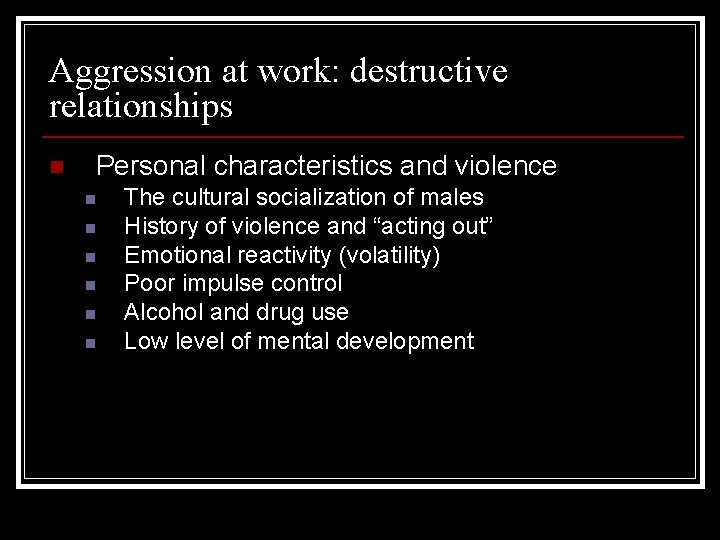
Aggression at work: destructive relationships n Personal characteristics and violence n n n The cultural socialization of males History of violence and “acting out” Emotional reactivity (volatility) Poor impulse control Alcohol and drug use Low level of mental development
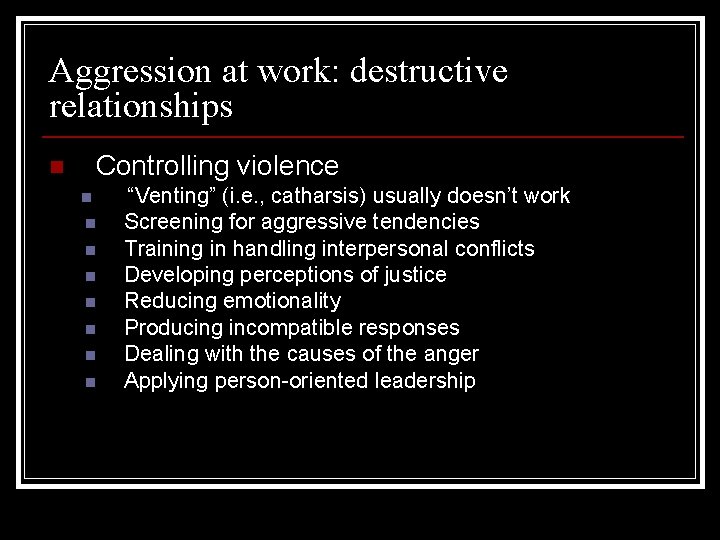
Aggression at work: destructive relationships Controlling violence n n n n n “Venting” (i. e. , catharsis) usually doesn’t work Screening for aggressive tendencies Training in handling interpersonal conflicts Developing perceptions of justice Reducing emotionality Producing incompatible responses Dealing with the causes of the anger Applying person-oriented leadership