
Chapter 12 Gravity currents bores and flow over
Chapter 12 Gravity currents, bores and flow over obstacles
Hydraulic theory Ø Now we examine some simple techniques from theory of hydraulics to study a range of small scale atmospheric flows, including gravity currents, bores (hydraulic jumps) and flow over orography.
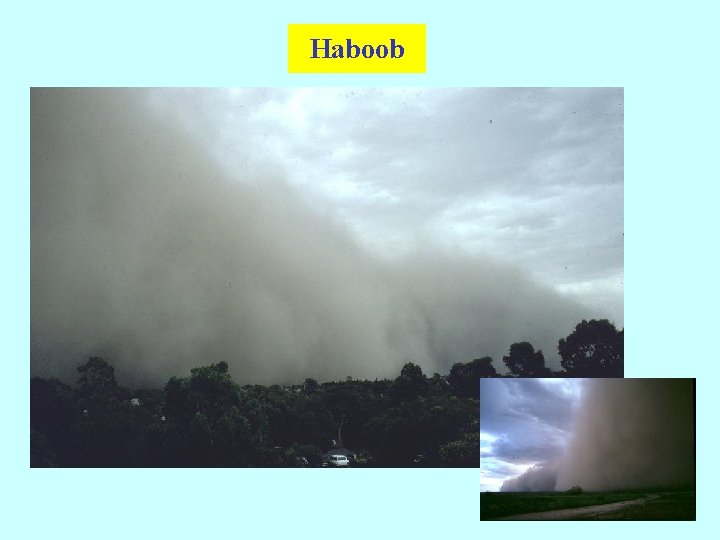
Gravity currents Ø A gravity current is produced when a relatively dense fluid moves quasi-horizontally into a lighter fluid. Examples: => Ø Sea breezes, produced when air over the land is heated during the daytime relative to that over the sea; Ø Katabatic (or drainage) winds, produced on slopes or in mountain valleys when air adjacent to the slope cools relative to that at the same height, but further from the slope; Ø Thunderstorm outflows, produced beneath large storms as air below cloud base is cooled by the evaporation of precipitation into it and spreads horizontally, sometimes with a strong gust front at its leading edge. Ø A concise review is given by Simpson (1987).
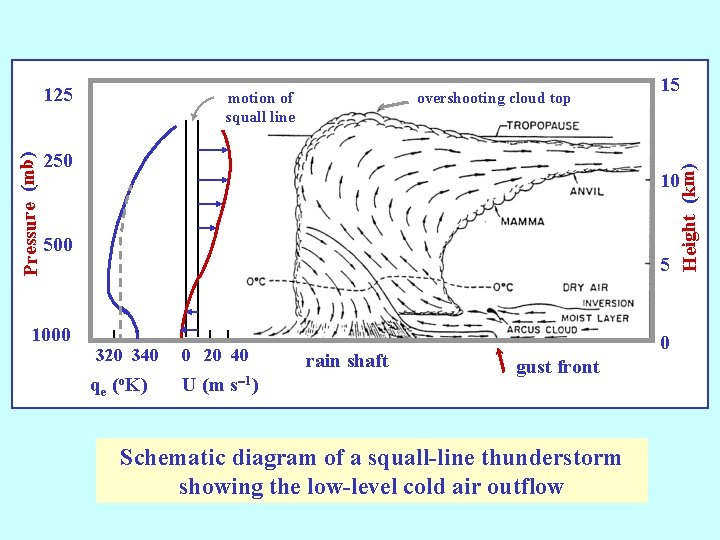
motion of squall line overshooting cloud top 250 10 500 1000 15 Height (km) Pressure (mb) 125 5 320 340 qe (o. K) 0 20 40 U (m s-1) rain shaft 0 gust front Schematic diagram of a squall-line thunderstorm showing the low-level cold air outflow
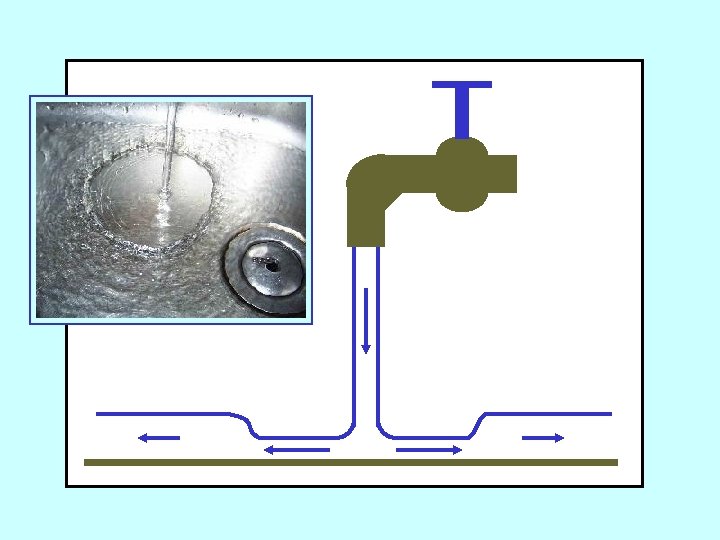
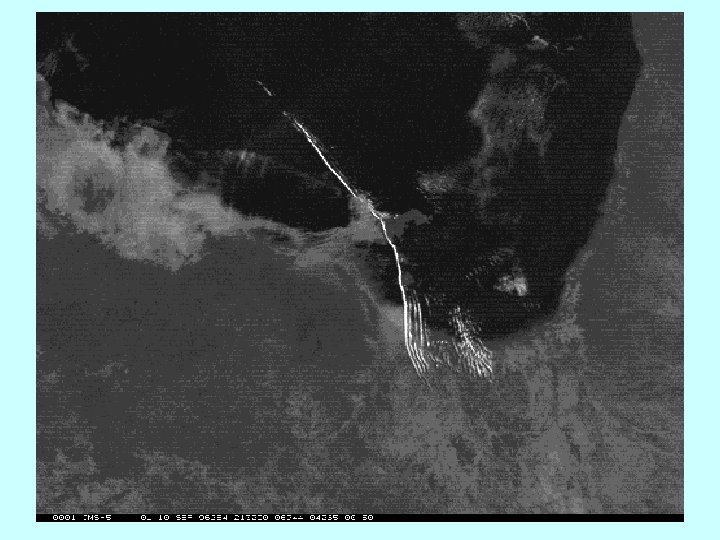
Bores Ø The more familiar examples of bores occur on water surfaces. Ø Examples are: - bores on tidal rivers, - quasi-stationary bores produced downstream of a weir, and - the bore produced in a wash basin when the tap is turned on and a laminar stream of water impinges on the bottom of the basin. Ø Perhaps the best known of atmospheric bores is the so-called 'morning glory' of northern Australia.
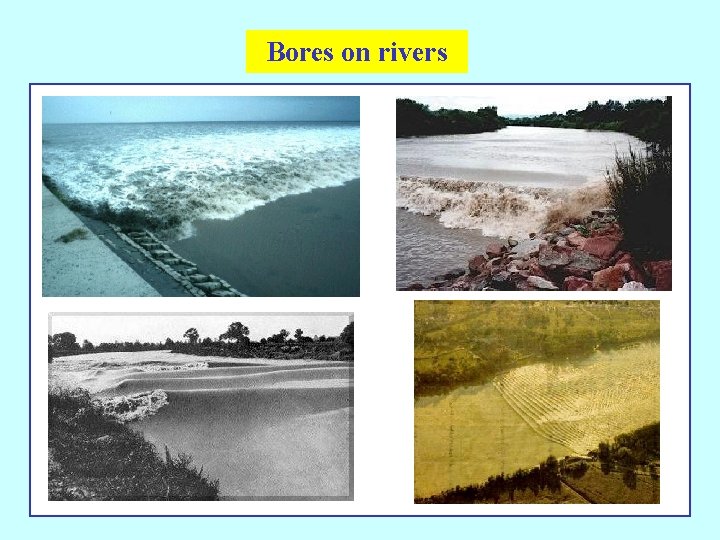
Bores on rivers

Mascaret bore, France
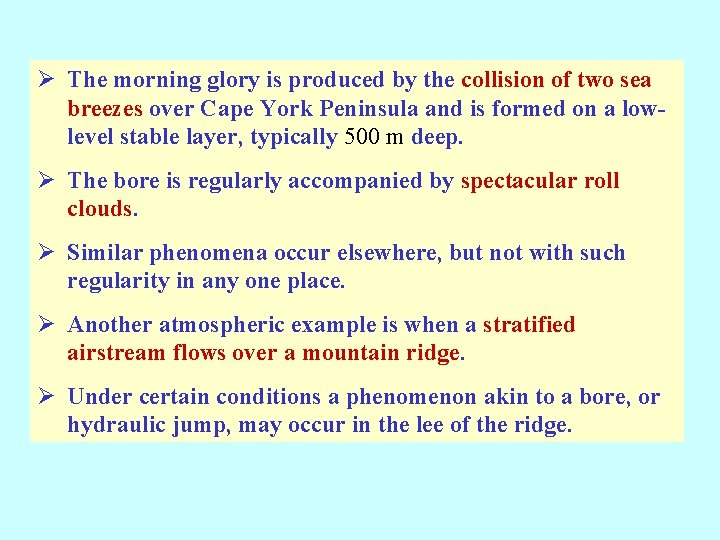
Ø The morning glory is produced by the collision of two sea breezes over Cape York Peninsula and is formed on a lowlevel stable layer, typically 500 m deep. Ø The bore is regularly accompanied by spectacular roll clouds. Ø Similar phenomena occur elsewhere, but not with such regularity in any one place. Ø Another atmospheric example is when a stratified airstream flows over a mountain ridge. Ø Under certain conditions a phenomenon akin to a bore, or hydraulic jump, may occur in the lee of the ridge.
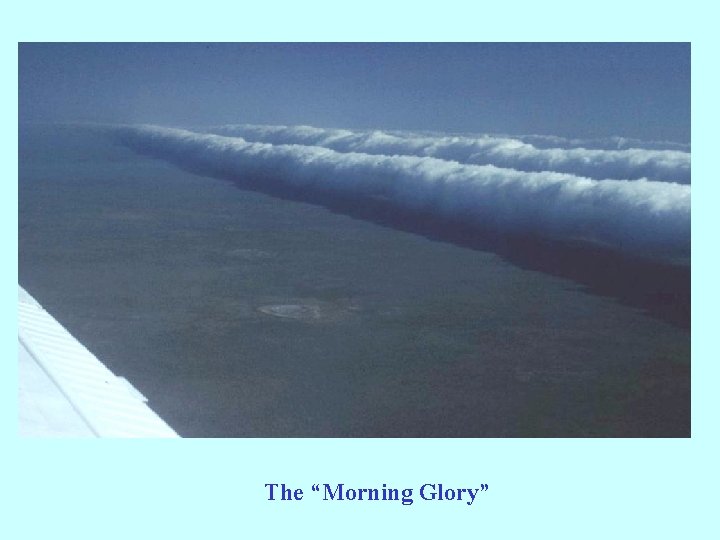
The “Morning Glory”
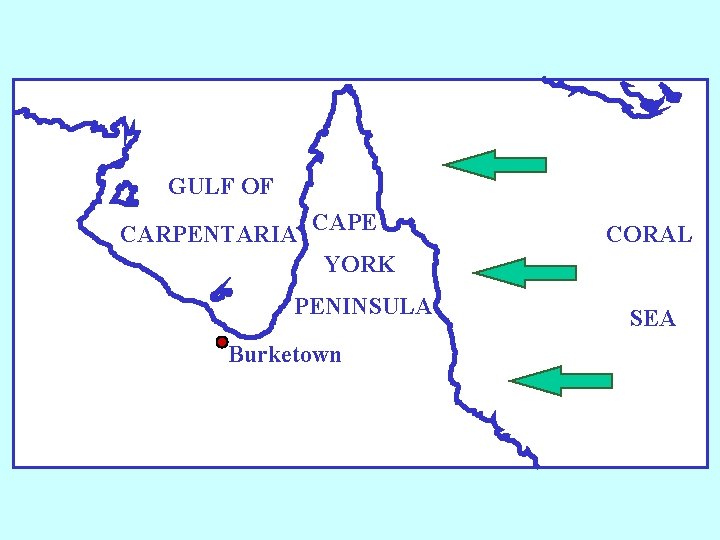
GULF OF CARPENTARIA CAPE YORK PENINSULA Burketown CORAL SEA
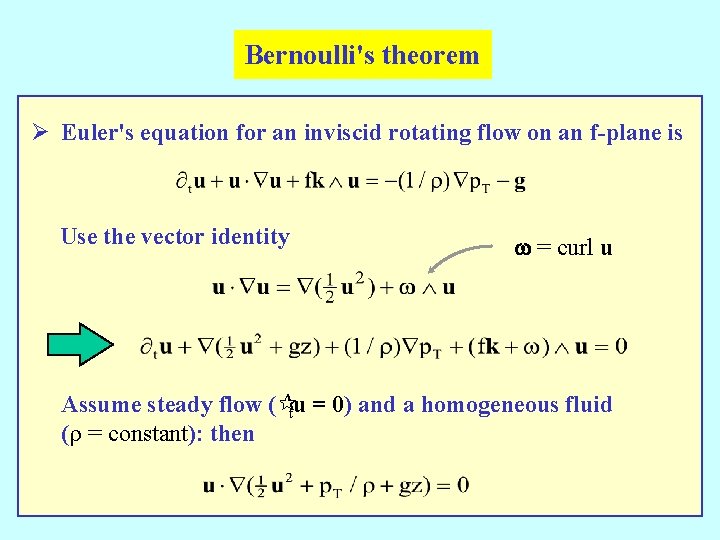
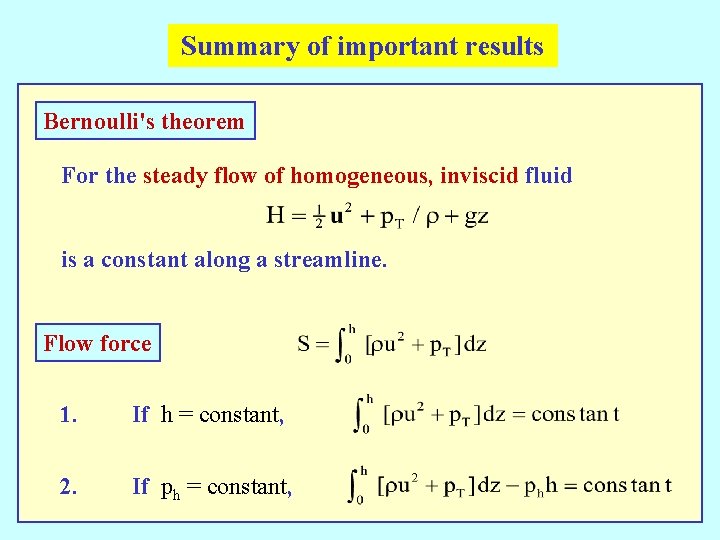
Bernoulli's theorem Ø Euler's equation for an inviscid rotating flow on an f-plane is Use the vector identity w = curl u Assume steady flow (¶tu = 0) and a homogeneous fluid (r = constant): then
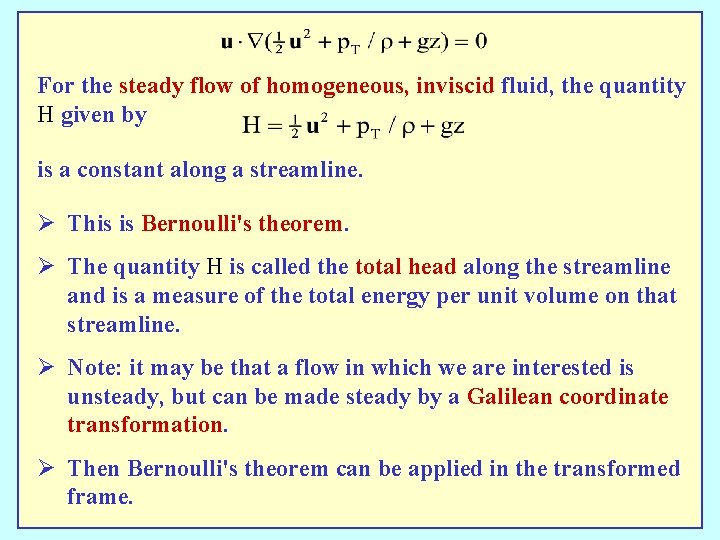
For the steady flow of homogeneous, inviscid fluid, the quantity H given by is a constant along a streamline. Ø This is Bernoulli's theorem. Ø The quantity H is called the total head along the streamline and is a measure of the total energy per unit volume on that streamline. Ø Note: it may be that a flow in which we are interested is unsteady, but can be made steady by a Galilean coordinate transformation. Ø Then Bernoulli's theorem can be applied in the transformed frame.

Flow force Ø Consider steady motion of an inviscid rotating fluid in two dimensions. Ø In flux form the x-momentum equation is Consider the motion of a layer of fluid of variable depth h(x); see next figure: =>

ph u(x) Integrating h(x) with respect to z
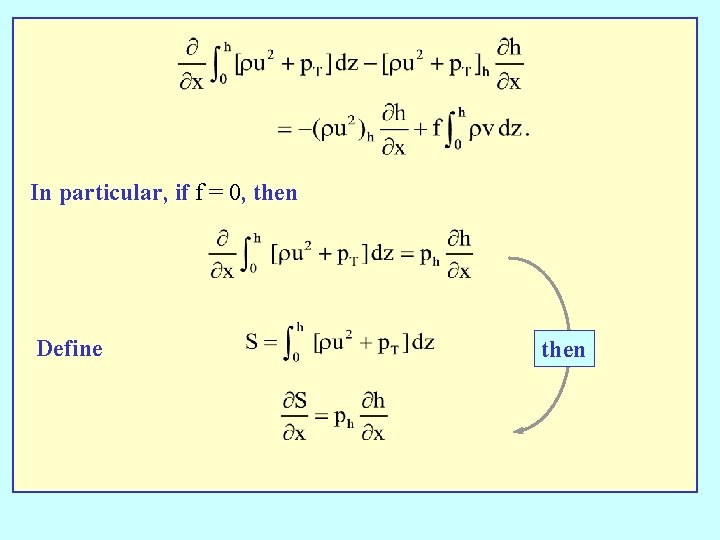
In particular, if f = 0, then Define then
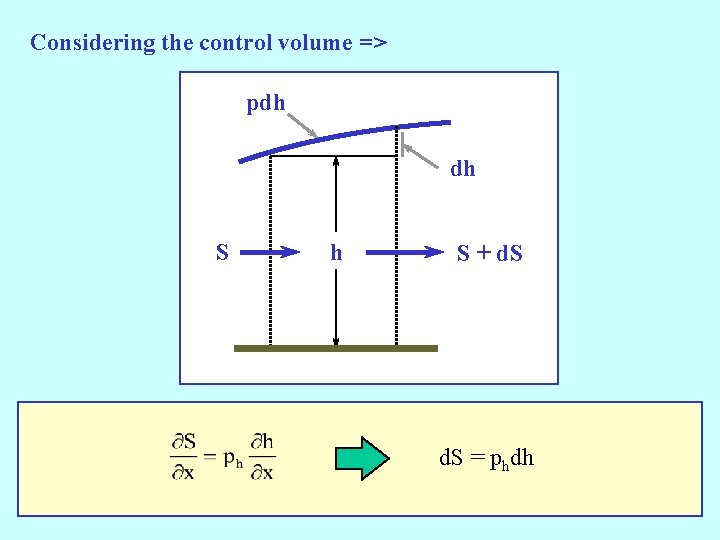
Considering the control volume => pdh dh S + d. S = phdh
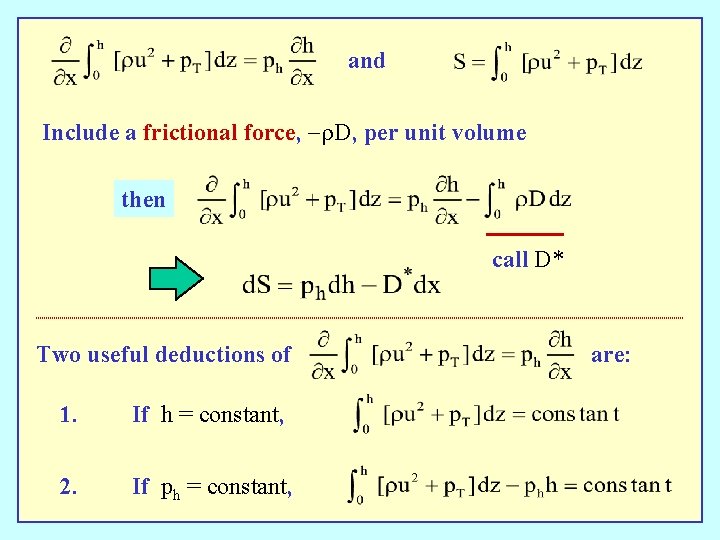
and Include a frictional force, -r. D, per unit volume then call D* Two useful deductions of 1. If h = constant, 2. If ph = constant, are:
Summary of important results Bernoulli's theorem For the steady flow of homogeneous, inviscid fluid is a constant along a streamline. Flow force 1. If h = constant, 2. If ph = constant,
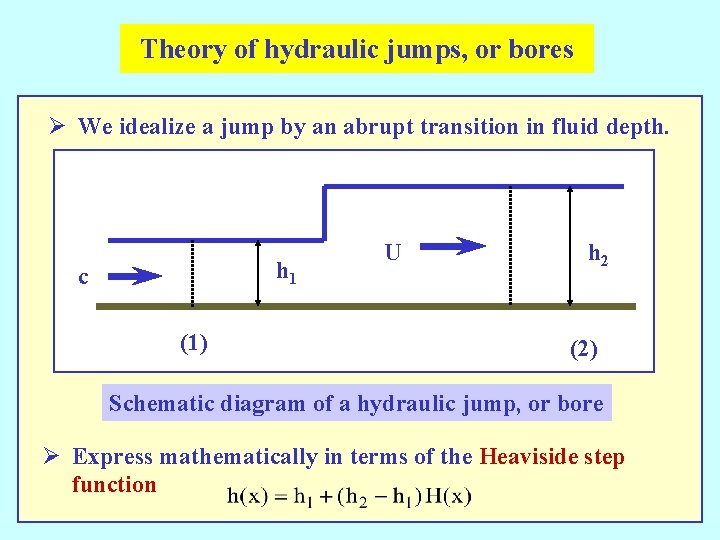
Theory of hydraulic jumps, or bores Ø We idealize a jump by an abrupt transition in fluid depth. h 1 c (1) U h 2 (2) Schematic diagram of a hydraulic jump, or bore Ø Express mathematically in terms of the Heaviside step function

atmospheric pressure Dirac delta function h 1 c (1) U h 2 (2) Integrate with respect to x between (1) and (2) =>
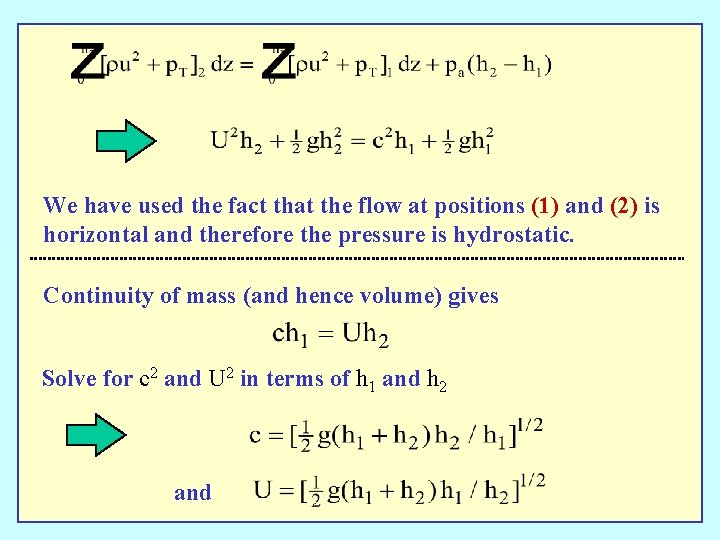
We have used the fact that the flow at positions (1) and (2) is horizontal and therefore the pressure is hydrostatic. Continuity of mass (and hence volume) gives Solve for c 2 and U 2 in terms of h 1 and h 2 and
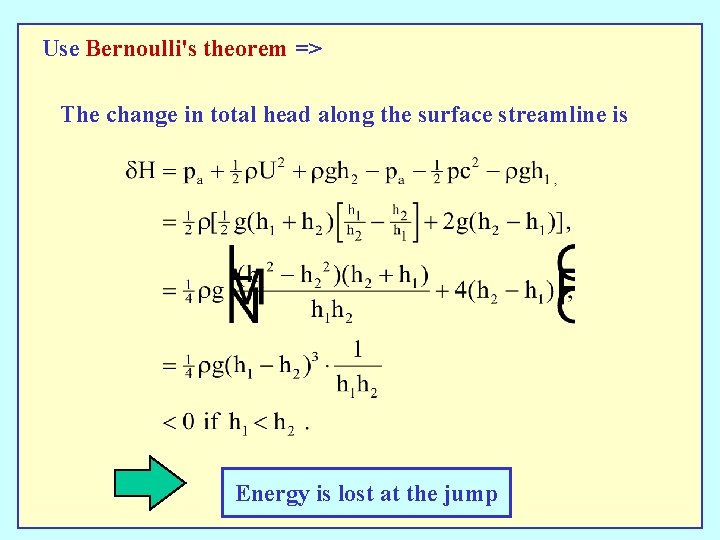
Use Bernoulli's theorem => The change in total head along the surface streamline is Energy is lost at the jump
Energy loss Ø The energy lost supplies the source for the turbulent motion at the jump that occurs in many cases. Ø For weaker bores, the jump may be accomplished by a series of smooth waves. Ø Such bores are termed undular. Ø In these cases the energy loss is radiated away by the waves. See Lighthill, 1978, § 2. 12.

Ø It follows from that the depth of fluid must increase, since a decrease would require an energy supply. Then and
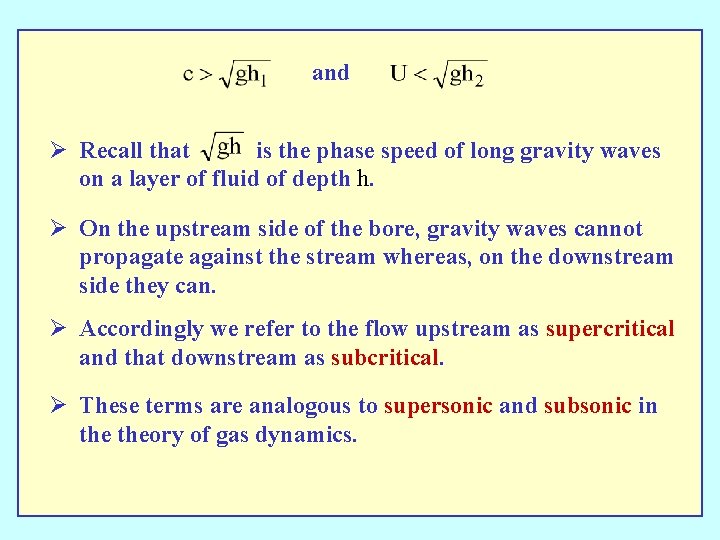
and Ø Recall that is the phase speed of long gravity waves on a layer of fluid of depth h. Ø On the upstream side of the bore, gravity waves cannot propagate against the stream whereas, on the downstream side they can. Ø Accordingly we refer to the flow upstream as supercritical and that downstream as subcritical. Ø These terms are analogous to supersonic and subsonic in theory of gas dynamics.
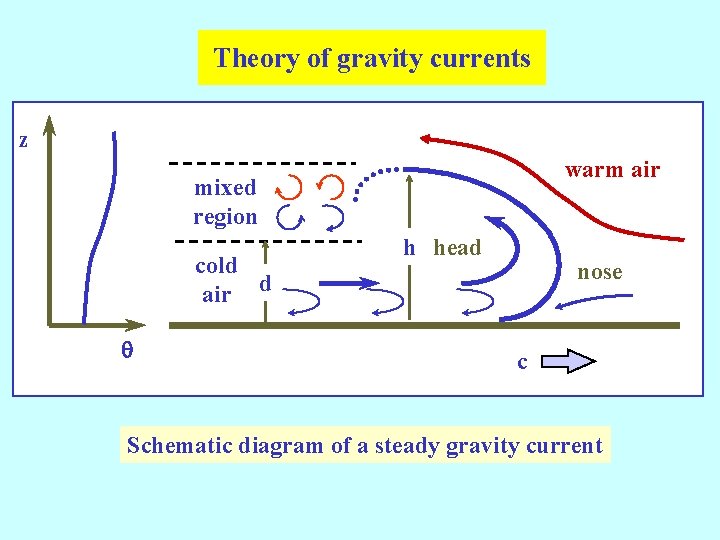
Theory of gravity currents z warm air mixed region cold air d q h head nose c Schematic diagram of a steady gravity current
Haboob
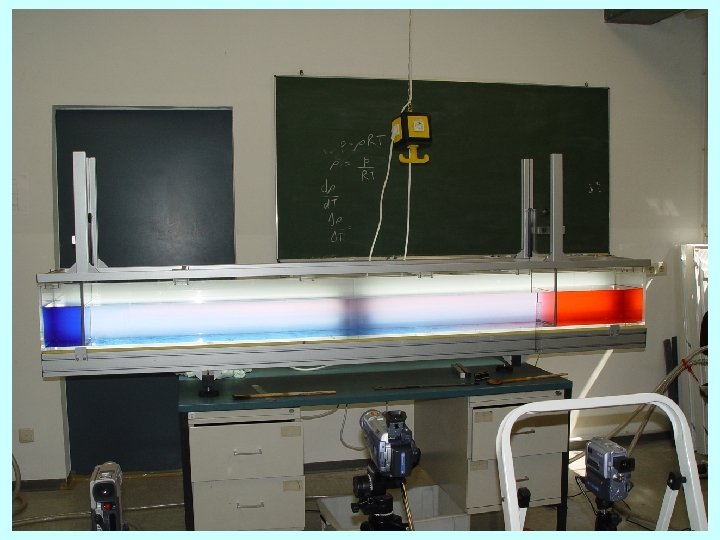

Show movies
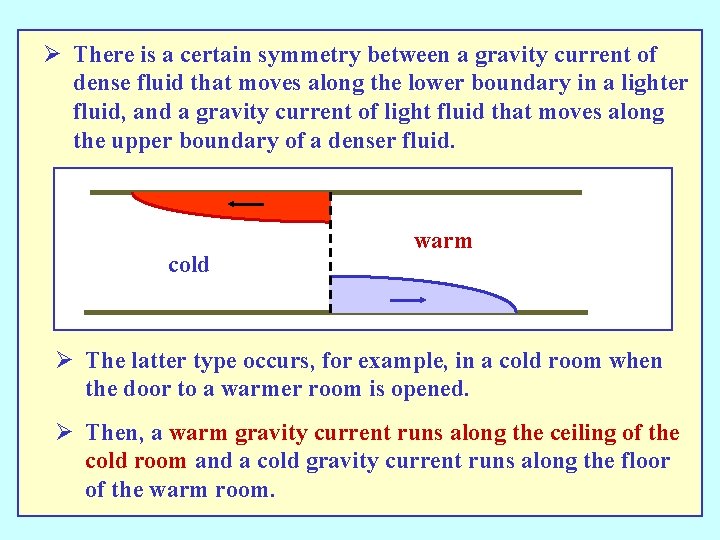
Ø There is a certain symmetry between a gravity current of dense fluid that moves along the lower boundary in a lighter fluid, and a gravity current of light fluid that moves along the upper boundary of a denser fluid. cold warm Ø The latter type occurs, for example, in a cold room when the door to a warmer room is opened. Ø Then, a warm gravity current runs along the ceiling of the cold room and a cold gravity current runs along the floor of the warm room.
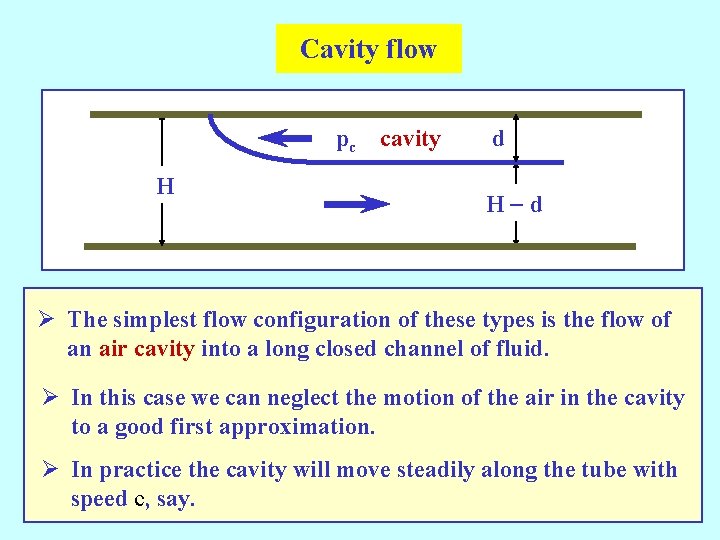
Cavity flow pc cavity H d H-d Ø The simplest flow configuration of these types is the flow of an air cavity into a long closed channel of fluid. Ø In this case we can neglect the motion of the air in the cavity to a good first approximation. Ø In practice the cavity will move steadily along the tube with speed c, say.
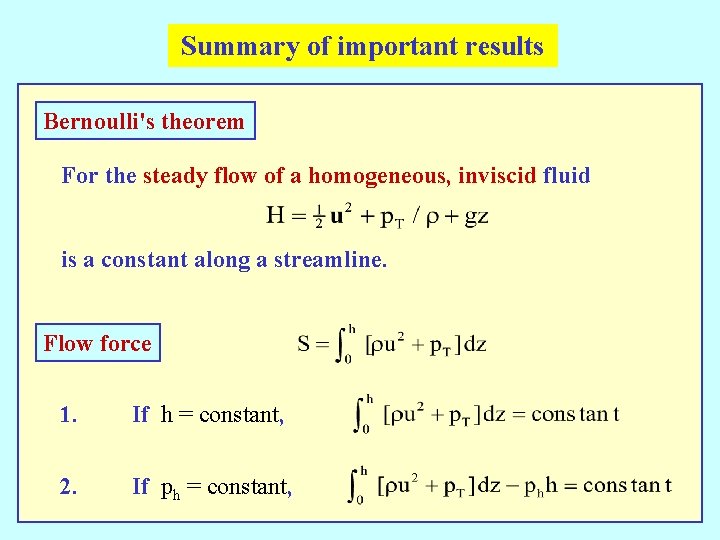
Summary of important results Bernoulli's theorem For the steady flow of a homogeneous, inviscid fluid is a constant along a streamline. Flow force 1. If h = constant, 2. If ph = constant,
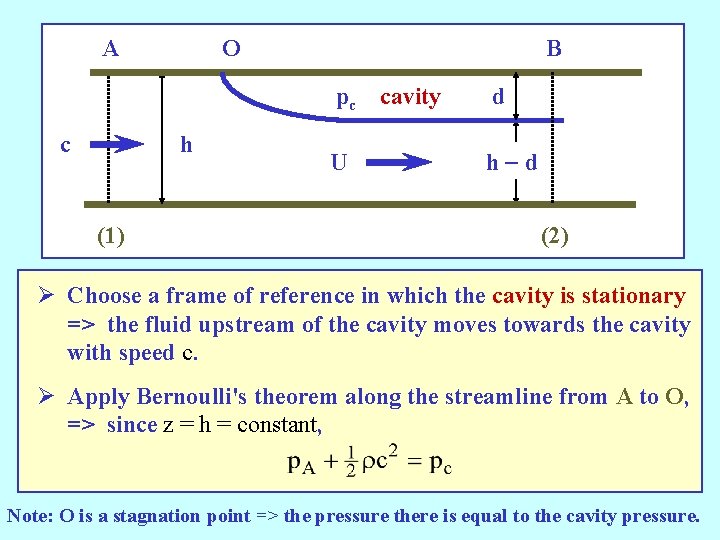
A c O h (1) B pc cavity d U h-d (2) Ø Choose a frame of reference in which the cavity is stationary => the fluid upstream of the cavity moves towards the cavity with speed c. Ø Apply Bernoulli's theorem along the streamline from A to O, => since z = h = constant, Note: O is a stagnation point => the pressure there is equal to the cavity pressure.
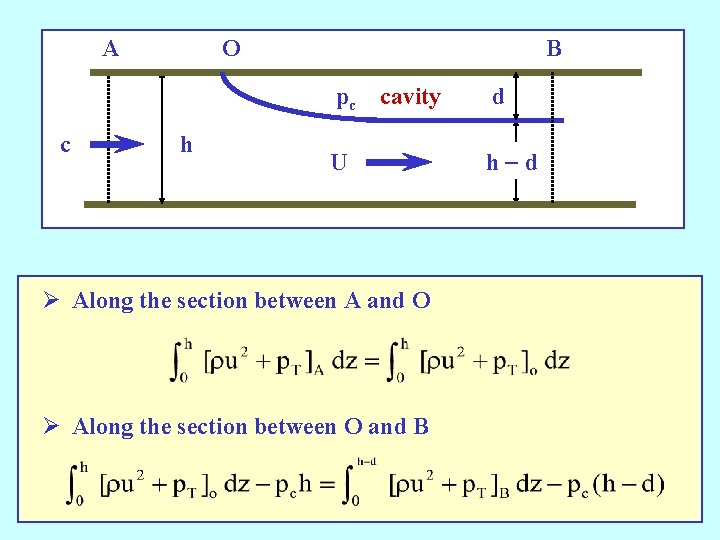
A c O h B pc cavity d U h-d Ø Along the section between A and O Ø Along the section between O and B
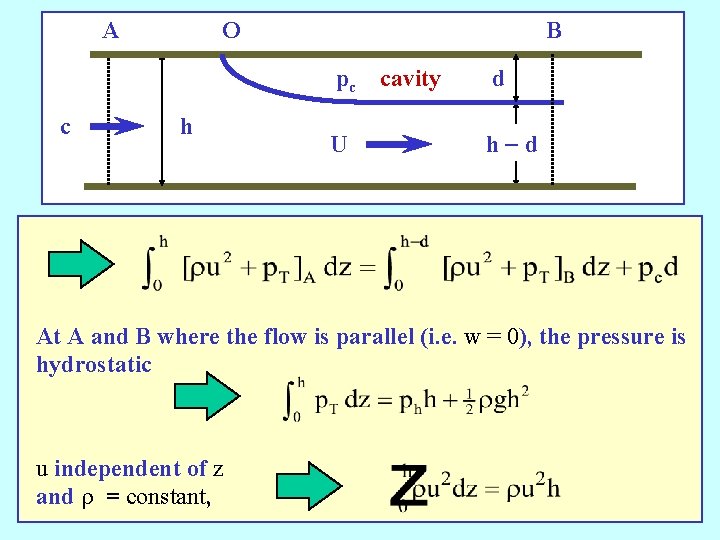
A c O h B pc cavity d U h-d At A and B where the flow is parallel (i. e. w = 0), the pressure is hydrostatic u independent of z and r = constant,
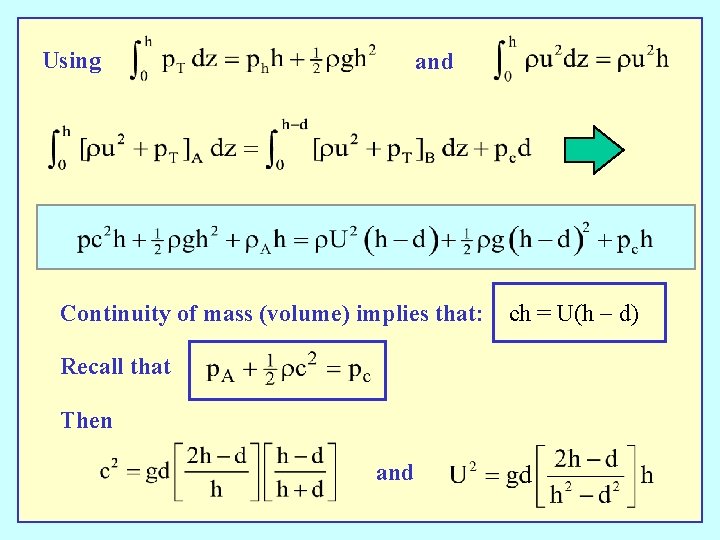
Using and Continuity of mass (volume) implies that: Recall that Then and ch = U(h - d)
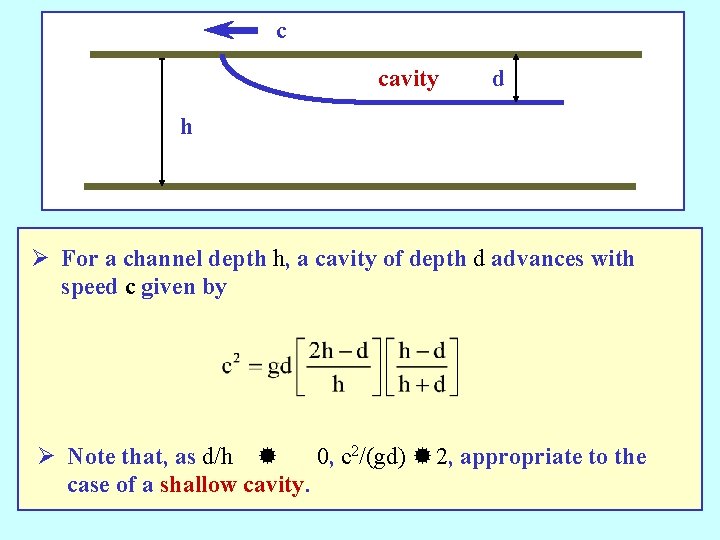
c cavity d h Ø For a channel depth h, a cavity of depth d advances with speed c given by Ø Note that, as d/h ® 0, c 2/(gd) ® 2, appropriate to the case of a shallow cavity.
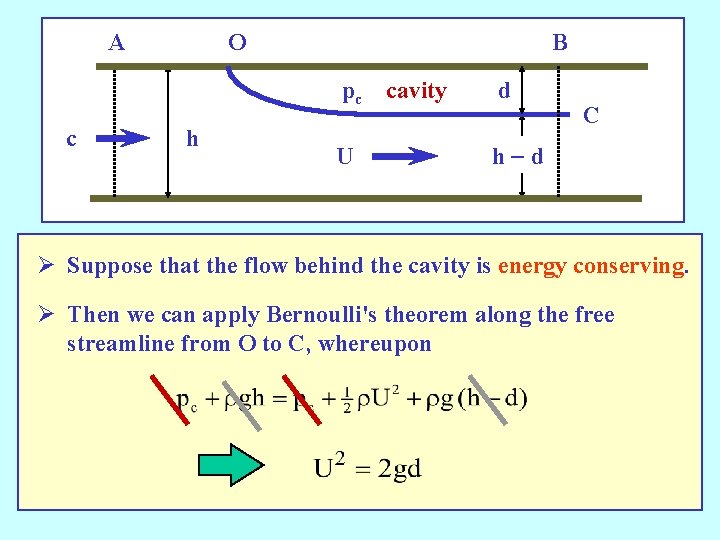
A c O h B pc cavity d U h-d C Ø Suppose that the flow behind the cavity is energy conserving. Ø Then we can apply Bernoulli's theorem along the free streamline from O to C, whereupon
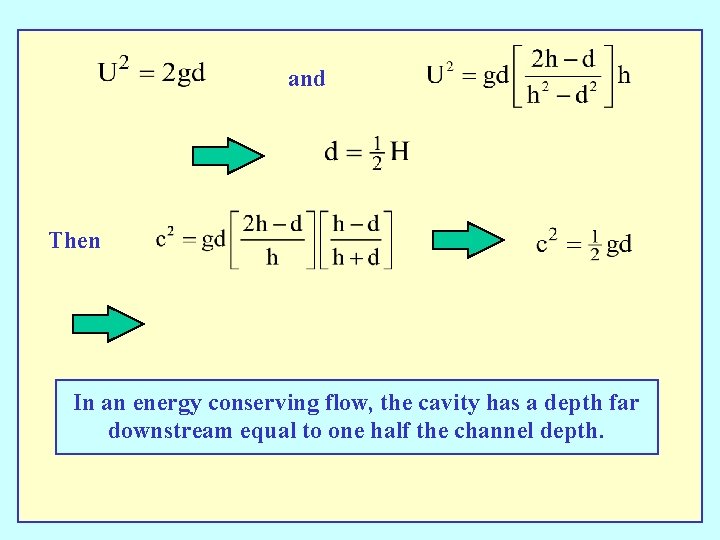
and Then In an energy conserving flow, the cavity has a depth far downstream equal to one half the channel depth.
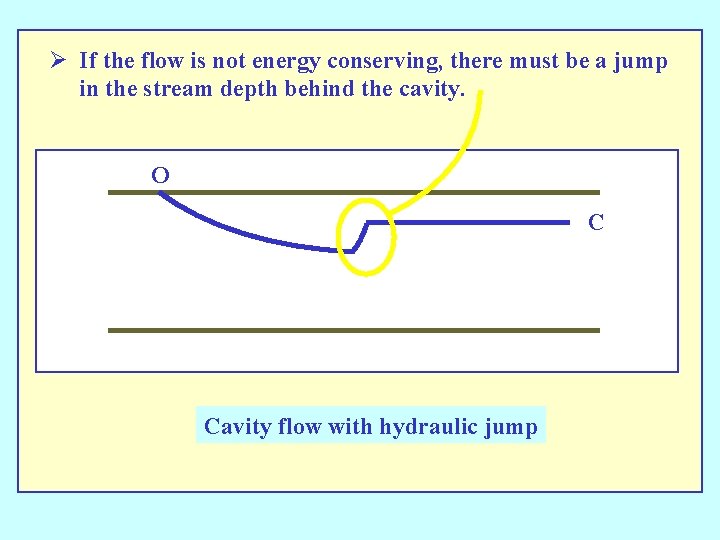
Ø If the flow is not energy conserving, there must be a jump in the stream depth behind the cavity. O C Cavity flow with hydraulic jump
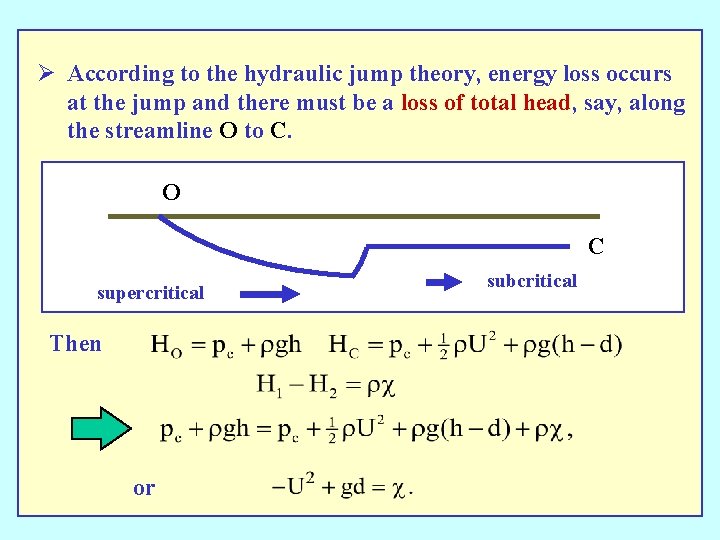
Ø According to the hydraulic jump theory, energy loss occurs at the jump and there must be a loss of total head, say, along the streamline O to C. O C supercritical Then or subcritical
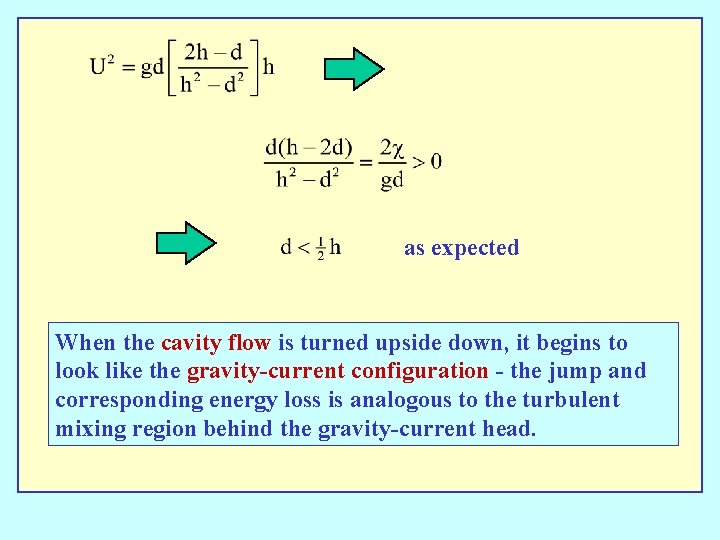
as expected When the cavity flow is turned upside down, it begins to look like the gravity-current configuration - the jump and corresponding energy loss is analogous to the turbulent mixing region behind the gravity-current head.
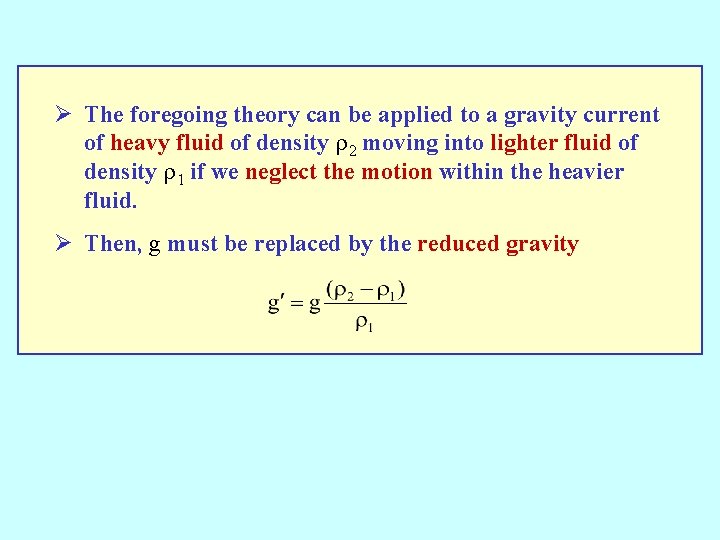
Ø The foregoing theory can be applied to a gravity current of heavy fluid of density r 2 moving into lighter fluid of density r 1 if we neglect the motion within the heavier fluid. Ø Then, g must be replaced by the reduced gravity
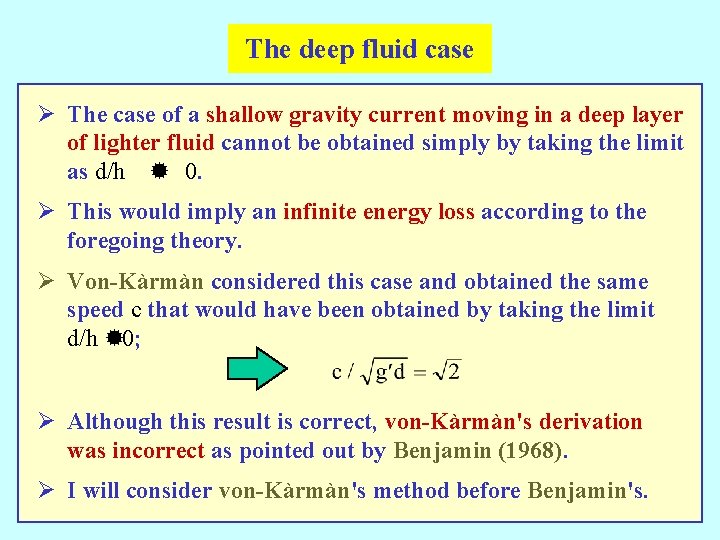
The deep fluid case Ø The case of a shallow gravity current moving in a deep layer of lighter fluid cannot be obtained simply by taking the limit as d/h ® 0. Ø This would imply an infinite energy loss according to the foregoing theory. Ø Von-Kàrmàn considered this case and obtained the same speed c that would have been obtained by taking the limit d/h ® 0; Ø Although this result is correct, von-Kàrmàn's derivation was incorrect as pointed out by Benjamin (1968). Ø I will consider von-Kàrmàn's method before Benjamin's.
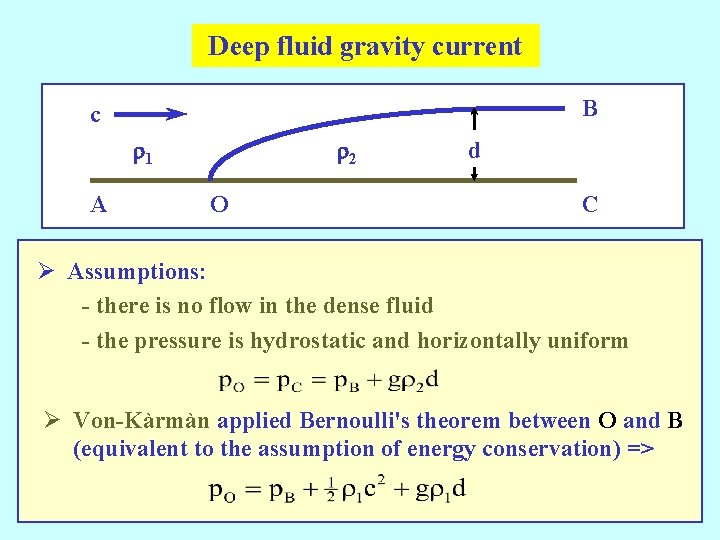
Deep fluid gravity current B c r 1 A r 2 O d C Ø Assumptions: - there is no flow in the dense fluid - the pressure is hydrostatic and horizontally uniform Ø Von-Kàrmàn applied Bernoulli's theorem between O and B (equivalent to the assumption of energy conservation) =>
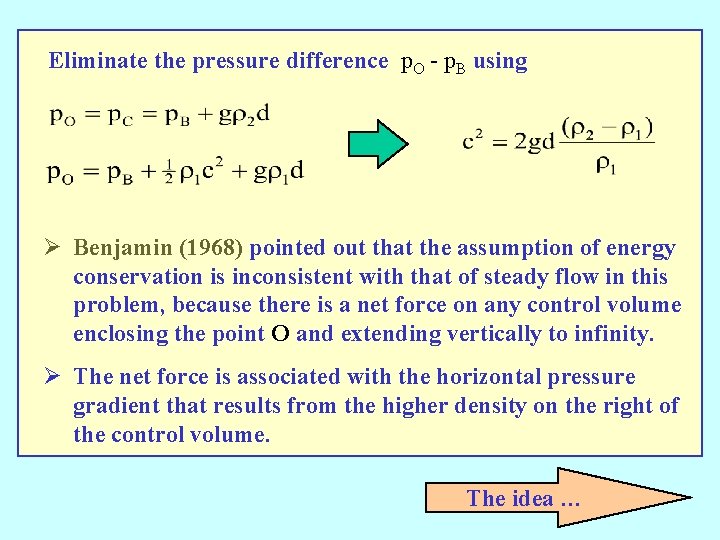
Eliminate the pressure difference p. O - p. B using Ø Benjamin (1968) pointed out that the assumption of energy conservation is inconsistent with that of steady flow in this problem, because there is a net force on any control volume enclosing the point O and extending vertically to infinity. Ø The net force is associated with the horizontal pressure gradient that results from the higher density on the right of the control volume. The idea …

Flow force p(z) = p(h*) + r 1 g(h* _ z) p(z) = p(h*) + r 1 g (h* - z) for z > d SA SC c c B r 1 A u=0 O r 2 d C p(z) = p(h*) + r 1 g (h* - d) + r 2 g(d - z ) for d < z
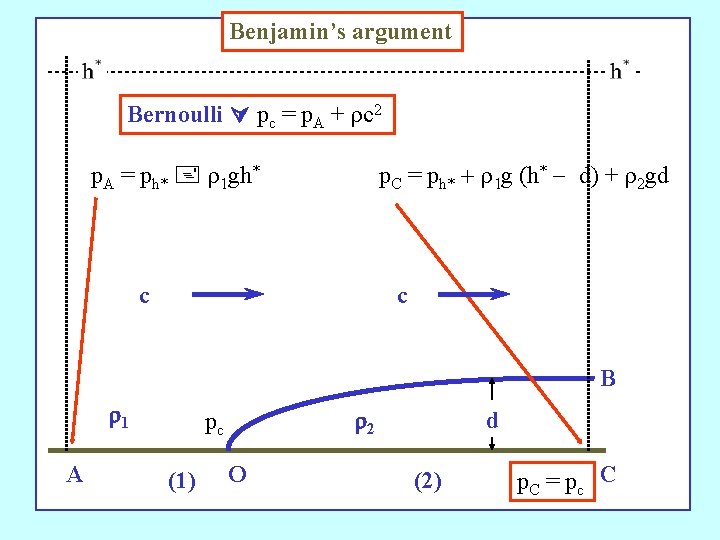
Benjamin’s argument Bernoulli pc = p. A + rc 2 p. A = ph* + r 1 gh* p. C = ph* + r 1 g (h* - d) + r 2 gd c c B r 1 A r 2 pc (1) O d (2) p. C = pc C
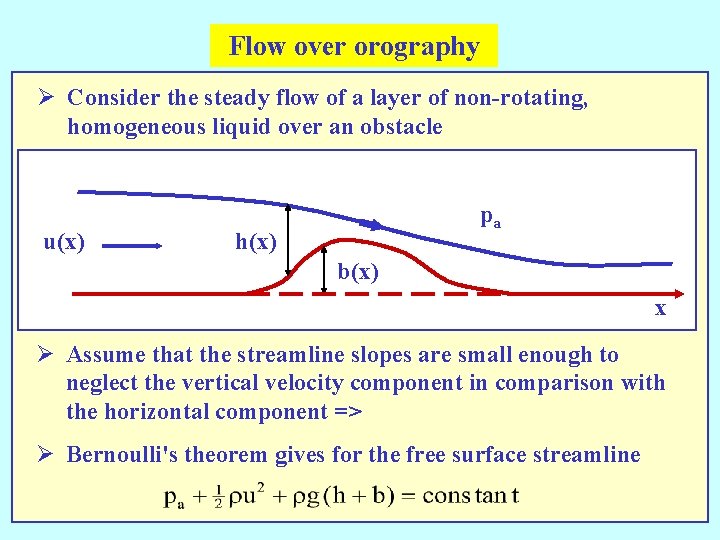
Flow over orography Ø Consider the steady flow of a layer of non-rotating, homogeneous liquid over an obstacle u(x) pa h(x) b(x) x Ø Assume that the streamline slopes are small enough to neglect the vertical velocity component in comparison with the horizontal component => Ø Bernoulli's theorem gives for the free surface streamline

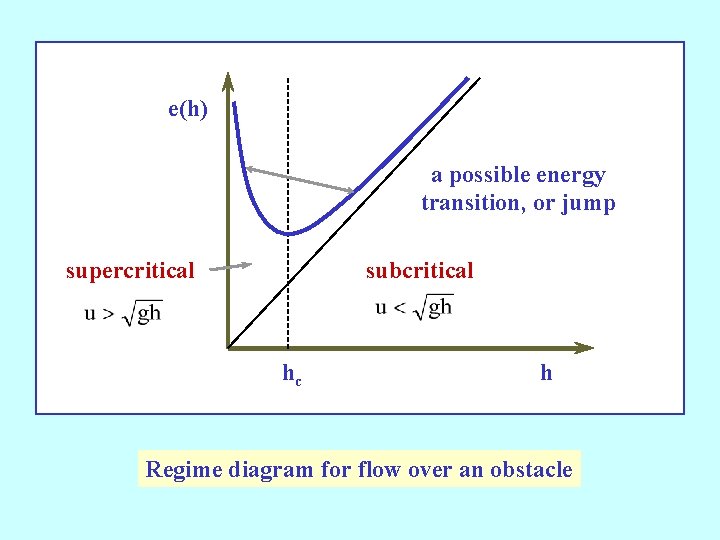
Defines the specific energy Continuity => uh = Q = constant the volume flux per unit span Can express e as a function of h A graph of this function is shown in the next picture

Differentiating when For a given energy e(h) > e(hc), there are two possible values for h, one > hc and one < hc. Ø Given the flow speed U and fluid depth H far upstream where b(x) = 0, Q = UH and
e(h) a possible energy transition, or jump supercritical subcritical hc h Regime diagram for flow over an obstacle
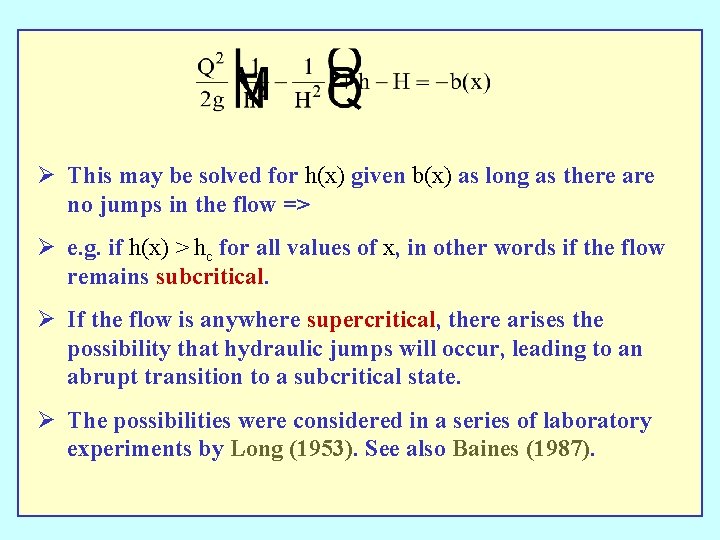
Ø This may be solved for h(x) given b(x) as long as there are no jumps in the flow => Ø e. g. if h(x) > hc for all values of x, in other words if the flow remains subcritical. Ø If the flow is anywhere supercritical, there arises the possibility that hydraulic jumps will occur, leading to an abrupt transition to a subcritical state. Ø The possibilities were considered in a series of laboratory experiments by Long (1953). See also Baines (1987).

The End
- Slides: 56