
Chapter 12 Forces Section 1 Newtons 1 and
- Slides: 12
Chapter 12: Forces Section 1: Newton’s 1° and 2° Laws
Bell Ringer 1. What do you know about Sir Isaac Newton? 2. What are three things that cause acceleration? 3. What is inertia?
Standards • Standard 3: Motion – #2: Investigate and apply Newton’s three Laws of Motion • Embedded Math – #1: Understand the mathematical principles behind the science of physics – #2: Utilize appropriate mathematical equations and processes to solve basic physics problems
Objectives 1. Explain Newton’s first law of motion and relate it to real life events 2. Define the term inertia 3. Explain how seat belts, car seats, and airbags work against inertia 4. State Newton’s second law of motion 5. Calculate force, mass and acceleration using Newton’s second law 6. Explain how acceleration is related to net force and mass
Objective 1: Explain Newton’s first law of motion and relate it to real life events Newton’s First Law of Motion!! • States – An object at rest remains at rest and an object in motion maintains its velocity unless it experiences a net force • In other words… – Objects only change their state of motion when a net force is applied • Example: – A bowling ball in motion will remain in motion until it hits the bowling pins – Can you name a force that ill stop a ball from rolling? • FRICTION!! – A book will remain at rest on a desk unless acted upon by a force
Objective 2: Define the term inertia The Concept of Inertia • Why is it difficult to get a bowling ball to start moving? – Because it is heavy • Inertia is the tendency of an object – At rest to remain at rest – If moving to maintain a constant velocity • All objects, even us, experience inertia! – What ways do you experience inertia? • Newton’s first law is sometimes called the LAW OF INERTIA!
Objective 3: Explain how seat belts, car seats, and airbags work agains inertia Seat Belts, Car Seats, and Air Bags…OH MY! • What do all of these have in common? – They save lives (provide protection) – They keep us in the seat while the car is driving • Seatbelts and static friction – Provide the unbalanced backward force necessary to help a person stop with the car • Helps reduce a person’s inertia while riding! • Air Bags – Cushion a passenger’s head during a collision – Helps to decrease the acceleration as well as the force!
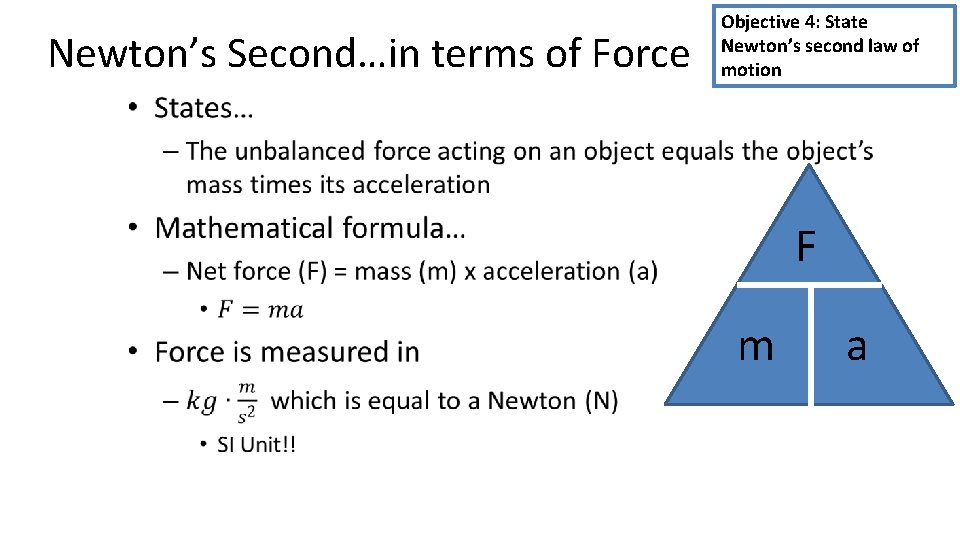
Newton’s Second…in terms of Force Objective 4: State Newton’s second law of motion • F m a
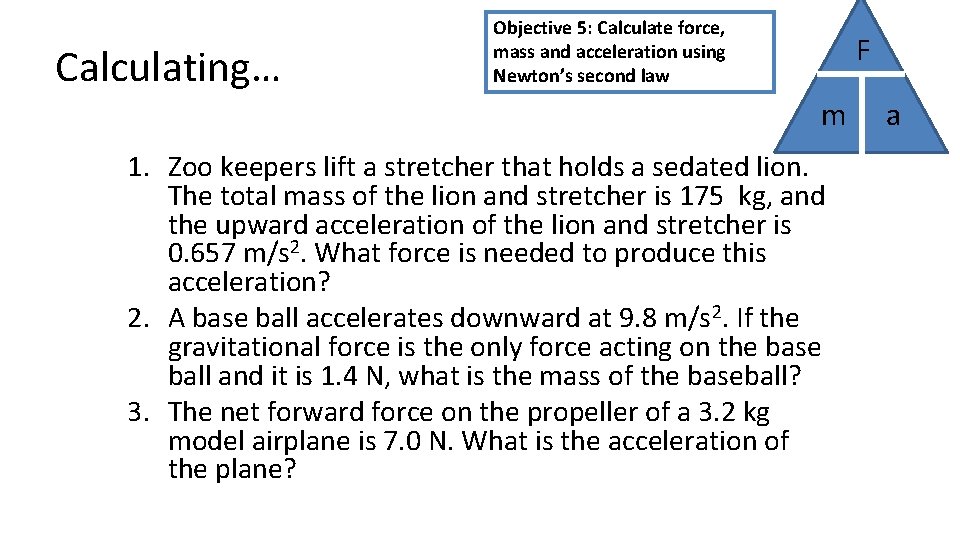
Calculating… Objective 5: Calculate force, mass and acceleration using Newton’s second law F m 1. Zoo keepers lift a stretcher that holds a sedated lion. The total mass of the lion and stretcher is 175 kg, and the upward acceleration of the lion and stretcher is 0. 657 m/s 2. What force is needed to produce this acceleration? 2. A base ball accelerates downward at 9. 8 m/s 2. If the gravitational force is the only force acting on the base ball and it is 1. 4 N, what is the mass of the baseball? 3. The net forward force on the propeller of a 3. 2 kg model airplane is 7. 0 N. What is the acceleration of the plane? a
Answers to Calculations 1. Given Unkwon
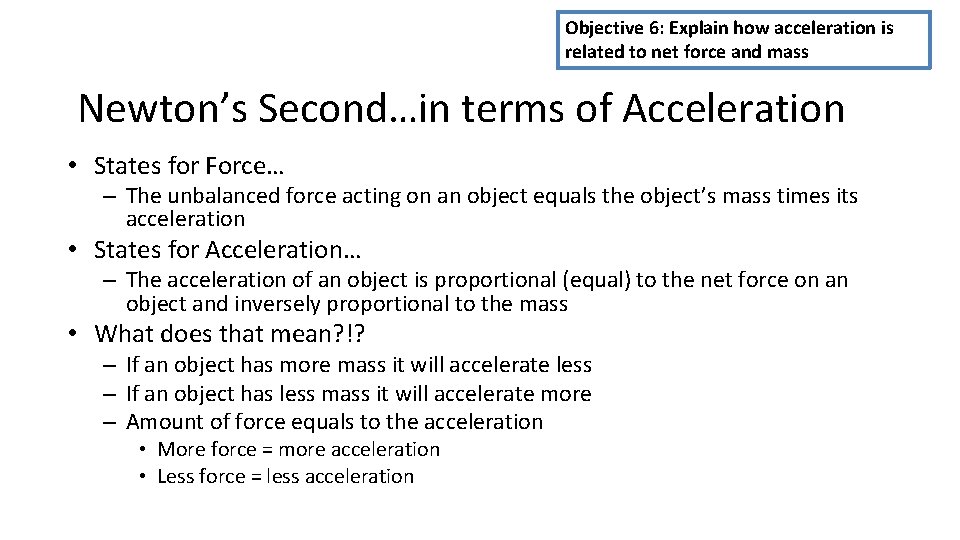
Objective 6: Explain how acceleration is related to net force and mass Newton’s Second…in terms of Acceleration • States for Force… – The unbalanced force acting on an object equals the object’s mass times its acceleration • States for Acceleration… – The acceleration of an object is proportional (equal) to the net force on an object and inversely proportional to the mass • What does that mean? !? – If an object has more mass it will accelerate less – If an object has less mass it will accelerate more – Amount of force equals to the acceleration • More force = more acceleration • Less force = less acceleration
Review 1. Explain Newton’s first law of motion and relate it to real life events 2. Define the term inertia 3. Explain how seat belts, car seats, and airbags work against inertia 4. State Newton’s second law of motion 5. Calculate force, mass and acceleration using Newton’s second law 6. Explain how acceleration is related to net force and mass