
Chapter 12 Forces and Motion 12 1 Forces









- Slides: 66
Chapter 12 – Forces and Motion
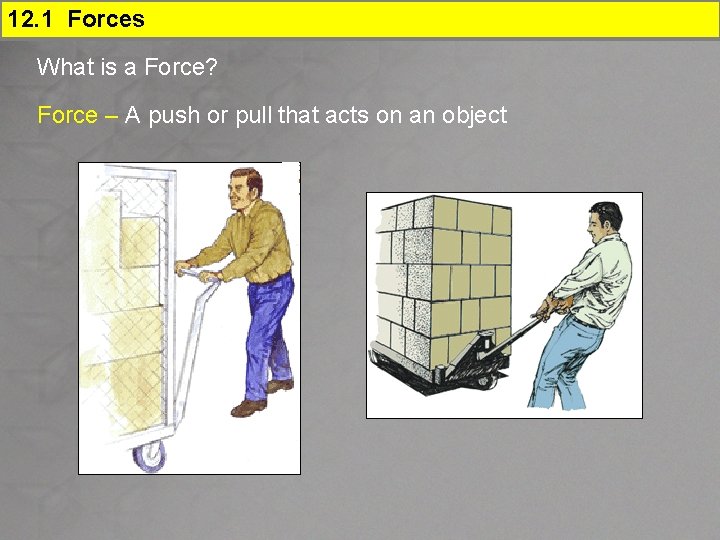
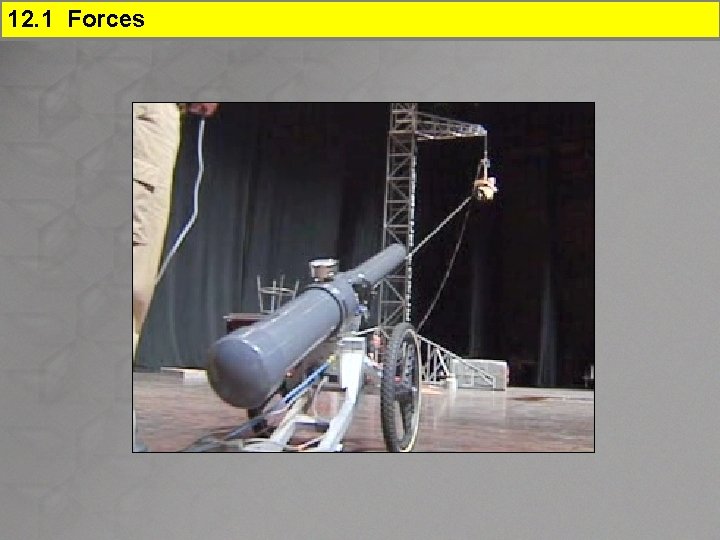
12. 1 Forces What is a Force? Force – A push or pull that acts on an object
12. 1 Forces What effect does a force have on an object? 1. Can cause an object to speed up or slow down 2. Can cause an object to change direction In other words a force causes an object to accelerate
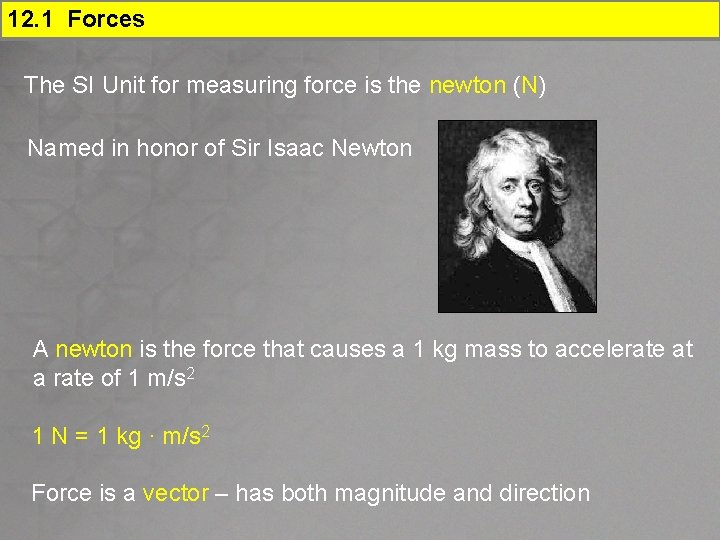
12. 1 Forces The SI Unit for measuring force is the newton (N) Named in honor of Sir Isaac Newton A newton is the force that causes a 1 kg mass to accelerate at a rate of 1 m/s 2 1 N = 1 kg · m/s 2 Force is a vector – has both magnitude and direction
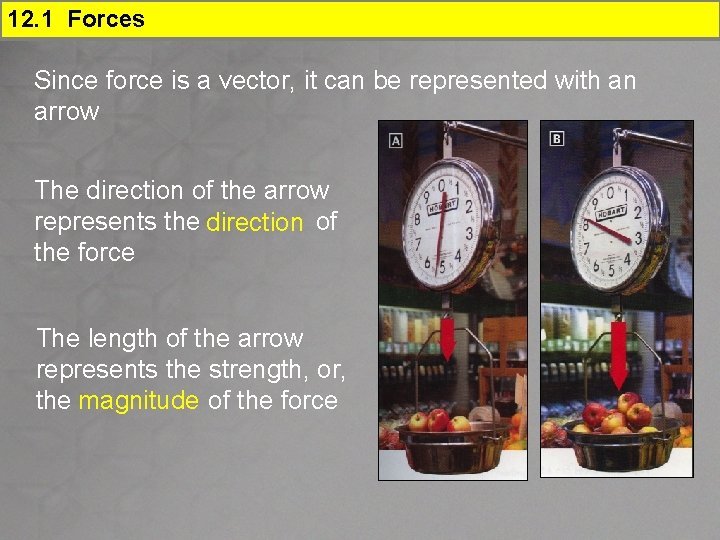
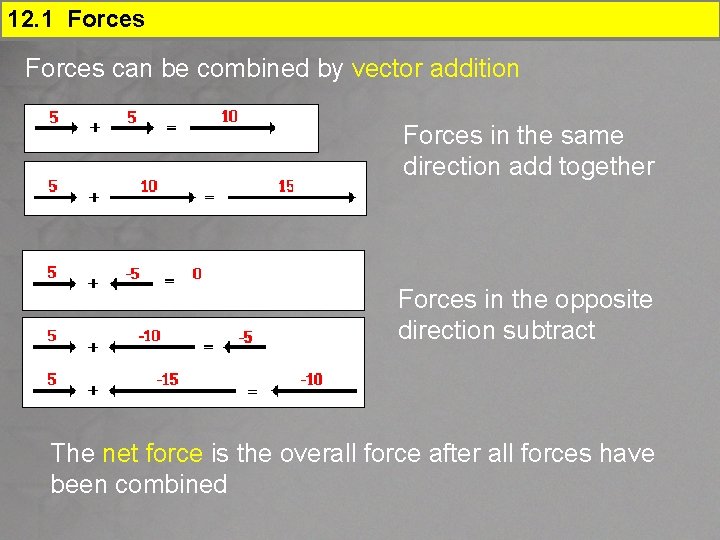
12. 1 Forces Since force is a vector, it can be represented with an arrow The direction of the arrow represents the direction of the force The length of the arrow represents the strength, or, the magnitude of the force
12. 1 Forces can be combined by vector addition Forces in the same direction add together Forces in the opposite direction subtract The net force is the overall force after all forces have been combined
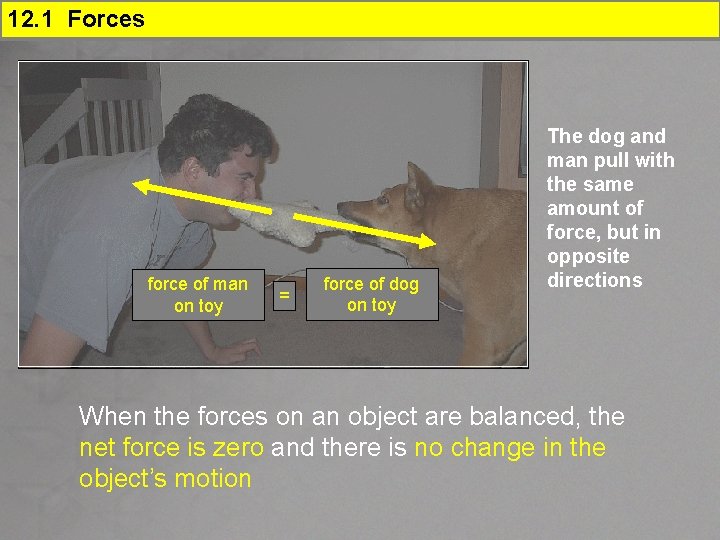
12. 1 Forces force of man on toy = force of dog on toy The dog and man pull with the same amount of force, but in opposite directions When the forces on an object are balanced, the net force is zero and there is no change in the object’s motion
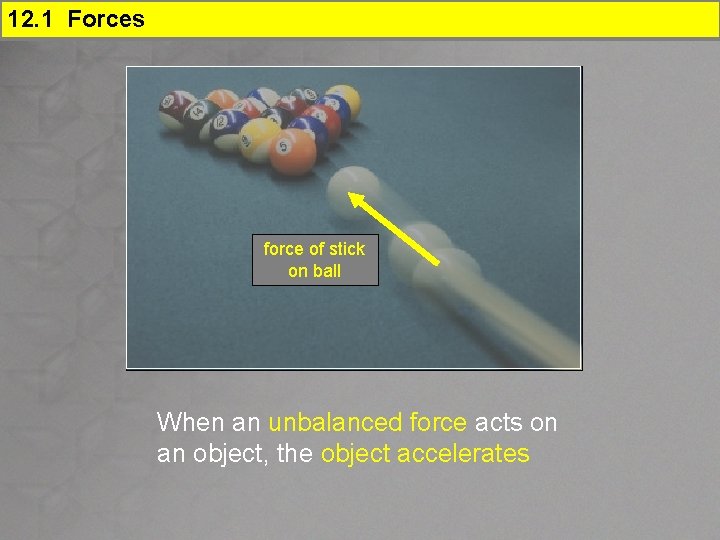
12. 1 Forces force of stick on ball When an unbalanced force acts on an object, the object accelerates
12. 1 Forces What is friction? friction – a force that opposes the motion of objects that touch as they move past each other friction acts at the surface where objects are in contact 4 main types of friction 1. Static friction 3. Rolling friction 2. Sliding friction 4. Fluid friction
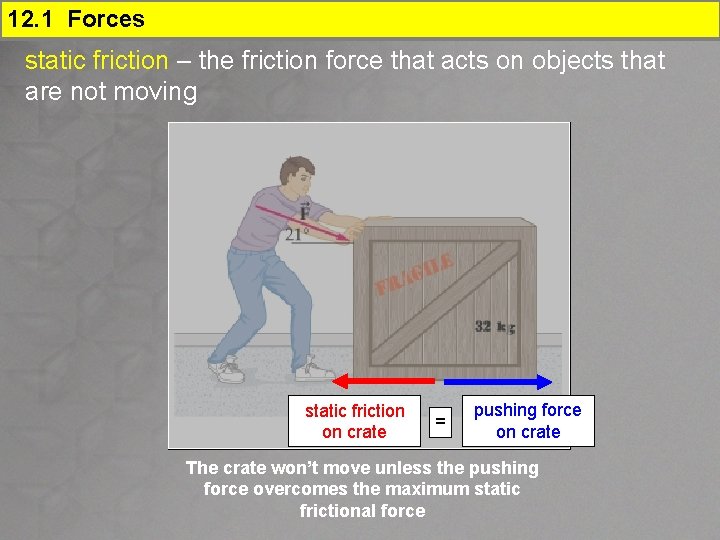
12. 1 Forces static friction – the friction force that acts on objects that are not moving static friction on crate = pushing force on crate The crate won’t move unless the pushing force overcomes the maximum static frictional force
12. 1 Forces sliding (kinetic) friction – a force that opposes the direction of motion of an object as it slides over a surface sliding friction on player friction always acts in a direction opposite the motion of an object
12. 1 Forces
12. 1 Forces sliding friction is always less than static friction
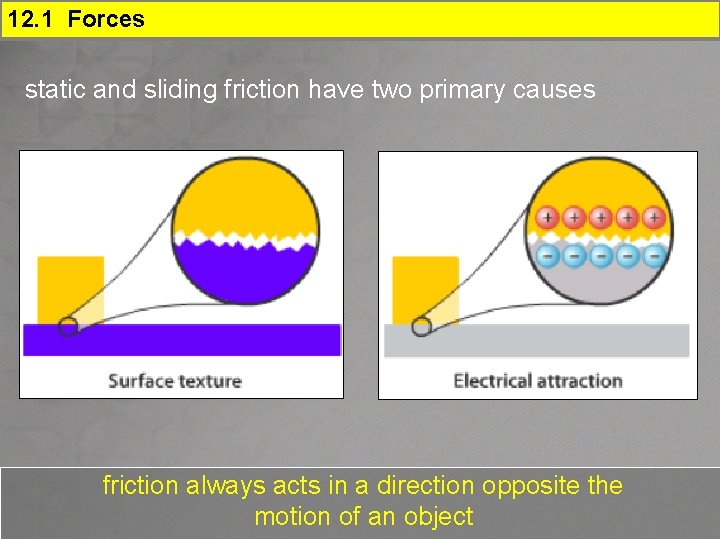
12. 1 Forces static and sliding friction have two primary causes friction always acts in a direction opposite the motion of an object
12. 1 Forces rolling friction – caused by the change in shape at the point of rolling contact friction always acts in a direction opposite the motion of an object
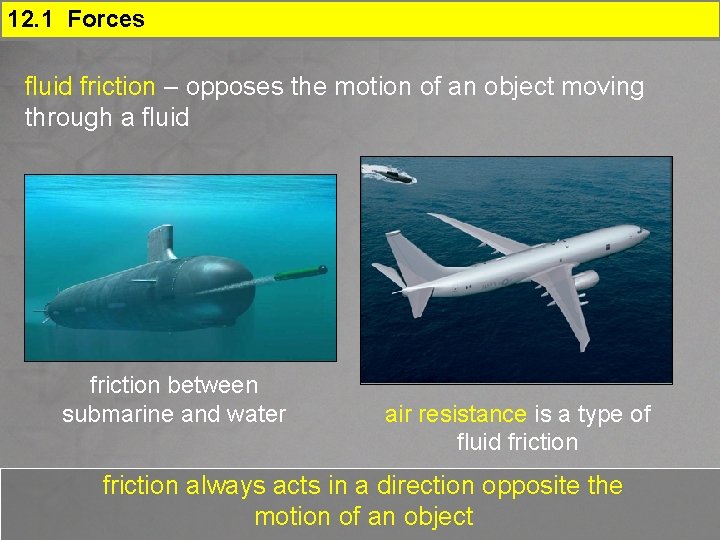
12. 1 Forces fluid friction – opposes the motion of an object moving through a fluid friction between submarine and water air resistance is a type of fluid friction always acts in a direction opposite the motion of an object
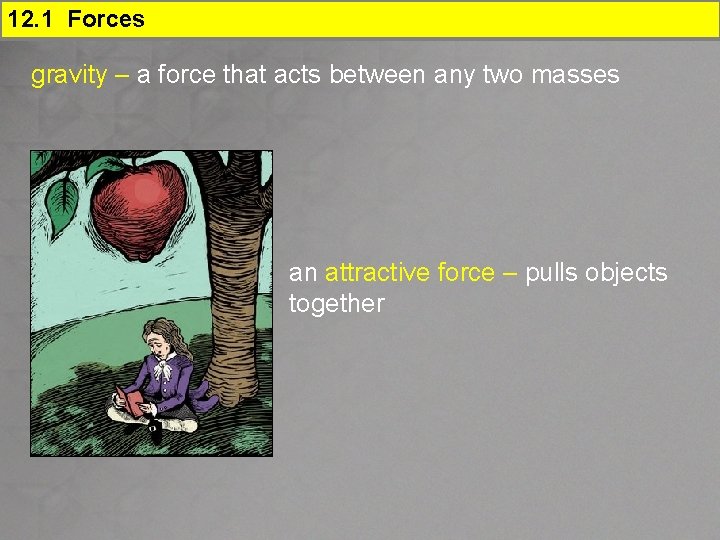
12. 1 Forces gravity – a force that acts between any two masses an attractive force – pulls objects together
12. 1 Forces
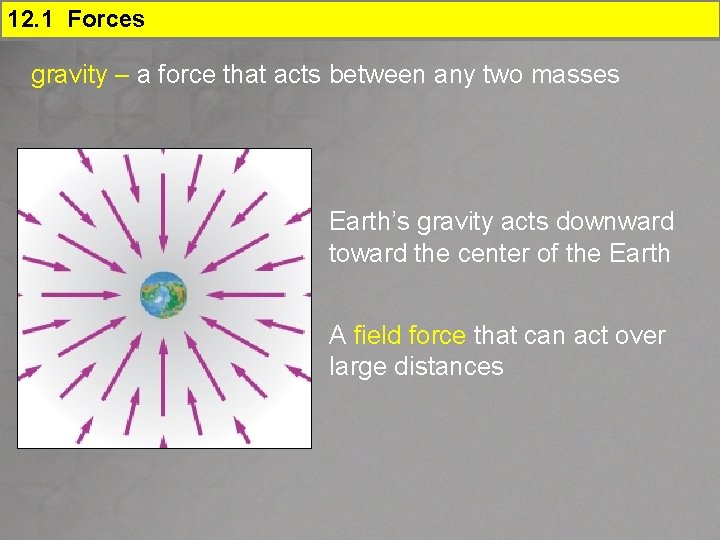
12. 1 Forces gravity – a force that acts between any two masses Earth’s gravity acts downward toward the center of the Earth A field force that can act over large distances
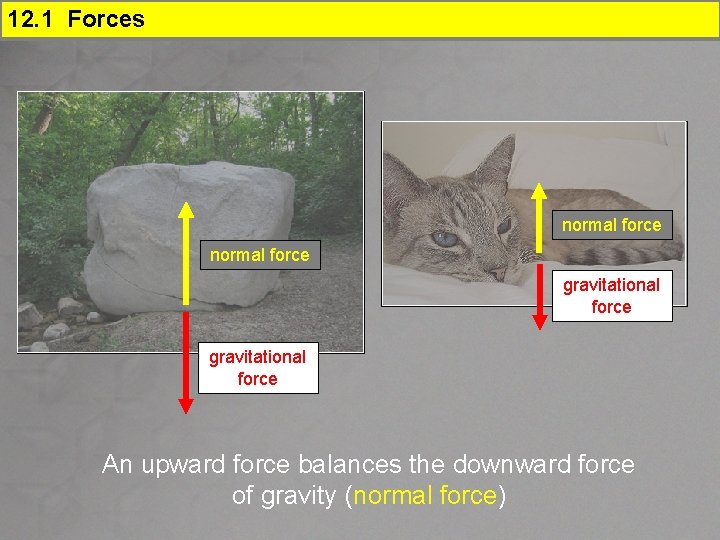
12. 1 Forces normal force gravitational force An upward force balances the downward force of gravity (normal force)
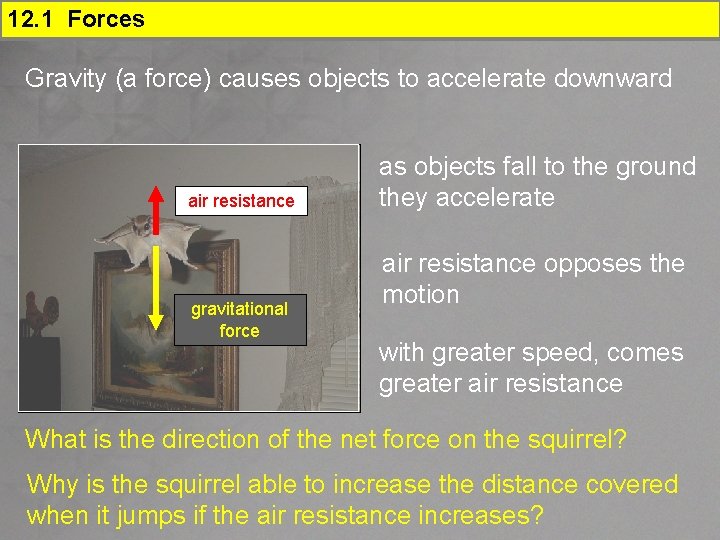
12. 1 Forces Gravity (a force) causes objects to accelerate downward air resistance gravitational force as objects fall to the ground they accelerate air resistance opposes the motion with greater speed, comes greater air resistance What is the direction of the net force on the squirrel? Why is the squirrel able to increase the distance covered when it jumps if the air resistance increases?
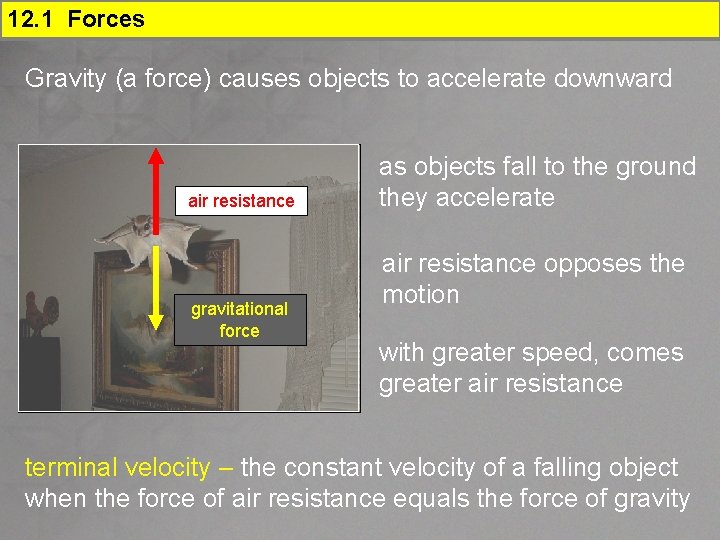
12. 1 Forces Gravity (a force) causes objects to accelerate downward air resistance gravitational force as objects fall to the ground they accelerate air resistance opposes the motion with greater speed, comes greater air resistance terminal velocity – the constant velocity of a falling object when the force of air resistance equals the force of gravity
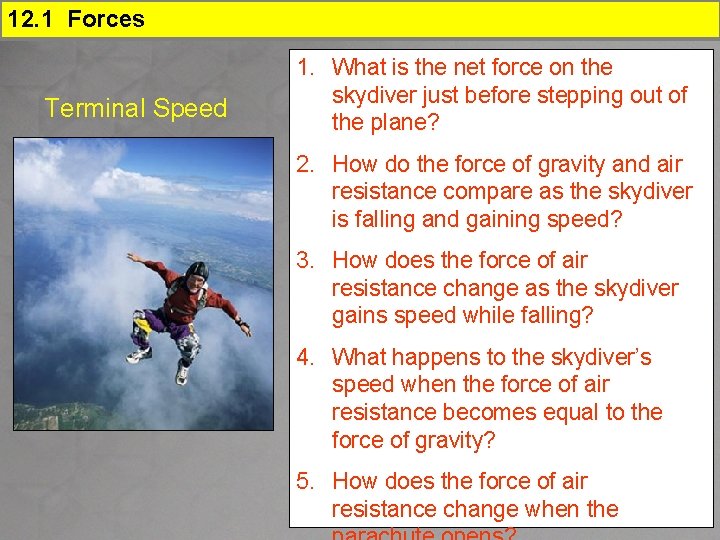
12. 1 Forces Terminal Speed 1. What is the net force on the skydiver just before stepping out of the plane? 2. How do the force of gravity and air resistance compare as the skydiver is falling and gaining speed? 3. How does the force of air resistance change as the skydiver gains speed while falling? 4. What happens to the skydiver’s speed when the force of air resistance becomes equal to the force of gravity? 5. How does the force of air resistance change when the
12. 1 Forces
12. 1 Forces
12. 1 Forces Projectile Motion projectile motion – the motion of a falling object (projectile) after it is given an initial forward velocity a projectile follows a curved path despite an initial forward velocity, both projectiles hit the ground at the same time
12. 1 Forces
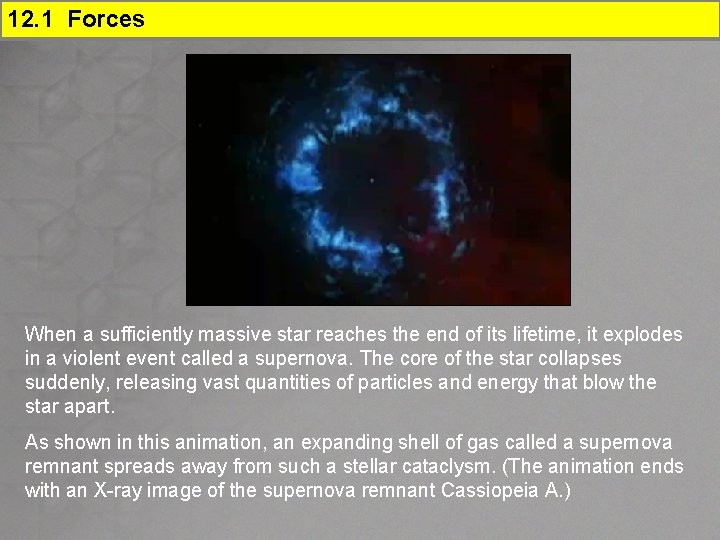
12. 1 Forces When a sufficiently massive star reaches the end of its lifetime, it explodes in a violent event called a supernova. The core of the star collapses suddenly, releasing vast quantities of particles and energy that blow the star apart. As shown in this animation, an expanding shell of gas called a supernova remnant spreads away from such a stellar cataclysm. (The animation ends with an X-ray image of the supernova remnant Cassiopeia A. )
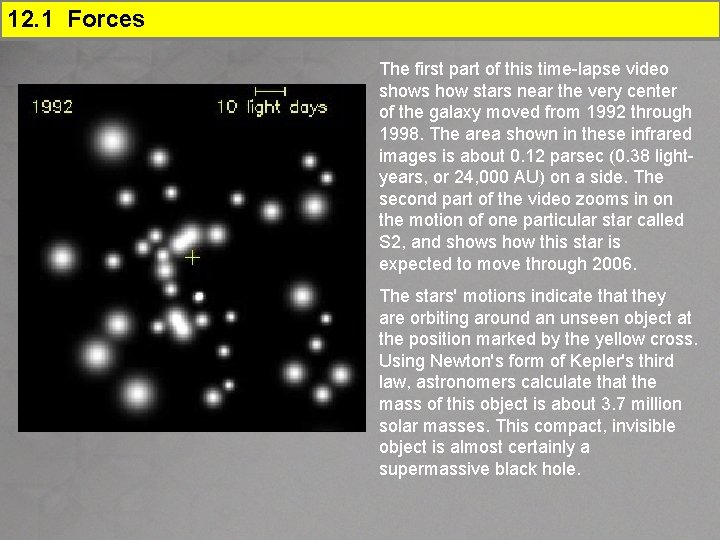
12. 1 Forces The first part of this time-lapse video shows how stars near the very center of the galaxy moved from 1992 through 1998. The area shown in these infrared images is about 0. 12 parsec (0. 38 lightyears, or 24, 000 AU) on a side. The second part of the video zooms in on the motion of one particular star called S 2, and shows how this star is expected to move through 2006. The stars' motions indicate that they are orbiting around an unseen object at the position marked by the yellow cross. Using Newton's form of Kepler's third law, astronomers calculate that the mass of this object is about 3. 7 million solar masses. This compact, invisible object is almost certainly a supermassive black hole.
12. 1 Forces
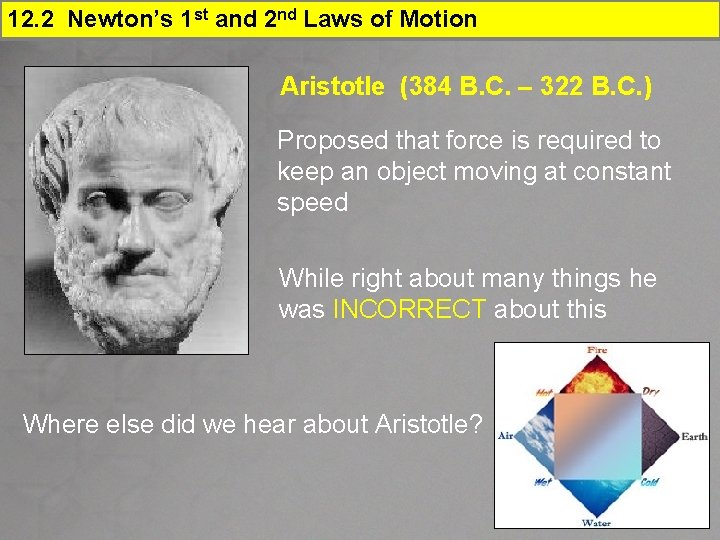
12. 2 Newton’s 1 st and 2 nd Laws of Motion Aristotle (384 B. C. – 322 B. C. ) Proposed that force is required to keep an object moving at constant speed While right about many things he was INCORRECT about this Where else did we hear about Aristotle?
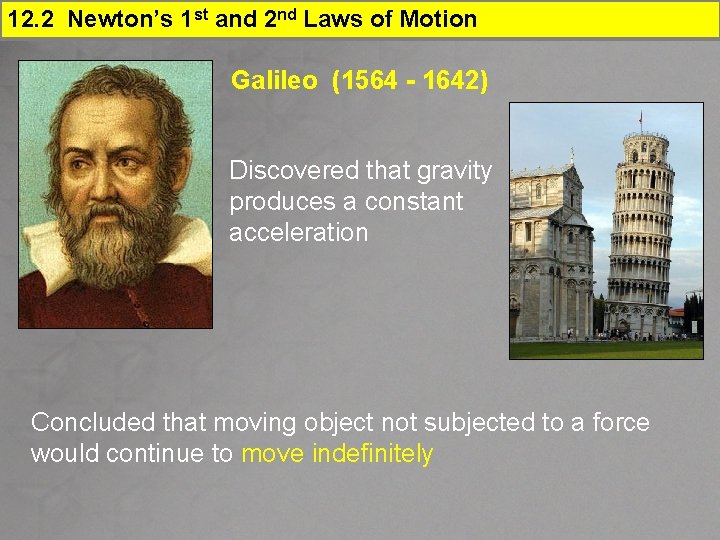
12. 2 Newton’s 1 st and 2 nd Laws of Motion Galileo (1564 - 1642) Discovered that gravity produces a constant acceleration Concluded that moving object not subjected to a force would continue to move indefinitely
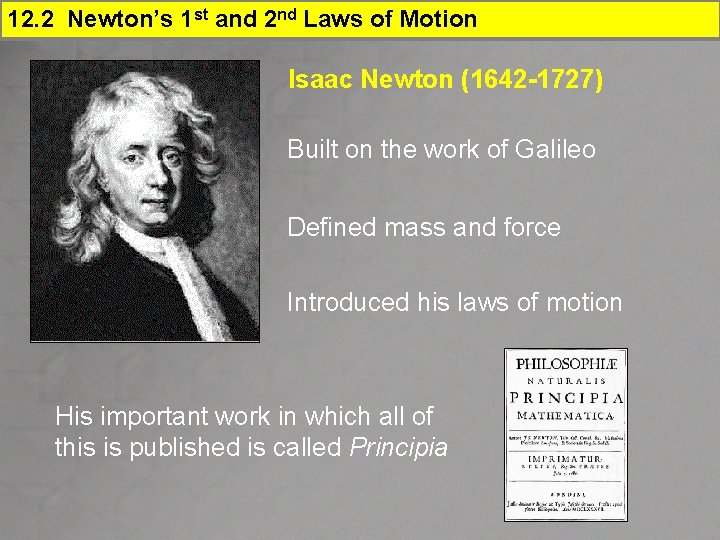
12. 2 Newton’s 1 st and 2 nd Laws of Motion Isaac Newton (1642 -1727) Built on the work of Galileo Defined mass and force Introduced his laws of motion His important work in which all of this is published is called Principia
12. 2 Newton’s 1 st and 2 nd Laws of Motion
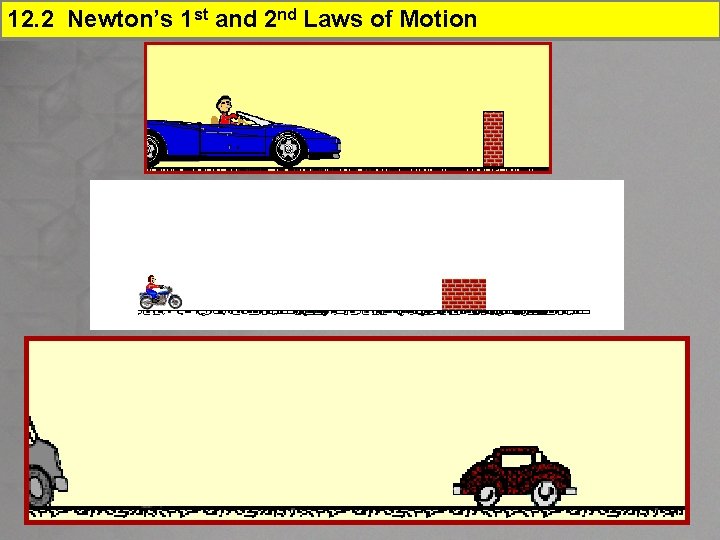
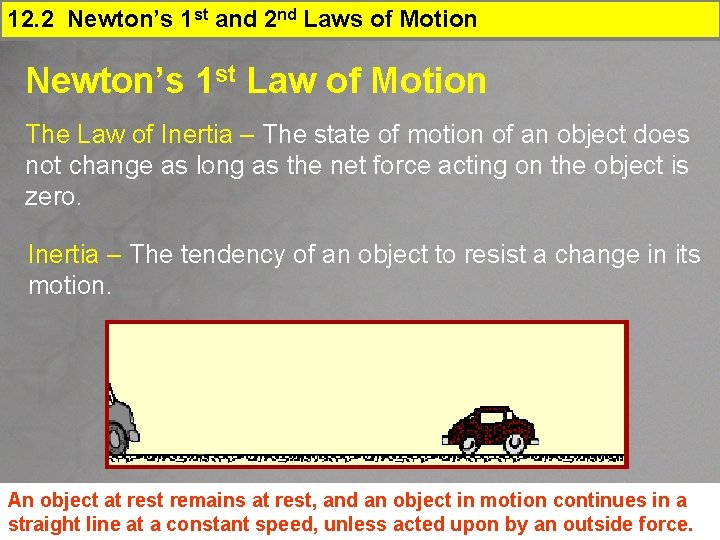
12. 2 Newton’s 1 st and 2 nd Laws of Motion Newton’s 1 st Law of Motion The Law of Inertia – The state of motion of an object does not change as long as the net force acting on the object is zero. Inertia – The tendency of an object to resist a change in its motion. An object at rest remains at rest, and an object in motion continues in a straight line at a constant speed, unless acted upon by an outside force.
12. 2 Newton’s 1 st and 2 nd Laws of Motion
12. 2 Newton’s 1 st and 2 nd Laws of Motion
12. 2 Newton’s 1 st and 2 nd Laws of Motion
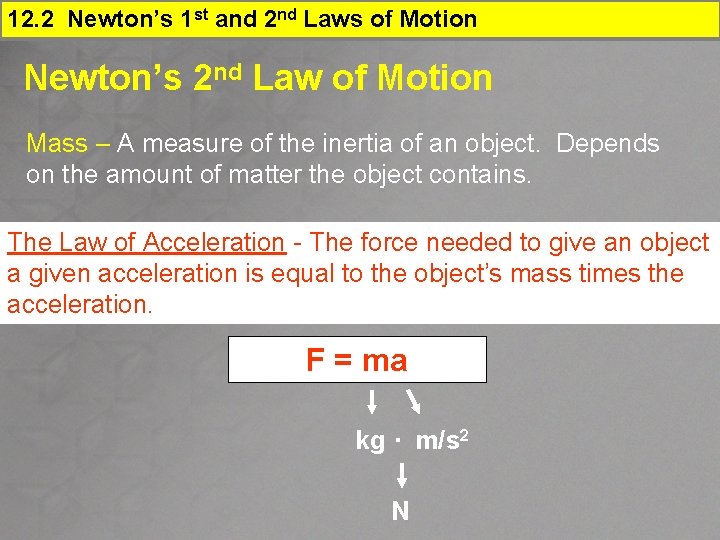
12. 2 Newton’s 1 st and 2 nd Laws of Motion Newton’s 2 nd Law of Motion Mass – A measure of the inertia of an object. Depends on the amount of matter the object contains. The Law of Acceleration - The force needed to give an object a given acceleration is equal to the object’s mass times the acceleration. F = ma kg · m/s 2 N
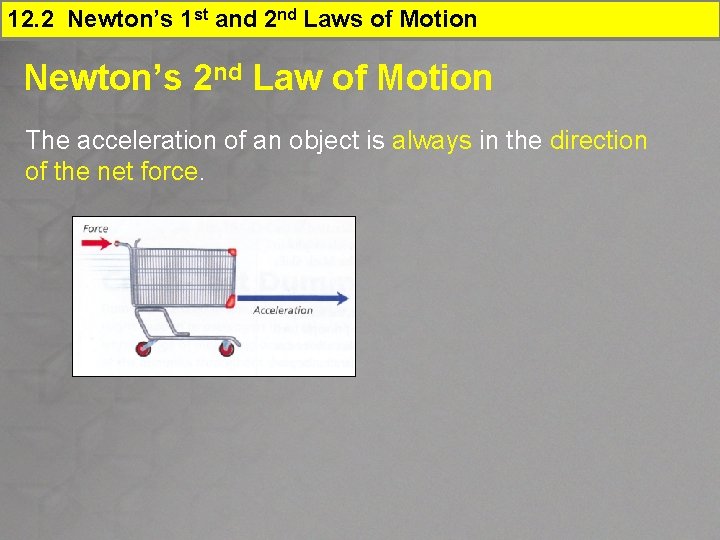
12. 2 Newton’s 1 st and 2 nd Laws of Motion Newton’s 2 nd Law of Motion The acceleration of an object is always in the direction of the net force.
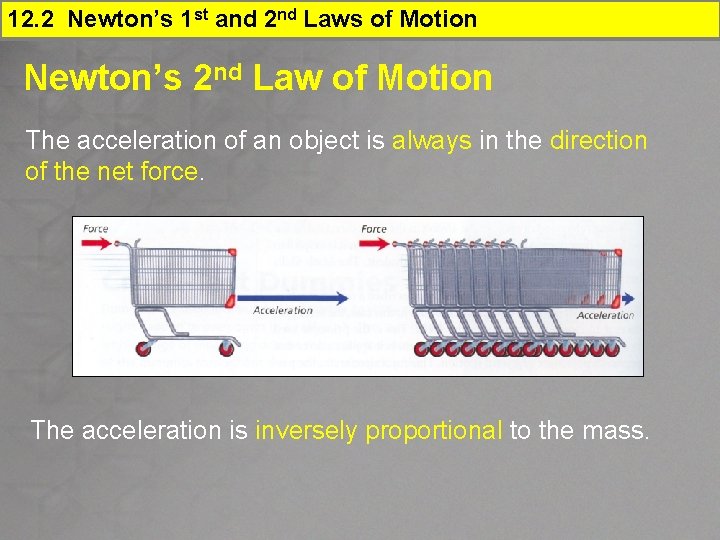
12. 2 Newton’s 1 st and 2 nd Laws of Motion Newton’s 2 nd Law of Motion The acceleration of an object is always in the direction of the net force. The acceleration is inversely proportional to the mass.
12. 2 Newton’s 1 st and 2 nd Laws of Motion Using Newton’s Second Law F = ma Example 1 A 20. 0 N net force acts on an object with a mass of 2. 0 kg. What is the object’s acceleration? Example 2 A box has a mass of 150 kg. If a net force of 3000 N acts on the box, what is the box’s acceleration? Example 3 What is the acceleration of a 1000 kg car subject to a 500 N net force? Page 367 Math Skills and Math Practice
12. 2 Newton’s 1 st and 2 nd Laws of Motion 1. You are stuck going to the grocery store. . . your job is to push the cart. If the cart has a mass of 15 kg and you can push with a force of 20 N, what acceleration can you give to the cart? 2. Just before leaving the grocery store, the cart is now loaded with 30 kg of stuff. Now, what acceleration can you give to the cart (with the same amount of force)? 3. Why did your answer for #2 change like it did? Explain.
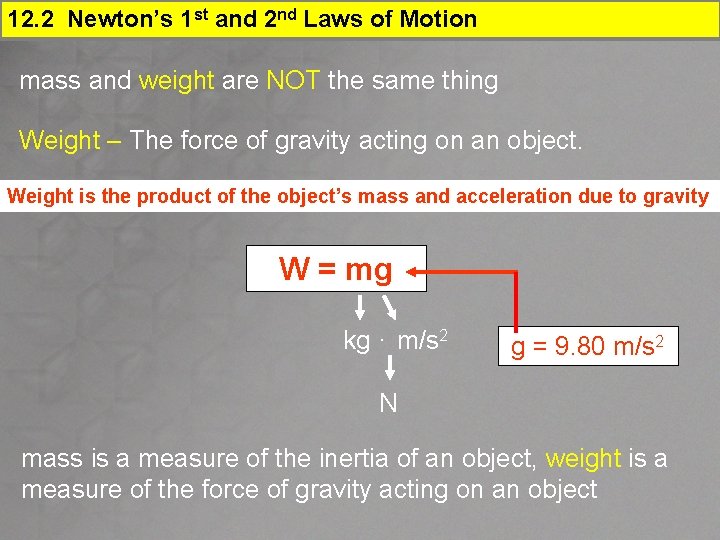
12. 2 Newton’s 1 st and 2 nd Laws of Motion mass and weight are NOT the same thing Weight – The force of gravity acting on an object. Weight is the product of the object’s mass and acceleration due to gravity W = mg kg · m/s 2 g = 9. 80 m/s 2 N mass is a measure of the inertia of an object, weight is a measure of the force of gravity acting on an object
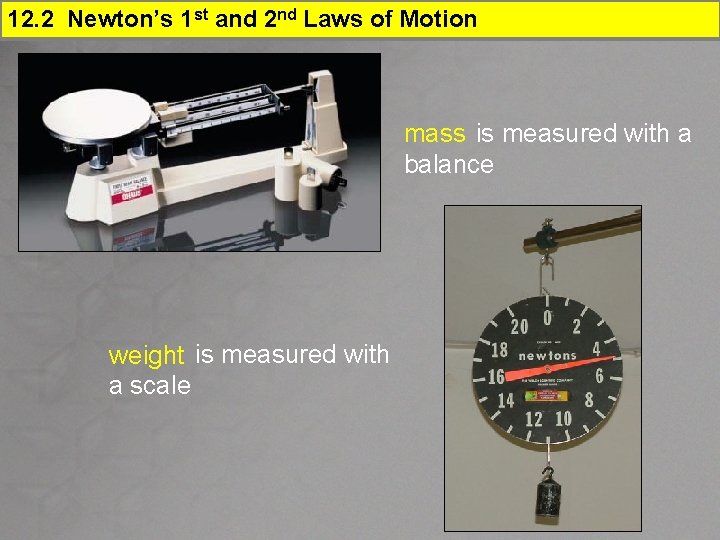
12. 2 Newton’s 1 st and 2 nd Laws of Motion mass is measured with a balance weight is measured with a scale
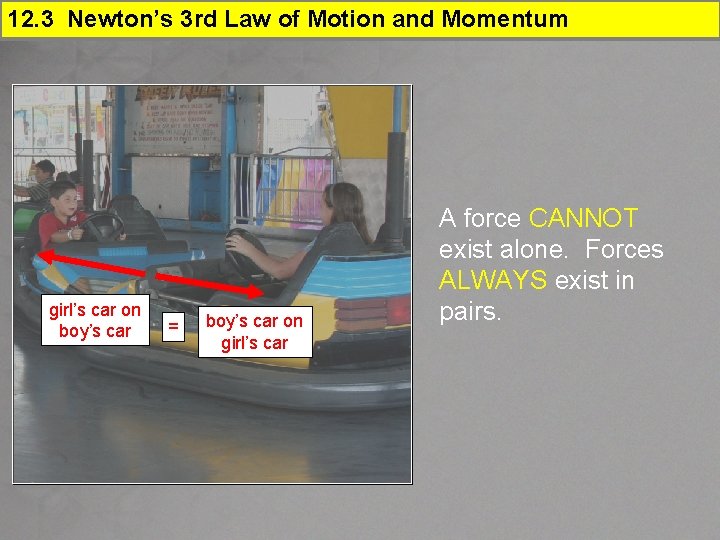
12. 3 Newton’s 3 rd Law of Motion and Momentum girl’s car on boy’s car = boy’s car on girl’s car A force CANNOT exist alone. Forces ALWAYS exist in pairs.
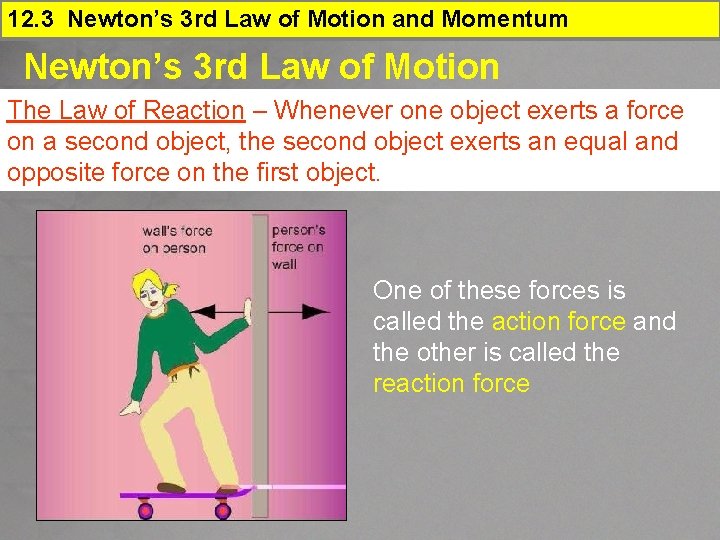
12. 3 Newton’s 3 rd Law of Motion and Momentum Newton’s 3 rd Law of Motion The Law of Reaction – Whenever one object exerts a force on a second object, the second object exerts an equal and opposite force on the first object. One of these forces is called the action force and the other is called the reaction force
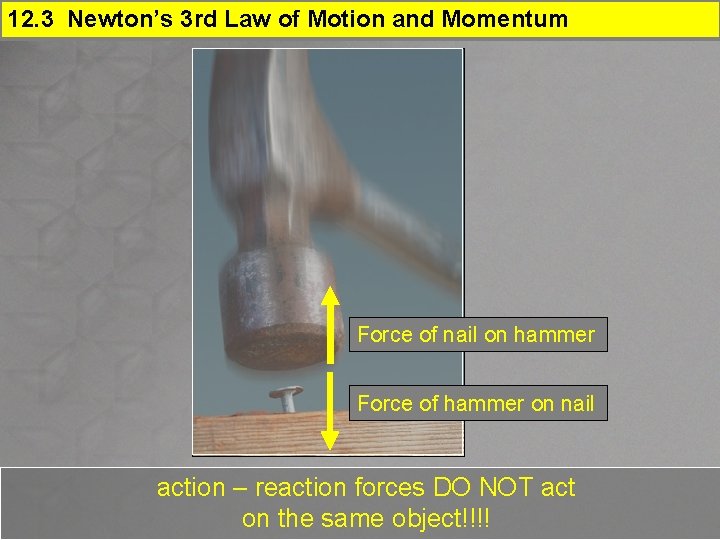
12. 3 Newton’s 3 rd Law of Motion and Momentum Force of nail on hammer Force of hammer on nail action – reaction forces DO NOT act on the same object!!!!
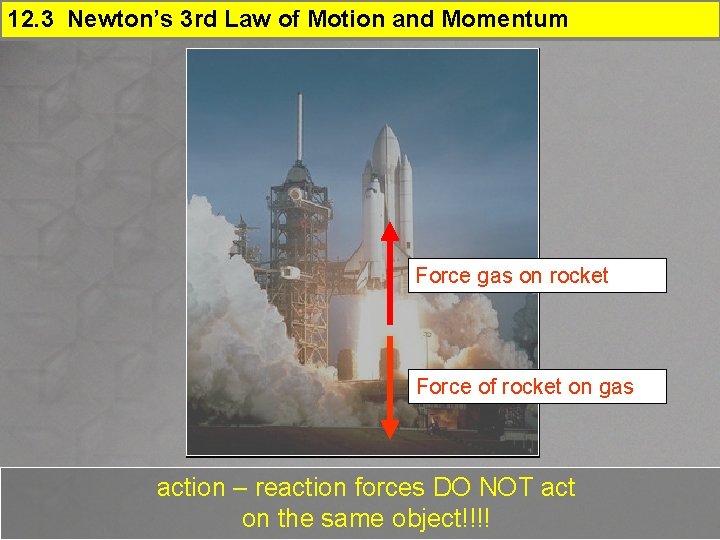
12. 3 Newton’s 3 rd Law of Motion and Momentum Force gas on rocket Force of rocket on gas action – reaction forces DO NOT act on the same object!!!!
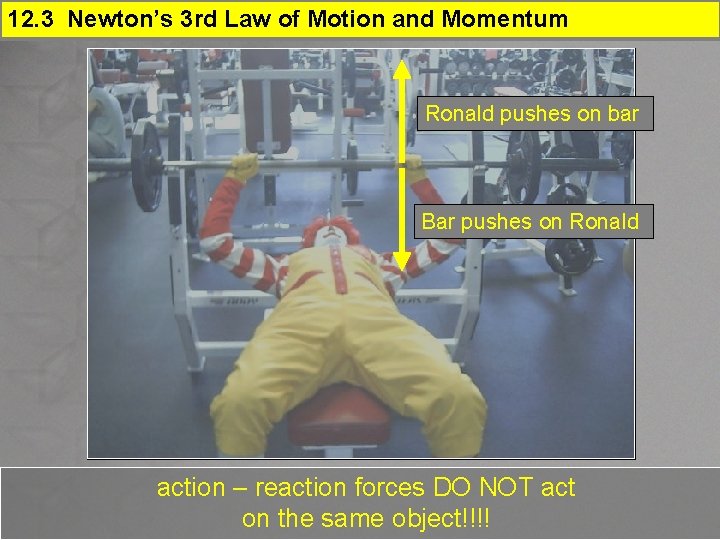
12. 3 Newton’s 3 rd Law of Motion and Momentum Ronald pushes on bar Bar pushes on Ronald action – reaction forces DO NOT act on the same object!!!!
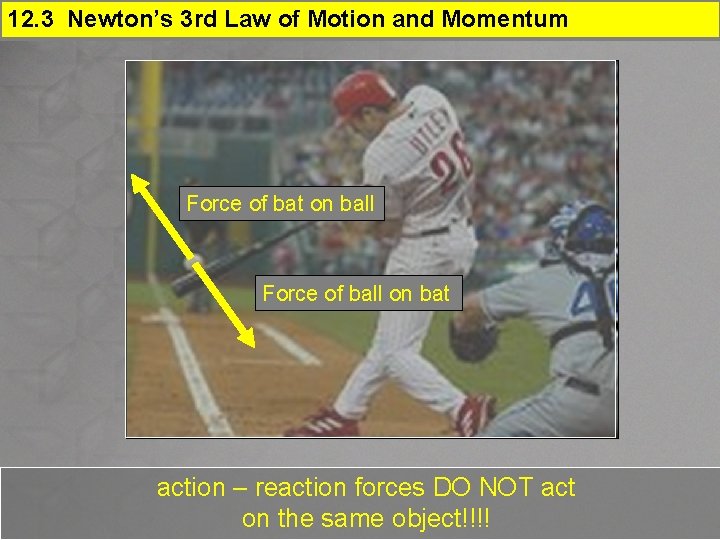
12. 3 Newton’s 3 rd Law of Motion and Momentum Force of bat on ball Force of ball on bat action – reaction forces DO NOT act on the same object!!!!
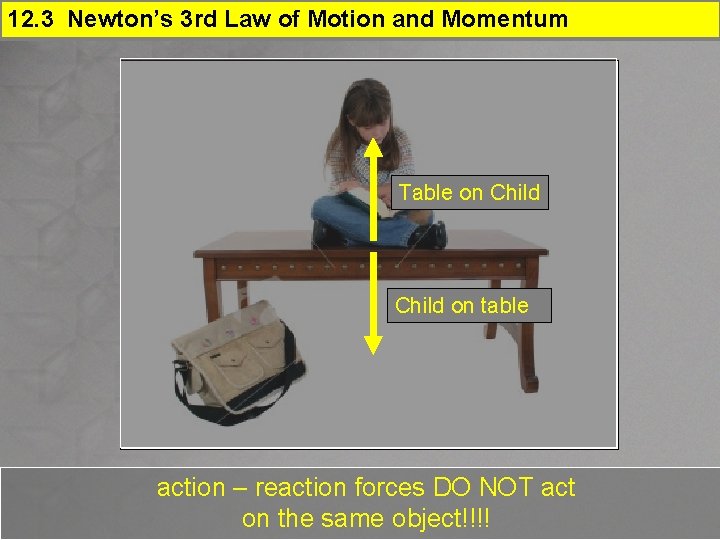
12. 3 Newton’s 3 rd Law of Motion and Momentum Table on Child on table action – reaction forces DO NOT act on the same object!!!!
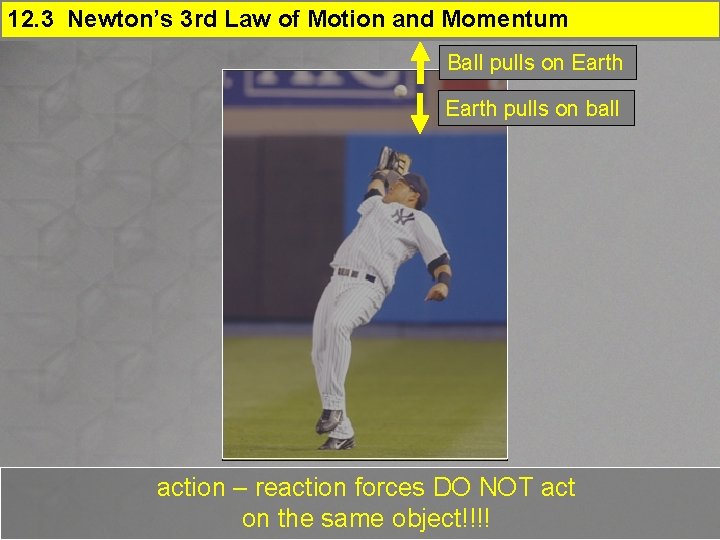
12. 3 Newton’s 3 rd Law of Motion and Momentum Ball pulls on Earth pulls on ball action – reaction forces DO NOT act on the same object!!!!
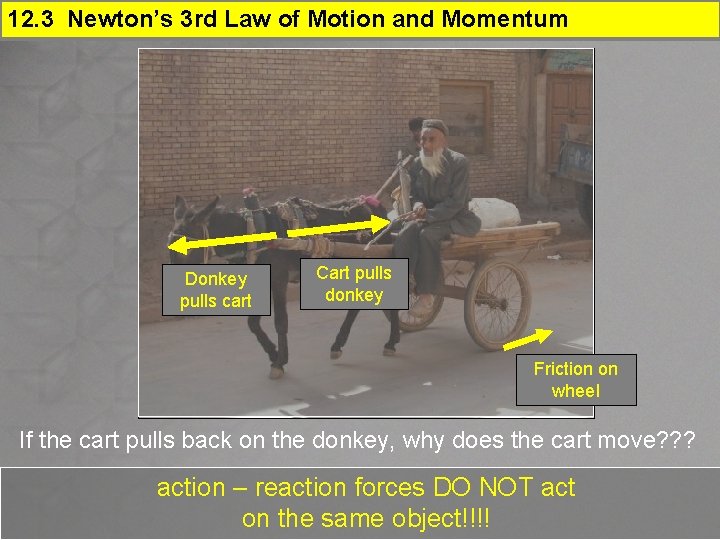
12. 3 Newton’s 3 rd Law of Motion and Momentum Donkey pulls cart Cart pulls donkey Friction on wheel If the cart pulls back on the donkey, why does the cart move? ? ? action – reaction forces DO NOT act on the same object!!!!
12. 3 Newton’s 3 rd Law of Motion and Momentum
12. 3 Newton’s 3 rd Law of Motion and Momentum
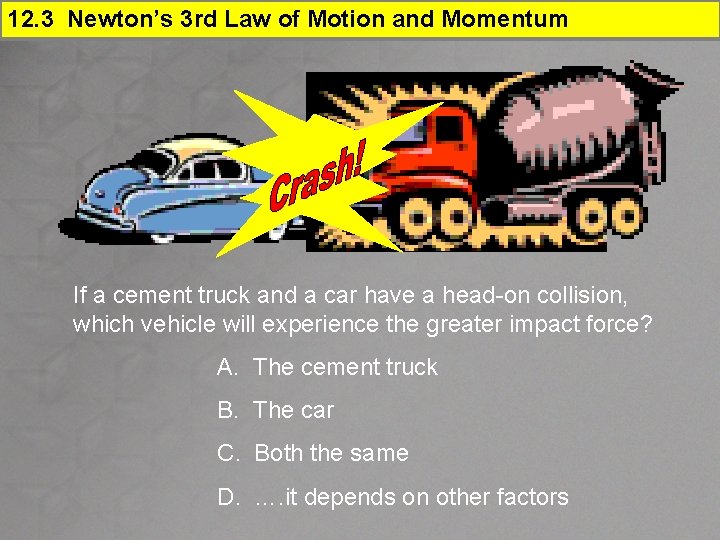
12. 3 Newton’s 3 rd Law of Motion and Momentum If a cement truck and a car have a head-on collision, which vehicle will experience the greater impact force? A. The cement truck B. The car C. Both the same D. …. it depends on other factors
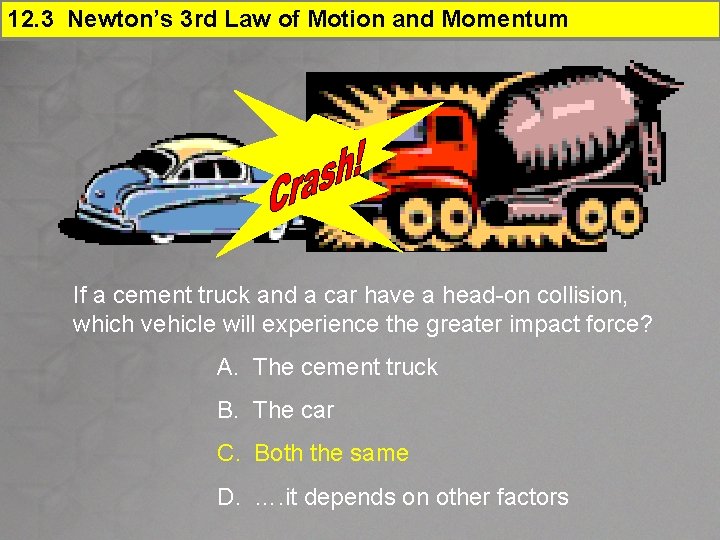
12. 3 Newton’s 3 rd Law of Motion and Momentum If a cement truck and a car have a head-on collision, which vehicle will experience the greater impact force? A. The cement truck B. The car C. Both the same D. …. it depends on other factors
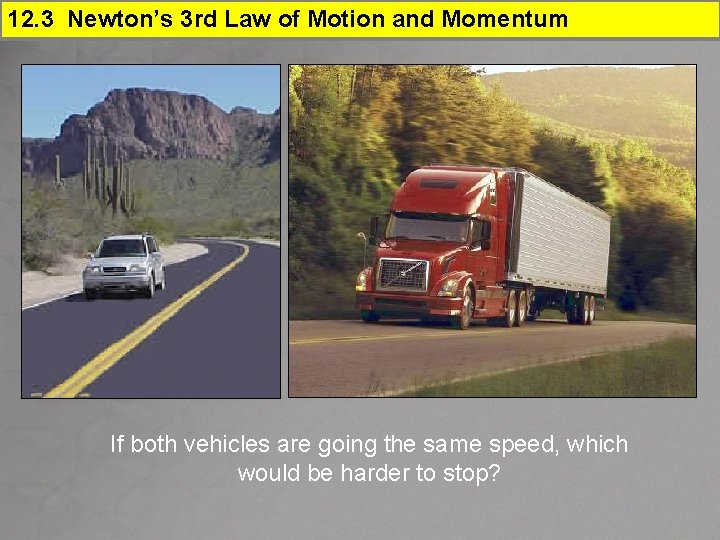
12. 3 Newton’s 3 rd Law of Motion and Momentum If both vehicles are going the same speed, which would be harder to stop?
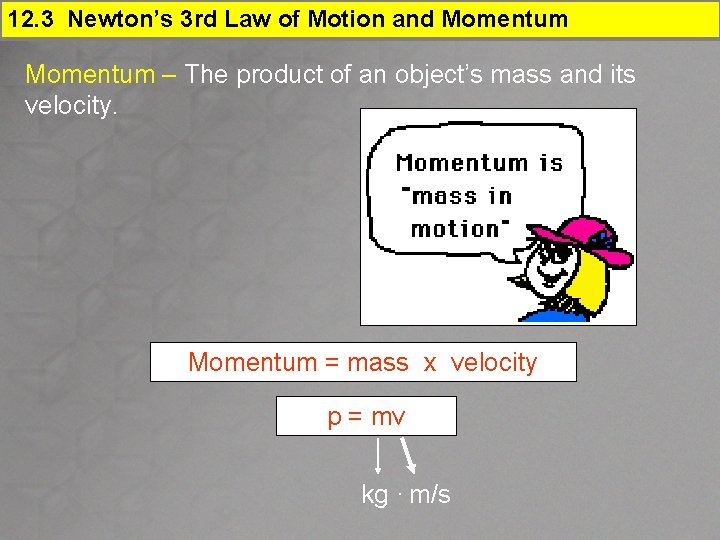
12. 3 Newton’s 3 rd Law of Motion and Momentum – The product of an object’s mass and its velocity. Momentum = mass x velocity p = mv kg · m/s
12. 3 Newton’s 3 rd Law of Motion and Momentum Which would be harder to stop…. a. 25 kg softball thrown at you at 40 m/s or a 7 kg bowling ball rolled at 1 m/s? It would be harder to stop the softball; it has more momentum.
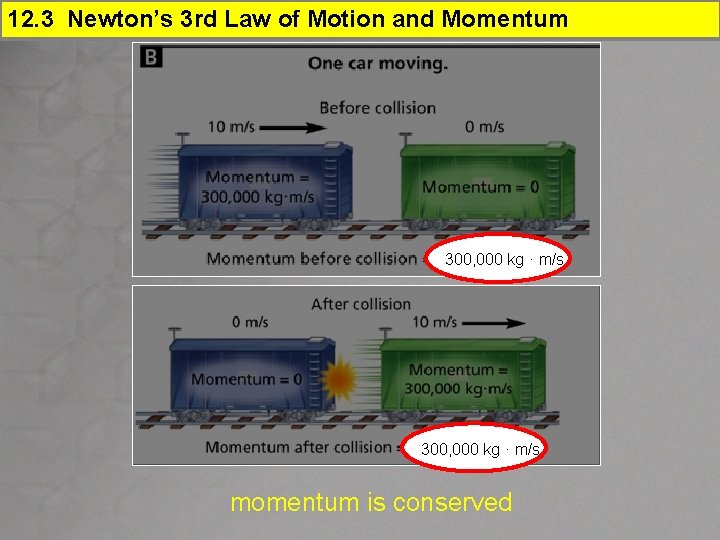
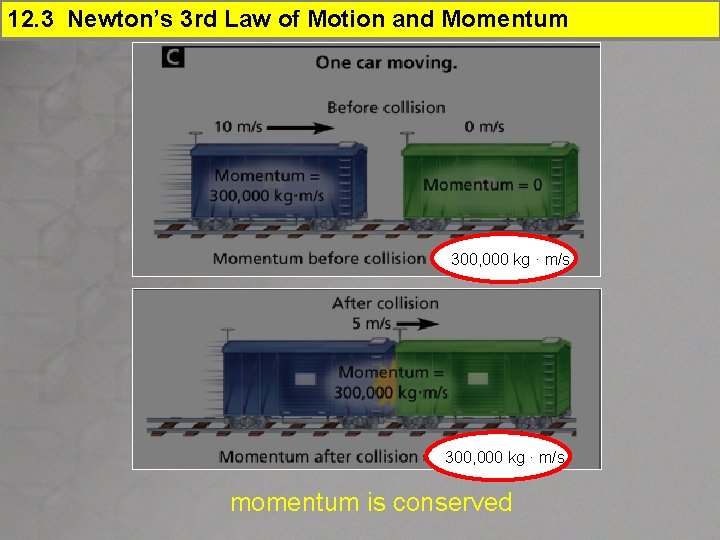
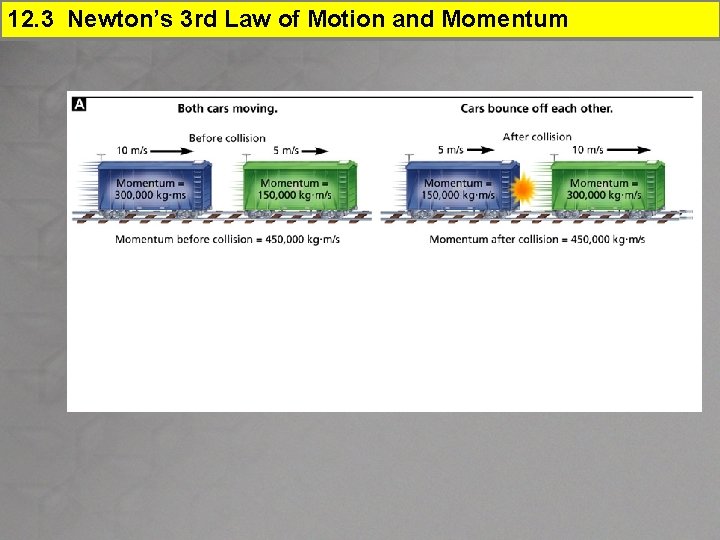
12. 3 Newton’s 3 rd Law of Motion and Momentum Law of Conservation of Momentum – If no net force acts on a system the total momentum of the system doesn’t change.
12. 3 Newton’s 3 rd Law of Motion and Momentum 300, 000 kg · m/s momentum is conserved
12. 3 Newton’s 3 rd Law of Motion and Momentum 300, 000 kg · m/s momentum is conserved
12. 3 Newton’s 3 rd Law of Motion and Momentum Data analysis on page 377
12. 3 Newton’s 3 rd Law of Motion and Momentum