
Chapter 12 Experimental Design One Way Correlated Samples

- Slides: 14
Chapter 12 Experimental Design: One. Way Correlated Samples Design Fundamentals of Behavioral Research
Experimental Design: One-Way Correlated Samples Design n n Advantages and limitations Comparing two groups Comparing t-test to ANOVA Comparing more than two groups Fundamentals of Behavioral Research
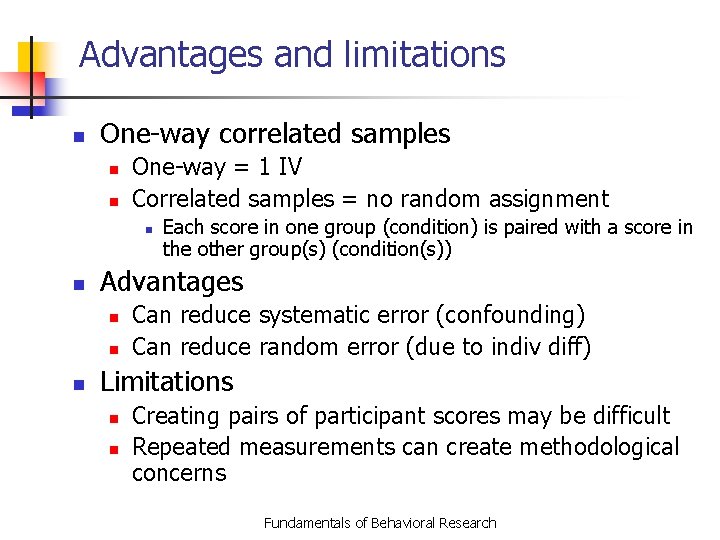
Advantages and limitations n One-way correlated samples n n One-way = 1 IV Correlated samples = no random assignment n n Advantages n n n Each score in one group (condition) is paired with a score in the other group(s) (condition(s)) Can reduce systematic error (confounding) Can reduce random error (due to indiv diff) Limitations n n Creating pairs of participant scores may be difficult Repeated measurements can create methodological concerns Fundamentals of Behavioral Research
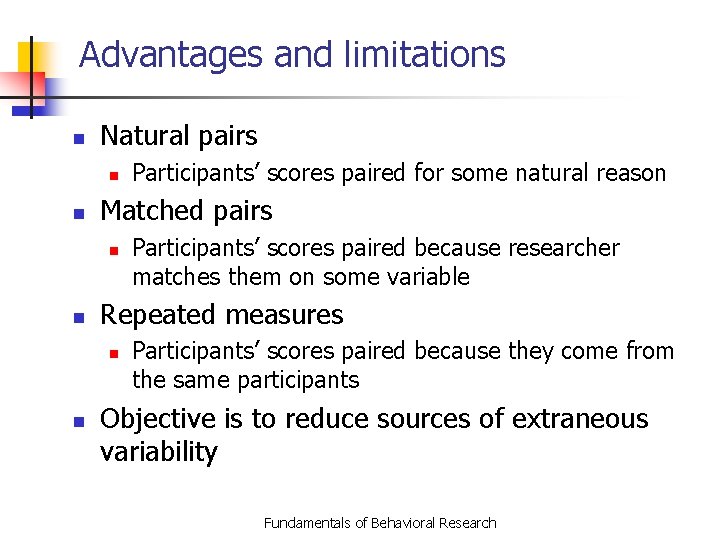
Advantages and limitations n Natural pairs n n Matched pairs n n Participants’ scores paired because researcher matches them on some variable Repeated measures n n Participants’ scores paired for some natural reason Participants’ scores paired because they come from the same participants Objective is to reduce sources of extraneous variability Fundamentals of Behavioral Research
Advantages and limitations n Advantages of repeated measures design n n Controls EVs due to individual differences Requires fewer participants Appropriate for studying questions that involve repeated exposure/testing Appropriate for longitudinal research Fundamentals of Behavioral Research
Advantages and limitations n Methodological issues of repeated measures design n Carryover effects n n Transient Permanent Sensitization Carryover effects can often be controlled by: n n Randomized order of conditions counterbalancing Fundamentals of Behavioral Research
Advantages and limitations n Comparing repeated measures design to independent samples design n Effect on random error and inferential statistic Effect on degrees of freedom Consider the net effect Fundamentals of Behavioral Research
Comparing two groups n n Random sampling Paired assignment to 2 groups (conditions) n n 1 IV with 2 levels Let’s try an experiment involving the Stroop effect n Go to the following website: n http: //faculty. washington. edu/chudler/java/ready. html Fundamentals of Behavioral Research
Comparing two groups n n n variability within groups (error variability) = random error (extraneous variables) variability between groups = systematic error (confounds) + systematic variability (effect of IV) Goals: n n n Reduce random error Eliminate systematic error Maximize systematic variability through manipulation of IV Fundamentals of Behavioral Research
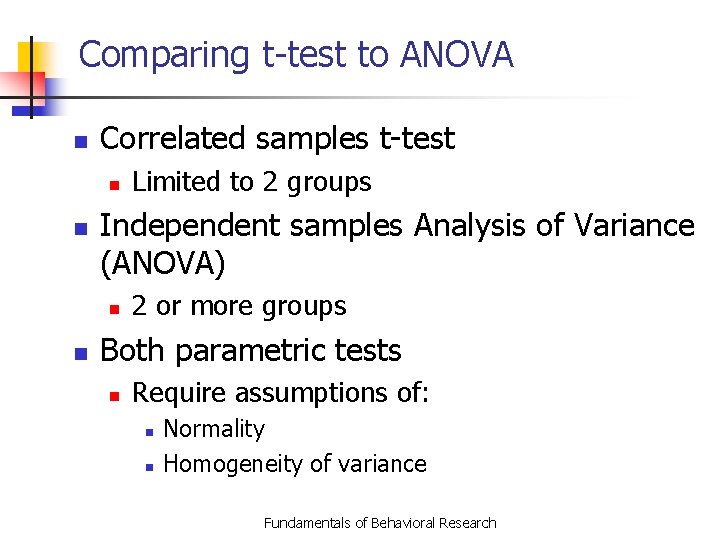
Comparing t-test to ANOVA n Correlated samples t-test n n Independent samples Analysis of Variance (ANOVA) n n Limited to 2 groups 2 or more groups Both parametric tests n Require assumptions of: n n Normality Homogeneity of variance Fundamentals of Behavioral Research
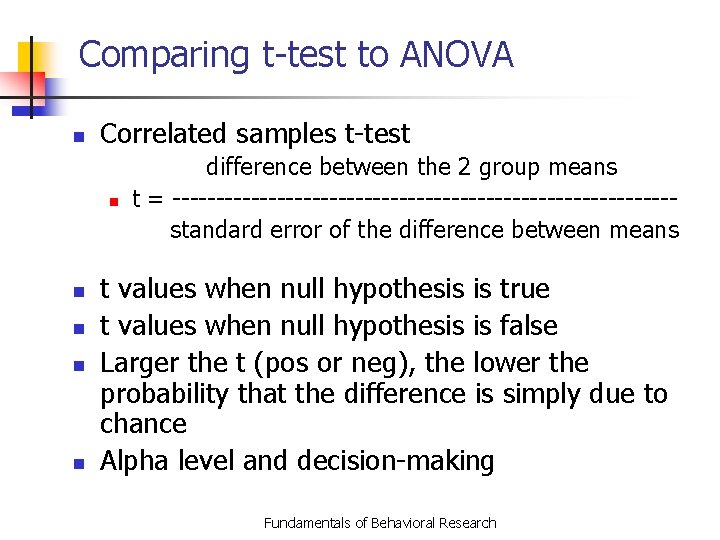
Comparing t-test to ANOVA n Correlated samples t-test n n n difference between the 2 group means t = -----------------------------standard error of the difference between means t values when null hypothesis is true t values when null hypothesis is false Larger the t (pos or neg), the lower the probability that the difference is simply due to chance Alpha level and decision-making Fundamentals of Behavioral Research
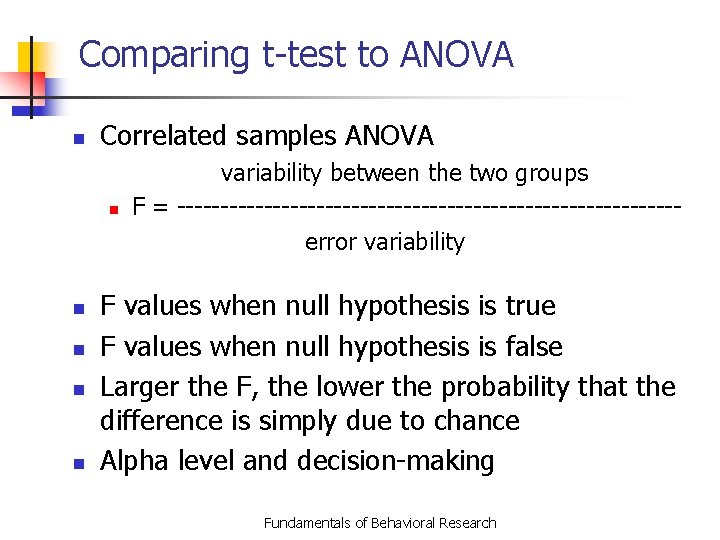
Comparing t-test to ANOVA n Correlated samples ANOVA n n n variability between the two groups F = -----------------------------error variability F values when null hypothesis is true F values when null hypothesis is false Larger the F, the lower the probability that the difference is simply due to chance Alpha level and decision-making Fundamentals of Behavioral Research
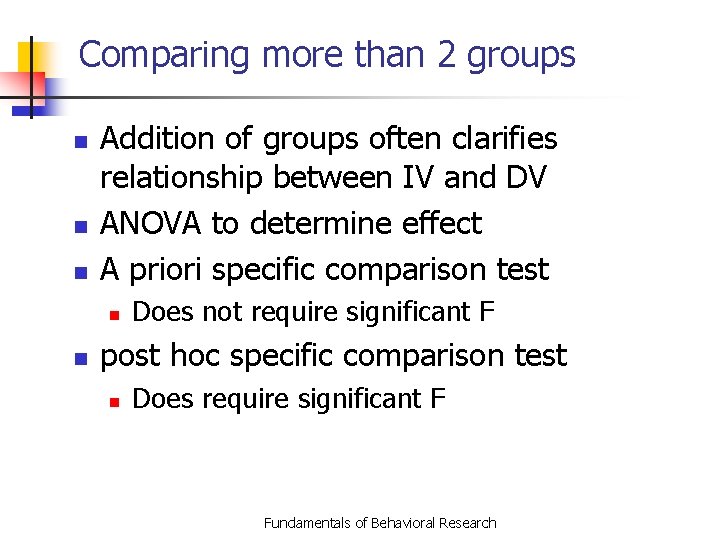
Comparing more than 2 groups n n n Addition of groups often clarifies relationship between IV and DV ANOVA to determine effect A priori specific comparison test n n Does not require significant F post hoc specific comparison test n Does require significant F Fundamentals of Behavioral Research
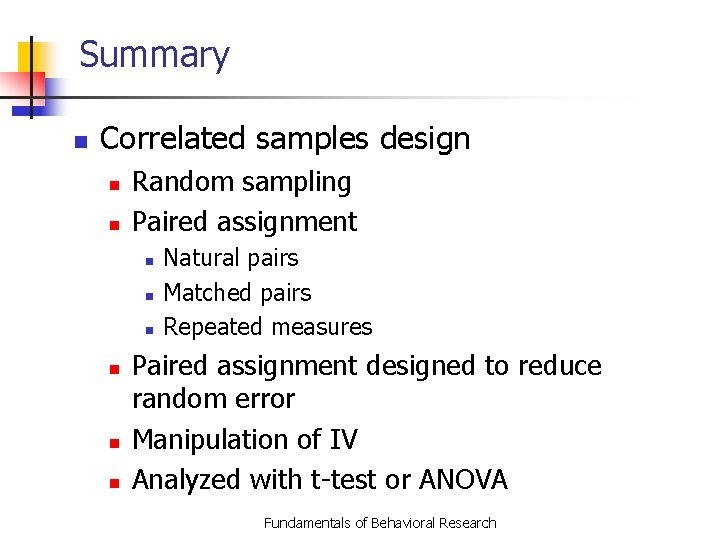
Summary n Correlated samples design n n Random sampling Paired assignment n n n Natural pairs Matched pairs Repeated measures Paired assignment designed to reduce random error Manipulation of IV Analyzed with t-test or ANOVA Fundamentals of Behavioral Research