
Chapter 12 Effective Teaching and the School Environment

- Slides: 13
Chapter 12 Effective Teaching and the School Environment Warner & Sower 1
NAEYC’s Code of Ethics • Appreciating childhood as a unique and valuable stage of the human life cycle • Basing our work with children on knowledge of child development • Appreciating and supporting the close ties between the child and the family • Recognizing that children are best understood and supported in the context of family, culture, community, and society • Respecting the dignity, worth, and uniqueness of each individual (child, family member, and colleague) • Helping children and adults achieve their full potential in the context of relationships that are based on trust, respect, and positive regard Warner & Sower 2
Ethical Responsibilities • To the children • To families • To colleagues • To employers Warner & Sower 3
The Child Abuse Prevention & Treatment Act (CAPTA) • Physical abuse • Sexual abuse • Emotional abuse • Neglect Warner & Sower 4
Professional Organizations • Association of American Educators (AAE) • American Federation of Teachers (AFT) • National Education Association (NEA) • Phi Delta Kappa (PDK) • National Association for the Education of Young Children (NAEYC) • Council for Exceptional Children (CEC) Warner & Sower 5
Types of Professional Portfolios • Employment portfolio • Evaluation portfolio • Professional development portfolio Warner & Sower 6
Ten Powerful Instructional Principles 1. Meaningfulness 2. Prerequisites 3. Open communication 4. Essential content 5. Learning aids Warner & Sower 7
Ten Powerful Instructional Principles (continued) 6. Novelty 7. Modeling 8. Active and appropriate practice 9. Pleasant conditions and consequences 10. Consistency Warner & Sower 8
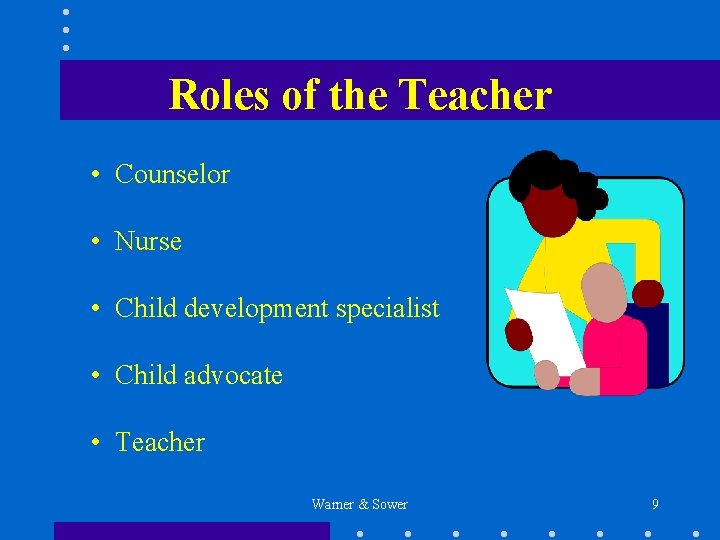
Roles of the Teacher • Counselor • Nurse • Child development specialist • Child advocate • Teacher Warner & Sower 9
Responsibilities of the Teacher • Environment • Curriculum • Assessment • Guidance • Parents • Collaborating with other professionals Warner & Sower 10
Working in the School Community • School staff • Principal • Nurse • Educational Diagnostician • Counselor • Parent-Teacher organizations Warner & Sower 11
Characteristics of Effective Teachers • Attitudes/Getting to know your children • Effective use of time • Organization/Planning • Communications/Presentation/Focus • Feedback/Evaluation Warner & Sower 12
Characteristics of Effective Teachers (continued) • Monitoring/Motivating • Questioning • Pacing • Review and closure • Knowledgeable and adaptability Warner & Sower 13