
Chapter 12 DNA Technology and Genomics Power Point
- Slides: 48
Chapter 12 DNA Technology and Genomics Power. Point Lectures for Biology: Concepts and Connections, Fifth Edition – Campbell, Reece, Taylor, and Simon Lectures by Chris Romero Copyright © 2005 Pearson Education, Inc. Publishing as Benjamin Cummings
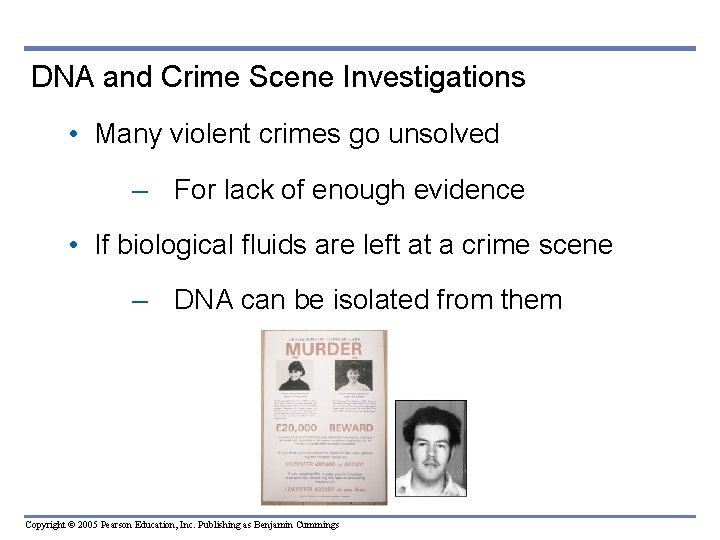
DNA and Crime Scene Investigations • Many violent crimes go unsolved – For lack of enough evidence • If biological fluids are left at a crime scene – DNA can be isolated from them Copyright © 2005 Pearson Education, Inc. Publishing as Benjamin Cummings
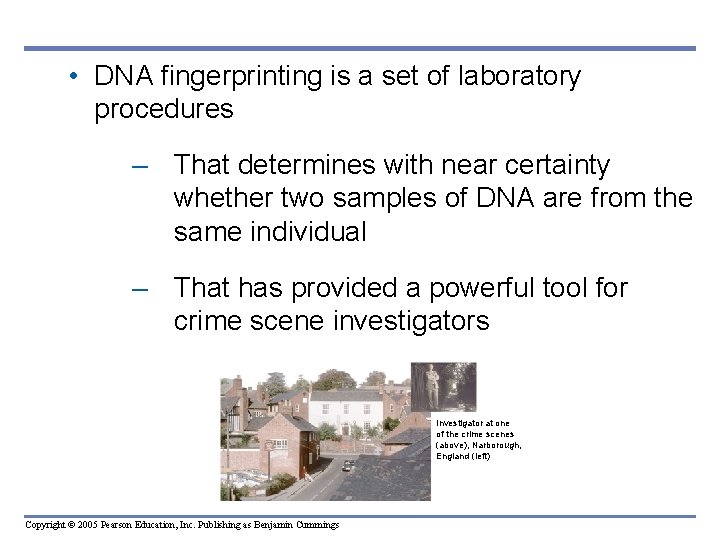
• DNA fingerprinting is a set of laboratory procedures – That determines with near certainty whether two samples of DNA are from the same individual – That has provided a powerful tool for crime scene investigators Investigator at one of the crime scenes (above), Narborough, England (left) Copyright © 2005 Pearson Education, Inc. Publishing as Benjamin Cummings
BACTERIAL PLASMIDS AND GENE CLONING 12. 1 Plasmids are used to customize bacteria: An overview • Gene cloning is one application of DNA technology – Methods for studying and manipulating genetic material Copyright © 2005 Pearson Education, Inc. Publishing as Benjamin Cummings
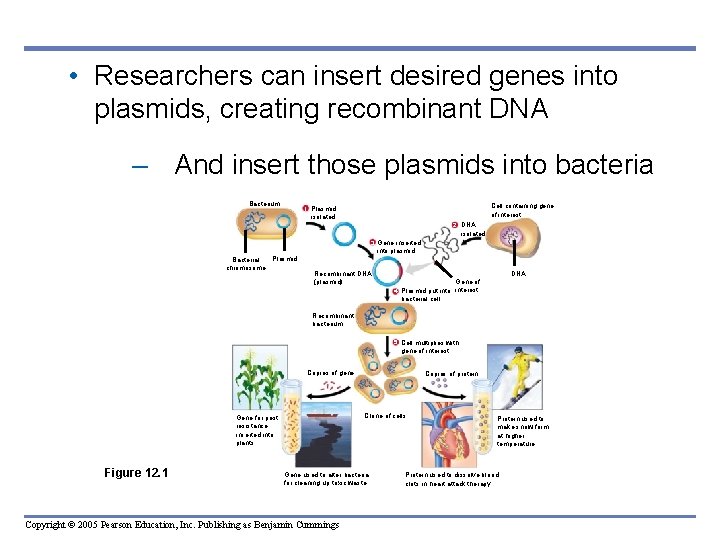
• Researchers can insert desired genes into plasmids, creating recombinant DNA – And insert those plasmids into bacteria Bacterium Cell containing gene of interest 1 Plasmid isolated 2 DNA isolated 3 Gene inserted into plasmid Plasmid Bacterial chromosome Recombinant DNA (plasmid) DNA Gene of 4 Plasmid put into interest bacterial cell Recombinant bacterium 5 Cell multiplies with gene of interest Copies of gene Clone of cells Gene for pest resistance inserted into plants Figure 12. 1 Copies of protein Gene used to alter bacteria for cleaning up toxic waste Copyright © 2005 Pearson Education, Inc. Publishing as Benjamin Cummings Protein used to make snow form at higher temperature Protein used to dissolve blood clots in heart attack therapy
• If the recombinant bacteria multiply into a clone – The foreign genes are also copied Copyright © 2005 Pearson Education, Inc. Publishing as Benjamin Cummings
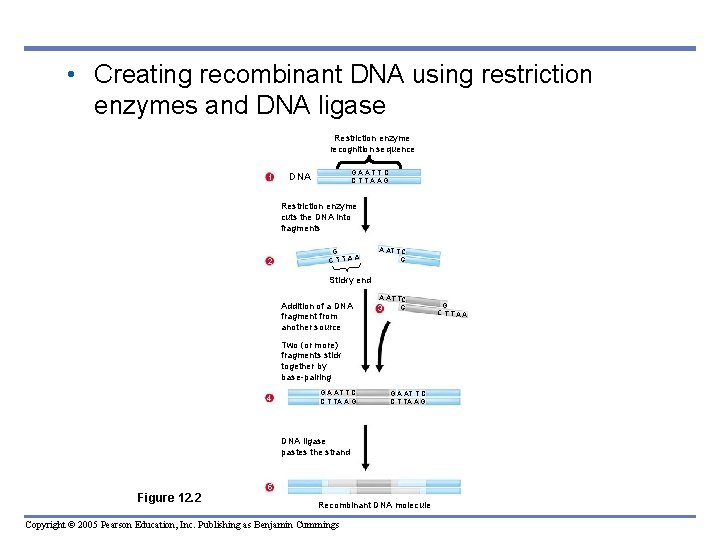
12. 2 Enzymes are used to “cut and paste” DNA • The tools used to make recombinant DNA are – Restriction enzymes, which cut DNA at specific sequences – DNA ligase, which “pastes” DNA fragments together Copyright © 2005 Pearson Education, Inc. Publishing as Benjamin Cummings
• Creating recombinant DNA using restriction enzymes and DNA ligase Restriction enzyme recognition sequence 1 GAATTC CTTAAG DNA Restriction enzyme cuts the DNA into fragments 2 G CTTAA A AT TC G Sticky end Addition of a DNA fragment from another source A AT TC G 3 Two (or more) fragments stick together by base-pairing 4 G A AT T C C T TA A G DNA ligase pastes the strand Figure 12. 2 5 Recombinant DNA molecule Copyright © 2005 Pearson Education, Inc. Publishing as Benjamin Cummings G CTTAA
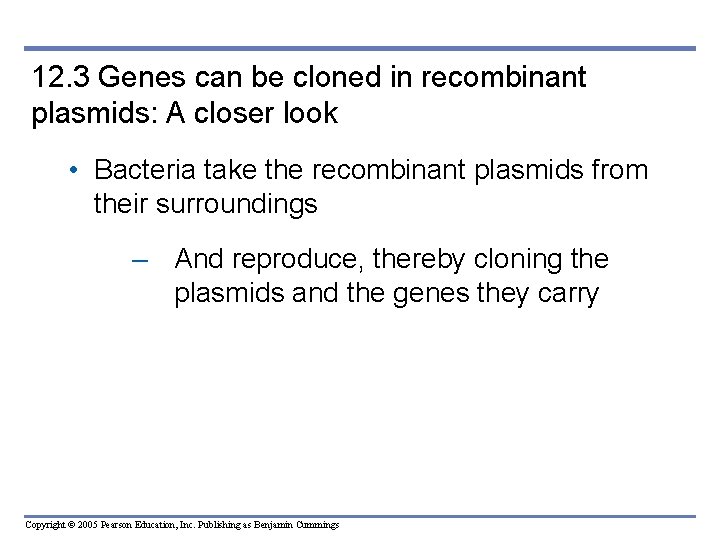
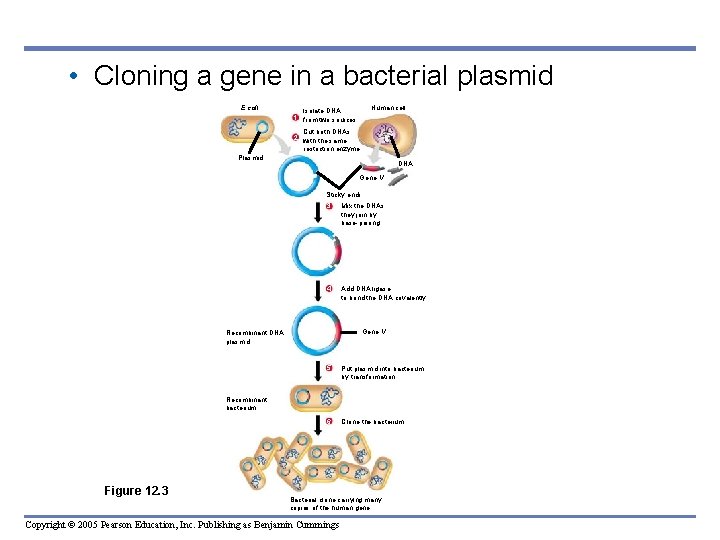
12. 3 Genes can be cloned in recombinant plasmids: A closer look • Bacteria take the recombinant plasmids from their surroundings – And reproduce, thereby cloning the plasmids and the genes they carry Copyright © 2005 Pearson Education, Inc. Publishing as Benjamin Cummings
• Cloning a gene in a bacterial plasmid E. coli Human cell Isolate DNA 1 from two sources Cut both DNAs 2 with the same restriction enzyme Plasmid DNA Gene V Sticky ends 3 Mix the DNAs; they join by base-pairing 4 Add DNA ligase to bond the DNA covalently Gene V Recombinant DNA plasmid 5 Put plasmid into bacterium by transformation 6 Clone the bacterium Recombinant bacterium Figure 12. 3 Bacterial clone carrying many copies of the human gene Copyright © 2005 Pearson Education, Inc. Publishing as Benjamin Cummings
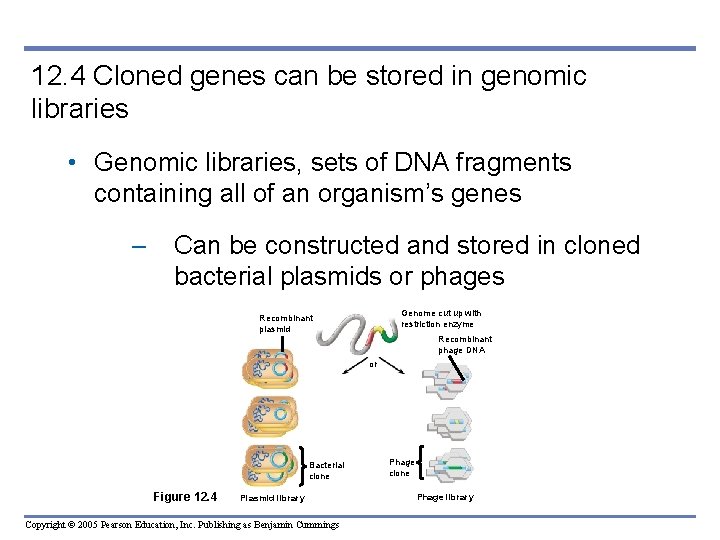
12. 4 Cloned genes can be stored in genomic libraries • Genomic libraries, sets of DNA fragments containing all of an organism’s genes – Can be constructed and stored in cloned bacterial plasmids or phages Genome cut up with restriction enzyme Recombinant plasmid Recombinant phage DNA or Bacterial clone Figure 12. 4 Plasmid library Copyright © 2005 Pearson Education, Inc. Publishing as Benjamin Cummings Phage clone Phage library
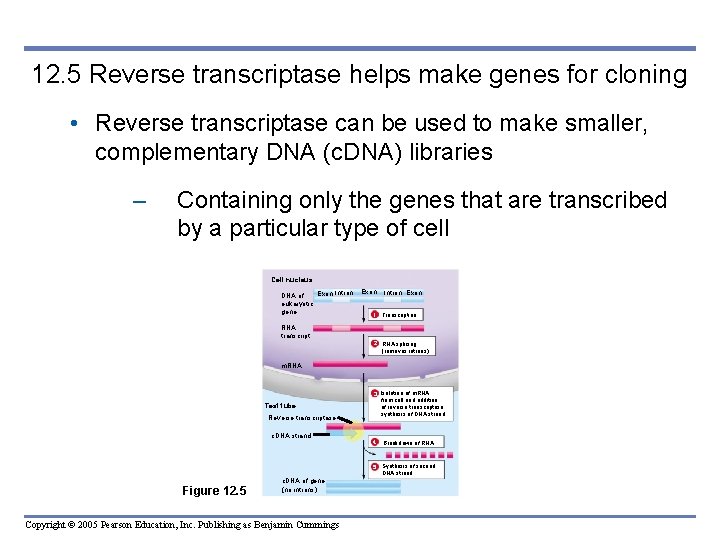
12. 5 Reverse transcriptase helps make genes for cloning • Reverse transcriptase can be used to make smaller, complementary DNA (c. DNA) libraries – Containing only the genes that are transcribed by a particular type of cell Cell nucleus Exon Intron DNA of eukaryotic gene Exon Intron Exon 1 Transcription RNA transcript 2 RNA splicing (removes introns) m. RNA Test tube Reverse transcriptase c. DNA strand 3 Isolation of m. RNA from cell and addition of reverse transcriptase; synthesis of DNA strand 4 Breakdown of RNA 5 Synthesis of second DNA strand Figure 12. 5 c. DNA of gene (no introns) Copyright © 2005 Pearson Education, Inc. Publishing as Benjamin Cummings
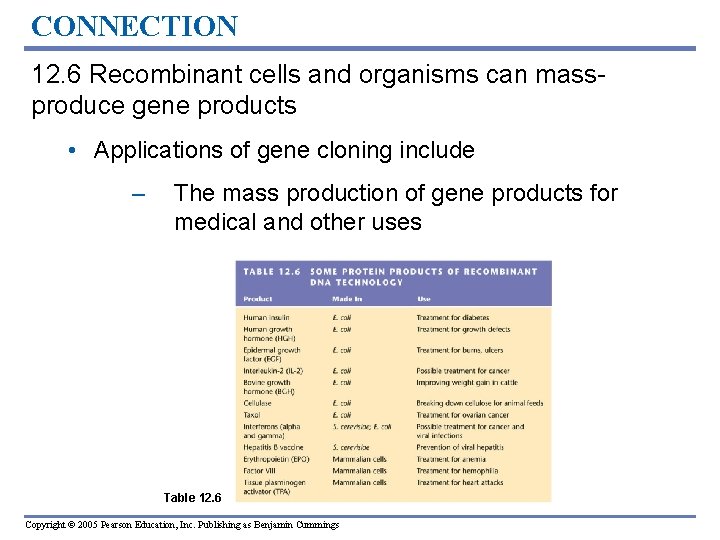
CONNECTION 12. 6 Recombinant cells and organisms can massproduce gene products • Applications of gene cloning include – The mass production of gene products for medical and other uses Table 12. 6 Copyright © 2005 Pearson Education, Inc. Publishing as Benjamin Cummings
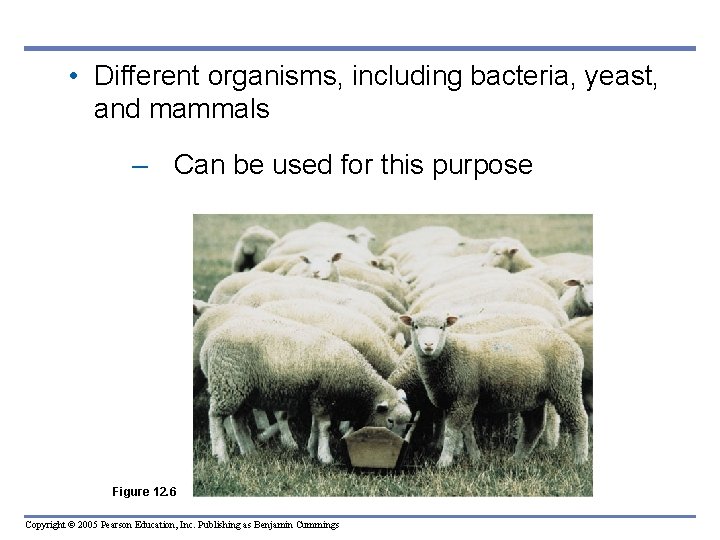
• Different organisms, including bacteria, yeast, and mammals – Can be used for this purpose Figure 12. 6 Copyright © 2005 Pearson Education, Inc. Publishing as Benjamin Cummings
CONNECTION 12. 7 DNA technology is changing the pharmaceutical industry • DNA technology – Is widely used to produce medicines and to diagnose diseases Copyright © 2005 Pearson Education, Inc. Publishing as Benjamin Cummings
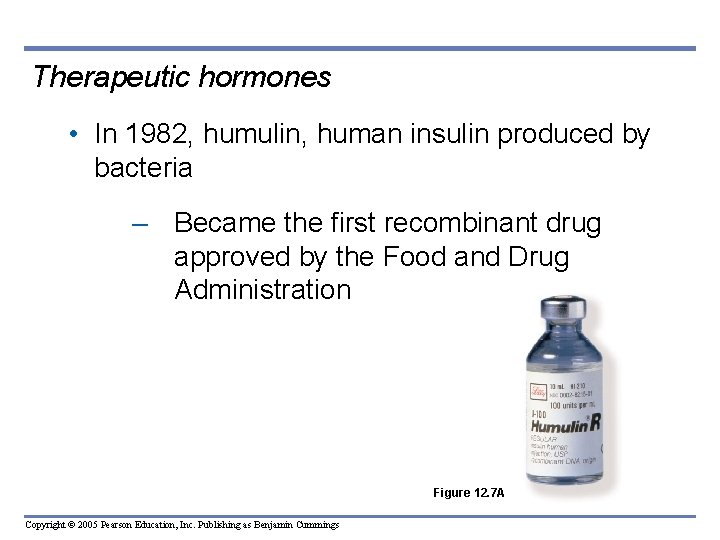
Therapeutic hormones • In 1982, humulin, human insulin produced by bacteria – Became the first recombinant drug approved by the Food and Drug Administration Figure 12. 7 A Copyright © 2005 Pearson Education, Inc. Publishing as Benjamin Cummings
Diagnosis and Treatment of Disease • DNA technology – Is being used increasingly in disease diagnosis Copyright © 2005 Pearson Education, Inc. Publishing as Benjamin Cummings
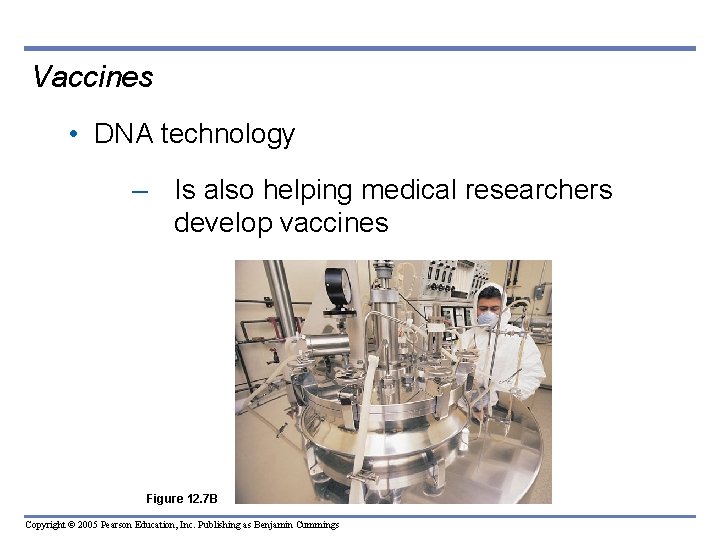
Vaccines • DNA technology – Is also helping medical researchers develop vaccines Figure 12. 7 B Copyright © 2005 Pearson Education, Inc. Publishing as Benjamin Cummings
RESTRICTION FRAGMENT ANALYSIS AND DNA FINGERPRINTING 12. 8 Nucleic acid probes identify clones carrying specific genes • DNA technology methods – Can be used to identify specific pieces of DNA Copyright © 2005 Pearson Education, Inc. Publishing as Benjamin Cummings
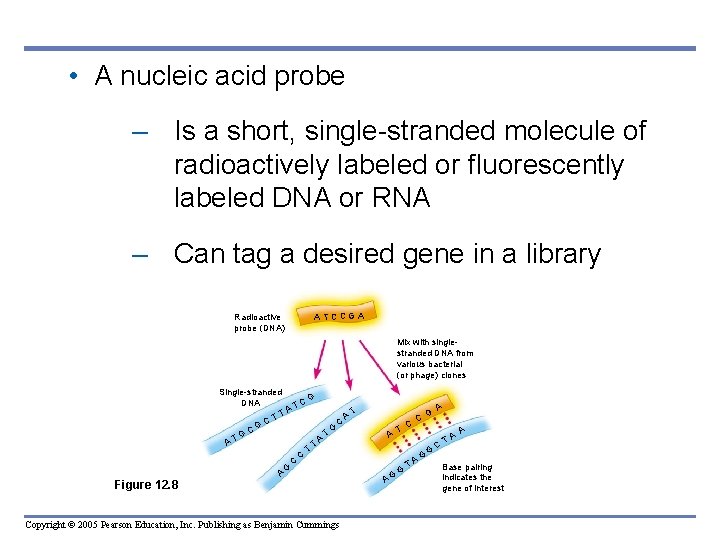
• A nucleic acid probe – Is a short, single-stranded molecule of radioactively labeled or fluorescently labeled DNA or RNA – Can tag a desired gene in a library Radioactive probe (DNA) ATCCGA Mix with singlestranded DNA from various bacterial (or phage) clones Figure 12. 8 Single-stranded G DNA TC A TT C C G G T GC T A A T T C C G A Copyright © 2005 Pearson Education, Inc. Publishing as Benjamin Cummings A A G T G C C TA G G G A C TA A Base pairing indicates the gene of interest
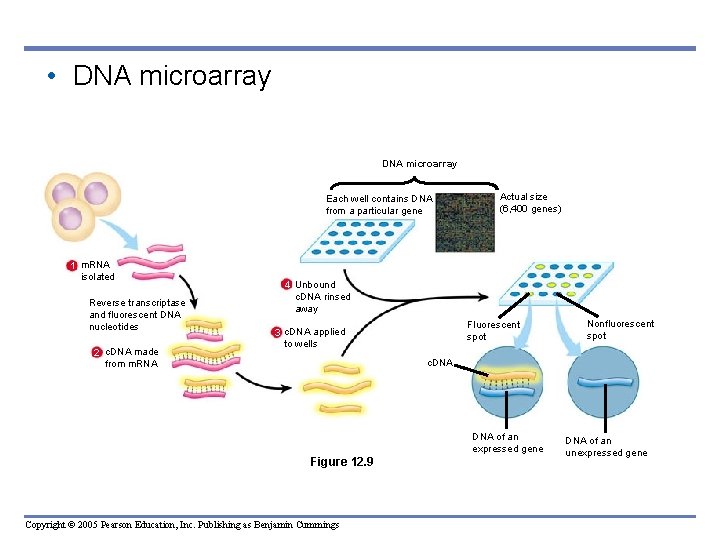
CONNECTION 12. 9 DNA microarrays test for the expression of many genes at once • DNA microarray assays – Can reveal patterns of gene expression in different kinds of cells Copyright © 2005 Pearson Education, Inc. Publishing as Benjamin Cummings
• DNA microarray Each well contains DNA from a particular gene 1 m. RNA isolated Reverse transcriptase and fluorescent DNA nucleotides 2 c. DNA made from m. RNA Actual size (6, 400 genes) 4 Unbound c. DNA rinsed away Fluorescent spot 3 c. DNA applied to wells Nonfluorescent spot c. DNA of an expressed gene Figure 12. 9 Copyright © 2005 Pearson Education, Inc. Publishing as Benjamin Cummings DNA of an unexpressed gene
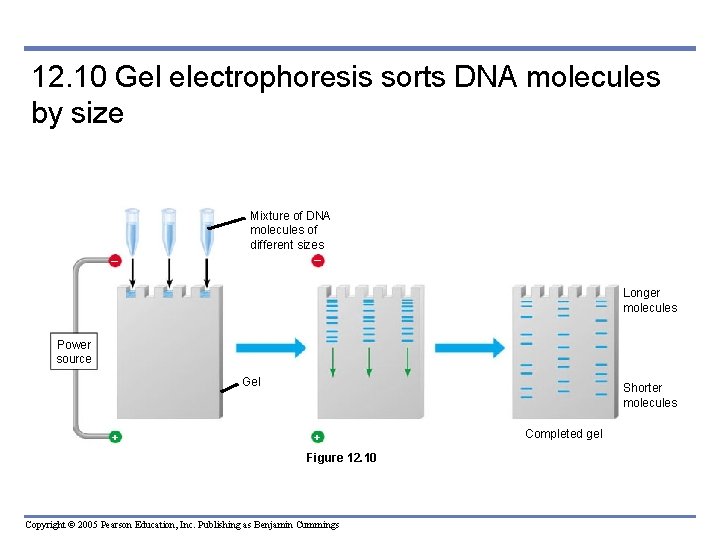
12. 10 Gel electrophoresis sorts DNA molecules by size Mixture of DNA molecules of different sizes – – Longer molecules Power source Gel + Shorter molecules + Figure 12. 10 Copyright © 2005 Pearson Education, Inc. Publishing as Benjamin Cummings Completed gel
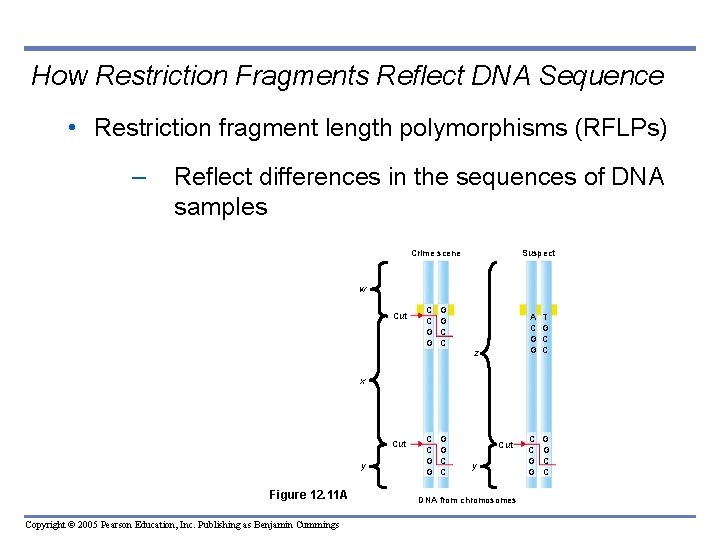
12. 11 Restriction fragment length polymorphisms can be used to detect differences in DNA sequences Copyright © 2005 Pearson Education, Inc. Publishing as Benjamin Cummings
How Restriction Fragments Reflect DNA Sequence • Restriction fragment length polymorphisms (RFLPs) – Reflect differences in the sequences of DNA samples Crime scene Suspect w Cut C C G G G G C C z A C G G T G C C G G C C x Cut y Figure 12. 11 A Copyright © 2005 Pearson Education, Inc. Publishing as Benjamin Cummings Cut y DNA from chromosomes
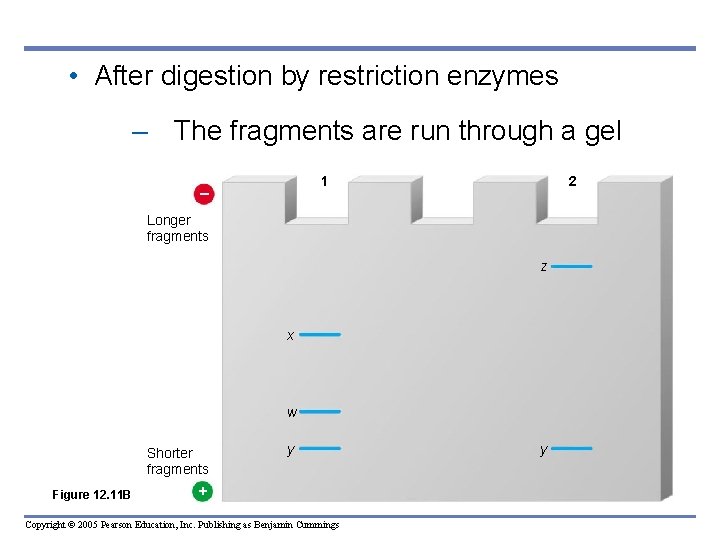
• After digestion by restriction enzymes – The fragments are run through a gel 1 – 2 Longer fragments z x w Shorter fragments Figure 12. 11 B y + Copyright © 2005 Pearson Education, Inc. Publishing as Benjamin Cummings y
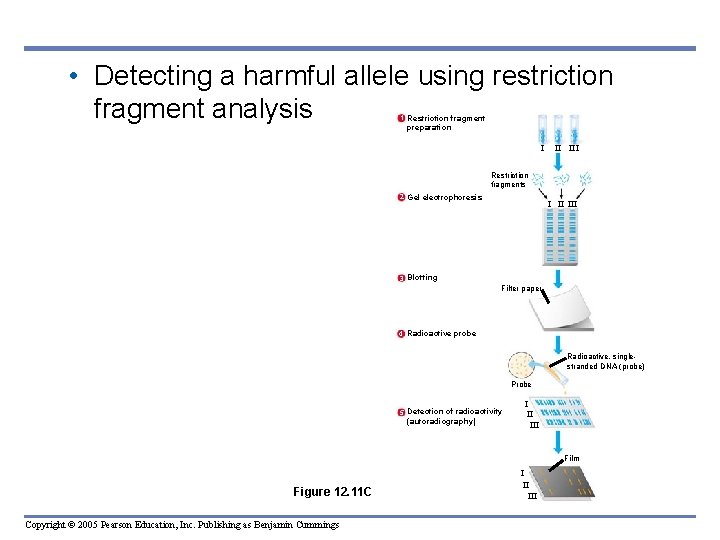
Using DNA Probes to Detect Harmful Alleles • Radioactive probes – Can reveal DNA bands of interest on a gel Copyright © 2005 Pearson Education, Inc. Publishing as Benjamin Cummings
• Detecting a harmful allele using restriction fragment analysis 1 Restriction fragment preparation I II III Restriction fragments 2 Gel electrophoresis I II III 3 Blotting Filter paper 4 Radioactive probe Radioactive, singlestranded DNA (probe) Probe 5 Detection of radioactivity (autoradiography) I II III Film Figure 12. 11 C Copyright © 2005 Pearson Education, Inc. Publishing as Benjamin Cummings I II III
CONNECTION 12. 12 DNA technology is used in courts of law Copyright © 2005 Pearson Education, Inc. Publishing as Benjamin Cummings
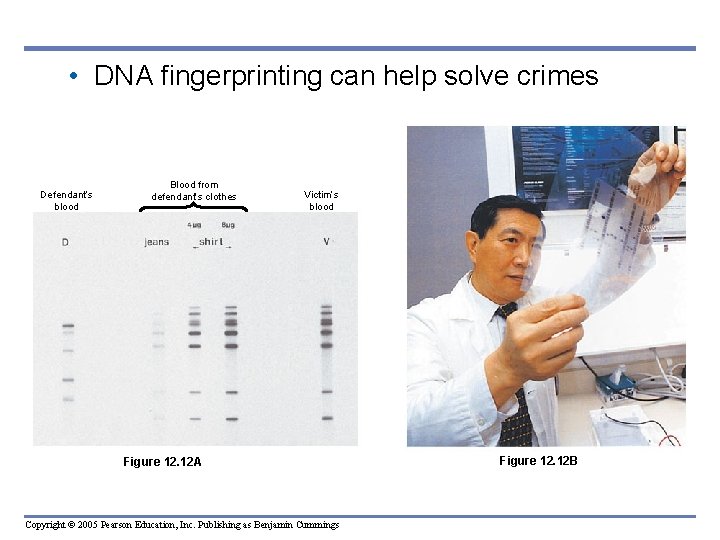
• DNA fingerprinting can help solve crimes Defendant’s blood Blood from defendant’s clothes Victim’s blood Figure 12. 12 A Copyright © 2005 Pearson Education, Inc. Publishing as Benjamin Cummings Figure 12. 12 B
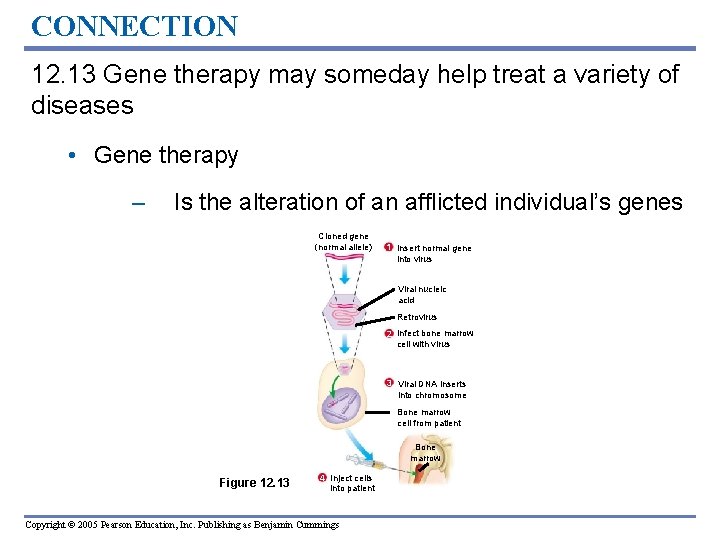
CONNECTION 12. 13 Gene therapy may someday help treat a variety of diseases • Gene therapy – Is the alteration of an afflicted individual’s genes Cloned gene (normal allele) 1 Insert normal gene into virus Viral nucleic acid Retrovirus 2 Infect bone marrow cell with virus 3 Viral DNA inserts into chromosome Bone marrow cell from patient Bone marrow Figure 12. 13 4 Inject cells into patient Copyright © 2005 Pearson Education, Inc. Publishing as Benjamin Cummings
• Gene therapy – May one day be used to treat both genetic diseases and nongenetic disorders • Unfortunately, progress is slow Copyright © 2005 Pearson Education, Inc. Publishing as Benjamin Cummings
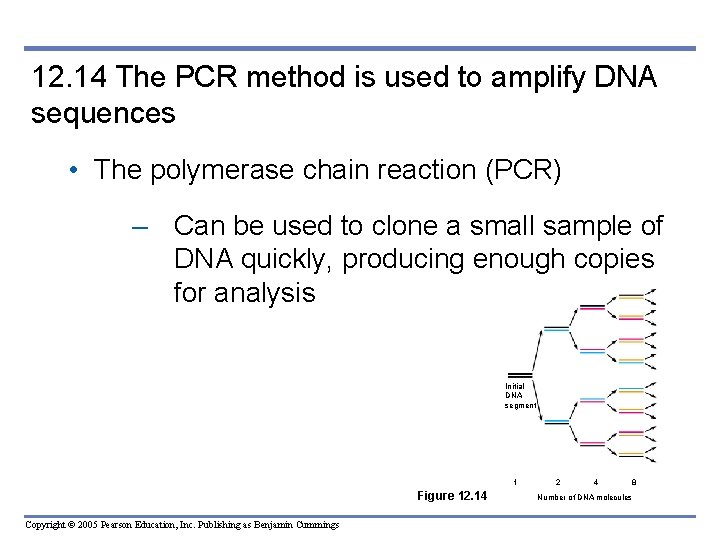
12. 14 The PCR method is used to amplify DNA sequences • The polymerase chain reaction (PCR) – Can be used to clone a small sample of DNA quickly, producing enough copies for analysis Initial DNA segment 1 Figure 12. 14 Copyright © 2005 Pearson Education, Inc. Publishing as Benjamin Cummings 2 4 8 Number of DNA molecules
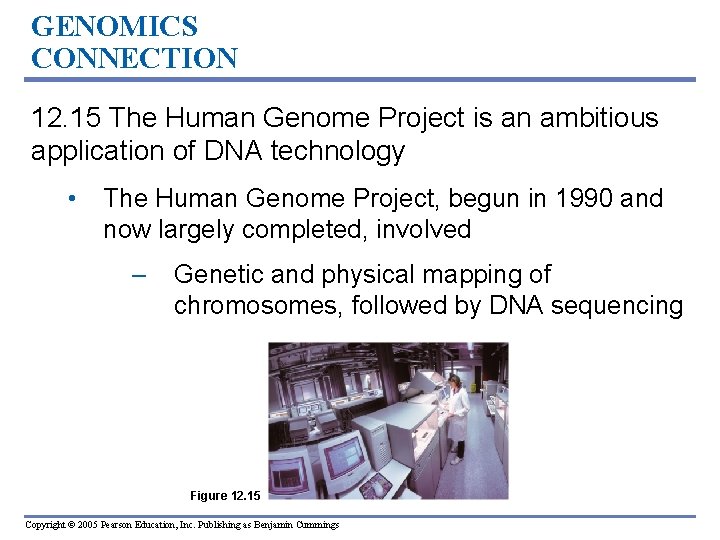
GENOMICS CONNECTION 12. 15 The Human Genome Project is an ambitious application of DNA technology • The Human Genome Project, begun in 1990 and now largely completed, involved – Genetic and physical mapping of chromosomes, followed by DNA sequencing Figure 12. 15 Copyright © 2005 Pearson Education, Inc. Publishing as Benjamin Cummings
• The data are providing insight into – Development, evolution, and many diseases Copyright © 2005 Pearson Education, Inc. Publishing as Benjamin Cummings
12. 16 Most of the human genome does not consist of genes • The haploid human genome contains about 25, 000 genes – And a huge amount of noncoding DNA Copyright © 2005 Pearson Education, Inc. Publishing as Benjamin Cummings
• Much of the noncoding DNA consists of repetitive nucleotide sequences – And transposons that can move about within the genome Copyright © 2005 Pearson Education, Inc. Publishing as Benjamin Cummings
CONNECTION 12. 17 The science of genomics compares whole genomes • The sequencing of many prokaryotic and eukaryotic genomes – Has produced data for genomics, the study of whole genomes Copyright © 2005 Pearson Education, Inc. Publishing as Benjamin Cummings
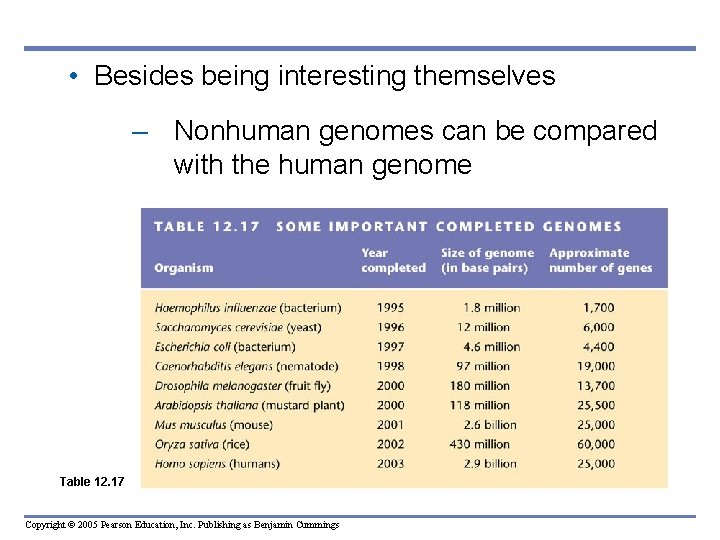
• Besides being interesting themselves – Nonhuman genomes can be compared with the human genome Table 12. 17 Copyright © 2005 Pearson Education, Inc. Publishing as Benjamin Cummings
• Proteomics – Is the study of the full sets of proteins produced by organisms Copyright © 2005 Pearson Education, Inc. Publishing as Benjamin Cummings
GENETICALLY MODIFIED ORGANISMS CONNECTION 12. 18 Genetically modified organisms are transforming agriculture Copyright © 2005 Pearson Education, Inc. Publishing as Benjamin Cummings
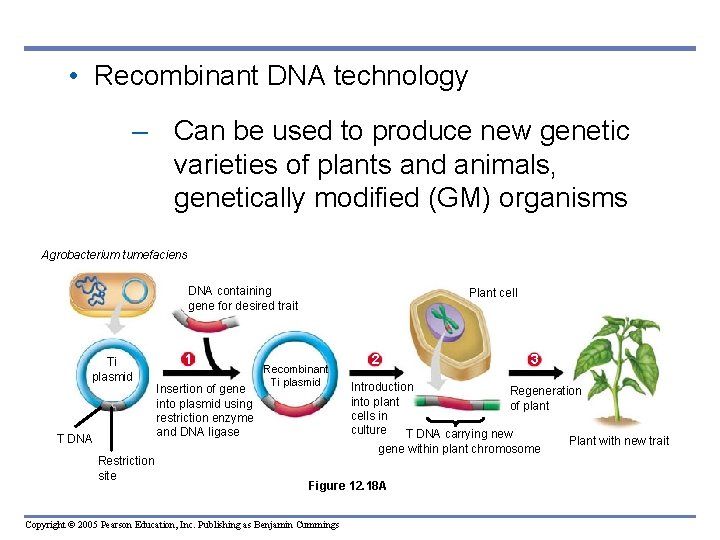
• Recombinant DNA technology – Can be used to produce new genetic varieties of plants and animals, genetically modified (GM) organisms Agrobacterium tumefaciens DNA containing gene for desired trait Ti plasmid T DNA Restriction site 1 Insertion of gene into plasmid using restriction enzyme and DNA ligase Plant cell Recombinant Ti plasmid 2 Introduction Regeneration into plant of plant cells in culture T DNA carrying new Plant with new trait gene within plant chromosome Figure 12. 18 A Copyright © 2005 Pearson Education, Inc. Publishing as Benjamin Cummings 3
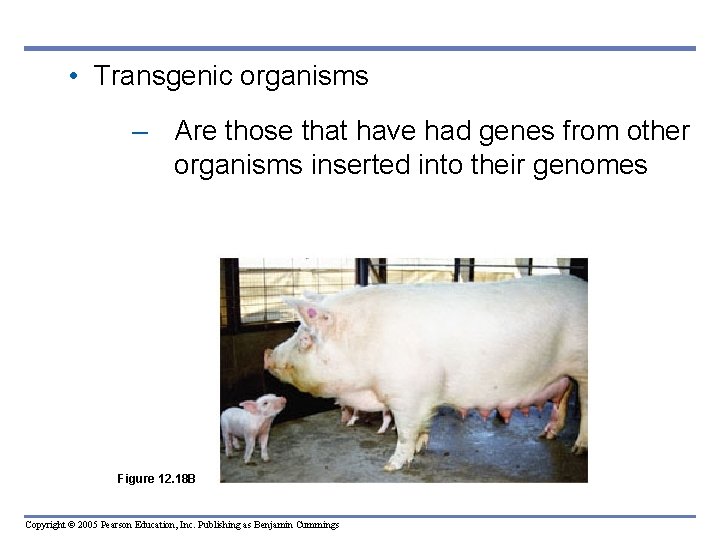
• Transgenic organisms – Are those that have had genes from other organisms inserted into their genomes Figure 12. 18 B Copyright © 2005 Pearson Education, Inc. Publishing as Benjamin Cummings
• A number of important crops and plants – Are genetically modified Copyright © 2005 Pearson Education, Inc. Publishing as Benjamin Cummings
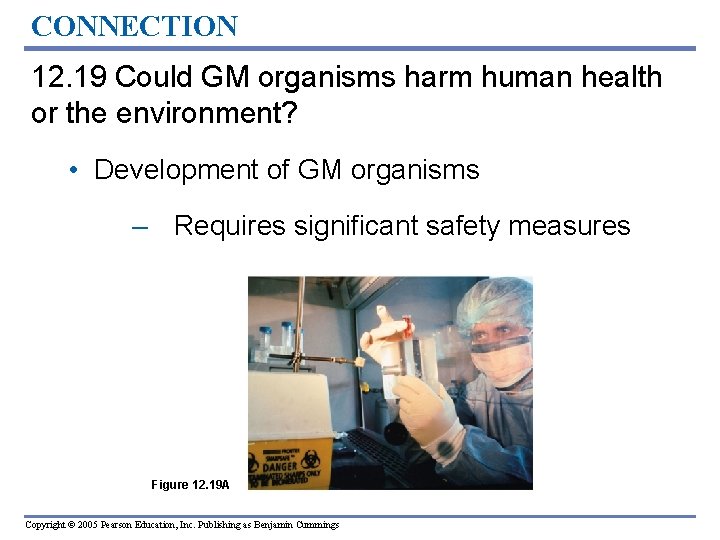
CONNECTION 12. 19 Could GM organisms harm human health or the environment? • Development of GM organisms – Requires significant safety measures Figure 12. 19 A Copyright © 2005 Pearson Education, Inc. Publishing as Benjamin Cummings
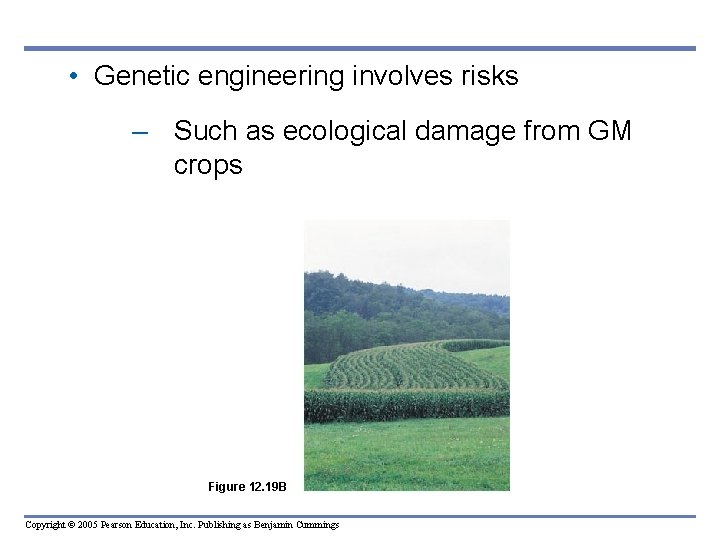
• Genetic engineering involves risks – Such as ecological damage from GM crops Figure 12. 19 B Copyright © 2005 Pearson Education, Inc. Publishing as Benjamin Cummings
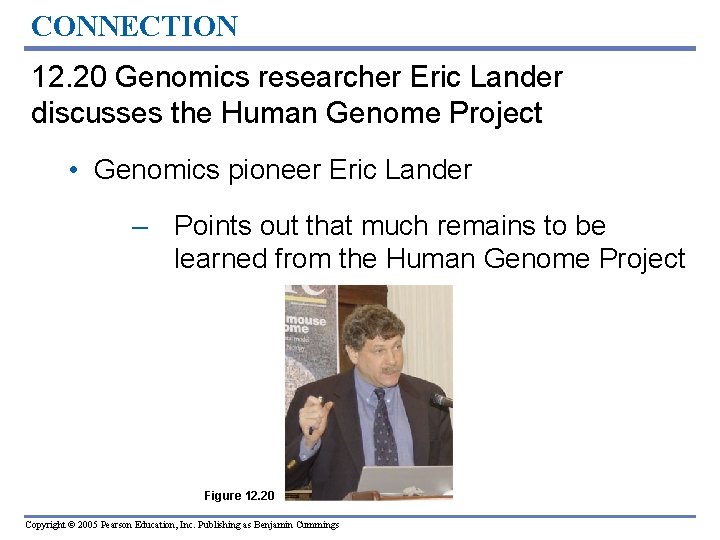
CONNECTION 12. 20 Genomics researcher Eric Lander discusses the Human Genome Project • Genomics pioneer Eric Lander – Points out that much remains to be learned from the Human Genome Project Figure 12. 20 Copyright © 2005 Pearson Education, Inc. Publishing as Benjamin Cummings
12. 17 The science of genomics compares whole genomes • The sequencing of many prokaryotic and eukaryotic genomes – Has produced data for genomics, the study of whole genomes Copyright © 2005 Pearson Education, Inc. Publishing as Benjamin Cummings