
Chapter 12 Diagnostic Coding Lesson 12 1 Diagnostic

- Slides: 35
Chapter 12 Diagnostic Coding
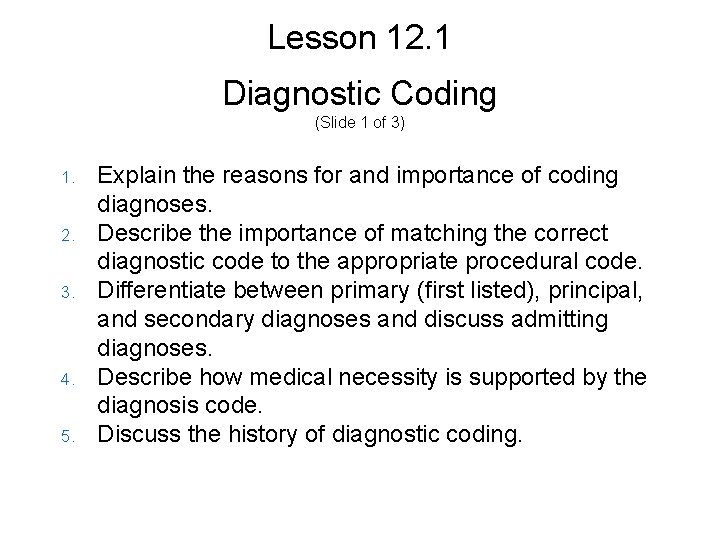
Lesson 12. 1 Diagnostic Coding (Slide 1 of 3) 1. 2. 3. 4. 5. Explain the reasons for and importance of coding diagnoses. Describe the importance of matching the correct diagnostic code to the appropriate procedural code. Differentiate between primary (first listed), principal, and secondary diagnoses and discuss admitting diagnoses. Describe how medical necessity is supported by the diagnosis code. Discuss the history of diagnostic coding.
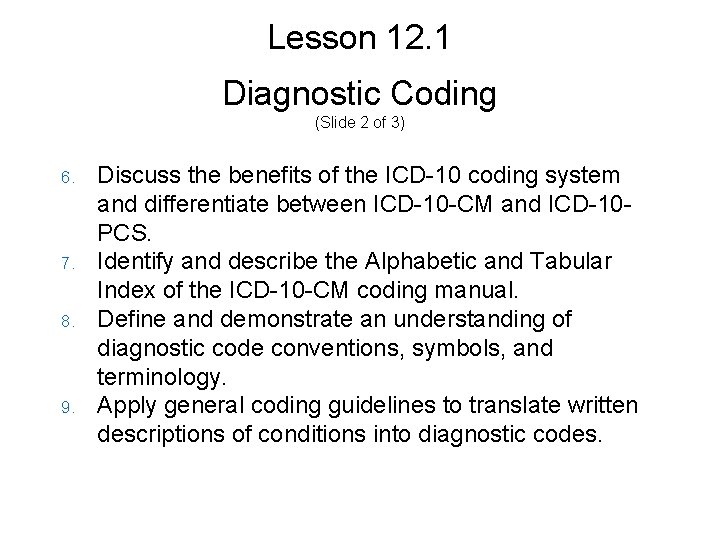
Lesson 12. 1 Diagnostic Coding (Slide 2 of 3) 6. 7. 8. 9. Discuss the benefits of the ICD-10 coding system and differentiate between ICD-10 -CM and ICD-10 PCS. Identify and describe the Alphabetic and Tabular Index of the ICD-10 -CM coding manual. Define and demonstrate an understanding of diagnostic code conventions, symbols, and terminology. Apply general coding guidelines to translate written descriptions of conditions into diagnostic codes.
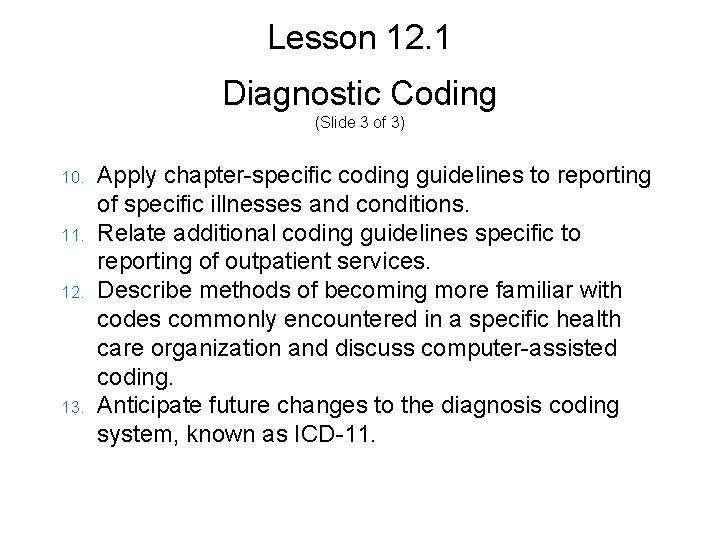
Lesson 12. 1 Diagnostic Coding (Slide 3 of 3) 10. 11. 12. 13. Apply chapter-specific coding guidelines to reporting of specific illnesses and conditions. Relate additional coding guidelines specific to reporting of outpatient services. Describe methods of becoming more familiar with codes commonly encountered in a specific health care organization and discuss computer-assisted coding. Anticipate future changes to the diagnosis coding system, known as ICD-11.
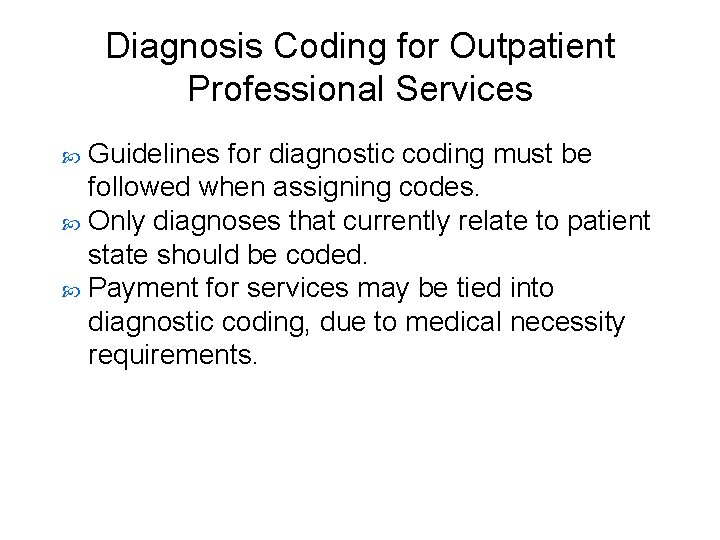
Diagnosis Coding for Outpatient Professional Services Guidelines for diagnostic coding must be followed when assigning codes. Only diagnoses that currently relate to patient state should be coded. Payment for services may be tied into diagnostic coding, due to medical necessity requirements.
Assigning a Diagnosis Code Diagnostic coding must be accurate because payment for inpatient services rendered to a patient may be based on the diagnosis. In the outpatient setting, the diagnosis code must correspond to the treatment or services rendered to the patient or payment may be denied.
Sequencing of Diagnostic Codes Primary diagnosis (first-listed) Ø Ø Secondary diagnosis Ø Ø Related to the chief complaint Main reason for the encounter May contribute to the primary diagnosis Not the underlying cause (etiology) Principal diagnosis Ø Ø Only applicable to inpatient cases/claims Similar to primary diagnosis for outpatient
Admitting Diagnoses The inpatient admission diagnosis may be expressed as one of the following: Ø Ø One or more significant findings representing patient distress or abnormal findings on examination A diagnosis established on an ambulatory care basis or previous hospital admission An injury or poisoning A reason or condition not classifiable as an illness or injury, such as pregnancy in labor or follow-up inpatient diagnostic tests
Medical Necessity Insurance companies may not cover procedures that are not diagnosis related. Ø Ø Reference book is helpful in these situations For cases dealing with the Centers for Medicare and Medicaid Services (CMS): • • Consult regional fiscal intermediary’s website for local coverage determinations (LCDs) Also consult federal government’s website for national coverage determinations (NCDs)
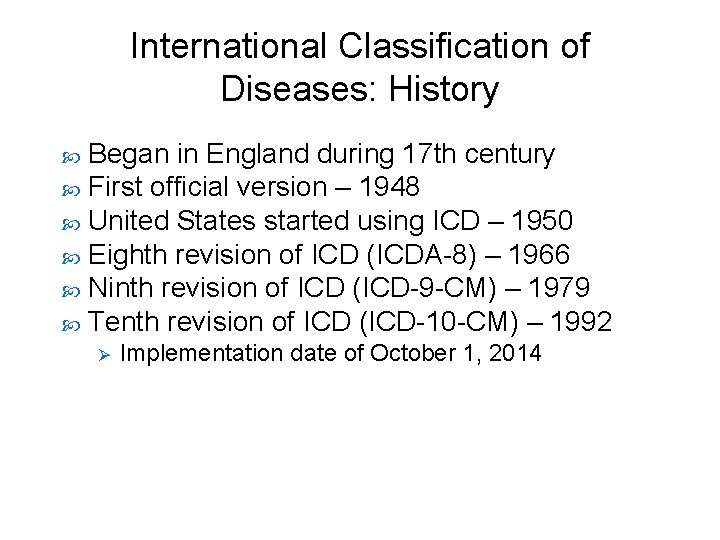
International Classification of Diseases: History Began in England during 17 th century First official version – 1948 United States started using ICD – 1950 Eighth revision of ICD (ICDA-8) – 1966 Ninth revision of ICD (ICD-9 -CM) – 1979 Tenth revision of ICD (ICD-10 -CM) – 1992 Ø Implementation date of October 1, 2014
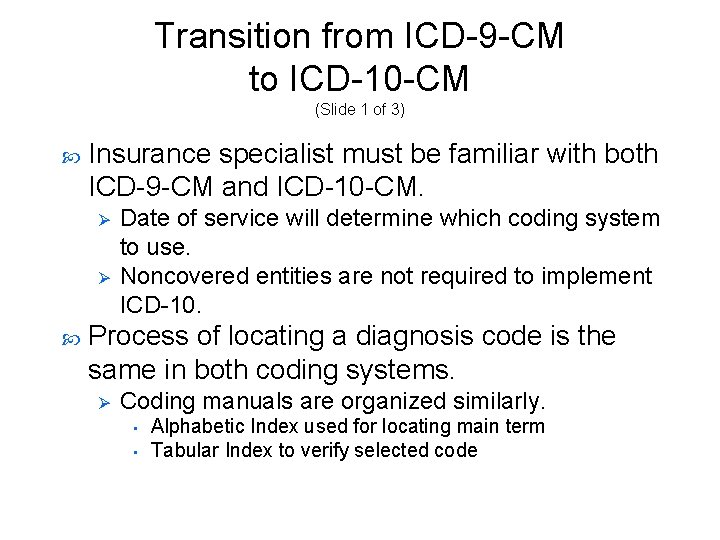
Transition from ICD-9 -CM to ICD-10 -CM (Slide 1 of 3) Insurance specialist must be familiar with both ICD-9 -CM and ICD-10 -CM. Ø Ø Date of service will determine which coding system to use. Noncovered entities are not required to implement ICD-10. Process of locating a diagnosis code is the same in both coding systems. Ø Coding manuals are organized similarly. • • Alphabetic Index used for locating main term Tabular Index to verify selected code
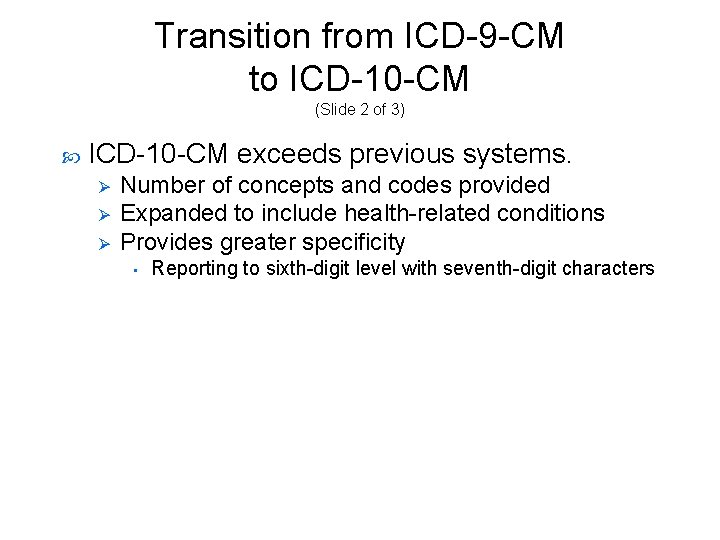
Transition from ICD-9 -CM to ICD-10 -CM (Slide 2 of 3) ICD-10 -CM exceeds previous systems. Ø Ø Ø Number of concepts and codes provided Expanded to include health-related conditions Provides greater specificity • Reporting to sixth-digit level with seventh-digit characters
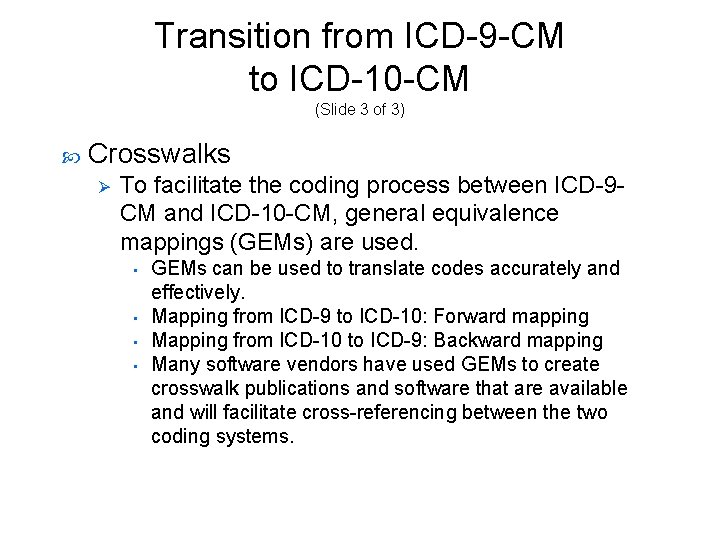
Transition from ICD-9 -CM to ICD-10 -CM (Slide 3 of 3) Crosswalks Ø To facilitate the coding process between ICD-9 CM and ICD-10 -CM, general equivalence mappings (GEMs) are used. • • GEMs can be used to translate codes accurately and effectively. Mapping from ICD-9 to ICD-10: Forward mapping Mapping from ICD-10 to ICD-9: Backward mapping Many software vendors have used GEMs to create crosswalk publications and software that are available and will facilitate cross-referencing between the two coding systems.
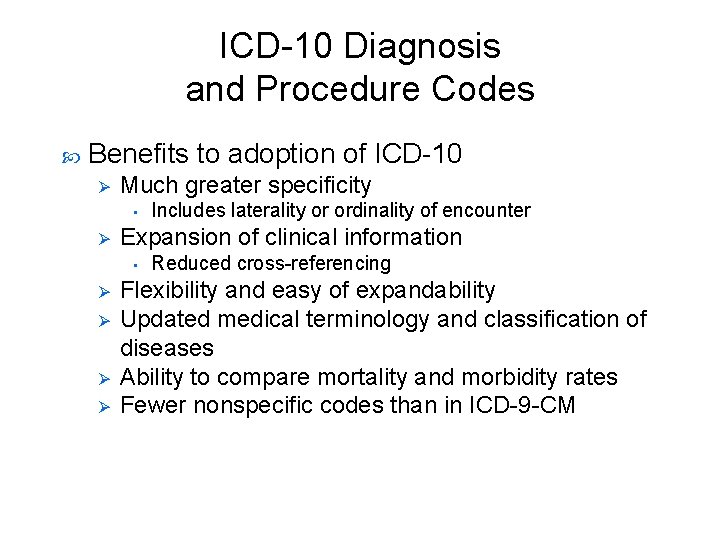
ICD-10 Diagnosis and Procedure Codes Benefits to adoption of ICD-10 Ø Much greater specificity • Ø Expansion of clinical information • Ø Ø Includes laterality or ordinality of encounter Reduced cross-referencing Flexibility and easy of expandability Updated medical terminology and classification of diseases Ability to compare mortality and morbidity rates Fewer nonspecific codes than in ICD-9 -CM
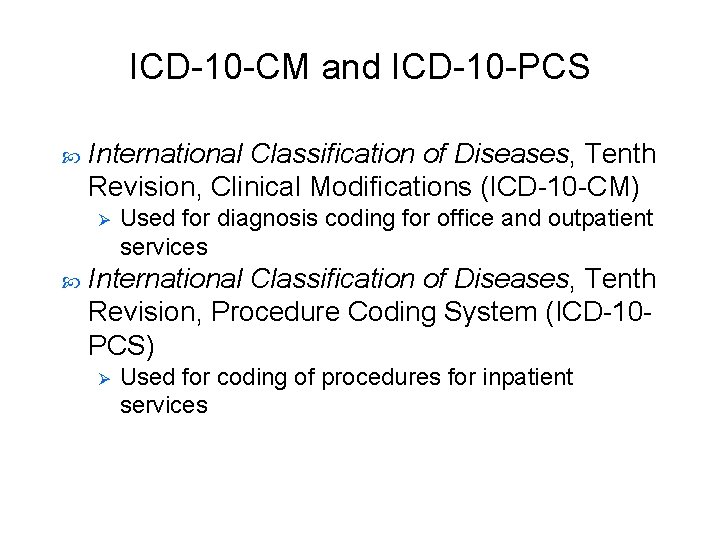
ICD-10 -CM and ICD-10 -PCS International Classification of Diseases, Tenth Revision, Clinical Modifications (ICD-10 -CM) Ø Used for diagnosis coding for office and outpatient services International Classification of Diseases, Tenth Revision, Procedure Coding System (ICD-10 PCS) Ø Used for coding of procedures for inpatient services
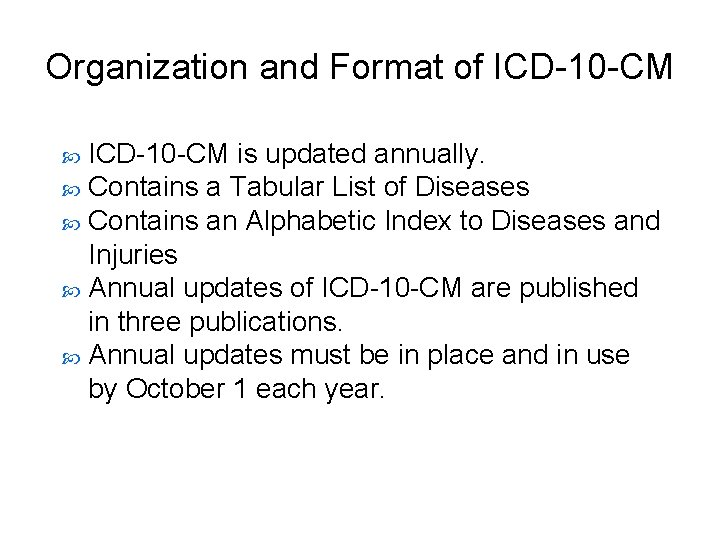
Organization and Format of ICD-10 -CM is updated annually. Contains a Tabular List of Diseases Contains an Alphabetic Index to Diseases and Injuries Annual updates of ICD-10 -CM are published in three publications. Annual updates must be in place and in use by October 1 each year.
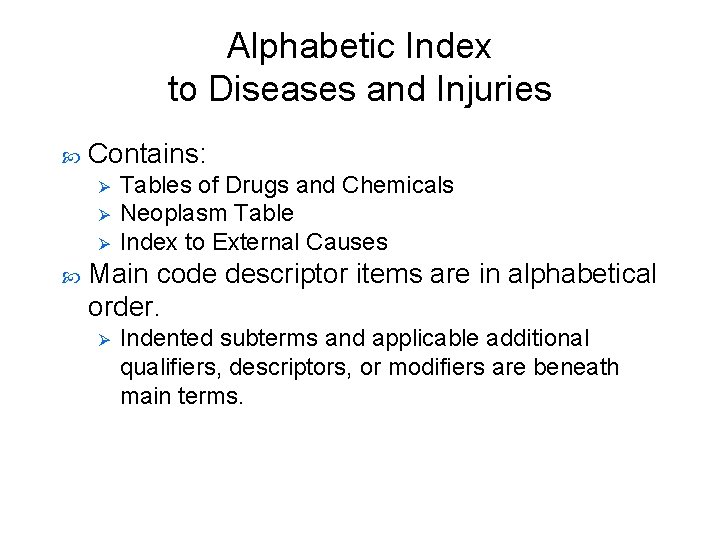
Alphabetic Index to Diseases and Injuries Contains: Ø Ø Ø Tables of Drugs and Chemicals Neoplasm Table Index to External Causes Main code descriptor items are in alphabetical order. Ø Indented subterms and applicable additional qualifiers, descriptors, or modifiers are beneath main terms.
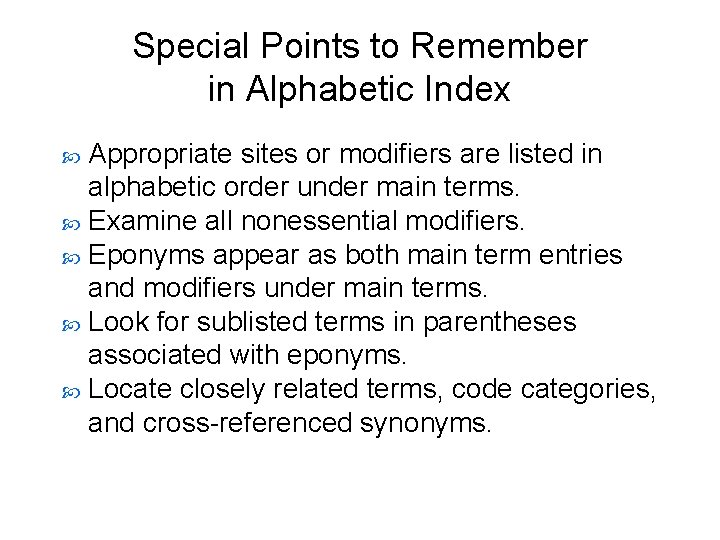
Special Points to Remember in Alphabetic Index Appropriate sites or modifiers are listed in alphabetic order under main terms. Examine all nonessential modifiers. Eponyms appear as both main term entries and modifiers under main terms. Look for sublisted terms in parentheses associated with eponyms. Locate closely related terms, code categories, and cross-referenced synonyms.
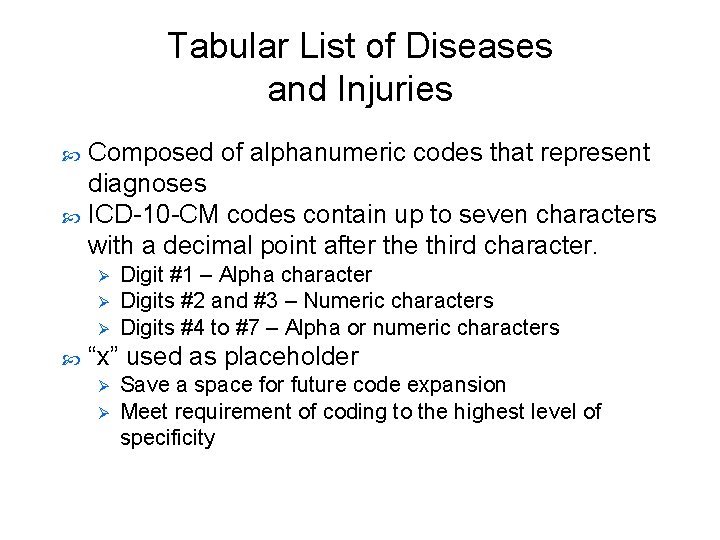
Tabular List of Diseases and Injuries Composed of alphanumeric codes that represent diagnoses ICD-10 -CM codes contain up to seven characters with a decimal point after the third character. Ø Ø Ø Digit #1 – Alpha character Digits #2 and #3 – Numeric characters Digits #4 to #7 – Alpha or numeric characters “x” used as placeholder Ø Ø Save a space for future code expansion Meet requirement of coding to the highest level of specificity
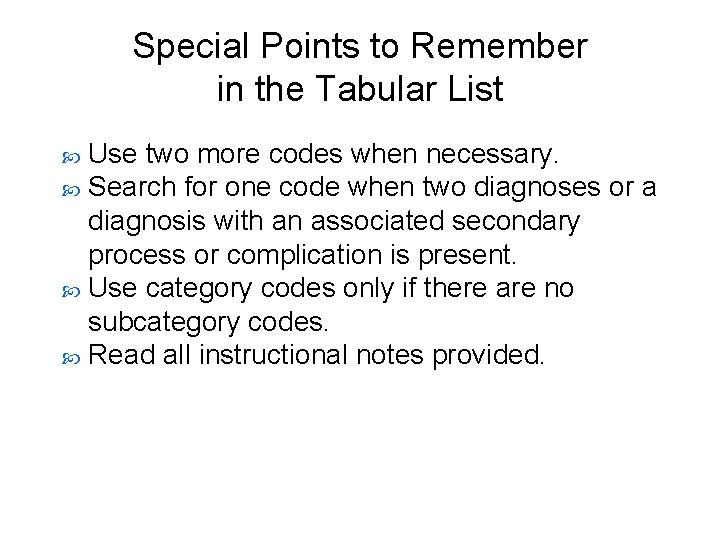
Special Points to Remember in the Tabular List Use two more codes when necessary. Search for one code when two diagnoses or a diagnosis with an associated secondary process or complication is present. Use category codes only if there are no subcategory codes. Read all instructional notes provided.
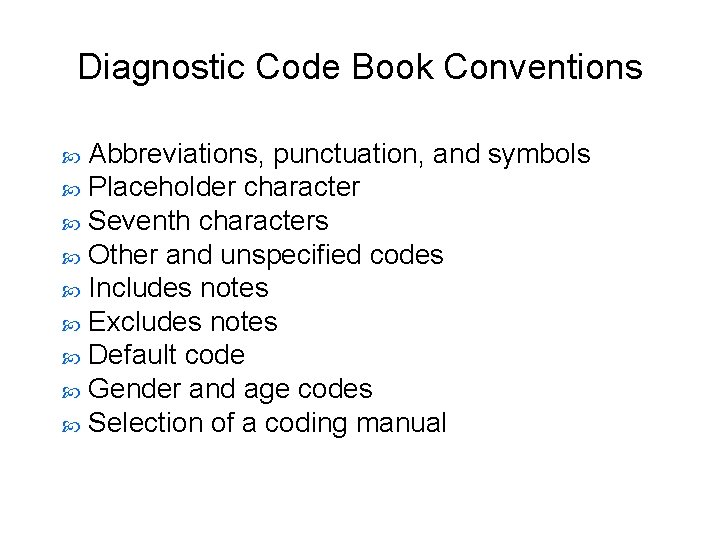
Diagnostic Code Book Conventions Abbreviations, punctuation, and symbols Placeholder character Seventh characters Other and unspecified codes Includes notes Excludes notes Default code Gender and age codes Selection of a coding manual
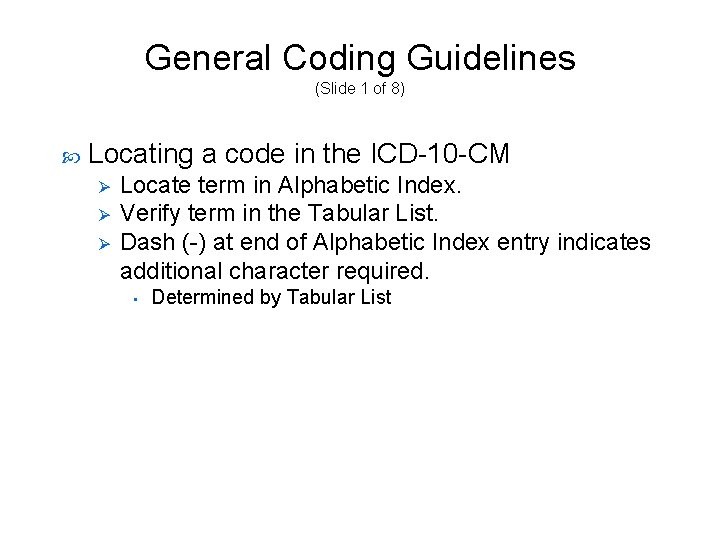
General Coding Guidelines (Slide 1 of 8) Locating a code in the ICD-10 -CM Ø Ø Ø Locate term in Alphabetic Index. Verify term in the Tabular List. Dash (-) at end of Alphabetic Index entry indicates additional character required. • Determined by Tabular List
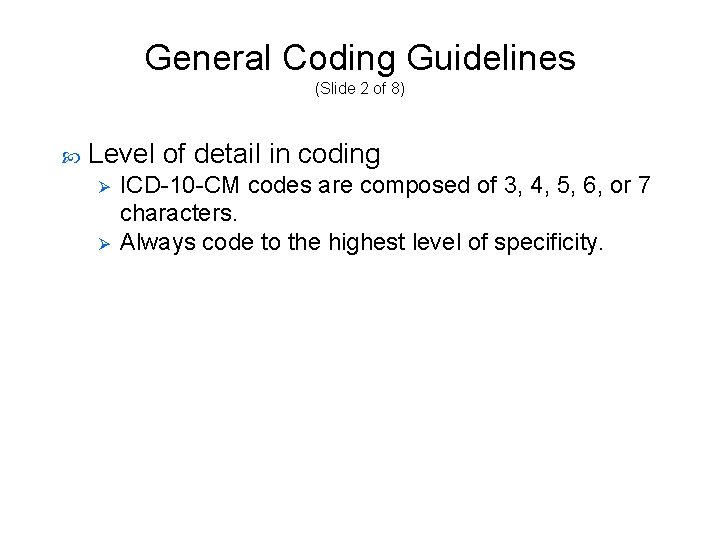
General Coding Guidelines (Slide 2 of 8) Level of detail in coding Ø Ø ICD-10 -CM codes are composed of 3, 4, 5, 6, or 7 characters. Always code to the highest level of specificity.
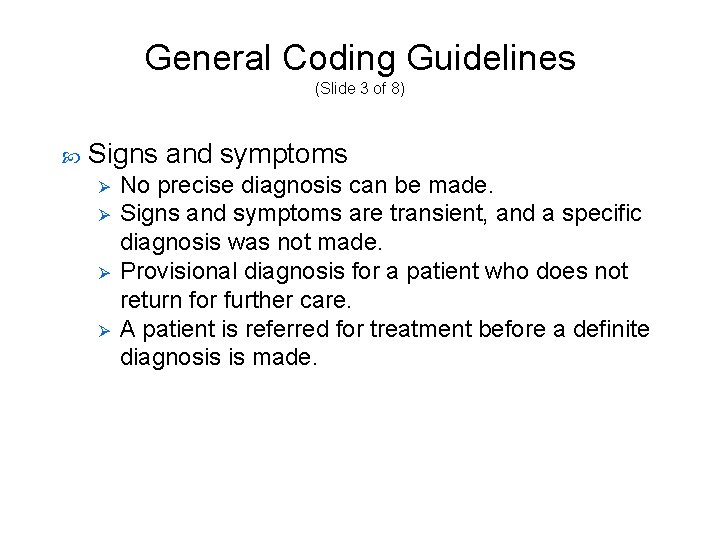
General Coding Guidelines (Slide 3 of 8) Signs and symptoms Ø Ø No precise diagnosis can be made. Signs and symptoms are transient, and a specific diagnosis was not made. Provisional diagnosis for a patient who does not return for further care. A patient is referred for treatment before a definite diagnosis is made.
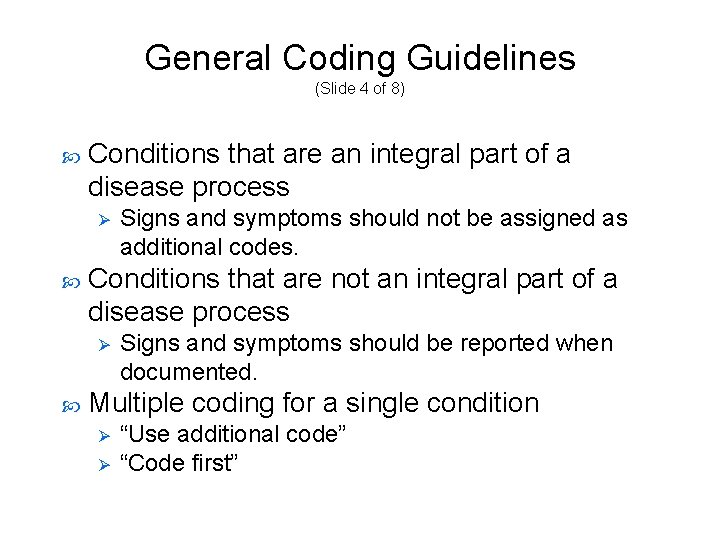
General Coding Guidelines (Slide 4 of 8) Conditions that are an integral part of a disease process Ø Conditions that are not an integral part of a disease process Ø Signs and symptoms should not be assigned as additional codes. Signs and symptoms should be reported when documented. Multiple coding for a single condition Ø Ø “Use additional code” “Code first”
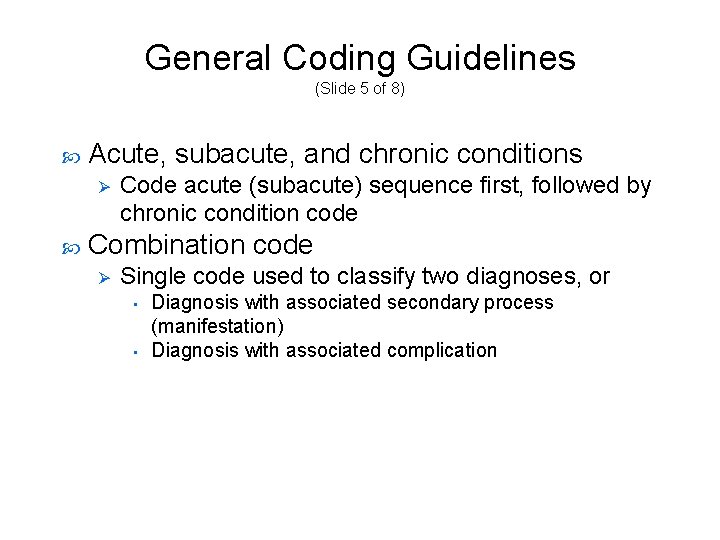
General Coding Guidelines (Slide 5 of 8) Acute, subacute, and chronic conditions Ø Code acute (subacute) sequence first, followed by chronic condition code Combination code Ø Single code used to classify two diagnoses, or • • Diagnosis with associated secondary process (manifestation) Diagnosis with associated complication
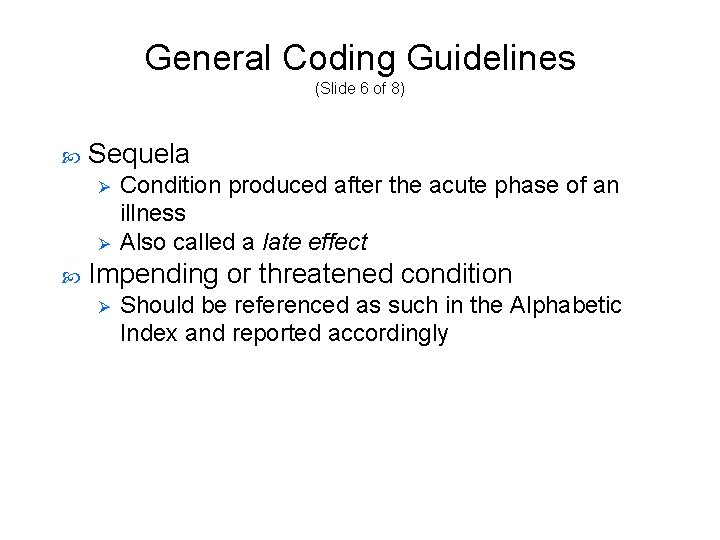
General Coding Guidelines (Slide 6 of 8) Sequela Ø Ø Condition produced after the acute phase of an illness Also called a late effect Impending or threatened condition Ø Should be referenced as such in the Alphabetic Index and reported accordingly
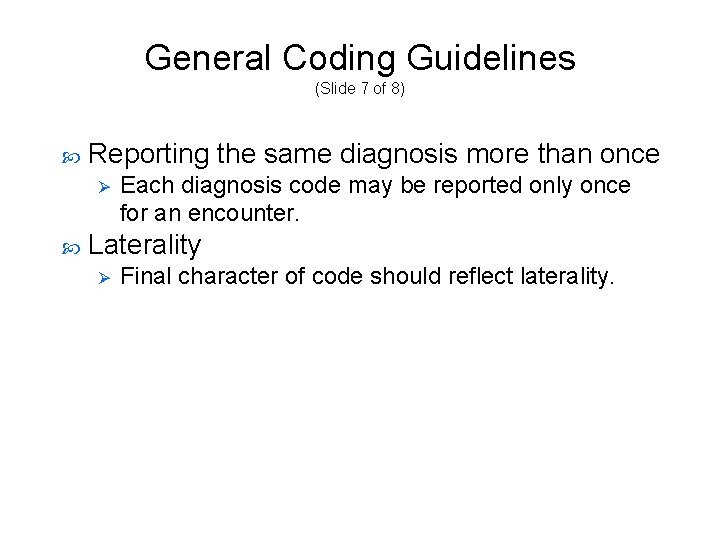
General Coding Guidelines (Slide 7 of 8) Reporting the same diagnosis more than once Ø Each diagnosis code may be reported only once for an encounter. Laterality Ø Final character of code should reflect laterality.
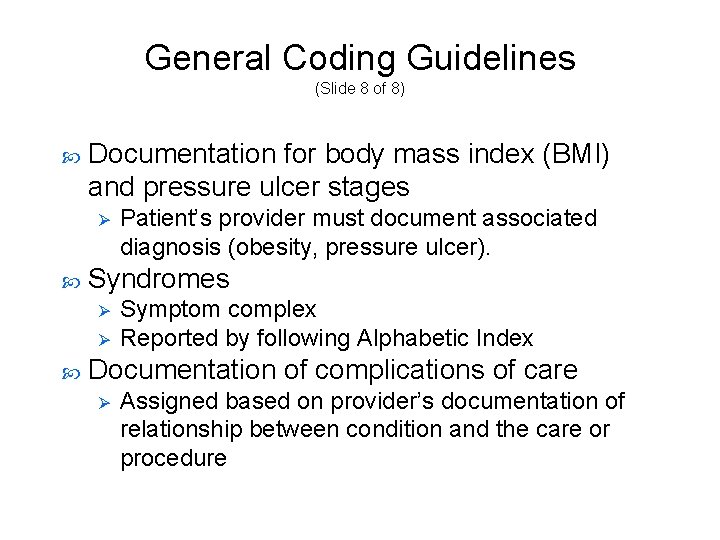
General Coding Guidelines (Slide 8 of 8) Documentation for body mass index (BMI) and pressure ulcer stages Ø Syndromes Ø Ø Patient’s provider must document associated diagnosis (obesity, pressure ulcer). Symptom complex Reported by following Alphabetic Index Documentation of complications of care Ø Assigned based on provider’s documentation of relationship between condition and the care or procedure
Chapter-Specific Coding Guidelines (Slide 1 of 2) Human immunodeficiency virus (HIV) Neoplasms Coding of diabetes mellitus Circulatory system conditions Hypertension Myocardial infarctions Pregnancy, delivery, or abortion
Chapter-Specific Coding Guidelines (Slide 2 of 2) Injury, poisoning, and other consequences of external causes Injuries and late effects Burns and corrosions Adverse effects, poisoning, underdosing, and toxic effects External causes of morbidity Factors influencing health status and contact with health services Encounters for reproductive services
Diagnostic Coding and Reporting Guidelines for Outpatient Services Outpatient surgery Uncertain diagnosis Chronic disease Code all documented conditions that coexist Patients receiving diagnostic services only Preoperative evaluations General medical examinations with abnormal findings
Handy Hints for Diagnostic Coding Identify important references with a highlighter. Add table to main section of Alphabetic Index, Tabular List, and Drug and Chemical Table. Keep a list of diagnostic and CPT procedure codes commonly encountered by your office. Consult payer guidelines. AMA publishes a list of the most common diagnostic codes at the end of each of its mini-specialty code books. Some medical practices develop an encounter form that is an all-encompassing billing document.
Computer-Assisted Coding Computer software automatically generates medical codes of review, validation, and use based on clinical documentation provided by health care practitioners. Two technology options Ø Structured input • Ø Data entry screens with point-and-click fields, pull-down menus, structure templates, or macros NLP • Uses artificial medical intelligence
The Future of Diagnosis Coding ICD is constantly under revision. Development of ICD-11 began in April 2007. ICD-11 is alphanumeric. ICD-11 was scheduled for dissemination by 2012, but the timeline has been pushed back. Ø Expected to be unveiled to the world in May 2017