
Chapter 12 Defining and Measuring Service Quality Chapter













- Slides: 28
Chapter 12 Defining and Measuring Service Quality
Chapter Objectives • Discuss the differences and the similarities between service quality and customer satisfaction. • Identify the gaps that influence consumer perceptions of service quality and discuss factors that influence the size of each of the service quality gaps. • Understand the basic concepts of the SERQUAL measurement scale and how “gap scores” are calculated. • Describe the variety of customer and noncustomer research approaches a service firm can use to construct a service quality information system. © 2017 Cengage Learning®. May not be scanned, copied or duplicated, or posted to a publicly accessible website, in whole or in part.
Opening Vignette: Pimalai Resort and Spa • Epitomizes the five dimensions of service quality – Tangibles, reliability responsiveness, assurance, and empathy • Has been recognized for: – Environmental protection – Providing an authentic local experience – Giving back to the community – Cultural commitment • Ninety percent of the flora and fauna found on the resort are indigenous to the area • Indigenous wildlife live in harmony within the resort – Flying dragon lizards, monkeys, and monitor lizards © 2017 Cengage Learning®. May not be scanned, copied or duplicated, or posted to a publicly accessible website, in whole or in part.
What Is Service Quality? • Service quality: an attitude formed by a long-term, overall evaluation of the firm’s performance • Customer satisfaction – A short-term, transaction-specific measure • The two concepts are intertwined but their relationship is unclear – Does customer satisfaction lead to perceived service quality or – Does service quality lead to customer satisfaction? © 2017 Cengage Learning®. May not be scanned, copied or duplicated, or posted to a publicly accessible website, in whole or in part.
Figure 12. 1: Conceptual Model of Service Quality © 2017 Cengage Learning®. May not be scanned, copied or duplicated, or posted to a publicly accessible website, in whole or in part.
Diagnosing Failure Gaps in Service Quality • Gap 1: The knowledge gap – Influenced by the firm’s: • Research orientation • Upward communication • Levels of management © 2017 Cengage Learning®. May not be scanned, copied or duplicated, or posted to a publicly accessible website, in whole or in part.
Diagnosing Failure Gaps in Service Quality (cont’d) • Gap 2: The standards gap – Influenced by: • Perceptions of feasibility • Management’s commitment to the delivery of service quality vs. cost reduction and short-term profits • No culture for service quality • Insufficient methods of measuring quality or converting those measurements into standards • Difficulties in attempts to write specifications for particular employee behaviors © 2017 Cengage Learning®. May not be scanned, copied or duplicated, or posted to a publicly accessible website, in whole or in part.
Diagnosing Failure Gaps in Service Quality (cont’d) • Gap 3: The delivery gap – Influenced by: • • • Willingness to perform Employee-job fit Role conflict Role ambiguity Dispersion of control – Learned helplessness • Inadequate support © 2017 Cengage Learning®. May not be scanned, copied or duplicated, or posted to a publicly accessible website, in whole or in part.
Diagnosing Failure Gaps in Service Quality (cont’d) • Gap 4: The communications gap – Influenced by the: • Propensity of overpromising • Amount of horizontal communication © 2017 Cengage Learning®. May not be scanned, copied or duplicated, or posted to a publicly accessible website, in whole or in part.
Measuring Service Quality: The SERVQUAL Measurement Scale • A diagnostic tool that uncovers a firm’s broad weaknesses and strengths in the area of service quality • Consists of two sections of questions – The first section is comprised of 22 questions that ask respondents to record their expectations of excellent firms in the specific service industry – The second section of questions is comprised of 22 matching questions that assess consumer perceptions of a particular company in that service industry © 2017 Cengage Learning®. May not be scanned, copied or duplicated, or posted to a publicly accessible website, in whole or in part.
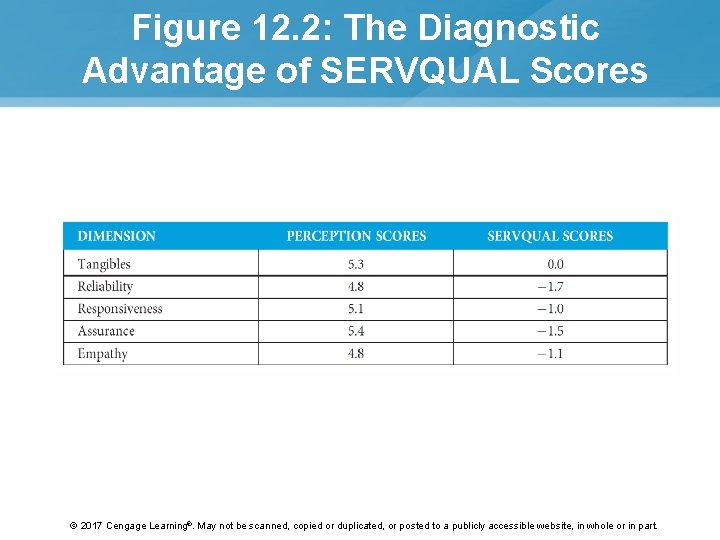
Measuring Service Quality: The SERVQUAL Measurement Scale (cont’d) • When the mean expectation score is subtracted from the mean perception score, a “gap score” is created – Positive gap scores reflect situations where perceptions exceed expectations and customers are happy – Negative gap scores exist where perceptions that are less than expectations reflect unsatisfactory situations and customer unhappiness – When the gap score equals zero, customer perceptions have met customer expectations, and consumers are satisfied © 2017 Cengage Learning®. May not be scanned, copied or duplicated, or posted to a publicly accessible website, in whole or in part.
Measuring Service Quality: The SERVQUAL Measurement Scale (cont’d) • A 44 -item scale that measures customer expectations and perceptions regarding five service quality dimensions © 2017 Cengage Learning®. May not be scanned, copied or duplicated, or posted to a publicly accessible website, in whole or in part.
Measuring Service Quality: The SERVQUAL Measurement Scale (cont’d) The Tangibles Dimension The Reliability Dimension The Responsiveness Dimension The Assurance Dimension The Empathy Dimension © 2017 Cengage Learning®. May not be scanned, copied or duplicated, or posted to a publicly accessible website, in whole or in part.
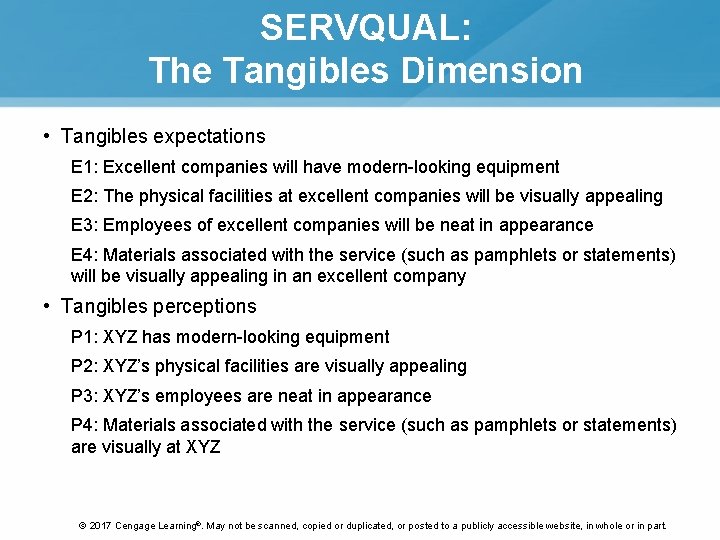
SERVQUAL: The Tangibles Dimension • Tangibles expectations E 1: Excellent companies will have modern-looking equipment E 2: The physical facilities at excellent companies will be visually appealing E 3: Employees of excellent companies will be neat in appearance E 4: Materials associated with the service (such as pamphlets or statements) will be visually appealing in an excellent company • Tangibles perceptions P 1: XYZ has modern-looking equipment P 2: XYZ’s physical facilities are visually appealing P 3: XYZ’s employees are neat in appearance P 4: Materials associated with the service (such as pamphlets or statements) are visually at XYZ © 2017 Cengage Learning®. May not be scanned, copied or duplicated, or posted to a publicly accessible website, in whole or in part.
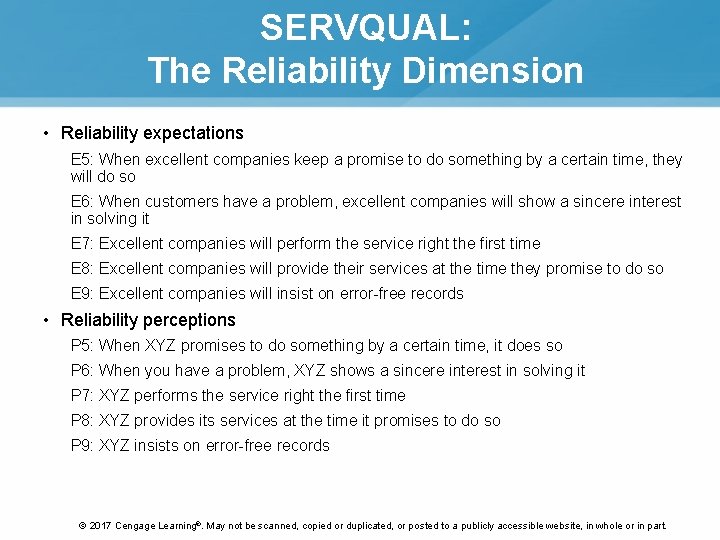
SERVQUAL: The Reliability Dimension • Reliability expectations E 5: When excellent companies keep a promise to do something by a certain time, they will do so E 6: When customers have a problem, excellent companies will show a sincere interest in solving it E 7: Excellent companies will perform the service right the first time E 8: Excellent companies will provide their services at the time they promise to do so E 9: Excellent companies will insist on error-free records • Reliability perceptions P 5: When XYZ promises to do something by a certain time, it does so P 6: When you have a problem, XYZ shows a sincere interest in solving it P 7: XYZ performs the service right the first time P 8: XYZ provides its services at the time it promises to do so P 9: XYZ insists on error-free records © 2017 Cengage Learning®. May not be scanned, copied or duplicated, or posted to a publicly accessible website, in whole or in part.
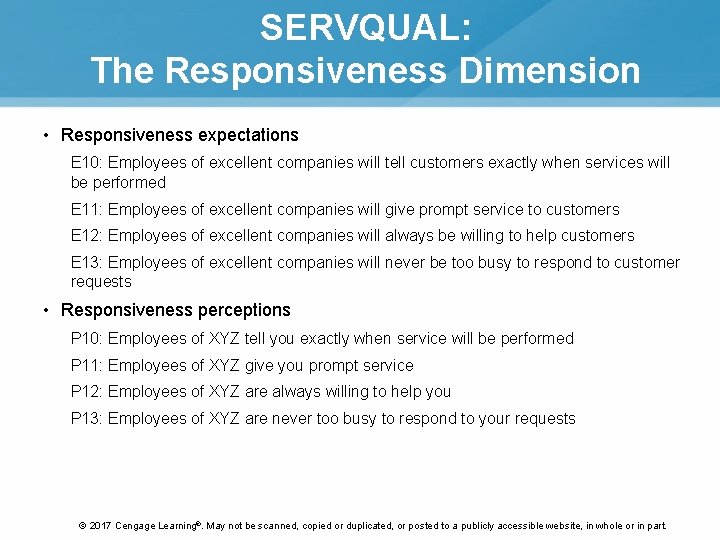
SERVQUAL: The Responsiveness Dimension • Responsiveness expectations E 10: Employees of excellent companies will tell customers exactly when services will be performed E 11: Employees of excellent companies will give prompt service to customers E 12: Employees of excellent companies will always be willing to help customers E 13: Employees of excellent companies will never be too busy to respond to customer requests • Responsiveness perceptions P 10: Employees of XYZ tell you exactly when service will be performed P 11: Employees of XYZ give you prompt service P 12: Employees of XYZ are always willing to help you P 13: Employees of XYZ are never too busy to respond to your requests © 2017 Cengage Learning®. May not be scanned, copied or duplicated, or posted to a publicly accessible website, in whole or in part.
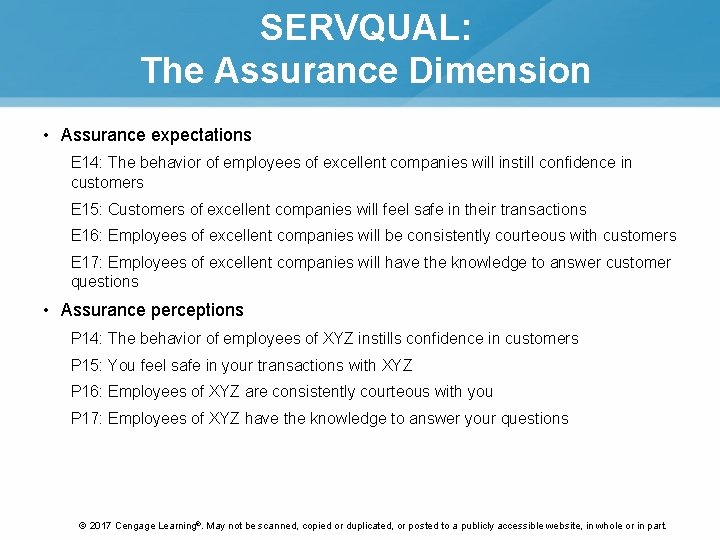
SERVQUAL: The Assurance Dimension • Assurance expectations E 14: The behavior of employees of excellent companies will instill confidence in customers E 15: Customers of excellent companies will feel safe in their transactions E 16: Employees of excellent companies will be consistently courteous with customers E 17: Employees of excellent companies will have the knowledge to answer customer questions • Assurance perceptions P 14: The behavior of employees of XYZ instills confidence in customers P 15: You feel safe in your transactions with XYZ P 16: Employees of XYZ are consistently courteous with you P 17: Employees of XYZ have the knowledge to answer your questions © 2017 Cengage Learning®. May not be scanned, copied or duplicated, or posted to a publicly accessible website, in whole or in part.
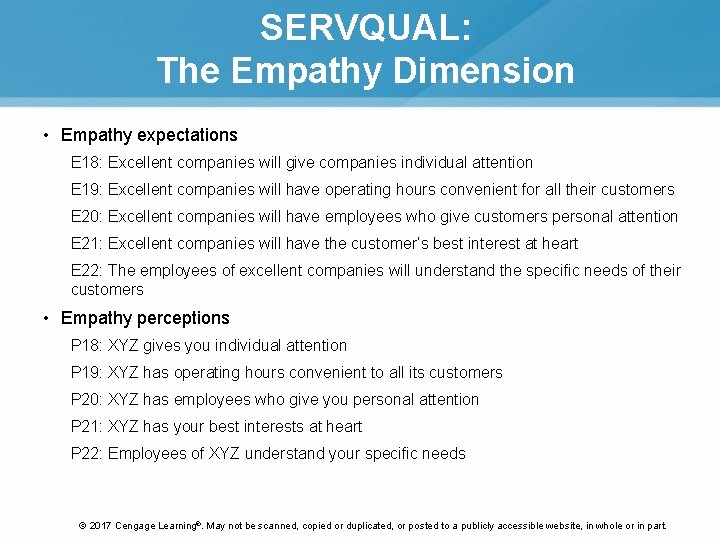
SERVQUAL: The Empathy Dimension • Empathy expectations E 18: Excellent companies will give companies individual attention E 19: Excellent companies will have operating hours convenient for all their customers E 20: Excellent companies will have employees who give customers personal attention E 21: Excellent companies will have the customer’s best interest at heart E 22: The employees of excellent companies will understand the specific needs of their customers • Empathy perceptions P 18: XYZ gives you individual attention P 19: XYZ has operating hours convenient to all its customers P 20: XYZ has employees who give you personal attention P 21: XYZ has your best interests at heart P 22: Employees of XYZ understand your specific needs © 2017 Cengage Learning®. May not be scanned, copied or duplicated, or posted to a publicly accessible website, in whole or in part.
Criticisms of SERVQUAL • Length of the questionnaire – Expectation and perception questions seem redundant – What’s the value of including the expectation section? • The validity of the five dimensions – The five proposed dimensions of service quality do not hold up under statistical scrutiny – Measurement issues © 2017 Cengage Learning®. May not be scanned, copied or duplicated, or posted to a publicly accessible website, in whole or in part.
Figure 12. 2: The Diagnostic Advantage of SERVQUAL Scores © 2017 Cengage Learning®. May not be scanned, copied or duplicated, or posted to a publicly accessible website, in whole or in part.
Figure 12. 3: Relative Importance of SERVQUAL Dimensions as Reported by Consumers © 2017 Cengage Learning®. May not be scanned, copied or duplicated, or posted to a publicly accessible website, in whole or in part.
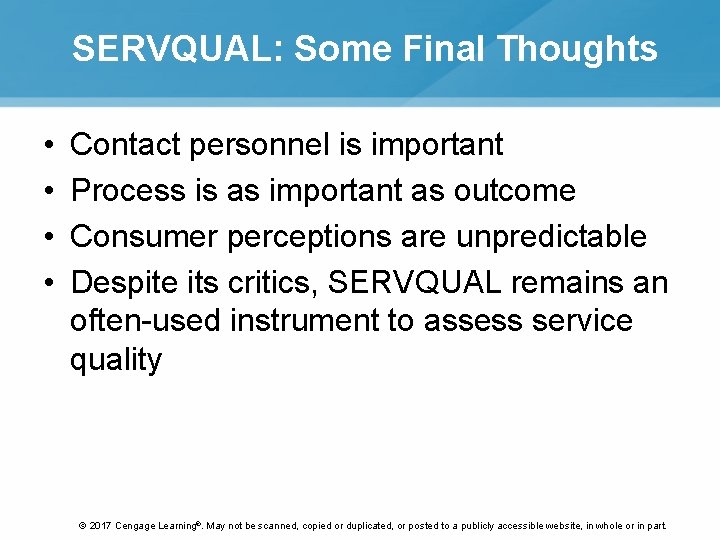
SERVQUAL: Some Final Thoughts • • Contact personnel is important Process is as important as outcome Consumer perceptions are unpredictable Despite its critics, SERVQUAL remains an often-used instrument to assess service quality © 2017 Cengage Learning®. May not be scanned, copied or duplicated, or posted to a publicly accessible website, in whole or in part.
Service Quality Information Systems • Solicitation of customer complaints – Primary objectives of soliciting customer complaints: • Identify unhappy customers • Identify weaknesses in the firm’s service delivery system and take the correction actions necessary to minimize future occurrences of the same problem • After-sales surveys – A more proactive approach to assessing customer satisfaction than solicitation of complaints – Attempts to contact every customer and take corrective action if a customer is less than satisfied with his or her purchase decision – The survey is taken while the encounter is fresh on the customer’s mind © 2017 Cengage Learning®. May not be scanned, copied or duplicated, or posted to a publicly accessible website, in whole or in part.
Service Quality Information Systems (cont’d) • Customer focus group interviews – Participants are encouraged to express their views and comment on suggestions made by others in the group – Other forms of research are generally necessary to confirm that the groups’ ideas reflect the feelings of the broader segment of consumers • Mystery shopping – Measures individual employee behavior – Aids the firm in coaching, training, evaluating, and formally recognizing its employees © 2017 Cengage Learning®. May not be scanned, copied or duplicated, or posted to a publicly accessible website, in whole or in part.
Service Quality Information Systems (cont’d) • Employee surveys – Employee satisfaction with the firm directly corresponds to customer satisfaction – Employee surveys should examine morale, attitudes, and perceived obstacles • Total market service quality surveys – Assesses the firm’s service quality and its competitors’ perceived service quality – Provide a firm with information about needed improvements in the service delivery system and measure the progress the firm has been making in previously identified areas of need © 2017 Cengage Learning®. May not be scanned, copied or duplicated, or posted to a publicly accessible website, in whole or in part.
Service Quality Information Systems (cont’d) • Listening – Quality is defined by the customer – Conformance to company specifications is not quality; conformance to customers’ specifications is • Reliability – The core of service quality – Little else matters to a customer when a service is unreliable • Basic service – Deliver the basics first; the frills can come later © 2017 Cengage Learning®. May not be scanned, copied or duplicated, or posted to a publicly accessible website, in whole or in part.
Service Quality Information Systems (cont’d) • Service design – Design flaws can reduce the perception of quality • Recovery – Firms that do not respond effectively to customer complaints compound the service failure • Surprising customers – Exceeding customer expectations • Fair play – Customers expect to be treated fairly and will become resentful and mistrustful if treated otherwise © 2017 Cengage Learning®. May not be scanned, copied or duplicated, or posted to a publicly accessible website, in whole or in part.
Service Quality Information Systems (cont’d) • Teamwork – Service team building should not be left to chance • Employee research – Is as important to service improvement as customer research • Servant leadership – Leadership must serve the servers—inspiring, coaching, and enabling them to achieve © 2017 Cengage Learning®. May not be scanned, copied or duplicated, or posted to a publicly accessible website, in whole or in part.