
CHAPTER 12 Decision Making Creativity and Ethics Copyright



- Slides: 46
CHAPTER 12 Decision Making, Creativity, and Ethics Copyright © 2016 Pearson Canada Inc.
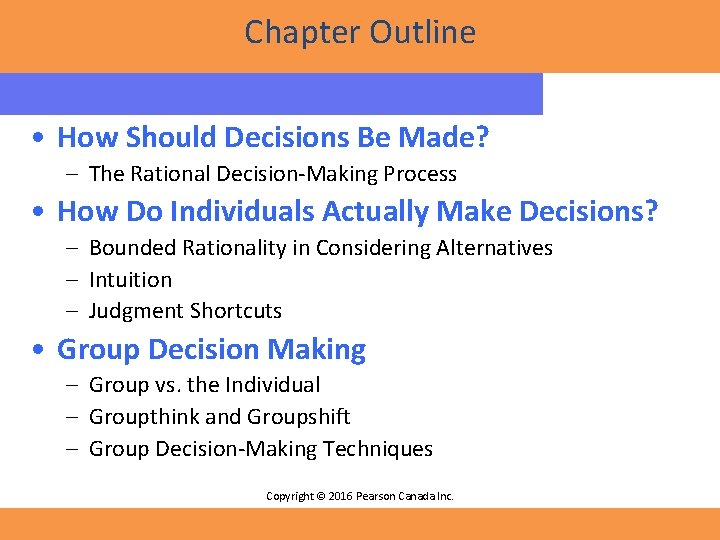
Chapter Outline • How Should Decisions Be Made? – The Rational Decision-Making Process • How Do Individuals Actually Make Decisions? – Bounded Rationality in Considering Alternatives – Intuition – Judgment Shortcuts • Group Decision Making – Group vs. the Individual – Groupthink and Groupshift – Group Decision-Making Techniques Copyright © 2016 Pearson Canada Inc.
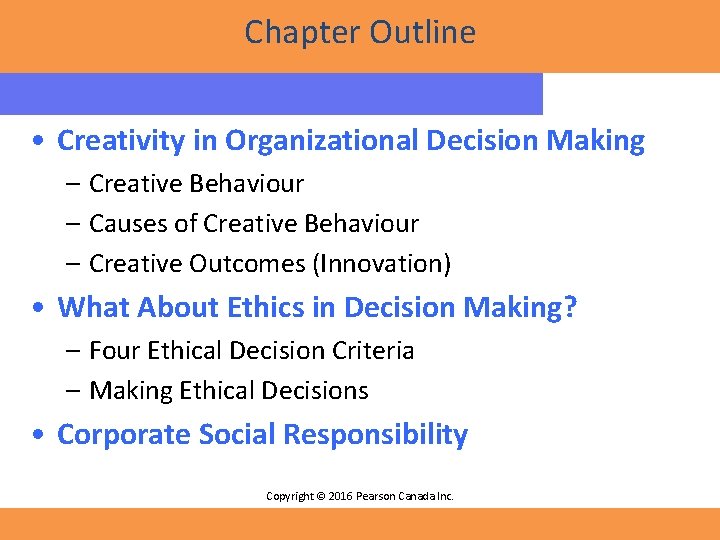
Chapter Outline • Creativity in Organizational Decision Making – Creative Behaviour – Causes of Creative Behaviour – Creative Outcomes (Innovation) • What About Ethics in Decision Making? – Four Ethical Decision Criteria – Making Ethical Decisions • Corporate Social Responsibility Copyright © 2016 Pearson Canada Inc.
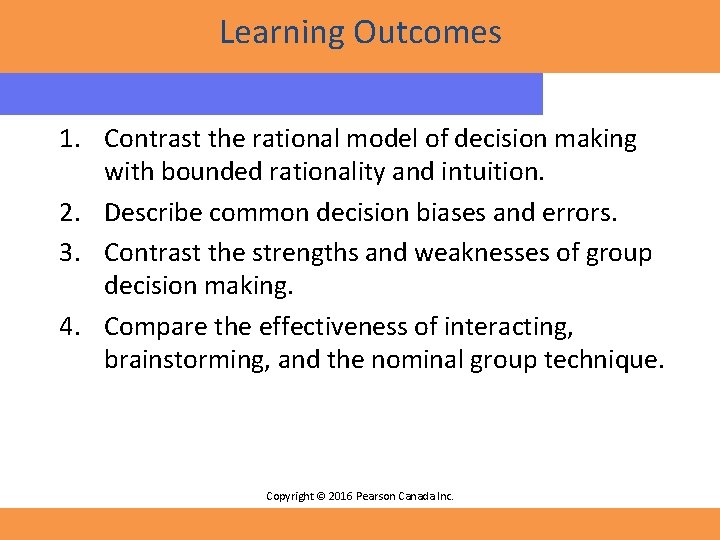
Learning Outcomes 1. Contrast the rational model of decision making with bounded rationality and intuition. 2. Describe common decision biases and errors. 3. Contrast the strengths and weaknesses of group decision making. 4. Compare the effectiveness of interacting, brainstorming, and the nominal group technique. Copyright © 2016 Pearson Canada Inc.
Learning Outcomes 5. Define creativity, and describe threestage model of creativity. 6. Describe the four criteria used in making ethical decisions. 7. Define corporate social responsibility. Copyright © 2016 Pearson Canada Inc.
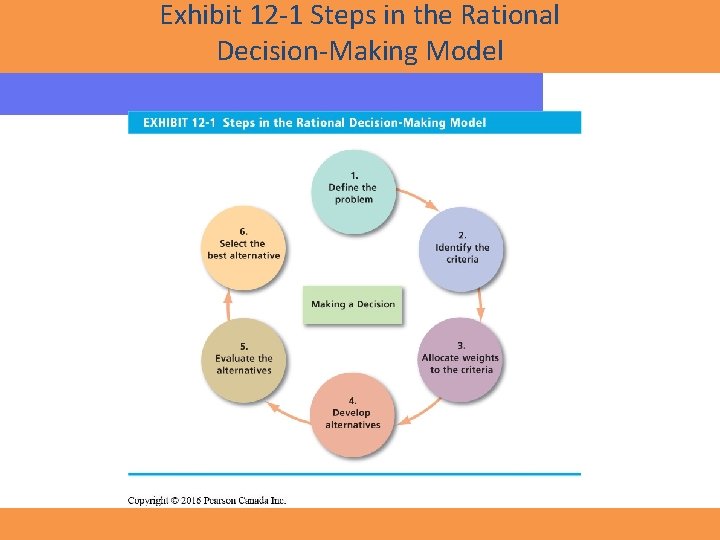
How Should Decisions Be Made? • Decision: Choice made from two or more alternatives • Rational: Choices that are consistent and valuemaximizing within specified constraints • Rational Decision-Making – Six step decision-making process – Describes how individuals should behave in order to maximize some outcome Copyright © 2016 Pearson Canada Inc.
Exhibit 12 -1 Steps in the Rational Decision-Making Model Copyright © 2016 Pearson Canada Inc.
Assumptions of the Rational Decision-Making Model • Complete information – The problem is clear and unambiguous. • Known options – The decision maker is able to identify all relevant options in an unbiased manner. • Chooses the option with the highest utility Copyright © 2016 Pearson Canada Inc.
How Do Individuals Actually Make Decisions? • Bounded Rationality – Limitations on one’s ability to interpret, process, and act on information. • Satisficing – Identifying a solution that is “good enough. ” – The first acceptable option rather than the optimal one • Intuition – A non-conscious process created from distilled experience that results in quick decisions • Relies on holistic associations • Affectively charged – engaging the emotions Copyright © 2016 Pearson Canada Inc.
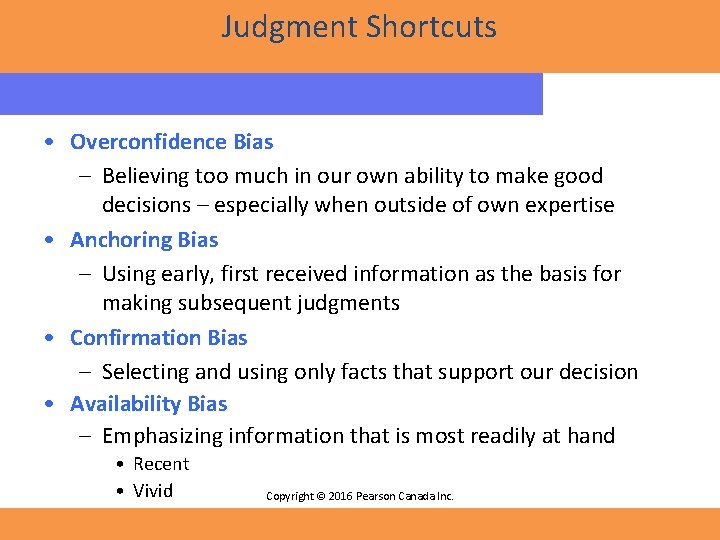
Judgment Shortcuts • Overconfidence Bias – Believing too much in our own ability to make good decisions – especially when outside of own expertise • Anchoring Bias – Using early, first received information as the basis for making subsequent judgments • Confirmation Bias – Selecting and using only facts that support our decision • Availability Bias – Emphasizing information that is most readily at hand • Recent • Vivid Copyright © 2016 Pearson Canada Inc.
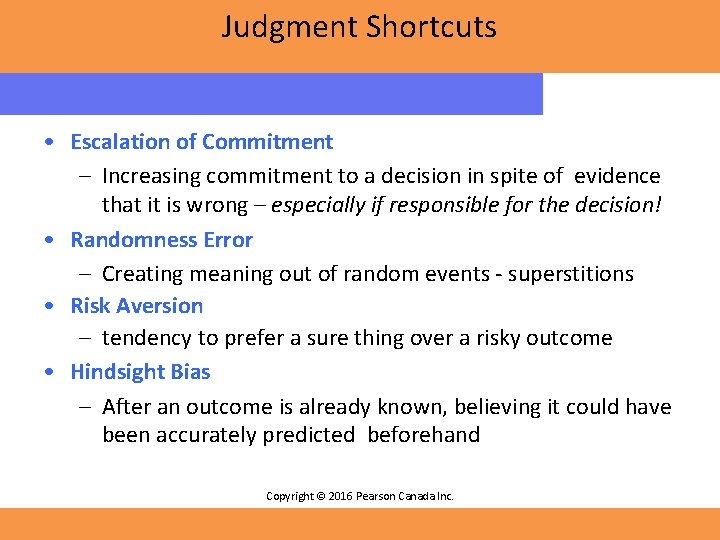
Judgment Shortcuts • Escalation of Commitment – Increasing commitment to a decision in spite of evidence that it is wrong – especially if responsible for the decision! • Randomness Error – Creating meaning out of random events - superstitions • Risk Aversion – tendency to prefer a sure thing over a risky outcome • Hindsight Bias – After an outcome is already known, believing it could have been accurately predicted beforehand Copyright © 2016 Pearson Canada Inc.
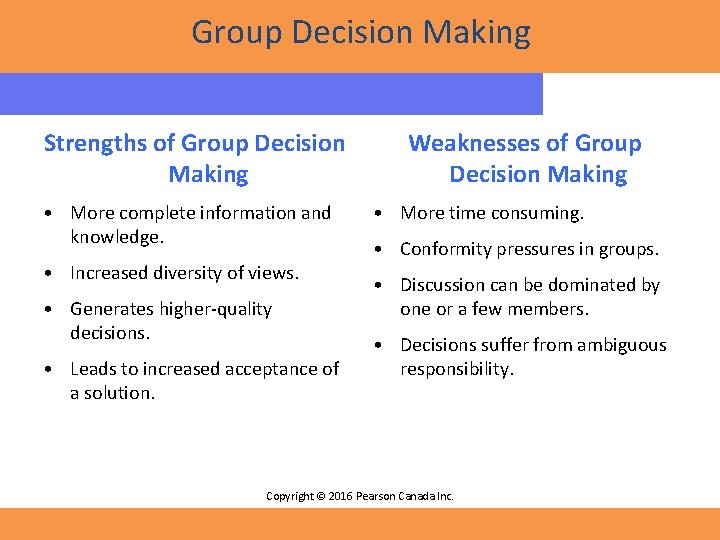
Group Decision Making Strengths of Group Decision Making • More complete information and knowledge. • Increased diversity of views. • Generates higher-quality decisions. • Leads to increased acceptance of a solution. Weaknesses of Group Decision Making • More time consuming. • Conformity pressures in groups. • Discussion can be dominated by one or a few members. • Decisions suffer from ambiguous responsibility. Copyright © 2016 Pearson Canada Inc.
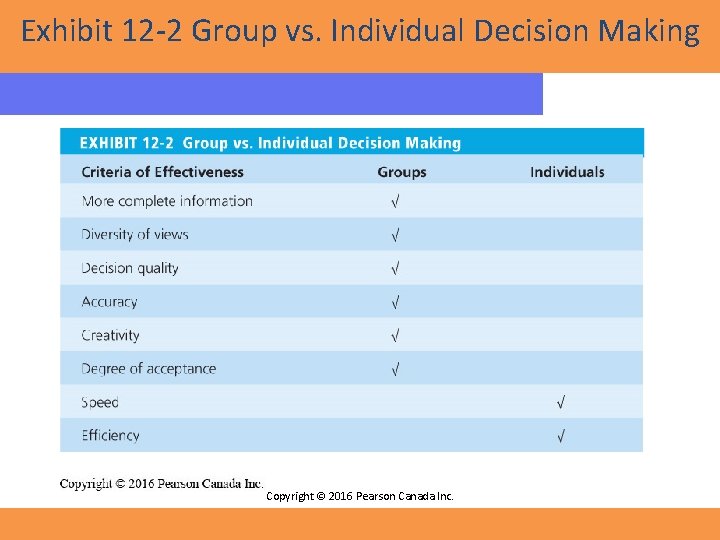
Exhibit 12 -2 Group vs. Individual Decision Making Copyright © 2016 Pearson Canada Inc.
Effectiveness and Efficiency • Measures of Effectiveness – Accuracy – Speed – Creativity – Acceptance • Efficiency – groups almost always stack up as a poor second to the individual decision maker – With few exceptions, group decision making consumes more work hours than if an individual were to tackle the same problem alone. Copyright © 2016 Pearson Canada Inc.
Groupthink and Groupshift • Groupthink – Phenomenon in which the norm for conformity prevents the group from critically appraising unusual, minority, or unpopular views • Groupshift – Phenomenon in which the initial positions of individual members of a group are exaggerated because of the interactions of the group Copyright © 2016 Pearson Canada Inc.
Symptoms of Groupthink • Illusion of invulnerability • Assumption of morality • Peer pressure • Minimized doubts • Illusion of unanimity • Rationalized resistance Copyright © 2016 Pearson Canada Inc.
Minimizing Groupthink • Monitor group size • Encourage group leaders to play an impartial role. • Appoint one group member to play the role of devil’s advocate. • Stimulate active discussion of diverse alternatives to encourage dissenting views and more objective evaluations Copyright © 2016 Pearson Canada Inc.
What Causes Groupshift? • Discussion creates familiarization among group members. • Group discussion motivates individuals to take risks. • Group diffuses responsibility. Copyright © 2016 Pearson Canada Inc.
Group Decision-Making Techniques • Interacting Groups • Brainstorming • Nominal Group Technique • Electronic Meetings Copyright © 2016 Pearson Canada Inc.
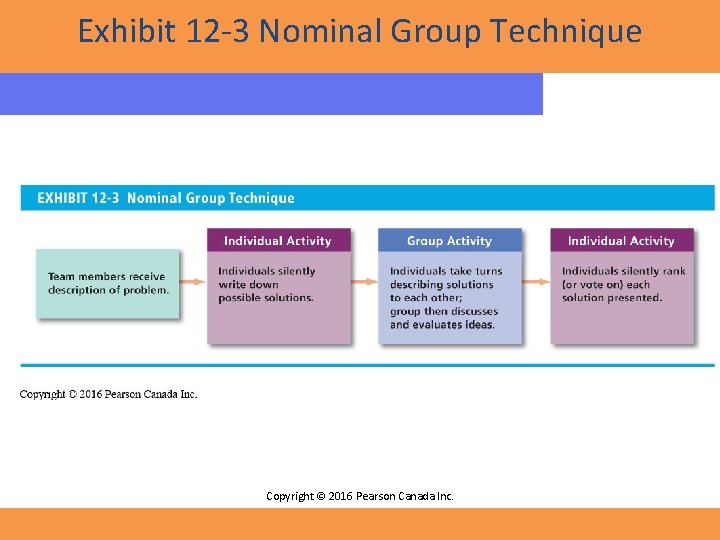
Exhibit 12 -3 Nominal Group Technique Copyright © 2016 Pearson Canada Inc.
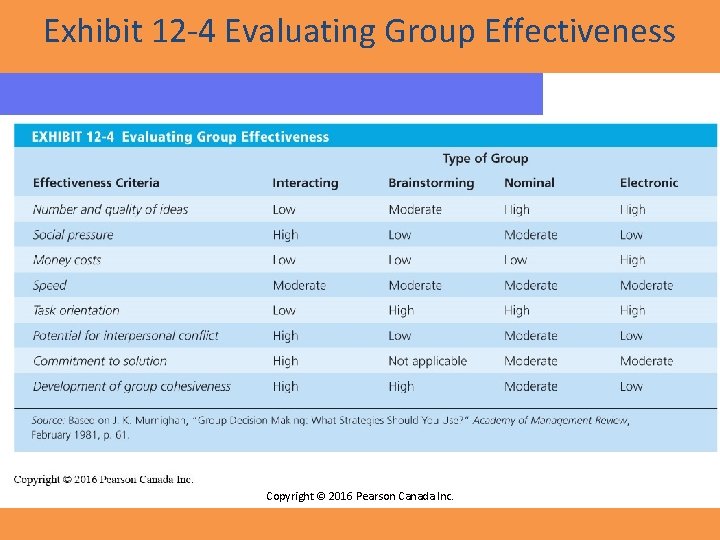
Exhibit 12 -4 Evaluating Group Effectiveness Copyright © 2016 Pearson Canada Inc.
Creativity in Organizational Decision Making • The ability to produce novel (original) and useful ideas. • Creativity is important because – It allows the decision maker to more fully understand appraise the problem Copyright © 2016 Pearson Canada Inc.
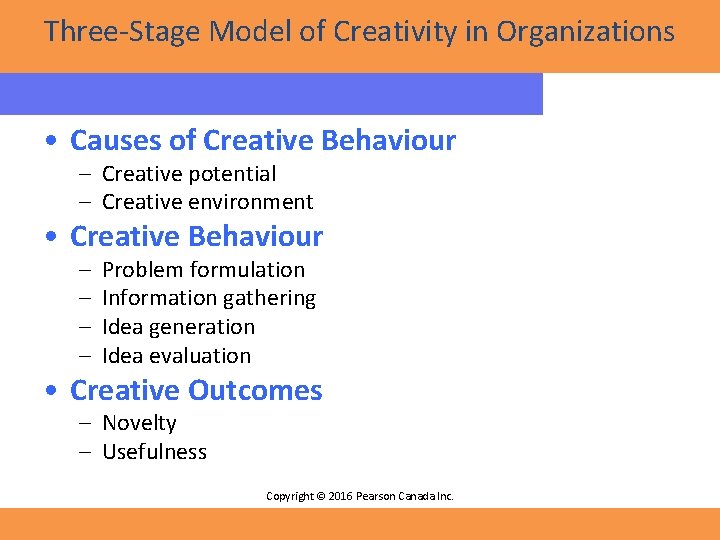
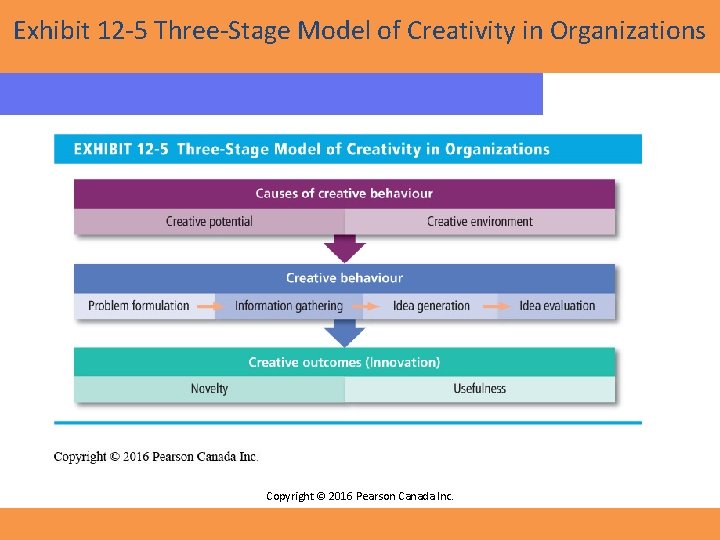
Three-Stage Model of Creativity in Organizations • Causes of Creative Behaviour – Creative potential – Creative environment • Creative Behaviour – – Problem formulation Information gathering Idea generation Idea evaluation • Creative Outcomes – Novelty – Usefulness Copyright © 2016 Pearson Canada Inc.
Exhibit 12 -5 Three-Stage Model of Creativity in Organizations Copyright © 2016 Pearson Canada Inc.
Creative Behaviour • Problem Formulation • Information Gathering • Idea Generation • Idea Evaluation Copyright © 2016 Pearson Canada Inc.
Creative Potential • Who has the greatest creative potential? – Those people who • • Are intelligent Score high in Openness to Experience (Chapter 2) Have proactive personality Have high self-confidence Are risk-takers Are tolerant of ambiguity Are able and willing to persevere Have expertise in the area Copyright © 2016 Pearson Canada Inc.
Creative Environment • We need to be in an environment where creative potential can be realized – Environment which • Creates motivation • Rewards and recognizes creative work • Freedom from excessive rules • Good leadership Copyright © 2016 Pearson Canada Inc.
Creative Outcomes (Innovation) • Ideas or solutions judged to be novel and useful by relevant stakeholders • “Ideas are useless unless used” • Creative ideas are more likely to be used when • The individual was motivated to translate the idea into practice • Conducive organizational climate Copyright © 2016 Pearson Canada Inc.
Ethics • The study of moral values or principles that guide our behaviour and inform us whether actions are right or wrong • Help us do the “right thing” • Ethical considerations should be an important criterion in organizational decision making. Copyright © 2016 Pearson Canada Inc.
Four Ethical Decision Criteria • Utilitarian criterion – A decision focused on outcomes or consequences that emphasize the greatest good for the greatest number of people. • Rights criterion – Decisions consistent with fundamental liberties and privileges as set forth in documents like the Canadian Charter of Rights and Freedoms. – Protects whistle-blowers Copyright © 2016 Pearson Canada Inc.
Four Ethical Decision Criteria • Justice criterion – Decisions that impose and enforce rules fairly and impartially so there is an equitable distribution of benefits and costs. • Care criterion – Decisions “…that expresses care in protecting the special relationships that individuals have with each other. ” Copyright © 2016 Pearson Canada Inc.
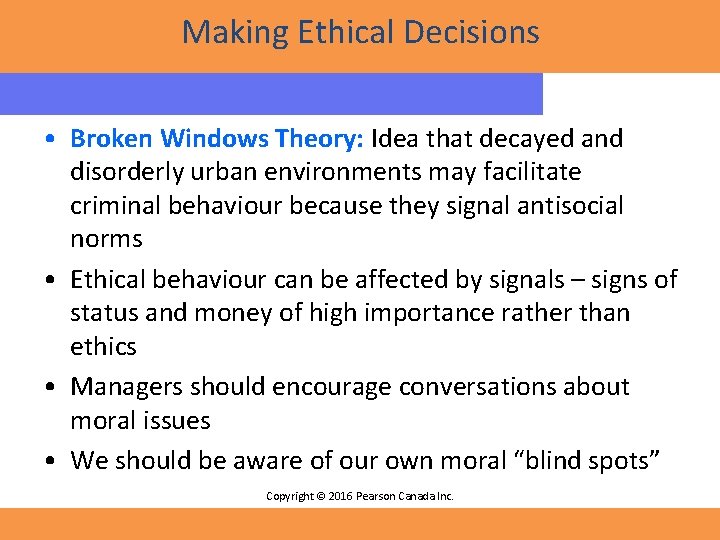
Making Ethical Decisions • Broken Windows Theory: Idea that decayed and disorderly urban environments may facilitate criminal behaviour because they signal antisocial norms • Ethical behaviour can be affected by signals – signs of status and money of high importance rather than ethics • Managers should encourage conversations about moral issues • We should be aware of our own moral “blind spots” Copyright © 2016 Pearson Canada Inc.
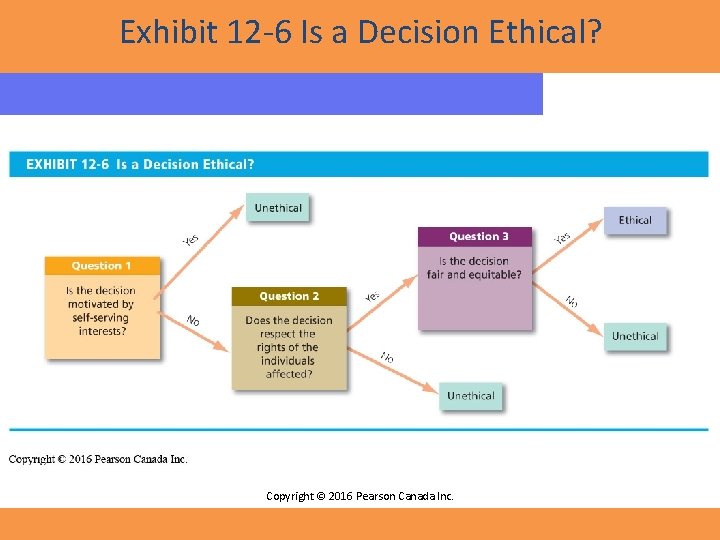
Exhibit 12 -6 Is a Decision Ethical? Copyright © 2016 Pearson Canada Inc.
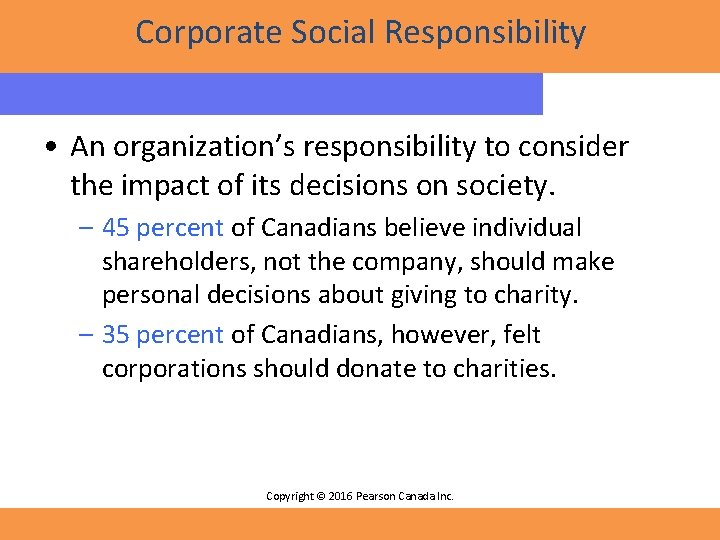
Corporate Social Responsibility • An organization’s responsibility to consider the impact of its decisions on society. – 45 percent of Canadians believe individual shareholders, not the company, should make personal decisions about giving to charity. – 35 percent of Canadians, however, felt corporations should donate to charities. Copyright © 2016 Pearson Canada Inc.
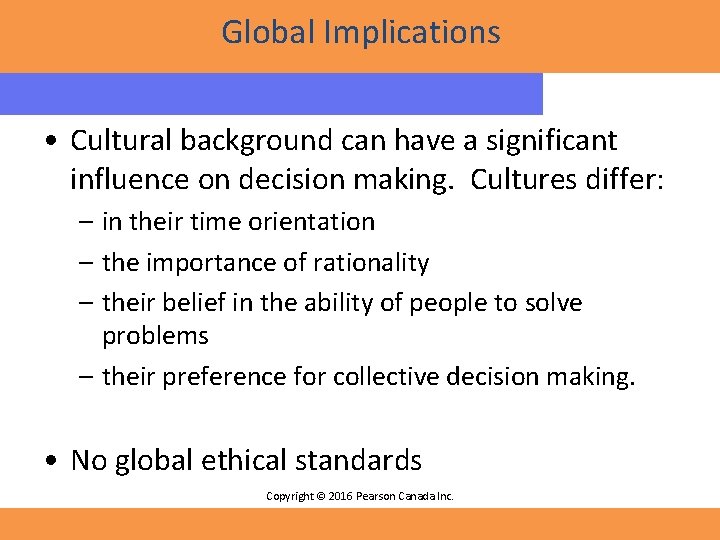
Global Implications • Cultural background can have a significant influence on decision making. Cultures differ: – in their time orientation – the importance of rationality – their belief in the ability of people to solve problems – their preference for collective decision making. • No global ethical standards Copyright © 2016 Pearson Canada Inc.
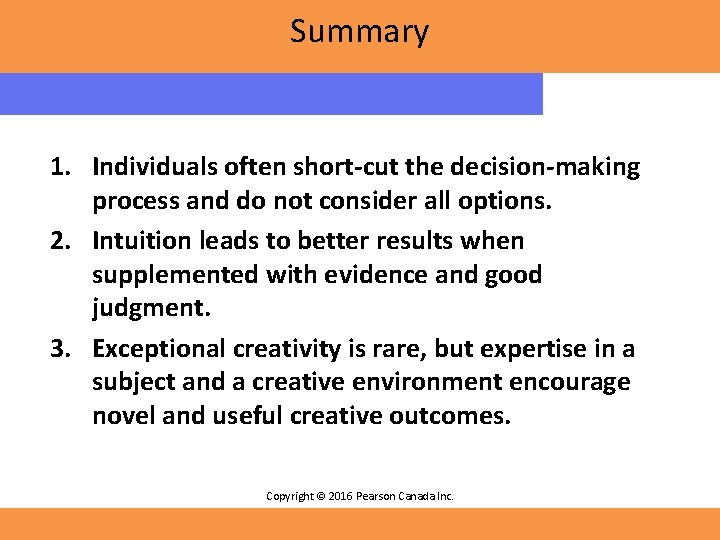
Summary 1. Individuals often short-cut the decision-making process and do not consider all options. 2. Intuition leads to better results when supplemented with evidence and good judgment. 3. Exceptional creativity is rare, but expertise in a subject and a creative environment encourage novel and useful creative outcomes. Copyright © 2016 Pearson Canada Inc.
OB at Work: For Review 1. What is the rational model of decision making? How is it different from bounded rationality and intuition? 2. What are some common decision biases or errors people make? 3. What are the strengths and weaknesses of group (versus individual) decision making? 4. How effective are interacting, brainstorming, and the nominal group technique? Copyright © 2016 Pearson Canada Inc.
OB at Work: For Review 5. What is creativity, and what is the threestage model of creativity? 6. What are the four criteria used in making ethical decisions, and how do they differ? 7. What is corporate social responsibility? Copyright © 2016 Pearson Canada Inc.
OB at Work: For Managers ■ Adjust your decision-making approach to the national culture you are operating in and to the criteria your organization values. ■ If you operate in a country that does not value rationality, don’t feel compelled to follow the rational decision-making model or to try to make your decisions appear rational. Adjust your decisionmaking approach to ensure compatibility with the organizational culture. Copyright © 2016 Pearson Canada Inc.
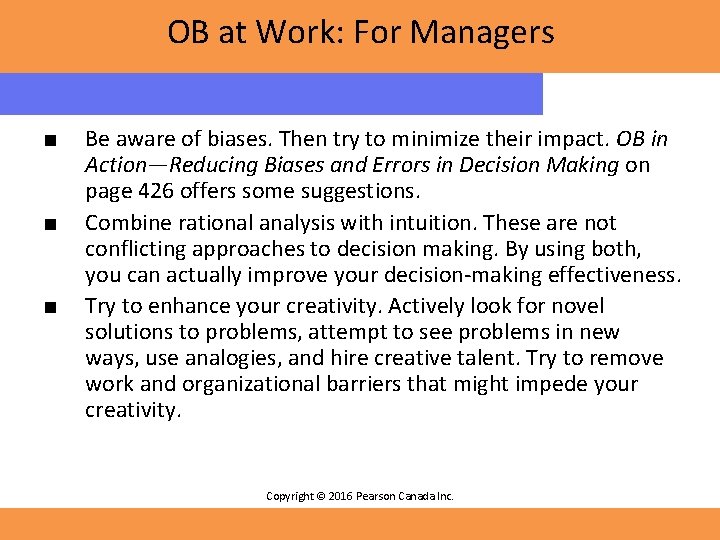
OB at Work: For Managers ■ ■ ■ Be aware of biases. Then try to minimize their impact. OB in Action—Reducing Biases and Errors in Decision Making on page 426 offers some suggestions. Combine rational analysis with intuition. These are not conflicting approaches to decision making. By using both, you can actually improve your decision-making effectiveness. Try to enhance your creativity. Actively look for novel solutions to problems, attempt to see problems in new ways, use analogies, and hire creative talent. Try to remove work and organizational barriers that might impede your creativity. Copyright © 2016 Pearson Canada Inc.
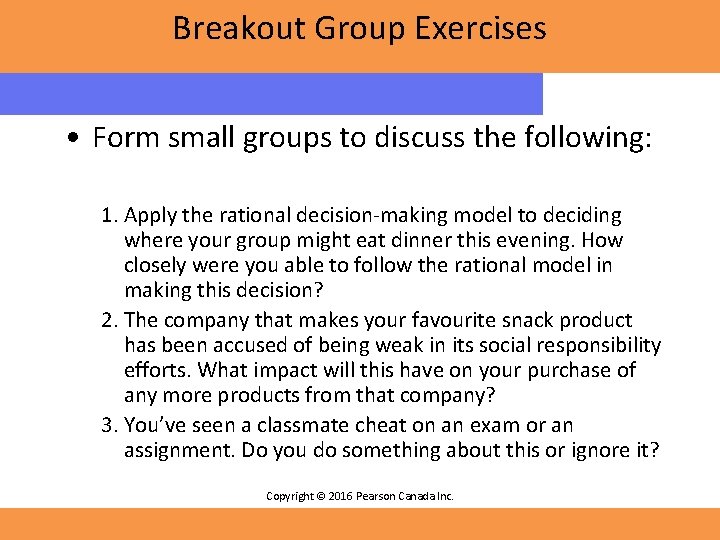
Breakout Group Exercises • Form small groups to discuss the following: 1. Apply the rational decision-making model to deciding where your group might eat dinner this evening. How closely were you able to follow the rational model in making this decision? 2. The company that makes your favourite snack product has been accused of being weak in its social responsibility efforts. What impact will this have on your purchase of any more products from that company? 3. You’ve seen a classmate cheat on an exam or an assignment. Do you do something about this or ignore it? Copyright © 2016 Pearson Canada Inc.
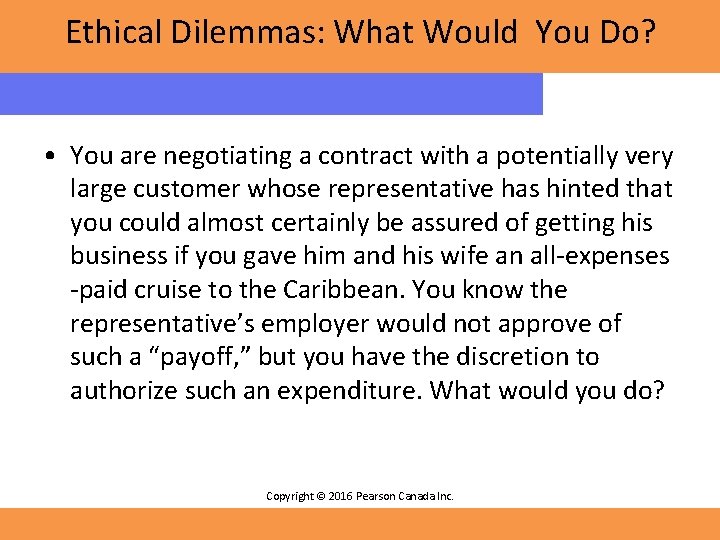
Ethical Dilemmas: What Would You Do? • You are negotiating a contract with a potentially very large customer whose representative has hinted that you could almost certainly be assured of getting his business if you gave him and his wife an all-expenses -paid cruise to the Caribbean. You know the representative’s employer would not approve of such a “payoff, ” but you have the discretion to authorize such an expenditure. What would you do? Copyright © 2016 Pearson Canada Inc.
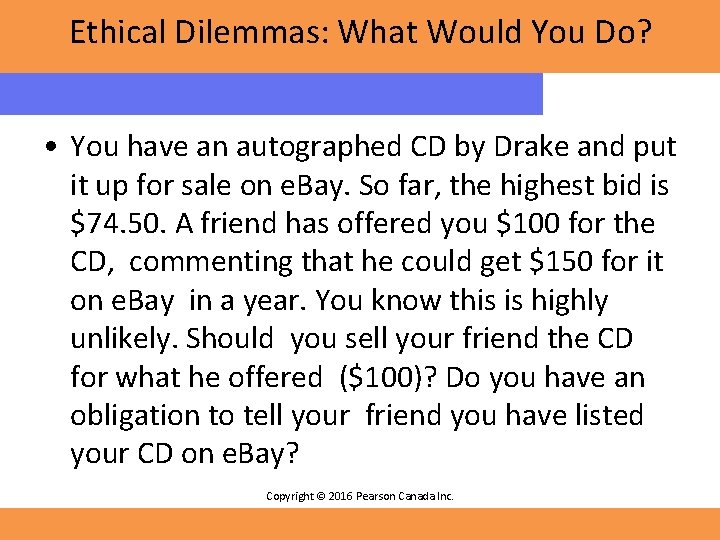
Ethical Dilemmas: What Would You Do? • You have an autographed CD by Drake and put it up for sale on e. Bay. So far, the highest bid is $74. 50. A friend has offered you $100 for the CD, commenting that he could get $150 for it on e. Bay in a year. You know this is highly unlikely. Should you sell your friend the CD for what he offered ($100)? Do you have an obligation to tell your friend you have listed your CD on e. Bay? Copyright © 2016 Pearson Canada Inc.
Ethical Dilemmas: What Would You Do? • Your company policy on reimbursement for meals while travelling on company business is that you will be repaid for your out-of-pocket costs, which are not to exceed $80 a day. You don’t need receipts for these expenses—the company will take your word. When travelling, you tend to eat at fast-food places and rarely spend in excess of $20 a day. Most of your colleagues submit reimbursement requests in the range of $55 to $60 a day regardless of what their actual expenses are. How much would you request for your meal reimbursements? Copyright © 2016 Pearson Canada Inc.
Ethical Dilemmas: What Would You Do? • You are the manager at a gaming company, and you are responsible for hiring a group to outsource the production of a highly anticipated new game. Because your company is a giant in the industry, numerous companies are trying to get the bid. One of them offers you some kickbacks if you give that firm the bid, but ultimately, it is up to your bosses to decide on the company. You don’t mention the incentive, but you push upper management to give the bid to the company that offered you the kickback. Is withholding the truth as bad as lying? Why or why not? Copyright © 2016 Pearson Canada Inc.
Ethical Dilemmas: What Would You Do? • You have discovered that one of your closest friends at work has stolen a large sum of money from the company. Would you do nothing? Go directly to an executive to report the incident before talking about it with the offender? Confront the individual before taking action? Make contact with the individual with the goal of persuading that person to return the money? Copyright © 2016 Pearson Canada Inc.